REVIEW 3 major objections 5 minor 47 references
Atomic to mesoscale hierarchical structures and magnetic states in an anisotropic layered ferromagnet FePd2Te2
T0 review · 3 major / 5 minor · reviewed 2026-08-07 · deepseek-v4-flash
Pith's one-line read The intrinsic twinning domains of the layered ferromagnet FePd2Te2 create compressive and tensile regions whose different magnetic moments produce a hierarchy of structure-locked magnetic states, including a polarized ferromagnetic state…
desk verdict New real-space structural hierarchy in FePd2Te2, but the magnetic-state claims need MFM controls before they carry the weight. read the letter →
The pith
A machine-rendered reading of the paper's core claim, the machinery that carries it, and where it could break.
The reading
What carries the argument
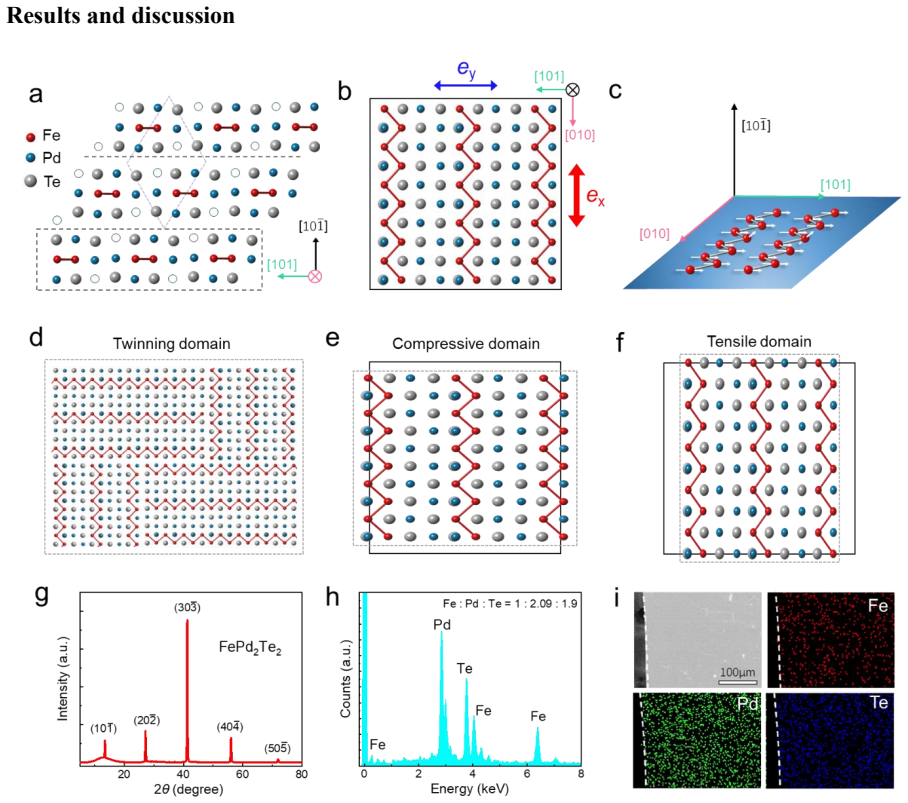
The central object is the twinning-domain strain landscape: orthogonal Fe-zigzag chain domains in the layered lattice produce alternating compressive and tensile regions because the Young's modulus is large along the chains and small perpendicular to them. That strain landscape does the argument's work—it sets the corrugated topography, distinguishes intact (C) from fragmented (T) Fe chains, assigns different local moments and anisotropy to the two regions, and thereby explains why magnetic contrast tracks the structure even after saturation and above TC.
What would settle it
Image the same FePd2Te2 regions at 230 K under 2 T with a nonmagnetic or reversely magnetized MFM tip; if the rippled phase pattern persists unchanged, the polarized-PM claim collapses. A clean alternative is to scan the identical area with an NV-center or Lorentz microscopy probe that is insensitive to topography and show that the structure-correlated contrast above TC disappears.
Extended reading notes
Core claim
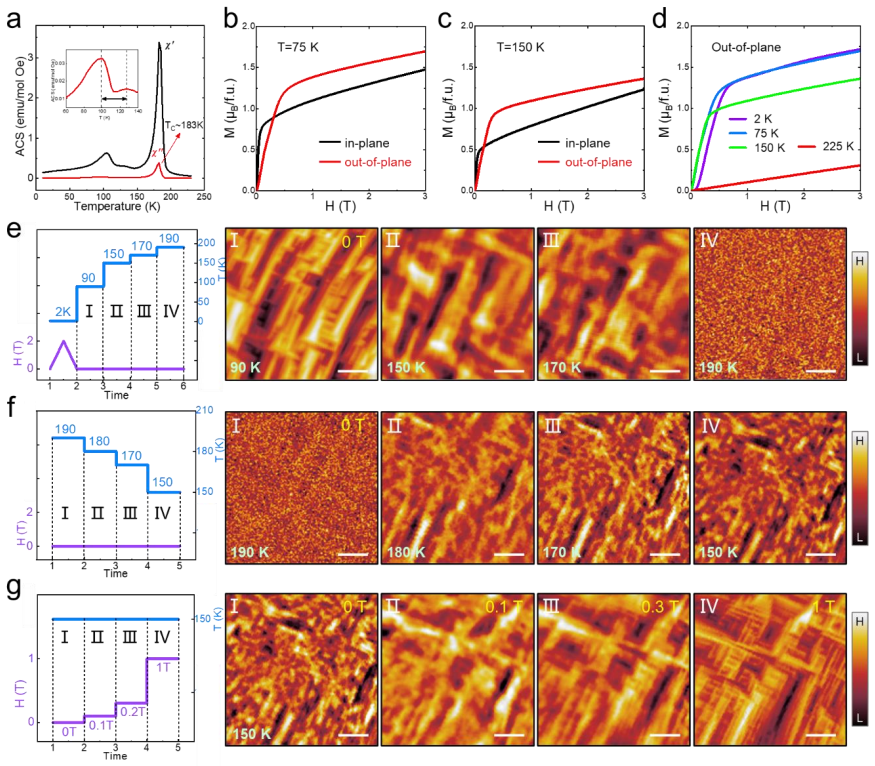
In FePd2Te2, monoclinic P21/m crystals naturally form twinning domains in which the Fe-zigzag chains rotate by 90°; because bonding is stiff along a chain and soft across it, the domain mismatch relaxes into periodic corrugated compressive (C) and tensile (T) regions that are visible all the way from high-resolution STM (intact versus fragmented Fe chains) to tens-of-micrometre AFM stripes. The paper's central experimental claim is that these C and T regions carry different magnetic moments and reorient differently under field: at ~0.4 T the in-plane moments flop out of plane, T regions show a gradual spin-flop, C regions an abrupt spin-flip-like switch, and the C/T contrast persists in a polarized-FM state up to 2 T. Above the 183 K transition the same structure-related contrast appears under field or field-cooling, defining a polarized-PM state. The paper condenses the temperature- and field-dependent evolution into an H-T phase diagram whose phases all inherit their identity from the hierarchical twinning structure.
Load-bearing premise
The load-bearing premise is that the MFM contrast at high field and above TC is magnetic rather than topographic or electrostatic crosstalk, since the tip scans ~100 nm above a ~10 nm corrugated surface and no topography-subtracted or independent-probe control is shown.
Editorial extensions
If this is right
- If the C/T strain pattern dictates the magnetic domains, then topography images of FePd2Te2 can be used to predict where high- and low-moment regions sit and how they will reorient in a field.
- The persistent polarized-FM contrast at 2 T means the saturated state is not a uniform ferromagnet; local moment differences remain, so magnetometry and MFM measure different aspects of the same phase.
- The polarized-PM state above TC implies that field-cooling can imprint a structure-defined moment pattern in a nominally paramagnetic regime, which may be recoverable as a memory state.
- The ~0.4 T spin-flop crossover and the distinct C/T switching behaviors provide a mesoscale mechanism for the kinks and hysteresis seen in the bulk M-H curves.
- The broad 100–120 K susceptibility feature and the blurring of MFM contrast in that range are attributed to an anisotropy-fluctuation crossover tied to the C/T regions, connecting local structure to macroscopic magnetic response.
Reading between the lines
- Going beyond the paper, the same C/T twinning mechanism could explain the fourfold anisotropic magnetoresistance reported for twinned FePd2Te2, since the orthogonal domains give two inequivalent conduction and spin channels that would respond differently to field orientation.
- A quantitative test that the paper leaves open: calculating how much tensile strain reduces the Fe moment (via chain fragmentation or exchange weakening) and comparing that reduction with the observed MFM phase asymmetry between C and T regions would turn the correlation into a calibrated strain-moment coupling.
- The corrugation wavelength and ~10 nm amplitude suggest the twin-boundary strain field extends far beyond a single domain wall; nanoscale strain-gradient mapping on the same crystals could quantify the coupling strength and guide strain-engineering of other in-plane anisotropic 2D magnets.
- If the polarized-PM state is generic, similar field-induced structure-locked contrast should appear in other twinned in-plane 2D ferromagnets; a comparative MFM survey of such compounds would test the mechanism's scope beyond FePd2Te2.
Editorial analysis
A structured set of objections, weighed in public.
Referee Report
Summary. The manuscript reports a real-space study of the layered anisotropic ferromagnet FePd2Te2 using AFM, STM, and MFM, combined with bulk magnetization measurements. The authors observe hierarchical twinning-domain structures from the atomic to mesoscale, identify compressive (C) and tensile (T) regions associated with Fe-chain integrity, and interpret MFM contrast as reflecting strain-modulated local magnetic moments. They propose field-induced transitions from an intact ferromagnetic state to a polarized-FM state below Tc, and a polarized-PM state above Tc, culminating in an H-T phase diagram. The core assertion is that intrinsic twinning domains directly couple to magnetic moments, producing distinct magnetic phases tied to C/T regions.
Significance. If the magnetic interpretation is correct, the paper would establish a direct atomic-to-mesoscale structure-magnetism coupling in a 2D in-plane anisotropic magnet, with potential implications for strain engineering of magnetic states. The structural observations (STM atomic resolution of orthogonal Fe chains, AFM corrugations, domain boundaries) are internally consistent and appear robust. The manuscript contains no parameter fitting or circular derivation, and the phase diagram is a useful summary of the proposed phenomenology. However, the central magnetic-state claims rest on MFM contrast that has not been separated from topographic and electrostatic crosstalk, and the paper does not provide an independent magnetic probe or a quantitative error analysis of the phase shifts. The significance is therefore conditional on resolving these methodological gaps.
major comments (3)
- [Materials and Methods (MFM), Fig. 3g-j, Fig. 5a,b] The polarized-FM and polarized-PM states are inferred from constant-height MFM phase contrast acquired at a nominal lift of ~100 nm over surfaces with ~10 nm vertical corrugations (Fig. S1). In constant-height mode the tip-sample gap varies by the full corrugation amplitude, so any distance-dependent non-magnetic interaction (electrostatic patches, van der Waals, capacitive forces) will produce phase contrast correlated with the C/T topography. The manuscript provides no control measurement with a non-magnetic tip at the same lift height, no lift-height series to establish the magnetic distance scaling of the C/T phase difference, and no independent magnetic probe (NV, SQUID, or local MOKE) co-registered to the same regions. These controls are necessary to support the claims that 'magnetic contrast persists under the saturation field' (Fig. 3g-j) and that 'structure-related magnetic contrast is observed even in the PM state' (Fig. 5a,b). Without them, the unique polarized states and the H-T phase diagram are not fully supported.
- [Fig. 3j and Fig. S4] The field-dependent MFM phase shifts of C and T regions in Fig. 3j are presented as lines without error bars, number of regions averaged, or statistical spread. The claim that C regions undergo an abrupt 'spin-flip-like' reorientation while T regions exhibit a gradual 'spin-flop-like' transition is load-bearing for the proposed distinct magnetic responses of the two regions. The extraction procedure described in Fig. S4 must quantify the scatter across the many C/T regions visible in the images, otherwise the distinction may reflect image noise or tip-state drift rather than a physical difference.
- [Fig. 2g,h and Section 'Results and discussion'] The assignment of C and T domains is based on the preservation or disruption of Fe chains after a short thermal treatment, with the identification drawn from prior work (refs 28, 32). This labeling is then used to interpret the magnetic contrast in the as-cleaved or field-cycled samples. If the C/T assignment depends on the thermal history or on the same twinning structure that produces the corrugations, the connection to the local magnetic moment should be validated independently, for example by correlating STM-observed chain integrity with MFM phase on the same length scale or by a strain-sensitive diffraction measurement. As written, the C/T labels are partly inferred and not directly confirmed on the exact regions where the magnetic phase shifts are extracted.
minor comments (5)
- [Fig. 5 caption] The caption contains a duplicated line: '(d,e) Histograms of MFM images in (a) and (b), respectively.' appears twice. Remove the redundant sentence.
- [Section 'Results and discussion' (Fig. 2f)] The text states that STM was conducted at ~10 K, but the description of Fig. 2f says 'at liquid nitrogen temperature.' Clarify the actual measurement temperature for this image.
- [Section 'Results and discussion' (Fig. 3a,b)] The transition temperature is reported as both 'around 180 K' and 'TC = 183 K.' Use a single consistent value with the uncertainty from the dM/dT analysis.
- [Abstract and Conclusions] The phrase 'unique H-T phase diagram' is used in the abstract and conclusions, but the phase diagram in Fig. 5f is a schematic with only three regions and no field/temperature error bars. Qualify it as a schematic phase diagram unless quantitative boundaries are provided.
- [References] References include several arXiv preprints (refs 27, 32) and are formatted inconsistently (e.g., ref 29 lacks page numbers). Please ensure all references are complete and, where possible, updated to published versions.
Circularity Check
No circularity: the structural and magnetic-state claims rest on direct AFM/STM/MFM/M-H measurements, not on fitted parameters or self-cited theorems.
full rationale
The paper's derivation chain is observational rather than derivational: hierarchical twinning domains and C/T regions are directly imaged by AFM and STM, and the FM, polarized-FM, and polarized-PM states are labels applied to measured MFM contrast and magnetization data. No parameter is fitted and then renamed as a prediction; no equation is constructed so that an output equals an input by definition. The C/T moment interpretation is an inference from observed MFM contrast plus cited external strain-magnetism studies, not a reduction of the conclusion to its premise. Self-citations (e.g., refs. 28 and 32) supply the prior identification of FePd2Te2 and twinned anisotropic magnetoresistance, but the present real-space observations stand independently of those citations, and the paper explicitly notes that quantitative theoretical understanding remains open. The main scientific risk, that constant-height MFM at ~100 nm lift over ~10 nm corrugations may include topographic or electrostatic crosstalk, is a control/validity concern rather than a circularity; it does not make the magnetic-state claims equivalent to their inputs by construction.
Assumptions & free parameters
assumptions (4)
- domain assumption MFM phase shift is proportional to the out-of-plane stray field gradient and reflects magnetic structure near the surface.
- domain assumption At about 100 nm lift height, the MFM signal is not significantly contaminated by topography or electrostatic forces from the about 10 nm surface corrugations.
- domain assumption Compressive (C) and tensile (T) domains can be identified by intact versus broken Fe chains after short-time thermal treatment.
- domain assumption Fe zigzag chains define an in-plane easy axis along [101] with quasi-1D spin character, and twinning rotates this axis by 90 degrees.
Cite this review
Pith. "Pith review of Atomic to mesoscale hierarchical structures and magnetic states in an anisotropic layered ferromagnet FePd2Te2." pith.science (2026). https://pith.science/paper/2OJQGKPG
@misc{pith2026250608773,
  author       = {Pith},
  title        = {Pith review of: Atomic to mesoscale hierarchical structures and magnetic states in an anisotropic layered ferromagnet FePd2Te2},
  year         = {2026},
  howpublished = {\url{https://pith.science/paper/2OJQGKPG}},
  note         = {Machine review of arXiv:2506.08773}
}
read the original abstract
Two-dimensional (2D) magnetic materials have predominantly exhibited easy-axis or easy-plane anisotropy and display a high sensitivity to the underlying crystal structure and lattice symmetry. Recently, an in-plane anisotropic 2D ferromagnet of FePd2Te2 has been discovered with intriguing structure and quasi-one-dimensional spin system. Here, we report a real-space investigation of its twinning structure and magnetic states using atomic/magnetic force microscopy (AFM/MFM) combined with scanning tunneling microscopy (STM). The atomic to mesoscale hierarchical structures with the orthogonal and corrugated compressive /tensile(C/T) regions are directly observed due to the intrinsic twinning-domain characteristic. The structure-related intact ferromagnetic (FM), field-induced polarized-FM states and their transitions are comparatively discussed at the mesoscale with the corresponding macroscopic magnetic measurements. Temperature- and field-dependent evolution of magnetic phase are further investigated at the FM and PM states, and summarized to obtain a unique H-T phase diagram of FePd2Te2. Our work provides key results for understanding the complicated magnetic properties of FePd2Te2, and suggests new directions for manipulating magnetic states through the atomic and mesoscale structure engineering.
Figures


Figures from the paper (2 more)

Reference graph
Works this paper leans on
-
[1]
Gong, C.; Li, L.; Li, Z.; Ji, H.; Stern, A.; Xia, Y .; Cao, T.; Bao, W.; Wang, C.; Wang, Y .; Qiu, Z. Q.; Cava, R. J.; Louie, S. G.; Xia, J.; Zhang, X. Discovery of Intrinsic Ferromagnetism in Two-Dimensional van der Waals Crystals. Nature 2017, 546, 265–269
work page 2017
-
[2]
Burch, K. S.; Mandrus, D.; Park, J.-G. Magnetism in Two-Dimensional van der Waals Materials. Nature 2018, 563, 47–52
work page 2018
-
[3]
Jin, C.; Kou, L. Two -Dimensional Non -van der Waals Magnetic Layers: Functional Materials for Potential Device Applications. J. Phys. D: Appl. Phys. 2021, 54, 413001
work page 2021
-
[4]
Guo, J.; Wang, H.; Wang, X.; Gu, S.; Mi, S.; Zhu, S.; Hu, J.; Pang, F.; Ji, W.; Gao, H.; Xia, T.; Cheng, Z. Coexisting Ferromagnetic–Antiferromagnetic Phases and Manipulation in a Magnetic Topological Insulator MnBi₄Te₇. J. Phys. Chem. C 2022, 126, 13884–13893
work page 2022
-
[5]
Guo, J.; Wang, H.; Zhang, H.; Mi, S.; Li, S.; Dong, H.; Zhu, S.; Hu, J.; Wang, X.; Li, Y .; Sugawara, Y .; Xu, R.; Pang, F.; Ji, W.; Xia, T.; Cheng, Z. Interlayer Coupling Modulated Tunable Magnetic States in Superlattice MnBi₂Te₄(Bi₂Te₃)ₙ Topological Insulators. Phys. Rev. B 2024, 109, 165410
work page 2024
-
[6]
Real -Space Topology-Engineering of Skyrmionic Spin Textures in a van der Waals Ferromagnet Fe₃GaTe₂
Mi, S.; Guo, J.; Hu, G.; Wang, G.; Li, S.; Gong, Z.; Jin, S.; Xu, R.; Pang, F.; Ji, W.; Yu, W.; Wang, X.; Wang, X.; Yang, H.; Cheng, Z. Real -Space Topology-Engineering of Skyrmionic Spin Textures in a van der Waals Ferromagnet Fe₃GaTe₂. Nano Lett. 2024, 24, 13094–13102
work page 2024
-
[7]
Huang, B.; Clark, G.; Navarro -Moratalla, E.; Klein, D. R.; Cheng, R.; Seyler, K. L.; Zhong, D.; Schmidgall, E.; McGuire, M. A.; Cobden, D. H.; Yao, W.; Xiao, D.; Jarillo-Herrero, P.; Xu, X. Layer- Dependent Ferromagnetism in a van der Waals Crystal Down to the Monolayer Limit. Nature 2017, 546, 270–273
work page 2017
-
[8]
Jiang, S.; Li, L.; Wang, Z.; Mak, K. F.; Shan, J. Controlling Magnetism in 2D CrI₃ by Electrostatic Doping. Nat. Nanotechnol. 2018, 13, 549–553
work page 2018
Show all 47 references
-
[9]
Z.; Sun, Z.; Yi, Y .; Wu, Y
Deng, Y .; Y u, Y .; Song, Y .; Zhang, J.; Wang, N. Z.; Sun, Z.; Yi, Y .; Wu, Y . Z.; Wu, S.; Zhu, J.; Wang, J.; Chen, X. H.; Zhang, Y . Gate -Tunable Room -Temperature Ferromagnetism in Two -Dimensional Fe₃GeTe₂. Nature 2018, 563, 94–99
2018
-
[10]
K.; Gargiani, P.; Valvidares, M.; Sessi, P.; Taylor, J
Bedoya-Pinto, A.; Ji, J.-R.; Pandeya, A. K.; Gargiani, P.; Valvidares, M.; Sessi, P.; Taylor, J. M.; Radu, F.; Chang, K.; Parkin, S. S. P . Intrinsic 2D-XY Ferromagnetism in a van der Waals Monolayer. Science 2021, 374, 616–620
2021
-
[11]
Boix-Constant, C.; Jenkins, S.; Rama -Eiroa, R.; Santos, E. J. G.; Maas -Valero, S.; Coronado, E. Multistep Magnetization Switching in Orthogonally Twisted Ferromagnetic Monolayers. Nat. Mater. 2023, 23, 212–218
2023
-
[12]
J.; Dismukes, A
Telford, E. J.; Dismukes, A. H.; Lee, K.; Cheng, M.; Wieteska, A.; Bartholomew, A. K.; Chen, Y .; Xu, X.; Pasupathy, A. N.; Zhu, X.; Dean, C. R.; Roy, X. Layered Antiferromagnetism Induces Large Negative Magnetoresistance in the van der Waals Semiconductor CrSBr. Adv. Mater. 2...
2020
-
[13]
Wang, Z.; Gibertini, M.; Dumcenco, D.; Taniguchi, T.; Watanabe, K.; Giannini, E.; Morpurgo, A. F. Determining the Phase Diagram of Atomically Thin Layered Antiferromagnet CrCl₃. Nat. Nanotechnol. 2019, 14, 1116–1122. 21
2019
-
[14]
P.; Clark, G.; He, M.; Zhang, X.; Taniguchi, T.; Watanabe, K.; Yao, W.; Xiao, D.; McGuire, M
Cai, X.; Song, T.; Wilson, N. P.; Clark, G.; He, M.; Zhang, X.; Taniguchi, T.; Watanabe, K.; Yao, W.; Xiao, D.; McGuire, M. A.; Cobden, D. H.; Xu, X. Atomically Thin CrCl₃: An In -Plane Layered Antiferromagnetic Insulator. Nano Lett. 2019, 19, 3993–3998
2019
-
[15]
J.; Dismukes, A
Telford, E. J.; Dismukes, A. H.; Dudley, R. L.; Wiscons, R. A.; Lee, K.; Chica, D. G.; Ziebel, M. E.; Han, M.-G.; Yu, J.; Shabani, S.; Scheie, A.; Watanabe, K.; Taniguchi, T.; Xiao, D.; Zhu, Y .; Pasupathy, A. N.; Nuckolls, C.; Zhu, X.; Dean, C. R.; Roy, X. Coupling between Ma...
2022
-
[16]
Modulation of Magnetic Domain and the Occurrence of Antisymmetric Magnetoresistance in the Folded van der Waals Ferromagnet Fe₃GaTe₂
Gao, X.; Wang, K.; Zhai, K.; Yan, J.; Yue, D.; Mu, C.; Yu, Z.; Cheng, Y .; Nie, A.; Liu, Z. Modulation of Magnetic Domain and the Occurrence of Antisymmetric Magnetoresistance in the Folded van der Waals Ferromagnet Fe₃GaTe₂. Adv. Mater. 2025, 37, 2420505
2025
-
[17]
-W.; Wang, X
Jin, S.; Liu, Y .; Deng, Z.; Wang, T.; Xu, S.; Chen, X.; Jiang, C.; Liang, J.; Hong, J.; Cheong, S. -W.; Wang, X. Strain Gradient Induced Skyrmion in a van der Waals Magnet by Wrinkling. Adv. Mater. 2025, 37, 2501935
2025
-
[18]
Strain and Electric-Field Control of Spin– Spin Interactions in Monolayer CrI₃
Izadi Vishkayi, S.; Torbatian, Z.; Qaiumzadeh, A.; Asgari, R. Strain and Electric-Field Control of Spin– Spin Interactions in Monolayer CrI₃. Phys. Rev. Mater. 2020, 4, 094004
2020
-
[19]
A.; Kirby, B
Guo, E.-J.; Desautels, R.; Keavney, D.; Roldan, M. A.; Kirby, B. J.; Lee, D.; Liao, Z.; Charlton, T.; Herklotz, A.; Ward, T. Z.; Fitzsimmons, M. R.; Lee, H. N. Nanoscale Ferroelastic Twins Formed in Strained LaCoO₃ Films. Sci. Adv. 2019, 5, eaav5050
2019
-
[20]
Two-Dimensional Multiferroic Material of Metallic p-Doped SnSe
Du, R.; Wang, Y .; Cheng, M.; Wang, P.; Li, H.; Feng, W.; Song, L.; Shi, J.; He, J. Two-Dimensional Multiferroic Material of Metallic p-Doped SnSe. Nat. Commun. 2022, 13, 6130
2022
-
[21]
J.; Ma, Z
Wang, Y .; Wang, C.; Liang, S. J.; Ma, Z. C.; Xu, K.; Liu, X. W.; Zhang, L. L.; Admasu, A. S.; Cheong, S. W.; Wang, L. Z.; Chen, M. Y .; Liu, Z. L.; Cheng, B.; Ji, W.; Miao, F. Strain-Sensitive Magnetization Reversal of a van der Waals Magnet. Adv. Mater. 2020, 32, 2004533
2020
-
[22]
O.; Das, T.; Mandal, P.; Pal, A
Pal, R.; Pal, B.; Mondal, S.; Sharma, R. O.; Das, T.; Mandal, P.; Pal, A. N. Spin-Reorientation Driven Emergent Phases and Unconventional Magnetotransport in Quasi-2D vdW Ferromagnet Fe₄GeTe₂. npj 2D Mater. Appl. 2024, 8, 30
2024
-
[23]
Strain-Induced Magnetic Phase Transition, Magnetic Anisotropy Switching and Bilayer Antiferromagnetic Skyrmions in van der Waals Magnet CrTe₂
Deng, D.; Shen, D.; Xue, Y .; Guan, Z.; Xiao, R.; Song, C. Strain-Induced Magnetic Phase Transition, Magnetic Anisotropy Switching and Bilayer Antiferromagnetic Skyrmions in van der Waals Magnet CrTe₂. Nanoscale 2023, 15, 1561–1567
2023
-
[24]
Strain-Tunable Magnetic Anisotropy in Monolayer CrCl₃, CrBr₃, and CrI₃
Webster, L.; Yan, J.-A. Strain-Tunable Magnetic Anisotropy in Monolayer CrCl₃, CrBr₃, and CrI₃. Phys. Rev. B 2018, 98, 144411
2018
-
[25]
V .; Awano, H.; Ando, A.; Toyoki, K.; Kotani, Y .; Nakamura, T.; Koyama, T.; Chiba, D
Ota, S.; Thach, P. V .; Awano, H.; Ando, A.; Toyoki, K.; Kotani, Y .; Nakamura, T.; Koyama, T.; Chiba, D. Strain-Induced Modulation of Temperature Characteristics in Ferrimagnetic Tb–Fe Films. Sci. Rep. 2021, 11, 6237
2021
-
[26]
Mukherjee, T.; Chowdhury, S.; Jana, D.; Lew Yan V oon, L. C. Strain-Induced Electronic and Magnetic Properties of 2D Magnet CrI₃: A DFT Approach. J. Phys. Condens. Matter 2019, 31 (33), 335802
2019
-
[27]
M.; Shumilin, A.; Dey, S.; López‑Alcalá, D.; Baldoví, J
Ruiz, A. M.; Shumilin, A.; Dey, S.; López‑Alcalá, D.; Baldoví, J. J. Tunable Itinerant Ferromagnetism in the Two‑Dimensional FePd2Te2 Hosting 1D Spin Chains. arXiv 2025, arXiv:2506.01009. 22
2025 arXiv
-
[28]
FePd2Te2: An Anisotropic Two-Dimensional Ferromagnet with One -Dimensional Fe Chains
Shi, B.; Geng, Y .; Wang, H.; Yang, J.; Shang, C.; Wang, M.; Mi, S.; Huang, J.; Pan, F.; Gui, X.; Wang, J.; Liu, J.; Xu, D.; Zhang, H.; Qin, J.; Wang, H.; Hao, L.; Tian, M.; Cheng, Z.; Zheng, G.; Cheng, P. FePd2Te2: An Anisotropic Two-Dimensional Ferromagnet with One -Dimensio...
2024
-
[29]
Enhanced THz Emission and Chirality Control in van der Waals Ferromagnetic FePd 2Te2/Pt Heterostructures
Zhang, J.; Shi, B.; Xu, H.; Song, Y .; Zou, Y .; Li, Z.; Dai, H.; Song, Y .; Jin, Q.; Cheng, P.; Jin, Z.; Zhang, Z. Enhanced THz Emission and Chirality Control in van der Waals Ferromagnetic FePd 2Te2/Pt Heterostructures. J. Am. Chem. Soc. 2025, 147
2025
-
[30]
Anisotropic Mechanical Properties of Black Phosphorus Nanoribbons
Chen, H.; Huang, P.; Guo, D.; Xie, G. Anisotropic Mechanical Properties of Black Phosphorus Nanoribbons. J. Phys. Chem. C 2016, 120, 29491–29497
2016
-
[31]
P .; Dorini, T
Ferreira, P. P .; Dorini, T. T.; Santos, F. B.; Machado, A. J. S.; Eleno, L. T. F. Elastic Anisotropy and Thermal Properties of Extended Linear Chain Compounds MV₂Ga₄ (M = Sc, Zr, Hf) from Ab Initio Calculations. Materialia 2018, 4, 529-539
2018
-
[32]
Fourfold Anisotropic Magnetoresistance and Unconventional Critical Exponents in Twinned FePd₂Te₂
Chen, Z.; Yang, Y .; Guo, J. Fourfold Anisotropic Magnetoresistance and Unconventional Critical Exponents in Twinned FePd₂Te₂. arXiv 2024, arXiv:2411.15842
2024 arXiv
-
[33]
Mechanical Origin of Martensite -Like Structures in Two - Dimensional ReS₂
Huang, L.; Zheng, F.; Chen, H.; et al. Mechanical Origin of Martensite -Like Structures in Two - Dimensional ReS₂. Commun. Mater. 2021, 2, 87
2021
-
[34]
Physics Infused Machine Learning Force Fields for 2D Materials Monolayers
Yang, Y .; Xu, B.; Zong, H. Physics Infused Machine Learning Force Fields for 2D Materials Monolayers. J. Mater. Inf. 2023, 3, 23
2023
-
[35]
Recent Progress on 2D Magnets: Fundamental Mechanism, Structural Design and Modification
Jiang, X.; Liu, Q.; Xing, J.; Liu, N.; Guo, Y .; Liu, Z.; Zhao, J. Recent Progress on 2D Magnets: Fundamental Mechanism, Structural Design and Modification. Appl. Phys. Rev. 2021, 8, 031305
2021
-
[36]
Kong, D.; Kovács, A.; Charilaou, M.; Zheng, F.; Wang, L.; Han, X.; Dunin -Borkowski, R. E. Direct Observation of Tensile-Strain-Induced Nanoscale Magnetic Hardening. Nat. Commun. 2023, 14, 3963
2023
-
[37]
M.; Kalaboukhov, A.; Svedlindh, P.; Sanyal, B.; Dash, S
Ngaloy, R.; Zhao, B.; Ershadrad, S.; Gupta, R.; Davoudiniya, M.; Bainsla, L.; Sjöström, L.; Hoque, A. M.; Kalaboukhov, A.; Svedlindh, P.; Sanyal, B.; Dash, S. P. Strong In -Plane Magnetization and Spin Polarization in (Co₀.₁₅Fe₀.₈₅)₅GeTe₂/Graphene van der W aals Heterostructur...
2024
-
[38]
E.; Butera, A.; Vavassori, P.; Steren, L
Román, A.; Gómez, J. E.; Butera, A.; Vavassori, P.; Steren, L. B. Magnetization Reversal and Direct Observation of Magnetic Domains on FePt Thin Films. In 2024 IEEE International Magnetic Conference - Short Papers (INTERMAG Short Papers); Rio de Janeiro, Brazil, 2024
2024
-
[39]
Milde, P.; Köhler, L.; Neuber, E.; Ritzinger, P.; Garst, M.; Bauer, A.; Pfleiderer, C.; Berger, H.; Eng, L. M. Field -Induced Reorientation of Helimagnetic Order in Cu₂OSeO₃ Probed by Magnetic Force Microscopy. Phys. Rev. B 2020, 102, 024426
2020
-
[40]
C.; Bertran, F.; Le Fèvre, P.; Turban, P.; Jacquot, J.-F.; Miwa, J
Bigi, C.; Jego, C.; Polewczyk, V .; De Vita, A.; Jaouen, T.; Tchouekem, H. C.; Bertran, F.; Le Fèvre, P.; Turban, P.; Jacquot, J.-F.; Miwa, J. A.; Clark, O. J.; Jana, A.; Chaluvadi, S. K.; Orgiani, P.; Cuoco, M.; Leandersson, M.; Balasubramanian, T.; Olsen, T.; Hwang, Y .; Jam...
2025
-
[41]
U.; Choudary, G
Bhasker, S. U.; Choudary, G. S. V . R. K.; Reddy, M. V . R. Modulation in Magnetic Exchange Interaction, Core Shell Structure and Hopkinson’s Peak with Chromium Substitution into Ni₀.₇₅Co₀.₂₅Fe₂O₄ 23 Nanoparticles. J. Magn. Magn. Mater. 2018, 454, 349–355
2018
-
[42]
G.; Wang, Y .; et al
Zhu, M.; Li, P. G.; Wang, Y .; et al. Temperature- and Field-Driven Spin Reorientations in Triple-Layer Ruthenate Sr₄Ru₃O₁₀. Sci. Rep. 2018, 8, 3914
2018
-
[43]
Dorantes-Dávila, J.; Garibay -Alonso, R.; Pastor, G. M. Spin -Fluctuation Theory of Temperature - Driven Spin Reorientations in Ferromagnetic Transition Metal Thin Films. Phys. Rev. B 2024, 110, 174406
2024
-
[44]
Metadynamics Study of the Temperature Dependence of Magnetic Anisotropy and Spin-Reorientation Transitions in Ultrathin Films
Nagyfalusi, B.; Udvardi, L.; Szunyogh, L. Metadynamics Study of the Temperature Dependence of Magnetic Anisotropy and Spin-Reorientation Transitions in Ultrathin Films. Phys. Rev. B 2019, 100, 174429
2019
-
[45]
Temperature-Driven Spin Reorientation Transition in Van der Waals Cr₁.₇Te₂ Ferromagnet
Wang, S.; Wang, Z.; Jiang, J.; Zhang, Y .; Li, R.; Feng, Y .; Liu, P.; Lu, Y .; Sheng, Z.; Du, H.; Gao, N.; Xiang, B. Temperature-Driven Spin Reorientation Transition in Van der Waals Cr₁.₇Te₂ Ferromagnet. Appl. Phys. Lett. 2024, 124, 232401
2024
-
[46]
Introduction to Solid State Physics, 8th ed.; Wiley: Hoboken, NJ, 2005
Kittel, C. Introduction to Solid State Physics, 8th ed.; Wiley: Hoboken, NJ, 2005
2005
-
[47]
D.; Graham, C
Cullity, B. D.; Graham, C. D. Introduction to Magnetic Materials, 2nd ed.; Wiley-IEEE Press: Hoboken, NJ, 2008
2008
Reviewed August 7, 2026 · model on record in the stance chip above.
Discussion (0). Sign in to comment.