REVIEW 5 major objections 5 minor 1 cited by
Gaussian2Scene: 3D Scene Representation Learning via Self-supervised Learning with 3D Gaussian Splatting
T0 review · 5 major / 5 minor · reviewed 2026-08-07 · deepseek-v4-flash
Pith's one-line read Gaussian2Scene uses explicit 3D Gaussian splatting as a self-supervised pre-training signal for scene-level point clouds, and reports that it improves downstream 3D object detection.
desk verdict Real idea—3DGS as explicit scene-level SSL supervision in a two-stage MAE—but the second-stage gradient path is underspecified and the paper's own tables do not support 'consistent improvements.' read the letter →
The pith
A machine-rendered reading of the paper's core claim, the machinery that carries it, and where it could break.
The reading
What carries the argument
The load-bearing object is the two-stage cross-modal masked autoencoder with 3DGS as a differentiable renderer, plus the two losses that attach Gaussian splatting to the backbone: $L_{\mathrm{GS-point}}$ (Eq. 5), a bidirectional nearest-neighbour Chamfer distance between optimized Gaussian centers $P_{GS}$ and reconstructed points $P_{rec}$, and $L_{\mathrm{GS-image}}$ (Eq. 6), an L1 plus D-SSIM photometric loss between rendered and ground-truth images. The Scaffold-GS optimizer supplies the Gaussian primitives (center, covariance, color, opacity) whose explicit centers give direct 3D supervision; the photometric loss gives cross-modal 2D supervision; the stage-1 MAE provides modality-specific reconstruction and cross-attention fusion. The claim is that this combination forces the backbone to encode scene geometry rather than only view-dependent appearance.
What would settle it
Measure the gradient norm of $L_{\mathrm{GS-point}}$ and $L_{\mathrm{GS-image}}$ with respect to the parameters of the point-cloud decoder during stage-2 training; if those norms are zero (because the reconstructed points are detached before seeding Scaffold-GS or the encoder is frozen), the reported AP50 gains cannot be caused by the joint supervision described by Eq. 8. A complementary check is to freeze the backbone during stage-2 and re-run fine-tuning; if the gains persist unchanged, the contribution is not the claimed joint optimization.
Extended reading notes
Core claim
On its own terms, the paper establishes that the explicit, parameterized representation of 3DGS is a better pre-training target than the implicit radiance fields used by volume-rendering SSL. In the first stage, a dual-branch masked autoencoder reconstructs masked 3D point clouds and masked 2D images together with a cross-modal consistency loss. In the second stage, the reconstructed point cloud seeds Scaffold-GS Gaussians; the positions of the optimized Gaussian primitives are pulled toward the reconstructed points by a bidirectional nearest-neighbour loss $L_{\mathrm{GS-point}}$, and rendered images are pulled toward ground-truth views by an L1 plus D-SSIM loss $L_{\mathrm{GS-image}}$. The total stage-2 loss adds these 3DGS terms to the stage-1 losses, so the encoder-decoder is supervised jointly by geometry and appearance. The reported detection results are the evidence: pre-training with this recipe improves AP50 by 3.2 points on SUN RGB-D and 5.4 points on ScanNetV2 over 3DETR, and by 0.3 and 3.9 points over PiMAE.
Load-bearing premise
The whole result depends on the 3DGS branch actually updating the shared encoder-decoder, yet the paper never states which parameters are frozen while Scaffold-GS is fitted and which receive gradients from $L_{\mathrm{GS-point}}$ and $L_{\mathrm{GS-image}}$.
Editorial extensions
If this is right
- Pre-training with explicit Gaussian primitives raises strict-overlap detection accuracy (AP50) while keeping coarse detection (AP25) competitive: +3.2 AP50 on SUN RGB-D and +5.4 on ScanNetV2 over the 3DETR baseline.
- The two supervision channels contribute differently: 3D point supervision improves fine-grained box geometry (AP50), while 2D rendering supervision improves semantic recall (AP25), so the two losses are complementary rather than redundant.
- The pre-trained backbone retains most of its coarse detection performance under reduced fine-tuning labels: at 70% of the training data, AP25 drops only 0.1 points on SUN RGB-D and 1.1 on ScanNetV2.
- Because 3DGS renders at real-time speed with explicit geometry, the same pre-training recipe avoids the memory footprint of volume rendering, making scene-level SSL more practical at scale.
Reading between the lines
- If the central claim holds, the recipe should transfer to outdoor LiDAR scenes, where volume-rendering pre-training is costly; the same two-stage MAE plus Gaussian seeding could be run on autonomous-driving data, with the expectation that geometric supervision helps sparse long-range detection.
- The ablations suggest a tunable trade-off between the image weight $\alpha$ and the point weight $\beta$; a task-aware weighting could yield further gains when the downstream metric is known in advance.
- The paper pre-trains on a SUN RGB-D subset only; scaling pre-training to more scenes and more views per scene should improve transfer further, and the framework predicts larger AP50 gains on ScanNetV2, where the geometry is denser and better reconstructed.
Editorial analysis
A structured set of objections, weighed in public.
Referee Report
Summary. The paper proposes Gaussian2Scene, a two-stage self-supervised pre-training method for 3D scene understanding. Stage one trains a dual-branch masked autoencoder on point clouds and RGB images with complementary masking and cross-modal reconstruction. Stage two seeds Scaffold-GS Gaussians from the point branch's reconstructed points and adds losses on rendered images (L_GS-image) and Gaussian positions (L_GS-point). The pre-trained encoder is transferred to 3DETR for object detection on SUN RGB-D and ScanNetV2, reporting AP improvements. The paper claims that explicit 3DGS supervision is computationally lighter and geometrically stronger than implicit volume rendering.
Significance. If the central mechanism works as described, the idea of using explicit 3DGS supervision in SSL is timely and potentially valuable, offering a way to obtain geometric supervision beyond 2D rendering. The two-stage progressive design is clear, and the downstream experiments cover two benchmarks and several ablations. However, the paper does not provide code, error bars, or quantitative comparisons with volume-rendering SSL methods; the significance hinges on the joint gradient path, which is not specified.
major comments (5)
- [§3.2.2, Eqs. (4)-(8)] The central claim of end-to-end multimodal optimization requires that L_GS-image and L_GS-point back-propagate into the encoder-decoder. The text states that Gaussians are seeded from reconstructed point clouds, optimized directly through back-propagation, and that the joint loss is applied 'after obtaining optimized 3DGS parameters.' In the standard Scaffold-GS implementation, Gaussian anchor positions are leaf parameters initialized from input points, not differentiable functions of the decoder output. Once fitted, rendered images depend on the fitted Gaussian parameters, not on the encoder. L_GS-point can reach the decoder through the reconstructed points Prec in Eq. (5), but L_GS-image has no path to the backbone unless the code re-parameterizes Gaussian positions through the decoder or back-propagates through initialization. The paper should specify stop-gradient scopes, parameter partitions, or an explicit backprop-through-initialization scheme. Without this, Table 4's GS_IMG row (SUN AP50 31.0 vs 33.5 full) cannot be attributed to backbone pre-training.
- [§5.2, Table 3] The abstract and Section 5.2 claim consistent improvements over existing pre-training methods, but Table 3 shows Ours+3DETR at 59.2 AP25 on SUN RGB-D, below PiMAE+3DETR's 59.4, and the AP50 advantage over PiMAE is only +0.3 (33.5 vs 33.2). All numbers are from a single run with no error bars or significance tests; differences of 0.2-0.3 AP are likely within run-to-run variation. The authors should report multiple seeds with standard deviation and either soften the consistency claim or provide statistical support.
- [§5.3, Tables 4 and 5] The ablation narrative is contradicted by the table entries. In Table 4, the GS_IMG-only row reports 63.3 AP25 on ScanNetV2, higher than the full model's 62.9, and GS_PC-only reports 63.0; the text acknowledges only that GS_IMG-only achieves the highest AP25. In Table 5, the combined-branch row without cross-modal reconstruction has ScanNetV2 AP50 42.4, which is better than the IMG-only row's 40.4, contradicting the claim that combining branches degrades AP50 'on both datasets' and is 'worse than either isolated branch.' The tables and text need to be reconciled, and the conclusion that the full model is best should be supported by consistent numbers.
- [§2.3 and §5.2] The paper's central motivation is that 3DGS is superior to volume-rendering SSL, but no quantitative comparison with volume-rendering methods (Ponder, Ponderv2, UniPAD) is provided on the same downstream benchmarks. The only comparison is PiMAE, which is a cross-modal MAE rather than a volume-rendering method. In addition, the claimed computational advantage ('alleviates the computational burden') is not substantiated with runtime or memory measurements. The authors should either add such comparisons or qualify the claim as conceptual.
- [§2, related work and references] The closely related work GS-PT (Liu et al., 2025), which also exploits 3D Gaussian Splatting for point cloud self-supervised learning, is cited only as an inspiration and is not discussed or compared. Given the paper's novelty claim of using 3DGS for SSL, the relationship to GS-PT must be clarified, including differences in architecture, objectives, and results.
minor comments (5)
- [§1 and §5.2] The phrasing 'AP50 gains of 33.5%' in the introduction is inaccurate; it should read 'AP50 of 33.5%'. Similarly, Section 5.2 states 'boosting AP50 of 1.2% and 5.4%', but Table 3 indicates improvements of +3.2% on SUN RGB-D and +5.4% on ScanNetV2.
- [§3.2.2 and §4] The hyperparameters lambda_ssim and gamma in Eq. (4) and alpha and beta in Eq. (7) are never given numerical values, and the code is not released. This makes the reported results hard to reproduce.
- [Throughout] There are numerous typos and formatting issues, including 'imcomplete', 'volumn-based', 'seperated', 'representaion', and 'Improments', as well as the missing space in the PiMAE row of Table 3 ('59.433.2'). A careful proofread is needed.
- [§5.1 and Figure 3] The PSNR comparison with Zhu et al. [2023] is qualitative; no baseline PSNR value is given, so the claim of 'surpassing' volume rendering is not verifiable from the text.
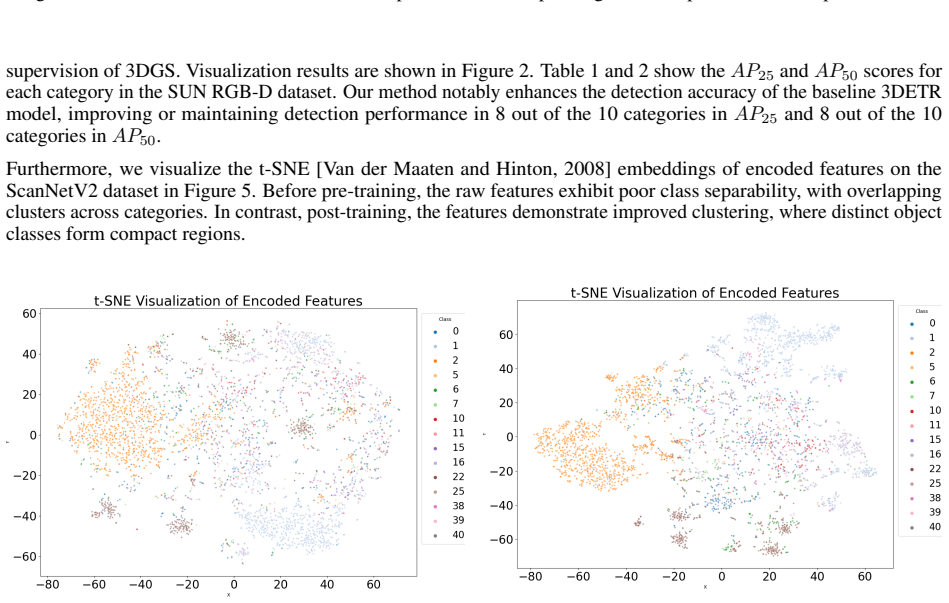
- [§5.2 and Figure 5] The t-SNE visualization is qualitative; adding a quantitative clustering metric (e.g., adjusted Rand index or silhouette score) would strengthen the claim of improved feature separability.
Circularity Check
No significant circularity: downstream object detection numbers are external benchmarks, and the pre-training losses in Eqs. (1) and (5)-(8) are not fitted to those metrics.
full rationale
The paper's central empirical claim is that the two-stage 3DGS-supervised pre-training transfers better to 3D object detection than volume-rendering SSL. This is checked against external baselines (3DETR without pre-training and PiMAE pre-training) on SUN RGB-D and ScanNetV2; the detection AP values are never used in any pre-training loss. L_stage1 (Eq. 1) combines point-cloud Chamfer, image MSE, and cross-modal reconstruction losses; L_GS-branch (Eq. 7) is a fixed combination of L_GS-image (Eq. 6) and L_GS-point (Eq. 5) with hand-selected weights. None of these terms depends on downstream detection targets, so there is no fitted-input-called-prediction pattern. The self-citations to Fei et al. and Liu et al. (GS-PT) are contextual: they motivate the use of 3DGS for point-cloud SSL but are not the evidence for the reported improvements, and the evaluations compare against external methods and the 3DETR baseline. The reviewer's concern that second-stage gradients from L_GS-image may not reach the backbone because Scaffold-GS parameters are optimized before the joint loss (Sec. 3.2.2) is a real implementation/correctness ambiguity, but it is not a circularity: it does not make the paper's equations equivalent to their own inputs, and the claim could fail without being circular. No equation in the paper reduces to its input by construction, so the derivation is self-contained against external benchmarks.
Assumptions & free parameters
free parameters (6)
- lambda_ssim =
not reported
- gamma =
not reported
- alpha =
not reported
- beta =
not reported
- point cloud mask ratio =
0.6
- stage-2 training length =
1 epoch
assumptions (4)
- domain assumption Multi-view images in the SUN RGB-D pretraining subset come with camera intrinsics and extrinsics aligned to the point clouds.
- domain assumption Scaffold-GS, initialized from reconstructed point clouds, is optimized jointly with the backbone so that L_GS-image and L_GS-point update the encoder-decoder.
- domain assumption The pretraining data distribution of SUN RGB-D transfers to ScanNetV2 detection.
- standard math 3DGS projection/covariance formulas (Eq. 2, Eq. 3) and Chamfer Distance are used as standard differentiable constructs.
invented entities (1)
-
None
Cite this review
Pith. "Pith review of Gaussian2Scene: 3D Scene Representation Learning via Self-supervised Learning with 3D Gaussian Splatting." pith.science (2026). https://pith.science/paper/RHZ4A4XB
@misc{pith2026250608777,
  author       = {Pith},
  title        = {Pith review of: Gaussian2Scene: 3D Scene Representation Learning via Self-supervised Learning with 3D Gaussian Splatting},
  year         = {2026},
  howpublished = {\url{https://pith.science/paper/RHZ4A4XB}},
  note         = {Machine review of arXiv:2506.08777}
}
read the original abstract
Self-supervised learning (SSL) for point cloud pre-training has become a cornerstone for many 3D vision tasks, enabling effective learning from large-scale unannotated data. At the scene level, existing SSL methods often incorporate volume rendering into the pre-training framework, using RGB-D images as reconstruction signals to facilitate cross-modal learning. This strategy promotes alignment between 2D and 3D modalities and enables the model to benefit from rich visual cues in the RGB-D inputs. However, these approaches are limited by their reliance on implicit scene representations and high memory demands. Furthermore, since their reconstruction objectives are applied only in 2D space, they often fail to capture underlying 3D geometric structures. To address these challenges, we propose Gaussian2Scene, a novel scene-level SSL framework that leverages the efficiency and explicit nature of 3D Gaussian Splatting (3DGS) for pre-training. The use of 3DGS not only alleviates the computational burden associated with volume rendering but also supports direct 3D scene reconstruction, thereby enhancing the geometric understanding of the backbone network. Our approach follows a progressive two-stage training strategy. In the first stage, a dual-branch masked autoencoder learns both 2D and 3D scene representations. In the second stage, we initialize training with reconstructed point clouds and further supervise learning using the geometric locations of Gaussian primitives and rendered RGB images. This process reinforces both geometric and cross-modal learning. We demonstrate the effectiveness of Gaussian2Scene across several downstream 3D object detection tasks, showing consistent improvements over existing pre-training methods.
Figures


Figures from the paper (3 more)


Forward citations
Cited by 1 Pith paper
-
Multi-modal Multi-task Pre-training for Improved Point Cloud Understanding
MMPT combines three existing self-supervised tasks for point cloud pre-training and reports improved results across several benchmarks.
Reference graph
Works this paper leans on
-
[1]
Comprehensive review of deep learning-based 3d point cloud completion processing and analysis
Ben Fei, Weidong Yang, Wen-Ming Chen, Zhijun Li, Yikang Li, Tao Ma, Xing Hu, and Lipeng Ma. Comprehensive review of deep learning-based 3d point cloud completion processing and analysis. IEEE Transactions on Intelligent Transportation Systems, 23 0 (12): 0 22862--22883, 2022
2022
-
[2]
Quar-vla: Vision-language-action model for quadruped robots
Pengxiang Ding, Han Zhao, Wenjie Zhang, Wenxuan Song, Min Zhang, Siteng Huang, Ningxi Yang, and Donglin Wang. Quar-vla: Vision-language-action model for quadruped robots. In European Conference on Computer Vision, pages 352--367. Springer, 2024
work page 2024
-
[3]
Discuss before moving: Visual language navigation via multi-expert discussions
Yuxing Long, Xiaoqi Li, Wenzhe Cai, and Hao Dong. Discuss before moving: Visual language navigation via multi-expert discussions. In 2024 IEEE International Conference on Robotics and Automation (ICRA), pages 17380--17387. IEEE, 2024
work page 2024
-
[4]
Curriculumformer: Taming curriculum pre-training for enhanced 3-d point cloud understanding
Ben Fei, Tianyue Luo, Weidong Yang, Liwen Liu, Rui Zhang, and Ying He. Curriculumformer: Taming curriculum pre-training for enhanced 3-d point cloud understanding. IEEE Transactions on Neural Networks and Learning Systems, 2024 a
work page 2024
-
[5]
Self-supervised learning for pre-training 3d point clouds: A survey
Ben Fei, Weidong Yang, Liwen Liu, Tianyue Luo, Rui Zhang, Yixuan Li, and Ying He. Self-supervised learning for pre-training 3d point clouds: A survey. arXiv preprint arXiv:2305.04691, 2023
arXiv 2023
-
[6]
Parameter efficient point cloud prompt tuning for unified point cloud understanding
Ben Fei, Liwen Liu, Weidong Yang, Zhijun Li, Wen-Ming Chen, and Lipeng Ma. Parameter efficient point cloud prompt tuning for unified point cloud understanding. IEEE Transactions on Intelligent Vehicles, 2024 b
work page 2024
-
[7]
Unsupervised point cloud pre-training via occlusion completion
Hanchen Wang, Qi Liu, Xiangyu Yue, Joan Lasenby, and Matt J Kusner. Unsupervised point cloud pre-training via occlusion completion. In Proceedings of the IEEE/CVF international conference on computer vision, pages 9782--9792, 2021
work page 2021
-
[8]
Point-bert: Pre-training 3d point cloud transformers with masked point modeling
Xumin Yu, Lulu Tang, Yongming Rao, Tiejun Huang, Jie Zhou, and Jiwen Lu. Point-bert: Pre-training 3d point cloud transformers with masked point modeling. In Proceedings of the IEEE/CVF conference on computer vision and pattern recognition, pages 19313--19322, 2022
work page 2022
Show all 43 references
-
[9]
Masked autoencoders for point cloud self-supervised learning
Yatian Pang, Wenxiao Wang, Francis EH Tay, Wei Liu, Yonghong Tian, and Li Yuan. Masked autoencoders for point cloud self-supervised learning. In European conference on computer vision, pages 604--621. Springer, 2022
2022
-
[10]
Point-m2ae: multi-scale masked autoencoders for hierarchical point cloud pre-training
Renrui Zhang, Ziyu Guo, Peng Gao, Rongyao Fang, Bin Zhao, Dong Wang, Yu Qiao, and Hongsheng Li. Point-m2ae: multi-scale masked autoencoders for hierarchical point cloud pre-training. Advances in neural information processing systems, 35: 0 27061--27074, 2022
2022
-
[11]
Pointcontrast: Unsupervised pre-training for 3d point cloud understanding
Saining Xie, Jiatao Gu, Demi Guo, Charles R Qi, Leonidas Guibas, and Or Litany. Pointcontrast: Unsupervised pre-training for 3d point cloud understanding. In Computer Vision--ECCV 2020: 16th European Conference, Glasgow, UK, August 23--28, 2020, Proceedings, Part III 16, pages...
2020
-
[12]
Crosspoint: Self-supervised cross-modal contrastive learning for 3d point cloud understanding
Mohamed Afham, Isuru Dissanayake, Dinithi Dissanayake, Amaya Dharmasiri, Kanchana Thilakarathna, and Ranga Rodrigo. Crosspoint: Self-supervised cross-modal contrastive learning for 3d point cloud understanding. In Proceedings of the IEEE/CVF Conference on Computer Vision and P...
2022
-
[13]
Spatio-temporal self-supervised representation learning for 3d point clouds
Siyuan Huang, Yichen Xie, Song-Chun Zhu, and Yixin Zhu. Spatio-temporal self-supervised representation learning for 3d point clouds. arXiv preprint arXiv:2109.00179, 2021
2021 arXiv
-
[14]
Ponder: Point cloud pre-training via neural rendering
Di Huang, Sida Peng, Tong He, Honghui Yang, Xiaowei Zhou, and Wanli Ouyang. Ponder: Point cloud pre-training via neural rendering. In Proceedings of the IEEE/CVF International Conference on Computer Vision, pages 16089--16098, 2023
2023
-
[15]
City-on-web: real-time neural rendering of large-scale scenes on the web
Kaiwen Song, Xiaoyi Zeng, Chenqu Ren, and Juyong Zhang. City-on-web: real-time neural rendering of large-scale scenes on the web. In European Conference on Computer Vision, pages 385--402. Springer, 2024
2024
-
[16]
3d gaussian splatting for real-time radiance field rendering
Bernhard Kerbl, Georgios Kopanas, Thomas Leimk \"u hler, and George Drettakis. 3d gaussian splatting for real-time radiance field rendering. ACM Trans. Graph., 42 0 (4): 0 139--1, 2023
2023
-
[17]
3d gaussian splatting as new era: A survey
Ben Fei, Jingyi Xu, Rui Zhang, Qingyuan Zhou, Weidong Yang, and Ying He. 3d gaussian splatting as new era: A survey. IEEE Transactions on Visualization and Computer Graphics, 2024 c
2024
-
[18]
Gs-pt: Exploiting 3d gaussian splatting for comprehensive point cloud understanding via self-supervised learning
Keyi Liu, Yeqi Luo, Weidong Yang, Jingyi Xu, Zhijun Li, Wen-Ming Chen, and Ben Fei. Gs-pt: Exploiting 3d gaussian splatting for comprehensive point cloud understanding via self-supervised learning. In ICASSP 2025-2025 IEEE International Conference on Acoustics, Speech and Sign...
2025
-
[19]
An end-to-end transformer model for 3d object detection
Ishan Misra, Rohit Girdhar, and Armand Joulin. An end-to-end transformer model for 3d object detection. In Proceedings of the IEEE/CVF international conference on computer vision, pages 2906--2917, 2021
2021
-
[20]
Sun rgb-d: A rgb-d scene understanding benchmark suite
Shuran Song, Samuel P Lichtenberg, and Jianxiong Xiao. Sun rgb-d: A rgb-d scene understanding benchmark suite. In Proceedings of the IEEE conference on computer vision and pattern recognition, pages 567--576, 2015
2015
-
[21]
Scannet: Richly-annotated 3d reconstructions of indoor scenes
Angela Dai, Angel X Chang, Manolis Savva, Maciej Halber, Thomas Funkhouser, and Matthias Nie ner. Scannet: Richly-annotated 3d reconstructions of indoor scenes. In Proceedings of the IEEE conference on computer vision and pattern recognition, pages 5828--5839, 2017
2017
-
[22]
Nerf: Representing scenes as neural radiance fields for view synthesis
Ben Mildenhall, Pratul P Srinivasan, Matthew Tancik, Jonathan T Barron, Ravi Ramamoorthi, and Ren Ng. Nerf: Representing scenes as neural radiance fields for view synthesis. Communications of the ACM, 65 0 (1): 0 99--106, 2021
2021
-
[23]
Sugar: Surface-aligned gaussian splatting for efficient 3d mesh reconstruction and high-quality mesh rendering
Antoine Gu \'e don and Vincent Lepetit. Sugar: Surface-aligned gaussian splatting for efficient 3d mesh reconstruction and high-quality mesh rendering. In Proceedings of the IEEE/CVF Conference on Computer Vision and Pattern Recognition, pages 5354--5363, 2024
2024
-
[24]
Deformable 3d gaussians for high-fidelity monocular dynamic scene reconstruction
Ziyi Yang, Xinyu Gao, Wen Zhou, Shaohui Jiao, Yuqing Zhang, and Xiaogang Jin. Deformable 3d gaussians for high-fidelity monocular dynamic scene reconstruction. In Proceedings of the IEEE/CVF Conference on Computer Vision and Pattern Recognition, pages 20331--20341, 2024 a
2024
-
[25]
Vastgaussian: Vast 3d gaussians for large scene reconstruction
Jiaqi Lin, Zhihao Li, Xiao Tang, Jianzhuang Liu, Shiyong Liu, Jiayue Liu, Yangdi Lu, Xiaofei Wu, Songcen Xu, Youliang Yan, et al. Vastgaussian: Vast 3d gaussians for large scene reconstruction. In Proceedings of the IEEE/CVF Conference on Computer Vision and Pattern Recognitio...
2024
-
[26]
Gaussianeditor: Swift and controllable 3d editing with gaussian splatting
Yiwen Chen, Zilong Chen, Chi Zhang, Feng Wang, Xiaofeng Yang, Yikai Wang, Zhongang Cai, Lei Yang, Huaping Liu, and Guosheng Lin. Gaussianeditor: Swift and controllable 3d editing with gaussian splatting. In Proceedings of the IEEE/CVF Conference on Computer Vision and Pattern ...
2024
-
[27]
Luciddreamer: Towards high-fidelity text-to-3d generation via interval score matching
Yixun Liang, Xin Yang, Jiantao Lin, Haodong Li, Xiaogang Xu, and Yingcong Chen. Luciddreamer: Towards high-fidelity text-to-3d generation via interval score matching. In Proceedings of the IEEE/CVF Conference on Computer Vision and Pattern Recognition, pages 6517--6526, 2024
2024
-
[28]
Drivinggaussian: Composite gaussian splatting for surrounding dynamic autonomous driving scenes
Xiaoyu Zhou, Zhiwei Lin, Xiaojun Shan, Yongtao Wang, Deqing Sun, and Ming-Hsuan Yang. Drivinggaussian: Composite gaussian splatting for surrounding dynamic autonomous driving scenes. In Proceedings of the IEEE/CVF Conference on Computer Vision and Pattern Recognition, pages 21...
2024
-
[29]
Hifi4g: High-fidelity human performance rendering via compact gaussian splatting
Yuheng Jiang, Zhehao Shen, Penghao Wang, Zhuo Su, Yu Hong, Yingliang Zhang, Jingyi Yu, and Lan Xu. Hifi4g: High-fidelity human performance rendering via compact gaussian splatting. In Proceedings of the IEEE/CVF Conference on Computer Vision and Pattern Recognition, pages 1973...
2024
-
[30]
Ponderv2: Pave the way for 3d foundation model with a universal pre-training paradigm
Haoyi Zhu, Honghui Yang, Xiaoyang Wu, Di Huang, Sha Zhang, Xianglong He, Tong He, Hengshuang Zhao, Chunhua Shen, Yu Qiao, and Wanli Ouyang. Ponderv2: Pave the way for 3d foundation model with a universal pre-training paradigm. arXiv preprint arXiv:2310.08586, 2023
-
[31]
Unsupervised point cloud representation learning by clustering and neural rendering
Guofeng Mei, Cristiano Saltori, Elisa Ricci, Nicu Sebe, Qiang Wu, Jian Zhang, and Fabio Poiesi. Unsupervised point cloud representation learning by clustering and neural rendering. International Journal of Computer Vision, 132 0 (8): 0 3251--3269, 2024
2024
-
[32]
Unipad: A universal pre-training paradigm for autonomous driving
Honghui Yang, Sha Zhang, Di Huang, Xiaoyang Wu, Haoyi Zhu, Tong He, Shixiang Tang, Hengshuang Zhao, Qibo Qiu, Binbin Lin, et al. Unipad: A universal pre-training paradigm for autonomous driving. In Proceedings of the IEEE/CVF Conference on Computer Vision and Pattern Recogniti...
2024
-
[33]
Pimae: Point cloud and image interactive masked autoencoders for 3d object detection
Anthony Chen, Kevin Zhang, Renrui Zhang, Zihan Wang, Yuheng Lu, Yandong Guo, and Shanghang Zhang. Pimae: Point cloud and image interactive masked autoencoders for 3d object detection. In Proceedings of the IEEE/CVF Conference on Computer Vision and Pattern Recognition, 2023
2023
-
[34]
An image is worth 16x16 words: Transformers for image recognition at scale
Alexey Dosovitskiy, Lucas Beyer, Alexander Kolesnikov, Dirk Weissenborn, Xiaohua Zhai, Thomas Unterthiner, Mostafa Dehghani, Matthias Minderer, Georg Heigold, Sylvain Gelly, et al. An image is worth 16x16 words: Transformers for image recognition at scale. arXiv preprint arXiv...
2010 arXiv
-
[35]
Image quality assessment: from error visibility to structural similarity
Zhou Wang, Alan C Bovik, Hamid R Sheikh, and Eero P Simoncelli. Image quality assessment: from error visibility to structural similarity. IEEE transactions on image processing, 13 0 (4): 0 600--612, 2004
2004
-
[36]
Generative sparse detection networks for 3d single-shot object detection
JunYoung Gwak, Christopher Choy, and Silvio Savarese. Generative sparse detection networks for 3d single-shot object detection. In Computer Vision--ECCV 2020: 16th European Conference, Glasgow, UK, August 23--28, 2020, Proceedings, Part IV 16, pages 297--313. Springer, 2020
2020
-
[37]
Decoupled weight decay regularization
Ilya Loshchilov and Frank Hutter. Decoupled weight decay regularization. arXiv preprint arXiv:1711.05101, 2017
2017 arXiv
-
[38]
Scaffold-gs: Structured 3d gaussians for view-adaptive rendering
Tao Lu, Mulin Yu, Linning Xu, Yuanbo Xiangli, Limin Wang, Dahua Lin, and Bo Dai. Scaffold-gs: Structured 3d gaussians for view-adaptive rendering. In Proceedings of the IEEE/CVF Conference on Computer Vision and Pattern Recognition, pages 20654--20664, 2024
2024
-
[39]
Deep sliding shapes for amodal 3d object detection in rgb-d images
Shuran Song and Jianxiong Xiao. Deep sliding shapes for amodal 3d object detection in rgb-d images. In Proceedings of the IEEE conference on computer vision and pattern recognition, pages 808--816, 2016
2016
-
[40]
Pointfusion: Deep sensor fusion for 3d bounding box estimation
Danfei Xu, Dragomir Anguelov, and Ashesh Jain. Pointfusion: Deep sensor fusion for 3d bounding box estimation. In Proceedings of the IEEE conference on computer vision and pattern recognition, pages 244--253, 2018
2018
-
[41]
3d-sis: 3d semantic instance segmentation of rgb-d scans
Ji Hou, Angela Dai, and Matthias Nie ner. 3d-sis: 3d semantic instance segmentation of rgb-d scans. In Proceedings of the IEEE/CVF conference on computer vision and pattern recognition, pages 4421--4430, 2019
2019
-
[42]
Deep hough voting for 3d object detection in point clouds
Charles R Qi, Or Litany, Kaiming He, and Leonidas J Guibas. Deep hough voting for 3d object detection in point clouds. In proceedings of the IEEE/CVF International Conference on Computer Vision, pages 9277--9286, 2019
2019
-
[43]
Visualizing data using t-sne
Laurens Van der Maaten and Geoffrey Hinton. Visualizing data using t-sne. Journal of machine learning research, 9 0 (11), 2008
2008
Reviewed August 7, 2026 · model on record in the stance chip above.
Discussion (0). Sign in to comment.