REVIEW 4 major objections 5 minor 64 references
Thermodynamics of microphase separation in a swollen, strain-stiffening polymer network
T0 review · 4 major / 5 minor · reviewed 2026-08-07 · deepseek-v4-flash
Pith's one-line read Adding strain-stiffening elasticity to Flory-Huggins theory, with no parameters fitted to the microphase-separation data, predicts both the swelling-equilibrium and metastable microphase-separation boundaries in swollen PDMS networks.
desk verdict Genuine out-of-sample test of the EMPS phase diagram, but the 'no fitting parameters' claim needs an asterisk and the α term has a reproducibility bug. read the letter →
The pith
A machine-rendered reading of the paper's core claim, the machinery that carries it, and where it could break.
The reading
What carries the argument
The machinery is an extended Flory-Huggins free-energy density $f_{\rm tot}(\phi,T)=\phi\log\phi+\chi(\phi,T)\phi(1-\phi)+f_{\rm el}(\phi)$, with $\chi(\phi,T)=A+B/T+C\phi$ fixed by the uncrosslinked liquid-liquid binodal and $f_{\rm el}$ built from the Arruda-Boyce strain-energy density parameterized by the shear modulus $\mu$ and the chain locking stretch $\lambda_m$ measured in uniaxial tension. The key behaviour is that the elastic free-energy density, normalized per volume of swollen network, diverges as $\phi\to(\lambda_m^3-1)/\lambda_m^3$, whereas the neo-Hookean version decays at high swelling; that divergence produces the convex region on which the double-tangent construction can be drawn. The same free energy gives the swelling-equilibrium boundary through a single tangent through $(\phi=1,f=0)$, and the cavitation boundary through a single tangent through $(\phi=1,f=P_c v_s/k_B T)$ with $P_c=5\mu/2$.
What would settle it
Measure the binodal of a lightly crosslinked PDMS network held at fixed volume, with no solvent exchange with a bath, and compare it with the uncrosslinked PDMS/HFBMA binodal; if the two do not coincide, crosslinking has changed $\chi(\phi,T)$ and the parameter-free agreement could not survive. A second check is to vary crosslinker density at fixed chain chemistry and see whether the swelling-equilibrium boundary follows the predicted dependence on $\mu$ and $\lambda_m$ alone.
Extended reading notes
Core claim
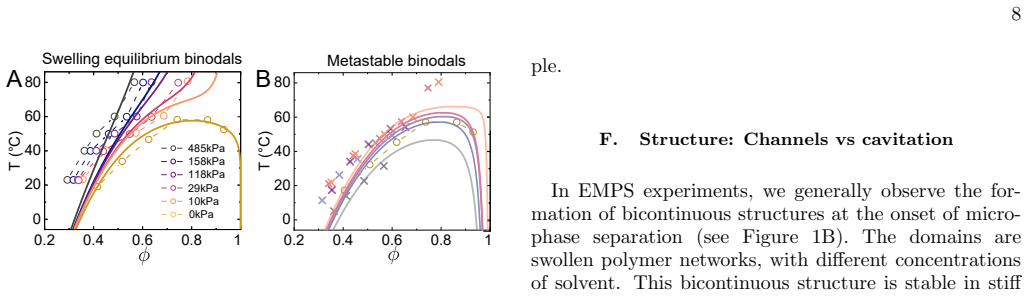
The central claim is that strain-stiffening elasticity is the essential physics that lets a swollen crosslinked polymer phase-separate into metastable microscopic domains: without it, the double-tangent construction that defines coexistence of two partially swollen networks cannot be drawn. With an Arruda-Boyce elastic energy, the elastic contribution to the free-energy density $f_{\rm el}$ diverges as the network approaches its locking stretch $\lambda_m$, so the total free energy develops a high-concentration convex region; the double tangent to that region defines a metastable binodal lying inside the classical swelling-equilibrium boundary. Because the timescale for local solvent exchange between microdomains is $10^6$–$10^8$ times shorter than diffusion of solvent to the external bath, these partially swollen states are reached and persist. The paper shows quantitative agreement between this parameter-free prediction and measured EMPS phase diagrams for PDMS/HFBMA networks with shear moduli from 10 to 485 kPa, and shows that the onset of cavitation, taken at the neo-Hookean threshold $P_c=5\mu/2$, separates droplet from bicontinuous morphologies.
Load-bearing premise
The load-bearing premise is that crosslinking the silicone chains into a network does not change the Flory-Huggins mixing parameter $\chi(\phi,T)$ measured for the uncrosslinked chains; if crosslinking alters that parameter, the predicted boundaries would shift and the agreement with experiment could be partly coincidental.
Editorial extensions
If this is right
- The swelling-equilibrium boundary and the metastable microphase-separation boundary can be predicted from independent measurements—solubility of uncrosslinked chains and tensile stress–strain curves—without any parameter fitted to microphase-separation data.
- Strain-stiffening, not network stiffness alone, is what permits microphase separation inside the swelling equilibrium; a neo-Hookean network cannot show metastable coexistence of two swollen phases.
- Increasing network stiffness suppresses swelling, while the metastable microphase-separation boundary is comparatively insensitive to stiffness in the baseline calculation; including the logarithmic volumetric elastic term brings the stiffest sample into better agreement.
- Cavitation, at a pressure threshold of order the shear modulus, selects the morphology: soft networks form droplets of pure solvent, stiff networks retain bicontinuous microphase-separated domains.
- Practical design follows: choose a solvent that swells the network far into its strain-stiffening regime, and choose an elastomer stiff enough to avoid cavitation if bicontinuous structures are wanted.
Reading between the lines
- If this parameter-free agreement generalizes, an EMPS phase diagram for a new network–solvent pair could be designed from two bench measurements only: the uncrosslinked miscibility gap and a tensile test into the stiffening regime.
- The model itself has no mechanism for the observed finite, non-coarsening domain size or for the vanishing onset contrast, so a natural next test is whether adding anisotropic or nonlocal elasticity to the same free energy selects a wavelength without spoiling the predicted phase boundaries.
- The paper's ambiguity between two choices for the volumetric elastic term suggests that EMPS phase boundaries could serve as a sensitive probe of the logarithmic term in rubber elasticity, which is otherwise hard to isolate.
- Because the interaction parameter is assumed unchanged by crosslinking, the agreement is fragile to crosslinker chemistry; comparing fixed-volume binodals of networks with different crosslinker types would test this directly.
Editorial analysis
A structured set of objections, weighed in public.
Referee Report
Summary. The paper extends Flory-Huggins theory to describe elastic microphase separation (EMPS) in polymer networks by adding a strain-stiffening (Arruda-Boyce) elastic free-energy contribution to the mixing free energy. The model is applied to PDMS networks swollen with HFBMA. The interaction parameter chi(phi,T) is fitted to liquid-liquid phase separation data of uncrosslinked PDMS/HFBMA, and the shear modulus and locking stretch are fitted to uniaxial tensile tests of the neat networks. With no parameters fitted to EMPS data, the paper reports quantitative agreement with measured swelling-equilibrium and metastable microphase-separation boundaries (Figs. 7 and 8), argues that neo-Hookean elasticity cannot produce a metastable binodal at alpha=0 while strain-stiffening can, and uses a cavitation criterion to rationalize droplet versus bicontinuous morphologies (Fig. 10). The paper also discusses limitations, including the absence of a length-scale selection mechanism and a predicted sharp composition contrast that is not observed experimentally.
Significance. If the central claims hold, this is an important step: it provides a predictive thermodynamic framework for EMPS phase diagrams from independently characterized mixing thermodynamics and large-deformation elasticity, and it identifies strain-stiffening as the key mechanical ingredient. The comparison is a genuine out-of-sample test because no EMPS data enter the fits, and the paper ships code and data via Figshare, which supports reproducibility. The conclusions are, however, contingent on several model choices—most notably the treatment of the logarithmic volume term in the elastic energy—that are not fully resolved. The paper also honestly reports discrepancies, such as the absence of a predicted composition contrast at the onset of microphase separation, which appropriately frames the model as a minimal thermodynamic description rather than a complete theory.
major comments (4)
- [§III.E, Eq. (5)] The choice alpha=0 is load-bearing for the headline quantitative comparison, but it is not independently constrained. Section III.E shows that alpha=1, an allowed value in Flory's affine network theory, qualitatively changes the metastable binodals and 'agrees much better with the stiffest experimental sample' (Fig. 9B), yet all results in Figs. 7 and 8 are computed with alpha=0. Because alpha is not measured and the paper presents both values as plausible, the claimed quantitative agreement is contingent on this choice. The authors should either justify alpha=0 from an independent measurement, report the alpha=1 comparison as the primary prediction, or quantify the resulting uncertainty in the predicted phase boundaries.
- [§III.C-D, Eqs. (6)-(10)] The central claim that strain-stiffening is the essential ingredient enabling metastable microphase separation is not fully established, because the paper never tests whether a neo-Hookean model with alpha=1 already produces a metastable binodal. The logarithmic volume term in Eq. (5) is present even without Arruda-Boyce stiffening, and its effect is not isolated from the effect of strain stiffening. The authors should compute the neo-Hookean phase diagram with alpha=1; if it already yields a metastable binodal, the conclusion that strain-stiffening is essential would need to be substantially revised.
- [Appendix B, Eqs. (18)-(19)] The printed alpha term in Eqs. (18) and (19) is written as (alpha vs)/(k_B T) (1-phi) log(1-phi), but from Eq. (5) the corresponding contribution in the elastic free-energy density should contain the shear modulus mu, i.e. (alpha mu vs)/(k_B T) (1-phi) log(1-phi). As printed, this term is numerically negligible at the quoted parameters, so the Fig. 9 calculations are not reproducible from the manuscript's own equations. The missing mu must be corrected.
- [§II, Eq. (2)] The Flory-Huggins chi(phi,T) is fitted with three parameters (A, B, C) to only six LLPS points, and the assumption that chi is unchanged when the chains are crosslinked into a network is stated but untested. Because chi is a central input to every predicted phase boundary, this assumption is load-bearing. A concrete test would be to use the independently measured mu and lambda_m to predict the swelling equilibrium composition of the crosslinked networks and compare it with the measured values in Fig. 8A; such a comparison would test whether the crosslinked-network chi is consistent with the uncrosslinked chi, and would strengthen the 'no fitting parameters specific to EMPS' claim.
minor comments (5)
- [Abstract and §III.D] The abstract states that the model 'requires no fitting parameters,' which is inaccurate because chi(phi,T), mu, and lambda_m are all fitted to experimental data. The more precise statement in Section III.D—'no fitting parameters specific to EMPS'—should be used consistently throughout, including the abstract.
- [Captions of Figs. 8 and 9] Figure 8 notes 'we assume alpha=0,' but Figure 9 does not state in its caption that alpha=1 is used. Adding this to the caption and, where possible, overlaying the alpha=0 and alpha=1 predictions in the same panel would make the model sensitivity much clearer.
- [§III.D and Table I] The text refers to 'lambda_B' in the sentence introducing the Arruda-Boyce parameters, while the table and equations use lambda_m. The notation should be unified.
- [Abstract] There is a typo: 'This works highlights' should be 'This work highlights.'
- [Materials & Methods] Minor language issues: 'peal off the teflon tubing' should be 'peel off the Teflon tubing,' and 'incubating for 2.5-3 days' should be 'incubating for 2.5-3 days at the desired temperature' for clarity.
Circularity Check
No significant circularity: the EMPS phase-boundary predictions use χ fitted to LLPS and Arruda-Boyce parameters from tensile tests, with no EMPS boundary data entering any fit, so the output does not reduce to the input by construction.
full rationale
The core derivation is not circular. The predicted swelling-equilibrium and metastable microphase-separation boundaries (Figs. 7-8) are computed by tangent constructions on ftot = FH mixing + elastic terms (Eqs. 3, 10), where χ(φ,T) is fitted exclusively to the LLPS binodal of uncrosslinked chains (Eq. 2; A=0.2108, B=247.76 K, C=−0.227) and the Arruda-Boyce parameters µ and λm are fitted to uniaxial tensile tests of neat elastomers (Table I); none of these fits uses the EMPS boundary data (circles and crosses in Figs. 3 and 7), so the agreement is a genuine independent test rather than a reduction of output to input. The contrast with the neo-Hookean case (Sec. III.C, where 'thermodynamic phase separation between networks at different levels of swelling (i.e. EMPS) is not possible') makes the strain-stiffening claim falsifiable. No uniqueness theorem is imported from prior work; Refs. 21-24 supply the experimental data used as benchmarks, not as authority. Several non-circular caveats are flagged and weighed per the review rules: (i) the abstract's 'no fitting parameters' overstates the case, since χ is a three-parameter fit to LLPS, though the text correctly narrows this to 'no fitting parameters specific to EMPS'; (ii) the α=0 choice (phantom network, Ref. 49) is revisited in Sec. III.E, where α=1 'agrees much better with the stiffest experimental sample,' which is honest model-sensitivity reporting but means the headline comparison is conditional on a debated constitutive term, and the paper never isolates the −µ log J term from strain stiffening; (iii) Appendix B prints the α term as αvs/(kBT)(1−φ)log(1−φ), omitting the shear modulus µ present in Eq. (5), so the Fig. 9 calculation is not reproducible from the manuscript's own printed equations; (iv) the transfer of χ from uncrosslinked chains to the network is an explicit stated assumption (Sec. II: 'This assumes that χ(φ,T) does not change when the silicone chains cross-link into an elastic network'). These issues affect robustness and reproducibility, not circularity: the central claim's predicted quantities are not equivalent to their inputs by construction.
Assumptions & free parameters
free parameters (3)
- Flory-Huggins chi parameters A, B, C =
A=0.2108, B=247.76 K, C=-0.227
- Shear modulus mu (Arruda-Boyce) =
9.8, 29.8, 117.7, 158.4, 485.3 kPa depending on crosslinker density
- Locking stretch lambda_m (Arruda-Boyce) =
3.7, 2.6, 3.2, 3.0, 3.2 depending on sample
assumptions (6)
- domain assumption The Flory-Huggins interaction parameter chi(phi,T) measured for uncrosslinked polymer-solvent mixtures is unchanged by crosslinking into a network.
- domain assumption Swelling is isotropic with stretches lambda_i = (1-phi)^(-1/3) and the Arruda-Boyce energy from dry uniaxial tests applies in the swollen state.
- ad hoc to paper The elastic energy contributes as f_el = (1-phi) W_el/(kBT/vs), neglecting surface energy and non-local elasticity.
- ad hoc to paper Metastable microphase coexistence is described by a double-tangent construction between two partially swollen phases, ignoring interfacial stress anisotropy.
- domain assumption The volumetric term -alpha mu log J with alpha either 0 or 1 spans the literature range; the main results use alpha=0.
- ad hoc to paper Cavitation threshold is Pc = 5 mu/2, the incompressible neo-Hookean value, applied to the swollen strain-stiffening network.
Cite this review
Pith. "Pith review of Thermodynamics of microphase separation in a swollen, strain-stiffening polymer network." pith.science (2026). https://pith.science/paper/GIIK7QJI
@misc{pith2026250608958,
  author       = {Pith},
  title        = {Pith review of: Thermodynamics of microphase separation in a swollen, strain-stiffening polymer network},
  year         = {2026},
  howpublished = {\url{https://pith.science/paper/GIIK7QJI}},
  note         = {Machine review of arXiv:2506.08958}
}
read the original abstract
Elastic MicroPhase Separation (EMPS) provides a simple route to create soft materials with homogeneous microstructures by leveraging the supersaturation of crosslinked polymer networks with liquids. At low supersaturation, network elasticity stabilizes a uniform mixture, but beyond a critical threshold, metastable microphase-separated domains emerge. While previous theories have focused on describing qualitative features about the size and morphology of these domains, they do not make quantitative predictions about EMPS phase diagrams. In this work, we extend Flory-Huggins theory to quantitatively capture EMPS phase diagrams by incorporating strain-stiffening effects. This model requires no fitting parameters and relies solely on independently measured solubility parameters and large-deformation mechanical responses. Our results reveal that strain-stiffening enables metastable microphase separation within the swelling equilibrium state and why the microstructures can range from discrete droplets to bicontinuous networks. This works highlights the critical role of nonlinear elasticity in controlling phase-separated morphologies in polymer gels.
Figures


Figures from the paper (6 more)



Reference graph
Works this paper leans on
-
[1]
Z. Xu, W. Wang, Y. Cao, and B. Xue, Supramolecular Materials , 100049 (2023)
work page 2023
-
[2]
Z. Wang, W. Qiu, and Q. Zhang, Progress in Polymer Science , 101847 (2024)
work page 2024
-
[3]
In particular, we obtain the two phase boundaries, representing where macroscopic phase separation (yel- low curve) and metastable microscopic phase separation (green curve) occur. Thus, strain-stiffening behavior ap- pears to be a key ingredient in capturing the phase be- havior of EMPS. Using this strain-stiffening model of elasticity, we ob- tain reaso...
-
[4]
D. R. Lloyd, S. S. Kim, and K. E. Kinzer, Journal of Membrane Science 64, 1 (1991)
work page 1991
- [5]
-
[6]
J. W. Gibbs, Transactions of the Connecticut Academy of Arts and Sciences 3, 108 (1879)
-
[7]
There, we have used χ(ϕ, T) from the fit of LLPS of HFBMA and silicone and µ and λB from the stress- strain curves of neat ( ϕ = 0) silicone elastomers. Thus, there are no fitting parameters specific to EMPS (see the full expression for ftot in Appendix B). There is surprisingly good agreement between theory and exper- iments for both the macroscopic swel...
-
[8]
G. R. Guillen, Y. Pan, M. Li, and E. M. V. Hoek, Indus- trial & Engineering Chemistry Research 50, 3798 (2011)
work page 2011
Show all 64 references
-
[9]
Wienk, R
I. Wienk, R. Boom, M. Beerlage, A. Bulte, C. Smolders, and H. Strathmann, Journal of membrane science 113, 361 (1996)
1996
-
[10]
Cardinaux, T
F. Cardinaux, T. Gibaud, A. Stradner, and P. Schurten- berger, Physical Review Letters 99, 118301 (2007)
2007
-
[11]
R. A. L. Jones, Soft condensed matter, Vol. 6 (Oxford University Press, 2002)
2002
-
[12]
Manley, H
S. Manley, H. Wyss, K. Miyazaki, J. Conrad, V. Trappe, L. Kaufman, D. Reichman, and D. Weitz, Physical re- view letters 95, 238302 (2005)
2005
-
[13]
G. R. Guillen, Y. Pan, M. Li, and E. M. V. Hoek, Cell 175, 3798 (2011)
2011
-
[14]
O. Y. Dudaryeva, L. Cousin, L. Krajnovic, G. Groebli, V. Sapkota, L. Ritter, D. Deshmukh, R. W. Style, R. Le- vato, C. Labouesse, et al., bioRxiv , 2024 (2024)
2024
-
[15]
Sicher, R
A. Sicher, R. Ganz, A. Menzel, D. Messmer, G. Pan- zarasa, M. Feofilova, R. Prum, R. Style, V. Saranathan, R. M. Rossi, et al., Soft Matter 17, 5772 (2021)
2021
-
[16]
A. J. Ardell, Metallurgical Transactions A 16, 2131 (1985)
1985
-
[17]
C. P. Brangwynne, C. R. Eckmann, D. S. Courson, A. Rybarska, C. Hoege, J. Gharakhani, F. J¨ ulicher, and A. A. Hyman, Science 324, 1729 (2009)
2009
-
[18]
Feric, N
M. Feric, N. Vaidya, T. S. Harmon, D. M. Mitrea, L. Zhu, T. M. Richardson, R. W. Kriwacki, R. V. Pappu, and C. P. Brangwynne, Cell 165, 1686 (2016)
2016
-
[19]
S. L. Burg and A. J. Parnell, Journal of Physics: Con- densed Matter 30, 413001 (2018)
2018
-
[20]
E. R. Dufresne, H. Noh, V. Saranathan, S. G. Mochrie, H. Cao, and R. O. Prum, Soft Matter 5, 1792 (2009)
2009
-
[21]
and C) bi-continuous morphologies [22] microphase-separated structures are stable to coarsening, they are unstable to the loss of solvent to the surrounding bath on a timescale that is O(10 hrs) [24]. The onset of elastic microphase separation is characterized by a novel phase...
2025 arXiv
-
[22]
Fern´ andez-Rico, S
C. Fern´ andez-Rico, S. Schreiber, H. Oudich, C. Lorenz, A. Sicher, T. Sai, V. Bauernfeind, S. Heyden, P. Carrara, L. D. Lorenzis, et al., Nature Materials 23, 124 (2024)
2024
-
[23]
S. F. Banani, H. O. Lee, A. A. Hyman, and M. K. Rosen, Nature reviews Molecular cell biology 18, 285 (2017)
2017
-
[24]
E. L. Elson, E. Fried, J. E. Dolbow, and G. M. Genin, Annual review of biophysics 39, 207 (2010)
2010
-
[25]
R. W. Style, T. Sai, N. Fanelli, M. Ijavi, K. Smith- Mannschott, Q. Xu, L. A. Wilen, and E. R. Dufresne, Physical Review X 8, 011028 (2018)
2018
-
[26]
Ronceray, S
P. Ronceray, S. Mao, A. Koˇ smrlj, and M. P. Haataja, Europhysics Letters 137, 67001 (2022)
2022
-
[27]
Fern´ andez-Rico, T
C. Fern´ andez-Rico, T. Sai, A. Sicher, R. W. Style, and E. R. Dufresne, JACS Au 2, 66 (2021)
2021
-
[28]
K. A. Rosowski, T. Sai, E. Vidal-Henriquez, D. Zwicker, R. W. Style, and E. R. Dufresne, Nature Physics 16, 422 (2020)
2020
-
[29]
Shin, Y.-C
Y. Shin, Y.-C. Chang, D. S. Lee, J. Berry, D. W. Sanders, P. Ronceray, N. S. Wingreen, M. Haataja, and C. P. Brangwynne, Cell 175, 1481 (2018)
2018
-
[30]
O. W. Paulin, L. C. Morrow, M. G. Hennessy, and C. W. MacMinn, Journal of the Mechanics and Physics of Solids 164, 104892 (2022)
2022
-
[31]
J. X. Liu, M. P. Haataja, A. Koˇ smrlj, S. S. Datta, C. B. Arnold, and R. D. Priestley, Nature communications 14, 6085 (2023)
2023
-
[32]
Tanaka, Journal of Physics: Condensed Matter 12, R207 (2000)
H. Tanaka, Journal of Physics: Condensed Matter 12, R207 (2000)
2000
-
[33]
Vidal-Henriquez and D
E. Vidal-Henriquez and D. Zwicker, Proceedings of the National Academy of Sciences 118, e2102014118 (2021)
2021
-
[34]
Mannattil, H
M. Mannattil, H. Diamant, and D. Andelman, arXiv preprint arXiv:2412.05910 (2024)
2024 arXiv
-
[35]
Qiang, C
Y. Qiang, C. Luo, and D. Zwicker, Physical Review X 14, 021009 (2024)
2024
-
[36]
While all of the above theories qualitatively capture different aspects of EMPS, there have been no quantitative comparisons of theory and experiments
showed that 1D gels with non-linear elasticity have similar phase diagrams to EMPS with two distinct phase boundaries. While all of the above theories qualitatively capture different aspects of EMPS, there have been no quantitative comparisons of theory and experiments. Here, ...
-
[37]
Vidal-Henriquez and D
E. Vidal-Henriquez and D. Zwicker, Soft Matter 16, 5898 (2020)
2020
-
[38]
L. Meng, S. Mao, and J. Lin, Proceedings of the National Academy of Sciences 121, e2316610121 (2024)
2024
-
[39]
Deviri and S
D. Deviri and S. A. Safran, The European Physical Jour- nal E 47, 16 (2024)
2024
-
[40]
M. G. Hennessy, A. M¨ unch, and B. Wagner, Physical Review E 101, 032501 (2020)
2020
-
[41]
Biswas, B
S. Biswas, B. Mukherjee, and B. Chakrabarti, Soft Mat- ter 18, 8117 (2022)
2022
-
[42]
Kothari and T
M. Kothari and T. Cohen, Journal of the Mechanics and Physics of Solids 145, 104153 (2020)
2020
-
[43]
X. Wei, J. Zhou, Y. Wang, and F. Meng, Physical Review Letters 125, 268001 (2020)
2020
-
[44]
P. J. Flory, The Journal of chemical physics 10, 51 (1942)
1942
-
[45]
Doi, Soft matter physics (Oxford University Press, USA, 2013)
M. Doi, Soft matter physics (Oxford University Press, USA, 2013)
2013
-
[46]
Koningsveld, W
R. Koningsveld, W. H. Stockmayer, and E. Nies, Polymer phase diagrams: a textbook (Oxford University 13 Press, USA, 2001)
2001
-
[47]
P. G. de Gennes, Scaling Concepts in Polymer Physics (Cornell, Ithaca, 1975)
1975
-
[48]
B. A. Wolf, Polymer Thermodynamics: Liquid Polymer- Containing Mixtures , 1 (2011)
2011
-
[49]
G. B. McKenna, K. M. Flynn, and Y. Chen, Polymer 31, 1937 (1990)
1990
-
[50]
W. Hong, X. Zhao, J. Zhou, and Z. Suo, Journal of the Mechanics and Physics of Solids 56, 1779 (2008)
2008
-
[51]
P. J. Flory and J. Rehner Jr, The journal of chemical physics 11, 521 (1943)
1943
-
[52]
Binder and H
K. Binder and H. Frisch, The Journal of chemical physics 81, 2126 (1984)
1984
-
[53]
H. M. James and E. Guth, The Journal of Chemical Physics 21, 1039 (1953)
1953
-
[54]
Marckmann and E
G. Marckmann and E. Verron, Rubber chemistry and technology 79, 835 (2006)
2006
-
[55]
E. M. Arruda and M. C. Boyce, Journal of the Mechanics and Physics of Solids 41, 389 (1993)
1993
-
[56]
Rickaby and N
S. Rickaby and N. Scott, International Journal of Non- Linear Mechanics 68, 71 (2015)
2015
-
[57]
J. R. Rice and M. P. Cleary, Reviews of Geophysics 14, 227 (1976)
1976
-
[58]
Okumura and S
D. Okumura and S. A. Chester, International Journal of Mechanical Sciences 144, 531 (2018)
2018
-
[59]
P. J. Flory, Proceedings of the Royal Society of London. A. Mathematical and Physical Sciences 351, 351 (1976)
1976
-
[60]
J. Y. Kim, Z. Liu, B. M. Weon, T. Cohen, C.-Y. Hui, E. R. Dufresne, and R. W. Style, Science advances 6, eaaz0418 (2020)
2020
-
[61]
Gent and P
A. Gent and P. Lindley, Proceedings of the Royal Society of London. Series A. Mathematical and Physical Sciences 249, 195 (1959)
1959
-
[62]
Oudich, P
H. Oudich, P. Carrara, and L. De Lorenzis, arXiv preprint arXiv:2505.01389 (2025)
2025 arXiv
-
[63]
R. W. Style, R. Boltyanskiy, B. Allen, K. E. Jensen, H. P. Foote, J. S. Wettlaufer, and E. R. Dufresne, Nature Physics 11 (2015)
2015
-
[64]
S. Mao, D. Kuldinow, M. P. Haataja, and A. Koˇ smrlj, Soft Matter 15, 1297 (2019)
2019
Reviewed August 7, 2026 · model on record in the stance chip above.
Discussion (0). Sign in to comment.