REVIEW 4 major objections 6 minor 13 references
GFRIEND: Generative Few-shot Reward Inference through EfficieNt DPO
T0 review · 4 major / 6 minor · reviewed 2026-08-07 · deepseek-v4-flash
Pith's one-line read A reward model trained on about 3,000 preference samples can match the judgment accuracy of models trained on far larger datasets, by sampling many chain-of-thought judgments and weighting them by perplexity.
desk verdict A plausible combination of existing ideas with a real ablation win, but the headline data-efficiency claim is not supported by a controlled comparison. read the letter →
The pith
A machine-rendered reading of the paper's core claim, the machinery that carries it, and where it could break.
The reading
What carries the argument
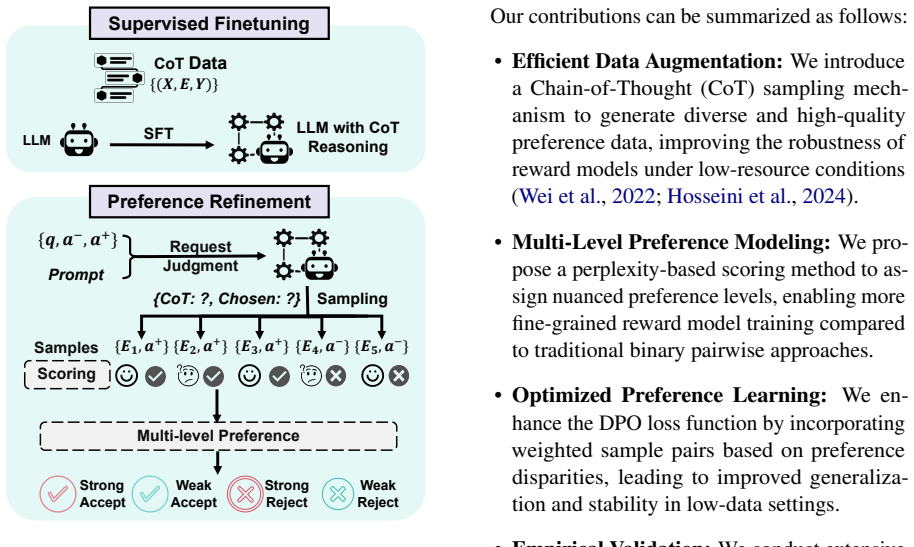
The machinery has two linked pieces. Perplexity-based scoring assigns each sampled chain-of-thought a confidence value through $\mathrm{PPL}(cot_i)=\exp(-\frac{1}{T}\sum_{t=1}^{T}\log p(cot_{i,t}\mid cot_{i,<t}))$, normalized as $\exp(-\mathrm{PPL}/\tau)$, and a threshold turns that value into one of four preference levels: Strong/Weak Accept for judgments matching the label, Strong/Weak Reject for judgments that miss it. Multi-level Direct Preference Optimization (M-DPO) is the weighted logistic objective $\mathcal{L}_{\mathrm{M\text{-}DPO}}=-\mathbb{E}_{q,a^+,a^-}\left[w(g^+,g^-)\log\sigma(r(q,a^+)-r(q,a^-))\right]$ with $w(g^+,g^-)=\log(1+\exp(\alpha|g^+-g^-|))$, where $g^+,g^-$ encode the intensity levels of the two judgments. Together they expand a small label set into a much larger pool of graded comparisons and make training concentrate on confident, high-contrast pairs.
What would settle it
On a held-out set of labeled preference pairs, sample several chain-of-thought judgments per pair and compare the accuracy of low-perplexity judgments with high-perplexity judgments. If the two accuracy rates are indistinguishable, the perplexity-based level assignment carries no information and the M-DPO weights cannot be the source of the reported gains.
Extended reading notes
Core claim
The central claim is that data efficiency in reward modeling comes from generating and grading reasoning traces, not from collecting more preference labels. From each labeled pair, the framework asks the base LLM to produce several chain-of-thought judgments under varied prompts and sampling temperatures, checks each judgment against the known label, and uses the perplexity of each reasoning chain to split correct and incorrect judgments into strong and weak levels. The expanded, graded preference pool is then trained with a weighted version of the DPO objective whose per-pair weight grows with the level gap between the accepted and rejected judgments. In the paper's experiments, this recipe lets a 7-8B parameter model trained on about 3,000 samples outperform other reward models trained on the same data and reach parity with much larger systems.
Load-bearing premise
The framework assumes that a low-perplexity chain-of-thought is more likely to be a correct judgment; if perplexity does not track correctness, the Strong/Weak labels are essentially arbitrary and the reported accuracy gains would not replicate.
Editorial extensions
If this is right
- A domain such as medicine can build a usable reward model from roughly 3,000 annotated consultations instead of tens of thousands of labeled examples, lowering the data cost of RLHF in privacy-constrained settings.
- Training the framework on the same 3,000-sample budget across Llama-3, Qwen, and Mistral bases lifts benchmark judgment accuracy well above SFT-only training and Bradley-Terry reward modeling on that budget.
- Both components matter: the paper's ablation reports that removing chain-of-thought sampling or removing multi-level DPO drops judgment accuracy from 83.9% to roughly 66-68% on the tested data.
- A reward model trained on 3,000 general-domain samples can score comparably to GPT-4o and Claude-3-Sonnet on Reward-Bench, UltraFeedback, and PKU-SafeRLHF, and reports higher accuracy than several dedicated generative-judge models in the comparison tables.
Reading between the lines
- [Editorial inference] If perplexity works as a reliability signal, the same weighting could be applied to other confidence indicators, such as agreement across independently sampled chain-of-thoughts, which the paper does not test.
- [Editorial inference] The gains may depend on the base LLM already being a competent reasoner; with weaker bases the link between fluent reasoning and correctness is likely to loosen, so the margin over plain DPO could shrink.
- [Editorial inference] Because the framework multiplies each label into many pairings, it is a natural fit for active learning: choose which new labels to collect based on disagreement among the model's own judgments, an extension the paper leaves implicit.
Editorial analysis
A structured set of objections, weighed in public.
Referee Report
Summary. The paper introduces GFRIEND, a framework for training generative reward models from few-shot preference data. The method first supervised fine-tunes a base LLM on (question, chain-of-thought) data, then samples multiple CoT judgments for each preference pair, assigns each judgment a perplexity-based score, thresholds those scores into Strong/Weak Accept/Reject levels, and trains with a weighted DPO-style loss (M-DPO) that upweights pairs with larger level gaps. Experiments on Reward-Bench, UltraFeedback, PKU-SafeRLHF, and a self-constructed medical dataset report that a Llama-3-8B-Instruct model trained on 3,000 Skywork samples reaches accuracy comparable to or exceeding GenRM, Prometheus2, GPT-4o, and Claude-3-Sonnet. The paper claims this demonstrates that few-shot training can match large-scale reward training.
Significance. If the controlled comparison were in place, the result would be a meaningful step toward low-resource RLHF: the pipeline is simple, uses only open models and public data, isolates data augmentation from the loss function, and the base-model generalization study in Table 2 shows the recipe transfers across four 7-8B architectures. The paper also releases code. However, the current evidence does not establish the headline parity claim: the key comparison is uncontrolled, and the core PPL-correctness hypothesis is unvalidated. The contribution is therefore conditional on additional experiments.
major comments (4)
- [Section 4.1, Table 1] The central data-efficiency claim is not supported by a controlled comparison. Table 1 reports GFRIEND trained on 3,000 Skywork samples against Auto-J, Prometheus2, GenRM, GPT-4o, and Claude-3-Sonnet, whose training sets and evaluation exposure are not matched; no same-base Llama-3-8B baseline trained on the full Skywork 80k set is reported, and Table 2 contains only 3k variants. The observed parity (e.g., 80.4 vs 80.1 on Reward-Bench) is therefore consistent with base-model, prompt-formatting, or benchmark-selection effects, and the Section 4.3 sentence claiming outperformance over 'other reward model frameworks trained with the same amount of data' is accurate only for the scalar baselines and GFRIEND. A controlled experiment varying only training-set size on the same base model is required to establish the parity claim.
- [Section 3.2, Eq. (9); Appendix C] Equation (9) is not the DPO loss; it is the Bradley-Terry reward-modeling loss from Eq. (1) written with an implicit reward function. The actual DPO objective uses the policy ratio with a reference model rather than a scalar reward difference. Because Eq. (10) then multiplies this BT-style log-sigmoid term by w(g+, g-), it is unclear whether the r(q,a) in Eq. (10) is a learned scalar reward head or the implicit DPO reward. This ambiguity matters because the appendix proof in Appendix C analyzes the weighted objective as a logistic reward model, not as a DPO objective, so the claimed consistency and convexity results do not transfer automatically to the policy-based DPO setting.
- [Section 3.2, Eqs. (7)-(8) and Eq. (11)] The framework's central assumption, that low-perplexity CoT judgments are more likely to be correct, is stated as a 'statistical correlation hypothesis' in Section 3.2 but is never validated. The threshold p, temperature tau, weight alpha, and the intensity values (2,1,-2,-1) are all free hyperparameters, and the four-level construction and the M-DPO weights depend entirely on this PPL-correctness correlation. If the correlation does not hold on the test distributions, the weighted training signal is largely noise. The paper should validate the hypothesis directly (for example, by measuring PPL against label accuracy across sampled CoTs) and report sensitivity to p, tau, and alpha on held-out tuning data rather than the same benchmarks used to select these values.
- [Tables 1-3] No error bars, confidence intervals, or multiple-seed runs are reported anywhere. With single runs, differences such as 80.4 vs 80.1 (Reward-Bench), 72.4 vs 72.2 (UltraFeedback), and 83.0 vs 81.0 (Med-domain) are within plausible run-to-run or evaluation noise, so the claimed superiority over GPT-4o and Claude is not established. The ablation table (Table 3) reports one number per variant; given the large jump from 66.2/67.9 to 83.9, seed sensitivity and variance reporting are essential to rule out chance.
minor comments (6)
- [Section 3.2] The example count is wrong: with 2 accepted and 3 rejected judgments, the Cartesian product yields 2x3=6 pairs, not C(3,2)=6; the text should be corrected to avoid confusion about the pairing procedure.
- [Section 4.2] The text refers to 'VLLM' when the library is 'vLLM'; the capitalization should be corrected.
- [Appendix B] Appendix B contains two identical paragraphs describing the line chart; one should be removed.
- [Figure 2] Figure 2 would benefit from specifying the data-size increments and including error bars or per-point variance; currently the reader cannot assess whether early-stage differences are meaningful.
- [Table 3] The header 'GFRIEND (w/. M-DPO,CoT-S)' contains a typo; it should read 'GFRIEND (w/ M-DPO, CoT-S)'.
- [References] Several references are incomplete or inconsistently formatted (for example, 'Rafailov et al., 2023' lacks a venue and 'Loshchilov et al., 2017' is cited with an 'et al.'); a careful reference pass is needed.
Circularity Check
No circularity found: GFRIEND's components are defined from preference labels and model-generated CoT perplexity, and the headline few-shot/large-scale parity claim rests on an uncontrolled experimental comparison rather than on a derivation that reduces to its inputs.
full rationale
I walked the derivation chain from CoT sampling through perplexity scoring, four-level preference construction, and M-DPO. Each step is operationally defined rather than presupposing the final claim. Perplexity scores (Eq. 7-8) are computed from the model's own generated chains; the Strong/Weak Accept/Reject categories are defined by thresholding those scores against the original preference labels; and M-DPO (Eq. 10-11) is a weighted logistic loss with bounded hyperparameter weights. None of these steps predicts a benchmark result by construction, and no fitted parameter is renamed as a prediction. The paper's own ablations (Table 3) provide direct comparisons of SFT, BT-model, and GFRIEND variants under the same 3,000-sample condition, so the internal component claims have independent empirical content. The broader claim of parity with large-scale or closed commercial judges is weakened by the absence of a same-base large-scale GFRIEND baseline and by mismatched training conditions across Table 1, but that is an experimental-control concern rather than a circularity: the benchmark numbers are not algebraically forced by the method's definitions. Self-citations to Zhao et al. appear only as general context for in-context learning and domain generalization and are not load-bearing for any derivation. I therefore find no circular step requiring a quote-based reduction.
Assumptions & free parameters
free parameters (5)
- threshold p =
0.5
- tau in PPL score =
not reported
- alpha in weight function =
not reported
- g+ and g- intensity values =
2, 1, -2, -1
- number of CoT samples per query =
5 (example only)
assumptions (4)
- ad hoc to paper Low-perplexity chain-of-thought corresponds to correct and reliable preference judgments (statistical correlation hypothesis)
- domain assumption LLM-generated CoT judgments are sufficiently diverse and accurate to serve as training data after filtering against ground-truth labels
- standard math The weighted logistic (BT) loss with nonnegative bounded weights is consistent under i.i.d. sampling from a logistic model
- domain assumption Training/test overlap filtering between Skywork and evaluation benchmarks is complete
Cite this review
Pith. "Pith review of GFRIEND: Generative Few-shot Reward Inference through EfficieNt DPO." pith.science (2026). https://pith.science/paper/OLNLCAE2
@misc{pith2026250608965,
  author       = {Pith},
  title        = {Pith review of: GFRIEND: Generative Few-shot Reward Inference through EfficieNt DPO},
  year         = {2026},
  howpublished = {\url{https://pith.science/paper/OLNLCAE2}},
  note         = {Machine review of arXiv:2506.08965}
}
read the original abstract
The ability to train high-performing reward models with few-shot data is critical for enhancing the efficiency and scalability of Reinforcement Learning from Human Feedback (RLHF). We propose a data augmentation and expansion framework that enables generative reward models trained on small datasets to achieve comparable performance to those trained on large-scale datasets. Traditional methods to train a generative reward model, such as Direct Preference Optimization (DPO), are constrained by inefficiencies in sample pairing and limited data diversity. This work introduces preference refinement, which employs Chain-of-Thought (CoT) sampling to uncover diverse and high-quality preference relationships. It also incorporates a perplexity-based scoring mechanism to assign nuanced preference levels and utilizes Multi-level Direct Preference Optimization (M-DPO) to enable the model to capture finer-grained preference differences between samples. Experimental results demonstrate that the proposed method significantly enhances data efficiency and model performance, enabling reward models trained in a few-shot setting to achieve results on par with those trained on large-scale datasets. This study underscores the potential of data-efficient strategies in advancing reward model optimization, offering a robust solution for low-resource RLHF applications.
Figures

Reference graph
Works this paper leans on
-
[1]
Exponential-Family Representation The Bradley-Terry model can be viewed as a logistic model within the exponential-family framework. As long as the loss function remains a weighted version of the logistic (i.e., negative log-likelihood) form, and the weighting function w(g+, g−) is nonnega- tive and bounded, the statistical properties of maximum likelihoo...
-
[2]
Nonnegativity and Boundedness of w(g+, g−) By definition, w(g+, g−) = log 1 + exp α · |g+ − g−| . For any real |g+ − g−| ≥0 and α > 0, we have w(g+, g−) > 0, and w(g+, g−) ≤ log 1+eα ∆ , where ∆ can be considered the maximum pos- sible gap in |g+ − g−| (for instance, if g+ and g− lie in a bounded range). Thus, w(·) is nonnegative and bounded, which is con...
-
[3]
Weak Accept or Strong Reject vs
Effective Multi-Level Preference Represen- tation M-DPO’s weighting function incorporates multi-level preference data, capturing distinc- tions such as Strong Accept vs. Weak Accept or Strong Reject vs. Weak Reject. It intensi- fies the focus on samples with greater prefer- ence gaps, yielding more rapid and stable dis- crimination in high-confidence, hig...
-
[5]
arXiv preprint arXiv:2410.12832
Generative reward models. arXiv preprint arXiv:2410.12832. Tomas Mikolov, Stefan Kombrink, Lukáš Burget, Jan ˇCernocký, and Sanjeev Khudanpur. 2011. Empirical evaluation and combination of advanced language modeling techniques. INTERSPEECH. Long Ouyang, Jeffrey Wu, Xu Jiang, Diogo Almeida, Carroll L. Wainwright, Pamela Mishkin, Chong Zhang, Saurabh Agarwa...
arXiv 2011
-
[8]
Beyond scalar reward model: Learning gen- erative judge from preference data. arXiv preprint arXiv:2410.03742. Jinghan Zhang, Xiting Wang, Yiqiao Jin, Changyu Chen, Xinhao Zhang, and Kunpeng Liu. 2024a. Prototyp- ical reward network for data-efficient rlhf. arXiv preprint arXiv:2406.06606. Yifan Zhang et al. 2024b. Fine-tuning language models with generat...
-
[11]
Consistency M-DPO, as a weighted version of the logistic (Bradley-Terry) preference model, preserves the consistency of the underlying maximum- likelihood estimator for large sample sizes. The model thus converges to an optimal solu- tion consistent with the true preference order- ing (up to an additive scaling)
-
[12]
Optimizability and Convergence Because w(g+, g−) is nonnegative, bounded, and not directly coupled to the model parame- ters, M-DPO only applies a multiplicative cor- rection at each sample in the gradient updates. This retains the positive gradient properties 14 of logistic log-likelihood, allowing standard optimizers to converge efficiently
-
[16]
Jeff Rasley, Samyam Rajbhandari, Olatunji Ruwase, and Yuxiong He
IEEE. Jeff Rasley, Samyam Rajbhandari, Olatunji Ruwase, and Yuxiong He. 2020. Deepspeed: System optimiza- tions enable training deep learning models with over 100 billion parameters. In Proceedings of the 26th ACM SIGKDD International Conference on Knowl- edge Discovery & Data Mining , pages 3505–3506. John Schulman, Filip Wolski, Prafulla Dhariwal, Alec ...
arXiv 2020
Show all 13 references
-
[1992]
In Proceedings of the Workshop on Speech and Natural Language, pages 103–108
An estimate of an upper bound for the en- tropy of english. In Proceedings of the Workshop on Speech and Natural Language, pages 103–108. Tianqi Chen, Bing Xu, Chiyuan Zhang, and Carlos Guestrin. 2016. Training deep nets with sublinear memory cost. arXiv preprint arXiv:1604.06...
2016 arXiv
-
[2021]
arXiv preprint arXiv:2112.00861
A general language assistant as a laboratory for alignment. arXiv preprint arXiv:2112.00861. Jinze Bai, Shuai Bai, Yunfei Chu, Zeyu Cui, Kai Dang, Xiaodong Deng, Yang Fan, Wenbin Ge, Yu Han, Fei Huang, Binyuan Hui, Luo Ji, Mei Li, Junyang Lin, Runji Lin, Dayiheng Liu, Gao Liu,...
2023 arXiv
-
[2022]
arXiv preprint arXiv:2203.02155
Training a helpful and harmless assistant with reinforcement learning from human feedback. arXiv preprint arXiv:2203.02155. Yoshua Bengio, Réjean Ducharme, Pascal Vincent, and Christian Jauvin. 2003. A neural probabilistic lan- guage model. Journal of Machine Learning Re- sear...
2003 arXiv
-
[2023]
Samyam Rajbhandari, Jeff Rasley, Olatunji Ruwase, and Yuxiong He
Direct preference optimization: Your language model is secretly a reward model. Samyam Rajbhandari, Jeff Rasley, Olatunji Ruwase, and Yuxiong He. 2020. Zero: Memory optimizations toward training trillion parameter models. In SC20: International Conference for High Performance ...
2020
-
[2024]
arXiv preprint arXiv:2408.11791
Critique-out-loud reward models. arXiv preprint arXiv:2408.11791. Anthropic. 2024. Claude 3 model family: Opus, sonnet, haiku. Amanda Askell, Yuntao Bai, Anna Chen, Dawn Drain, Deep Ganguli, Andy Jones, Nicholas Joseph, Saurav Kadavath, Jackson Kernion, Shauna Kravec, et al
2024 arXiv
Reviewed August 7, 2026 · model on record in the stance chip above.
Discussion (0). Sign in to comment.