REVIEW 4 major objections 4 minor 49 references
Reconstructing Heterogeneous Biomolecules via Hierarchical Gaussian Mixtures and Part Discovery
T0 review · 4 major / 4 minor · reviewed 2026-08-07 · deepseek-v4-flash
Pith's one-line read A hierarchical Gaussian mixture with discovered parts tops heterogeneous cryo-EM reconstruction.
desk verdict CryoSPIRE is a genuine GMM-based advance on CryoBench with a novel part-discovery idea, but the part discovery is only qualitatively validated and the abstract's state-of-the-art claim overstates the Ribosembly result. read the letter →
The pith
A machine-rendered reading of the paper's core claim, the machinery that carries it, and where it could break.
The reading
What carries the argument
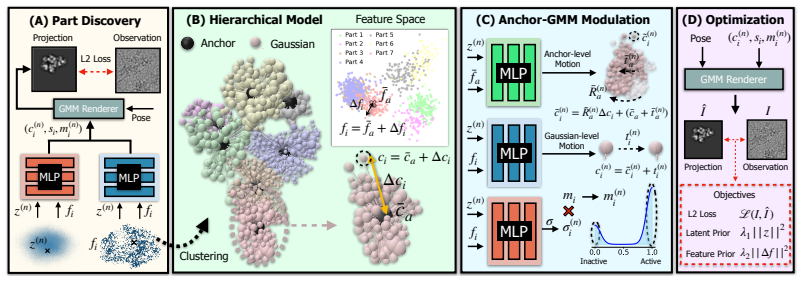
The central object is the hierarchical anchor-Gaussian mixture: a set of anchors, each carrying a center and a feature vector, with Gaussians attached to anchors through center and feature offsets; per-image latent codes condition three MLPs that generate anchor rigid-body motions, per-Gaussian residual shifts, and sigmoid amplitude modulation for occupancy. The load-bearing mechanism is part discovery: k-means++ clustering on the learned feature space, followed in some datasets by spatial clustering, assigns each Gaussian to a part. In one phrase, the identity is learnable feature-conditioned piecewise-smooth deformation with occupancy modulation.
What would settle it
Retrain the part-discovery stage from several random initializations and check whether the same parts emerge; then train the second stage with part assignments randomly permuted while keeping the same anchor count and loss. If the CryoBench AUC-FSC does not drop when the discovered parts are replaced by random groupings, the part-based inductive bias is not what the performance gain rests on.
Extended reading notes
Core claim
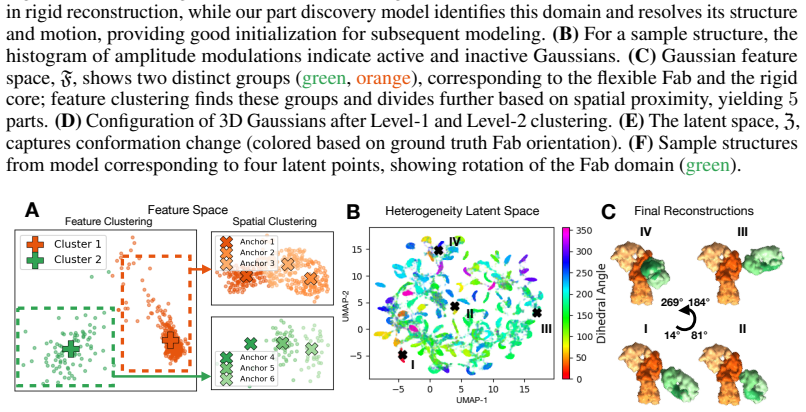
The core claim is that a coarse Gaussian mixture with learnable per-component features has feature structure that mirrors structural parts: components that co-move or co-appear converge to nearby feature vectors without any supervision on features. Clustering those features yields a part segmentation, and a second-stage model that ties Gaussian motion to one anchor per part learns locally rigid, composable deformations. On CryoBench, this outperforms widely used latent-variable and deformation baselines, sometimes by a wide margin, and on experimental ribosome and spliceosome data it recovers parts that match previously reported structural domains.
Load-bearing premise
The load-bearing premise is that after feature clustering, each anchor groups Gaussians that truly move and appear together; if the clusters are not coherent kinematic units, the hierarchical motion model is built on a faulty inductive bias.
Editorial extensions
If this is right
- A single framework now covers both continuous conformational changes and discrete compositional changes, so one does not need separate deformation and classification pipelines.
- Part-based anchors give a route to interpreting latent trajectories as large-scale rigid motions of domains, which is closer to how structural biologists describe complexes.
- Because Gaussian components are sparse and atomic, the output can feed downstream molecular fitting or physics-based priors, extending earlier GMM work.
- The ablation implies that replacing the learned feature space with positional encodings, as in DynaMight, costs accuracy on CryoBench, so feature learning rather than coordinate smoothness is what the gain hinges on.
- On Ribosembly, where linear subspace models are favored by design, CryoSPIRE matches but does not clearly beat RECOVAR, so the method's edge is largest when motion dominates.
Reading between the lines
- Beyond the paper: the feature-clustering step could be turned into a quantitative part-validity measure, for example by comparing discovered parts against independently known structural domains on a curated set of complexes, rather than relying only on visual inspection.
- Beyond the paper: one could track whether cluster assignments stay stable across different random initializations of the part-discovery stage; stable parts would strengthen the claim that features encode structural regularities.
- Beyond the paper: because anchors persist across latent states, the occupancy activations of parts could be used to estimate per-state populations directly, giving a compositional state count without supervised classification.
Editorial analysis
A structured set of objections, weighed in public.
Referee Report
Summary. The paper introduces CryoSPIRE, a hierarchical Gaussian mixture model for heterogeneous cryo-EM reconstruction. The method first trains a coarse-grained GMM with learnable per-Gaussian features, then clusters those features (with k-means++) to discover a part-based segmentation. Each part becomes an anchor in a hierarchical model where the latent code per image drives rigid anchor motions, per-Gaussian displacements, and amplitude modulations for compositional variability. The model is evaluated on the CryoBench synthetic benchmark (IgG-1D, IgG-RL, Ribosembly) and on two experimental datasets (EMPIAR-10076, EMPIAR-10180). The authors report state-of-the-art AUC-FSC on CryoBench compared with RECOVAR, 3DVA, 3DFlex, CryoDRGN, and DRGN-AI, and they provide ablation studies supporting the hierarchical motion model, the learnable Gaussian features, and the importance of the discovered parts.
Significance. If the results hold, CryoSPIRE provides a principled and interpretable way to inject part-based inductive bias into heterogeneous cryo-EM reconstruction. The use of CryoBench, a standardized benchmark with ground-truth states, is a clear strength, as is the inclusion of ablations that isolate key design choices. The paper is also, to my knowledge, the first GMM-based method to be benchmarked on CryoBench. However, the central novelty — automatic part discovery — is only validated qualitatively, and the number of parts is selected manually. Moreover, the state-of-the-art claim is not uniform across all CryoBench datasets: on Ribosembly the gap to RECOVAR is not statistically significant. These issues do not invalidate the approach, but they need to be addressed before the paper's strongest claims are fully supported.
major comments (4)
- [Sec. 3.2 and Supplement C] The claim that learned Gaussian features 'naturally group Gaussians into 3D parts' is supported only by UMAP visualizations and qualitative figures; no quantitative comparison is made between the inferred parts and ground-truth structural parts on CryoBench. Supplement C explicitly states that the number of anchors is chosen manually, e.g., using UMAP visualization. This makes the part-discovery step manual rather than fully automatic, and it means that the reported benchmark gains could depend on the selected anchor count. I recommend adding a quantitative evaluation of part discovery (for example, measuring overlap or consistency between inferred clusters and the known structural states on CryoBench) and either automating the selection of the number of clusters or demonstrating robustness across a range of plausible anchor counts.
- [Sec. 5, Table 1] The Abstract and Introduction state that CryoSPIRE establishes a new state-of-the-art on CryoBench, but on Ribosembly CryoSPIRE (0.427 ± 0.014) is statistically indistinguishable from RECOVAR (0.430 ± 0.016), as the text itself acknowledges. Since Ribosembly is one of the three benchmark datasets, the state-of-the-art claim should be qualified: either restrict the claim to the IgG datasets or report significance tests across independent training runs to support the comparison on all datasets.
- [Sec. 5.1, Table 2] The ablation study shows that over-segmenting to 64 anchors reduces AUC on all datasets, and that removing hierarchical motion also reduces performance. Together with the manual anchor selection, this sensitivity indicates that the benchmark numbers may be specific to the chosen anchor configuration rather than to the proposed part-discovery mechanism per se. The authors should report performance across a sweep of anchor counts or provide a data-driven criterion for selecting the number of anchors, so that the results can be attributed to the method rather than to manual tuning.
- [Sec. 4 and Table 1] The reported standard deviations in Table 1 are computed across structural states, not across independent training runs. Because the optimization involves stochastic initialization and sampling, the claim that CryoSPIRE 'significantly outperforms' RECOVAR on IgG datasets is not supported without multiple seeds and an appropriate paired significance test. Please report mean and standard deviation over at least three independent training runs, or otherwise justify the current statistics.
minor comments (4)
- [Abstract and Supplement A] The paper refers to a 'Project Webpage' but does not provide a URL. Since the qualitative comparisons and videos are said to be on the webpage, the URL should be included for reproducibility.
- [Fig. 7 and Sec. 5] The text refers to 'Fig. 7E', but Figure 7 contains panels (A)-(C); this should be corrected to 'Fig. 7C'.
- [Throughout] The abbreviation 'c.f.' should be 'cf.' (for example, in Section 3.2). There are also a few grammatical issues, such as 'the structure of the model is grounded in an initial process that infers a part-based segmentation' being clearer as 'the model structure is grounded in an initial process that infers a part-based segmentation.'
- [Sec. 4] The definition of AUC for FSC curves is implicit. Please state explicitly that the area under the FSC curve is computed up to the Nyquist frequency (or the maximum frequency sampled by the grid), so that the metric is unambiguous.
Circularity Check
No significant circularity: the CryoBench SOTA claim is evaluated against external ground-truth benchmark data, and the part-discovery step is an unsupervised initialization whose manual anchor choice is model selection, not a fitted prediction.
full rationale
The paper's central quantitative claim is benchmarked on CryoBench, an external benchmark with ground-truth structural states; the AUC-FSC values in Table 1 measure agreement between model-generated density maps and ground-truth states, and no benchmark label is used in fitting the model. The part-discovery stage is an unsupervised k-means clustering of learned Gaussian feature vectors, and although the number of anchors is chosen manually (Supplement C) and the resulting part segmentation is not quantitatively validated against ground-truth parts, this is a validation/model-selection gap rather than a circular reduction: the clustering is not defined in terms of the benchmark metric, the anchor hierarchy is only one component of the full model, and the ablations show that performance is sensitive to whether hierarchical motion or the chosen number of anchors is used. The authors' prior work (3DVA, 3DFlex, CryoSPARC) appears as baselines and preprocessing tools, not as the justification for the central claim. Limitation statements in Sec. 6 acknowledge open problems in validating experimental latent spaces and in requiring initial poses/structure, but these are honest caveats, not circular derivations. No equation reduces to its own input, and no fitted parameter is renamed as a prediction.
Assumptions & free parameters
free parameters (8)
- Number of anchors per dataset =
5 (IgG-1D), 6 (IgG-RL), 8 (Ribosembly), 4 (EMPIAR-10076), 4 (EMPIAR-10180)
- Number of Gaussian components G =
2048 (part discovery); 8192 or 16384 (part-aware)
- Density threshold for seeding Gaussians =
not specified numerically (user-defined)
- Regularization weights lambda_z and lambda_f =
lambda_z=0.1, lambda_f=0.01
- Feature dimensionality E and latent dimensionality D =
E=24, D=4
- Initial Gaussian scale and amplitude =
m=0.15; s=0.02 (part discovery), s=0.01 (part-aware)
- Number of spatial clusters after feature clustering =
5 (IgG-1D), 6 (IgG-RL)
- Training epochs =
15 or 50 (part discovery), 30 (part-aware)
assumptions (6)
- domain assumption The 3D density of a biomolecule can be represented as a sum of isotropic 3D Gaussians, and the 2D projection is the analytic sum of 2D Gaussians (Eq. 1 and 2).
- domain assumption Per-particle poses (rotations and translations) and CTFs are known or estimated by external software (CryoSPARC, RELION).
- domain assumption Latent codes z follow a zero-mean Gaussian prior and feature offsets are small (Eq. 7).
- ad hoc to paper k-means++ clustering on learned Gaussian features yields a semantically meaningful part decomposition without direct supervision.
- domain assumption Per-Conformation FSC on CryoBench is a valid measure of heterogeneity reconstruction quality.
- standard math The rendering grid and separability tricks compute the projection accurately.
invented entities (1)
-
Part anchors
Cite this review
Pith. "Pith review of Reconstructing Heterogeneous Biomolecules via Hierarchical Gaussian Mixtures and Part Discovery." pith.science (2026). https://pith.science/paper/DLPWSWLU
@misc{pith2026250609063,
  author       = {Pith},
  title        = {Pith review of: Reconstructing Heterogeneous Biomolecules via Hierarchical Gaussian Mixtures and Part Discovery},
  year         = {2026},
  howpublished = {\url{https://pith.science/paper/DLPWSWLU}},
  note         = {Machine review of arXiv:2506.09063}
}
read the original abstract
Cryo-EM is a transformational paradigm in molecular biology where computational methods are used to infer 3D molecular structure at atomic resolution from extremely noisy 2D electron microscope images. At the forefront of research is how to model the structure when the imaged particles exhibit non-rigid conformational flexibility and compositional variation where parts are sometimes missing. We introduce a novel 3D reconstruction framework with a hierarchical Gaussian mixture model, inspired in part by Gaussian Splatting for 4D scene reconstruction. In particular, the structure of the model is grounded in an initial process that infers a part-based segmentation of the particle, providing essential inductive bias in order to handle both conformational and compositional variability. The framework, called CryoSPIRE, is shown to reveal biologically meaningful structures on complex experimental datasets, and establishes a new state-of-the-art on CryoBench, a benchmark for cryo-EM heterogeneity methods.
Figures


Figures from the paper (11 more)



Reference graph
Works this paper leans on
-
[1]
K-Means++: The advantages of careful seeding.Proc
David Arthur and Sergei Vassilvitskii. K-Means++: The advantages of careful seeding.Proc. 18th Annual ACM-SIAM Symposium on Discrete Algorithms, page 1027–1035, 2007. 5, 15
work page 2007
-
[2]
Per- Gaussian embedding-based deformation for deformable 3d Gaussian splatting
Jeongmin Bae, Seoha Kim, Youngsik Yun, Hahyun Lee, Gun Bang, and Youngjung Uh. Per- Gaussian embedding-based deformation for deformable 3d Gaussian splatting. InEuropean Conference on Computer Vision (ECCV), pages 321–335. Springer, 2024. 1, 3
work page 2024
-
[3]
Building proteins in a day: Efficient 3d molecular reconstruction.Proc IEEE Conf
Marcus A Brubaker, Ali Punjani, and David J Fleet. Building proteins in a day: Efficient 3d molecular reconstruction.Proc IEEE Conf. Computer Vision and Pattern Recognition (CVPR),
-
[4]
Muyuan Chen and Steven J Ludtke. Deep learning-based mixed-dimensional Gaussian mixture model for characterizing variability in cryo-EM.Nature Methods, 18(8):930–936, 2021. 2, 3
work page 2021
-
[5]
Muyuan Chen, Michael F. Schmid, and Wah Chiu. Improving resolution and resolvability of single particle cryoem structures using Gaussian mixture models.Nature Methods, 21:37–40,
-
[6]
Muyuan Chen, Bogdan Toader, and Lederman Roy. Integrating molecular models into cryoem heterogeneity analysis using scalable high-resolution deep Gaussian mixture models.Journal of Molecular Biology, 435(9):168014, 2023. 2, 3, 15
work page 2023
-
[7]
Modular assembly of the bacterial large ribosomal subunit.Cell, 167(6):1610–1622,
Joseph H Davis, Yong Zi Tan, Bridget Carragher, Clinton S Potter, Dmitry Lyumkis, and James R Williamson. Modular assembly of the bacterial large ribosomal subunit.Cell, 167(6):1610–1622,
-
[8]
V olume rendering.ACM SIGGRAPH, 22(4):65–74, 1988
Robert A Drebin, Loren Carpenter, and Pat Hanrahan. V olume rendering.ACM SIGGRAPH, 22(4):65–74, 1988. 3
work page 1988
Show all 49 references
-
[9]
Frank and L
J. Frank and L. Al-Ali. Signal-to-noise ratio of electron micrographs obtained by cross correla- tion.Nature, 256(5516):376–379, 1975. 16 10
1975
-
[10]
Cryo-EM heterogeneity analysis using regularized covari- ance estimation and kernel regression.Proc
Marc Aurèle Gilles and Amit Singer. Cryo-EM heterogeneity analysis using regularized covari- ance estimation and kernel regression.Proc. National Academy of Science, 122(9):e2419140122,
-
[11]
Sugar: Surface-aligned Gaussian splatting for efficient 3D mesh reconstruction and high-quality mesh rendering
Antoine Guédon and Vincent Lepetit. Sugar: Surface-aligned Gaussian splatting for efficient 3D mesh reconstruction and high-quality mesh rendering. InProc. CVPR, 2024. 3
2024
-
[12]
Harauz and M
G. Harauz and M. van Heel. Optimal determination of particle orientation, absolute hand, and contrast loss in single-particle electron cryomicroscopy.Optik, 73:146–156, 1986. 16
1986
-
[13]
Estimating confor- mational landscapes from cryo-em particles by 3d zernike polynomials.Nature Communications, 14(1):154, 2023
David Herreros, Roy R Lederman, James M Krieger, Amaya Jiménez-Moreno, Marta Martínez, David Myška, D Strelak, J Filipovic, Carlos OS Sorzano, and José M Carazo. Estimating confor- mational landscapes from cryo-em particles by 3d zernike polynomials.Nature Communications, 14(1...
2023
-
[14]
High-resolution real-space reconstruction of cryo-em structures using a neural field network.Nature Machine Intelligence, 6:892–903, 2024
Yue Huang, Chengguang Zhu, Xiaokang Yang, and Manhua Liu. High-resolution real-space reconstruction of cryo-em structures using a neural field network.Nature Machine Intelligence, 6:892–903, 2024. 2
2024
-
[15]
Hanson, Pilar Cossio, and Ellen D
Minkyu Jeon, Rishwanth Raghu, Miro Astore, Geoffrey Woollard, Ryan Feathers, Alkin Kaz, Sonya M. Hanson, Pilar Cossio, and Ellen D. Zhong. CryoBench: Diverse and challeng- ing datasets for the heterogeneity problem in cryo-em. InAdvances in Neural Information Processing System...
2024
-
[16]
3D Gaus- sian splatting for real-time radiance field rendering.ACM Transactions on Graphics (Proc
Bernhard Kerbl, Georgios Kopanas, Thomas Leimkuehler, and George Drettakis. 3D Gaus- sian splatting for real-time radiance field rendering.ACM Transactions on Graphics (Proc. SIGGRAPH), 2023. 3, 15
2023
-
[17]
3D Gaussian splatting as Markov chain Monte Carlo
Shakiba Kheradmand, Daniel Rebain, Gopal Sharma, Weiwei Sun, Yang-Che Tseng, Hossam Isack, Abhishek Kar, Andrea Tagliasacchi, and Kwang Moo Yi. 3D Gaussian splatting as Markov chain Monte Carlo. InProc. NeurIPS, 2024. 3
2024
-
[18]
The Resolution Revolution: Advances in detector technology and image processing are yielding high-resolution electron cryo-microscopy structures of biomolecules
Werner Kühlbrandt. The Resolution Revolution: Advances in detector technology and image processing are yielding high-resolution electron cryo-microscopy structures of biomolecules. Science, 343(6178):1443–1444, 2014. 1
2014
-
[19]
Revealing biomolecular structure and motion with neural ab initio cryo-em reconstruction.bioRxiv, 2024
Axel Levy, Michal Grzadkowski, Frederic Poitevin, Francesca Vallese, Oliver B Clarke, Gordon Wetzstein, and Ellen D Zhong. Revealing biomolecular structure and motion with neural ab initio cryo-em reconstruction.bioRxiv, 2024. 1, 2, 5, 6, 17, 19
2024
-
[20]
Amortized inference for heterogeneous reconstruction in cryo-EM.Advances in Neural Information Processing Systems, 35:13038–13049, 2022
Axel Levy, Gordon Wetzstein, Julien NP Martel, Frederic Poitevin, and Ellen Zhong. Amortized inference for heterogeneous reconstruction in cryo-EM.Advances in Neural Information Processing Systems, 35:13038–13049, 2022. 1
2022
-
[21]
Scaffold- gs: Structured 3d Gaussians for view-adaptive rendering
Tao Lu, Mulin Yu, Linning Xu, Yuanbo Xiangli, Limin Wang, Dahua Lin, and Bo Dai. Scaffold- gs: Structured 3d Gaussians for view-adaptive rendering. InProc IEEE/CVF Conf Computer Vision and Pattern Recognition (CVPR), pages 20654–20664, 2024. 2, 3
2024
-
[22]
Dynamic 3D Gaussians: Tracking by persistent dynamic view synthesis
Jonathon Luiten, Georgios Kopanas, Bastian Leibe, and Deva Ramanan. Dynamic 3D Gaussians: Tracking by persistent dynamic view synthesis. InProc. 3DV, 2024. 3
2024
-
[23]
Optical models for direct volume rendering.IEEE Trans
Nelson Max. Optical models for direct volume rendering.IEEE Trans. Vis. Comput. Graph., 1(2):99–108, 2002. 3
2002
-
[24]
NERF: Representing scenes as neural radiance fields for view synthesis
Ben Mildenhall, Pratul P Srinivasan, Matthew Tancik, Jonathan T Barron, Ravi Ramamoor- thi, and Ren Ng. NERF: Representing scenes as neural radiance fields for view synthesis. Communications of the ACM, 65(1):99–106, 2022. 2
2022
-
[25]
Multi-body refinement of cryo-em images in relion
Takanori Nakane and Sjors HW Scheres. Multi-body refinement of cryo-em images in relion. InCryoEM: Methods and Protocols, pages 145–160. Springer, 2020. 3
2020
-
[26]
Deepsdf: Learning continuous signed distance functions for shape representation
Jeong Joon Park, Peter Florence, Julian Straub, Richard Newcombe, and Steven Lovegrove. Deepsdf: Learning continuous signed distance functions for shape representation. InProc IEEE/CVF Conf Computer Vision and Pattern Recognition (CVPR), pages 165–174, 2019. 5 11
2019
-
[27]
Nerfies: Deformable neural radiance fields
Keunhong Park, Utkarsh Sinha, Jonathan T Barron, Sofien Bouaziz, Dan B Goldman, Steven M Seitz, and Ricardo Martin-Brualla. Nerfies: Deformable neural radiance fields. InProc IEEE/CVF International Conference on Computer Vision (CVPR), pages 5865–5874, 2021. 5
2021
-
[28]
Pawel A. Penczek. Three-dimensional spectral signal-to-noise ratio for a class of reconstruction algorithms.Journal of Structural Biology, 138(1):34–46, 2002. 16
2002
-
[29]
Ucsf chimerax: Structure visualization for researchers, educators, and developers.Protein science, 30(1):70–82, 2021
Eric F Pettersen, Thomas D Goddard, Conrad C Huang, Elaine C Meng, Gregory S Couch, Tristan I Croll, John H Morris, and Thomas E Ferrin. Ucsf chimerax: Structure visualization for researchers, educators, and developers.Protein science, 30(1):70–82, 2021. 14
2021
-
[30]
Structure of a pre-catalytic spliceosome
Clemens Plaschka, Pei-Chun Lin, and Kiyoshi Nagai. Structure of a pre-catalytic spliceosome. Nature, 546(7660):617–621, 2017. 5, 8, 9, 15, 20, 21
2017
-
[31]
D-nerf: Neural radiance fields for dynamic scenes
Albert Pumarola, Enric Corona, Gerard Pons-Moll, and Francesc Moreno-Noguer. D-nerf: Neural radiance fields for dynamic scenes. InProc IEEE/CVF Conf on Computer Vision and Pattern Recognition (CVPR), pages 10318–10327, 2021. 5
2021
-
[32]
3D Variability Analysis: Directly resolving continuous flexibility and discreteheterogeneity from single particle cryo-EM images.Journal of Structural Biology, 213:107702, 2021
Ali Punjani and David J Fleet. 3D Variability Analysis: Directly resolving continuous flexibility and discreteheterogeneity from single particle cryo-EM images.Journal of Structural Biology, 213:107702, 2021. 1, 2, 5, 6, 17, 19, 20, 21
2021
-
[33]
3DFlex: Determining structure and motion of flexible proteins from cryo-em.Nature Methods, 20:860–870, 2023
Ali Punjani and David J Fleet. 3DFlex: Determining structure and motion of flexible proteins from cryo-em.Nature Methods, 20:860–870, 2023. 1, 2, 3, 5, 6, 17, 19, 20, 21
2023
-
[34]
CryoSPARC: Algorithms for rapid unsupervised cryo-em structure determination.Nature Methods, 14:290–296, 2017
Ali Punjani, John L Rubinstein, David J Fleet, and Marcus A Brubaker. CryoSPARC: Algorithms for rapid unsupervised cryo-em structure determination.Nature Methods, 14:290–296, 2017. 15, 20
2017
-
[35]
Cryo-em captures early ribosome assembly in action.Nature Communications, 14(1):898, 2023
Bo Qin, Simon M Lauer, Annika Balke, Carlos H Vieira-Vieira, Jörg Bürger, Thorsten Mielke, Matthias Selbach, Patrick Scheerer, Christian MT Spahn, and Rainer Nikolay. Cryo-em captures early ribosome assembly in action.Nature Communications, 14(1):898, 2023. 5
2023
-
[36]
P. B. Rosenthal and R. Henderson. Optimal determination of particle orientation, absolute hand, and contrast loss in single-particle electron cryomicroscopy.J. Molecular Biology, 333(4):721–745, 2003. 6, 16
2003
-
[37]
Sjors H. W. Scheres. RELION: Implementation of a Bayesian approach to cryo-em structure determination.Journal of Structural Biology, 180(3):519 – 530, 2012. 15
2012
-
[38]
Processing of structurally heterogeneous cryo-em data in RELION
Sjors H W Scheres. Processing of structurally heterogeneous cryo-em data in RELION. In R A Crowther, editor,The Resolution Revolution: Recent Advances In cryoEM, volume 579 of Methods in Enzymology, pages 125–157. Academic Press, 2016. 1
2016
-
[39]
Disentangling conformational states of macromolecules in 3D-EM through likelihood optimization.Nature Methods, 4(1):27–29, 2007
Sjors H W Scheres, Haixiao Gao, Mikel Valle, Gabor T Herman, Paul P B Eggermont, Joachim Frank, and Jose-Maria Carazo. Disentangling conformational states of macromolecules in 3D-EM through likelihood optimization.Nature Methods, 4(1):27–29, 2007. 6, 17
2007
-
[40]
Johannes Schwab, Dari Kimanius, Alister Burt, Tom Dendooven, and Sjors H. W. Scheres. DynaMight: Estimating molecular motions with improved reconstruction from cryo-em images. Nature Methods, 21:1855–1862, 2024. 2, 3, 5, 9
2024
-
[41]
Computational methods for single-particle electron cryomi- croscopy.Annual review of biomedical data science, 3(1):163–190, 2020
Amit Singer and Fred J Sigworth. Computational methods for single-particle electron cryomi- croscopy.Annual review of biomedical data science, 3(1):163–190, 2020. 14
2020
-
[42]
Unser, B
M. Unser, B. L. Trus, and A. C. Steven. A new resolution criterion based on spectral signal-to- noise ratios.Ultramicroscopy, 23(1):39–51, 1987. 16
1987
-
[43]
Fourier shell correlation threshold criteria.Journal of structural biology, 151(3):250–262, 2005
Marin Van Heel and Michael Schatz. Fourier shell correlation threshold criteria.Journal of structural biology, 151(3):250–262, 2005. 6, 16
2005
-
[44]
4D Gaussian splatting for real-time dynamic scene rendering
Guanjun Wu, Taoran Yi, Jiemin Fang, Lingxi Xie, Xiaopeng Zhang, Wei Wei, Wenyu Liu, Qi Tian, and Xinggang Wang. 4D Gaussian splatting for real-time dynamic scene rendering. In Proc. CVPR, 2024. 3 12
2024
-
[45]
Deformable 3D Gaussians for high-fidelity monocular dynamic scene reconstruction
Ziyi Yang, Xinyu Gao, Wen Zhou, Shaohui Jiao, Yuqing Zhang, and Xiaogang Jin. Deformable 3D Gaussians for high-fidelity monocular dynamic scene reconstruction. InProc. CVPR, 2024. 3
2024
-
[46]
Mip-splatting: Alias-free 3D Gaussian splatting
Zehao Yu, Anpei Chen, Binbin Huang, Torsten Sattler, and Andreas Geiger. Mip-splatting: Alias-free 3D Gaussian splatting. InProc. CVPR, 2024. 3
2024
-
[47]
Zhong, Tristan Bepler, Bonnie Berger, and Joseph H
Ellen D. Zhong, Tristan Bepler, Bonnie Berger, and Joseph H. Davis. CryoDRGN: Reconstruc- tion of heterogeneous cryo-em structures using neural networks.Nature Methods, 18:176–185,
-
[48]
gold standard
Matthias Zwicker, Hanspeter Pfister, Jeroen Van Baar, and Markus Gross. Ewa splatting.IEEE Transactions on Visualization and Computer Graphics, 8(3):223–238, 2002. 3 13 Supplementary Material Reconstructing Heterogeneous Biomolecules via Hierarchical Gaussian Mixtures and Part...
2002
-
[2021]
1, 2, 5, 6, 17, 19, 20, 21
Reviewed August 7, 2026 · model on record in the stance chip above.
Discussion (0). Sign in to comment.