REVIEW 4 major objections 5 minor 29 references
STREAMINGGS: Voxel-Based Streaming 3D Gaussian Splatting with Memory Optimization and Architectural Support
T0 review · 4 major / 5 minor · reviewed 2026-08-07 · deepseek-v4-flash
Pith's one-line read A voxel-based, memory-centric redesign of 3D Gaussian Splatting rendering claims to make 90 FPS achievable on mobile hardware by eliminating intermediate off-chip traffic.
desk verdict Real algorithmic step for 3DGS memory efficiency, but the headline speedup and energy numbers rest on an undescribed simulator, so treat them as unverified. read the letter →
The pith
A machine-rendered reading of the paper's core claim, the machinery that carries it, and where it could break.
The reading
What carries the argument
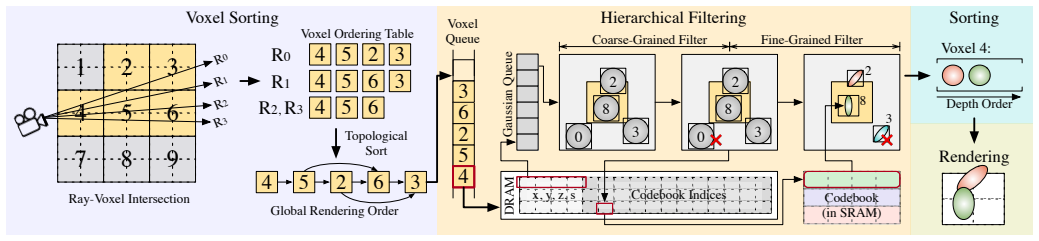
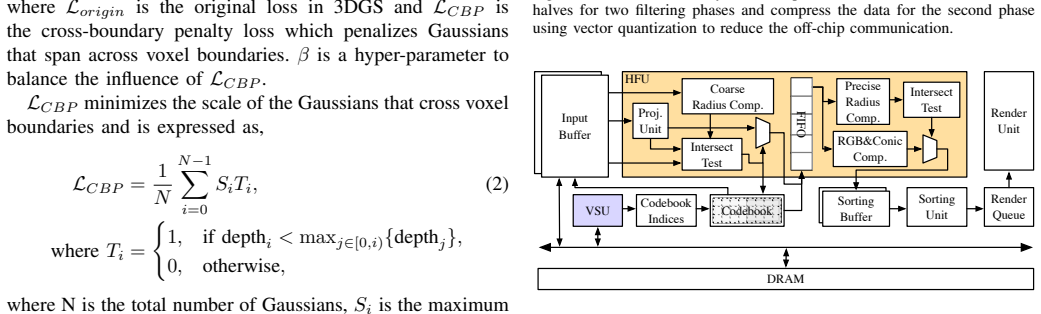
The central mechanism is the voxel-based memory-centric rendering pipeline, which has four named parts. The voxel sorting unit partitions the scene into voxels and uses a topological sort to build a global rendering order for all voxels intersected by a pixel group. The hierarchical filtering unit is a two-phase Gaussian culling scheme: a coarse phase reads only the lightweight half of each Gaussian's parameters, and a fine phase uses the compressed second half for precise intersection tests. Vector quantization compresses that second half into codebook indices stored off-chip while the codebook itself stays on-chip. Boundary-aware fine-tuning adds a cross-boundary penalty loss $\mathcal{L}_{CBP}$ that shrinks Gaussians spanning voxel boundaries, so voxel-order rendering matches true depth order; together these parts regularize DRAM access and eliminate intermediate off-chip traffic.
What would settle it
Run the STREAMINGGS accelerator model in a cycle-accurate simulator that models LPDDR3 DRAM timing, bank conflicts, refresh, and the overlap between voxel streaming and rendering, and measure end-to-end energy for the four benchmark scenes; if the speedup over a mobile Ampere GPU falls substantially below the reported 45.7×, the central bandwidth-bound claim would be falsified.
Extended reading notes
Core claim
The paper's central claim is that the entire 3DGS rendering pipeline can be made fully streaming by switching from a tile-centric to a memory-centric computation pattern. Partitioning the scene into voxels and rendering voxel-by-voxel makes each stage's intermediate data small enough to stay on-chip, so the intermediate off-chip traffic that dominates the original pipeline is eliminated. A voxel sorting unit establishes global voxel order via topological sort; hierarchical filtering first rejects Gaussians using only 4 parameters (coordinates plus maximum scale), then uses vector-quantized codebook indices for precise intersection testing; and boundary-aware fine-tuning reshapes cross-boundary Gaussians to preserve depth order. The claimed result is 45.7× speedup and 62.9× energy reduction over a mobile Ampere GPU, with average PSNR dropping only 0.04 dB across three 3DGS algorithms and four datasets.
Load-bearing premise
The central quantitative claim stands on the performance and energy simulator used to produce the 45.7× speedup and 62.9× energy numbers; the paper specifies the synthesis process and DRAM model but does not describe or validate that simulator.
Editorial extensions
If this is right
- A 90 FPS real-time target becomes plausible on mobile-class GPUs: the design reports 45.7× speedup over a mobile Ampere GPU while keeping average quality loss at 0.04 dB PSNR.
- Hierarchical filtering is the main performance lever: removing coarse-grained filtering drops the speedup from 45.7× to 22.2×, while vector quantization has a smaller performance impact because voxel streaming overlaps later stages.
- DRAM traffic is cut at two points: vector quantization removes 92.3% of voxel-streaming traffic, and hierarchical filtering reduces the number of Gaussians processed per voxel by 76.3%.
- The streaming pipeline composes with existing 3DGS compression and pruning algorithms: quality is preserved on 3DGS, Mini-Splatting, and LightGaussian, so memory-centric streaming can be added on top of different base representations.
Reading between the lines
- The same voxel-streaming idea could be applied to 3DGS training, where off-chip traffic is also a known bottleneck, though the paper only evaluates inference; that extension would need to handle gradient accumulation across voxels.
- If the bandwidth-bound thesis carries out, memory-centric restructuring should also benefit other tile-based neural renderers, such as radiance-field pipelines that do not use Gaussian splats.
- The codebook-plus-indices layout suggests a path toward rendering directly from a compressed scene representation without ever expanding the model on device; testing this on a wider range of scenes would show whether the 0.04 dB average quality drop remains bounded.
Editorial analysis
A structured set of objections, weighed in public.
Referee Report
Summary. The paper presents STREAMINGGS, an algorithm-architecture co-design for streaming 3D Gaussian splatting (3DGS) on mobile devices. The algorithm partitions the scene into voxels, renders in a memory-centric order, applies hierarchical filtering (coarse then fine) with vector-quantized codebooks, and uses boundary-aware fine-tuning to reduce cross-boundary ordering errors. The architecture adds a voxel sorting unit (VSU) and hierarchical filtering unit (HFU) to a GSCore-like sorting/rendering pipeline. The authors report average PSNR losses of about 0.04 dB across four datasets and three 3DGS variants, and claim a 45.7x speedup and 62.9x energy reduction over the Orin NX GPU, as well as 2.1x/2.3x gains over GSCore. The rendering-quality results are evaluated with clear protocols, but the performance and energy figures depend on a simulation setup that is described only by listing synthesis tools, CACTI, and a DRAM model, without specifying the simulator itself.
Significance. If the quantitative results are reproducible, the memory-centric streaming paradigm is a substantial advance for mobile 3DGS: eliminating intermediate off-chip traffic and regularizing DRAM accesses while preserving rendering quality is exactly what is needed for real-time mobile VR/AR. The paper's quality evaluation is credible: Table II spans standard datasets and multiple baselines, the fine-tuning curve in Fig. 7 supports the claimed regression, and the architectural components (VSU, HFU, VQ codebook) are clearly presented. However, the headline claims of speedup and energy savings are not verifiable from the manuscript alone because the performance simulator and the GPU measurement protocol are not disclosed. The paper would materially benefit from releasing the simulator source or a detailed validation study.
major comments (4)
- [Sec. V-A, Sec. V-C, Fig. 11] The 45.7x speedup and 62.9x energy savings are simulation outputs, but the simulation framework is never described. The manuscript only names the synthesis library (TSMC 32nm), CACTI 7.0, and an LPDDR3 datasheet; it does not describe the cycle-accurate model, the DRAM latency/contention model, the queue/occupancy model for VSU, HFU, sorting, and rendering, or the validation of the GSCore implementation. The single sentence 'We implement GSCore based on its published specifications and validate our results against reported data' cannot substantiate the baseline numbers. Please provide the simulator architecture, a validation comparison against GSCore's published results and against measured Orin NX traces, and a cycle/energy breakdown across pipeline stages.
- [Sec. V-A, Sec. V-C] The GPU baseline is said to be recorded with 'built-in hardware measurements,' but no protocol is given: no frame count, warm-up, GPU clock configuration, power measurement domain (GPU-only vs. SoC), or frame synchronization. The accelerator is synthesized at 32nm while the Orin NX is a modern mobile GPU; comparing energy across different technology nodes without scaling or calibration makes the 62.9x energy-reduction figure difficult to interpret. Report the exact measurement protocol and either scale the accelerator to a comparable technology node or bound the process-technology effect on the energy comparison.
- [Sec. IV-B, Sec. V-C] The claim that VQ has 'minimal impact on performance' because voxel streaming is 'overlapped by the subsequent stages' presumes an ideal streaming overlap that is not demonstrated. The paper does not report whether the on-chip intermediate buffer (89 KB) and codebook buffer (250 KB) are sufficient for the largest voxel encountered in the tested scenes, nor whether DRAM contention between input voxel streaming, codebook fetches, and parameter fetches is modeled in the simulator. Please provide voxel-size distributions, buffer-occupancy traces, and a description of how streaming overlap and DRAM contention are accounted for; without this, the 'fully streaming' claim and the speedup figures remain unsupported.
- [Sec. III-B, Eq. (2)] The loss L_CBP penalizes every Gaussian whose depth is smaller than the maximum depth among previously processed Gaussians, rather than specifically penalizing Gaussians that cross voxel boundaries. The text states that this loss 'punishes the cross-boundary Gaussians,' but the equation as written targets all depth-order violations in the voxel-based rendering order. To establish the stated mechanism, please provide an ablation with and without L_CBP, or a distribution showing which Gaussians receive T_i=1, since the current definition may also distort non-boundary Gaussians and the claimed causal effect on cross-boundary errors is not demonstrated.
minor comments (5)
- [Fig. 2, Sec. II-B] The percentage labels in Fig. 2 (25.9%, 23.9%, 8.0%, etc.) are not clearly mapped to the pipeline stages, and the text's 41% and 49% figures for projection and sorting do not obviously reconcile with the figure; please clarify the traffic breakdown.
- [Abstract vs. Sec. V-C] The abstract states 'up to 45.7x speedup' while Sec. V-C reports an average of 45.7x; please align the wording.
- [Sec. III-C] The claim of reducing DRAM traffic by 92.3% needs an explicit baseline: is it relative to the uncompressed second half, to the full voxel streaming traffic, or to the original tile-centric 3DGS pipeline?
- [Footnote 1] The footnote announcing acceptance at DAC 2025 is unusual for a journal submission; it should be removed or replaced with a proper provenance or extended-version statement.
- [Sec. V-A] Please specify the exact Synopsys/Cadence synthesis flow and the CACTI configuration (cache/buffer geometry, number of ports, technology assumptions) so that the area and energy numbers in Table I and Fig. 11 are reproducible.
Circularity Check
No circular derivation found: STREAMINGGS's speedup and energy claims are simulation outputs with an undisclosed simulator, which is a reproducibility risk, not circularity.
full rationale
Walking the paper's derivation chain, the memory-centric rendering transform is an algorithmic proposal, not a quantity fitted to the target result. Sections III-B and III-C define voxel ordering, boundary-aware fine-tuning, and hierarchical filtering; none of these equations reduce to the 45.7x or 62.9x figures. The evaluation in Section V reports simulation results from a synthesis flow and DRAM models; the missing cycle-accurate simulator description is a validation gap, but no equation in the paper defines the speedup in terms of the simulator's assumptions. Hyperparameters such as voxel size, beta, and codebook sizes are chosen empirically and tested in sensitivity studies; the headline result is not a prediction of a fitted parameter. The self-citations [19] and [21] (Potamoi and Cicero) appear as contextual references for streaming and neural-rendering memory optimizations, and the sorting and rendering units are adopted from GSCore [18], an external paper; no load-bearing claim reduces to a self-citation. The quality comparison in Table II is against external 3DGS implementations with no fitted quality target. Thus no specific reduction of output to input can be exhibited, so the circularity score is 0. The undisclosed performance simulator and missing GPU measurement protocol are correctness and reproducibility concerns, not circularity.
Assumptions & free parameters
free parameters (6)
- voxel_size_real_world =
2
- voxel_size_synthetic =
0.4
- beta =
0.05
- codebook_entries_scale_rotation_dc =
4096
- codebook_entries_sh =
512
- cfu_ffu_count =
4 CFUs, 1 FFU
assumptions (5)
- domain assumption 3DGS alpha-blending model is the correct rendering model
- ad hoc to paper Voxel intermediate data always fits on-chip
- ad hoc to paper The unspecified performance simulator faithfully models the accelerator
- domain assumption LPDDR3 DRAM model and Micron power calculator match the mobile target
- domain assumption Topological sort DAG from per-pixel voxel orders is acyclic
Cite this review
Pith. "Pith review of STREAMINGGS: Voxel-Based Streaming 3D Gaussian Splatting with Memory Optimization and Architectural Support." pith.science (2026). https://pith.science/paper/46KSYEUF
@misc{pith2026250609070,
  author       = {Pith},
  title        = {Pith review of: STREAMINGGS: Voxel-Based Streaming 3D Gaussian Splatting with Memory Optimization and Architectural Support},
  year         = {2026},
  howpublished = {\url{https://pith.science/paper/46KSYEUF}},
  note         = {Machine review of arXiv:2506.09070}
}
abstract
3D Gaussian Splatting (3DGS) has gained popularity for its efficiency and sparse Gaussian-based representation. However, 3DGS struggles to meet the real-time requirement of 90 frames per second (FPS) on resource-constrained mobile devices, achieving only 2 to 9 FPS.Existing accelerators focus on compute efficiency but overlook memory efficiency, leading to redundant DRAM traffic. We introduce STREAMINGGS, a fully streaming 3DGS algorithm-architecture co-design that achieves fine-grained pipelining and reduces DRAM traffic by transforming from a tile-centric rendering to a memory-centric rendering. Results show that our design achieves up to 45.7 $\times$ speedup and 62.9 $\times$ energy savings over mobile Ampere GPUs.
Figures


Figures from the paper (6 more)





Reference graph
Works this paper leans on
-
[1]
Pharr, W
M. Pharr, W. Jakob, and G. Humphreys,Physically based rendering: From theory to implementation. MIT Press, 2023
2023
-
[2]
Toward real-time ray tracing: A survey on hardware acceleration and microarchitecture techniques,
Y . Deng, Y . Ni, Z. Li, S. Mu, and W. Zhang, “Toward real-time ray tracing: A survey on hardware acceleration and microarchitecture techniques,”ACM Computing Surveys (CSUR), vol. 50, no. 4, pp. 1–41, 2017
work page 2017
-
[3]
Nerf: Representing scenes as neural radiance fields for view synthesis,
B. Mildenhall, P. P. Srinivasan, M. Tancik, J. T. Barron, R. Ramamoorthi, and R. Ng, “Nerf: Representing scenes as neural radiance fields for view synthesis,”Communications of the ACM, vol. 65, no. 1, pp. 99–106, 2021
2021
-
[4]
Mip-nerf: A multiscale representation for anti- aliasing neural radiance fields,
J. T. Barron, B. Mildenhall, M. Tancik, P. Hedman, R. Martin-Brualla, and P. P. Srinivasan, “Mip-nerf: A multiscale representation for anti- aliasing neural radiance fields,” inProceedings of the IEEE/CVF Inter- national Conference on Computer Vision, pp. 5855–5864, 2021
work page 2021
-
[5]
Recent advances in 3d gaussian splatting,
T. Wu, Y .-J. Yuan, L.-X. Zhang, J. Yang, Y .-P. Cao, L.-Q. Yan, and L. Gao, “Recent advances in 3d gaussian splatting,”arXiv preprint arXiv:2403.11134, 2024
arXiv 2024
-
[6]
A survey on 3d gaussian splatting,
G. Chen and W. Wang, “A survey on 3d gaussian splatting,”arXiv preprint arXiv:2401.03890, 2024
arXiv 2024
-
[7]
3d gaussian splatting for real-time radiance field rendering,
B. Kerbl, G. Kopanas, T. Leimk ¨uhler, and G. Drettakis, “3d gaussian splatting for real-time radiance field rendering,”ACM Transactions on Graphics, vol. 42, no. 4, pp. 1–14, 2023
2023
-
[8]
Mini-splatting: Representing scenes with a constrained number of gaussians,
G. Fang and B. Wang, “Mini-splatting: Representing scenes with a constrained number of gaussians,”arXiv preprint arXiv:2403.14166, 2024
arXiv 2024
Show all 29 references
-
[9]
Compact 3d gaussian representation for radiance field,
J. C. Lee, D. Rho, X. Sun, J. H. Ko, and E. Park, “Compact 3d gaussian representation for radiance field,”arXiv preprint arXiv:2311.13681, 2023
2023 arXiv
-
[10]
Lightgaussian: Unbounded 3d gaussian compression with 15x reduction and 200+ fps,
Z. Fan, K. Wang, K. Wen, Z. Zhu, D. Xu, and Z. Wang, “Lightgaussian: Unbounded 3d gaussian compression with 15x reduction and 200+ fps,” arXiv preprint arXiv:2311.17245, 2023
2023 arXiv
-
[11]
Metasapiens: Real-time neural rendering with efficiency-aware pruning and accelerated foveated rendering,
W. Lin, Y . Feng, and Y . Zhu, “Metasapiens: Real-time neural rendering with efficiency-aware pruning and accelerated foveated rendering,” in Proceedings of the 30th ACM International Conference on Architectural Support for Programming Languages and Operating Systems, Volume 1...
2025
-
[12]
Seele: A unified acceleration framework for real-time gaussian splatting,
X. Huang, H. Zhu, Z. Liu, W. Lin, X. Liu, Z. He, J. Leng, M. Guo, and Y . Feng, “Seele: A unified acceleration framework for real-time gaussian splatting,”arXiv preprint arXiv:2503.05168, 2025
2025
-
[13]
Meta Quest Pro specs
“Meta Quest Pro specs.”
-
[14]
Apple Vision Pro screen refresh rate is up to 100Hz
“Apple Vision Pro screen refresh rate is up to 100Hz.”
-
[15]
Effect of frame rate on user experience, performance, and simulator sickness in virtual reality,
J. Wang, R. Shi, W. Zheng, W. Xie, D. Kao, and H.-N. Liang, “Effect of frame rate on user experience, performance, and simulator sickness in virtual reality,”IEEE Transactions on Visualization and Computer Graphics, vol. 29, no. 5, pp. 2478–2488, 2023
2023
-
[16]
Nvidia jetson orin nx
“Nvidia jetson orin nx.”
-
[17]
Qualcomm QCS8550/QCM8550 Processors
“Qualcomm QCS8550/QCM8550 Processors.”
-
[18]
Gscore: Efficient radiance field rendering via architectural support for 3d gaussian splatting,
J. Lee, S. Lee, J. Lee, J. Park, and J. Sim, “Gscore: Efficient radiance field rendering via architectural support for 3d gaussian splatting,” in Proceedings of the 29th ACM International Conference on Architectural Support for Programming Languages and Operating Systems, Volu...
2024
-
[19]
Potamoi: Accelerating neural rendering via a unified streaming architecture,
Y . Feng, W. Lin, Z. Liu, J. Leng, M. Guo, H. Zhao, X. Hou, J. Zhao, and Y . Zhu, “Potamoi: Accelerating neural rendering via a unified streaming architecture,”ACM Transactions on Architecture and Code Optimization, 2024
2024
-
[20]
Gsarch: Breaking memory barriers in 3d guassian splatting training via architectural support,
H. He, G. Li, F. Liu, L. Jiang, X. Liang, and Z. Song, “Gsarch: Breaking memory barriers in 3d guassian splatting training via architectural support,” in2025 IEEE International Symposium on High-Performance Computer Architecture (HPCA), IEEE, 2025
2025
-
[21]
Cicero: Addressing algorithmic and architectural bottlenecks in neural rendering by radiance warping and memory optimizations,
Y . Feng, Z. Liu, J. Leng, M. Guo, and Y . Zhu, “Cicero: Addressing algorithmic and architectural bottlenecks in neural rendering by radiance warping and memory optimizations,” in2024 ACM/IEEE 51st Annual International Symposium on Computer Architecture (ISCA), pp. 1293– 1308,...
2024
-
[22]
Topological sorting of large networks,
A. B. Kahn, “Topological sorting of large networks,”Communications of the ACM, vol. 5, no. 11, pp. 558–562, 1962
1962
-
[23]
Cacti 7: New tools for interconnect exploration in innovative off-chip memories,
R. Balasubramonian, A. B. Kahng, N. Muralimanohar, A. Shafiee, and V . Srinivas, “Cacti 7: New tools for interconnect exploration in innovative off-chip memories,”ACM Transactions on Architecture and Code Optimization (TACO), vol. 14, no. 2, pp. 1–25, 2017
2017
-
[24]
Micron 178-Ball, Single-Channel Mobile LPDDR3 SDRAM Features
“Micron 178-Ball, Single-Channel Mobile LPDDR3 SDRAM Features.”
-
[25]
Micron System Power Calculators
“Micron System Power Calculators.”
-
[26]
Deepscaletool: A tool for the accurate estimation of technology scaling in the deep-submicron era,
S. Sarangi and B. Baas, “Deepscaletool: A tool for the accurate estimation of technology scaling in the deep-submicron era,” in2021 IEEE International Symposium on Circuits and Systems (ISCAS), pp. 1– 5, IEEE, 2021
2021
-
[27]
Neural sparse voxel fields,
L. Liu, J. Gu, K. Zaw Lin, T.-S. Chua, and C. Theobalt, “Neural sparse voxel fields,”Advances in Neural Information Processing Systems, vol. 33, pp. 15651–15663, 2020
2020
-
[28]
Tanks and temples: Benchmarking large-scale scene reconstruction,
A. Knapitsch, J. Park, Q.-Y . Zhou, and V . Koltun, “Tanks and temples: Benchmarking large-scale scene reconstruction,”ACM Transactions on Graphics (ToG), vol. 36, no. 4, pp. 1–13, 2017
2017
-
[29]
Deep blending for free-viewpoint image-based rendering,
P. Hedman, J. Philip, T. Price, J.-M. Frahm, G. Drettakis, and G. Bros- tow, “Deep blending for free-viewpoint image-based rendering,”ACM Transactions on Graphics (ToG), vol. 37, no. 6, pp. 1–15, 2018
2018
Reviewed August 7, 2026 · model on record in the stance chip above.
Discussion (0). Sign in to comment.