REVIEW 3 major objections 4 minor 40 references
SILK: Smooth InterpoLation frameworK for motion in-betweening A Simplified Computational Approach
T0 review · 3 major / 4 minor · reviewed 2026-08-07 · deepseek-v4-flash
Pith's one-line read SILK shows that a single Transformer encoder, with zero-filled gaps and root-space pose features, matches or beats more complex motion in-betweening models on LaFAN1.
desk verdict Useful empirical paper on data-centric choices, but its central simplicity claim rests on a velocity feature leak that gives SILK ground-truth access to a frame it should predict. read the letter →
The pith
A machine-rendered reading of the paper's core claim, the machinery that carries it, and where it could break.
The reading
What carries the argument
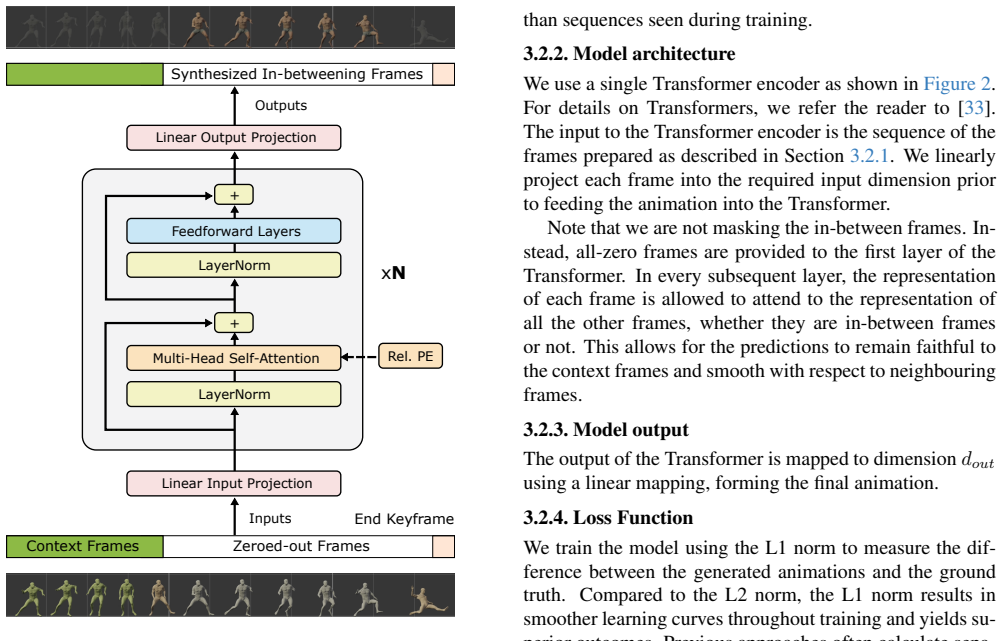
The central mechanism is a single encoder-only Transformer that treats in-betweening as sequence-to-sequence with the missing frames set to all zeros. The zero pattern gives the model an implicit signal for which frames to predict, while learned relative position encodings supply temporal ordering, so no keyframe-position embeddings or masking are needed. Supporting machinery: root-space pose features (the hip trajectory projected on the ground plus joint transforms expressed relative to the root), input-only velocity features, a single L1 loss, and a denser training set produced by slicing LaFAN1 animations at offset 5.
What would settle it
Re-run every published baseline, including the omitted phase-manifold and space-time-control models and any with divergent SLERP or RMIB numbers, on the LaFAN1 subject-5 test set using exactly SILK's preprocessing: offset-5 slicing, same context length, root-space evaluation, and the same metric code. If any excluded model then reports lower L2P at 30 or 45 frames than SILK, the paper's claim that a single encoder matches or beats complex models would be contradicted.
Extended reading notes
Core claim
SILK is a minimalist, non-autoregressive Transformer encoder that produces all in-between frames in one pass. Missing frames are simply filled with zeros; the model uses learned relative position embeddings and no masking, so every frame attends to every other. On the standard LaFAN1 protocol, SILK reports L2P 0.13/0.38/0.83/1.59 and NPSS 0.0012/0.018/0.105/0.30 for gaps of 5/15/30/45 frames, matching or beating the two-stage TST model (0.10/0.39/0.89/1.68 and 0.0011/0.019/0.112/0.32) and other state-of-the-art entries. The paper attributes the gains to data and representation choices: sampling training transitions with an offset of 5 instead of 20, representing poses in root space, feeding velocities as input only, and zero-filling rather than SLERP-filling missing frames. It concludes that model complexity is not the primary determinant of animation quality.
Load-bearing premise
The central claim rests on the assumption that all compared models were evaluated under exactly the same protocol; since the paper only re-runs TST and excludes papers whose published SLERP and RMIB numbers diverge, a change in ranking under identical conditions would weaken the simplicity-wins conclusion.
Editorial extensions
If this is right
- A single Transformer encoder suffices for competitive motion in-betweening; multi-encoder and multi-stage designs such as TST and Delta Interpolator are not required by the task.
- Zero-filling missing frames outperforms SLERP pre-filling, contradicting a common design choice in prior work.
- Increasing training data volume by denser slicing helps simple models and can close or reverse the gap to more complex architectures.
- Root-space pose representation and input velocity features each improve quality enough to be worth their extra runtime costs of inverse kinematics and an additional specified frame.
- Trained on gaps up to 30 frames, SILK extrapolates to 45-frame gaps without retraining.
Reading between the lines
- Because the paper only re-runs TST under offset-5 sampling and omits methods whose published SLERP and RMIB numbers diverge, the Table 1 ranking should be treated as conditional; re-evaluating the omitted methods under identical preprocessing could shift it.
- The offset-5 result suggests a capacity-dependent data regime: denser overlapping slices help a six-layer encoder but slightly hurt the larger TST, so the best sampling density may need to be tuned per architecture.
- Zero-filling outperforming SLERP hints that pre-filling injects a bias toward the interpolated path; a direct test would compare zero-filling against randomized or learned placeholder fills.
- SILK is deterministic and single-shot, so combining its data-centric recipe with a lightweight generative head is a natural next step that the authors point toward in future work.
Editorial analysis
A structured set of objections, weighed in public.
Referee Report
Summary. The paper proposes SILK, a single Transformer encoder for motion in-betweening. The missing frames are filled with zeros, the pose is represented in root space, velocity features are added to the input, and the training data are sampled with an offset of 5 rather than the offset of 20 used in prior work. On the LaFAN1 benchmark, the authors report L2P, L2Q, and NPSS numbers and claim that SILK achieves comparable or superior performance to more complex state-of-the-art models such as TST and ST-TMIB. Ablations study pose representation, velocity features, filling strategy, and key-position embeddings. The central claim is not established by the current experiments because the velocity features leak ground-truth frames that are not available in the standard in-betweening setting, and because the comparison against published baseline numbers is not fully controlled.
Significance. If the central claim held, the paper would make a useful practical point: simple architectures can match complex ones when data representation, sampling density, and input features are chosen carefully. The ablations are well designed and informative, especially the offset study in Table 2, the root-space versus local-space comparison in Table 3, and the zero-filling versus SLERP comparison in Table 5. The paper also makes a genuine effort to compare against a broad set of prior work on a standardized benchmark and to be transparent about excluded papers. However, the velocity-feature leakage in Section 4.5.2 directly undermines the headline claim, and the absence of error bars and code release limits reproducibility. The data-centric insights are still valuable, but they need to be separated from an invalid cross-method comparison.
major comments (3)
- [§4.5.2, Table 4] The velocity features leak information that is not available in the standard in-betweening setting. Section 4.5.2 states that velocities are computed from two consecutive frames, 'specifically, requiring one additional frame after both the start and target keyframes.' For the start keyframe, that additional frame is exactly the first in-between frame that SILK is supposed to predict; for the target keyframe, the additional frame lies outside the interpolation window. Thus the 'Input Vel' configuration receives ground-truth values of the first output frame and of a frame beyond the target, while the baselines in Table 1 do not. Table 4 quantifies the impact: removing velocity inputs ('Static Only') raises L2P from 1.59 to 2.1 at length 45 and from 0.83 to 1.0 at length 30, while TST reports 1.68 and 0.89, respectively. Under the standard MIB protocol, SILK would therefore be worse than TST at these lengths. The claim that a single Transformer encoder performs comparably to or better than complex models is not supported by the current experiments. The authors should re-run the evaluation without this leakage or explicitly redefine the task as in-betweening with additional temporal context and compare against baselines under matched conditions.
- [§4.3, Table 1] The comparison in Table 1 relies on published numbers from different papers without verifying that all methods were evaluated under exactly the same preprocessing, context length, and evaluation code. The paper excludes [5] and [28] because of discrepancies in SLERP/RMIB baselines, which is reasonable, but the same protocol concern applies to the included methods. Table 2 shows that training offset alone changes TST's L2P from 0.89 to 0.93 at length 30 and from 1.68 to 1.73 at length 45, which is the same scale as the differences between SILK and its closest competitors (e.g., SILK vs. ST-TMIB at length 30: 0.83 vs. 0.89). To support the central claim, the authors should run the included baselines under identical conditions or clearly limit the claim to a published-numbers comparison and release the evaluation code.
- [§4.2, Tables 1–5] All quantitative results are reported from single training runs without confidence intervals or significance tests. Several comparisons at short gaps differ by only 0.01–0.03 in L2P (e.g., length 5: SILK 0.13 vs. TST 0.10; length 15: SILK 0.38 vs. TST 0.39), so it is unclear whether those differences are meaningful. The paper should provide multiple seeds with mean and standard deviation, or a significance test, and should release code and model checkpoints to make the results reproducible.
minor comments (4)
- [§4.6] The text near Table 5 contains a typo: 'Table Table 5' should be 'Table 5'.
- [References] References [31] and [32] have the same title, 'Human motion diffusion model,' with overlapping content; please check whether one is a duplicate or should be distinguished by venue/year in the citation.
- [Table 1 caption] The caption states that the primary task of each model is added for easier comparison, but it would also help to state the training offset and context length for each method, since Section 4.4 shows that these choices affect the numbers.
- [§3.2.3 and §4.5.2] The architecture description says the output dimension is d_out, but the 'Full Vel' configuration in Table 4 requires predicting velocity features as well; please clarify how d_out changes for that variant.
Circularity Check
Velocity input features leak the first in-between frame and a frame past the target, so SILK's headline result partially reduces to its input by construction.
-
self definitional
[Section 4.5.2 (impact of velocity features); feature definition in Section 3.1.1; results in Table 4]
"We calculate these velocity features (linear velocity for positions and angular velocity for rotations) using two consecutive frames - specifically, requiring one additional frame after both the start and target keyframes."
With velocity v_f computed between consecutive frames, the start-keyframe velocity is v_s = (p_{s+1} - p_s)/dt, so the first in-between frame SILK is supposed to output is recoverable as p_{s+1} = p_s + dt*v_s. The model input contains p_s and v_s, so the first predicted frame is a direct linear transformation of the input; a linear output layer can copy it without learning the transition. Similarly the target velocity uses a frame after the target keyframe, outside the interpolation window, leaking boundary information unavailable to baselines. Table 4 quantifies the leakage: removing velocity inputs ('Static Only') raises L2P at length 30/45 from 0.83/1.59 to 1.0/2.1, worse than TST's 0.89/1.68, so SILK's Table 1 advantage is driven by ground-truth frames embedded in the input.
full rationale
The paper is otherwise an empirical benchmark comparison with no derivation chain that reduces to fitted values: offset-5 sampling is standard hyperparameter/data-augmentation selection, the zero-vs-slerp ablation is a direct model comparison, and there is no load-bearing self-citation or imported uniqueness theorem. However, the central simplicity-wins claim is partially produced by construction: the velocity input is computed from the first frame the model is supposed to predict (and from a frame beyond the target keyframe), making that portion of the output a deterministic function of the input. Because the ablated numbers show the leaked velocity input is what lifts SILK past TST on the longer horizons, the headline comparison is not established as the same task as the baselines. This is a genuine input/output identity, not merely an unfair protocol choice, so the circularity score is 6 rather than 1.
Assumptions & free parameters
free parameters (5)
- training data offset =
5 frames
- model hyperparameters =
6 layers, 8 heads, d_model=1024, d_ff=4096
- context frames =
10
- loss type =
single L1 loss
- velocity computation window =
one extra frame after keyframes
assumptions (4)
- domain assumption LaFAN1 benchmark and evaluation protocol are representative and fair
- standard math Transformer self-attention is a standard building block
- ad hoc to paper The extra frame after keyframes is available at inference
- domain assumption Comparison numbers for prior methods in Table 1 are directly comparable
Cite this review
Pith. "Pith review of SILK: Smooth InterpoLation frameworK for motion in-betweening A Simplified Computational Approach." pith.science (2026). https://pith.science/paper/TXBDEUI2
@misc{pith2026250609075,
  author       = {Pith},
  title        = {Pith review of: SILK: Smooth InterpoLation frameworK for motion in-betweening A Simplified Computational Approach},
  year         = {2026},
  howpublished = {\url{https://pith.science/paper/TXBDEUI2}},
  note         = {Machine review of arXiv:2506.09075}
}
read the original abstract
Motion in-betweening is a crucial tool for animators, enabling intricate control over pose-level details in each keyframe. Recent machine learning solutions for motion in-betweening rely on complex models, incorporating skeleton-aware architectures or requiring multiple modules and training steps. In this work, we introduce a simple yet effective Transformer-based framework, employing a single Transformer encoder to synthesize realistic motions for motion in-betweening tasks. We find that data modeling choices play a significant role in improving in-betweening performance. Among others, we show that increasing data volume can yield equivalent or improved motion transitions, that the choice of pose representation is vital for achieving high-quality results, and that incorporating velocity input features enhances animation performance. These findings challenge the assumption that model complexity is the primary determinant of animation quality and provide insights into a more data-centric approach to motion interpolation. Additional videos and supplementary material are available at https://silk-paper.github.io.
Figures


Reference graph
Works this paper leans on
-
[5]
Real-time diverse motion in- betweening with space-time control
Yuchen Chu and Zeshi Yang. Real-time diverse motion in- betweening with space-time control. InProceedings of the 17th ACM SIGGRAPH Conference on Motion, Interaction, and Games, pages 1–8, 2024. 5, 6
work page 2024
-
[28]
Paul Starke, Sebastian Starke, Taku Komura, and Frank Steinicke. Motion in-betweening with phase manifolds.Pro- ceedings of the ACM on Computer Graphics and Interactive Techniques, 6(3):1–17, 2023. 5, 6, 7
work page 2023
-
[1]
Kfir Aberman, Peizhuo Li, Dani Lischinski, Olga Sorkine- Hornung, Daniel Cohen-Or, and Baoquan Chen. Skeleton- aware networks for deep motion retargeting.ACM Transac- tions on Graphics (TOG), 39(4):62–1, 2020. 2
work page 2020
-
[2]
Dhruv Agrawal, Jakob Buhmann, Dominik Borer, Robert W Sumner, and Martin Guay. Skel-betweener: a neural motion rig for interactive motion authoring.ACM Transactions on Graphics (TOG), 43(6):1–11, 2024. 1, 2
work page 2024
-
[3]
Simon Alexanderson, Rajmund Nagy, Jonas Beskow, and Gustav Eje Henter. Listen, denoise, action! audio-driven motion synthesis with diffusion models.ACM Transactions on Graphics (TOG), 42(4):1–20, 2023. 8
work page 2023
-
[4]
Zhi Chai and Hong Qin. Dynamic motion transition: A hy- brid data-driven and model-driven method for human pose transitions.IEEE Transactions on Visualization and Com- puter Graphics, 2024. 3, 5
work page 2024
-
[6]
Jacob Devlin, Ming-Wei Chang, Kenton Lee, and Kristina Toutanova. Bert: Pre-training of deep bidirectional transformers for language understanding.arXiv preprint arXiv:1810.04805, 2018. 2
arXiv 2018
-
[7]
A unified framework for real time motion completion
Yinglin Duan, Yue Lin, Zhengxia Zou, Yi Yuan, Zhehui Qian, and Bohan Zhang. A unified framework for real time motion completion. InProceedings of the AAAI Conference on Artificial Intelligence, pages 4459–4467, 2022. 1, 2, 5
work page 2022
Show all 40 references
-
[8]
Harvey and Christopher Pal
F ´elix G. Harvey and Christopher Pal. Recurrent transition networks for character locomotion. InSIGGRAPH Asia 2018 Technical Briefs, New York, NY , USA, 2018. Association for Computing Machinery. 2
2018
-
[9]
Robust motion in-betweening.ACM Trans- actions on Graphics (TOG), 39(4):60–1, 2020
F ´elix G Harvey, Mike Yurick, Derek Nowrouzezahrai, and Christopher Pal. Robust motion in-betweening.ACM Trans- actions on Graphics (TOG), 39(4):60–1, 2020. 1, 2, 3, 4, 5, 6
2020
-
[10]
Nemf: Neural motion fields for kinematic an- imation.Advances in Neural Information Processing Sys- tems, 35:4244–4256, 2022
Chengan He, Jun Saito, James Zachary, Holly Rushmeier, and Yi Zhou. Nemf: Neural motion fields for kinematic an- imation.Advances in Neural Information Processing Sys- tems, 35:4244–4256, 2022. 2
2022
-
[11]
Phase- functioned neural networks for character control.ACM Trans
Daniel Holden, Taku Komura, and Jun Saito. Phase- functioned neural networks for character control.ACM Trans. Graph., 36(4):42:1–42:13, 2017. 3
2017
-
[12]
Long-term motion in-betweening via keyframe prediction
Seokhyeon Hong, Haemin Kim, Kyungmin Cho, and Jun- yong Noh. Long-term motion in-betweening via keyframe prediction. InComputer Graphics Forum, page e15171. Wi- ley Online Library, 2024. 6
2024
-
[13]
Human3.6m: Large scale datasets and predic- tive methods for 3d human sensing in natural environments
Catalin Ionescu, Dragos Papava, Vlad Olaru, and Cristian Sminchisescu. Human3.6m: Large scale datasets and predic- tive methods for 3d human sensing in natural environments. IEEE Transactions on Pattern Analysis and Machine Intelli- gence, 36(7):1325–1339, 2014. 8
2014
-
[14]
Convolutional autoen- coders for human motion infilling
Manuel Kaufmann, Emre Aksan, Jie Song, Fabrizio Pece, Remo Ziegler, and Otmar Hilliges. Convolutional autoen- coders for human motion infilling. In2020 International Conference on 3D Vision (3DV), pages 918–927, 2020. 1, 2, 7
2020
-
[15]
Conditional motion in- betweening.Pattern Recognition, 132:108894, 2022
Jihoon Kim, Taehyun Byun, Seungyoun Shin, Jung- dam Won, and Sungjoon Choi. Conditional motion in- betweening.Pattern Recognition, 132:108894, 2022. 1, 2, 5
2022
-
[16]
Computer aided inbetweening
Alexander Kort. Computer aided inbetweening. InPro- ceedings of the 2nd International Symposium on Non- Photorealistic Animation and Rendering, page 125–132, New York, NY , USA, 2002. Association for Computing Ma- chinery. 2
2002
-
[17]
Foot-constrained spatial-temporal trans- former for keyframe-based complex motion synthesis.Com- puter Animation and Virtual Worlds, 35(1):e2217, 2024
Hao Li, Ju Dai, Rui Zeng, Junxuan Bai, Zhangmeng Chen, and Junjun Pan. Foot-constrained spatial-temporal trans- former for keyframe-based complex motion synthesis.Com- puter Animation and Virtual Worlds, 35(1):e2217, 2024. 6
2024
-
[18]
Task-generic hi- erarchical human motion prior using vaes
Jiaman Li, Ruben Villegas, Duygu Ceylan, Jimei Yang, Zhengfei Kuang, Hao Li, and Yajie Zhao. Task-generic hi- erarchical human motion prior using vaes. In2021 Inter- national Conference on 3D Vision (3DV), pages 771–781. IEEE, 2021. 5
2021
-
[19]
Towards robust direction invariance in character animation
Li-Ke Ma, Zeshi Yang, Baining Guo, and KangKang Yin. Towards robust direction invariance in character animation. InComputer Graphics Forum, pages 235–242. Wiley Online Library, 2019. 3
2019
-
[20]
On human motion prediction using recurrent neural networks
Julieta Martinez, Michael J Black, and Javier Romero. On human motion prediction using recurrent neural networks. InProceedings of the IEEE Conference on Computer Vision and Pattern Recognition, pages 2891–2900, 2017. 7
2017
-
[21]
A unified masked autoencoder with patchified skeletons for motion synthesis
Esteve Valls Mascar ´o, Hyemin Ahn, and Dongheui Lee. A unified masked autoencoder with patchified skeletons for motion synthesis. InProceedings of the AAAI Conference on Artificial Intelligence, pages 5261–5269, 2024. 1, 2, 3, 5
2024
-
[22]
Continuous intermediate token learning with implicit motion manifold for keyframe based motion interpolation
Clinton A Mo, Kun Hu, Chengjiang Long, and Zhiyong Wang. Continuous intermediate token learning with implicit motion manifold for keyframe based motion interpolation. InProceedings of the IEEE/CVF Conference on Computer Vision and Pattern Recognition, pages 13894–13903, 2023. 5
2023
-
[23]
Motion inbetweening via deep∆-interpolator.IEEE Trans- actions on Visualization and Computer Graphics, 2023
Boris N Oreshkin, Antonios Valkanas, F ´elix G Harvey, Louis-Simon M´enard, Florent Bocquelet, and Mark J Coates. Motion inbetweening via deep∆-interpolator.IEEE Trans- actions on Visualization and Computer Graphics, 2023. 1, 2, 3, 5, 6
2023
-
[24]
Deeploco: Dynamic locomotion skills us- ing hierarchical deep reinforcement learning.ACM Trans
Xue Bin Peng, Glen Berseth, Kangkang Yin, and Michiel Van De Panne. Deeploco: Dynamic locomotion skills us- ing hierarchical deep reinforcement learning.ACM Trans. Graph., 36(4), 2017. 3
2017
-
[25]
Motion in-betweening via two-stage transformers.ACM Trans
Jia Qin, Youyi Zheng, and Kun Zhou. Motion in-betweening via two-stage transformers.ACM Trans. Graph., 41(6),
-
[26]
Di- verse motion in-betweening from sparse keyframes with dual posture stitching.IEEE Transactions on Visualization and Computer Graphics, 2024
Tianxiang Ren, Jubo Yu, Shihui Guo, Ying Ma, Yutao Ouyang, Zijiao Zeng, Yazhan Zhang, and Yipeng Qin. Di- verse motion in-betweening from sparse keyframes with dual posture stitching.IEEE Transactions on Visualization and Computer Graphics, 2024. 3, 5
2024
-
[27]
Transformer based motion in-betweening
Pavithra Sridhar, Madhav Aggarwal, R Leela Velusamy, et al. Transformer based motion in-betweening. InPro- ceedings of the Asian Conference on Computer Vision, pages 289–302, 2022. 5
2022
-
[29]
Anidance: real- time dance motion synthesize to the song
Taoran Tang, Hanyang Mao, and Jia Jia. Anidance: real- time dance motion synthesize to the song. InProceedings of the 26th ACM international conference on Multimedia, pages 1237–1239, 2018. 8
2018
-
[30]
Real-time controllable motion transition for characters.ACM Trans
Xiangjun Tang, He Wang, Bo Hu, Xu Gong, Ruifan Yi, Qi- long Kou, and Xiaogang Jin. Real-time controllable motion transition for characters.ACM Trans. Graph., 41(4), 2022. 2, 5, 7
2022
-
[31]
Human motion diffu- sion model
Guy Tevet, Sigal Raab, Brian Gordon, Yoni Shafir, Daniel Cohen-or, and Amit Haim Bermano. Human motion diffu- sion model. InThe Eleventh International Conference on Learning Representations, 2022. 2
2022
-
[32]
Human motion diffu- sion model
Guy Tevet, Sigal Raab, Brian Gordon, Yoni Shafir, Daniel Cohen-or, and Amit Haim Bermano. Human motion diffu- sion model. InThe Eleventh International Conference on Learning Representations, 2023. 8
2023
-
[33]
Gomez, and Łukasz Kaiser
Ashish Vaswani, Noam Shazeer, Niki Parmar, Jakob Uszko- reit, Llion Jones, Aidan N. Gomez, and Łukasz Kaiser. At- tention is all you need.arXiv preprint arXiv:1706.03762v5,
-
[34]
Motion in- betweening with spatial and temporal transformers.IEEE Transactions on Circuits and Systems for Video Technology,
Zhiming Wang, Ning Ge, and Jianhua Lu. Motion in- betweening with spatial and temporal transformers.IEEE Transactions on Circuits and Systems for Video Technology,
-
[35]
Spatial- temporal graph u-net for skeleton-based human motion in- filling
Leiyang Xu, Qiang Wang, and Chenguang Yang. Spatial- temporal graph u-net for skeleton-based human motion in- filling. In2024 IEEE International Conference on Industrial Technology (ICIT), pages 1–6. IEEE, 2024. 3, 5
2024
-
[36]
Dancecraft: A music-reactive real-time dance im- prov system
Ruilin Xu, Vu An Tran, Shree K Nayar, and Gurunandan Krishnan. Dancecraft: A music-reactive real-time dance im- prov system. InProceedings of the 9th International Confer- ence on Movement and Computing, pages 1–10, 2024. 1, 2, 3, 5
2024
-
[37]
Mode-adaptive neural networks for quadruped motion con- trol.ACM Transactions on Graphics (TOG), 37(4):1–11,
He Zhang, Sebastian Starke, Taku Komura, and Jun Saito. Mode-adaptive neural networks for quadruped motion con- trol.ACM Transactions on Graphics (TOG), 37(4):1–11,
-
[38]
Data-driven auto- completion for keyframe animation
Xinyi Zhang and Michiel van de Panne. Data-driven auto- completion for keyframe animation. InProceedings of the 11th ACM SIGGRAPH Conference on Motion, Interaction and Games, New York, NY , USA, 2018. Association for Computing Machinery. 2
2018
-
[39]
On the continuity of rotation representations in neu- ral networks
Yi Zhou, Connelly Barnes, Jingwan Lu, Jimei Yang, and Hao Li. On the continuity of rotation representations in neu- ral networks. InProceedings of the IEEE/CVF Conference on Computer Vision and Pattern Recognition, pages 5745– 5753, 2019. 3
2019
-
[40]
Generative tweening: Long- term inbetweening of 3d human motions.arXiv preprint arXiv:2005.08891, 2020
Yi Zhou, Jingwan Lu, Connelly Barnes, Jimei Yang, Sitao Xiang, and Hao Li. Generative tweening: Long- term inbetweening of 3d human motions.arXiv preprint arXiv:2005.08891, 2020. 1, 2
2005 arXiv
Reviewed August 7, 2026 · model on record in the stance chip above.
Discussion (0). Sign in to comment.