REVIEW 3 major objections 4 minor 63 references
Low-Rank Augmented Implicit Neural Representation for Unsupervised High-Dimensional Quantitative MRI Reconstruction
T0 review · 3 major / 4 minor · reviewed 2026-08-07 · deepseek-v4-flash
Pith's one-line read LoREIN combines low-rank representation with implicit neural representation to reconstruct undersampled 3D multi-parametric quantitative MRI without training data.
desk verdict LoREIN is a clean synthesis of low-rank and INR for MP-qMRI, but its reported gains may rest on an oracle temporal basis and simulation-only validation. read the letter →
The pith
A machine-rendered reading of the paper's core claim, the machinery that carries it, and where it could break.
The reading
What carries the argument
The load-bearing object is the low-rank factorization $I_w = \Phi \times U$, where $\Phi$ is a temporal-basis tensor derived from SVD of simulated signals and $U$ is a set of spatial bases represented by coordinate MLPs with multi-resolution hash encoding, refined by a CNN that shares structural features across bases. A parallel set of hash-encoded MLPs represents each parametric map, and the two are tied together by the total loss $L_{tot} = L_{DC1} + L_{DC2} + L_{prior} + \lambda L_{WNNM}$: data consistency for the low-rank reconstruction, data consistency for the Bloch-equation forward projection of the parametric maps, a soft prior term aligning the two weighted-image predictions, and weighted nuclear norm minimization regularizing the parametric maps. This machinery is what lets the method exploit both temporal redundancy (low-rank) and spatial continuity (INR) simultaneously, rather than relying on either alone.
What would settle it
Prospectively undersample a real 3D MP-qMRI acquisition with a known reference, such as a T2IR-GRE or QALAS protocol, run LoREIN at the same acceleration factors, and check whether the reported NRMSE ordering against SUMMIT, Zero-DeepSub, and LRT persists; a systematic bias in T1, T2, or T2* maps under model mismatch would refute the central claim.
Extended reading notes
Core claim
The paper's central claim is that the highly ill-posed inverse problem of MP-qMRI can be made tractable without external training data by jointly estimating spatial bases, coil sensitivity maps, and parametric maps as continuous functions of 3D coordinates. The low-rank block factorizes the multi-contrast weighted images as $\Phi \times U$, with temporal bases $\Phi$ from SVD and spatial bases $U$ produced by a hash-encoded MLP refined by a CNN, while the parametric-map block uses separate MLPs to output T1, T2, T2*, and phase maps from the same coordinates. These two blocks are coupled by a soft consistency loss and by two forward operators (data consistency against k-space) built from the Bloch signal models, so that low-rank structural guidance and physics-based quantification reinforce each other. The paper claims this is the first such integration of low-rank representation with INR for 3D MP-qMRI and that it generalizes across acceleration factors, sequences, and resolutions.
Load-bearing premise
The method assumes that the SVD temporal basis computed from simulated signals exactly spans the true signal-evolution space and that the Bloch equations used in the forward models are correct for real measurements, but all validation is on simulated data generated from those same equations.
Editorial extensions
If this is right
- At the tested acceleration factors, LoREIN reports the lowest NRMSE on all quantitative maps compared with Joint-MAPLE, Zero-DeepSub, SUMMIT, and LRT, with the largest gains at the highest factors such as R=48 and R=960.
- Because the framework is unsupervised and trained per scan, it removes the need for large paired training datasets and can be applied to new acquisition protocols without retraining.
- LoREIN estimates coil sensitivity maps jointly, eliminating the separate ESPIRiT calibration step that the baseline methods require.
- 3D reconstruction takes about 20 minutes on the reported hardware, compared with 1.5–2 hours for Zero-DeepSub and Joint-MAPLE.
- The method generalizes across two different MP-qMRI sequences with different contrast mechanisms and temporal dimensionalities, supporting the claim that the dual-prior structure transfers across sequences.
Reading between the lines
- If the reported gains come from the dual-prior coupling, then ablation studies that remove the LRR block or the PMR guidance at the same acceleration factors should show clear performance drops; the paper does not report such ablations, so this is a testable prediction rather than a demonstrated fact.
- The framework's reliance on an SVD temporal basis from simulated signals suggests a natural next experiment: deriving $\Phi$ directly from acquired k-space or from a more comprehensive dictionary, and checking whether the R=960 results survive that change.
- The same architecture could be transplanted to other high-dimensional spatiotemporal reconstruction tasks, such as cardiac cine MRI or MR fingerprinting, by substituting the appropriate signal model, but the zero-shot advantage would still depend on how well that model matches the measured data.
- In practice, the extreme acceleration factors on the T2IR-GRE dataset depend on temporally complementary sampling across thousands of time points; whether the reported gains translate to real clinical scans depends on whether such sampling patterns are physically realizable on clinical gradients and hardware.
Editorial analysis
A structured set of objections, weighed in public.
Referee Report
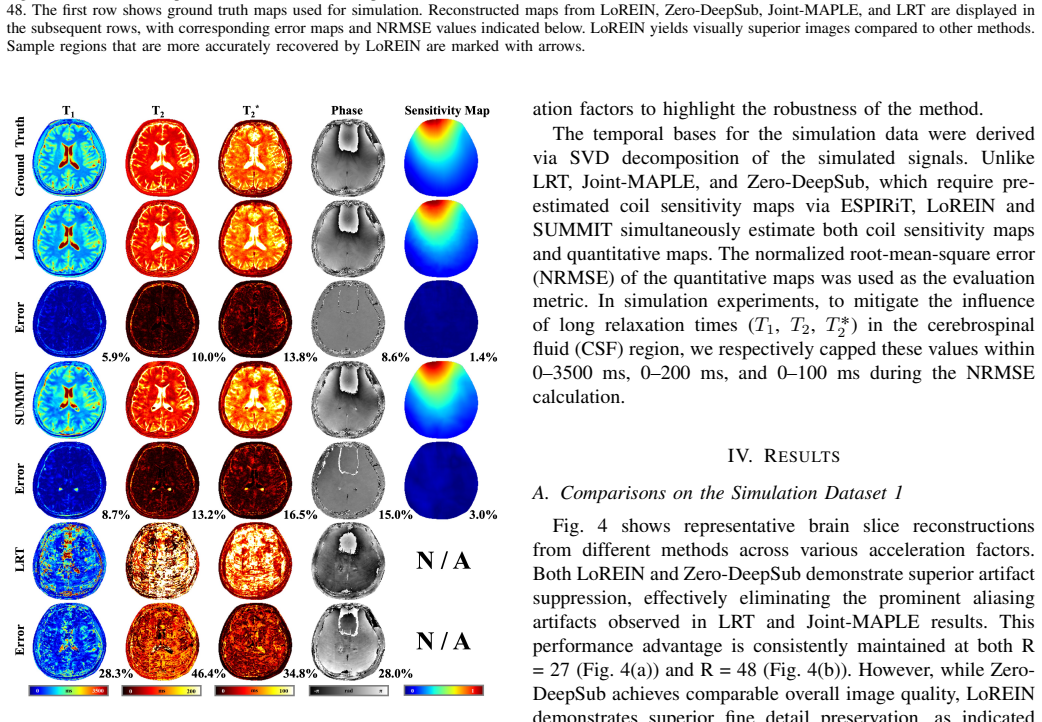
Summary. The paper proposes LoREIN, an unsupervised dual-prior framework for accelerated 3D multiparametric quantitative MRI (MP-qMRI). The method combines a low-rank representation (LRR) block, in which implicit neural representations (INRs) produce spatial bases and coil sensitivity maps, with a parametric map reconstruction (PMR) block, in which INRs map spatial coordinates to T1, T2, T2*, and phase maps. The two blocks are jointly optimized through data-consistency losses derived from two Bloch-equation signal models, a cross-block prior between the predicted weighted images, and a WNNM regularization term. Validation is performed on two retrospectively undersampled simulated datasets, with comparisons to LRT, Joint-MAPLE, Zero-DeepSub, and SUMMIT. The authors report consistently lower NRMSE for all quantitative maps at acceleration factors up to R = 960, together with a substantial reduction in reconstruction time relative to the unrolled-network baselines.
Significance. If the reported comparisons are valid, LoREIN is a useful contribution: it appears to be the first framework to couple low-rank representation with INR for 3D MP-qMRI, it is unsupervised and scan-specific, and its reported runtime advantage (about 20 minutes versus 1.5–2 hours for the compared baselines) is practically meaningful. The architecture is coherent, the optimization is internally consistent, and the paper clearly explains how the two priors are integrated. However, the central empirical claim depends on a load-bearing ambiguity: the temporal basis Phi is said to be derived from the simulated signals, which may make the low-rank subspace an oracle for the ground-truth images. The comparison also lacks error bars, noise-level specification, and any in vivo validation. These issues make the quantitative superiority claim uncertain as currently presented, although the framework itself seems salvageable with additional experiments.
major comments (3)
- [Sec. III.F and Fig. 2 caption] The paper contains an unresolved contradiction about the origin of the temporal basis Phi, and this is load-bearing for the main claim. Sec. III.F states: 'The temporal bases for the simulation data were derived via SVD decomposition of the simulated signals,' while the Fig. 2 caption states: 'The temporal bases Phi are extracted from measured k-space data as well.' If Phi is computed by SVD of the noiseless fully sampled ground-truth signals, then the true weighted images lie exactly in span(Phi), and the reconstruction in Eq. (14) is a projection onto a subspace that is guaranteed to contain the target. The baselines (Joint-MAPLE, Zero-DeepSub, SUMMIT, LRT) are not given this oracle information, so the reported NRMSE advantage could be an artifact of information leakage rather than a benefit of the dual-prior architecture. The authors must clarify whether Phi was computed from the ground-truth simulated signals, from a Bloch dictionary independent of the phantom, or from undersampled measured data. If the oracle interpretation is correct, additional experiments are needed in which Phi is estimated from undersampled k-space data or from a parameter-range dictionary, together with robustness checks with respect to the number of bases K = 15 and to basis perturbation.
- [Sec. III.F and Sec. IV] The quantitative evaluation protocol needs strengthening before the 'lowest NRMSE across all maps' claim can be accepted. First, NRMSE is computed after capping T1, T2, and T2* values at 0–3500 ms, 0–200 ms, and 0–100 ms, respectively; this can mask errors in CSF-dominated regions and may favor methods that perform poorly there. Second, no noise level or multiple noise realizations are described, and no error bars or statistical significance tests are reported, so the consistency of the improvements across the two datasets cannot be assessed. The authors should report uncapped or region-specific metrics, specify the noise model (or state that the simulations are noiseless), and provide repeated-trial statistics.
- [Sec. III.D, Sec. III.F, and Sec. V] All validation is performed on simulated data generated with the same forward models used in the reconstruction, namely Eqs. (9) and (10), and the Discussion does not acknowledge this limitation. The paper's broader claims of a 'zero-shot learning paradigm' and generalization to real scans are not supported by the presented evidence, because no model mismatch, noise correlation, B0/B1 inhomogeneity, or in vivo acquisition is tested. At minimum, the authors should add an explicit limitation statement and an experiment with a dictionary-based temporal basis and a perturbed signal model, or clearly restrict the claims to the simulation setting.
minor comments (4)
- [Sec. III.F] The comparison is not fully controlled for coil sensitivity estimation: LoREIN and SUMMIT estimate coil sensitivity maps, while Joint-MAPLE and Zero-DeepSub use ESPIRiT estimates and LRT uses ground-truth sensitivities. The authors should state how the coil sensitivities were generated in the simulations and report whether the results change if all methods use the same sensitivity input.
- [Sec. III.D] The sampling patterns for the two simulated datasets are not described in sufficient detail. The definition of R in Eq. (19) is global across all temporal dimensions, so for sequences with hundreds of temporal frames an extremely high R can correspond to very few samples per frame. The paper should state the per-frame sampling strategy (e.g., variable-density, pseudo-random, golden-angle) and the number of sampled points per temporal frame.
- [Sec. III.C.1] The claim that the CNN refinement 'recovers components associated with smaller singular values' is asserted without direct evidence. A small experiment varying the number of singular values retained or ablating the CNN would make this claim concrete.
- [Abstract] The abstract contains the typo 'consisently'; the same word is spelled correctly in Sec. IV.A. Please proofread the manuscript for similar issues.
Circularity Check
Oracle temporal basis may drive the reported NRMSE gains: Phi is obtained by SVD of the simulated target signals, so the low-rank subspace contains the ground truth by construction.
-
self definitional
[Section III.F (Experiment Design), temporal-basis setup; Eq. (7) in Section III.A.1]
"In MP-qMRI, weighted images can be effectively decomposed as: Iw = Phi x U ... The temporal bases for the simulation data were derived via SVD decomposition of the simulated signals."
The LRR block reconstructs weighted images as Phi x U (Eq. 7), with Phi computed by SVD of the very simulated signals that were generated from the ground-truth quantitative maps used for evaluation. The true weighted images therefore lie exactly in the span of Phi by construction, so the reconstruction search space already contains the target. The consistent 'lowest NRMSE' result is thus an oracle-informed reconstruction, not an independent test of LoREIN's dual-prior architecture. The paper does not disclose whether the baseline methods received the same temporal basis, whether Phi was built from a parameter-independent dictionary, or how sensitive the results are to K=15, so the central empirical claim is partially reduced to the validation data itself.
full rationale
LoREIN's optimization itself is not circular in the narrow sense: the training losses (Eq. 18) are data-consistency terms and WNNM regularization, and the quantitative maps are not directly fitted to target maps. The self-citations (SUMMIT [40], WNNM [40,59]) are descriptive and not load-bearing for the performance claim. The central problem is the low-rank prior: Section III.F states that the temporal basis was derived via SVD of the simulated signals, and in this retrospective simulation those signals are generated from the ground-truth maps. Using Eq. (7), I_w = Phi x U, LoREIN reconstructs inside a subspace guaranteed to contain the true weighted images, so the reported 'consistently lowest NRMSE' advantage may reflect oracle subspace information rather than an independent evaluation of the dual-prior architecture. The caption of Fig. 2 says Phi is extracted from measured k-space data, which conflicts with the explicit implementation sentence; the implementation sentence is the procedural description and triggers the oracle concern. The paper should disclose how Phi was constructed (ground-truth signal SVD vs. an independent Bloch dictionary), supply the same subspace to baselines, and test sensitivity to K=15. Apart from this validation-loop issue, I find no definitional or self-citation circularity.
Assumptions & free parameters
free parameters (5)
- Rank of spatial bases K =
15
- WNNM loss weights =
lambda1=0.05, lambda2=0.2, lambda3=2
- Hash encoding hyperparameters for phase map =
N_min=1, log2(T)=12
- Learning rate and schedule =
1e-3 with decay
- NRMSE capping thresholds =
T1: 0-3500 ms, T2: 0-200 ms, T2*: 0-100 ms
assumptions (5)
- standard math SVD provides a valid low-rank subspace for the weighted images.
- domain assumption The Bloch equations (9) and (10) exactly model the measured MR signal.
- domain assumption The coil sensitivity maps are smooth and can be represented by INR with reduced hash encoding resolution.
- ad hoc to paper The CNN refinement recovers components associated with smaller singular values.
- ad hoc to paper Pre-training the LRR block for 20 epochs improves the joint optimization.
Cite this review
Pith. "Pith review of Low-Rank Augmented Implicit Neural Representation for Unsupervised High-Dimensional Quantitative MRI Reconstruction." pith.science (2026). https://pith.science/paper/TGNY5YRJ
@misc{pith2026250609100,
  author       = {Pith},
  title        = {Pith review of: Low-Rank Augmented Implicit Neural Representation for Unsupervised High-Dimensional Quantitative MRI Reconstruction},
  year         = {2026},
  howpublished = {\url{https://pith.science/paper/TGNY5YRJ}},
  note         = {Machine review of arXiv:2506.09100}
}
read the original abstract
Quantitative magnetic resonance imaging (qMRI) provides tissue-specific parameters vital for clinical diagnosis. Although simultaneous multi-parametric qMRI (MP-qMRI) technologies enhance imaging efficiency, robustly reconstructing qMRI from highly undersampled, high-dimensional measurements remains a significant challenge. This difficulty arises primarily because current reconstruction methods that rely solely on a single prior or physics-informed model to solve the highly ill-posed inverse problem, which often leads to suboptimal results. To overcome this limitation, we propose LoREIN, a novel unsupervised and dual-prior-integrated framework for accelerated 3D MP-qMRI reconstruction. Technically, LoREIN incorporates both low-rank prior and continuity prior via low-rank representation (LRR) and implicit neural representation (INR), respectively, to enhance reconstruction fidelity. The powerful continuous representation of INR enables the estimation of optimal spatial bases within the low-rank subspace, facilitating high-fidelity reconstruction of weighted images. Simultaneously, the predicted multi-contrast weighted images provide essential structural and quantitative guidance, further enhancing the reconstruction accuracy of quantitative parameter maps. Furthermore, our work introduces a zero-shot learning paradigm with broad potential in complex spatiotemporal and high-dimensional image reconstruction tasks, further advancing the field of medical imaging.
Figures


Figures from the paper (2 more)

Reference graph
Works this paper leans on
-
[39]
Subspace implicit neural representations for real-time cardiac cine MR imaging,
W. Huang, V . Spieker, S. Xu, G. Cruz, C. Prieto, J. Schnabel, K. Hammernik, T. Kuestner, and D. Rueckert, “Subspace implicit neural representations for real-time cardiac cine MR imaging,” 2024, arXiv:2412.12742
arXiv 2024
-
[1]
Mapping astrogliosis in the individual human brain using multidimensional MRI,
D. Benjamini, D. S. Priemer, D. P. Perl, D. L. Brody, and P. J. Basser, “Mapping astrogliosis in the individual human brain using multidimensional MRI,”Brain, vol. 146, no. 3, pp. 1212–1226, Aug. 2022
work page 2022
-
[2]
Y . Uchida, H. Kan, K. Sakurai, N. Arai, D. Kato, S. Kawashima, Y . Ueki, and N. Matsukawa, “V oxel-based quantitative susceptibility mapping in Parkinson’s disease with mild cognitive impairment,”Movement Disorders, vol. 34, no. 8, pp. 1164–1173, May 2019
work page 2019
-
[3]
V . Sawlani, M. D. Patel, N. Davies, R. Flintham, R. Wesolowski, I. Ughratdar, U. Pohl, S. Nagaraju, V . Petrik, A. Kay, S. Jacob, P. Sanghera, V . Wykes, C. Watts, and H. Poptani, “Multiparametric MRI: practical approach and pictorial review of a useful tool in the evaluation of brain tumours and tumour-like lesions,”Insights into Imaging, vol. 11, no. 1...
work page 2020
-
[4]
MRI biomarkers in neuro-oncology,
M. Smits, “MRI biomarkers in neuro-oncology,”Nat. Rev. Neurol., vol. 17, no. 8, pp. 486–500, Jun. 2021. JOURNAL OF LATEX CLASS FILES, VOL. 14, NO. 8, AUGUST 2021 9
work page 2021
-
[5]
R. Metere, T. Kober, H. E. M ¨oller, and A. Sch ¨afer, “Simultaneous quantitative mri mapping of t1, t2* and magnetic susceptibility with multi-echo MP2RAGE,”PLOS One, vol. 12, no. 1, p. e0169265, Jan. 2017
work page 2017
-
[6]
Fast 3d magnetic resonance fingerprinting for a whole- brain coverage,
D. Ma, Y . Jiang, Y . Chen, D. McGivney, B. Mehta, V . Gulani, and M. Griswold, “Fast 3d magnetic resonance fingerprinting for a whole- brain coverage,”Magn. Reson. Med., vol. 79, no. 4, pp. 2190–2197, Aug. 2017
work page 2017
-
[7]
Magnetic resonance multitasking for motion-resolved quan- titative cardiovascular imaging,
A. G. Christodoulou, J. L. Shaw, C. Nguyen, Q. Yang, Y . Xie, N. Wang, and D. Li, “Magnetic resonance multitasking for motion-resolved quan- titative cardiovascular imaging,”Nat. Biomed. Eng., vol. 2, no. 4, pp. 215–226, Apr. 2018
work page 2018
Show all 63 references
-
[8]
Echo planar time-resolved imaging (EPTI),
F. Wang, Z. Dong, T. G. Reese, B. Bilgic, M. Katherine Manhard, J. Chen, J. R. Polimeni, L. L. Wald, and K. Setsompop, “Echo planar time-resolved imaging (EPTI),”Magn. Reson. Med., vol. 81, no. 6, pp. 3599–3615, Feb. 2019
2019
-
[9]
Blip up-down acquisition for spin- and gradient-echo imaging with self-supervised denoising enables efficient t2, t2*, para- and dia-magnetic susceptibility mapping,
Z. Zhang, J. Cho, L. Wang, C. Liao, H. Shin, X. Cao, J. Lee, J. Xu, T. Zhang, H. Ye, K. Setsompop, H. Liu, and B. Bilgic, “Blip up-down acquisition for spin- and gradient-echo imaging with self-supervised denoising enables efficient t2, t2*, para- and dia-magnetic susceptibili...
2022
-
[10]
Extracting more for less: multi-echo MP2RAGE for simultaneous t1-weighted imaging, t1 mapping, r2* mapping, SWI, and QSM from a single acquisition,
H. Sun, J. O. Cleary, R. Glarin, S. C. Kolbe, R. J. Ordidge, B. A. Moffat, and G. B. Pike, “Extracting more for less: multi-echo MP2RAGE for simultaneous t1-weighted imaging, t1 mapping, r2* mapping, SWI, and QSM from a single acquisition,”Magn. Reson. Med., vol. 83, no. 4, pp...
2019
-
[11]
Free-breathing multitasking multi-echo MRI for whole-liver water-specific t1, proton density fat fraction, and r2* quantification,
N. Wang, T. Cao, F. Han, Y . Xie, X. Zhong, S. Ma, A. Kwan, Z. Fan, H. Han, X. Bi, M. Noureddin, V . Deshpande, A. G. Christodoulou, and D. Li, “Free-breathing multitasking multi-echo MRI for whole-liver water-specific t1, proton density fat fraction, and r2* quantification,” ...
2021
-
[12]
High-resolution myelin-water fraction and quantitative relaxation mapping using 3d ViSTa-MR fin- gerprinting,
C. Liao, X. Cao, S. S. Iyer, S. Schauman, Z. Zhou, X. Yan, Q. Chen, Z. Li, N. Wang, T. Gong, Z. Wu, H. He, J. Zhong, Y . Yang, A. Kerr, K. Grill-Spector, and K. Setsompop, “High-resolution myelin-water fraction and quantitative relaxation mapping using 3d ViSTa-MR fin- gerprin...
2023
-
[13]
Y . Chen, S. Liu, Y . Wang, Y . Kang, and E. M. Haacke, “Strategically acquired gradient echo (STAGE) imaging, part i: Creating enhanced t1 contrast and standardized susceptibility weighted imaging and quantita- tive susceptibility mapping,”Magn. Reson. Imag., vol. 46, pp. 130...
2018
-
[14]
Three-dimensional simultaneous brain mapping of t1, t2, and magnetic susceptibility with MR multitasking,
T. Cao, S. Ma, N. Wang, S. Gharabaghi, Y . Xie, Z. Fan, E. Hogg, C. Wu, F. Han, M. Tagliati, E. M. Haacke, A. G. Christodoulou, and D. Li, “Three-dimensional simultaneous brain mapping of t1, t2, and magnetic susceptibility with MR multitasking,”Magn. Reson. Med., vol. 87, no....
2021
-
[15]
Magnetic resonance fingerprinting,
D. Ma, V . Gulani, N. Seiberlich, K. Liu, J. L. Sunshine, J. L. Duerk, and M. A. Griswold, “Magnetic resonance fingerprinting,”Nature, vol. 495, no. 7440, pp. 187–192, Mar. 2013
2013
-
[16]
Magnetic resonance fingerprinting: a technical review,
B. Bipin Mehta, S. Coppo, D. Frances McGivney, J. Ian Hamilton, Y . Chen, Y . Jiang, D. Ma, N. Seiberlich, V . Gulani, and M. Alan Gris- wold, “Magnetic resonance fingerprinting: a technical review,”Magn. Reson. Med., vol. 81, no. 1, pp. 25–46, Sep. 2018
2018
-
[17]
Accelerating parameter mapping with a locally low rank constraint,
T. Zhang, J. M. Pauly, and I. R. Levesque, “Accelerating parameter mapping with a locally low rank constraint,”Magn. Reson. Med., vol. 73, no. 2, pp. 655–661, Feb. 2014
2014
-
[18]
Accelerated high-dimensional MR imaging with sparse sampling using low-rank tensors,
J. He, Q. Liu, A. G. Christodoulou, C. Ma, F. Lam, and Z.-P. Liang, “Accelerated high-dimensional MR imaging with sparse sampling using low-rank tensors,”IEEE Trans. Med. Imag., vol. 35, no. 9, pp. 2119– 2129, Sep. 2016
2016
-
[19]
Optimized multi-axis spiral projection MR fingerprinting with subspace reconstruction for rapid whole-brain high-isotropic-resolution quantita- tive imaging,
X. Cao, C. Liao, S. S. Iyer, Z. Wang, Z. Zhou, E. Dai, G. Liberman, Z. Dong, T. Gong, H. He, J. Zhong, B. Bilgic, and K. Setsompop, “Optimized multi-axis spiral projection MR fingerprinting with subspace reconstruction for rapid whole-brain high-isotropic-resolution quantita- ...
2022
-
[20]
Accelerating magnetic resonance imaging via deep learning,
S. Wang, Z. Su, L. Ying, X. Peng, S. Zhu, F. Liang, D. Feng, and D. Liang, “Accelerating magnetic resonance imaging via deep learning,” inProc. IEEE 13th Int. Symp. Biomed. Imag. (ISBI), Apr. 2016, pp. 514– 517
2016
-
[21]
DIMENSION: Dynamic mr imaging with both k-space and spatial prior knowledge obtained via multi-supervised network training,
S. Wang, Z. Ke, H. Cheng, S. Jia, L. Ying, H. Zheng, and D. Liang, “DIMENSION: Dynamic mr imaging with both k-space and spatial prior knowledge obtained via multi-supervised network training,”NMR Biomed., vol. 35, no. 4, Sep. 2019
2019
-
[22]
Deep magnetic resonance image reconstruction: Inverse problems meet neural networks,
D. Liang, J. Cheng, Z. Ke, and L. Ying, “Deep magnetic resonance image reconstruction: Inverse problems meet neural networks,”IEEE Signal Process. Mag., vol. 37, no. 1, pp. 141–151, Jan. 2020
2020
-
[23]
High-frequency space diffusion model for accelerated MRI,
C. Cao, Z.-X. Cui, Y . Wang, S. Liu, T. Chen, H. Zheng, D. Liang, and Y . Zhu, “High-frequency space diffusion model for accelerated MRI,” IEEE Trans. Med. Imag., vol. 43, no. 5, pp. 1853–1865, May 2024
2024
-
[24]
Machine learning for rapid magnetic resonance fingerprinting tissue property quantification,
J. I. Hamilton and N. Seiberlich, “Machine learning for rapid magnetic resonance fingerprinting tissue property quantification,”Proc. IEEE, vol. 108, no. 1, pp. 69–85, Jan. 2020
2020
-
[25]
Ac- celerating quantitative susceptibility and r2* mapping using incoherent undersampling and deep neural network reconstruction,
Y . Gao, M. Cloos, F. Liu, S. Crozier, G. B. Pike, and H. Sun, “Ac- celerating quantitative susceptibility and r2* mapping using incoherent undersampling and deep neural network reconstruction,”NeuroImage, vol. 240, p. 118404, Oct. 2021
2021
-
[26]
High-resolution 3d magnetic resonance fingerprinting with a graph convolutional network,
F. Cheng, Y . Liu, Y . Chen, and P.-T. Yap, “High-resolution 3d magnetic resonance fingerprinting with a graph convolutional network,”IEEE Trans. Med. Imag., vol. 42, no. 3, pp. 674–683, Mar. 2023
2023
-
[27]
SuperMAP: Deep ultrafast mr relax- ometry with joint spatiotemporal undersampling,
H. Li, M. Yang, J. H. Kim, C. Zhang, R. Liu, P. Huang, D. Liang, X. Zhang, X. Li, and L. Ying, “SuperMAP: Deep ultrafast mr relax- ometry with joint spatiotemporal undersampling,”Magn. Reson. Med., vol. 89, no. 1, pp. 64–76, Sep. 2022
2022
-
[28]
PINQI: An end-to-end physics-informed approach to learned quantitative mri reconstruction,
F. F. Zimmermann, C. Kolbitsch, P. Schuenke, and A. Kofler, “PINQI: An end-to-end physics-informed approach to learned quantitative mri reconstruction,”IEEE Trans. Comput. Imag., vol. 10, pp. 628–639, 2024
2024
-
[29]
Acceleration of simulta- neous multislice magnetic resonance fingerprinting with spatiotemporal convolutional neural network,
L. Lu, Y . Liu, A. Zhou, P. Yap, and Y . Chen, “Acceleration of simulta- neous multislice magnetic resonance fingerprinting with spatiotemporal convolutional neural network,”NMR Biomed., vol. 38, no. 1, Dec. 2024
2024
-
[30]
Joint-MAPLE: Accelerated joint t1 and t2* mapping with scan-specific self-supervised networks,
A. Heydari, A. Ahmadi, T. H. Kim, and B. Bilgic, “Joint-MAPLE: Accelerated joint t1 and t2* mapping with scan-specific self-supervised networks,”Magn. Reson. Med., vol. 91, no. 6, pp. 2294–2309, Jan. 2024
2024
-
[31]
Zero-DeepSub: Zero-shot deep subspace reconstruction for rapid multiparametric quantitative mri using 3d-QALAS,
Y . Jun, Y . Arefeen, J. Cho, S. Fujita, X. Wang, P. E. Grant, B. Gagoski, C. Jaimes, M. S. Gee, and B. Bilgic, “Zero-DeepSub: Zero-shot deep subspace reconstruction for rapid multiparametric quantitative mri using 3d-QALAS,”Magn. Reson. Med., vol. 91, no. 6, pp. 2459–2482, Jan. 2024
2024
-
[32]
Implicit neural representations with periodic activation functions,
V . Sitzmann, J. N. P. Martel, A. W. Bergman, D. B. Lindell, and G. Wetzstein, “Implicit neural representations with periodic activation functions,” 2020,arXiv:2006.09661
2020 arXiv
-
[33]
Fourier features let networks learn high frequency functions in low dimensional domains,
M. Tancik, P. Srinivasan, B. Mildenhall, S. Fridovich-Keil, N. Raghavan, U. Singhal, R. Ramamoorthi, J. Barron, and R. Ng, “Fourier features let networks learn high frequency functions in low dimensional domains,” 2020,arXiv:2006.10739
2020 arXiv
-
[34]
Recovery of continuous 3d refractive index maps from discrete intensity-only measurements using neural fields,
R. Liu, Y . Sun, J. Zhu, L. Tian, and U. S. Kamilov, “Recovery of continuous 3d refractive index maps from discrete intensity-only measurements using neural fields,”Nat. Mach. Intell., vol. 4, no. 9, pp. 781–791, Sep. 2022
2022
-
[35]
NeRP: Implicit neural representation learning with prior embedding for sparsely sampled image reconstruc- tion,
L. Shen, J. Pauly, and L. Xing, “NeRP: Implicit neural representation learning with prior embedding for sparsely sampled image reconstruc- tion,”IEEE Trans. Neural Networks Learn. Syst., vol. 35, no. 1, pp. 770–782, Jan. 2024
2024
-
[36]
IMJENSE: Scan-specific implicit representation for joint coil sensitivity and image estimation in parallel MRI,
R. Feng, Q. Wu, J. Feng, H. She, C. Liu, Y . Zhang, and H. Wei, “IMJENSE: Scan-specific implicit representation for joint coil sensitivity and image estimation in parallel MRI,”IEEE Trans. Med. Imag., vol. 43, no. 4, pp. 1539–1553, Apr. 2024
2024
-
[37]
Self-supervised coordinate projection network for sparse-view computed tomography,
Q. Wu, R. Feng, H. Wei, J. Yu, and Y . Zhang, “Self-supervised coordinate projection network for sparse-view computed tomography,” IEEE Trans. Comput. Imag., vol. 9, pp. 517–529, 2023
2023
-
[38]
CuNeRF: Cube-based neural radiance field for zero-shot medical image arbitrary-scale super resolution,
Z. Chen, L. Yang, J.-H. Lai, and X. Xie, “CuNeRF: Cube-based neural radiance field for zero-shot medical image arbitrary-scale super resolution,” inIEEE Int. Conf. Comput. Vis., Oct. 2023
2023
-
[40]
Coordinate-based neural representation enabling zero-shot learning for fast 3d multiparametric quantitative mri,
G. Lao, R. Feng, H. Qi, Z. Lv, Q. Liu, C. Liu, Y . Zhang, and H. Wei, “Coordinate-based neural representation enabling zero-shot learning for fast 3d multiparametric quantitative mri,”Med. Image Anal., vol. 102, p. 103530, May 2025
2025
-
[41]
Dynamic programming,
R. Bellman, “Dynamic programming,”Science, vol. 153, no. 3731, pp. 34–37, Jul. 1966
1966
-
[42]
Tackling the curse of dimensionality with physics-informed neural networks,
Z. Hu, K. Shukla, G. E. Karniadakis, and K. Kawaguchi, “Tackling the curse of dimensionality with physics-informed neural networks,”Neural Networks, vol. 176, p. 106369, Aug. 2024
2024
-
[43]
Accel- erated MR parameter mapping with low-rank and sparsity constraints,
B. Zhao, W. Lu, T. K. Hitchens, F. Lam, C. Ho, and Z. Liang, “Accel- erated MR parameter mapping with low-rank and sparsity constraints,” Magn. Reson. Med., vol. 74, no. 2, pp. 489–498, Aug. 2014
2014
-
[44]
Tensor decompositions and applications,
T. G. Kolda and B. W. Bader, “Tensor decompositions and applications,” SIAM Rev., vol. 51, no. 3, pp. 455–500, Aug. 2009. JOURNAL OF LATEX CLASS FILES, VOL. 14, NO. 8, AUGUST 2021 10
2009
-
[45]
Robust recovery of subspace structures by low-rank representation,
G. Liu, Z. Lin, S. Yan, J. Sun, Y . Yu, and Y . Ma, “Robust recovery of subspace structures by low-rank representation,”IEEE Trans. Pattern Anal. Mach. Intell., vol. 35, no. 1, pp. 171–184, Jan. 2013
2013
-
[46]
Low-rank tensor models for improved multidimensional MRI: Application to dynamic cardiac t1 mapping,
B. Yaman, S. Weingartner, N. Kargas, N. D. Sidiropoulos, and M. Ak- cakaya, “Low-rank tensor models for improved multidimensional MRI: Application to dynamic cardiac t1 mapping,”IEEE Trans. Comput. Imag., vol. 6, pp. 194–207, 2020
2020
-
[47]
Spatial-spectral structured sparse low-rank representation for hyper- spectral image super-resolution,
J. Xue, Y .-Q. Zhao, Y . Bu, W. Liao, J. C.-W. Chan, and W. Philips, “Spatial-spectral structured sparse low-rank representation for hyper- spectral image super-resolution,”IEEE Trans. Image Process., vol. 30, pp. 3084–3097, 2021
2021
-
[48]
NeRF: representing scenes as neural radiance fields for view synthesis,
B. Mildenhall, P. P. Srinivasan, M. Tancik, J. T. Barron, R. Ramamoorthi, and R. Ng, “NeRF: representing scenes as neural radiance fields for view synthesis,”Commun. ACM, vol. 65, no. 1, pp. 99–106, Dec. 2021
2021
-
[49]
NeRF-SLAM: Real-time dense monocular SLAM with neural radiance fields,
A. Rosinol, J. J. Leonard, and L. Carlone, “NeRF-SLAM: Real-time dense monocular SLAM with neural radiance fields,” inIROS, Oct. 2023, pp. 3437–3444
2023
-
[50]
COLLATOR: Consistent spatial-temporal longitudinal atlas construction via implicit neural representation,
L. Chen, X. Tian, J. Wu, G. Lao, Y . Zhang, and H. Wei, “COLLATOR: Consistent spatial-temporal longitudinal atlas construction via implicit neural representation,”Med. Image Anal., vol. 100, p. 103396, Feb. 2025
2025
-
[51]
Spatiotemporal implicit neural representation for unsupervised dynamic mri reconstruction,
J. Feng, R. Feng, Q. Wu, X. Shen, L. Chen, X. Li, L. Feng, J. Chen, Z. Zhang, C. Liu, Y . Zhang, and H. Wei, “Spatiotemporal implicit neural representation for unsupervised dynamic mri reconstruction,” IEEE Trans. Med. Imag., vol. 44, no. 5, pp. 2143–2156, May 2025
2025
-
[52]
A subject-specific unsupervised deep learning method for quantitative susceptibility mapping using implicit neural representation,
M. Zhang, R. Feng, Z. Li, J. Feng, Q. Wu, Z. Zhang, C. Ma, J. Wu, F. Yan, C. Liu, Y . Zhang, and H. Wei, “A subject-specific unsupervised deep learning method for quantitative susceptibility mapping using implicit neural representation,”Med. Image Anal., vol. 95, p. 103173, Jul. 2024
2024
-
[53]
Highly accelerated mri via implicit neural representation guided pos- terior sampling of diffusion models,
J. Chu, C. Du, X. Lin, X. Zhang, L. Wang, Y . Zhang, and H. Wei, “Highly accelerated mri via implicit neural representation guided pos- terior sampling of diffusion models,”Med. Image Anal., vol. 100, p. 103398, Feb. 2025
2025
-
[54]
Unsupervised reconstruction of accelerated cardiac cine MRI using neural fields,
T. Catal ´an, M. Courdurier, A. Osses, A. Fotaki, R. Botnar, F. Sahli- Costabal, and C. Prieto, “Unsupervised reconstruction of accelerated cardiac cine MRI using neural fields,”Comput. Biol. Med., vol. 185, p. 109467, Feb. 2025
2025
-
[55]
ESPIRiT—an eigenvalue approach to autocalibrating parallel MRI: Where SENSE meets GRAPPA,
M. Uecker, P. Lai, M. J. Murphy, P. Virtue, M. Elad, J. M. Pauly, S. S. Vasanawala, and M. Lustig, “ESPIRiT—an eigenvalue approach to autocalibrating parallel MRI: Where SENSE meets GRAPPA,”Magn. Reson. Med., vol. 71, no. 3, pp. 990–1001, May 2013
2013
-
[56]
Variable flip angle echo planar time-resolved imaging (vFA-EPTI) for fast high-resolution gradient echo myelin water imaging,
Z. Dong, F. Wang, K.-S. Chan, T. G. Reese, B. Bilgic, J. P. Marques, and K. Setsompop, “Variable flip angle echo planar time-resolved imaging (vFA-EPTI) for fast high-resolution gradient echo myelin water imaging,”NeuroImage, vol. 232, p. 117897, May 2021
2021
-
[57]
Instant neural graphics primitives with a multiresolution hash encoding,
T. M ¨uller, A. Evans, C. Schied, and A. Keller, “Instant neural graphics primitives with a multiresolution hash encoding,”ACM Trans. Graph., vol. 41, no. 4, pp. 1–15, Jul. 2022
2022
-
[58]
Sensitivity of low-rank matrix recovery,
P. Breiding and N. Vannieuwenhoven, “Sensitivity of low-rank matrix recovery,”Numer. Math., vol. 152, no. 4, pp. 725–759, Oct. 2022
2022
-
[59]
Weighted nuclear norm minimization with application to image denoising,
S. Gu, L. Zhang, W. Zuo, and X. Feng, “Weighted nuclear norm minimization with application to image denoising,” inProc. IEEE/CVF Conf. Comput. Vis. Pattern Recognit. (CVPR), Jun. 2014
2014
-
[60]
Model compression via distillation and quantization,
A. Polino, R. Pascanu, and D. Alistarh, “Model compression via distillation and quantization,” 2018,arXiv:1802.05668
2018 arXiv
-
[61]
Tinyvit: Fast pretraining distillation for small vision transformers,
K. Wu, J. Zhang, H. Peng, M. Liu, B. Xiao, J. Fu, and L. Yuan, “Tinyvit: Fast pretraining distillation for small vision transformers,” inEur. Conf. Comput. Vis., 2022, pp. 68–85
2022
-
[62]
Learned initializations for optimizing coordinate- based neural representations,
M. Tancik, B. Mildenhall, T. Wang, D. Schmidt, P. P. Srinivasan, J. T. Barron, and R. Ng, “Learned initializations for optimizing coordinate- based neural representations,” inProc. IEEE/CVF Conf. Comput. Vis. Pattern Recognit. (CVPR), Jun. 2021
2021
-
[63]
Meta-learning sparse implicit neural representations,
J. Lee, J. Tack, N. Lee, and J. Shin, “Meta-learning sparse implicit neural representations,” 2021,arXiv:2110.14678
2021 arXiv
Reviewed August 7, 2026 · model on record in the stance chip above.
Discussion (0). Sign in to comment.