REVIEW 3 major objections 4 minor 24 references
Feature Shift Localization Network
T0 review · 3 major / 4 minor · reviewed 2026-08-07 · deepseek-v4-flash
Pith's one-line read Trained once on 1,350 datasets, FSL-Net matches DataFix's localization accuracy while running about 36x faster, on datasets and shift types it has never seen.
desk verdict Fast, comparable-accuracy feature shift localizer with a real architecture contribution—but the 'unseen shift types' claim is broader than the experiments support. read the letter →
The pith
A machine-rendered reading of the paper's core claim, the machinery that carries it, and where it could break.
The reading
What carries the argument
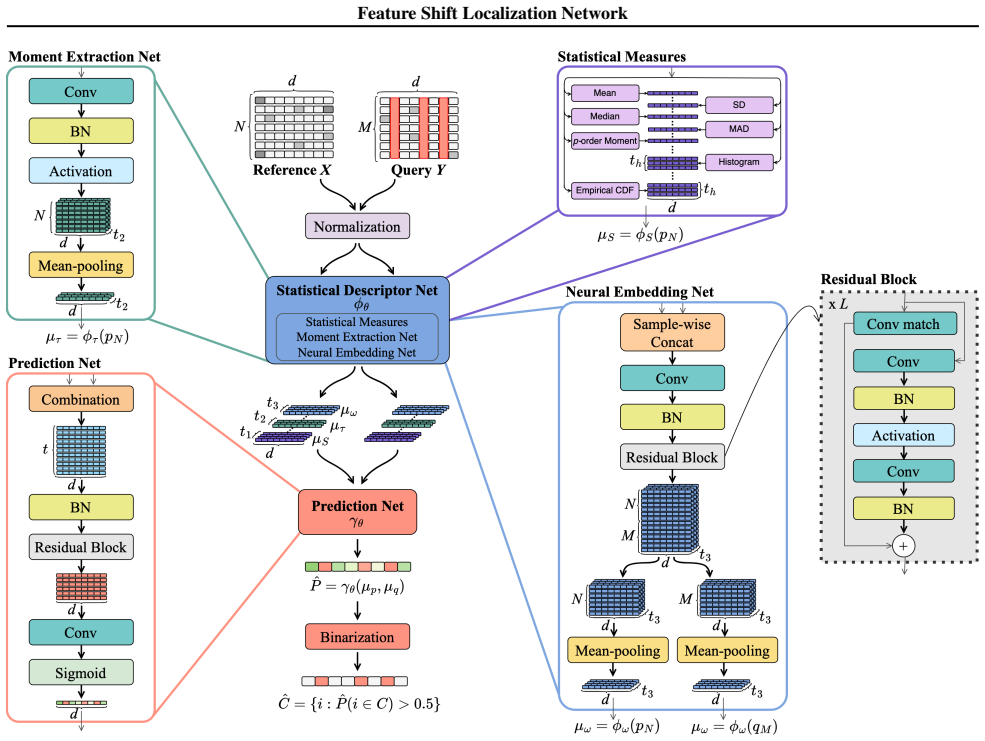
The central mechanism is the statistical functional map: a mapping from a multivariate distribution's CDF to a $d \times t$ tensor whose $i$-th slice summarizes the $i$-th feature's marginal distribution and its interactions with other features. FSL-Net builds three such maps per dataset—hand-coded statistical measures, a Moment Extraction Network (convolution plus ReLU averaged over samples, approximating generalized moments), and a Neural Embedding Network (residual 1-D convolutions that add a learned term to each feature's affine transform)—then fuses reference and query with the normalized squared difference $\frac{(\mu_p-\mu_q)^2}{\|\mu_p\|+\epsilon}$. Sample-order invariance comes from mean pooling over samples and sorting for non-linear measures; approximate feature-order equivariance comes from shuffling features in each training mini-batch; locality is enforced by marginal measures, residual connections, and an auxiliary loss that penalizes differences on non-corrupted features. The Prediction Network then maps this distance-like object to per-feature probabilities through residual blocks and a sigmoid.
What would settle it
Construct a dataset where the only change between reference and query is a correlation between two features separated by more than 256 positions, with all marginals and local statistics matched, and run the released FSL-Net; if neither feature is flagged with high probability, the zero-shot claim fails for long-range correlation shifts, which the paper's training windows do not directly cover.
Extended reading notes
Core claim
On the paper's own terms, the discovery is that feature shift localization generalizes across datasets when cast as learning statistical functional maps. FSL-Net's Statistical Descriptor Network maps each dataset to a $d \times t$ tensor whose rows summarize the marginal and interaction structure of each feature: hand-coded statistical measures (mean, standard deviation, median, mean absolute deviation, moments, histograms, empirical CDFs), a Moment Extraction Network that approximates generalized moments, and a Neural Embedding Network whose residual convolutions capture nonlinear feature relations. The Prediction Network combines the reference and query descriptors through the normalized squared difference $\frac{(\mu_p-\mu_q)^2}{\|\mu_p\|+\epsilon}$, a contrast resembling maximum mean discrepancy, applies residual blocks, and outputs per-feature corruption probabilities. Trained end-to-end on 1,350 datasets with eight simulated manipulation types, the model matches DataFix's localization accuracy on the shared benchmark and beats all baselines that require knowing the number of corrupted features, with the largest advantages on datasets up to 198,473 features.
Load-bearing premise
Training on random contiguous windows of only 8 to 256 features is assumed sufficient for the network to localize shifts in full feature spaces up to 198,473 features, so shifts that depend on correlations between features farther apart than the training window must be captured indirectly or they will be missed.
Editorial extensions
If this is right
- On unseen datasets and unseen manipulation types, FSL-Net localizes shifted features with a single forward pass, so localization cost is roughly one dataset read and one network evaluation instead of an iterative search.
- Average F1 on the shared benchmark is on par with DataFix while mean runtime drops by about 36x overall and about 136x on Phenotypes, making the method practical for datasets with hundreds of thousands of features.
- Correlation-only shifts (E3 and E8), which defeat univariate feature-selection methods, are localized by FSL-Net because the Moment and Neural Embedding descriptors encode inter-feature structure.
- FSL-Net outperforms conditional-test baselines (MB-SM, MB-KS, KNN-KS, Deep-SM) even though those baselines are given the true number of corrupted features, which FSL-Net does not receive.
- Ablation results attribute the largest single gain to the Prediction Network (thresholding alone reaches 0.307, adding the Prediction Network raises this to 0.710, and the full model reaches 0.894), with each descriptor component contributing further.
Reading between the lines
- Editorial inference: because training uses contiguous windows of only 8 to 256 features, a shift carried entirely by a correlation between features separated by many positions is not directly in the training distribution; such long-range correlation shifts would be a natural stress test the paper does not report.
- Editorial inference: the forward-pass formulation makes FSL-Net a plausible first-stage filter in data-quality pipelines—flag candidate corrupted features quickly, then confirm a much smaller candidate set with slower statistical tests.
- Editorial inference: the paper notes that label shifts can be modeled as an extra dimension, so the same architecture could be pointed at label mismatch without changes, but no label-shift evaluation is included.
Editorial analysis
A structured set of objections, weighed in public.
Referee Report
Summary. The paper introduces FSL-Net, a neural network for feature shift localization. Given a reference dataset and a query dataset, FSL-Net predicts a per-feature corruption probability by computing statistical functional maps, including hand-crafted measures, a Moment Extraction Network, and a Neural Embedding Network, and then combining the reference and query maps with a normalized squared-difference operation followed by residual blocks and a sigmoid output. The model is trained end-to-end on 1,350 datasets with eight simulated manipulation types and is evaluated on 12 benchmark datasets with ten evaluation manipulation types. The main reported results are that FSL-Net achieves average F1 comparable to DataFix while being about 36x faster on average and up to 136x faster on the Phenotypes dataset, and the paper claims that the model generalizes to previously unseen datasets and shifts without retraining.
Significance. If the claims hold, the paper makes a practically useful contribution: a single forward-pass feature shift localizer that scales to high-dimensional tabular data, with released code and a ready-to-use trained model. The architecture's sample-order invariance and approximate feature-order equivariance are well motivated, and the ablation study in Table 4 gives useful evidence that each descriptor component contributes to performance. The paper is also transparent about the benchmark and about cases where DataFix is stronger (E4 and E9). However, the central 'unseen shift types' claim is not established by the reported experiments, and the lack of error bars together with the imputation rule for unfinished runs limits confidence in the precise F1 comparison. The speed advantage is credible regardless of the generalization claim, and the paper would be publishable after the claims are re-scoped and the missing statistical support is added.
major comments (3)
- [Section 4, Evaluation Data (Table 2 vs. Table 5)] The statement that 'both testing datasets and manipulations differ from those used during FSL-Net training and validation (see Table 2)' is contradicted by a direct comparison of Tables 2 and 5. Every test manipulation has a same-family training counterpart: T1 vs. E1 (marginal corruption/replacement), T2 vs. E2 (linear combination/negation), T3 vs. E3 (per-feature resampling/permutation), T4 vs. E4 (additive noise), T5 vs. E7 (neural-network feature transform), T6 vs. E8 (joint resampling/permutation preserving marginals), T7 vs. E9 (KNN regressor), and T8 vs. E10 (KNN classifier). The evaluation therefore demonstrates generalization to new datasets, but not to previously unseen shift types, and the abstract's claim of localizing shifts from 'previously unseen datasets and shifts' is not supported. The authors should either remove the 'unseen shift types' component of the claim or add an evaluation with manipulation families that are genuinely absent from training.
- [Section 3, Training and Validation Manipulations Simulations; Section 4, Evaluation Data] The training protocol samples feature windows of 8 to 256 features per mini-batch, while the test datasets have up to 198,473 features. The Moment Extraction Network uses a kernel size of 75 and the Neural Embedding Network a kernel size of 5, so any shift signal that depends on correlations between features separated by more than the training window size can only be captured indirectly, if at all. The E3 and E8 manipulations are precisely correlation-altering shifts, and the paper does not provide an experiment or analysis showing that the learned descriptors capture correlation structure at distances larger than the trained window. This is a load-bearing gap for the scalability claim to high-dimensional datasets such as Canine, and the authors should address it, for example by varying the training window size and measuring performance on correlation-only shifts at increasing feature dimensionality.
- [Section 4, Evaluation Protocol and Hardware Specifications] No error bars, confidence intervals, or multiple-seed results are reported for any of the F1 scores or runtimes. In addition, experiments that do not finish within 30 hours are imputed with the lowest F1 score from the same experiment among competing methods and assigned a 30-hour runtime. Because FSL-Net always finishes, this imputation rule can systematically lower the averages of slower baselines and inflate the reported F1 advantage. The central empirical claim of 'comparable F1 at much lower runtime' would be considerably stronger with per-seed results, at least for FSL-Net and DataFix, and with a sensitivity analysis showing how the average F1 changes under alternative imputation rules.
minor comments (4)
- [Section 3, Sample-wise Invariance, Feature-wise Equivariance, and Locality] The heading and text use 'Feature-wise invariance' in one place and 'feature-order equivariance' in another; since the target property for the feature dimension is equivariance (permuting features permutes the output probabilities), the terminology should be made consistent.
- [Section 4, Performance across Manipulation Types and Datasets] The text says lower probability thresholds may improve detection on E9 and E4, but no threshold sweep on the full model is reported; a short experiment would make the statement concrete.
- [Appendix E.3, Alternative Merging Operations] The description of the normalized squared difference says it is 'resembling the Maximum Mean Discrepancy,' but no formal connection is needed; the sentence could be simplified to avoid implying a metric property that is not established.
- [Figure 2 and Figure 3] The multi-panel figures are dense and the legends are small; the paper would benefit from larger fonts and from reporting the per-dataset F1 values for FSL-Net and DataFix in a table, since Figure 4 shows only means.
Circularity Check
One partial circularity: the 'previously unseen shift types' claim is evaluated on manipulation families already used in training, so that part of the central claim reduces to seen training inputs; the rest of the pipeline is independent.
-
fitted input called prediction
[Section 4, 'Evaluation Data' and Table 5 (from Barrabés et al., 2023); Section 3, 'Training and Validation Manipulations Simulations' and Table 2]
"Note that both testing datasets and manipulations differ from those used during FSL-Net training and validation (see Table 2). ... E9 KNN(x) Predict feature with KNN (Regressor). - Cont. E10 KNN(x) Predict feature with KNN (Classifier). - Cat."
The paper's evidence for 'localize feature shifts from previously unseen datasets and shifts' depends on the test manipulations E1-E10 being genuinely different from the training manipulations T1-T8. The paper's own tables contradict this: E9 and E10 are literally the same KNN regressor/classifier manipulations as T7 and T8; E2 and E6 are instantiations of T2's linear combination with negation; E5 and E7 are covered by T5's binarization/neural-transform family; E3, E4, and E8 are same-family counterparts of T3, T4, and T6. Since the model parameters were fit on these manipulation families, the test F1 scores measure recognition of seen shift families, not generalization to unseen shift types.
full rationale
The core FSL-Net training loop is ordinary supervised learning: the network is fit on simulated shifts with ground-truth corrupted-feature labels, and the held-out evaluation datasets (Gas, Covid, Energy, MNIST, Phenotypes, Founders, Canine, etc.) are not used to fit any parameter. The DataFix benchmark and baseline come from the authors' prior work, but they are shared, reproducible, and not themselves the source of the localization prediction, so that self-citation is not load-bearing in a circular way. The one genuine circularity concern is the claim of generalization to 'previously unseen ... shifts': the test manipulations E1-E10 are, by the paper's own Tables 2 and 5, drawn from the same manipulation families used during training, with E9/T7 and E10/T8 identical in form. Thus the 'unseen shift types' result is not an independent test of that claim; it is a renamed presentation of the training distribution. This partial circularity affects the generalization claim's shift-type component, while the architecture, speed advantage, and high-dimensional accuracy results stand on independent evidence. Overall score 4 reflects a central claim that retains substantial independent content despite one constructed equivalence.
Assumptions & free parameters
free parameters (4)
- Auxiliary loss weight lambda =
0.001
- Architecture hyperparameters (channels, kernel sizes, depths, bins) =
ME 64 kernels, kernel 75; NE 5 layers, 64 kernels, kernel 5; PN 7 layers, 64 kernels, kernel 5; histogram bins 100
- Decision threshold on output probabilities =
0.5
- Feature window sizes for training mini-batches =
8 to 256 features (validation: 2,048)
assumptions (4)
- domain assumption The true, unmodified query distribution equals the reference distribution; only a subset of features can be corrupted.
- domain assumption Per-feature normalization to [0,1] is sufficient preprocessing for the statistical descriptors used by the network.
- domain assumption 1D convolutions across features, trained on small feature windows, provide approximate feature-order equivariance and locality.
- domain assumption The benchmark manipulations and datasets used for evaluation are representative of real feature shifts.
Cite this review
Pith. "Pith review of Feature Shift Localization Network." pith.science (2026). https://pith.science/paper/V7JQUZ4P
@misc{pith2026250609101,
  author       = {Pith},
  title        = {Pith review of: Feature Shift Localization Network},
  year         = {2026},
  howpublished = {\url{https://pith.science/paper/V7JQUZ4P}},
  note         = {Machine review of arXiv:2506.09101}
}
read the original abstract
Feature shifts between data sources are present in many applications involving healthcare, biomedical, socioeconomic, financial, survey, and multi-sensor data, among others, where unharmonized heterogeneous data sources, noisy data measurements, or inconsistent processing and standardization pipelines can lead to erroneous features. Localizing shifted features is important to address the underlying cause of the shift and correct or filter the data to avoid degrading downstream analysis. While many techniques can detect distribution shifts, localizing the features originating them is still challenging, with current solutions being either inaccurate or not scalable to large and high-dimensional datasets. In this work, we introduce the Feature Shift Localization Network (FSL-Net), a neural network that can localize feature shifts in large and high-dimensional datasets in a fast and accurate manner. The network, trained with a large number of datasets, learns to extract the statistical properties of the datasets and can localize feature shifts from previously unseen datasets and shifts without the need for re-training. The code and ready-to-use trained model are available at https://github.com/AI-sandbox/FSL-Net.
Figures


Figures from the paper (4 more)


Reference graph
Works this paper leans on
-
[1]
pi ̸=q i Cont. E21−xEach value is negated.p i ̸=q i,E[q i] = 1−E[pi]Both E3P iXi Pi is a random permutation matrix applied to featurei. pi =q i, pC ̸=q C , qC = Q i∈C qi Both E4.1-4.3 clamp 0,1(x+ασ) σ∼Rademacher(0.5) Add constant noise with a random sign. α∈ {0.02,0.05,0.1}for 4.1-4.3 respectively. pi ̸=q i,E[p i]≈E[q i]Cont. E5 round(x)Values are binari...
work page 2023
-
[5]
These transformations include normalization (standard or min-max scaling), followed by a linear transformation in which the dataset is multiplied by a randomly sampled matrix W∈R d×d. The entries of W are drawn from one of four distributions: U(0,1) , N(0,1) , Beta(1,1) , or Bernoulli(0.5). Additionally, a non-linear transformation is applied, randomly ch...
work page 2023
-
[9]
Lim, L.-H. and Nelson, B. J. What is an equivariant neural network.arXiv preprint arXiv:2205.07362, pp. 5987– 6001,
-
[10]
Comparison of FSL-Net and DataFix averaged across manipulation types and fractions of manipulated features on two datasets: CIFAR10 (10k) and COIL-100. Dataset F-1 Score Mean Runtime (hours) Max Runtime (hours) FSL-Net DataFix FSL-Net DataFix FSL-Net DataFix CIFAR10 0.95650.89110.03190.29480.03360.8084 COIL-1000.97200.9805 0.49062.92280.84069.1567 23 Feat...
-
[11]
M., Lin, Q., Allebach, J., and Delp, E
11 Feature Shift Localization Network Montserrat, D. M., Lin, Q., Allebach, J., and Delp, E. J. Training object detection and recognition cnn models using data augmentation.Electronic Imaging, 2017(10): 27–36,
work page 2017
-
[12]
Pan, J., Pham, V ., Dorairaj, M., Chen, H., and Lee, J.-Y . Ad- versarial validation approach to concept drift problem in user targeting automation systems at uber.arXiv preprint arXiv:2004.03045,
work page Pith review arXiv 2004
-
[13]
M., Barrab ´es, M., Geleta, M., Gir´o-i Nieto, X., and Ioannidis, A
Perera, M., Montserrat, D. M., Barrab ´es, M., Geleta, M., Gir´o-i Nieto, X., and Ioannidis, A. G. Generative mo- ment matching networks for genotype simulation. In 2022 44th Annual International Conference of the IEEE Engineering in Medicine & Biology Society (EMBC), pp. 1379–1383. IEEE,
work page 2022
-
[18]
Yu, S., Wang, X., and Pr´ıncipe, J. C. Request-and-reverify: Hierarchical hypothesis testing for concept drift detection with expensive labels.arXiv preprint arXiv:1806.10131,
Show all 24 references
-
[20]
Effi- cient attention via control variates.arXiv preprint arXiv:2302.04542,
Zheng, L., Yuan, J., Wang, C., and Kong, L. Effi- cient attention via control variates.arXiv preprint arXiv:2302.04542,
-
[21]
Benchmarking Methods DataFix detects and localizes feature shifts using an iterative adversarial approach called DF-Locate
13 Feature Shift Localization Network A. Benchmarking Methods DataFix detects and localizes feature shifts using an iterative adversarial approach called DF-Locate. At each iteration, a random forest classifier is trained to distinguish between samples from a reference and a q...
2013
-
[1958]
and Wu, E
Krishnan, S. and Wu, E. A. Automatic generation of data cleaning pipelines.arXiv preprint arXiv:1904.11827,
1904 arXiv
-
[1998]
Interactive weak supervision: Learning useful heuristics for data labeling.arXiv preprint arXiv:2012.06046,
Boecking, B., Neiswanger, W., Xing, E., and Dubrawski, A. Interactive weak supervision: Learning useful heuristics for data labeling.arXiv preprint arXiv:2012.06046,
2012 arXiv
-
[2004]
A feature extraction & selection benchmark for structural health monitoring
Buckley, T., Ghosh, B., and Pakrashi, V . A feature extraction & selection benchmark for structural health monitoring. Structural Health Monitoring, 22(3):2082–2127,
-
[2011]
N., Gir ´o-i Nieto, X., Montserrat, D
Barrab´es, M., Bonet, D., Moriano, V . N., Gir ´o-i Nieto, X., Montserrat, D. M., and Ioannidis, A. G. Genomic databases homogenization with machine learning. In 2023 IEEE International Conference on Bioinformatics and Biomedicine (BIBM), pp. 2952–2959. IEEE,
2023
-
[2012]
and Reifenrath, S
Hopf, K. and Reifenrath, S. Filter methods for feature selection in supervised machine learning applications– review and benchmark.arXiv preprint arXiv:2111.12140,
-
[2014]
Geleta, M., Mas Montserrat, D., Giro-i Nieto, X., and Ioan- nidis, A. G. Deep variational autoencoders for population genetics.biorxiv, pp. 2023–09,
2023
-
[2015]
doi: 10.1109/FSKD.2015. 7382218. Deng, L. The mnist database of handwritten digit images for machine learning research.IEEE Signal Processing Magazine, 29(6):141–142,
2015 doi
-
[2016]
N., Bischl, B., Torgo, L., Gao, B., Umaashankar, V ., Fischer, S., Winter, P., Wiswedel, B., Berthold, M
Van Rijn, J. N., Bischl, B., Torgo, L., Gao, B., Umaashankar, V ., Fischer, S., Winter, P., Wiswedel, B., Berthold, M. R., and Vanschoren, J. Openml: A collaborative science platform. InMachine Learning and Knowledge Discov- ery in Databases: European Conference, ECML PKDD 201...
2013
-
[2017]
P., Lai, K.-H., Yang, F., Jiang, Z., Zhong, S., and Hu, X
Zha, D., Bhat, Z. P., Lai, K.-H., Yang, F., Jiang, Z., Zhong, S., and Hu, X. Data-centric artificial intelligence: A survey.arXiv preprint arXiv:2303.10158,
-
[2018]
A pso based hybrid feature selection algorithm for high-dimensional classification
Tran, B., Zhang, M., and Xue, B. A pso based hybrid feature selection algorithm for high-dimensional classification. In 2016 IEEE congress on evolutionary computation (CEC), pp. 3801–3808. IEEE,
2016
-
[2020]
Multi-head or single-head? an empirical comparison for transformer training.arXiv preprint arXiv:2106.09650,
Liu, L., Liu, J., and Han, J. Multi-head or single-head? an empirical comparison for transformer training.arXiv preprint arXiv:2106.09650,
-
[2022]
Approximating optimal transport with linear programs.arXiv preprint arXiv:1810.05957,
Quanrud, K. Approximating optimal transport with linear programs.arXiv preprint arXiv:1810.05957,
-
[2023]
Diagnosing and remediating harmful data shifts for the responsible deployment of clinical ai models.medRxiv, pp
Subasri, V ., Krishnan, A., Dhalla, A., Pandya, D., Malkin, D., Razak, F., Verma, A., Goldenberg, A., and Dolatabadi, E. Diagnosing and remediating harmful data shifts for the responsible deployment of clinical ai models.medRxiv, pp. 2023–03,
2023
-
[2024]
doi: 10.1109/ACCESS.2024. 3516506. Battiti, R. Using mutual information for selecting features in supervised neural net learning.IEEE Transactions on neural networks, 5(4):537–550,
2024 doi
Reviewed August 7, 2026 · model on record in the stance chip above.
Discussion (0). Sign in to comment.