REVIEW 4 major objections 6 minor 1 cited by
Dissecting environmental effects with eccentric gravitational wave sources
T0 review · 4 major / 6 minor · reviewed 2026-08-07 · deepseek-v4-flash
Pith's one-line read This paper argues that, for eccentric gas-embedded binaries, the gravitational-wave dephasing is dominated by the n=1 epicyclical resonance of the environmental force rather than by orbit-averaged drag once the eccentricity is above about…
desk verdict A solid analytic framework for resonant dephasing in eccentric binaries, with the n=1 dominance claim still conditional on the laminar, low-e numerics. read the letter →
The pith
A machine-rendered reading of the paper's core claim, the machinery that carries it, and where it could break.
The reading
What carries the argument
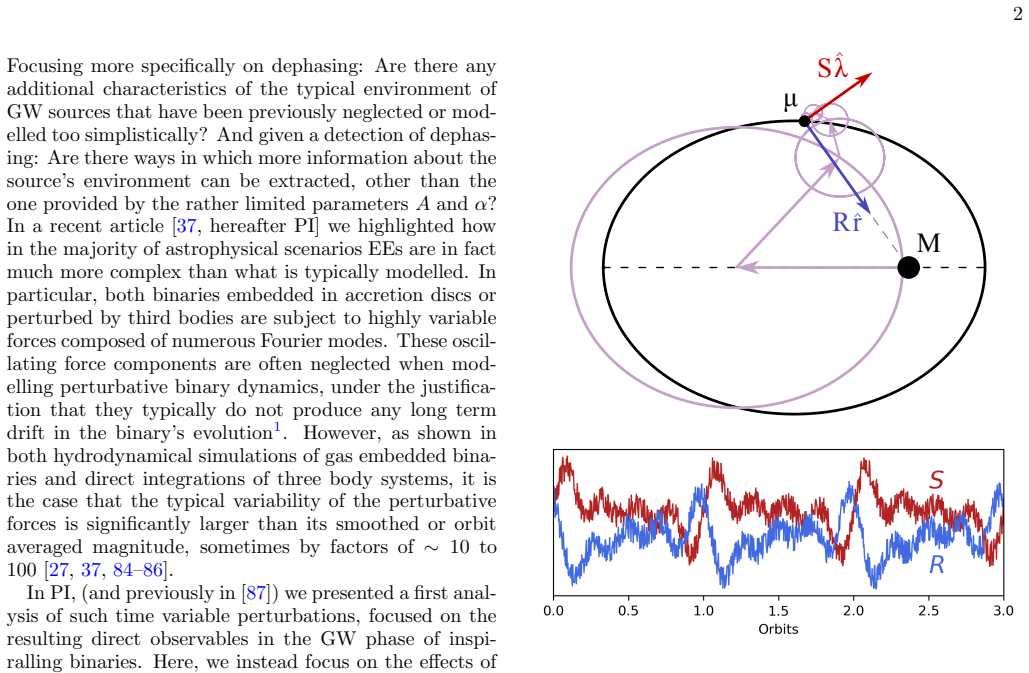
The load-bearing object is the Fourier decomposition of the perturbative acceleration into radial and azimuthal components at integer multiples of the instantaneous Keplerian frequency, with slowly varying complex coefficients (Eq. 3). Inserting this decomposition into the Lagrange planetary equations and expanding the true anomaly in eccentricity (the equation of the center) separates oscillatory perturbations from secular drifts: the orbit average selects resonant modes $n=1,2,3$ that would vanish for a circular orbit, producing Eqs. (15) and (16) for $\dot a$ and $\dot e$. These secular drifts are converted into gravitational-wave dephasing through the chirp integral of Eq. (31), with the accumulated eccentricity difference computed from the standard vacuum eccentric-inspiral relation, giving the per-mode dephasing formula of Eq. (37). The mechanism carrying the argument is that the orbit average of the product of force and velocity does not equal the product of their averages, $\langle T v_T\rangle \neq \langle T\rangle\langle v_T\rangle$, so fluctuating forces leave a net secular imprint that smoothed models miss.
What would settle it
Run a self-consistent hydrodynamical simulation of an equal-mass binary embedded in a thin circumbinary disk with initial eccentricity near 0.1, letting the orbit evolve under both gas and gravitational-wave forces, and measure the dephasing relative to vacuum: if it follows the orbit-averaged drag power law of the $n=0$ component instead of growing with the $n=1$ resonance scaling $e_0\,f^{-19/18}$, the paper's dominance claim is falsified. A cheaper check is to track the phase of the $n=1$ force Fourier coefficient over many orbits in the paper's own fixed-orbit data; if that phase wanders on super-orbital timescales, the coherent resonance assumption breaks down.
Extended reading notes
Core claim
The central claim is that, in the gravitational-wave-driven inspiral of mildly eccentric binaries, the secular drift of the orbital elements—and hence the gravitational-wave dephasing—is set by resonant Fourier modes of the perturbing force that are invisible to an orbit average. At first order in perturbation theory, expanding the true anomaly in powers of eccentricity shows that force modes $n=1,2,3$ enter the secular equations for $\dot a$ and $\dot e$ (Eqs. 15 and 16) with coefficients proportional to powers of $e$, and these convert into dephasing components $\delta\phi_n$ with eccentricity and frequency scalings distinct from the $n=0$ baseline (Eq. 37). Applying the framework to gas-embedded binaries through analytic drag models, linear-response dynamical friction, mildly nonlinear hydrodynamics, and a fully nonlinear circumbinary-disk simulation, the paper finds that the $n=1$ epicyclical resonance dominates the dephasing for eccentricities in the range roughly $0.05$ to $0.4$, often by an order of magnitude or more relative to the orbit-averaged expectation.
Load-bearing premise
The derivation assumes that the environmental force can be represented as a set of oscillations locked to integer multiples of the instantaneous orbital frequency with slowly drifting coefficients; if real gas forces are dominated by aperiodic turbulence or stochastic accretion that is not phase-locked to the orbit, the coherent resonance that drives the predicted dominance can be suppressed or replaced by a different stochastic dephasing.
Editorial extensions
If this is right
- Standard power-law dephasing templates for gas-embedded eccentric sources are incomplete; they must be supplemented with eccentricity-dependent terms, each resonance order adding an extra $f^{-19/18}$ scaling.
- Above $e\approx0.05$, the total gas-induced dephasing of an equal-mass binary is dominated by the $n=1$ resonance, so its amplitude is set by force variability rather than by the orbit-averaged drag magnitude.
- The phases of the force Fourier components can reverse the sign of the dephasing or change which mode dominates in different frequency intervals, so a single power-law fit can miss or misattribute the environmental signal.
- Dissecting dephasing into its Fourier components turns eccentric gravitational-wave sources into probes of the environment's time-variable coupling, allowing features such as torque peaks at multiples of the orbital frequency to be measured.
- A binary with reference eccentricity around $0.1$ in the same gas environment shows gas-induced dephasing roughly an order of magnitude larger than the circular-orbit expectation.
Reading between the lines
- We infer that the same Fourier dissection applies to any periodic environmental perturbation, not just gas drag—for example tidal fields from a companion whose orientation varies on orbital timescales—so the dephasing components could serve as a generic environmental spectroscopy.
- Because the numerical evidence uses binaries on fixed Keplerian orbits, an immediate testable extension is to run self-consistently evolving hydrodynamical simulations and check whether the back-reaction shifts the $e\approx0.05$ transition or the sign of the $n=1$ contribution.
- We further infer that for extreme-mass-ratio inspirals, where force fluctuations are proportionally larger, resonant dephasing may set in at even lower eccentricities; the paper notes the equal-mass case is conservative but does not compute the extreme-mass-ratio dephasing explicitly.
- A practical consequence we draw is that measured dephasing in eccentric binaries should be fitted with a sum of components whose frequency slopes are related by powers of $f^{-19/18}$; detecting such a ladder would be strong evidence for orbit-locked force variability rather than smooth drag.
Editorial analysis
A structured set of objections, weighed in public.
Referee Report
Summary. The paper develops a systematic perturbative framework for computing the secular evolution of semi-major axis and eccentricity, and the resulting gravitational-wave dephasing, for eccentric binaries subject to time-varying forces decomposed into Fourier modes at integer multiples of the orbital frequency (Eq. 3). The central result is that epicyclical resonances, especially the n=1 mode, produce secular drifts that survive orbit averaging and dominate over standard orbit-averaged environmental dephasing for gas-embedded binaries with mild eccentricity (e > 0.05). The authors support this with analytical expansions (Eqs. 15, 16, and 37), three analytical prescriptions for environmental forces (Table I), and three numerical approaches: linear gaseous dynamical friction, non-linear Athena++ simulations, and a fully non-linear Sailfish circumbinary-disc simulation. The paper concludes that eccentric gas-embedded binaries will show dephasing dominated by force variability rather than by smoothed drag, and that future GW analyses should account for this.
Significance. If the central claim holds, the paper identifies a genuinely new and potentially important effect: standard power-law environmental dephasing templates are incomplete for eccentric sources, and individual Fourier modes of the environmental force could be measured from GW signals. The analytic derivation is a strength: the secular equations are derived from Lagrange's planetary equations with an eccentricity expansion, and the coefficients in Appendix A are machine-checked with Mathematica. The paper also gives explicit, falsifiable scalings, e.g., that n-th resonant dephasing components are suppressed by additional powers of eccentricity and scale as f^{-19/18} relative to the n=0 component. However, the paper's own text repeatedly qualifies the numerical results as 'illustrative' or 'qualitative' (Sec. VI.B, Fig. 5 caption), and the dephasing curves underpinning the e > 0.05 dominance claim are computed with the low-e expansion Eq. 37. The significance is therefore high if the effect is confirmed for realistic gas flows, but the current evidence is conditional.
major comments (4)
- [§VI.B and Figs. 5–7] All dephasing curves supporting the e > 0.05 dominance claim are computed with Eq. 37, which is explicitly a low-eccentricity expansion truncated at O(e0^3), and the authors themselves mark e > 0.3 results as illustrative. Yet Fig. 7 shows dominance extending to e ~ 0.4 and the abstract states the result for e > 0.05 without this caveat. This is load-bearing: please quantify the convergence of Eq. 37 by comparing it with the O(e0^4) expressions in Appendix A, or with a direct numerical integration of the dephasing integral, and either extend the validated range or soften the claim accordingly.
- [§II.A and §VI.A] The entire framework rests on Eq. (3), which represents the perturbative force as a discrete Fourier series at integer multiples of the instantaneous Keplerian frequency with slowly varying coefficients. The paper itself notes in §VI.A that turbulence and stochastic accretion are real sources of variability, and Ref. [83] shows that stochastic torques can corrupt dephasing recovery. The numerical evidence in Sec. VI is laminar and isothermal, and extracting Fourier coefficients by averaging over 20–1000 orbits implicitly assumes phase coherence of the n=1 component over the dephasing accumulation time. If real gas forces contain a broad-band or phase-wandering component at fK, the coherent resonant dephasing is suppressed relative to the laminar estimate. This does not invalidate the analytic framework, but it does mean the abstract's unconditional 'dominate for e > 0.05' claim is not established by the present simulations. A concrete test would be to measure the n=1 phase coherence time in a turbulent or MRI-driven simulation, or to inject a stochastic component into the analytic model and show the dominance survives.
- [§VI.B.2–VI.B.3] The hydrodynamical simulations prescribe fixed Keplerian orbits and do not evolve the binary under the measured back-reaction force. The secular equations (15)–(16) assume the orbital elements change adiabatically, but the measured Fourier coefficients B_n(a,e) are obtained at fixed (a,e) and may not remain valid as the binary actually inspirals and its eccentricity changes. In particular, the phase of the n=1 mode, which controls whether energy is added to or extracted from the binary (as noted in §VI.C), could vary during self-consistent evolution. Please test this by evolving the orbital elements using the measured coefficients over the relevant dephasing timescale, or by performing a simulation with self-consistent orbital updating, to confirm that the resonance persists.
- [§IV.A and §VI.C] Eq. (37) is derived under the assumption of constant Fourier coefficients, as stated in §IV.A. The application in Section VI, however, uses coefficients extracted from simulations that depend strongly on eccentricity and frequency, and Fig. 5–7 present total dephasing curves obtained by combining Eq. (37) with these e-dependent coefficients. The manuscript notes that power-law forms modify the scalings but does not provide the corresponding derivation or a numerical check. Please specify exactly how Eq. (37) is adapted for e-dependent and f-dependent coefficients, and validate the resulting dephasing against a direct numerical integration of Eq. (31), especially in regions where the coefficients vary rapidly with e.
minor comments (6)
- [Fig. 2 caption] The caption states the force has '|BS_1| = 1, |BS_1| = 3 and |BS_2| = 15'; the second coefficient presumably should be BS_0 (or a different n). Please fix this typo, as it makes the described normalization ambiguous.
- [Eq. 37 and Eq. 41] The coefficient of BS_1 in Eq. (37) is reported as 3106BS_1, while the expanded component in Eq. (41) is written as 3104BS_1. Please check which value is correct, as both are claimed to be parts of the same expansion.
- [Eq. 43] The Gaussian envelope is written as exp((a - ares)^2 / sigma_a^2), which lacks the negative sign; it should be exp(- (a - ares)^2 / sigma_a^2) so that the envelope decays away from the resonance.
- [Data availability] The Data Availability statement says data and notebooks 'will be shared upon reasonable request'. For a paper whose numerical results are central to the main claim, depositing the analysis scripts and hydrodynamical output in a permanent archive would substantially improve reproducibility.
- [References] There are duplicated references: [26] and [37] are the same paper, and [44] and [45] are the same paper. Please merge these entries to avoid confusion.
- [§III.B] The text contains a typo, 'peturbative forces', which should read 'perturbative forces'.
Circularity Check
No significant circularity: resonance dephasing is derived from Lagrange equations and evaluated with independently measured force spectra.
full rationale
The paper's central derivation chain is self-contained. Equations (15)-(16) are obtained by inserting the equation-of-center expansion (Eq. 12) into the Lagrange planetary equations (Eqs. 6-7) and performing the orbit average (Eqs. 13-14); no target result is used as an input. Equation (37) follows by substituting these secular drifts into the dephasing integral (Eq. 31), which is a standard first-order perturbation expression. The numerical sections do not fit any dephasing parameter to data: Fourier coefficients B_n are extracted from force time series of the simulations, and the dephasing is then evaluated through the derived formula. The dominance of the n=1 resonance is therefore a forward application of measured force spectra, not a fitted quantity relabeled as a prediction. Self-citations to PI (Zwick et al. 2024) and O'Neill et al. (2024) supply methodology and one of three force datasets, but the central claim is independently supported by the new Athena++ and Sailfish simulations and by the analytic derivation. The stated assumptions of the adiabatic two-timescale approximation and periodic force decomposition (Eq. 3) are explicit and not smuggled in through citation. The paper also openly flags limitations: Eq. 37 is used as a proxy with high-eccentricity results marked illustrative, and stochastic gas torques are acknowledged via Ref. [83]. These are validity caveats, not circular steps, so no significant circularity is present.
Assumptions & free parameters
free parameters (5)
- Illustrative Fourier amplitudes (Figs. 2-3) =
Arbitrary units: |B_S0|=1, |B_S1|=3, |B_S2|=10 to 15; phases varied
- Reference eccentricity and mass for demonstration =
e10Hz=0.05, m1=m2=8 Msun
- Athena++ nonlinear dynamical friction setup =
rs=0.05a, GM/(c_s^2 rs)=10 (B=0.5), Mach=8 at pericenter
- CBD Sailfish disk setup =
h/r=0.1, cs=h v_kep, nu=10^-3 a^2 Omega_b, 2000 orbits
- Truncation order of dephasing formula =
O(e^2) through Eq. 37
assumptions (6)
- standard math Lagrange planetary equations govern the secular response of a and e to perturbative forces.
- domain assumption The perturbative force is periodic at integer multiples of the instantaneous Keplerian frequency and evolves adiabatically.
- domain assumption Newtonian binary dynamics with first-order perturbation theory; relativistic and environmental cross terms decouple.
- standard math Vacuum GW-driven inspiral follows Peters-Mathews with F(e) and g(e).
- standard math Dephasing can be expanded to first order in small perturbations, with the accumulated eccentricity difference defined by Eq. 32.
- domain assumption Force Fourier coefficients measured on fixed Keplerian orbits are representative of those during the actual inspiral.
Cite this review
Pith. "Pith review of Dissecting environmental effects with eccentric gravitational wave sources." pith.science (2026). https://pith.science/paper/V7KNGKMY
@misc{pith2026250609140,
  author       = {Pith},
  title        = {Pith review of: Dissecting environmental effects with eccentric gravitational wave sources},
  year         = {2026},
  howpublished = {\url{https://pith.science/paper/V7KNGKMY}},
  note         = {Machine review of arXiv:2506.09140}
}
abstract
We model the effect of resonances between time-varying perturbative forces and the epi-cyclical motion of eccentric binaries in the gravitational wave (GW) driven regime. These induce secular drifts in the orbital elements which are reflected in a dephasing of the binary's GW signal, derived here systematically. The resulting dephasing prescriptions showcase a much richer phenomenology with respect to typically adopted power-laws, and are better able to model realistic environmental effects (EE). The most important consequences are for gas embedded binaries, which we analyse in detail with a series of analytical calculations, numerical experiments and a curated set of hydrodynamical simulations for equal masses. Even in these simplified tests, we find the surprising result that dephasing caused by epi-cyclical resonances dominate over expectations based on smoothed or orbit averaged gas drag models in GW signals that retain mild eccentricity in the detector band ($e> 0.05$). We discuss how dissecting GW dephasing in its component Fourier modes can be used to probe the coupling of binaries with their surrounding environment in unprecedented detail.
Figures


Figures from the paper (4 more)


Forward citations
Cited by 1 Pith paper
-
Observable signature of magnetic tidal coupling in hierarchical triple systems
Magnetic tidal fields from a supermassive black hole trigger new orbital resonances in a companion compact binary, boosting eccentricity and altering its gravitational-wave signal.
Reference graph
Works this paper leans on
- [83]
-
[1]
Gas dynamical friction in the linear regime We first consider the case of a low-mass binary in mo- tion through a homogeneous gas medium, i.e, gaseous dynamical friction [134] for a binary system. Here we closely follow the results presented in [173], which anal- yse both the gas density perturbations and back-reaction forces onto the binary components, f...
-
[2]
The binary follows a fixed ec- centric orbit with a Mach number of 8, here denoting the ratio of the pericenter velocity and the gas speed of sound
Gas dynamical friction in the non-linear regime To illustrate the increase in complexity introduced by the non-linear response to the embedded binary, we per- form a suite of 3D inviscid hydrodynamical simulations with Athena++ [174]. The binary follows a fixed ec- centric orbit with a Mach number of 8, here denoting the ratio of the pericenter velocity a...
-
[3]
Fully non-linear CBD simulation Lastly, we consider the time-varying forces on an equal- mass binary on a fixed Keplerian orbit surrounded by a thin, Keplerian accretion disk. We numerically solve the isothermal Navier-Stokes equations in two dimen- sions with Sailfish [177] for nine binary eccentricities ranging from e ∈ [0, 0.8] at a global grid resolut...
2000
-
[4]
Y. Levin, Starbursts near supermassive black holes: young stars in the Galactic Centre, and gravita- tional waves in LISA band, MNRAS 374, 515 (2007), arXiv:astro-ph/0603583 [astro-ph]
arXiv 2007
- [5]
-
[6]
These components are shown to introduce com- plex dephasing behavior that deviates significantly 15 from the typical orbit averaged power-law approx- imations used in GW modeling
We derived the GW phase shift components result- ing from Fourier modes of the perturbative forces. These components are shown to introduce com- plex dephasing behavior that deviates significantly 15 from the typical orbit averaged power-law approx- imations used in GW modeling. Our prescrip- tions therefore capture a broader and more nuanced range of phy...
-
[7]
These showcase frequency scal- ings that are distinct from what is usually associ- ated to the respective EE
We demonstrated that even the simplest models of EE give rise to additional dephasing components due to resonances. These showcase frequency scal- ings that are distinct from what is usually associ- ated to the respective EE. In the basic case where all Fourier coefficients are constant, we expect the n-th dephasing component δϕn to be steeper by a factor...
Show all 180 references
-
[8]
We provided strong evidence for the fact that the first epicyclical resonance will most often dominate the dephasing in gas embedded binaries with ec- centricities larger than ∼ 0.05, even in the equal mass case. Equal mass gas embedded binaries with a reference eccentricity o...
-
[9]
S. K. Chakrabarti, Binary Black Holes in Station- ary Orbits and a Test of the Active Galactic Nucleus Paradigm, Astrophys. J. 411, 610 (1993)
1993
-
[10]
This results in a value of B = 0 .5 for our chosen softening of rs = 0.05a. This value ensures that the non- linear response of the gas will be dominated by the effect of the increased gravitational influence of each compo- nent, rather than the curvature of the orbit. However...
-
[11]
F. D. Ryan, Gravitational waves from the inspiral of a compact object into a massive, axisymmetric body with arbitrary multipole moments, Phys. Rev. D 52, 5707 (1995)
1995
-
[12]
Barausse and L
E. Barausse and L. Rezzolla, Influence of the hydro- dynamic drag from an accretion torus on extreme mass-ratio inspirals, Phys. Rev. D 77, 104027 (2008), arXiv:0711.4558 [gr-qc]
2008 arXiv
-
[13]
D. J. D’Orazio and A. Loeb, Repeated gravita- tional lensing of gravitational waves in hierarchical black hole triples, Phys. Rev. D 101, 083031 (2020), arXiv:1910.02966 [astro-ph.HE]
2020 arXiv
-
[14]
Barausse, V
E. Barausse, V. Cardoso, and P. Pani, Can en- vironmental effects spoil precision gravitational-wave astrophysics?, Phys. Rev. D 89, 104059 (2014), arXiv:1404.7149 [gr-qc]
2014 arXiv
-
[15]
It is also worth noting that most numerical stud- ies on this topic—have primarily focused on discs with 12 FIG. 6. Left panel: Fourier coefficients for the forces experienced by an equal mass binary at a given reference frequency subject to gas dynamical friction in the non-l...
-
[16]
Inayoshi, R
K. Inayoshi, R. Hirai, T. Kinugawa, and K. Hotokezaka, Formation pathway of Population III coalescing binary black holes through stable mass transfer, MNRAS 468, 5020 (2017), arXiv:1701.04823 [astro-ph.HE]
2017 arXiv
-
[17]
Meiron, B
Y. Meiron, B. Kocsis, and A. Loeb, Detecting Triple Systems with Gravitational Wave Observations, As- trophys. J. 834, 200 (2017), arXiv:1604.02148 [astro- ph.HE]
2017 arXiv
-
[18]
Bonetti, E
M. Bonetti, E. Barausse, G. Faye, F. Haardt, and A. Sesana, About gravitational-wave generation by a three-body system, Classical and Quantum Gravity 34, 215004 (2017), arXiv:1707.04902 [gr-qc]
2017 arXiv
-
[19]
Torres-Orjuela, X
A. Torres-Orjuela, X. Chen, Z. Cao, P. Amaro-Seoane, and P. Peng, Detecting the beaming effect of grav- itational waves, Phys. Rev. D 100, 063012 (2019), arXiv:1806.09857 [astro-ph.HE]
2019 arXiv
-
[20]
Randall and Z.-Z
L. Randall and Z.-Z. Xianyu, Observing Eccentric- ity Oscillations of Binary Black Holes in LISA, arXiv e-prints , arXiv:1902.08604 (2019), arXiv:1902.08604 [astro-ph.HE]
2019 arXiv
-
[21]
Cardoso and A
V. Cardoso and A. Maselli, Constraints on the astrophysical environment of binaries with gravitational-wave observations, A&A 644, A147 (2020), arXiv:1909.05870 [astro-ph.HE]
2020 arXiv
-
[22]
B. Liu, D. J. D’Orazio, A. Vigna-G´ omez, and J. Sams- ing, Uncovering a hidden black hole binary from secular eccentricity variations of a tertiary star, Phys. Rev. D 106, 123010 (2022), arXiv:2207.10091 [astro-ph.HE]
2022 arXiv
-
[24]
M. Garg, A. Derdzinski, L. Zwick, P. R. Capelo, and L. Mayer, The imprint of gas on gravitational waves from LISA intermediate-mass black hole binaries, MN- RAS 517, 1339 (2022), arXiv:2206.05292 [astro-ph.GA]
2022 arXiv
-
[25]
P. S. Cole, A. Coogan, B. J. Kavanagh, and G. Bertone, Measuring dark matter spikes around pri- mordial black holes with Einstein Telescope and Cos- mic Explorer, arXiv e-prints , arXiv:2207.07576 (2022), arXiv:2207.07576 [astro-ph.CO]
2022 arXiv
-
[26]
R. S. Chandramouli and N. Yunes, Ready-to-use ana- lytic model for gravitational waves from a hierarchical triple with Kozai-Lidov oscillations, Phys. Rev. D 105, 064009 (2022), arXiv:2107.00741 [gr-qc]
2022 arXiv
-
[27]
Sberna, S
L. Sberna, S. Babak, S. Marsat, A. Caputo, G. Cusin, A. Toubiana, E. Barausse, C. Caprini, T. Dal Canton, A. Sesana, and N. Tamanini, Observing GW190521-like binary black holes and their environment with LISA, Phys. Rev. D 106, 064056 (2022), arXiv:2205.08550 [gr- qc]
2022 arXiv
-
[28]
Zwick, P
L. Zwick, P. R. Capelo, and L. Mayer, Priorities in gravitational waveforms for future space-borne detec- tors: vacuum accuracy or environment?, MNRAS 521, 4645 (2023), arXiv:2209.04060 [gr-qc]
2023 arXiv
-
[29]
Tiede, D
C. Tiede, D. J. D’Orazio, L. Zwick, and P. C. Duffell, Disk-induced Binary Precession: Implications for Dynamics and Multimessenger Observations of Black Hole Binaries, Astrophys. J. 964, 46 (2024), arXiv:2312.01805 [astro-ph.HE]
2024 arXiv
-
[30]
Dyson, J
C. Dyson, J. Redondo-Yuste, M. van de Meent, and V. Cardoso, Relativistic aerodynamics of spin- ning black holes, Phys. Rev. D 109, 104038 (2024), arXiv:2402.07981 [gr-qc]
2024 arXiv
-
[31]
Destounis, A
K. Destounis, A. Kulathingal, K. D. Kokkotas, and G. O. Papadopoulos, Gravitational-wave imprints of compact and galactic-scale environments in extreme- mass-ratio binaries, arXiv e-prints , arXiv:2210.09357 (2022), arXiv:2210.09357 [gr-qc]
2022 arXiv
-
[32]
Cardoso, K
V. Cardoso, K. Destounis, F. Duque, R. P. Macedo, and A. Maselli, Gravitational Waves from Extreme-Mass- Ratio Systems in Astrophysical Environments, Phys. Rev. Lett. 129, 241103 (2022), arXiv:2210.01133 [gr- qc]
2022 arXiv
-
[33]
Caputo, L
A. Caputo, L. Sberna, A. Toubiana, S. Babak, E. Ba- rausse, S. Marsat, and P. Pani, Gravitational-wave De- tection and Parameter Estimation for Accreting Black- hole Binaries and Their Electromagnetic Counterpart, Astrophys. J. 892, 90 (2020), arXiv:2001.03620 [astro- ph.HE]
2020 arXiv
-
[35]
Derdzinski, D
A. Derdzinski, D. D’Orazio, P. Duffell, Z. Haiman, and A. MacFadyen, Evolution of gas disc-embedded inter- 17 mediate mass ratio inspirals in the LISA band, MNRAS 501, 3540 (2021), arXiv:2005.11333 [astro-ph.HE]
2021 arXiv
-
[36]
P. Basu, S. Chatterjee, and S. Mondal, Eccentric or- bits in disc-embedded EMRIs : orbital evolution and observability trend in LISA, MNRAS 531, 1506 (2024)
2024
-
[37]
Caneva Santoro, S
G. Caneva Santoro, S. Roy, R. Vicente, M. Haney, O. J. Piccinni, W. Del Pozzo, and M. Martinez, First Constraints on Compact Binary Environments from LIGO-Virgo Data, Phys. Rev. Lett. 132, 251401 (2024), arXiv:2309.05061 [gr-qc]
2024 arXiv
-
[38]
Samsing, K
J. Samsing, K. Hendriks, L. Zwick, D. J. D’Orazio, and B. Liu, Gravitational Wave Phase Shifts in Eccentric Black Hole Mergers as a Probe of Dynamical Formation Environments, arXiv e-prints , arXiv:2403.05625 (2024), arXiv:2403.05625 [astro-ph.HE]
2024 arXiv
-
[39]
Hendriks, D
K. Hendriks, D. Atallah, M. Martinez, M. Zevin, L. Zwick, A. A. Trani, P. Saini, J. Tak´ atsy, and J. Sams- ing, Large Gravitational Wave Phase Shifts from Strong 3-body Interactions in Dense Stellar Clusters, arXiv e-prints , arXiv:2411.08572 (2024), arXiv:2411.08572 [astro-ph.HE]
2024 arXiv
-
[40]
Hendriks, L
K. Hendriks, L. Zwick, and J. Samsing, Eccentric features in the gravitational wave phase of dynam- ically formed black hole binaries, arXiv e-prints , arXiv:2408.04603 (2024), arXiv:2408.04603 [gr-qc]
2024 arXiv
-
[41]
Robson, N
T. Robson, N. J. Cornish, N. Tamanini, and S. Toonen, Detecting hierarchical stellar systems with LISA, Phys. Rev. D 98, 064012 (2018), arXiv:1806.00500 [gr-qc]
2018 arXiv
-
[42]
B. Liu, D. J. Mu˜ noz, and D. Lai, Suppression of ex- treme orbital evolution in triple systems with short- range forces, MNRAS 447, 747 (2015), arXiv:1409.6717 [astro-ph.EP]
2015 arXiv
-
[43]
Toubiana, L
A. Toubiana, L. Sberna, A. Caputo, G. Cusin, S. Marsat, K. Jani, S. Babak, E. Barausse, C. Caprini, P. Pani, A. Sesana, and N. Tamanini, Detectable Envi- ronmental Effects in GW190521-like Black-Hole Bina- ries with LISA, Phys. Rev. Lett. 126, 101105 (2021), arXiv:2010.06056 [...
2021 arXiv
-
[44]
Martin Barandiaran, S
M. Martin Barandiaran, S. Kuroyanagi, and S. Nesseris, Gravitational waves in the circular restricted three body problem, Classical and Quantum Gravity 41, 095002 (2024), arXiv:2309.15510 [gr-qc]
2024 arXiv
-
[45]
Zwick, C
L. Zwick, C. Tiede, A. A. Trani, A. Derdzinski, Z. Haiman, D. J. D’Orazio, and J. Samsing, Novel cat- egory of environmental effects on gravitational waves from binaries perturbed by periodic forces, Phys. Rev. D 110, 103005 (2024), arXiv:2405.05698 [gr-qc]
2024 arXiv
-
[46]
Belczynski, V
K. Belczynski, V. Kalogera, and T. Bulik, A Compre- hensive Study of Binary Compact Objects as Gravi- tational Wave Sources: Evolutionary Channels, Rates, and Physical Properties, Astrophys. J. 572, 407 (2002), arXiv:astro-ph/0111452 [astro-ph]
2002 arXiv
-
[47]
R. M. O’Leary, R. O’Shaughnessy, and F. A. Ra- sio, Dynamical interactions and the black-hole merger rate of the Universe, Phys. Rev. D 76, 061504 (2007), arXiv:astro-ph/0701887 [astro-ph]
2007 arXiv
-
[48]
Sadowski, K
A. Sadowski, K. Belczynski, T. Bulik, N. Ivanova, F. A. Rasio, and R. O’Shaughnessy, The Total Merger Rate of Compact Object Binaries in the Local Universe, Astro- phys. J. 676, 1162 (2008), arXiv:0710.0878 [astro-ph]
2008 arXiv
-
[49]
Antonini and F
F. Antonini and F. A. Rasio, Merging Black Hole Bi- naries in Galactic Nuclei: Implications for Advanced- LIGO Detections, Astrophys. J. 831, 187 (2016), arXiv:1606.04889 [astro-ph.HE]
2016 arXiv
-
[50]
Vitale, R
S. Vitale, R. Lynch, R. Sturani, and P. Graff, Use of gravitational waves to probe the formation channels of compact binaries, Classical and Quantum Gravity 34, 03LT01 (2017), arXiv:1503.04307 [gr-qc]
2017 arXiv
-
[51]
B. J. Kavanagh, D. A. Nichols, G. Bertone, and D. Gag- gero, Detecting dark matter around black holes with gravitational waves: Effects of dark-matter dynamics on the gravitational waveform, Phys. Rev. D 102, 083006 (2020), arXiv:2002.12811 [gr-qc]
2020 arXiv
-
[53]
Zevin, S
M. Zevin, S. S. Bavera, C. P. L. Berry, V. Kalogera, T. Fragos, P. Marchant, C. L. Rodriguez, F. Antonini, D. E. Holz, and C. Pankow, One Channel to Rule Them All? Constraining the Origins of Binary Black Holes Using Multiple Formation Pathways, Astrophys. J.910, 152 (2021), a...
2021 arXiv
-
[54]
Kimball, C
C. Kimball, C. Talbot, C. P. L. Berry, M. Zevin, E. Thrane, V. Kalogera, R. Buscicchio, M. Carney, T. Dent, H. Middleton, E. Payne, J. Veitch, and D. Williams, Evidence for Hierarchical Black Hole Merg- ers in the Second LIGO-Virgo Gravitational Wave Cat- alog, ApJ 915, L35 (2...
2021 arXiv
-
[55]
Santini, D
A. Santini, D. Gerosa, R. Cotesta, and E. Berti, Black- hole mergers in disklike environments could explain the observed q -χef fcorrelation, Phys. Rev. D 108, 083033 (2023), arXiv:2308.12998 [astro-ph.HE]
2023 arXiv
-
[56]
S. F. Portegies Zwart and S. L. W. McMillan, Black Hole Mergers in the Universe, Astrophys. J. 528, L17 (2000)
2000
-
[57]
W. H. Lee, E. Ramirez-Ruiz, and G. van de Ven, SHORT GAMMA-RAY BURSTS FROM DY- NAMICALLY ASSEMBLED COMPACT BINARIES IN GLOBULAR CLUSTERS: PATHW AYS, RATES, HYDRODYNAMICS, AND COSMOLOGICAL SET- TING, Astrophys. J. 720, 953 (2010)
2010
-
[58]
Banerjee, H
S. Banerjee, H. Baumgardt, and P. Kroupa, Stellar- mass black holes in star clusters: implications for grav- itational wave radiation, MNRAS 402, 371 (2010), arXiv:0910.3954 [astro-ph.SR]
2010 arXiv
-
[59]
A. Tanikawa, Dynamical evolution of stellar mass black holes in dense stellar clusters: estimate for merger rate of binary black holes originating from globular clusters, MNRAS 435, 1358 (2013), arXiv:1307.6268
2013 arXiv
-
[60]
Y.-B. Bae, C. Kim, and H. M. Lee, Compact bina- ries ejected from globular clusters as gravitational wave sources, MNRAS 440, 2714 (2014), arXiv:1308.1641 [astro-ph.HE]
2014 arXiv
-
[61]
C. L. Rodriguez, M. Morscher, B. Pattabiraman, S. Chatterjee, C.-J. Haster, and F. A. Rasio, Binary Black Hole Mergers from Globular Clusters: Implica- tions for Advanced LIGO, Phys. Rev. Lett. 115, 051101 (2015), arXiv:1505.00792 [astro-ph.HE]
2015 arXiv
-
[62]
Ramirez-Ruiz, M
E. Ramirez-Ruiz, M. Trenti, M. MacLeod, L. F. Roberts, W. H. Lee, and M. I. Saladino-Rosas, Com- pact Stellar Binary Assembly in the First Nuclear Star Clusters and r-process Synthesis in the Early Universe, ApJ 802, L22 (2015), arXiv:1410.3467. 18
2015 arXiv
-
[63]
C. L. Rodriguez, S. Chatterjee, and F. A. Rasio, Bi- nary black hole mergers from globular clusters: Masses, merger rates, and the impact of stellar evolution, Phys. Rev. D 93, 084029 (2016), arXiv:1602.02444 [astro- ph.HE]
2016 arXiv
-
[64]
C. L. Rodriguez, C.-J. Haster, S. Chatterjee, V. Kalogera, and F. A. Rasio, Dynamical Formation of the GW150914 Binary Black Hole, ApJ 824, L8 (2016), arXiv:1604.04254 [astro-ph.HE]
2016 arXiv
-
[65]
Askar, M
A. Askar, M. Szkudlarek, D. Gondek-Rosi´ nska, M. Giersz, and T. Bulik, MOCCA-SUR VEY Database - I. Coalescing binary black holes originating from globu- lar clusters, MNRAS 464, L36 (2017), arXiv:1608.02520 [astro-ph.HE]
2017 arXiv
-
[66]
D. Park, C. Kim, H. M. Lee, Y.-B. Bae, and K. Belczyn- ski, Black hole binaries dynamically formed in globular clusters, MNRAS 469, 4665 (2017), arXiv:1703.01568 [astro-ph.HE]
2017 arXiv
-
[67]
Samsing, Eccentric black hole mergers forming in globular clusters, Phys
J. Samsing, Eccentric black hole mergers forming in globular clusters, Phys. Rev. D 97, 103014 (2018), arXiv:1711.07452 [astro-ph.HE]
2018 arXiv
-
[68]
Samsing and D
J. Samsing and D. J. D’Orazio, Black Hole Mergers From Globular Clusters Observable by LISA I: Ec- centric Sources Originating From Relativistic N-body Dynamics, MNRAS 10.1093/mnras/sty2334 (2018), arXiv:1804.06519 [astro-ph.HE]
2018 arXiv
-
[69]
Samsing, D
J. Samsing, D. J. D’Orazio, K. Kremer, C. L. Rodriguez, and A. Askar, Single-single gravitational-wave captures in globular clusters: Eccentric deci-Hertz sources ob- servable by DECIGO and Tian-Qin, Phys. Rev. D 101, 123010 (2020), arXiv:1907.11231 [astro-ph.HE]
2020 arXiv
-
[70]
A. A. Trani, A. Tanikawa, M. S. Fujii, N. W. C. Leigh, and J. Kumamoto, Spin misalignment of black hole bi- naries from young star clusters: implications for the origin of gravitational waves events, MNRAS 504, 910 (2021), arXiv:2102.01689 [astro-ph.HE]
2021 arXiv
-
[71]
S. Naoz, B. Kocsis, A. Loeb, and N. Yunes, Resonant Post-Newtonian Eccentricity Excitation in Hierarchical Three-body Systems, Astrophys. J. 773, 187 (2013), arXiv:1206.4316 [astro-ph.SR]
2013 arXiv
-
[72]
G. Li, S. Naoz, B. Kocsis, and A. Loeb, Eccentricity Growth and Orbit Flip in Near-coplanar Hierarchical Three-body Systems, Astrophys. J. 785, 116 (2014), arXiv:1310.6044 [astro-ph.EP]
2014 arXiv
-
[74]
J. M. O. Antognini and T. A. Thompson, Dynamical formation and scattering of hierarchical triples: cross- sections, Kozai-Lidov oscillations, and collisions, MN- RAS 456, 4219 (2016), arXiv:1507.03593 [astro-ph.SR]
2016 arXiv
-
[76]
Randall and Z.-Z
L. Randall and Z.-Z. Xianyu, An Analytical Portrait of Binary Mergers in Hierarchical Triple Systems, Astro- phys. J. 864, 134 (2018), arXiv:1802.05718 [gr-qc]
2018 arXiv
-
[77]
A. S. Hamers and T. A. Thompson, Double Neutron Star Mergers from Hierarchical Triple-star Systems, As- trophys. J. 883, 23 (2019), arXiv:1907.08297 [astro- ph.HE]
2019 arXiv
-
[78]
Liu and D
B. Liu and D. Lai, Hierarchical black hole merg- ers in multiple systems: constrain the formation of GW190412-, GW190814-, and GW190521-like events, MNRAS 502, 2049 (2021), arXiv:2009.10068 [astro- ph.HE]
2021 arXiv
-
[80]
Bartos, B
I. Bartos, B. Kocsis, Z. Haiman, and S. M´ arka, Rapid and Bright Stellar-mass Binary Black Hole Mergers in Active Galactic Nuclei, Astrophys. J. 835, 165 (2017), arXiv:1602.03831 [astro-ph.HE]
2017 arXiv
-
[81]
N. C. Stone, B. D. Metzger, and Z. Haiman, Assisted inspirals of stellar mass black holes embedded in AGN discs: solving the ‘final au problem’, MNRAS 464, 946 (2017), arXiv:1602.04226
2017 arXiv
-
[82]
McKernan, K
B. McKernan, K. E. S. Ford, J. Bellovary, N. W. C. Leigh, Z. Haiman, B. Kocsis, W. Lyra, M.-M. MacLow, B. Metzger, M. O’Dowd, S. Endlich, and D. J. Rosen, On stellar-mass black hole mergers in AGN disks detectable with LIGO, ArXiv e-prints (2017), arXiv:1702.07818 [astro-ph.HE]
2017 arXiv
-
[84]
Samsing, I
J. Samsing, I. Bartos, D. J. D’Orazio, Z. Haiman, B. Kocsis, N. W. C. Leigh, B. Liu, M. E. Pessah, and H. Tagawa, AGN as potential factories for eccentric black hole mergers, Nature (London) 603, 237 (2022), arXiv:2010.09765 [astro-ph.HE]
2022 arXiv
-
[86]
A. A. Trani, S. Quaini, and M. Colpi, Three-body encounters in black hole discs around a supermassive black hole. The disc velocity dispersion and the Kep- lerian tidal field determine the eccentricity and spin- orbit alignment of gravitational wave mergers, A&A 683, A135 (202...
2024 arXiv
-
[87]
Fabj and J
G. Fabj and J. Samsing, Eccentric mergers in agn discs: Influence of the supermassive black-hole on three-body interactions, arXiv e-prints , arXiv:2402.16948 (2024)
2024 arXiv
-
[88]
Kejriwal, L
S. Kejriwal, L. Speri, and A. J. K. Chua, Impact of Correlations on the Modeling and Inference of Beyond Vacuum-GR Effects in Extreme-Mass-Ratio Inspirals, arXiv e-prints , arXiv:2312.13028 (2023), arXiv:2312.13028 [gr-qc]
2023 arXiv
-
[89]
C. B. Owen, C.-J. Haster, S. Perkins, N. J. Cor- nish, and N. Yunes, Waveform accuracy and system- atic uncertainties in current gravitational wave ob- servations, arXiv e-prints , arXiv:2301.11941 (2023), arXiv:2301.11941 [gr-qc]
2023 arXiv
-
[90]
Zwick, J
L. Zwick, J. Tak´ atsy, P. Saini, K. Hendriks, J. Sam- sing, C. Tiede, C. Rowan, and A. A. Trani, Envi- ronmental effects in stellar mass gravitational wave sources I: Expected fraction of signals with significant dephasing in the dynamical and AGN channels, arXiv 19 e-prints ...
2025 arXiv
-
[91]
Copparoni, L
L. Copparoni, L. Speri, L. Sberna, A. Derdzinski, and E. Barausse, The implications of stochastic gas torques for asymmetric binaries in the LISA band, arXiv e- prints , arXiv:2502.10087 (2025), arXiv:2502.10087 [gr- qc]
2025 arXiv
-
[92]
Kley and R
W. Kley and R. P. Nelson, Planet-Disk Interac- tion and Orbital Evolution, ARA&A 50, 211 (2012), arXiv:1203.1184 [astro-ph.EP]
2012 arXiv
-
[93]
Roedig, A
C. Roedig, A. Sesana, M. Dotti, J. Cuadra, P. Amaro- Seoane, and F. Haardt, Evolution of binary black holes in self gravitating discs. Dissecting the torques, A&A 545, A127 (2012), arXiv:1202.6063 [astro-ph.CO]
2012 arXiv
-
[94]
Tiede, J
C. Tiede, J. Zrake, A. MacFadyen, and Z. Haiman, Gas-driven Inspiral of Binaries in Thin Accretion Disks, Astrophys. J. 900, 43 (2020), arXiv:2005.09555 [astro- ph.GA]
2020 arXiv
-
[95]
Zwick, A
L. Zwick, A. Derdzinski, M. Garg, P. R. Capelo, and L. Mayer, Dirty waveforms: multiband harmonic con- tent of gas-embedded gravitational wave sources, MN- RAS 511, 6143 (2022), arXiv:2110.09097 [astro-ph.HE]
2022 arXiv
-
[96]
Romero-Shaw, P
I. Romero-Shaw, P. D. Lasky, and E. Thrane, Signs of Eccentricity in Two Gravitational-wave Signals May Indicate a Subpopulation of Dynamically As- sembled Binary Black Holes, ApJ 921, L31 (2021), arXiv:2108.01284 [astro-ph.HE]
2021 arXiv
-
[97]
Gupte, A
N. Gupte, A. Ramos-Buades, A. Buonanno, J. Gair, M. C. Miller, M. Dax, S. R. Green, M. P¨ urrer, J. Wild- berger, J. Macke, I. M. Romero-Shaw, and B. Sch¨ olkopf, Evidence for eccentricity in the population of binary black holes observed by LIGO-Virgo-KAGRA, arXiv e- prints , ...
2024 arXiv
-
[98]
Z. Xuan, S. Naoz, and X. Chen, Detecting accelerating eccentric binaries in the LISA band, Phys. Rev. D 107, 043009 (2023), arXiv:2210.03129 [astro-ph.HE]
2023 arXiv
-
[99]
Maggiore, C
M. Maggiore, C. Van Den Broeck, N. Bartolo, E. Bel- gacem, D. Bertacca, M. A. Bizouard, M. Branch- esi, S. Clesse, S. Foffa, J. Garc ´ ıa-Bellido, S. Grimm, J. Harms, T. Hinderer, S. Matarrese, C. Palomba, M. Peloso, A. Ricciardone, and M. Sakellariadou, Sci- ence case for the...
2020 arXiv
-
[100]
Evans, A
M. Evans, A. Corsi, C. Afle, A. Ananyeva, K. G. Arun, S. Ballmer, A. Bandopadhyay, L. Barsotti, M. Baryakhtar, E. Berger, E. Berti, S. Biscov- eanu, S. Borhanian, F. Broekgaarden, D. A. Brown, C. Cahillane, L. Campbell, H.-Y. Chen, K. J. Daniel, A. Dhani, J. C. Driggers, A. Ef...
2023 arXiv
-
[101]
Poisson and C
E. Poisson and C. M. Will, Gravity (2014)
2014
-
[102]
C. M. Will, Post-Newtonian effects in N-body dynam- ics: conserved quantities in hierarchical triple systems, Classical and Quantum Gravity 31, 244001 (2014), arXiv:1404.7724 [astro-ph.GA]
2014 arXiv
-
[103]
C. M. Will and M. Maitra, Relativistic orbits around spinning supermassive black holes: Secular evolution to 4.5 post-Newtonian order, Phys. Rev. D 95, 064003 (2017), arXiv:1611.06931 [gr-qc]
2017 arXiv
-
[104]
Liu and D
B. Liu and D. Lai, Black Hole and Neutron Star Bi- nary Mergers in Triple Systems: Merger Fraction and Spin-Orbit Misalignment, Astrophys. J. 863, 68 (2018), arXiv:1805.03202 [astro-ph.HE]
2018 arXiv
-
[105]
H. S. Chia, S. Olsen, J. Roulet, L. Dai, T. Venumadhav, B. Zackay, and M. Zaldarriaga, Signs of higher multi- poles and orbital precession in GW151226, Phys. Rev. D 106, 024009 (2022), arXiv:2105.06486 [astro-ph.HE]
2022 arXiv
-
[106]
Karas and D
V. Karas and D. Vokrouhlicky, Relativistic Precession of the Orbit of a Star near a Supermassive Black Hole, Astrophys. J. 422, 208 (1994)
1994
-
[107]
Merritt, Dynamics and Evolution of Galactic Nuclei (2013)
D. Merritt, Dynamics and Evolution of Galactic Nuclei (2013)
2013
-
[108]
Speri and J
L. Speri and J. R. Gair, Assessing the impact of tran- sient orbital resonances, Phys. Rev. D 103, 124032 (2021), arXiv:2103.06306 [gr-qc]
2021 arXiv
-
[109]
Eleni, K
A. Eleni, K. Destounis, T. A. Apostolatos, and K. D. Kokkotas, Resonant excitation of eccentricity in spher- ical extreme-mass-ratio inspirals, Phys. Rev. D 110, 124004 (2024), arXiv:2408.02004 [gr-qc]
2024 arXiv
-
[110]
Bonga, H
B. Bonga, H. Yang, and S. A. Hughes, Tidal Resonance in Extreme Mass-Ratio Inspirals, Phys. Rev. Lett. 123, 101103 (2019), arXiv:1905.00030 [gr-qc]
2019 arXiv
-
[111]
Camilloni, T
F. Camilloni, T. Harmark, G. Grignani, M. Orselli, and D. Pica, Binary mergers in strong gravity back- ground of Kerr black hole, MNRAS 531, 1884 (2024), arXiv:2310.06894 [gr-qc]
2024 arXiv
-
[112]
Cocco, G
M. Cocco, G. Grignani, T. Harmark, M. Orselli, and D. Pica, Strong-gravity precession resonances for binary systems orbiting a Schwarzschild black hole, arXiv e- prints , arXiv:2505.15901 (2025), arXiv:2505.15901 [gr- qc]
2025
-
[113]
Blas and A
D. Blas and A. C. Jenkins, Detecting stochastic gravita- tional waves with binary resonance, Phys. Rev. D 105, 064021 (2022), arXiv:2107.04063 [gr-qc]
2022 arXiv
-
[114]
Cutler and ´E
C. Cutler and ´E. E. Flanagan, Gravitational waves from merging compact binaries: How accurately can one extract the binary’s parameters from the inspiral waveform\?, Phys. Rev. D 49, 2658 (1994), arXiv:gr- qc/9402014 [gr-qc]
1994
-
[115]
Maggiore, Gravitational Waves: Volume 2: Astro- physics and Cosmology(2018)
M. Maggiore, Gravitational Waves: Volume 2: Astro- physics and Cosmology(2018)
2018
-
[116]
P. C. Peters, Gravitational Radiation and the Motion of Two Point Masses, Physical Review 136, 1224 (1964)
1964
-
[117]
Yunes, K
N. Yunes, K. G. Arun, E. Berti, and C. M. Will, Post- circular expansion of eccentric binary inspirals: Fourier- domain waveforms in the stationary phase approxima- tion, Phys. Rev. D 80, 084001 (2009), arXiv:0906.0313 [gr-qc]
2009 arXiv
-
[118]
Tak´ atsy, L
J. Tak´ atsy, L. Zwick, K. Hendriks, P. Saini, G. Fabj, and J. Samsing, The construction and use of dephasing 20 prescriptions for environmental effects in gravitational wave astronomy, arXiv e-prints , arXiv:2505.09513 (2025), arXiv:2505.09513 [astro-ph.HE]
2025
-
[119]
Deme, B.-M
B. Deme, B.-M. Hoang, S. Naoz, and B. Kocsis, Detect- ing Kozai-Lidov Imprints on the Gravitational Waves of Intermediate-mass Black Holes in Galactic Nuclei, As- trophys. J. 901, 125 (2020), arXiv:2005.03677 [astro- ph.HE]
2020 arXiv
-
[120]
P. S. Cole, G. Bertone, A. Coogan, D. Gaggero, T. Kary- das, B. J. Kavanagh, T. F. M. Spieksma, and G. M. Tomaselli, Distinguishing environmental effects on bi- nary black hole gravitational waveforms, Nature Astron- omy 7, 943 (2023), arXiv:2211.01362 [gr-qc]
2023
-
[121]
Tak´ atsy, B
J. Tak´ atsy, B. Kocsis, and P. Kov´ acs, Observability of dynamical tides in merging eccentric neutron star bina- ries, Phys. Rev. D110, 103043 (2024), arXiv:2407.17560 [astro-ph.HE]
2024 arXiv
-
[122]
Antonini, S
F. Antonini, S. Chatterjee, C. L. Rodriguez, M. Morscher, B. Pattabiraman, V. Kalogera, and F. A. Rasio, Black Hole Mergers and Blue Stragglers from Hierarchical Triples Formed in Globular Clus- ters, Astrophys. J. 816, 65 (2016), arXiv:1509.05080 [astro-ph.GA]
2016 arXiv
-
[123]
Antonini, S
F. Antonini, S. Toonen, and A. S. Hamers, Binary Black Hole Mergers from Field Triples: Properties, Rates, and the Impact of Stellar Evolution, Astrophys. J. 841, 77 (2017), arXiv:1703.06614 [astro-ph.GA]
2017 arXiv
-
[124]
Silsbee and S
K. Silsbee and S. Tremaine, Lidov-Kozai Cycles with Gravitational Radiation: Merging Black Holes in Iso- lated Triple Systems, Astrophys. J. 836, 39 (2017), arXiv:1608.07642 [astro-ph.HE]
2017 arXiv
-
[125]
Toonen, H
S. Toonen, H. B. Perets, and A. S. Hamers, Rate of WD-WD head-on collisions in isolated triples is too low to explain standard type Ia supernovae, A&A 610, A22 (2018), arXiv:1709.00422 [astro-ph.HE]
2018 arXiv
-
[126]
C. L. Rodriguez and F. Antonini, A Triple Origin for the Heavy and Low-spin Binary Black Holes De- tected by LIGO/VIRGO, Astrophys. J. 863, 7 (2018), arXiv:1805.08212 [astro-ph.HE]
2018 arXiv
-
[127]
Vigna-G´ omez, S
A. Vigna-G´ omez, S. Toonen, E. Ramirez-Ruiz, N. W. C. Leigh, J. Riley, and C.-J. Haster, Massive Stellar Triples Leading to Sequential Binary Black Hole Mergers in the Field, ApJ 907, L19 (2021), arXiv:2010.13669 [astro- ph.HE]
2021 arXiv
-
[128]
M. A. S. Martinez, G. Fragione, K. Kremer, S. Chatter- jee, C. L. Rodriguez, J. Samsing, C. S. Ye, N. C. Weath- erford, M. Zevin, S. Naoz, and F. A. Rasio, Black Hole Mergers from Hierarchical Triples in Dense Star Clus- ters, Astrophys. J. 903, 67 (2020), arXiv:2009.08468 [as...
2020 arXiv
-
[129]
Arca Sedda, G
M. Arca Sedda, G. Li, and B. Kocsis, Order in the chaos. Eccentric black hole binary mergers in triples formed via strong binary-binary scatterings, A&A 650, A189 (2021), arXiv:1805.06458 [astro-ph.HE]
2021 arXiv
-
[130]
A. A. Trani, S. Rastello, U. N. D. Carlo, F. Santoliq- uido, A. Tanikawa, and M. Mapelli, Compact object mergers in hierarchical triples from low-mass young star clusters, MNRAS 10.1093/mnras/stac122 (2022), arXiv:2111.06388 [astro-ph.HE]
2022 arXiv
-
[131]
Antoni, M
A. Antoni, M. MacLeod, and E. Ramirez-Ruiz, The Evolution of Binaries in a Gaseous Medium: Three-dimensional Simulations of Binary Bondi-Hoyle- Lyttleton Accretion, Astrophys. J. 884, 22 (2019), arXiv:1901.07572 [astro-ph.HE]
2019 arXiv
-
[132]
Li and D
R. Li and D. Lai, Hydrodynamical evolution of black- hole binaries embedded in AGN discs, MNRAS 517, 1602 (2022), arXiv:2202.07633 [astro-ph.HE]
2022 arXiv
-
[133]
A. M. Dempsey, H. Li, B. Mishra, and S. Li, Contract- ing and Expanding Binary Black Holes in 3D Low-mass AGN Disks: The Importance of Separation, Astrophys. J. 940, 155 (2022), arXiv:2203.06534 [astro-ph.HE]
2022 arXiv
-
[134]
Rowan, T
C. Rowan, T. Boekholt, B. Kocsis, and Z. Haiman, Black Hole Binary Formation in AGN Discs: From Isolation to Merger, arXiv e-prints , arXiv:2212.06133 (2022), arXiv:2212.06133 [astro-ph.GA]
2022 arXiv
-
[137]
A. J. Dittmann, A. M. Dempsey, and H. Li, The Evolu- tion of Inclined Binary Black Holes in the Disks of Ac- tive Galactic Nuclei, arXiv e-prints , arXiv:2310.03832 (2023), arXiv:2310.03832 [astro-ph.HE]
2023 arXiv
-
[138]
Rowan, H
C. Rowan, H. Whitehead, and B. Kocsis, Black Hole Merger Rates in AGN: contribution from gas-captured binaries, arXiv e-prints , arXiv:2412.12086 (2024), arXiv:2412.12086 [astro-ph.HE]
2024
-
[139]
Coogan, G
A. Coogan, G. Bertone, D. Gaggero, B. J. Kavanagh, and D. A. Nichols, Measuring the dark matter environ- ments of black hole binaries with gravitational waves, Phys. Rev. D 105, 043009 (2022), arXiv:2108.04154 [gr- qc]
2022 arXiv
-
[140]
Dyson, T
C. Dyson, T. F. M. Spieksma, R. Brito, M. van de Meent, and S. Dolan, Environmental effects in extreme mass ratio inspirals: perturbations to the environ- ment in Kerr, arXiv e-prints , arXiv:2501.09806 (2025), arXiv:2501.09806 [gr-qc]
2025 arXiv
-
[141]
Speeney, A
N. Speeney, A. Antonelli, V. Baibhav, and E. Berti, Impact of relativistic corrections on the detectability of dark-matter spikes with gravitational waves, Phys. Rev. D 106, 044027 (2022), arXiv:2204.12508 [gr-qc]
2022 arXiv
-
[142]
E. C. Ostriker, Dynamical Friction in a Gaseous Medium, Astrophys. J. 513, 252 (1999), arXiv:astro- ph/9810324 [astro-ph]
1999
-
[143]
Bondi, On spherically symmetrical accretion, MN- RAS 112, 195 (1952)
H. Bondi, On spherically symmetrical accretion, MN- RAS 112, 195 (1952)
1952
-
[144]
G. Fabj, S. S. Nasim, F. Caban, K. E. S. Ford, B. McK- ernan, and J. M. Bellovary, Aligning nuclear cluster or- bits with an active galactic nucleus accretion disc, MN- RAS 499, 2608 (2020), arXiv:2006.11229 [astro-ph.GA]
2020 arXiv
-
[145]
D¨ onmez, Relativistic simulation of flip-flop instabil- ities of Bondi-Hoyle accretion and quasi-periodic oscil- lations, MNRAS 426, 1533 (2012)
O. D¨ onmez, Relativistic simulation of flip-flop instabil- ities of Bondi-Hoyle accretion and quasi-periodic oscil- lations, MNRAS 426, 1533 (2012)
2012
-
[146]
R. S. Beckmann, A. Slyz, and J. Devriendt, Bondi or not Bondi: the impact of resolution on accretion and drag force modelling for supermassive black holes, MNRAS 478, 995 (2018), arXiv:1803.03014 [astro-ph.HE]
2018 arXiv
-
[147]
D. J. D’Orazio and P. C. Duffell, Orbital Evolution of Equal-mass Eccentric Binaries due to a Gas Disk: Ec- centric Inspirals and Circular Outspirals, ApJ 914, L21 (2021), arXiv:2103.09251 [astro-ph.HE]
2021 arXiv
-
[148]
Franchini, A
A. Franchini, A. Lupi, and A. Sesana, Resolving Mas- sive Black Hole Binary Evolution via Adaptive Parti- cle Splitting, ApJ 929, L13 (2022), arXiv:2201.05619 21 [astro-ph.HE]
2022 arXiv
-
[149]
D. J. D’Orazio and M. Charisi, Observational Sig- natures of Supermassive Black Hole Binaries, arXiv e-prints , arXiv:2310.16896 (2023), arXiv:2310.16896 [astro-ph.HE]
2023 arXiv
-
[150]
D. J. D’Orazio, P. C. Duffell, and C. Tiede, Fast Methods for Computing Photometric Variability of Eccentric Binaries: Boosting, Lensing, and Variable Accretion, arXiv e-prints , arXiv:2403.05629 (2024), arXiv:2403.05629 [astro-ph.HE]
2024 arXiv
-
[151]
Whitehead, C
H. Whitehead, C. Rowan, T. Boekholt, and B. Kocsis, Gas assisted binary black hole formation in AGN discs, MNRAS 531, 4656 (2024), arXiv:2309.11561 [astro- ph.GA]
2024 arXiv
-
[152]
L. J. Dai, S. V. Fuerst, and R. Blandford, Quasi-periodic flares from star-accretion-disc collisions, MNRAS 402, 1614 (2010), arXiv:0906.0800 [astro-ph.HE]
2010 arXiv
-
[153]
Franchini, M
A. Franchini, M. Bonetti, A. Lupi, G. Miniutti, E. Bor- tolas, M. Giustini, M. Dotti, A. Sesana, R. Arcodia, and T. Ryu, Quasi-periodic eruptions from impacts between the secondary and a rigidly precessing accretion disc in an extreme mass-ratio inspiral system, A&A 675, A100 ...
2023 arXiv
-
[154]
Linial and B
I. Linial and B. D. Metzger, EMRI + TDE = QPE: Peri- odic X-Ray Flares from Star-Disk Collisions in Galactic Nuclei, Astrophys. J. 957, 34 (2023), arXiv:2303.16231 [astro-ph.HE]
2023 arXiv
-
[155]
J. E. Barnes and L. Hernquist, Transformations of Galaxies. II. Gasdynamics in Merging Disk Galaxies, Astrophys. J. 471, 115 (1996)
1996
-
[156]
Springel, T
V. Springel, T. Di Matteo, and L. Hernquist, Modelling feedback from stars and black holes in galaxy merg- ers, MNRAS 361, 776 (2005), arXiv:astro-ph/0411108 [astro-ph]
2005 arXiv
-
[157]
M. C. Begelman, R. D. Blandford, and M. J. Rees, Mas- sive black hole binaries in active galactic nuclei, Nature (London) 287, 307 (1980)
1980
-
[158]
Milosavljevi´ c and D
M. Milosavljevi´ c and D. Merritt, Long-Term Evolution of Massive Black Hole Binaries, Astrophys. J. 596, 860 (2003), arXiv:astro-ph/0212459 [astro-ph]
2003 arXiv
-
[159]
Haiman, B
Z. Haiman, B. Kocsis, K. Menou, Z. Lippai, and Z. Frei, Identifying decaying supermassive black hole binaries from their variable electromagnetic emission, Classical and Quantum Gravity 26, 094032 (2009), arXiv:0811.1920 [astro-ph]
2009 arXiv
-
[160]
B. D. Farris, P. Duffell, A. I. MacFadyen, and Z. Haiman, Binary black hole accretion during inspiral and merger., MNRAS 447, L80 (2015), arXiv:1409.5124 [astro-ph.HE]
2015 arXiv
-
[161]
A. J. Dittmann, G. Ryan, and M. C. Miller, The Decou- pling of Binaries from Their Circumbinary Disks, ApJ 949, L30 (2023), arXiv:2303.16204 [astro-ph.HE]
2023 arXiv
-
[162]
L. M. Krauth, J. Davelaar, Z. Haiman, J. R. Westernacher-Schneider, J. Zrake, and A. MacFadyen, Disappearing thermal X-ray emission as a tell-tale sig- nature of merging massive black hole binaries, MNRAS 526, 5441 (2023), arXiv:2304.02575 [astro-ph.HE]
2023 arXiv
-
[163]
M. J. Avara, J. H. Krolik, M. Campanelli, S. C. No- ble, D. Bowen, and T. Ryu, Accretion onto a Su- permassive Black Hole Binary Before Merger, arXiv e-prints , arXiv:2305.18538 (2023), arXiv:2305.18538 [astro-ph.HE]
2023 arXiv
-
[164]
Cocchiararo, A
F. Cocchiararo, A. Franchini, A. Lupi, and A. Sesana, Electromagnetic signatures from accreting massive black hole binaries in time domain photometric surveys, arXiv e-prints , arXiv:2402.05175 (2024), arXiv:2402.05175 [astro-ph.HE]
2024 arXiv
-
[165]
O’Neill, C
D. O’Neill, C. Tiede, D. J. D’Orazio, Z. Haiman, and A. MacFadyen, Gravitational Wave Decoupling in Retrograde Circumbinary Disks, arXiv e-prints , arXiv:2501.11679 (2025), arXiv:2501.11679 [astro- ph.HE]
2025 arXiv
-
[166]
M. Garg, A. Derdzinski, S. Tiwari, J. Gair, and L. Mayer, Measuring eccentricity and gas-induced per- turbation from gravitational waves of LISA massive black hole binaries, arXiv e-prints , arXiv:2402.14058 (2024), arXiv:2402.14058 [astro-ph.GA]
2024 arXiv
-
[167]
Lai and D
D. Lai and D. J. Mu˜ noz, Circumbinary Accretion: From Binary Stars to Massive Binary Black Holes, arXiv e-prints , arXiv:2211.00028 (2022), arXiv:2211.00028 [astro-ph.HE]
2022 arXiv
-
[168]
Franchini, M
A. Franchini, M. Bonetti, A. Lupi, and A. Sesana, Emission signatures from sub-pc Post-Newtonian bi- naries embedded in circumbinary discs, arXiv e-prints , arXiv:2401.10331 (2024), arXiv:2401.10331 [astro- ph.HE]
2024 arXiv
-
[169]
Goldreich and S
P. Goldreich and S. Tremaine, Disk-satellite interac- tions., Astrophys. J. 241, 425 (1980)
1980
-
[170]
S. A. Balbus and J. F. Hawley, A Powerful Local Shear Instability in Weakly Magnetized Disks. I. Linear Anal- ysis, Astrophys. J. 376, 214 (1991)
1991
-
[171]
Secunda, J
A. Secunda, J. Bellovary, M.-M. Mac Low, K. E. S. Ford, B. McKernan, N. Leigh, and W. Lyra, Orbital Migration of Interacting Stellar Mass Black Holes in Disks around Supermassive Black Holes, ArXiv e-prints (2018), arXiv:1807.02859 [astro-ph.HE]
2018 arXiv
-
[172]
R. P. Nelson, On the orbital evolution of low mass proto- planets in turbulent, magnetised disks, A&A 443, 1067 (2005), arXiv:astro-ph/0508486 [astro-ph]
2005 arXiv
-
[173]
Wu, Y.-X
Y. Wu, Y.-X. Chen, and D. N. C. Lin, Chaotic Type I migration in turbulent discs, MNRAS 528, L127 (2024), arXiv:2311.15747 [astro-ph.EP]
2024 arXiv
-
[174]
B. C. Kelly, M. Sobolewska, and A. Siemiginowska, A Stochastic Model for the Luminosity Fluctuations of Ac- creting Black Holes, Astrophys. J. 730, 52 (2011)
2011
-
[175]
Frank, A
J. Frank, A. King, and D. J. Raine, Accretion Power in Astrophysics: Third Edition(2002)
2002
-
[176]
Sirko and J
E. Sirko and J. Goodman, Spectral energy distribu- tions of marginally self-gravitating quasi-stellar object discs, MNRAS 341, 501 (2003), arXiv:astro-ph/0209469 [astro-ph]
2003 arXiv
-
[177]
T. A. Thompson, E. Quataert, and N. Murray, Ra- diation Pressure-supported Starburst Disks and Ac- tive Galactic Nucleus Fueling, Astrophys. J. 630, 167 (2005), arXiv:astro-ph/0503027 [astro-ph]
2005 arXiv
-
[178]
A. J. Dittmann and G. Ryan, A survey of disc thickness and viscosity in circumbinary accretion: Binary evo- lution, variability, and disc morphology, MNRAS 513, 6158 (2022), arXiv:2201.07816 [astro-ph.HE]
2022 arXiv
-
[179]
A. B. T. Penzlin, W. Kley, H. Audiffren, and C. M. Sch¨ afer, Binary orbital evolution driven by a circumbi- nary disc, A&A 660, A101 (2022), arXiv:2202.06681 [astro-ph.SR]
2022 arXiv
-
[180]
A. M. Derdzinski, D. D’Orazio, P. Duffell, Z. Haiman, and A. MacFadyen, Probing gas disc physics with LISA: simulations of an intermediate mass ratio in- spiral in an accretion disc, MNRAS 486, 2754 (2019), arXiv:1810.03623 [astro-ph.HE]. 22
2019 arXiv
-
[181]
O’Neill, D
D. O’Neill, D. J. D’Orazio, J. Samsing, and M. E. Pes- sah, Gaseous Dynamical Friction on Elliptical Keplerian Orbits, Astrophys. J. 974, 216 (2024), arXiv:2401.16166 [astro-ph.HE]
2024 arXiv
-
[182]
J. M. Stone, K. Tomida, C. J. White, and K. G. Felker, The athena++ adaptive mesh refinement framework: Design and magnetohydrodynamic solvers, The Astro- physical Journal Supplement Series 249, 4 (2020)
2020
-
[183]
Kim, Nonlinear Dynamical Friction of a Circular- orbit Perturber in a Gaseous Medium, Astrophys
W.-T. Kim, Nonlinear Dynamical Friction of a Circular- orbit Perturber in a Gaseous Medium, Astrophys. J. 725, 1069 (2010), arXiv:1010.1995 [astro-ph.GA]
2010 arXiv
-
[184]
Kim and W.-T
H. Kim and W.-T. Kim, Nonlinear Dynamical Friction in a Gaseous Medium, Astrophys. J. 703, 1278 (2009), arXiv:0908.1391 [astro-ph.GA]
2009 arXiv
-
[185]
Zrake and A
J. Zrake and A. MacFadyen, Sailfish: Gpu-accelerated grid-based astrophysics gas dynamics code, Astro- physics Source Code Library, record ascl:2408.004 (2024)
2024
-
[186]
P. C. Duffell, A. J. Dittmann, D. J. D’Orazio, A. Fran- chini, K. M. Kratter, A. B. T. Penzlin, E. Ragusa, M. Si- wek, C. Tiede, H. Wang, J. Zrake, A. M. Dempsey, Z. Haiman, A. Lupi, M. Pirog, and G. Ryan, The Santa Barbara Binary-Disk Code Comparison, arXiv e-prints , arXiv:2...
2024 arXiv
-
[187]
Zrake, C
J. Zrake, C. Tiede, A. MacFadyen, and Z. Haiman, Equilibrium eccentricity of accreting binaries, The As- trophysical Journal Letters 909, L13 (2021)
2021
-
[188]
Duque, S
F. Duque, S. Kejriwal, L. Sberna, L. Speri, and J. Gair, Constraining accretion physics with gravitational waves from eccentric extreme-mass-ratio inspirals, arXiv e- prints , arXiv:2411.03436 (2024), arXiv:2411.03436 [gr- qc]
2024 arXiv
-
[189]
Speri, A
L. Speri, A. Antonelli, L. Sberna, S. Babak, E. Barausse, J. R. Gair, and M. L. Katz, Measuring accretion-disk effects with gravitational waves from extreme mass ra- tio inspirals, arXiv e-prints , arXiv:2207.10086 (2022), arXiv:2207.10086 [gr-qc]
2022 arXiv
Reviewed August 7, 2026 · model on record in the stance chip above.
Discussion (0). Sign in to comment.