REVIEW 3 major objections 6 minor 4 references
Efficient Prediction of SO(3)-Equivariant Hamiltonian Matrices via SO(2) Local Frames
T0 review · 3 major / 6 minor · reviewed 2026-08-07 · deepseek-v4-flash
Pith's one-line read QHNetV2 predicts quantum Hamiltonian matrices with exact global SO(3) equivariance while replacing expensive SO(3) Clebsch–Gordan tensor products with SO(2) local-frame operations.
desk verdict Promising SO(2)-frame Hamiltonian model with strong results, but exact SO(3) equivariance hinges on an underspecified SO(2) tensor product that needs a clear fix before the headline claim holds. read the letter →
The pith
A machine-rendered reading of the paper's core claim, the machinery that carries it, and where it could break.
The reading
What carries the argument
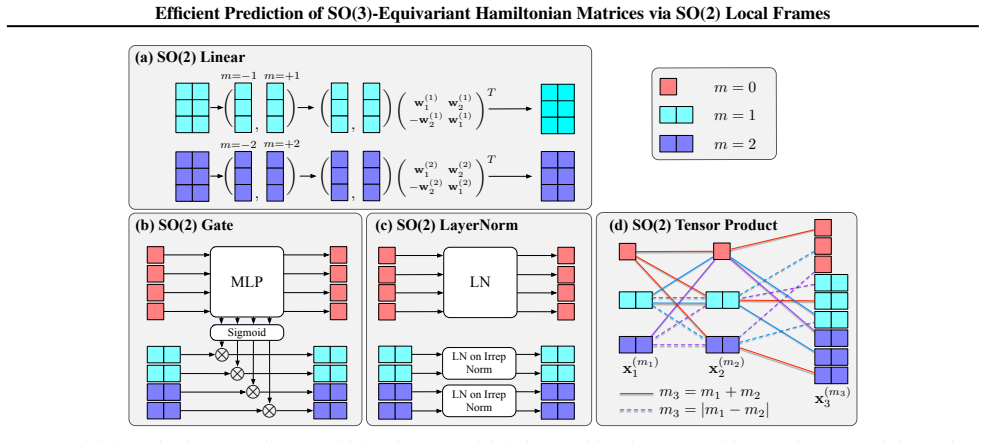
The load-bearing object is the SO(2) local frame—a rotation F(r̂) ∈ SO(3) that carries a reference direction r̂, typically the atom-pair direction r̂_ij, onto a fixed target vector v̂. Combining the frame with minimal frame averaging over the stabilizer Stab_SO(3)(v̂) ≅ SO(2) makes any SO(2)-equivariant block Φ satisfy Φ(g·r̂) = gΦ(r̂); the averaging sum then collapses to the single rotation h (Eq. 20), which is what proves global SO(3) equivariance. The new SO(2) operations are the SO(2) linear layer (a complex linear map per order m, Eq. 6), the SO(2) gate (Eq. 8) that lets m = 0 features modulate higher-m features, the norm-based SO(2) LayerNorm (Eq. 9) that normalizes the per-channel norm of each irrep, and the continuous SO(2) tensor product (Eqs. 3–5) which enumerates all valid paths with m₃ = m₁ + m₂ or m₃ = |m₁ − m₂| and costs O(M_max^v) paths for v features instead of the O($L_max^{6}$) of SO(3) tensor products.
What would settle it
Train or load the model on a molecule, rotate the atomic coordinates by a random Euler angle triple, predict the Hamiltonian, and rotate the predicted matrix back with the inverse Wigner-D matrices; the maximum entrywise residual against the unrotated prediction, averaged over many random rotations, should be at machine precision. A residual above about 1e−6 Hartree would demonstrate broken equivariance, and applying the same test block-by-block would isolate whether the SO(2) LayerNorm (Eq. 9) or the SO(2) tensor product (Eqs. 3–5) is the violating operation.
Extended reading notes
Core claim
The central claim is that the inherent structure of the task—the Hamiltonian's off-diagonal blocks live on atom pairs, and each pair defines a reference direction—can be exploited to reduce the architecture's symmetry demand. The paper constructs, for any unit direction r̂, a local frame F(r̂) that rotates r̂ to a fixed target vector v̂, and shows that any SO(2)-equivariant network Φ applied within that frame yields a globally SO(3)-equivariant architecture because the minimal-frame-averaging sum over the stabilizer collapses to the single canonicalizing rotation h (Eq. 20). Inside these frames the paper introduces SO(2) linear, gate, norm-based layer normalization (Eq. 9), and a continuous multi-path SO(2) tensor product (Eqs. 3–5) that fuses irreps under the selection rules m₃ = m₁ + m₂ or m₃ = |m₁ − m₂|, mimicking MACE-style symmetric contraction. All off-diagonal features are kept in their pair's frame across layers (Eq. 17), and only the diagonal blocks are updated in the global SO(3) system. On QH9 the model improves most metrics over the prior best (off-diagonal MAE 28.30 vs 73.68 × 10⁻⁶ Eh on stable-id compared with QHNet), on three MD17 molecules it cuts H MAE by at least 42%, and training throughput rises from 19.20 to 83.33 samples/s on the efficiency benchmark.
Load-bearing premise
The whole architecture's rotation symmetry rests on each SO(2) block inside the frame being exactly equivariant under rotations about the frame axis; if the norm-based LayerNorm's channel statistics or the m-truncated tensor product break that equivariance even slightly, the proof that the frame average collapses to a single rotation no longer applies and global SO(3) equivariance is lost.
Editorial extensions
If this is right
- SO(3)-equivariant Hamiltonian prediction becomes dominated by O(L_max^3) rotation costs rather than O(L_max^6) tensor products, so higher angular momentum cutoffs such as f-orbitals become affordable; the paper already operates at L_max = 4.
- A single frame per node pair plus node-level frames gives off-diagonal and diagonal blocks a uniform treatment, and ablation studies show both the SO(2) tensor product node update and the SO(2) FFN off-diagonal update contribute, with all-block MAE dropping from 49.84 to 31.50 × 10⁻⁶ Eh on QH9-stable-id.
- Training throughput rises 4.34× over QHNet with lower GPU memory per sample (0.32 vs 0.70 GB), so larger molecules and longer molecular-dynamics trajectories become practical to train on.
- The model transfers to unseen molecules (QH9-stable-ood split) and to MD17 trajectories, cutting H MAE by at least 42% on three of the four datasets, indicating the frame-based parametrization generalizes beyond its training distribution.
Reading between the lines
- The paper leaves room for an exact equivariance audit of Eq. 9: because the LayerNorm statistics μ and σ are computed from the norm of the irreps, they are rotation-invariant and the formula looks equivariant on paper, but whether the per-channel affine bias term preserves equivariance for m > 0 features is not proved in the text; a direct random-rotation residual test would settle it quickly.
- The nearest-neighbor node frame (Eq. 13) is discontinuous, as the paper itself notes; replacing the single chosen frame by an average over all neighbor frames would cost O(n²) frames per molecule but restore continuity of node features, and the reported efficiency numbers suggest that cost may be affordable.
- Because the SO(2) tensor product's path count is O(M_max^v), multi-body contractions of order v become polynomially cheap, so a natural testable extension is to raise v beyond 2 and check whether QH9 or MD17 errors keep dropping in the way the MACE many-body hierarchy does.
Editorial analysis
A structured set of objections, weighed in public.
Referee Report
Summary. The paper proposes QHNetV2, a graph neural network for predicting Hamiltonian matrices in atomic-orbital bases, which aims to achieve global SO(3) equivariance without using SO(3) Clebsch-Gordan tensor products. The key idea is to project node and edge features into local SO(2) frames and to perform all feature updates, message passing, and node updates using newly introduced SO(2)-equivariant operations: SO(2) Linear, SO(2) Gate, SO(2) LayerNorm, and a continuous SO(2) tensor product. The authors argue that because each operation is exactly SO(2)-equivariant inside the frame, the frame-averaging collapse of Appendix C yields exact global SO(3) equivariance. Experiments on QH9 and MD17 report consistently lower errors than QHNet and SPHNet on most benchmarks, with a 4.34x training speedup on QH9-stable-id, although on MD17 water QHNetV2 is worse than QHNet.
Significance. If the theoretical and empirical claims are substantiated, the paper offers a practically valuable way to reduce the computational cost of high-degree equivariant networks for Hamiltonian prediction, which is a core problem in machine-learning-accelerated electronic structure calculations. The 4.34x speedup and the improved accuracy on QH9 are attractive, and the idea of porting arbitrary SO(2) operations into a frame-averaging construction is a natural and potentially impactful extension of eSCN and minimal frame averaging. However, the central equivariance guarantee rests on the exact SO(2) equivariance of the newly introduced continuous tensor product, and the current presentation does not fully specify the treatment of negative or out-of-range output orders. The manuscript also ships no formal proof for this operation, and the complexity analysis contains an internal contradiction. The empirical superiority is not universal (MD17 water) and no error bars or multiple seeds are reported. These issues are fixable, but they are load-bearing for the paper's headline claims.
major comments (3)
- [Section 3.2, Eqs. (3)-(5)] The continuous SO(2) tensor product is not fully specified, and this is load-bearing for the global SO(3) equivariance claim. Eq. (5) sums over paths with m_o = s_1 m_1 + ... + s_v m_v, s_i in {+1,-1}, but the feature store only contains orders m in [0, Mmax]. The paper never states what happens when m_o < 0 or |m_o| > Mmax. For the binary case, Eq. (4) defines m_o = m_1 - m_2 only for m_1 > m_2; the claimed case m_o = m_2 - m_1 is not given a formula, and for general v the intermediate outputs may leave the allowed order range. If negative m_o are stored in the positive-order basis without an explicit conjugation/basis change, the operation does not commute with the SO(2) representation; if paths with out-of-range m_o are clamped to Mmax, that is not equivariant because R_{m_o}(phi) != R_{Mmax}(phi). Discarding is equivariant only if done consistently, but the paper does not say that this is the policy. Since Appendix C, Eq. (20) collapses the frame average only under exact SO(2) equivariance of every operation inside the frame, the ambiguity directly threatens the paper's headline claim of global SO(3) equivariance. Please provide an exact definition of the path set (including the admissible output orders), the handling of negative m_o, and a proof of equivariance for the full operation.
- [Section 3.2, complexity discussion] The complexity analysis is internally inconsistent. The text states that 'the number of paths for SO(2) TP is O(Mmax^2)' for the binary case, then asks the reader to see 'why the time complexity is linear in Mmax', and later concludes 'the total complexity will be M^2 for two SO(2) irreps as input of SO(2) TP.' A number of paths quadratic in Mmax cannot yield complexity linear in Mmax unless each path costs O(1/Mmax), which is not the case. The 'linear' sentence is presumably a typo, but it is in the central efficiency argument and must be fixed. Please also clarify the scaling in v and Mmax for the multi-path case, and state the overall asymptotic cost including the O(Lmax^3) frame rotations.
- [Table 2 and Section 5.2] The empirical claim of 'superior performance across a wide range of molecular structures and trajectories' is contradicted by the water results in Table 2, where QHNetV2 reports H MAE 22.55 x 10^-6 Eh versus 10.36 for QHNet, and the 100.00 vs 99.99 value for psi is also reversed. The paper's explanation about the small training set is plausible, but it does not change the fact that the abstract and conclusion overstate the empirical advantage. In addition, no error bars, standard deviations, or multiple seeds are reported anywhere, so the significance of the improvements on QH9 and on the other MD17 molecules cannot be assessed. Please report multiple seeds (or justify why a single run is sufficient for these benchmarks) and qualify the claim to reflect the water result.
minor comments (6)
- [Eq. (5)] The term 'continuous' in 'continuous SO(2) tensor product' is never defined; please clarify whether it refers to the continuous set of m values, the multi-path continuous indexing, or something else.
- [Eq. (9)] The text writes 'standard derivation' where 'standard deviation' is meant. Also, the formula in the displayed equation uses sigma^2 in the denominator but the definition says 'standard deviation'; make the notation consistent.
- [Section 3.2, after Eq. (5)] The phrase 'To see why the time complexity is linear in Mmax' is clearly an error; it should say 'quadratic' or be removed. The sentence 'The total complexity will be M^2' also uses an undefined symbol M; use Mmax.
- [Section 3.3, Eq. (13)] The notation 'F(n_i) = F(hat{r}_ij) with arg min_{j in N_i} bar{r}_ij' is ambiguous; write explicitly that j is the index of the nearest neighbor of i.
- [Section 6] The sentence 'eliminating the need for tensor product (TP) operations in both diagonal and off-diagonal components' is too strong: the matrix construction (Section 3.3, 'Matrix Construction') still uses a CG-based expansion module from QHNet. Please rephrase to say that TP operations are removed from the feature updates and message passing.
- [Table 3] The efficiency comparison would be more informative with parameter counts for QHNet, SPHNet, and QHNetV2, since a speed/accuracy trade-off is otherwise incomplete.
Circularity Check
No significant circularity: the SO(3)-equivariance claim follows from external frame-averaging and eSCN results plus explicit SO(2)-equivariant layer formulas, not from fitted parameters or self-defined predictions.
full rationale
The derivation chain is self-contained in the relevant sense: Appendix C proves that a Stab_SO(3)(v)-equivariant local network Phi yields a global SO(3)-equivariant averaged network via Eq. 20, and each proposed SO(2) operation is given with an explicit equivariant form (Eqs. 3-9) that does not depend on the Hamiltonian labels being predicted. The minimal frame averaging theorem from Lin et al. (2024) and the SO(2)-linear equivalence from eSCN are cited as mathematical, parameter-free results with stated assumptions that do not include the Hamiltonian prediction target; although Lin et al. shares authors with this paper, it is independent support rather than a fitted or task-specific input, so it does not raise the circularity score. The experimental claims are benchmark comparisons and ablations against existing models, not predictions forced by construction from training targets. The unclarified handling of negative or out-of-range output orders in the multi-path SO(2) tensor product (Eq. 5) is a potential equivariance correctness issue, but it is not a circularity because it is not an input-output equivalence by construction. No self-definitional step, fitted-input-called-prediction step, or renaming of a known result was found. Therefore the paper is scored 0 for circularity.
Assumptions & free parameters
free parameters (1)
- cutoff distance =
15 Bohr
assumptions (4)
- standard math Representations of SO(3) and SO(2) and the Wigner-D matrices transform Hamiltonian blocks as stated in Section 2.1.
- domain assumption The frame-averaging theorem of minimal frame averaging (Lin et al., 2024) applies to the constructed local frames and guarantees SO(3) equivariance for any SO(2)-equivariant local model.
- domain assumption eSCN's proposition that an SO(2) linear layer with appropriate frames can implement the action of an SO(3) tensor product with spherical harmonics (Passaro and Zitnick, 2023).
- domain assumption The DFT-computed Hamiltonian matrices in QH9 and MD17 are accurate enough to serve as ground truth for supervised learning.
Cite this review
Pith. "Pith review of Efficient Prediction of SO(3)-Equivariant Hamiltonian Matrices via SO(2) Local Frames." pith.science (2026). https://pith.science/paper/M5PMFFOK
@misc{pith2026250609398,
  author       = {Pith},
  title        = {Pith review of: Efficient Prediction of SO(3)-Equivariant Hamiltonian Matrices via SO(2) Local Frames},
  year         = {2026},
  howpublished = {\url{https://pith.science/paper/M5PMFFOK}},
  note         = {Machine review of arXiv:2506.09398}
}
read the original abstract
We consider the task of predicting Hamiltonian matrices to accelerate electronic structure calculations, which plays an important role in physics, chemistry, and materials science. Motivated by the inherent relationship between the off-diagonal blocks of the Hamiltonian matrix and the SO(2) local frame, we propose a novel and efficient network, called QHNetV2, that achieves global SO(3) equivariance without the costly SO(3) Clebsch-Gordan tensor products. This is achieved by introducing a set of new efficient and powerful SO(2)-equivariant operations and performing all off-diagonal feature updates and message passing within SO(2) local frames, thereby eliminating the need of SO(3) tensor products. Moreover, a continuous SO(2) tensor product is performed within the SO(2) local frame at each node to fuse node features, mimicking the symmetric contraction operation. Extensive experiments on the large QH9 and MD17 datasets demonstrate that our model achieves superior performance across a wide range of molecular structures and trajectories, highlighting its strong generalization capability. The proposed SO(2) operations on SO(2) local frames offer a promising direction for scalable and symmetry-aware learning of electronic structures. Our code will be released as part of the AIRS library https://github.com/divelab/AIRS.
Figures

Reference graph
Works this paper leans on
-
[2]
Dym, N., Lawrence, H., and Siegel, J
URL https://openreview.net/forum? id=_xwr8gOBeV1. Dym, N., Lawrence, H., and Siegel, J. W. Equivariant frames and the impossibility of continuous canonicaliza- tion.arXiv preprint arXiv:2402.16077, 2024. Fey, M. and Lenssen, J. E. Fast graph representation learning with PyTorch Geometric.arXiv Preprint, arXiv:1903.02428, 2019. Fuchs, F., Worrall, D., Fisc...
arXiv 2024
-
[2021]
doi: 10.1038/s41586-021-03819-2. Khrabrov, K., Shenbin, I., Ryabov, A., Tsypin, A., Telepov, A., Alekseev, A., Grishin, A., Strashnov, P., Zhilyaev, P., Nikolenko, S., et al. nablaDFT: Large-scale conforma- tional energy and Hamiltonian prediction benchmark and dataset.Physical Chemistry Chemical Physics, 24(42): 25853–25863, 2022. Khrabrov, K., Ber, A., ...
-
[2022]
Batzner, S., Musaelian, A., Sun, L., Geiger, M., Mailoa, J
URL https://openreview.net/forum? id=YPpSngE-ZU. Batzner, S., Musaelian, A., Sun, L., Geiger, M., Mailoa, J. P., Kornbluth, M., Molinari, N., Smidt, T. E., and Kozinsky, B. E(3)-equivariant graph neural networks for data-efficient and accurate interatomic potentials.Nature Communications, 13(1):2453, 2022. Brandstetter, J., Hesselink, R., van der Pol, E.,...
work page 2022
-
[2023]
Wang, Y ., Li, H., Tang, Z., Tao, H., Wang, Y ., Yuan, Z., Chen, Z., Duan, W., and Xu, Y
URL https://openreview.net/forum? id=3DIpIf3wQMC. Wang, Y ., Li, H., Tang, Z., Tao, H., Wang, Y ., Yuan, Z., Chen, Z., Duan, W., and Xu, Y . DeepH-2: enhancing deep-learning electronic structure via an equivariant local- coordinate transformer.arXiv preprint arXiv:2401.17015, 2024. Xu, Z., Yu, H., Bohde, M., and Ji, S. Equivariant graph network approximat...
arXiv 2024
Reviewed August 7, 2026 · model on record in the stance chip above.
Discussion (0). Continue with ORCID to comment.