REVIEW 6 major objections 6 minor 26 references
Analytic Task Scheduler: Recursive Least Squares Based Method for Continual Learning in Embodied Foundation Models
T0 review · 6 major / 6 minor · reviewed 2026-08-07 · deepseek-v4-flash
Pith's one-line read A language-driven analytic scheduler lets a robot learn new skills without losing old ones.
desk verdict A clean RLS router over a per-task model library; the math is right, but the fe module is unspecified and the experiments are too thin to support the forgetting-free claim as stated. read the letter →
The pith
A machine-rendered reading of the paper's core claim, the machinery that carries it, and where it could break.
The reading
What carries the argument
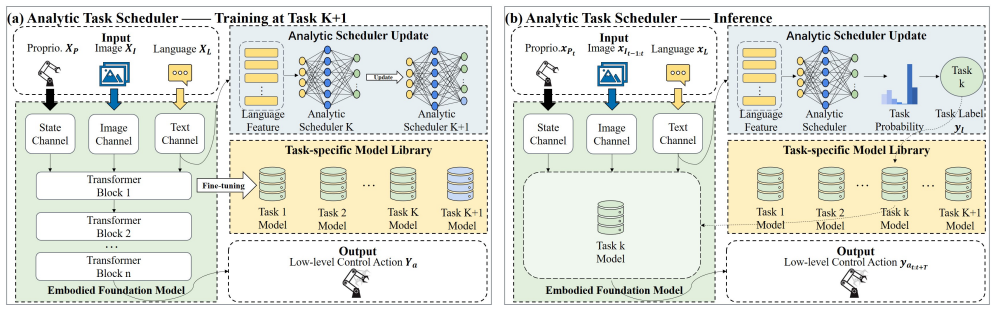
The carrier of the argument is the analytic scheduler, a linear map $W$ that takes expanded language features to task-label scores via ridge regression. Its closed-form solution is $W = R_K Q_K$, where $R_K$ is the regularized autocorrelation of the expanded feature matrix and $Q_K$ is its cross-correlation with task labels; these two matrices are the only memory the scheduler keeps. When a new task arrives, the Woodbury matrix identity rewrites the inverse in the updated autocorrelation so that $R_{K+1}$ and $W_{K+1}$ are computed from the new task's features and labels alone. The ReLU feature-expansion layer $f_e$ (Eq. 8) is what makes the linearly regressed features more separable, and the recursion is what carries the forgetting-free claim.
What would settle it
Run the scheduler twice on the same task sequence, once with the feature-expansion layer frozen after initial training and once letting it adapt by backpropagation, and compare the recursive weights with the closed-form batch solution over all tasks; any difference, or any drop in task-1 recognition accuracy, would falsify the claim of complete resistance to catastrophic forgetting.
Extended reading notes
Core claim
The central claim is that an embodied foundation model can continually acquire new skills if task identity is handled by a separate analytic module rather than by the policy network itself. ATS fine-tunes one model per task into a task-specific model library, then inserts a recursive least squares scheduler into the language input channel that predicts $p(k|x_L)$ from pooled, ReLU-expanded language features. Because the scheduler update (Eq. 18) derives from the Woodbury identity and reproduces the ridge-regression solution over all tasks seen so far, the authors assert that adding task $K+1$ cannot degrade task-to-model mappings learned earlier. The validation on the RM65B platform with two real manipulation tasks and ten language-instruction categories is presented as evidence that the framework is deployable, not merely a simulation result.
Load-bearing premise
The forgetting-free property assumes the expanded language features are fixed inputs to the regression, yet the paper never states how the ReLU feature-expansion layer is trained—if that layer changes after the first task, the stored autocorrelation and cross-correlation matrices are no longer sufficient statistics.
Editorial extensions
If this is right
- A new skill can be added without replaying old data: fine-tune one task model, extract its expanded language features, and update the scheduler with the Woodbury recursion.
- Task recognition and action generation are decoupled, so scheduler accuracy and per-task execution skill can be improved independently.
- The reported numbers imply that sequential fine-tuning without ATS nearly destroys the first task (banana execution drops to 23.05 after learning corn), while ATS keeps both tasks above 66/100.
- Because scheduler inference is one linear map followed by softmax, task routing can run on CPU-only edge hardware even if the heavier per-task models are served elsewhere.
Reading between the lines
- The math implies an unstated design rule: freeze the language encoder and feature-expansion layer after initial training, because any later change to $f_e$ invalidates the stored autocorrelation and cross-correlation statistics and breaks the exactness of the recursive update.
- Since the scheduler only reads language and never inspects the action decoder, the same router could in principle choose among heterogeneous policies—even from different robot embodiments—making ATS a cross-platform routing layer.
- The practical cost of the approach is storage: each new task adds a full fine-tuned model, so large-scale deployments would want a pruning or model-merging mechanism as the library grows.
Editorial analysis
A structured set of objections, weighed in public.
Referee Report
Summary. The paper introduces the Analytic Task Scheduler (ATS), a continual-learning module for embodied foundation models. ATS maintains a library of independently fine-tuned, task-specific policies and a separate 'analytic scheduler' that maps language instructions to task identities. The scheduler is a ridge-regression classifier whose weights are updated with recursive least squares using only stored autocorrelation and cross-correlation statistics, avoiding replay. The authors derive the RLS update, claim complete resistance to catastrophic forgetting, and report experiments on a real RM65B robot with an RDT-170m backbone: scheduler accuracy across 10 instruction categories in a 5+5 incremental protocol, and task-execution scores on banana/corn picking for sequential fine-tuning, joint fine-tuning, and ATS.
Significance. If the system performs as claimed, it would be a useful system-level contribution: decoupling task-specific policies from a replay-free router is a clean way to avoid parameter interference, and the RLS algebra in Eqs. (15)-(18) is correct under the stated fixed-feature assumption. The paper deserves credit for testing on a real robot and for making the scheduler lightweight. However, the current evidence does not support the paper's central claims: the feature-expansion map is unspecified, no held-out language instructions are used, no single-task performance ceiling is reported for the robot tasks, and the reported forgetting rates in Table 2 directly contradict the 'complete resistance' claim. The approach is plausible, but the manuscript needs substantial additional experiments and clarification before the claims can be accepted.
major comments (6)
- [Section 3.5, Eq. (8)] The feature-expansion module f_e is described only as a 'feedforward layer with ReLU activation'; the paper never states its architecture, initialization, or whether its parameters are trained. The exactness of the RLS update in Eqs. (15)-(18) depends on the rows \tilde{L}_{f1:K} being fixed across incremental phases. If f_e is trained on new-task data, the stored autocorrelation R_K and cross-correlation Q_K no longer describe the current feature space, so Eq. (18) does not minimize Eq. (9) and the Section 3.6 claim of complete resistance to catastrophic forgetting does not follow. If f_e is a frozen random projection, that must be stated explicitly along with the initialization.
- [Sections 3.3-3.4, Eqs. (4)-(5)] The paper decouples the language channel C_L but does not state whether C_L is a single frozen feature map shared by the scheduler and all task-specific models. Because each M_{theta2}^k in the model library is independently fine-tuned, any update to the text encoder inside those models creates different language-feature maps. The scheduler's RLS statistics are valid only if \tilde{L}_f is computed by one fixed C_L; the manuscript must specify whose C_L is used at training and inference time and confirm that it is not updated by task-specific fine-tuning.
- [Section 4.3, Table 2] Table 2 reports 98.61% accuracy through IL Phase 4 and 95.83% at IL Phase 5, with a corresponding forgetting rate of 5.00%. This directly contradicts the Section 3.6 claim of 'complete resistance to catastrophic forgetting.' The RLS update is exact only with respect to the ridge-regression objective; adding new classes changes the joint minimizer, so accuracy on old tasks can legitimately drop. The text and the table need to be reconciled, either by tempering the word 'complete' or by explaining why the reported accuracy drops despite the exact batch-equivalent update.
- [Section 4.1, Language Dataset] The scheduler evaluation uses 102 hand-crafted instructions per category, but the paper does not describe any train/test split. The sentence 'The dataset is employed to train the analytic scheduler and evaluate the performance of task recognition' suggests the same instructions may be used for both, and the reported 95.83-100% accuracies could reflect memorization rather than generalization to unseen instructions. The authors should report accuracy on held-out instruction sets that were never used for training.
- [Section 4.3, Table 3] Table 3 lacks the single-task-only performance ceiling for each manipulation task. Without 'Pick up the banana (single-task only)' and 'Pick up the corn (single-task only)' scores, the ATS values of 66.27 and 66.50 cannot support the claim that task-specific performance is retained with minimal forgetting. The table also reports only mean scores over 20 trials with no standard deviations or trial-level data, so the differences among B-after-A, mix, and ATS are not statistically assessable.
- [Section 4, Overall Evaluation] The full-system claim of continual learning in an embodied foundation model is not directly tested. Table 2 evaluates the scheduler on 10 language-instruction categories in isolation, while Table 3 evaluates only two robot manipulation tasks and no pipeline that adds a third task to the library and measures both router accuracy and execution performance after the incremental step. The experiments should include at least one end-to-end continual-learning scenario in which a new task is added and the system's recognition and execution performance are measured together.
minor comments (6)
- [Section 3.5, Eq. (9)] The objective in Eq. (9) is written as 'arg max' but the expression to be minimized should be 'arg min.'
- [Section 3.6] The sentence 'given the previously computed matrices R_K and C_K' should refer to the cross-correlation matrix Q_K, not C_K.
- [Section 1, Contributions] The contribution bullet says 'enabling continual learning without catastrophic learning'; this should presumably read 'without catastrophic forgetting.'
- [Section 4.3, Table 2] The text says the average forgetting rate remains close to 2.34%, but the table lists per-phase forgetting rates; please state explicitly how the average is computed and over which previous tasks it is averaged.
- [Section 3.1, Eq. (1)] Eq. (1) writes the objective as a product of two log-likelihood terms; this is not a joint log-likelihood in the usual sense, and the notation should be corrected or clarified.
- [Section 4.1] The subsection labeled 'Hardware Information' is about the robot and sensors rather than about the datasets; consider renaming it to avoid confusion.
Circularity Check
No substantial circularity; the RLS forgetting-free claim follows by direct algebra, and the only self-citation in the Related Work taxonomy is not load-bearing.
full rationale
The central derivation in Sections 3.5 and 3.6 is self-contained. Equation (11) is the closed-form ridge-regression solution, Equations (12) through (14) define the stored autocorrelation and cross-correlation statistics, and Equation (18) follows from Equation (15) by the Woodbury identity. The statement that the update does not require historical task data is therefore an exact algebraic identity of recursive least squares, not a conclusion assumed as a premise. The scheduler mapping is trained on language-instruction data, and the task-specific models are fine-tuned independently, so no fitted parameter is renamed as a prediction. The only self-citation, reference [10], appears in a general taxonomy of continual-learning methods in the Related Work section and is not load-bearing for the derivation or for the RM65B experiments. One condition is left implicit: the derivation treats the expanded features from f_e and the language channel C_L as fixed functions, so R_K and Q_K remain valid sufficient statistics across incremental phases. If f_e were trained by backpropagation, Equation (18) would no longer reproduce the batch solution; this is an unstated assumption and a correctness risk, not a circular step. Overall, no significant circularity is present.
Assumptions & free parameters
free parameters (3)
- regularization coefficient gamma =
not reported
- feature expansion output dimension de =
not reported
- feature expansion parameters fe =
not reported
assumptions (7)
- standard math The Woodbury matrix identity is valid for the stated matrices.
- standard math The batch ridge regression solution (Eq. 11) is the intended optimum of Eq. (9).
- domain assumption The language encoder CL is fixed and its features remain valid across incremental tasks.
- domain assumption Task identity labels Yl are available for every training instruction.
- ad hoc to paper The feature expansion fe is a fixed feature map, or its training is independent of the ridge regression.
- domain assumption Average pooling over the language sequence preserves task-discriminative information.
- domain assumption Each fine-tuned task model remains competent without updates, and the backbone is not jointly trained.
Cite this review
Pith. "Pith review of Analytic Task Scheduler: Recursive Least Squares Based Method for Continual Learning in Embodied Foundation Models." pith.science (2026). https://pith.science/paper/XJBIDKYU
@misc{pith2026250609623,
  author       = {Pith},
  title        = {Pith review of: Analytic Task Scheduler: Recursive Least Squares Based Method for Continual Learning in Embodied Foundation Models},
  year         = {2026},
  howpublished = {\url{https://pith.science/paper/XJBIDKYU}},
  note         = {Machine review of arXiv:2506.09623}
}
read the original abstract
Embodied foundation models are crucial for Artificial Intelligence (AI) interacting with the physical world by integrating multi-modal inputs, such as proprioception, vision and language, to understand human intentions and generate actions to control robots. While these models demonstrate strong generalization and few-shot learning capabilities, they face significant challenges in continually acquiring new skills without forgetting previously learned skills, a problem known as catastrophic forgetting. To address this issue, we propose the Analytic Task Scheduler (ATS), a novel framework for continual learning in embodied foundation models. ATS consists of a task-specific model library, where each model is fine-tuned independently on a single task, and an analytic scheduler trained using recursive least squares (RLS) to learn the mapping between language instructions and task-specific models. This architecture enables accurate task recognition and dynamic model selection while fundamentally avoiding parameter interference across tasks. The scheduler updates its parameters incrementally using only statistics (autocorrelation and cross-correlation matrices), enabling forgetting-resistant learning without the need to revisit historical data. We validate ATS on a real-world robot platform (RM65B), demonstrating superior resistance to forgetting and strong adaptability to task variations. The results highlight ATS as an effective, scalable, and deployable solution for continual learning in embodied foundation models operating in complex, dynamic environments. Our code will be available at https://github.com/MIAA-Embodied-AI/AnalyticTaskScheduler
Figures


Figures from the paper (1 more)

Reference graph
Works this paper leans on
-
[1]
C. L. Cheang, G. Chen, Y . Jing, T. Kong, H. Li, Y . Li, Y . Liu, H. Wu, J. Xu, Y . Yang, et al., Gr-2: A generative video- language-action model with web-scale knowledge for robot manipulation, arXiv preprint arXiv:2410.06158, 2024
- [2]
-
[3]
S. Liu, L. Wu, B. Li, H. Tan, H. Chen, Z. Wang, K. Xu, H. Su, and J. Zhu, Rdt-1b: A diffusion foundation model for bimanual manipulation, arXiv preprint arXiv:2410.07864, 2024
arXiv 2024
-
[4]
D.-W. Zhou, Q.-W. Wang, Z.-H. Qi, H.-J. Ye, D.-C. Zhan, and Z. Liu, Class-incremental learning: A survey, IEEE Transac- tions on Pattern Analysis and Machine Intelligence , 2024
work page 2024
-
[5]
E. Belouadah, A. Popescu, and I. Kanellos, A comprehensive study of class incremental learning algorithms for visual tasks, Neural Networks, vol. 135, pp. 38–54, 2021
work page 2021
-
[6]
J. He, H. Guo, K. Zhu, Z. Zhao, M. Tang, and J. Wang, SEEKR: Selective Attention-Guided Knowledge Retention for Continual Learning of Large Language Models, arXiv preprint arXiv:2411.06171, 2024
work page Pith review arXiv 2024
-
[7]
F. Xie, A. Chowdhury, M. De Paolis Kaluza, L. Zhao, L. Wong, and R. Yu, Deep imitation learning for bimanual robotic ma- nipulation, Advances in Neural Information Processing Sys- tems, vol. 33, pp. 2327–2337, 2020
work page 2020
-
[8]
L. Tang, Z. Tian, K. Li, C. He, H. Zhou, H. Zhao, X. Li, and J. Jia, Mind the interference: Retaining pre-trained knowledge in parameter efficient continual learning of vision- language models, in European Conference on Computer Vi- sion, Springer, 2024, pp. 346–365
work page 2024
Show all 26 references
-
[9]
Z. Wang, Z. Zhang, C.-Y . Lee, H. Zhang, R. Sun, X. Ren, G. Su, V . Perot, J. Dy, and T. Pfister, Learning to prompt for continual learning, in Proceedings of the IEEE/CVF Con- ference on Computer Vision and Pattern Recognition , 2022, pp. 139–149
2022
-
[10]
K. Tong, K. Pan, X. Zhang, E. Meng, R. He, Y . Cui, N. Guo, and H. Zhuang, Analytic Subspace Routing: How Recursive Least Squares Works in Continual Learning of Large Language Model, arXiv preprint arXiv:2503.13575, 2025
2025 arXiv
-
[11]
Aljundi, F
R. Aljundi, F. Babiloni, M. Elhoseiny, M. Rohrbach, and T. Tuytelaars, Memory aware synapses: Learning what (not) to forget, in Proceedings of the European Conference on Com- puter Vision (ECCV), 2018, pp. 139–154
2018
-
[12]
Kirkpatrick, R
J. Kirkpatrick, R. Pascanu, N. Rabinowitz, J. Veness, G. Des- jardins, A. A. Rusu, K. Milan, J. Quan, T. Ramalho, A. Grabska-Barwinska, et al., Overcoming catastrophic forget- ting in neural networks, Proceedings of the National Academy of Sciences, vol. 114, no. 13, pp. 3521–...
2017
-
[13]
Li and D
Z. Li and D. Hoiem, Learning without forgetting, IEEE Transactions on Pattern Analysis and Machine Intelligence , vol. 40, no. 12, pp. 2935–2947, 2017
2017
-
[14]
Zenke, B
F. Zenke, B. Poole, and S. Ganguli, Continual learning through synaptic intelligence, in International Conference on Machine Learning, PMLR, 2017, pp. 3987–3995
2017
-
[15]
X. Li, Y . Zhou, T. Wu, R. Socher, and C. Xiong, Learn to grow: A continual structure learning framework for overcom- ing catastrophic forgetting, inInternational Conference on Ma- chine Learning, PMLR, 2019, pp. 3925–3934
2019
-
[16]
N. Loo, S. Swaroop, and R. E. Turner, Generalized variational continual learning, arXiv preprint arXiv:2011.12328, 2020
2011 arXiv
-
[17]
Z. Ke, B. Liu, and X. Huang, Continual learning of a mixed sequence of similar and dissimilar tasks, Advances in Neu- ral Information Processing Systems, vol. 33, pp. 18493–18504, 2020
2020
-
[18]
Chaudhry, M
A. Chaudhry, M. Rohrbach, M. Elhoseiny, T. Ajanthan, P. K. Dokania, P. H. S. Torr, and M. A. Ranzato, On tiny episodic memories in continual learning, arXiv preprint arXiv:1902.10486, 2019
1902 arXiv
-
[19]
Chaudhry, M
A. Chaudhry, M. A. Ranzato, M. Rohrbach, and M. Elho- seiny, Efficient lifelong learning with a-gem, arXiv preprint arXiv:1812.00420, 2018
2018 arXiv
-
[20]
T. L. Hayes, N. D. Cahill, and C. Kanan, Memory efficient experience replay for streaming learning, in2019 International Conference on Robotics and Automation (ICRA) , IEEE, 2019, pp. 9769–9776
2019
-
[21]
H. Cha, J. Lee, and J. Shin, Co2l: Contrastive continual learn- ing, in Proceedings of the IEEE/CVF International Conference on Computer Vision, 2021, pp. 9516–9525
2021
-
[22]
Buzzega, M
P. Buzzega, M. Boschini, A. Porrello, D. Abati, and S. Calder- ara, Dark experience for general continual learning: a strong, simple baseline, Advances in Neural Information Processing Systems, vol. 33, pp. 15920–15930, 2020
2020
-
[23]
Y . Meng, Z. Bing, X. Yao, K. Chen, K. Huang, Y . Gao, F. Sun, and A. Knoll, Preserving and combining knowledge in robotic lifelong reinforcement learning, Nature Machine Intelligence, pp. 1–14, 2025
2025
-
[24]
Z. Han, C. Gao, J. Liu, J. Zhang, and S. Q. Zhang, Parameter- efficient fine-tuning for large models: A comprehensive survey, arXiv preprint arXiv:2403.14608, 2024
2024 arXiv
-
[25]
E. J. Hu, Y . Shen, P. Wallis, Z. Allen-Zhu, Y . Li, S. Wang, L. Wang, W. Chen, et al., Lora: Low-rank adaptation of large language models, ICLR, vol. 1, no. 2, p. 3, 2022
2022
-
[26]
M. A. Woodbury, Inverting modified matrices, Department of Statistics, Princeton University, 1950
1950
Reviewed August 7, 2026 · model on record in the stance chip above.
Discussion (0). Sign in to comment.