REVIEW 2 major objections 4 minor 2 cited by
Higher Chiral Algebras in a Polysimplicial Model
T0 review · 2 major / 4 minor · reviewed 2026-08-07 · deepseek-v4-flash
Pith's one-line read First explicit higher-dimensional chiral algebra is constructed on affine n-space.
desk verdict A substantial and likely correct construction of higher chiral algebras via a polysimplicial model; the stress-test on Lemma 40 does not survive a close read. read the letter →
The pith
A machine-rendered reading of the paper's core claim, the machinery that carries it, and where it could break.
The reading
What carries the argument
The paper's central object is the polysimplicial model $P^k_{\mathbb{A}^n}$: polynomial differential forms on a product of $\binom{k}{2}$ copies of the algebraic $(n-1)$-simplex, one factor for each pair of marked points, with boundary conditions that force the form to be regular in $z^r_i-z^r_j$ on the face $u^r_{ij}=0$. This model represents the derived global sections $R\Gamma(\mathrm{Conf}_k(\mathbb{A}^n),\mathcal{O})$ and, for $D$-modules, the pushforward along the open embedding of the configuration space (Theorems 2 and 3). The load-bearing identities are the propagators $P_{ij}=\mathrm{Vol}(\Delta_{n-1})_{ij}/(z^1_{ij}\cdots z^n_{ij})$, whose cohomology classes generate $H^*(P^k_{\mathbb{A}^n})$ and obey Arnold relations; together with the residue map $\mu_2=\int_{\Delta_{n-1}}\mathrm{res}_{z^1_2\to z^1_1} e^{\lambda^1_2(z^1_2-z^1_1)}\cdots\mathrm{res}_{z^n_2\to z^n_1}e^{\lambda^n_2(z^n_2-z^n_1)}$, these generate the operad of chiral operations on the shifted canonical sheaf and carry the comparison with the Lie-infinity operad.
What would settle it
A concrete check is to compute $H^*(P^3_{\mathbb{A}^2})$ directly and verify that $P_{12}P_{23}+P_{23}P_{31}+P_{31}P_{12}$ is exact in the polysimplicial model; if it is not, the injectivity step of the proof of Theorem 9 fails. Alternatively, compute the homology of the Chevalley-Cousin complex for $k=3$, $n=2$: Theorem 45 predicts that it is concentrated in the bottom degree, so any additional homology class there would falsify the resolution statement.
Extended reading notes
Core claim
The central claim is Theorem 10: there is a quasi-isomorphism of dg operads $\mathrm{Lie}_\infty \xrightarrow{\sim} P^{\mathrm{ch}}_{\mathbb{A}^n}$, where $P^{\mathrm{ch}}_{\mathbb{A}^n}$ is the dg operad whose $k$-ary operations are $D$-module maps from the polysimplicial model of the $k$-fold external product of the shifted canonical sheaf to its diagonal pushforward. Concretely, the operations are built from iterated residues and integration over a polysimplex, with the binary operation $\mu_2$ being the chiral bracket and the higher $\mu_p$'s solving the coherence relations of an $L_\infty$-algebra. Consequently (Corollary 12) the shifted canonical sheaf $\omega^\diamondsuit_{\mathbb{A}^n}$ is a homotopy polysimplicial chiral algebra on $\mathbb{A}^n$, generalizing the one-dimensional situation where the same sheaf carries the unit chiral algebra and the chiral operad is exactly the Lie operad. The proof goes through an explicit computation of the cohomology of the polysimplicial model: it is generated by propagators $P_{ij}$ subject to Arnold relations, and the de Rham cohomology of the resulting complex is identified with the dual of the Lie operad.
Load-bearing premise
The load-bearing premise is that the polysimplicial model with its boundary conditions correctly computes the derived global sections of the structure sheaf, and the $D$-module pushforward, on the configuration space of $k$ points in $\mathbb{A}^n$; if the boundary conditions are incomplete, the chiral operations would not be the true chiral operations on $\mathbb{A}^n$.
Editorial extensions
If this is right
- For every $n\ge 1$, the shifted canonical sheaf $\omega^\diamondsuit_{\mathbb{A}^n}$ carries an explicit $L_\infty$-algebra structure, so higher-dimensional chiral algebras exist as concrete algebraic objects rather than only as formal homotopy-theoretic constructions.
- The cohomology of the configuration space of $k$ points in $\mathbb{A}^n$ is explicitly generated by propagators with Arnold relations, yielding a $k$-linear basis for $H^*(P^k_{\mathbb{A}^n})$ in all degrees (Theorem 22 and Corollary 23).
- The Chevalley-Cousin complex built from the chiral operations is a resolution of the global sections of the shifted canonical sheaf on $(\mathbb{A}^n)^k$, giving a higher-dimensional analog of the Cousin resolution behind chiral homology (Theorem 45).
- The first higher product $\mu_3$ is computed explicitly in dimension $n=2$, and the result agrees with the higher product obtained by summing Feynman diagrams in four-dimensional holomorphic theories.
Reading between the lines
- The same propagator-residue calculus should produce explicit higher chiral algebras for free bosons, free fermions, and $\beta\gamma$/$bc$ systems, since their operations can be expressed through the same $P_{ij}$ and $\mu_2$; the paper lists this as an expected application but does not carry it out.
- Because the dg operad is tied to the polysimplicial model, the resulting homotopy chiral algebras are model-dependent; embedding the hom spaces into the derived dg quotient described in Remark 13 should turn them into examples in the fully derived chiral setting of [FG12], a step the paper leaves open.
- The agreement of $\mu_3$ with the Feynman-diagram computation suggests that the algebraic model can serve as a rigorous, regularization-free definition of the divergent-looking renormalized integrals of higher-dimensional holomorphic field theories.
- The explicit chain-level control in this model suggests a testable program: compute the higher operations $\mu_p$ for all $p$ as iterated integrals over the dissections of the hypercube, and compare them with the operatope products appearing in the physics literature.
Editorial analysis
A structured set of objections, weighed in public.
Referee Report
Summary. The paper develops an explicit algebraic model, called the polysimplicial model, for the derived global sections of the structure sheaf on the configuration space of k labelled points in affine n-space. Using this model, the authors define a dg operad P^ch_{A^n} of chiral operations on a degree-shifted canonical sheaf ω^♦_{A^n} and prove that this operad is quasi-isomorphic to the Lie-infinity operad Lie_∞. As a corollary, ω^♦_{A^n} becomes the first constructed example of a homotopy polysimplicial chiral algebra on A^n, generalizing Malikov–Schechtman's one-dimensional homotopy chiral algebras. The paper also contains an explicit cohomology computation for the model, a Chevalley–Cousin complex, and an explicit formula for the first higher chiral operation µ_3 in dimension two, matching a Feynman-diagram computation in the physics literature.
Significance. If the main theorem is correct, this is a substantial and useful result: it gives the first explicit algebraic higher-dimensional analog of a vertex algebra, with all higher L_∞ operations realized by concrete residue and integration maps. The paper is not purely programmatic: the polysimplicial model is proved to compute the desired derived sections (Theorem 2 and Theorem 3), the operad structure is written down in detail, the cohomology of the model is computed by a spectral sequence, and the main quasi-isomorphism is proved from the model rather than assumed. The explicit µ_3 computation and its match with [Bud+23] is a valuable concrete check. The main theorems are therefore significant for chiral algebra theory, derived algebraic geometry, and mathematical physics, provided the flagged proof gaps are repaired.
major comments (2)
- [§7.3, Lemma 40 (and Proposition 33)] The eigenvalue bookkeeping for the Euler vector field E_◦ is not correct as written. In a right D-module, if f is a homogeneous coefficient of z-degree d and L = n(k−1) is the number of summands in E_◦, then (f dz♦^⊠k)·E_◦ = −(d + L) f dz♦^⊠k, because each term (m·z^s_{v◦})·∂_{z^s_v} contributes an additional −m from the Weyl relation ∂z = z∂ + 1. Thus the statement that 'propagators P_{ij} have eigenvalue −n' is a statement about z-degree, not about the right action. Concretely, for n=2, k=2, one computes P_{12} dz♦_1 dz♦_2 · E_◦ = 0, not ∓n. The kernel computation can be repaired: writing d = N − n r for the z-degree of the coefficient, the right E_◦-eigenvalue is −(d + n(k−1)), which vanishes exactly for N = 0 and r = k−1. So the claimed conclusion about maximal trees is correct, but the proof as written is not justified and the displayed eigenvalues in Lemma 40 must be corrected.
- [§6, Corollary 23] The k-basis of H_dP(P^k_{A^n}) is asserted with the proof omitted ('The proof is straightforward and we omit the details'). This basis is load-bearing: it is used directly in Lemma 40 to identify the kernel of E_◦ and to obtain the basis of h_dR ≅ Lie(k)^∨ on which the injectivity step of Theorem 9 rests. Since the spanning set (10) is described as overcomplete and the reduction to it involves nontrivial replacement manipulations, the omitted details are not merely cosmetic and should be supplied or replaced by a precise reference.
minor comments (4)
- [§5.3, Theorem 19] The Arnold relations are proved by a 'somewhat lengthy direct calculation' whose primitive is displayed. Given that the Arnold relations are used in Lemma 40 to control the S_k-compatibility and in Lemma 37 to reduce to special maximal trees, it would help the reader if the calculation were presented in more detail or in an appendix.
- [§4, Proposition 15] The associativity of the operad composition is checked in detail, but the remaining operad axioms are dismissed as 'straightforward to verify.' A brief indication of the axioms (unit, equivariance) would make the section self-contained.
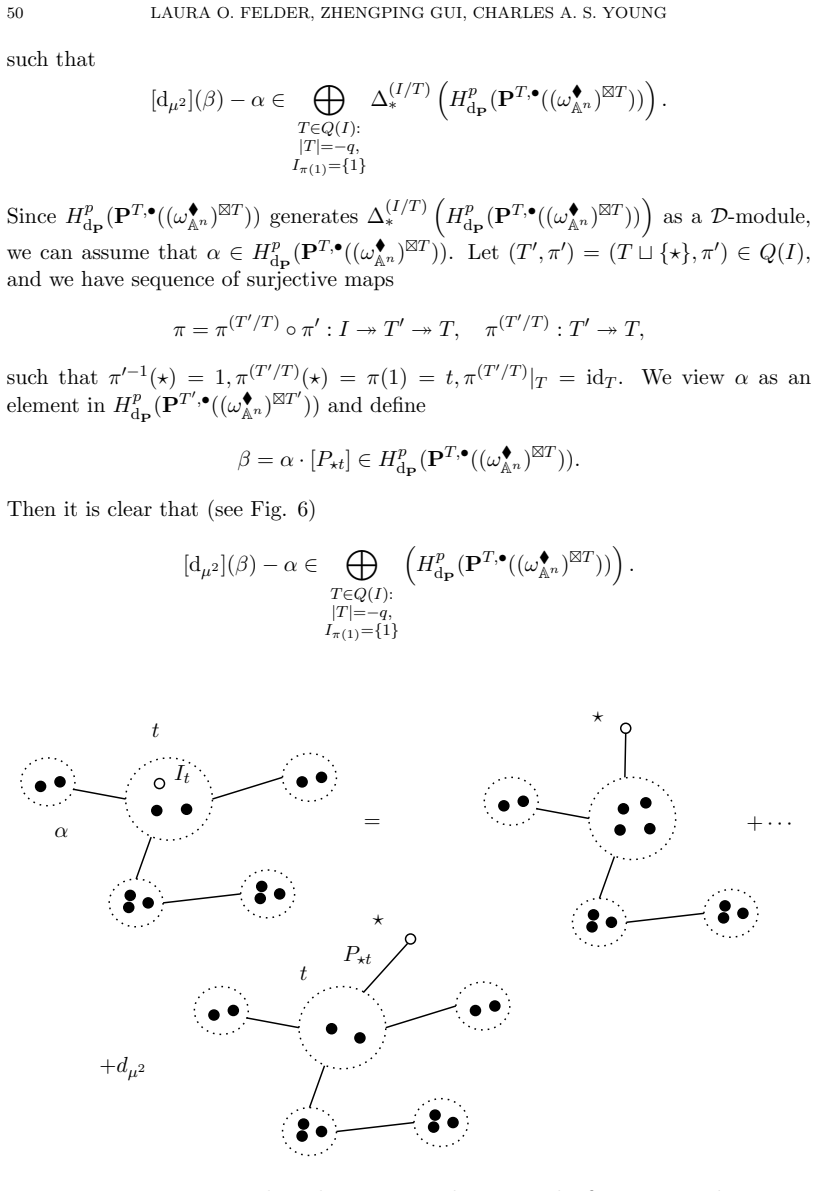
- [§8, Lemma 44 and Theorem 45] The proof of the Chevalley–Cousin complex resolution is sketched with the help of two figures and several 'similarly' steps. Since this is a separate theorem and not needed for the main quasi-isomorphism, the level of detail may be acceptable, but adding the missing [dµ2]-exactness verification would improve readability.
- [§3.3, Theorem 10] The model-category lifting proof is terse, especially in the diagram involving the truncation P^ch_{A^n,≥0}. A sentence clarifying why the vertical map is a trivial fibration (degree-wise surjectivity and quasi-isomorphism) would remove a possible ambiguity.
Circularity Check
No significant circularity: the polysimplicial model and operad P^ch_An are constructed independently, and the quasi-isomorphism Lie_∞ → P^ch_An is proved from the model rather than assumed.
full rationale
The derivation chain is self-contained against external benchmarks. The polysimplicial model P^k_An is defined by explicit boundary conditions (Section 2.2, equation (4)); its quasi-isomorphism to RΓ(Conf_k(A^n),O) is proved in Appendix B.5 via the Thom–Sullivan functor and an explicit deformation retract (Proposition 47), not assumed. The operad P^ch_An is then defined as Hom_D(...) spaces (Section 3.2), again without importing the target isomorphism. Theorem 9 is proved by computing H_dP(P^k_An) (Theorem 22 and Corollary 23), passing to translation-invariant de Rham cohomology, and comparing the resulting basis labelled by tuples (ℓ_2,...,ℓ_k), ℓ_j<j, with the standard Orlik–Solomon basis of Lie(k)^∨ cited from [Tot96] and [LV12]; that citation is external and the basis comparison is a computation, so the identification is not an input. The deduction of Theorem 10 from Theorem 9 uses the standard model-category argument for minimal cofibrant resolutions, again external and not specific to this construction. Self-citations appear in peripheral roles: [AY23] supplies only a conceptual analogy for a homotopy in Appendix B.5; [GWW] is an in-preparation aside about Arnold relations in the Jouanolou model and about Feynman integrals; [Gui23], [GL21], [AKY25] are contextual references. None is load-bearing for the central quasi-isomorphism. The skeptical concern about Lemma 40's Euler-vector-field eigenvalue bookkeeping is a possible correctness or rigor issue, not circularity: even if the eigenvalue argument were flawed, the claimed identification h_dR ≅ Lie(k)^∨ would be unsupported, but it would not reduce to an assumption of the theorem, because the basis computation is carried out from the model. Hence no step satisfies the standard for circularity: no fitted parameter is renamed a prediction, no defining equation equals the target by construction, and no load-bearing premise rests on the authors' own unverified prior work.
Assumptions & free parameters
assumptions (5)
- standard math The ordered Čech complex of a Leray cover computes sheaf cohomology, and the Thom-Sullivan functor models the homotopy limit of a semicosimplicial dg algebra.
- domain assumption Beilinson-Drinfeld's one-dimensional equivalence: vertex algebras correspond to translation-equivariant chiral algebras on A^1, and the unit chiral operad on A^1 is exactly the Lie operad.
- standard math The category of dg operads is a model category with quasi-isomorphisms as weak equivalences, and Lie_∞ is the minimal cofibrant resolution of Lie.
- domain assumption D-module pushforward along open and closed embeddings has the stated properties, including the projection formula and Bernstein's theorem for bounded complexes.
- standard math The Orlik-Solomon algebra of the braid arrangement is isomorphic to the dual of the Lie operad: OS(k)^{k-1} ≅ Lie(k)^∨.
Cite this review
Pith. "Pith review of Higher Chiral Algebras in a Polysimplicial Model." pith.science (2026). https://pith.science/paper/ZTNOJHRV
@misc{pith2026250609728,
  author       = {Pith},
  title        = {Pith review of: Higher Chiral Algebras in a Polysimplicial Model},
  year         = {2026},
  howpublished = {\url{https://pith.science/paper/ZTNOJHRV}},
  note         = {Machine review of arXiv:2506.09728}
}
abstract
Vertex algebras are equivalent to translation-equivariant chiral algebras on $\mathbb{A}^1$, in the sense of Beilinson and Drinfeld. In this paper we give an algebraic construction of a chiral algebra on $\mathbb{A}^n$; this can be seen as an algebraic construction of a higher-dimensional vertex algebra. We introduce a model, in dg commutative algebras, of the derived algebra of functions on the configuration space of $k$ distinct labelled marked points in $\mathbb{A}^n$. Working in this model -- which we call the polysimplicial model -- we obtain a dg operad of chiral operations on a degree-shifted copy of the canonical sheaf. We prove that there is a quasi-isomorphism, to this dg operad, from the Lie-infinity operad. This result makes the shifted canonical sheaf into a first example of a homotopy polysimplicial chiral algebra on $\mathbb{A}^n$, in a sense which generalizes to higher dimensions Malikov and Schechtman's notion of a homotopy chiral algebra.
Figures


Figures from the paper (6 more)




Forward citations
Cited by 2 Pith papers
-
Factorization Algebras and Quantum Groups from Generalized Poisson Sigma Models
Generalized Poisson sigma models realize deformation quantizations of holomorphic-topological factorization algebras and produce quantum groups as Koszul duals of their boundary algebras.
-
Higher-dimensional Chiral Algebras in the Jouanolou Model and free-field realization
The authors define d-dimensional homotopy chiral algebras in a Jouanolou model, construct the unit such algebra from Feynman-graph residues, and realize higher Kac-Moody and Virasoro structures via free fields.
Reference graph
Works this paper leans on
-
[1]
Raviolo vertex algebras, cochains, and conformal blocks
[AKY25] L. Alfonsi, H. Kim, and C. A. S. Young. “Raviolo vertex algebras, cochains, and conformal blocks”. In:Int. Math. Res. Not. IMRN4 (2025), Paper No. rnaf004, 42.doi:10.1093/imrn/rnaf004(cit. on p. 7). [AY23] L. Alfonsi and C. Young. “Higher current algebras, homotopy Manin triples, and a rectilinear adelic complex”. In:Journal of Geometry and Physic...
-
[10]
Infinite-dimensional (dg) Lie algebras and factorization algebras in algebraic geometry
American Mathe- matical Society, Providence, RI, 1998, pp. vi+201.doi:10.1090/ulect/ 010(cit. on p. 1). [Kap21] M. Kapranov. “Infinite-dimensional (dg) Lie algebras and factorization algebras in algebraic geometry”. In:Japanese Journal of Mathematics 16.1 (2021), pp. 49–80.doi:10 . 1007 / s11537 - 020 - 1921 - 4(cit. on p. 57). [Li23] S. Li. “Vertex algeb...
-
[16]
Higgs and coulomb branches from superconformal raviolo vertex algebras
Springer, New York, 2013, pp. xii+224.doi:10. 1007/978-1-4614-8468-4(cit. on p. 27). [GR W23] N. Garner, S. Raghavendran, and B. R. Williams.Higgs and coulomb branches from superconformal raviolo vertex algebras. Preprint, arXiv:2310.08524 [math.QA] (2023). 2023 (cit. on p. 7). [Gui23] Z. Gui.Trace Map on Chiral Weyl Algebras
work page Pith review arXiv 2023
-
[31]
Cambridge University Press, Cambridge, 2017, pp. ix+387.doi:10.1017/9781316678626(cit. on p. 7). [CG23] R. Campos and A. Grataloup. “Operadic Deformation Theory”. In:arXiv preprint arXiv:2307.11187(2023) (cit. on p. 15). [CLM76] F. R. Cohen, T. J. Lada, and J. P. May.The homology of iterated loop spaces. Springer-Verlag, Berlin-New York, 1976, pp. vii+490...
work page Pith review arXiv 2023
-
[38]
xiv+450.doi:10.1017/ CBO9781139644136(cit
Cam- bridge University Press, Cambridge, 1994, pp. xiv+450.doi:10.1017/ CBO9781139644136(cit. on pp. 28, 31). Email address:l.o.felder@herts.ac.uk, zgui@simis.cn, c.young8@herts.ac.uk ZG: Shanghai Institute for Mathematics and Interdisciplinary Sciences, Shanghai, China; LOF,CASY: Department of Physics, Astronomy and Mathematics, University of Hertfordshi...
work page 1994
-
[51]
Axiomatic homotopy theory for operads
American Mathe- matical Society, Providence, RI, 2004, pp. vi+375.doi:10.1090/coll/ 051(cit. on pp. 1–4, 7, 14, 16, 33, 45, 46, 48). [BM03] C. Berger and I. Moerdijk. “Axiomatic homotopy theory for operads”. In:Commentarii Mathematici Helvetici78 (2003), pp. 805–831 (cit. on p. 15). 72 REFERENCES [Bor86] R. E. Borcherds. “Vertex algebras, Kac-Moody algebr...
-
[88]
American Mathematical Society, Providence, RI, 2004, pp. xiv+400 (cit. on p. 1). [FG12] J. Francis and D. Gaitsgory. “Chiral Koszul duality”. In:Selecta Math. (N.S.)18.1 (2012), pp. 27–87.doi:10.1007/s00029-011-0065-z(cit. on pp. 2, 16). [FHK19] G. Faonte, B. Hennion, and M. Kapranov. “Higher Kac-Moody algebras and moduli spaces ofG-bundles”. In:Adv. Math...
-
[227]
xiv+318.doi:10.1007/978-0-8176-8186-9(cit
Birkh¨ auser Boston, Inc., Boston, MA, 2004, pp. xiv+318.doi:10.1007/978-0-8176-8186-9(cit. on p. 1). [L V12] J.-L. Loday and B. Vallette.Algebraic operads. Vol
Show all 13 references
-
[236]
Birkh¨ auser Boston, Inc., Boston, MA, 2008, pp
Translated from the 1995 Japanese edition by Takeuchi. Birkh¨ auser Boston, Inc., Boston, MA, 2008, pp. xii+407. doi:10.1007/978-0-8176-4523-6(cit. on pp. 19, 55, 65). [Kac98] V. Kac.Vertex algebras for beginners. Second. Vol
1995 doi
-
[271]
The Grothendieck duality theorem via Bousfield’s tech- niques and Brown representability
Springer-Verlag, Berlin-New York, 1972, pp. viii+175 (cit. on p. 17). [MS24] F. Malikov and V. Schechtman.Homotopy chiral algebras. 2024 (cit. on pp. 1, 2, 4, 15). [Nee96] A. Neeman. “The Grothendieck duality theorem via Bousfield’s tech- niques and Brown representability”. In...
1996
-
[346]
xxiv+634.doi:10.1007/978-3-642-30362-3(cit
Springer, Hei- delberg, 2012, pp. xxiv+634.doi:10.1007/978-3-642-30362-3(cit. on pp. 6, 15, 44). [Man22] M. Manetti.Lie methods in deformation theory. Springer, Singapore, [2022]©2022, pp. xii+574.doi:10 . 1007 / 978 - 981 - 19 - 1185 - 9(cit. on pp. 57, 64, 65). [May72] J. P....
2012 doi
-
[2021]
arXiv: 2112.14572 [math.QA](cit. on p. 46). [GM13] P. Griffiths and J. Morgan.Rational homotopy theory and differential forms. Second. Vol
-
[2023]
Higher Kac-Moody algebras and sym- metries of holomorphic field theories
arXiv:2310 . 15086 [math.QA](cit. on p. 46). [GW21] O. Gwilliam and B. R. Williams. “Higher Kac-Moody algebras and sym- metries of holomorphic field theories”. In:Adv. Theor. Math. Phys.25.1 (2021), pp. 129–239.doi:10.4310/ATMP.2021.v25.n1.a4(cit. on p. 2). [GW25] N. Garner an...
2021 doi
Reviewed August 7, 2026 · model on record in the stance chip above.
Discussion (0). Continue with ORCID to comment.