REVIEW 2 major objections 4 minor 1 cited by
Influence of photon-magnon coupling to enhance spin-wave excitation
T0 review · 2 major / 4 minor · reviewed 2026-08-07 · deepseek-v4-flash
Pith's one-line read The paper claims that an inverse split-ring resonator used as a spin-wave antenna excites spin waves in a 40-nanometer permalloy film with more than four times the efficiency of a conventional microstrip line at equal feed current, with…
desk verdict Solid numerical proof-of-concept for field-enhancing spin-wave excitation, but the 'fourfold conversion efficiency' claim is not supported by the metric actually computed. read the letter →
The pith
A machine-rendered reading of the paper's core claim, the machinery that carries it, and where it could break.
The reading
What carries the argument
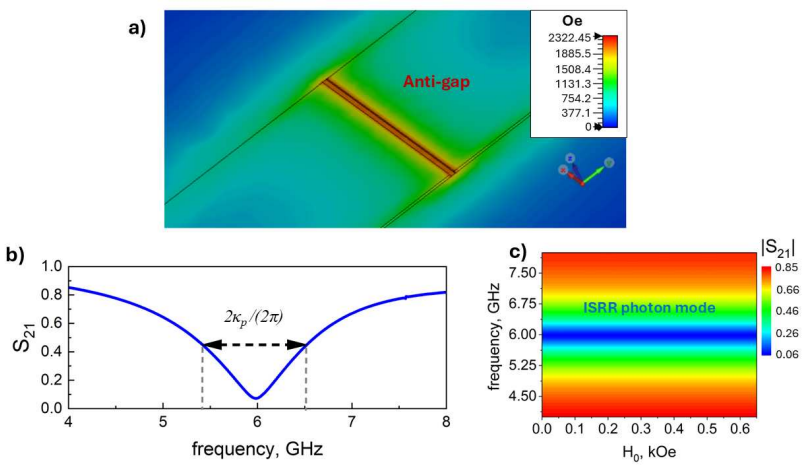
The load-bearing element is the inverse split-ring resonator, specifically its anti-gap strip: a narrow metallic bridge (1 by 50 micrometers) that carries a resonant microwave current and concentrates the alternating magnetic field in the region where the permalloy film sits. At resonance, this confined near field hybridizes the microwave photon mode with width-quantized magnetostatic modes, producing anti-crossing frequency gaps from which the coupling strength is read with the two-coupled-oscillator formula. The efficiency comparison is made through the enhancement factor $\eta = \langle|h_z^{\mathrm{ISRR}}|\rangle / \langle|h_z^{\mathrm{MSTL}}|\rangle$, the ratio of spatially averaged out-of-plane AC field in the film for the two antennas at equal input current. The ferromagnetic response is modeled with the Polder susceptibility tensor in full-wave simulations, and the lowest four spin-wave band frequencies are verified independently in micromagnetic simulations.
What would settle it
Measure, in a fabricated ISRR-plus-permalloy device at 6.62 GHz and a bias field near 390 Oe, the amplitude of the excited spin wave by Brillouin light scattering or propagating spin-wave spectroscopy, comparing the ISRR with a microstrip line under the same accepted microwave power rather than the same port current. If the on-chip spin-wave signal is not several times larger for the ISRR, or if impedance correction reduces the ratio toward unity, the central claim would be falsified.
Extended reading notes
Core claim
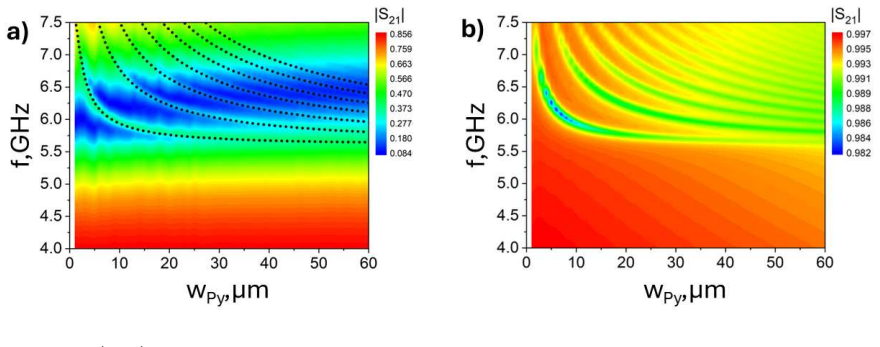
In its own terms, the paper's central claim is that the anti-gap strip of an inverse split-ring resonator acts as a resonant near-field antenna for spin waves: when a 50 by 12 by 0.04 micrometer permalloy film is placed over it, the out-of-plane alternating magnetic field inside the film is several times stronger than the field produced by a microstrip line of the same cross-section fed by the same 1 mA current. The transmission spectra show anti-crossings between the resonator mode and at least four width-quantized magnetostatic modes, with coupling strengths $g/(2\pi)$ of 175, 165, and 108 MHz and cooperativities between 0.826 and 0.143, placing the system in the weak-coupling regime. Along the spin-wave branches the spatially averaged field reaches above 700 Oe for the ISRR versus below 240 Oe for the microstrip, and the enhancement peaks at 6.62 GHz rather than at the 6 GHz resonator resonance. Increasing the film thickness to 100 nm raises the coupling strength to 267 MHz but reduces the enhancement to 2.8, which the paper interprets as evidence that weak coupling is preferable for efficient spin-wave excitation.
Load-bearing premise
The argument rests on identifying the ratio of spatially averaged AC magnetic field amplitudes in the permalloy film, at equal 1 mA feed current, with microwave-to-spin-wave conversion efficiency; if the field amplitude does not track the power actually delivered into spin waves, especially because the two antennas have different input impedances, the fourfold claim does not follow from the simulations.
Editorial extensions
If this is right
- At frequencies and bias fields around the anti-crossing gap, an ISRR excites the fundamental and first width-quantized spin-wave modes in a 40-nanometer permalloy film with roughly four times the AC field amplitude of a microstrip line at the same feed current.
- The enhancement is available in the weak-coupling regime, so the resonator does not need cryogenic superconducting materials or extremely narrow magnetic linewidths to be useful as a spin-wave launcher.
- Increasing the ferromagnet volume strengthens photon-magnon coupling but lowers the enhancement, from above 4.45 for the 40-nanometer film to 2.8 for the 100-nanometer film, indicating an optimal coupling strength for transduction.
- The active region is confined to subwavelength dimensions below 1 by 12 micrometers at 6 GHz while the feed line remains macroscopic, which supports integration into magnonic circuits.
- The ISRR simultaneously excites pure magnetostatic waves and hybrid photon-magnon modes, unlike a conventional microstrip antenna that predominantly excites only the magnetostatic modes.
Reading between the lines
- Because the reported factor compares AC field amplitudes at equal port current rather than spin-wave power delivered per unit of accepted microwave power, the practical efficiency gain should be rechecked with impedance-corrected or direct spin-wave power measurements; the two antennas present different input impedances.
- If the unexplained shift of maximum enhancement from 6 GHz to 6.62 GHz reflects the non-reciprocal negative permeability discussed in the paper, then changing the bias-field direction or the film position over the anti-gap should move or suppress the peak, which is a testable prediction.
- The same resonant near-field idea should transfer to other planar resonators and ferromagnetic metals; a systematic scan of resonator loss, film thickness, and lateral size could map where the weak-coupling enhancement is largest.
- The paper's coupling parameters suggest that pushing the same design into the strong-coupling regime, for example by reducing resonator loss, could be counterproductive for transduction efficiency even if it is desirable for quantum information applications.
Editorial analysis
A structured set of objections, weighed in public.
Referee Report
Summary. The paper proposes an inverse split-ring resonator (ISRR) as a near-field antenna for exciting spin waves in a thin permalloy film, arguing that photon-magnon hybridization enhances the excitation compared with a conventional microstrip line. Full-wave CST simulations with a Polder-tensor material model show an anti-crossing in the |S21|(f, H0) map, from which the authors extract coupling strengths g/2π = 175 MHz for the fundamental mode, 165 MHz and 108 MHz for higher modes, and cooperativities below unity, i.e., weak coupling. The enhancement factor η, defined as the ratio of spatially averaged |hz| inside the Py film for the ISRR and MSTL at equal 1 mA port current, reaches a maximum above 4.45 at 6.62 GHz for the 40 nm film and 2.8 for the 100 nm film. These numbers are presented in the abstract and conclusions as 'more than fourfold improvement in conversion efficiency.'
Significance. The potential significance is substantial if the efficiency claim is substantiated: a compact resonant planar antenna with reported anti-crossing gaps around 350 MHz for a nanometer-thick metallic ferromagnet would be a useful building block for magnonic microwave circuits, and operation in the weak-coupling regime would relax material-loss constraints. Strengths of the manuscript include the explicit geometric and material parameters, the use of full-wave simulations, and the independent Mumax3 verification of the first four magnetostatic mode frequencies. However, the headline conclusion currently overstates the computed quantity: η is a local AC magnetic-field amplitude ratio under equal port current, not a measured or simulated conversion efficiency, and the paper does not account for the different input impedances and reflected powers of the two antennas.
major comments (2)
- [Excitation of SWs by ISRR and comparison with MTSL] The central quantitative claim rests on η = <|hz|>_ISRR / <|hz|>_MSTL, the ratio of spatial averages of the |hz| field in the Py film at equal port current. This ratio is a local-field enhancement factor, not a conversion efficiency. A conversion efficiency must compare the microwave power accepted by each antenna (or absorbed in the ferromagnet) with the resulting spin-wave power or amplitude; equal 1 mA port current does not equalize accepted power because the ISRR is a resonant load with a strong frequency-dependent reflection dip (Fig. 2(b)) while the MSTL is broadband. The abstract's 'more than fourfold improvement in conversion efficiency' and the Conclusions' 'approximately 4.2 times' therefore do not follow from the simulations as stated. Please either relabel the claim as near-field h-field enhancement, or include a power-based normalization (e.g., accepted power, reflected power, or integrated magnetization precession amplitude) to support the efficiency language.
- [Excitation of SWs by ISRR and comparison with MTSL] The statement that the hz component is 'a direct result of the SW dynamics in the Py film' conflates the microwave magnetic field inside the linear-response ferromagnet (CST/Polder-tensor solution) with the excited spin-wave amplitude. The reported enhancement may be dominated by the resonant field concentration of the empty ISRR rather than by an increased magnon population or spin-wave power. This is why a power-based or magnetization-based efficiency metric is needed; as it stands, the simulations demonstrate field concentration, not more efficient MW-to-SW conversion.
minor comments (4)
- [Abstract and Conclusions] The abstract states 'more than a fourfold improvement', the Results section reports a maximum η above 4.45, and the Conclusions say 'approximately 4.2 times for the fundamental SW mode and 4.0 times for the width-quantized SW mode'; please reconcile these numbers or clarify which quantity each value refers to.
- [Throughout] The acronyms are used inconsistently: 'ISSR' appears in the section 'The photon-magnon coupling' and in figure text, and 'MTSL' is used interchangeably with 'MSTL' in several places; please standardize to the definitions given in the Methods.
- [Supporting Information S1] The MuMax3 package is spelled both 'MuMax3' and 'Mumax3' in different places; please choose one consistent spelling for the software and for the reference list entry.
- [The photon-magnon coupling] The sentence 'The full width at half maximum 2 κp/(2π) at the resonance is 1.28 GHz' uses an unusual notation; stating the half-linewidth κp/(2π) = 0.64 GHz directly would avoid ambiguity, especially since κp is later used in the cooperativity expression.
Circularity Check
No significant circularity: the enhancement factor is a direct numerical simulation output; the field-ratio metric is an interpretive assumption, not a circular derivation.
full rationale
The paper's claimed derivation chain is linear: the ISRR geometry is simulated with CST; the simulated |hz| fields inside the Py film are spatially averaged; the ratio eta = <|hz|>_ISRR / <|hz|>_MSTL is computed at equal 1 mA port current; and this ratio is reported as the enhancement. No parameter is fitted and then renamed as a prediction. The coupling strength g and magnon/photon linewidths are extracted from the same simulated anti-crossings, but they are used only to characterize the regime (weak coupling, C < 1); they are not inputs that force the eta values. The Mumax3 comparison uses the CST field as an excitation and verifies mode frequencies, which is a cross-check, not a circular input. No load-bearing self-citation or imported uniqueness theorem appears. The main critical concern with the paper -- that 'conversion efficiency' is operationalized as a local-field ratio at equal port current rather than delivered power or emitted spin-wave power -- is a validity/interpretation issue, not a circularity of the derivation. The paper also honestly states that the shift of the maximum enhancement from 6 GHz to 6.62 GHz is unexplained. Under the circularity definition used here, no step reduces by construction to its own input.
Assumptions & free parameters
free parameters (3)
- ISRR resonance frequency f_p = 6 GHz =
6 GHz
- Py film dimensions 50 x 12 x 0.04 um =
50 x 12 x 0.04 um
- Feed current 1 mA in both antennas =
1 mA
assumptions (3)
- domain assumption Polder tensor with neglected exchange and demagnetizing-field inhomogeneity describes the Py response in CST.
- standard math Two coupled harmonic oscillators describe the hybrid photon-magnon branches (Eq. 2).
- domain assumption Standard Py material parameters (4*pi*Ms = 10600 G, Delta H = 10 Oe, sigma = 2.4 MS/m) apply to the simulated film.
Cite this review
Pith. "Pith review of Influence of photon-magnon coupling to enhance spin-wave excitation." pith.science (2026). https://pith.science/paper/MAC2YHL7
@misc{pith2026250609808,
  author       = {Pith},
  title        = {Pith review of: Influence of photon-magnon coupling to enhance spin-wave excitation},
  year         = {2026},
  howpublished = {\url{https://pith.science/paper/MAC2YHL7}},
  note         = {Machine review of arXiv:2506.09808}
}
abstract
One of the main challenges in magnonics is the efficiency of the conversion of microwave signals into spin waves. This efficiency is low due to the significant mismatch between microwave and spin wave wavelengths in the GHz range $10^{-2}$ m and $10^{-8}$ m, respectively, leading to high energy consumption in magnonic circuits. To address this issue, we propose an approach based on a planar inverse split-ring resonator (ISRR) loaded with a nanometer-thick Py film and exploiting the photon-magnon coupling effect. Our numerical studies show that the ISRR-based antenna achieves more than a fourfold improvement in conversion efficiency compared to a conventional single microstrip transmission line at frequencies and bias magnetic fields around the anti-crossing frequency gap. This has been demonstrated in the weak photon-magnon coupling regime for the nanometer-thin permalloy film with micrometer lateral dimensions. Further optimization of the ISRR can help to achieve the strong coupling regime, making the system potentially useful for quantum technology. Our compact and efficient antenna design offers a significant advantage over standard microstrip lines, paving the way for scalable and powerful magnonic circuits for microwave signal processing.
Figures


Figures from the paper (6 more)



Forward citations
Cited by 1 Pith paper
-
Coupling phase interference effects in a multimode cavity magnonics system
Coupling phases—not just strengths—determine which cavity modes couple to magnons and can produce nonreciprocal transmission at antiresonances in a multimode cavity magnonics system.
Reference graph
Works this paper leans on
-
[1]
1.1 Computing's energy problem (and what we can do about it)
Horowitz, M. 1.1 Computing's energy problem (and what we can do about it). 2014 IEEE International Solid-State Circuits Conference Digest of Technical Papers (ISSCC). 2014; pp 10--14
work page 2014
-
[2]
Manipatruni, S.; Nikonov, D. E.; Young, I. A. Beyond CMOS computing with spin and polarization. Nature Physics 2018, 14, 338--343
work page 2018
-
[3]
Kruglyak, V. V.; Demokritov, S. O.; Grundler, D. Magnonics. Journal of Physics D: Applied Physics 2010, 43, 260301
work page 2010
-
[4]
Barman, A. et al. The 2021 Magnonics Roadmap . J. Phys. Condens. Matter 2021, 33, 413001
work page 2021
-
[5]
Chumak, A. V. et al. Advances in Magnetics Roadmap on Spin-Wave Computing . IEEE Trans. Magn. 2022, 58, 1--72
work page 2022
-
[6]
Wang, Q.; Csaba, G.; Verba, R.; Chumak, A. V.; Pirro, P. Perspective on Nanoscaled Magnonic Networks. 2023
work page 2023
-
[7]
Reservoir Computing with Spin Waves in a Skyrmion Crystal
Lee, M.-K.; Mochizuki, M. Reservoir Computing with Spin Waves in a Skyrmion Crystal. Phys. Rev. Appl. 2022, 18, 014074
work page 2022
-
[8]
V.; Hamdioui, S.; Adelmann, C.; Cotofana, S
Mahmoud, A.; Ciubotaru, F.; Vanderveken, F.; Chumak, A. V.; Hamdioui, S.; Adelmann, C.; Cotofana, S. Introduction to spin wave computing . J. Appl. Phys. 2020, 128, 161101
work page 2020
Show all 53 references
-
[9]
J.; Brandl, F.; Franke, K
H\"am\"al\"ainen, S. J.; Brandl, F.; Franke, K. J. A.; Grundler, D.; van Dijken, S. Tunable Short-Wavelength Spin-Wave Emission and Confinement in Anisotropy-Modulated Multiferroic Heterostructures. Phys. Rev. Appl. 2017, 8, 014020
2017
-
[10]
Towards magnonic devices based on voltage-controlled magnetic anisotropy
Rana, B.; Otani, Y. Towards magnonic devices based on voltage-controlled magnetic anisotropy. Communications Physics 2019, 2, 90
2019
-
[11]
Magnetization oscillations and waves driven by pure spin currents
Demidov, V.; Urazhdin, S.; de Loubens , G.; Klein, O.; Cros, V.; Anane, A.; Demokritov, S. Magnetization oscillations and waves driven by pure spin currents. Physics Reports 2017, 673, 1--31, Magnetization oscillations and waves driven by pure spin currents
2017
-
[12]
A.; Muralidhar, S.; Dvornik, M.; Åkerman, J
Fulara, H.; Zahedinejad, M.; Khymyn, R.; Awad, A. A.; Muralidhar, S.; Dvornik, M.; Åkerman, J. Spin-orbit torque–driven propagating spin waves. Science Advances 2019, 5, eaax8467
2019
-
[13]
E.; Krawczyk, M.; \' S migaj, W
Gruszecki, P.; Kasprzak, M.; Serebryannikov, A. E.; Krawczyk, M.; \' S migaj, W. Microwave excitation of spin wave beams in thin ferromagnetic films. Scientific Reports 2016, 6, 22367
2016
-
[14]
Magnetic vortex cores as tunable spin-wave emitters
Wintz, S.; Tiberkevich, V.; Weigand, M.; Raabe, J.; Lindner, J.; Erbe, A.; Slavin, A.; Fassbender, J. Magnetic vortex cores as tunable spin-wave emitters. Nat Nanotechnol 2016, 11, 948--953
2016
-
[15]
Approaching soft X-ray wavelengths in nanomagnet-based microwave technology
Yu, H.; d' Allivy Kelly, O.; Cros, V.; Bernard, R.; Bortolotti, P.; Anane, A.; Brandl, F.; Heimbach, F.; Grundler, D. Approaching soft X-ray wavelengths in nanomagnet-based microwave technology. Nature Communications 2016, 7, 11255
2016
-
[16]
B.; Ustinov, A
Mori, K.; Goto, T.; Watanabe, T.; Koguchi, T.; Nakamura, Y.; Lim, P. B.; Ustinov, A. B.; Inoue, M. Broadband excitation of spin wave using microstrip line antennas for integrated magnonic devices. Journal of Physics D: Applied Physics 2021, 55, 115002
2021
-
[17]
F.; Kalinikos, B
Dmitriev, V. F.; Kalinikos, B. A. Excitation of propagating magnetization waves by microstrip antennas. Soviet Physics Journal 1988, 31, 875--898
1988
-
[18]
A.; Sekiguchi, K.; Granovsky, A
Goto, T.; Yoshimoto, T.; Iwamoto, B.; Shimada, K.; Ross, C. A.; Sekiguchi, K.; Granovsky, A. B.; Nakamura, Y.; Uchida, H.; Inoue, M. Three port logic gate using forward volume spin wave interference in a thin yttrium iron garnet film. Scientific Reports 2019, 9, 16472
2019
-
[19]
Time-Domain Measurement of Current-Induced Spin Wave Dynamics
Sekiguchi, K.; Yamada, K.; Seo, S.-M.; Lee, K.-J.; Chiba, D.; Kobayashi, K.; Ono, T. Time-Domain Measurement of Current-Induced Spin Wave Dynamics. Phys. Rev. Lett. 2012, 108, 017203
2012
-
[20]
a ger, N.; F \
Gro , F.; Tr \"a ger, N.; F \"o rster, J.; Weigand, M.; Sch \"u tz, G.; Gr \"a fe, J. Nanoscale detection of spin wave deflection angles in permalloy. Applied Physics Letters 2019, 114, Publisher Copyright: 2019 Author(s)
2019
-
[21]
Lisiecki, F. et al. Magnons in a Quasicrystal: Propagation, Extinction, and Localization of Spin Waves in Fibonacci Structures. Phys. Rev. Appl. 2019, 11, 054061
2019
-
[22]
Microstrip Excitation of Magnetostatic Surface Waves: Theory and Experiment
Ganguly, A.; Webb, D. Microstrip Excitation of Magnetostatic Surface Waves: Theory and Experiment. IEEE Transactions on Microwave Theory and Techniques 1975, 23, 998--1006
1975
-
[23]
Aquino, H. R. O.; Connelly, D.; Orlov, A.; Chisum, J.; Bernstein, G. H.; Porod, W. Design of a Coplanar-Waveguide-Based Microwave-to-Spin-Wave Transducer. IEEE Transactions on Magnetics 2022, 58, 1--5
2022
-
[24]
Micromagnetic Simulation and Optimization of Spin-Wave Transducers
Bruckner, F.; Davídková, K.; Abert, C.; Chumak, A.; Suess, D. Micromagnetic Simulation and Optimization of Spin-Wave Transducers. 2025; https://arxiv.org/abs/2501.16553
2025 arXiv
-
[25]
Design rules for low-insertion-loss magnonic transducers
Erd \'e lyi, R.; Csaba, G.; Maucha, L.; Kohl, F.; Heinz, B.; Greil, J.; Becherer, M.; Pirro, P.; Papp, \'A . Design rules for low-insertion-loss magnonic transducers. Scientific Reports 2025, 15, 9806
2025
-
[26]
Visualization of spin dynamics in single nanosized magnetic elements
Banholzer, A.; Narkowicz, R.; Hassel, C.; Meckenstock, R.; Stienen, S.; Posth, O.; Suter, D.; Farle, M.; Lindner, J. Visualization of spin dynamics in single nanosized magnetic elements. Nanotechnology 2011, 22, 295713
2011
-
[27]
Pattern recognition in reciprocal space with a magnon-scattering reservoir
Körber, L.; Heins, C.; Hula, T.; Kim, J.-V.; Thlang, S.; Schultheiss, H.; Fassbender, J.; Schultheiss, K. Pattern recognition in reciprocal space with a magnon-scattering reservoir. Nature Communications 2023, 14, 3954
2023
-
[28]
C.; Yang, F
Guo, S.; Russell, D.; Lanier, J.; Da, H.; Hammel, P. C.; Yang, F. Strong on-Chip Microwave Photon–Magnon Coupling Using Ultralow-Damping Epitaxial Y3Fe5O12 Films at 2 K. Nano Letters 2023, 23, 5055--5060
2023
-
[29]
T.; Liu, L
Hou, J. T.; Liu, L. Strong Coupling between Microwave Photons and Nanomagnet Magnons. Phys. Rev. Lett. 2019, 123, 107702
2019
-
[30]
Hybridizing Ferromagnetic Magnons and Microwave Photons in the Quantum Limit
Tabuchi, Y.; Ishino, S.; Ishikawa, T.; Yamazaki, R.; Usami, K.; Nakamura, Y. Hybridizing Ferromagnetic Magnons and Microwave Photons in the Quantum Limit. Phys. Rev. Lett. 2014, 113, 083603
2014
-
[31]
Zhang, X.; Zou, C.-L.; Jiang, L.; Tang, H. X. Strongly Coupled Magnons and Cavity Microwave Photons. Phys. Rev. Lett. 2014, 113, 156401
2014
-
[32]
Robust Magnon-Photon Coupling in a Planar-Geometry Hybrid of Inverted Split-Ring Resonator and YIG Film
Bhoi, B.; Kim, B.; Kim, J.; Cho, Y.-J.; Kim, S.-K. Robust Magnon-Photon Coupling in a Planar-Geometry Hybrid of Inverted Split-Ring Resonator and YIG Film. Scientific Reports 2017, 7, 11930
2017
-
[33]
T.; Wagle, D.; Rai, A.; Meyer, T.; Xiao, J
Kaffash, M. T.; Wagle, D.; Rai, A.; Meyer, T.; Xiao, J. Q.; Jungfleisch, M. B. Direct probing of strong magnon–photon coupling in a planar geometry. Quantum Science and Technology 2022, 8, 01LT02
2022
-
[34]
Magnetic-field controlled on-off switchable non-reciprocal negative refractive index in non-Hermitian photon-magnon hybrid systems
Kim, J.; Kim, B.; Kim, B.; Jeon, H.; Kim, S.-K. Magnetic-field controlled on-off switchable non-reciprocal negative refractive index in non-Hermitian photon-magnon hybrid systems. Nature Communications 2024, 15, 9014
2024
-
[35]
H.; Sun, D.; Li, Y.; Cahoon, J
Xiong, Y.; Christy, A.; Dong, Y.; Comstock, A. H.; Sun, D.; Li, Y.; Cahoon, J. F.; Yang, B.; Zhang, W. Combinatorial split-ring and spiral metaresonator for efficient magnon-photon coupling. Phys. Rev. Appl. 2024, 21, 034034
2024
-
[36]
C.; Baity, P
Mac \^e do, R.; Holland, R. C.; Baity, P. G.; McLellan, L. J.; Livesey, K. L.; Stamps, R. L.; Weides, M. P.; Bozhko, D. A. Electromagnetic Approach to Cavity Spintronics. Phys. Rev. Appl. 2021, 15, 024065
2021
-
[37]
Yadav, S.; Sharma, M.; Kuanr, B. K. Enhancement of Magnon–Photon Coupling Strength: Effect of Spatial Distribution. IEEE Magnetics Letters 2024, 15, 1--5
2024
-
[38]
T.; Jungfleisch, M
Wagle, D.; Rai, A.; Kaffash, M. T.; Jungfleisch, M. B. Controlling magnon-photon coupling in a planar geometry. Journal of Physics: Materials 2024, 7, 025005
2024
-
[39]
O.; Davídková, K.; Mikkelsen, J.; Chumak, A
Levchenko, K. O.; Davídková, K.; Mikkelsen, J.; Chumak, A. V. Review on spin-wave RF applications. 2024; https://arxiv.org/abs/2411.19212
2024 arXiv
-
[40]
Strong to ultrastrong coherent coupling measurements in a YIG/cavity system at room temperature
Bourcin, G.; Bourhill, J.; Vlaminck, V.; Castel, V. Strong to ultrastrong coherent coupling measurements in a YIG/cavity system at room temperature. Phys. Rev. B 2023, 107, 214423
2023
-
[41]
Li, Y. et al. Strong Coupling between Magnons and Microwave Photons in On-Chip Ferromagnet-Superconductor Thin-Film Devices. Phys. Rev. Lett. 2019, 123, 107701
2019
-
[42]
Mart \'i nez-Losa del Rinc \'o n, S.; Gimeno, I.; P\'erez-Bail \'o n, J.; Rollano, V.; Luis, F.; Zueco, D.; Mart \' nez-P \'e rez, M. J. Measuring the Magnon-Photon Coupling in Shaped Ferromagnets: Tuning of the Resonance Frequency. Phys. Rev. Appl. 2023, 19, 014002
2023
-
[43]
Hybrid Magnonics for Short-Wavelength Spin Waves Facilitated by a Magnetic Heterostructure
Inman, J.; Xiong, Y.; Bidthanapally, R.; Louis, S.; Tyberkevych, V.; Qu, H.; Sklenar, J.; Novosad, V.; Li, Y.; Zhang, X.; Zhang, W. Hybrid Magnonics for Short-Wavelength Spin Waves Facilitated by a Magnetic Heterostructure. Phys. Rev. Appl. 2022, 17, 044034
2022
-
[44]
M.; Rippard, W
Haygood, I.; Pufall, M.; Edwards, E.; Shaw, J. M.; Rippard, W. Strong Coupling of an Fe - Co Alloy with Ultralow Damping to Superconducting Co-planar Waveguide Resonators. Phys. Rev. Appl. 2021, 15, 054021
2021
-
[45]
Zhao, Y.; Song, Q.; Yang, S.-H.; Su, T.; Yuan, W.; Parkin, S. S. P.; Shi, J.; Han, W. Experimental Investigation of Temperature-Dependent Gilbert Damping in Permalloy Thin Films. Scientific Reports 2016, 6, 22890
2016
-
[46]
V.; Krawczyk, M.; Dobrovolskiy, O
Vanatka, M.; Szulc, K.; Wojewoda, O.; Dubs, C.; Chumak, A. V.; Krawczyk, M.; Dobrovolskiy, O. V.; Klos, J. W.; Urb\'anek, M. Spin-Wave Dispersion Measurement by Variable-Gap Propagating Spin-Wave Spectroscopy. Phys. Rev. Appl. 2021, 16, 054033
2021
-
[47]
Polder, D. VIII. On the theory of ferromagnetic resonance. Philosophical Magazine Series 1 1949, 40, 99--115
1949
-
[48]
D.; Prabhakar, A
Stancil, D. D.; Prabhakar, A. Spin Waves: Theory and Applications ; Springer, 2009
2009
-
[49]
The design and verification of MuMax3
Vansteenkiste, A.; Leliaert, J.; Dvornik, M.; Helsen, M.; Garcia-Sanchez, F.; Van Waeyenberge, B. The design and verification of MuMax3. AIP Advances 2014, 4, 107133
2014
-
[50]
V.; Van Waeyenberge, B
Leliaert, J.; Dvornik, M.; Mulkers, J.; De Clercq, J.; Milo s evi \' c , M. V.; Van Waeyenberge, B. Fast micromagnetic simulations on GPU—recent advances made with Mumax3 . Journal of Physics D: Applied Physics 2018, 51, 123002
2018
-
[51]
A.; Usami, K.; Lachance-Quirion, D.; Nakamura, Y.; Hu, C.-M.; Tang, H
Zare Rameshti , B.; Viola Kusminskiy , S.; Haigh, J. A.; Usami, K.; Lachance-Quirion, D.; Nakamura, Y.; Hu, C.-M.; Tang, H. X.; Bauer, G. E.; Blanter, Y. M. Cavity magnonics. Physics Reports 2022, 979, 1--61, Cavity Magnonics
2022
-
[52]
In Recent Advances in Topological Ferroics and their Dynamics; Stamps, R
Bhoi, B.; Kim, S.-K. In Recent Advances in Topological Ferroics and their Dynamics; Stamps, R. L., Schultheiß, H., Eds.; Solid State Physics; Academic Press, 2019; Vol. 70; pp 1--77
2019
-
[53]
'Wmmm p ʤR)q--)!6ƌ!I 188X*T;T*up>#U. *^ s0m ma BB
Guslienko, K. Y.; Chantrell, R. W.; Slavin, A. N. Dipolar localization of quantized spin-wave modes in thin rectangular magnetic elements. Phys. Rev. B 2003, 68, 024422 mcitethebibliography ACS_paper.tex0000664000000000000000000011675415022311016012102 0ustar rootroot [journal...
2003
Reviewed August 7, 2026 · model on record in the stance chip above.
Discussion (0). Continue with ORCID to comment.