REVIEW 4 major objections 5 minor 1 cited by
WDMIR: Wavelet-Driven Multimodal Intent Recognition
T0 review · 4 major / 5 minor · reviewed 2026-08-07 · deepseek-v4-flash
Pith's one-line read The paper claims that decomposing video and audio into low- and high-frequency bands with a wavelet transform, fusing them in the frequency domain, and progressively aligning them with text improves multimodal intent recognition, beating…
desk verdict Wavelet fusion for video-audio intent recognition is a plausible new idea, but the CTC alignment step in Eq. 6 lacks a coherent definition and undermines the main result. read the letter →
The pith
A machine-rendered reading of the paper's core claim, the machinery that carries it, and where it could break.
The reading
What carries the argument
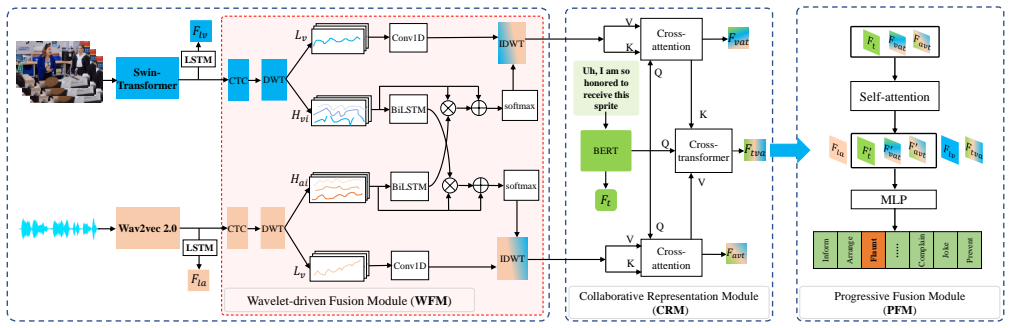
The load-bearing object is the Wavelet-driven Fusion Module (WFM), a three-stage pipeline that (1) aligns video and audio features with a CTC model, (2) performs a three-level Haar discrete wavelet transform on each stream, splitting them into low-frequency 'trend' and high-frequency 'detail' coefficients, and (3) recombines those coefficients with 1D convolutions, BiLSTMs, and a softmax element-wise interaction before inverse-wavelet reconstruction. The design intent is that low-frequency parts carry global, stable cues while high-frequency parts carry abrupt, fine-grained cues such as tone shifts or facial micro-expressions; fusing each kind separately in the frequency domain is what the paper argues yields richer non-verbal semantics. Surrounding it, the Collaborative Representation Module uses cross-attention with text as the query to bring the fused audio-video features into a trimodal space, and the Progressive Fusion Module stacks and self-attends multi-level features before classification.
What would settle it
Run WDMIR on MIntRec with the CTC alignment replaced by a fixed-length resampling or interpolation to bring video and audio features to the same sequence length, keeping everything else identical; if accuracy does not drop measurably, the alignment premise is not load-bearing and the wavelet fusion is robust to misalignment, whereas a large drop would confirm CTC's role. A complementary check is to visualize or score the CTC-produced alignments against known utterance timestamps to see whether matched frames actually correspond.
Extended reading notes
Core claim
The central discovery is that decomposing and fusing non-verbal modalities in the wavelet domain produces a representation that is measurably better for intent classification than fusing raw or simply encoded features. Concretely, after CTC-based sequence alignment, the video and audio features are passed through a three-level one-dimensional discrete wavelet transform with Haar bases; low-frequency components (global trends) are strengthened with 1D convolution, while three levels of high-frequency components (local details) are concatenated, mapped across modalities with BiLSTMs, and combined by a frequency-domain interaction that uses element-wise multiplication and softmax. An inverse wavelet transform reconstructs the enhanced audio and video features, which then interact with text tokens through cross-modal attention and a progressive fusion module. The paper reports state-of-the-art accuracy on MIntRec (75.06%, +1.13) and MELD-DA (+0.41), and its ablation attributes a 3.03-point accuracy drop on MIntRec to removal of the wavelet fusion module. The intended takeaway is that frequency-domain fusion of video and audio is a new, effective axis for multimodal intent recognition, not merely a tweak on existing late fusion.
Load-bearing premise
The pipeline assumes that the CTC model in Eq. (6) actually produces a meaningful temporal alignment between video and audio feature sequences before they are decomposed; the paper specifies neither the CTC configuration nor the training target for this alignment, so if CTC is not synchronizing the two streams faithfully, every subsequent frequency-domain fusion step operates on mismatched signals.
Editorial extensions
If this is right
- If the central claim holds, frequency-domain fusion of non-verbal streams becomes a viable and transferable design for intent recognition, not only on MIntRec but on other multimodal dialogue tasks such as MELD-DA's emotion-label setting.
- The ablation results imply that most of the improvement over text-centric baselines comes from the wavelet fusion module itself, so future multimodal models should treat non-verbal feature engineering as a first-class concern rather than a late fusion afterthought.
- The model's reliance on text as the query modality means gains concentrate in intent categories with implicit cues (Flaunt, Joke, Oppose), while highly context-dependent humor categories still lag human performance; better frequency features alone are not sufficient for those cases.
- Since removing video or audio hurts less than removing text, the paper's design implies a graceful degradation path: the audio-video branch can be treated as a boost module, and the text backbone remains the primary carrier of semantic intent.
Reading between the lines
- A natural stress test would replace the fixed Haar basis with learned or adaptive wavelet filters (or a wavelet packet tree) and check whether MIntRec accuracy rises further; the paper only reports one basis, so the choice is not yet shown to be optimal.
- The CTC alignment step is underspecified and may be the fragile link: a comparison against simpler length-alignment methods (resampling or dynamic time warping) would reveal whether the claimed gains depend on this particular alignment mechanism or merely on temporal synchronization.
- The same wavelet-driven fusion recipe could be applied to other non-verbal signal pairs, such as gesture and gaze streams or physiological signals, where high-frequency transients are semantically meaningful; if it transfers, the contribution generalizes beyond the two datasets tested.
- One could isolate the wavelet contribution by substituting a short-time Fourier transform magnitude spectrogram in place of DWT coefficients; if accuracy holds, the gain is about frequency decomposition in general, and if it drops, the multi-resolution wavelet structure specifically is doing the work.
Editorial analysis
A structured set of objections, weighed in public.
Referee Report
Summary. The paper proposes WDMIR, a multimodal intent recognition framework that fuses video and audio features in the frequency domain using a three-level Haar wavelet decomposition, followed by cross-modal attention with text and progressive fusion. The main claims are state-of-the-art accuracy on MIntRec (+1.13% ACC over the best baseline) and MELD-DA (+0.41% ACC), and that the wavelet-driven fusion module (WFM) contributes a 3.03% accuracy gain on MIntRec when ablated. The method consists of feature extraction with BERT, Swin-Transformer, and Wav2Vec 2.0, a CTC-based video-audio alignment step, a wavelet fusion module, a collaborative representation module, and a progressive fusion module.
Significance. If the architecture as described were fully reproducible and the empirical claims held with statistical support, the paper would offer a modest but potentially useful contribution by introducing wavelet-domain fusion for non-verbal modalities in multimodal intent recognition. The authors provide a public code link, compare against several recent baselines on two public datasets, and include ablations and per-category F1 analysis. However, the central alignment step is underspecified to the point of appearing un-implementable as written, and the reported gains are small and presented without error bars or significance testing, so the significance of the contribution is currently not established.
major comments (4)
- [§3.4, Eq. (6)] The equation V, A = CTC(Fv, Fa) is not a valid description of connectionist temporal classification. CTC produces a distribution over label sequences for one input sequence; it does not emit two aligned real-valued feature streams. The paper gives no label vocabulary, no CTC training loss, no decoding rule, and no explanation of how Fv from Swin-Transformer and Fa from Wav2Vec 2.0, which have different temporal resolutions, become V and A of matched length. Because every subsequent step (DWT in Eq. 7, reconstruction in Eq. 12, and cross-attention in Eq. 13) consumes V and A, this undefined step severs the causal link between the wavelet fusion and the reported ablation gains. The authors must either specify a concrete CTC-based alignment procedure, including how feature pairs are produced, or describe the actual alignment mechanism used in the code and correct the manuscript accordingly.
- [§4.5, Table 1] The empirical claims rest on single-run results without error bars, confidence intervals, or significance tests. On MIntRec the test set has 445 samples, so the reported 1.13% accuracy improvement corresponds to roughly 5 samples; on MELD-DA the 0.41% improvement corresponds to roughly 8 samples. Calling these gains 'significant progress' is not supported without multiple seeds and a statistical test. The authors should report mean and standard deviation over at least 3–5 runs and, ideally, a paired test or bootstrap confidence interval for the differences against the best baseline.
- [§3.4, Eqs. (7), (9), (11), (12)] The tensor shapes after the wavelet operations are not specified, and the equations appear dimensionally inconsistent. A 3-level 1D DWT produces coefficients of different lengths per level (approximately n/8, n/4, and n/2 for a length-n input), so concatenating Hv1, Hv2, Hv3 in Eq. (9) yields a vector whose length differs from the original sequence and from the low-frequency component Lv. Eq. (11) further requires Fha and H'v to have the same shape for element-wise multiplication, while Eq. (12) concatenates L'a with HAV before inverse DWT, which requires matching lengths. The paper should state the exact shapes, padding/resampling choices, and how the concatenated high-frequency components are aligned with the low-frequency component before IDWT.
- [§4.6, Table 2] The ablation attribution for the wavelet-driven fusion module is not clean. In Table 2, removing WFM (row 4 vs. row 5) lowers MIntRec ACC by 3.03%, but removing Ftva (row 3 vs. row 5) also lowers ACC by exactly 3.03%, and the text does not explain why these two very different ablations have identical effects. Moreover, the description says that without WFM the pre-trained video and audio features are 'directly passed' to cross-modal attention, but no details are given about how this replacement handles the length mismatch or the interaction with the other modules. The ablation should specify the exact replacement architecture and report results across seeds so that the 3.03% effect can be attributed to wavelet fusion rather than to a change in feature dimensions or alignment.
minor comments (5)
- [Abstract] The phrase 'with a 0.41% increase in recognition accuracy when analyzing subtle emotional cues' is vague; 0.41% is the MELD-DA ACC gain in Table 1, and the connection to 'subtle emotional cues' is not established in the experiments.
- [Table 1] The footnote says asterisks indicate re-experimented results, but no asterisks appear in the table. Also, SDIF-DA and CAGC have no entries for MELD-DA; the paper should state whether these methods were not evaluated on MELD-DA or whether the entries were omitted for another reason.
- [§4.4] Experimental settings are incomplete: the paper reports batch size and optimizer but not learning rate, number of epochs, warmup steps, gradient clipping, sequence length, number of sampled frames lv, audio sampling rate, or feature dimensions for the CTC and wavelet stages. This information is necessary for reproducibility.
- [References] Reference [Lee and Toutanova, 2018] appears to attribute the BERT paper to incorrect authors and title; the citation should be corrected to Devlin et al., 2019, 'BERT: Pre-training of Deep Bidirectional Transformers for Language Understanding.'
- [Figure 2] The framework figure uses the label 'CTC' twice but does not show how the outputs V and A connect to the DWT blocks, and the CTC blocks are not explained in the method section beyond Eq. (6). Clarify the figure or remove the ambiguous labels.
Circularity Check
No significant circularity: the central claims are empirical comparisons against external baselines on public datasets, and the self-citations are background only.
full rationale
The paper's central claim is an empirical one: WDMIR is trained and evaluated on MIntRec and MELD-DA, and its performance is compared against external baselines in Table 1. The wavelet-driven fusion contribution is supported by an ablation in Table 2 that removes the WFM and measures the resulting degradation. No parameter is fitted to a subset of the test data and then renamed a prediction; the reported gains are held-out test-set metrics against public benchmarks. The authors' self-citations (e.g., Zhang et al. 2022b, Zhang et al. 2024, Sun et al. 2025, Liu et al. 2023) appear only in related-work and background sentences and do not supply the load-bearing evidence for the architecture or the reported improvements. The CTC alignment step in Eq. 6 is underspecified and potentially problematic—CTC as originally defined produces a distribution over label sequences for a single input sequence, not two aligned feature streams—but this is a correctness, reproducibility, and interpretability concern, not a circularity. Eq. 6 does not reduce to the performance claim, and no fitted quantity is defined in terms of the evaluation metric. The paper also explicitly acknowledges limitations in humor- and context-dependent categories, which is a limitation statement rather than a circular step. No uniqueness theorem or methodological ansatz is imported from the authors' prior work, and the method is self-contained against external benchmarks. Therefore, the circularity burden is low and the appropriate finding is no significant circularity.
Assumptions & free parameters
free parameters (2)
- Number of wavelet decomposition levels =
3
- 1D convolution kernel size =
3
assumptions (4)
- domain assumption Text is the primary modality for intent recognition
- domain assumption Wavelet decomposition of learned video/audio features separates useful global and local information
- domain assumption CTC aligns video and audio sequences
- domain assumption Pre-trained encoders provide suitable input features
Cite this review
Pith. "Pith review of WDMIR: Wavelet-Driven Multimodal Intent Recognition." pith.science (2026). https://pith.science/paper/QGNIFNWS
@misc{pith2026250610011,
  author       = {Pith},
  title        = {Pith review of: WDMIR: Wavelet-Driven Multimodal Intent Recognition},
  year         = {2026},
  howpublished = {\url{https://pith.science/paper/QGNIFNWS}},
  note         = {Machine review of arXiv:2506.10011}
}
read the original abstract
Multimodal intent recognition (MIR) seeks to accurately interpret user intentions by integrating verbal and non-verbal information across video, audio and text modalities. While existing approaches prioritize text analysis, they often overlook the rich semantic content embedded in non-verbal cues. This paper presents a novel Wavelet-Driven Multimodal Intent Recognition(WDMIR) framework that enhances intent understanding through frequency-domain analysis of non-verbal information. To be more specific, we propose: (1) a wavelet-driven fusion module that performs synchronized decomposition and integration of video-audio features in the frequency domain, enabling fine-grained analysis of temporal dynamics; (2) a cross-modal interaction mechanism that facilitates progressive feature enhancement from bimodal to trimodal integration, effectively bridging the semantic gap between verbal and non-verbal information. Extensive experiments on MIntRec demonstrate that our approach achieves state-of-the-art performance, surpassing previous methods by 1.13% on accuracy. Ablation studies further verify that the wavelet-driven fusion module significantly improves the extraction of semantic information from non-verbal sources, with a 0.41% increase in recognition accuracy when analyzing subtle emotional cues.
Figures


Figures from the paper (2 more)


Forward citations
Cited by 1 Pith paper
-
Adaptive Modality Reliability Diagnosis and Restoration for Robust Multimodal Intent Recognition
A closed-loop framework that learns modality reliability via self-supervised corruption, restores unreliable modalities from reliable ones, re-checks reliability, and fuses with precision weights.
Reference graph
Works this paper leans on
-
[1]
wav2vec 2.0: A framework for self-supervised learning of speech repre- sentations
[Baevski et al., 2020] Alexei Baevski, Yuhao Zhou, Abdel- rahman Mohamed, and Michael Auli. wav2vec 2.0: A framework for self-supervised learning of speech repre- sentations. Advances in neural information processing sys- tems, 33:12449–12460,
work page 2020
-
[6]
An effective multimodal representation and fusion method for multimodal intent recognition
[Huang et al., 2023] Xuejian Huang, Tinghuai Ma, Li Jia, Yuanjian Zhang, Huan Rong, and Najla Alnabhan. An effective multimodal representation and fusion method for multimodal intent recognition. Neurocomputing, 548:126373,
work page 2023
-
[8]
[Lahmiri, 2014] Salim Lahmiri. Wavelet low-and high- frequency components as features for predicting stock prices with backpropagation neural networks. Journal of King Saud University-Computer and Information Sci- ences, 26(2):218–227,
work page 2014
-
[11]
Swin transformer: Hierarchical vision transformer using shifted windows
[Liu et al., 2021] Ze Liu, Yutong Lin, Yue Cao, Han Hu, Yixuan Wei, Zheng Zhang, Stephen Lin, and Baining Guo. Swin transformer: Hierarchical vision transformer using shifted windows. In Proceedings of the IEEE/CVF in- ternational conference on computer vision, pages 10012– 10022,
work page 2021
-
[12]
Enhancing hierarchical text classification through knowl- edge graph integration
[Liu et al., 2023] Ye Liu, Kai Zhang, Zhenya Huang, Ke- hang Wang, Yanghai Zhang, Qi Liu, and Enhong Chen. Enhancing hierarchical text classification through knowl- edge graph integration. In Findings of the Association for Computational Linguistics: ACL 2023, pages 5797–5810,
work page 2023
-
[13]
Decoupled weight decay regularization
[Loshchilov, 2017] I Loshchilov. Decoupled weight decay regularization. arXiv preprint arXiv:1711.05101,
arXiv 2017
-
[15]
Application of deep learning- based user intent recognition in human-computer interac- tion
[Qiu, 2024] Lingling Qiu. Application of deep learning- based user intent recognition in human-computer interac- tion. In 2024 5th International Conference on Intelligent Computing and Human-Computer Interaction (ICHCI) , pages 549–552. IEEE,
work page 2024
-
[16]
Integrating mul- timodal information in large pretrained transformers
[Rahman et al., 2020] Wasifur Rahman, Md Kamrul Hasan, Sangwu Lee, Amir Zadeh, Chengfeng Mao, Louis- Philippe Morency, and Ehsan Hoque. Integrating mul- timodal information in large pretrained transformers. In Proceedings of the conference. Association for Computa- tional Linguistics. Meeting, volume 2020, page
work page 2020
Show all 31 references
-
[17]
Lung dis- ease recognition methods using audio-based analysis with machine learning
[Sabry et al., 2024] Ahmad H Sabry, Omar I Dallal Bashi, NH Nik Ali, and Yasir Mahmood Al Kubaisi. Lung dis- ease recognition methods using audio-based analysis with machine learning. Heliyon,
2024
-
[18]
Towards emotion-aided multi-modal dialogue act classification
[Saha et al., 2020] Tulika Saha, Aditya Patra, Sriparna Saha, and Pushpak Bhattacharyya. Towards emotion-aided multi-modal dialogue act classification. In Proceedings of the 58th Annual Meeting of the Association for Computa- tional Linguistics, pages 4361–4372,
2020
-
[19]
An approach to gps analysis incorporating wavelet decomposition
[Satirapod et al., 2001] Chalermchon Satirapod, Clement Ogaja, Jinling Wang, and Chris Rizos. An approach to gps analysis incorporating wavelet decomposition. Artifi- cial Satellites, 36(2):27–35,
2001
-
[21]
Contextual augmented global contrast for multimodal intent recognition
[Sun et al., 2024] Kaili Sun, Zhiwen Xie, Mang Ye, and Huyin Zhang. Contextual augmented global contrast for multimodal intent recognition. In Proceedings of the IEEE/CVF Conference on Computer Vision and Pattern Recognition, pages 26963–26973,
2024
-
[22]
Daskt: A dynamic affect simulation method for knowledge tracing
[Sun et al., 2025] Xinjie Sun, Kai Zhang, Qi Liu, Shuanghong Shen, Fei Wang, Yuxiang Guo, and En- hong Chen. Daskt: A dynamic affect simulation method for knowledge tracing. IEEE Transactions on Knowledge and Data Engineering,
2025
-
[25]
Tensor fusion network for multimodal sentiment analysis
[Zadeh et al., 2017] Amir Zadeh, Minghai Chen, Soujanya Poria, Erik Cambria, and Louis-Philippe Morency. Tensor fusion network for multimodal sentiment analysis. arXiv preprint arXiv:1707.07250,
2017 arXiv
-
[26]
Interac- tive attention transfer network for cross-domain sentiment classification
[Zhang et al., 2019] Kai Zhang, Hefu Zhang, Qi Liu, Hongke Zhao, Hengshu Zhu, and Enhong Chen. Interac- tive attention transfer network for cross-domain sentiment classification. In Proceedings of the AAAI Conference on Artificial Intelligence, volume 33, pages 5773–5780,
2019
-
[27]
Eatn: An ef- ficient adaptive transfer network for aspect-level sentiment analysis
[Zhang et al., 2021] Kai Zhang, Qi Liu, Hao Qian, Biao Xi- ang, Qing Cui, Jun Zhou, and Enhong Chen. Eatn: An ef- ficient adaptive transfer network for aspect-level sentiment analysis. IEEE Transactions on Knowledge and Data En- gineering, 35(1):377–389,
2021
-
[29]
Leveraging entity information for cross-modality correlation learning: The entity-guided multimodal summarization
[Zhang et al., 2024] Yanghai Zhang, Ye Liu, Shiwei Wu, Kai Zhang, Xukai Liu, Qi Liu, and Enhong Chen. Leveraging entity information for cross-modality correlation learning: The entity-guided multimodal summarization. In Find- ings of the Association for Computational Linguisti...
2024
-
[30]
Token- level contrastive learning with modality-aware prompting for multimodal intent recognition
[Zhou et al., 2024] Qianrui Zhou, Hua Xu, Hao Li, Hanlei Zhang, Xiaohan Zhang, Yifan Wang, and Kai Gao. Token- level contrastive learning with modality-aware prompting for multimodal intent recognition. In Proceedings of the AAAI Conference on Artificial Intelligence, pages 17...
2024
-
[31]
Divide and conquer: Text semantic matching with disentangled keywords and intents
[Zou et al., 2022] Yicheng Zou, Hongwei Liu, Tao Gui, Jun- zhe Wang, Qi Zhang, Meng Tang, Haixiang Li, and Daniel Wang. Divide and conquer: Text semantic matching with disentangled keywords and intents. arXiv preprint arXiv:2203.02898, 2022
2022 arXiv
-
[2001]
Multimodal analysis of im- age search intent: Intent recognition in image search from user behavior and visual content
[Soleymani et al., 2017] Mohammad Soleymani, Michael Riegler, and P ˚al Halvorsen. Multimodal analysis of im- age search intent: Intent recognition in image search from user behavior and visual content. In Proceedings of the 2017 ACM on International Conference on Multimedia R...
2017
-
[2006]
Misa: Modality-invariant and-specific representations for multimodal sentiment analysis
[Hazarika et al., 2020] Devamanyu Hazarika, Roger Zim- mermann, and Soujanya Poria. Misa: Modality-invariant and-specific representations for multimodal sentiment analysis. In Proceedings of the 28th ACM international conference on multimedia, pages 1122–1131,
2020
-
[2014]
Pre-training of deep bidirectional transformers for lan- guage understanding
[Lee and Toutanova, 2018] JDMCK Lee and K Toutanova. Pre-training of deep bidirectional transformers for lan- guage understanding. arXiv preprint arXiv:1810.04805 , 3(8),
2018 arXiv
-
[2017]
Blind image inpainting via omni-dimensional gated atten- tion and wavelet queries
[Phutke et al., 2023] Shruti S Phutke, Ashutosh Kulkarni, Santosh Kumar Vipparthi, and Subrahmanyam Murala. Blind image inpainting via omni-dimensional gated atten- tion and wavelet queries. In Proceedings of the IEEE/CVF Conference on Computer Vision and Pattern Recognition, ...
2023
-
[2018]
Learning attention from attention: Efficient self-refinement transformer for face super-resolution
[Li et al., 2023] Guanxin Li, Jingang Shi, Yuan Zong, Fei Wang, Tian Wang, and Yihong Gong. Learning attention from attention: Efficient self-refinement transformer for face super-resolution. In IJCAI, pages 1035–1043,
2023
-
[2019]
Attention is all you need
[Vaswani, 2017] A Vaswani. Attention is all you need. Ad- vances in Neural Information Processing Systems,
2017
-
[2020]
Multimodal emotion recognition and intention understanding in human-robot interaction
[Chen et al., 2021] Luefeng Chen, Zhentao Liu, Min Wu, Kaoru Hirota, and Witold Pedrycz. Multimodal emotion recognition and intention understanding in human-robot interaction. Developments in Advanced Control and Intel- ligent Automation for Complex Systems , pages 255–288,
2021
-
[2021]
Robust time series denoising with learnable wavelet packet transform
[Frusque and Fink, 2024] Gaetan Frusque and Olga Fink. Robust time series denoising with learnable wavelet packet transform. Advanced Engineering Informatics , 62:102669,
2024
-
[2022]
Incorporating dynamic semantics into pre-trained language model for aspect-based sentiment analysis.arXiv preprint arXiv:2203.16369,
[Zhang et al., 2022c] Kai Zhang, Kun Zhang, Mengdi Zhang, Hongke Zhao, Qi Liu, Wei Wu, and Enhong Chen. Incorporating dynamic semantics into pre-trained language model for aspect-based sentiment analysis.arXiv preprint arXiv:2203.16369,
-
[2023]
Sdif-da: A shallow- to-deep interaction framework with data augmentation for multi-modal intent detection
[Huang et al., 2024] Shijue Huang, Libo Qin, Bingbing Wang, Geng Tu, and Ruifeng Xu. Sdif-da: A shallow- to-deep interaction framework with data augmentation for multi-modal intent detection. In ICASSP 2024-2024 IEEE International Conference on Acoustics, Speech and Signal Pro...
2024
-
[2024]
Connectionist temporal classification: labelling unsegmented sequence data with recurrent neural networks
[Graves et al., 2006] Alex Graves, Santiago Fern ´andez, Faustino Gomez, and J¨urgen Schmidhuber. Connectionist temporal classification: labelling unsegmented sequence data with recurrent neural networks. In Proceedings of the 23rd international conference on Machine learning,...
2006
-
[2025]
Multimodal transformer for un- aligned multimodal language sequences
[Tsai et al., 2019] Yao-Hung Hubert Tsai, Shaojie Bai, Paul Pu Liang, J Zico Kolter, Louis-Philippe Morency, and Ruslan Salakhutdinov. Multimodal transformer for un- aligned multimodal language sequences. In Proceedings of the conference. Association for computational linguis-...
2019
Reviewed August 7, 2026 · model on record in the stance chip above.
Discussion (0). Continue with ORCID to comment.