REVIEW 4 major objections 5 minor 1 cited by
Light Dark Matter Detection with Sub-eV Transition-Edge Sensors
T0 review · 4 major / 5 minor · reviewed 2026-08-07 · deepseek-v4-flash
Pith's one-line read Optical TES sensors could probe dark matter at sub-MeV masses with nanogram-month exposures.
desk verdict Useful first projection for optical TES dark matter detection, but the abstract oversells the background-free reach and the validation claim conflicts with the paper's own Table II. read the letter →
The pith
A machine-rendered reading of the paper's core claim, the machinery that carries it, and where it could break.
The reading
What carries the argument
The load-bearing element is the optical TES as a near-ideal quantum calorimeter: a superconducting film biased at the transition edge converts a single sub-eV energy deposition into a measurable current pulse, with energy resolution set by Johnson and thermal-fluctuation noise. Optimal filtering extracts pulse amplitudes whose variance matches the analytic small-signal limit, yielding the $\sim 0.1$ eV threshold used throughout. On the physics side, the in-medium response of the aluminum target is captured by the dynamic structure factor $S(q,\omega)$ and the energy-loss function $\mathrm{Im}[-1/\epsilon(q,\omega)]$, which enter the DM scattering and absorption rate integrals through the fluctuation-dissipation theorem.
What would settle it
Build the proposed 72 mK TES-O device and measure its FWHM energy resolution and dark-count rate in an underground environment: if the resolution exceeds about 30 meV or the background rate is above one event per month per pixel in the 0.1–1 eV window, the projected reach to $\sigma_e < 10^{-27}$ cm$^2$ is not attainable.
Extended reading notes
Core claim
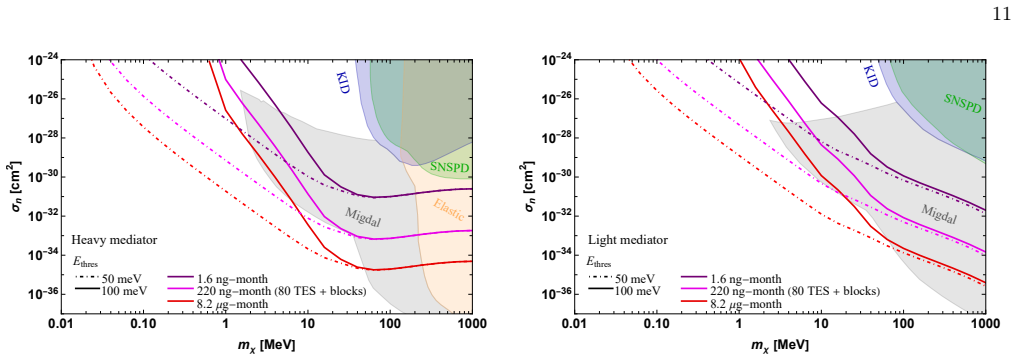
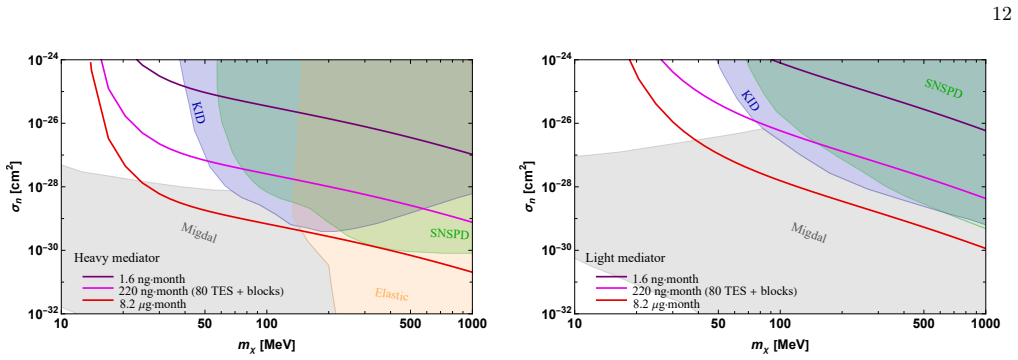
The central discovery is that high-resolution optical transition-edge sensors, operated near the thermodynamic noise limit with sub-eV energy thresholds, can serve as both target and sensor for light dark matter. The authors show that with the reference device ($T_c = 115$ mK, $\Delta E_{FWHM} \simeq 36$ meV) and an optimized 72 mK variant ($\Delta E \simeq 16$ meV), a $3\sigma$ threshold of roughly 0.1 eV is achievable. Using aluminum as the target and computing the full dynamic structure factor and the energy-loss function with a finite electron collision rate, they find that ng-month exposures reach $\sigma_e \le 10^{-27}$ cm$^2$ for sub-MeV masses via electron scattering, while nucleon scattering can be probed at the MeV scale; dark photon absorption can test kinetic mixing down to $\kappa \sim 10^{-15}$. The same platform covers electron scattering, absorption, nucleon scattering, and Migdal-assisted recoils simultaneously.
Load-bearing premise
The projected sensitivity assumes a background-free detector (zero irreducible backgrounds) and a 0.1 eV threshold derived from an extrapolated 72 mK TES that has not yet been built; if single-event backgrounds or the extrapolated resolution are a few times worse, the claimed unexplored parameter space shrinks or disappears.
Editorial extensions
If this is right
- A single 100 micrometer TES pixel with one month of exposure could already reach $\bar{\sigma}_e \lesssim 10^{-27}$ cm$^2$ for sub-MeV dark matter, a region not yet excluded by any experiment.
- An 80-pixel sub-array with aluminum collection blocks, totaling about 220 ng of target, improves the reach by roughly two orders of magnitude in cross section.
- Lowering the critical temperature from 115 mK to 72 mK halves the energy resolution and extends sensitivity toward lighter dark matter, including part of the phonon-dominated nucleon-scattering regime.
- The same platform can simultaneously probe dark matter–electron scattering, dark photon absorption, and dark matter–nucleon scattering with Migdal ionization, making it a multi-channel dark matter detector.
- If the zero-background assumption holds, microgram-month exposures would push electron-scattering reach toward $\bar{\sigma}_e \sim 10^{-40}$ cm$^2$.
Reading between the lines
- The zero-background assumption is the single optimistic driver; a dedicated underground site with shielding and active vetoes would be needed to realize the projected reach, and even a few stray-photon events per month could erase it.
- The sensitivity scaling with $T_c$ suggests a concrete roadmap: reducing the critical temperature (or the heat capacity) further would extend the reach to still lighter dark matter, provided the excess Johnson noise factor $M$ can be controlled.
- The same detector concept could be adapted to other rare-event searches that need sub-eV thresholds, such as coherent elastic neutrino-nucleus scattering or axion-like particle absorption.
- Because aluminum's phonon response is suppressed by the 0.1 eV threshold, replacing the target with a material with a smaller energy gap or different phonon spectrum could recover access to the phonon-dominated channel for lighter dark matter.
Editorial analysis
A structured set of objections, weighed in public.
Referee Report
Summary. The paper presents an end-to-end model of optical transition-edge sensors (TESs) as both target and readout for sub-GeV dark matter detection. It adopts the parameters of a 115 mK Au/Ti optical TES from Ref. [33], computes Johnson and thermal-fluctuation noise, simulates pulses with optimal filtering, and uses the aluminum dielectric response and phonon structure factors (via DarkELF) to project 95% C.L. sensitivities for DM-electron scattering, dark-photon absorption, DM-nucleon scattering, and the Migdal effect. The central quantitative claim is that nanogram-month exposures can reach DM-electron cross sections below 10^-27 cm^2 for sub-MeV masses and can probe MeV-scale DM-nucleon couplings, with an 80-pixel array improving the reach by about two orders of magnitude.
Significance. If the projections were realized, a compact optical TES array would open a new window on sub-GeV dark matter, and the paper usefully combines detector noise simulation with standard in-medium rate calculations. The paper is transparent about its parameter inputs, uses the public DarkELF code, and provides a full noise model including excess Johnson noise. The main caveats are that the quoted validation against the measured 67 meV resolution is contradicted by the paper's own Table II, and that the headline reach assumes zero irreducible background and an extrapolated 72 mK device; these make the quoted reach a projection rather than a demonstrated capability. With those caveats stated quantitatively, the study is a valuable roadmap for quantum-sensor dark matter searches.
major comments (4)
- [§II.B, Table II] The text in §II.B says 'our simulations reproduce the experimentally measured single-photon resolution of ΔE_FWHM ≃ 67 meV' from Ref. [33], but Table II reports an optimal-filtering resolution of 0.031 eV and analytic estimates of 0.031–0.036 eV for the same TES-R with M = 1.474. The factor-of-two discrepancy means the validation claim is not supported by the paper's own results. This matters because the detection threshold Eth = 0.1 eV and the per-event sensitivity used in all rate projections are set by the energy resolution. The authors should either reconcile the discrepancy (for example, by identifying unmodeled noise or readout contributions, or by clarifying that the 67 meV value corresponds to a different analysis) or remove the validation claim; a side-by-side plot of the measured and simulated pulse-height distributions for TES-R would resolve the issue.
- [§II.A, §IV.A, Fig. 6] The headline reach below 10^-27 cm^2 for the 1.6 ng-month exposure is computed from N95 ≃ 3 events under the explicit 'zero irreducible backgrounds' assumption stated in §II.A. With a target mass of order a nanogram, the signal is only a few events in the exposure, so a single background event in the analysis window changes the 95% C.L. bound by a factor comparable to the span of the claimed new parameter space. The paper acknowledges that backgrounds are site-dependent and that mitigation is essential, but it does not quantify the effect. Please add a figure or table showing how the projected curves, in particular the 1.6 ng-month and 220 ng-month curves, shift for expected background rates of 0.1, 1, and 10 counts per month in the 0.1–1 eV range, and explicitly state in the abstract and conclusions that the sub-10^-27 cm^2 claim is a background-free projection.
- [§II.A, Table I (TES-O)] The optimized TES-O configuration at Tc = 72 mK is an extrapolation: all Tc-dependent parameters in Table I are rescaled using the assumed ΔE ∝ Tc^{3/2} scaling, while α, β, and the excess Johnson noise factor M = 1.474 are taken from the existing 115 mK device. No sub-100 mK device with these parameters is demonstrated, and the sensitivity curves shown for Eth = 50 meV (Figs. 7 and 9) rely on this hypothetical device. Since the paper's central claim of reaching previously unexplored cross sections is meant to apply to near-term exposures, the authors should separate the demonstrated TES-R reach (with the measured 67 meV resolution and Eth ≃ 0.1 eV) from the extrapolated TES-O reach, and clearly mark which lines in each figure require the 72 mK device.
- [§IV.A, Fig. 6 (80 TES + blocks)] The intermediate 220 ng-month benchmark assumes Al collection blocks that increase the target mass by a factor of ~10 per pixel 'without significantly compromising energy resolution' and while 'maintaining thermal coupling,' but no quantitative model of quasiparticle diffusion, thermalization efficiency, or the resulting resolution degradation is provided. If the added absorber volume introduces incomplete collection or increased heat capacity, the effective exposure gain will not be realized. Please either supply a thermal/quasiparticle model for the blocks or label the 220 ng-month curve as an optimistic engineering assumption in the figure and text.
minor comments (5)
- [§III.A] The word 'wihtin' should be 'within' in the sentence 'For low momentum transfers wihtin the first Brillouin zone.'
- [§II.B, Eq. (13)] The values τ_rise = 50 ns and τ_fall = 4 μs are called 'best fit parameters,' but the fit to the experimental data in Ref. [33] is not shown; please state the source of these values or display the fit.
- [Eq. (6), Table II] The excess Johnson noise factor M enters quadratically, and Table II shows that the resolution depends on it (0.026 eV for M = 0 versus 0.031 eV for M = 1.474), yet no uncertainty on M is propagated; please quote the uncertainty from Ref. [33] and show its effect on the projected reach.
- [Fig. 6 caption] The captions mention 'Cosmic ray up (PANDAX-4T)' and 'Cosmic ray up (Super-K)' without citing the corresponding papers; these constraints should be referenced in the caption or text.
- [§IV.E] The conversion from P ∼ 10^-7 eV (μg s)^-1 to P ∼ 10^-31 W μm^-3 is not shown; please display the assumed absorber volume and density so the power-density comparison is reproducible.
Circularity Check
No significant circularity: the sensitivity projections are Poisson scalings of independently measured TES resolution and standard DM rate formulas; the main self-citation to the device paper is external measured data, not a fitted prediction.
full rationale
I walked the claimed derivation chain. The TES energy resolution and the 0.1 eV threshold are inputs taken from the measured device of Ref. [33] (co-authored by K. Hattori), including the excess Johnson noise factor M=1.474 inferred from that measured noise spectrum. This is calibration to external data, not a prediction derived from the DM target result. The DM-electron scattering rate uses the independent DarkELF/Mermin dielectric function, the Standard Halo Model velocity distribution, and reference cross-section definitions, and the projected limits are obtained by requiring N_95=3 events under the explicitly stated zero-background assumption. No equation reduces to its own input: the cross section is a free parameter solved from the rate integral (Eqs. 38-39 and 42-43), and the threshold enters only as an integration limit. The zero-background assumption is optimistic but transparently declared, with a note that nonzero backgrounds rescale the reach trivially; this is an assumption, not circularity. I do, however, flag as a non-circular limitation the paper's validation claim in Sec. II.B: the text states that the simulations 'reproduce the experimentally measured single-photon resolution of ΔE_FWHM ≃ 67 meV,' while Table II lists TES-R optimal-filter resolutions of 26-36 meV and the adopted 0.1 eV threshold is looser than the simulated 3-sigma values. That internal inconsistency affects the credibility of the validation but does not make the derivation circular. The only self-citation is the device measurement itself, which is external, reproducible data and is not load-bearing in a way that would force the DM result. Overall circularity is therefore minimal, warranting a low score of 2 rather than a higher score.
Assumptions & free parameters
free parameters (6)
- Excess Johnson noise factor M =
1.474 (M^2 = 2.17)
- Optimized TES critical temperature Tc =
72 mK
- Detection energy threshold Eth =
0.1 eV (3 sigma)
- Al collection block mass factor =
about 10x per pixel
- Irreducible background rate =
0
- Migdal electronic excitation threshold =
5 eV
assumptions (5)
- standard math Fluctuation-dissipation theorem connects the electron dynamic structure factor to the energy loss function (Eq. 19).
- domain assumption Lindhard and Mermin dielectric functions describe aluminum's response over the q and omega range of interest.
- domain assumption The aluminum target is a near-ideal calorimeter with unit detection efficiency for all deposited energy above threshold.
- ad hoc to paper Zero irreducible background in the detector.
- ad hoc to paper TES energy resolution scales as Tc^{3/2} and all Tc-dependent parameters can be rescaled to 72 mK.
invented entities (1)
-
TES-O optimized 72 mK transition-edge sensor configuration
Cite this review
Pith. "Pith review of Light Dark Matter Detection with Sub-eV Transition-Edge Sensors." pith.science (2026). https://pith.science/paper/ADZ4P57L
@misc{pith2026250610070,
  author       = {Pith},
  title        = {Pith review of: Light Dark Matter Detection with Sub-eV Transition-Edge Sensors},
  year         = {2026},
  howpublished = {\url{https://pith.science/paper/ADZ4P57L}},
  note         = {Machine review of arXiv:2506.10070}
}
abstract
We present a comprehensive analysis of high-resolution transition-edge sensors (TESs) as a quantum sensing platform for detecting dark matter (DM). Operating near the thermodynamic noise limit with sub-eV energy resolution, TESs offer a powerful approach for probing light DM in the sub-GeV mass range. Optical TESs, realized on superconducting films with critical temperatures below 150 mK, achieve energy thresholds below 100 meV and enable precise calorimetric detection of individual energy depositions. We model TES response by incorporating fundamental noise sources and applying optimal filtering techniques, and evaluate their sensitivity across a range of DM interaction channels, accounting for in-medium effects in the target material. We show that even ng-month-scale exposures can reach previously unexplored DM-electron scattering cross sections below $10^{-27}$ cm$^2$ for sub-MeV masses, and can probe the MeV-scale mass range for DM-nucleon couplings. Combining high energy resolution, photon-number sensitivity, and scalability, optical TESs provide a compelling quantum sensing platform for rare-event searches at the intersection of particle physics and quantum metrology.
Figures


Figures from the paper (7 more)


Forward citations
Cited by 1 Pith paper
-
New Constraints on Neutrino-Dark Matter Interactions: A Comprehensive Analysis
Most benchmark neutrino-dark matter couplings adopted in previous studies are excluded when laboratory meson and Z decay bounds are combined with cosmological and astrophysical constraints, leaving only special galact...
Reference graph
Works this paper leans on
-
[33]
G. Bratrudet al., Eur. Phys. J. C85, 118 (2025), arXiv:2406.02025 [hep-ex]
work page Pith review arXiv 2025
-
[1]
Intrinsic material properties The space-time correlation function of an operator O(t,x), typically representing the electron or nuclear number density in a material, is defined as SO(ω,x) = 1 VT Z dt Z d3x′eiωt ⟨O(t,x+x ′)O(0,x ′)⟩, (A1) whereV T is the material volume and the expectation value is taken over thermal equilibrium state ensemble ⟨•⟩= P m pm ...
-
[2]
The initial state|ψI (0)⟩in the interaction picture evolves according to |ψI (t)⟩= T exp −i Z t 0 HI (t) |ψI (0)⟩,(A11) 4 Up to a factor of the electromagnetic couplinge2
DM scattering As an example, let us consider the interaction Hamil- tonian density H1 =ϕ(g χnχ +g ini),(A10) whereϕis a mediator scalar,n χ andn i are number den- sity operators of DM particleχand SM fieldi(electron or nucleon), respectively5. The initial state|ψI (0)⟩in the interaction picture evolves according to |ψI (t)⟩= T exp −i Z t 0 HI (t) |ψI (0)⟩...
-
[3]
DM absorption Next, let us consider the absorption of dark matter by the material. Focusing for illustration on dark photon DM, the relevant interaction Hamiltonian density is H1 =κeA ′ µJ µ e .(A20) whereκis the kinetic mixing parameter,A ′ µ is the dark photon field, andJµ e is the electromagnetic current of the electrons. In this case, the transition o...
-
[4]
Essiget al., inSnowmass 2021(2022) arXiv:2203.08297 [hep-ph]
R. Essiget al., inSnowmass 2021(2022) arXiv:2203.08297 [hep-ph]
arXiv 2022
- [5]
- [6]
-
[7]
Y. Hochberg, M. Pyle, Y. Zhao, and K. M. Zurek, JHEP 08, 057 (2016), arXiv:1512.04533 [hep-ph]
arXiv 2016
Show all 97 references
-
[8]
Hochberg, T
Y. Hochberg, T. Lin, and K. M. Zurek, Phys. Rev. D 94, 015019 (2016), arXiv:1604.06800 [hep-ph]
2016 arXiv
-
[9]
Hochberg, T
Y. Hochberg, T. Lin, and K. M. Zurek, Phys. Rev. D 95, 023013 (2017), arXiv:1608.01994 [hep-ph]
2017 arXiv
-
[10]
Hochberg, Y
Y. Hochberg, Y. Kahn, M. Lisanti, K. M. Zurek, A. G. Grushin, R. Ilan, S. M. Griffin, Z.-F. Liu, S. F. We- 16 ber, and J. B. Neaton, Phys. Rev. D97, 015004 (2018), arXiv:1708.08929 [hep-ph]
2018 arXiv
-
[11]
Knapen, T
S. Knapen, T. Lin, M. Pyle, and K. M. Zurek, Phys. Lett. B785, 386 (2018), arXiv:1712.06598 [hep-ph]
2018 arXiv
-
[12]
Griffin, S
S. Griffin, S. Knapen, T. Lin, and K. M. Zurek, Phys. Rev. D98, 115034 (2018), arXiv:1807.10291 [hep-ph]
2018 arXiv
-
[13]
Trickle, Z
T. Trickle, Z. Zhang, K. M. Zurek, K. Inzani, and S. M. Griffin, JHEP03, 036 (2020), arXiv:1910.08092 [hep-ph]
2020 arXiv
-
[14]
G. B. Gelmini, V. Takhistov, and E. Vitagliano, Phys. Lett. B809, 135779 (2020), arXiv:2006.13909 [hep-ph]
2020 arXiv
-
[15]
M. Chen, G. B. Gelmini, and V. Takhistov, JCAP12, 048 (2021), arXiv:2105.08101 [hep-ph]
2021 arXiv
-
[16]
Hochberg, Y
Y. Hochberg, Y. Kahn, N. Kurinsky, B. V. Lehmann, T. C. Yu, and K. K. Berggren, Phys. Rev. Lett.127, 151802 (2021), arXiv:2101.08263 [hep-ph]
2021 arXiv
-
[17]
Knapen, J
S. Knapen, J. Kozaczuk, and T. Lin, Phys. Rev. D104, 015031 (2021), arXiv:2101.08275 [hep-ph]
2021 arXiv
-
[18]
Knapen, J
S. Knapen, J. Kozaczuk, and T. Lin, Phys. Rev. D105, 015014 (2022), arXiv:2104.12786 [hep-ph]
2022 arXiv
-
[19]
Mitridate, T
A. Mitridate, T. Trickle, Z. Zhang, and K. M. Zurek, JHEP09, 123 (2021), arXiv:2106.12586 [hep-ph]
2021 arXiv
-
[20]
Campbell-Deem, S
B. Campbell-Deem, S. Knapen, T. Lin, and E. Villarama, Phys. Rev. D106, 036019 (2022), arXiv:2205.02250 [hep-ph]
2022 arXiv
- [21]
-
[22]
M. Chen, G. B. Gelmini, and V. Takhistov, Phys. Lett. B841, 137922 (2023), arXiv:2209.10902 [hep-ph]
2023 arXiv
-
[23]
Mitridate, K
A. Mitridate, K. Pardo, T. Trickle, and K. M. Zurek, Phys. Rev. D109, 015010 (2024), arXiv:2308.06314 [hep- ph]
2024 arXiv
-
[24]
S. M. Griffin, G. D. Hadas, Y. Hochberg, K. Inzani, and B. V. Lehmann, (2024), arXiv:2412.16283 [hep-ph]
2024 arXiv
-
[25]
Hochberg, I
Y. Hochberg, I. Charaev, S.-W. Nam, V. Verma, M. Colangelo, and K. K. Berggren, Phys. Rev. Lett. 123, 151802 (2019), arXiv:1903.05101 [hep-ph]
2019 arXiv
-
[26]
Hochberg, B
Y. Hochberg, B. V. Lehmann, I. Charaev, J. Chiles, M. Colangelo, S. W. Nam, and K. K. Berggren, Phys. Rev. D106, 112005 (2022), arXiv:2110.01586 [hep-ph]
2022 arXiv
-
[27]
Chileset al., Phys
J. Chileset al., Phys. Rev. Lett.128, 231802 (2022), arXiv:2110.01582 [hep-ex]
2022 arXiv
-
[28]
J. Gao, Y. Hochberg, B. V. Lehmann, S. W. Nam, P. Szypryt, M. R. Vissers, and T. Xu, (2024), arXiv:2403.19739 [hep-ph]
2024 arXiv
-
[29]
Transition-edge sensors,
K. Irwin and G. Hilton, “Transition-edge sensors,” inCryogenic Particle Detection, edited by C. Enss (Springer Berlin Heidelberg, Berlin, Heidelberg, 2005) pp. 63–150
2005
-
[30]
C. L. Changet al.(TESSERACT), (2025), arXiv:2503.03683 [hep-ex]
2025 arXiv
-
[31]
Baracchiniet al.(PTOLEMY), (2018), arXiv:1808.01892 [physics.ins-det]
E. Baracchiniet al.(PTOLEMY), (2018), arXiv:1808.01892 [physics.ins-det]
2018 arXiv
-
[32]
Augieret al.(Ricochet), Nucl
C. Augieret al.(Ricochet), Nucl. Instrum. Meth. A 1057, 168765 (2023), arXiv:2304.14926 [physics.ins-det]
2023 arXiv
-
[34]
B. K. Alpertet al., (2025), arXiv:2503.19920 [hep-ex]
2025
-
[35]
Manentiet al., Phys
L. Manentiet al., Phys. Rev. Applied22, 024051 (2024), arXiv:2402.03073 [physics.ins-det]
2024
-
[36]
Hattori, T
K. Hattori, T. Konno, Y. Miura, S. Takasu, and D. Fukuda, Supercond. Sci. Technol.35, 095002 (2022), arXiv:2204.01903 [physics.ins-det]
2022 arXiv
-
[37]
Knill, R
E. Knill, R. Laflamme, and G. J. Milburn, Nature409, 46 (2001)
2001
-
[38]
F. E. Becerra, J. Fan, and A. Migdall, Nature Photonics 9, 48 (2015)
2015
-
[39]
J. C. Matthews, X.-Q. Zhou, H. Cable, P. J. Shadbolt, D. J. Saunders, G. A. Durkin, G. J. Pryde, and J. L. O’Brien, npj Quantum Information2, 16023 (2016)
2016
-
[40]
von Helversen, J
M. von Helversen, J. Böhm, M. Schmidt, M. Gschrey, J.- H. Schulze, A. Strittmatter, S. Rodt, J. Beyer, T. Hein- del, and S. Reitzenstein, New Journal of Physics21, 035007 (2019)
2019
-
[41]
Schwemmbauer, Y
C. Schwemmbauer, Y. Hochberg, K.-S. Isleif, F. Januschek, B. V. Lehmann, A. Lindner, M. Meyer, G. Othman, and J. A. Rubiera Gimeno, PoSCOS- MICWISPers, 055 (2024), arXiv:2407.02954 [hep-ex]
2024 arXiv
-
[42]
K. D. Itwin, S. W. Nam, B. Cabrera, and B. Chugg, Rev. Sci. Instrum.66, 5322 (1995)
1995
-
[43]
Nakashima, F
Y. Nakashima, F. Hirayama, S. Kohjiro, H. Yamamori, S. Nagasawa, A. Sato, S. Yamada, R. Hayakawa, N. Y. Yamasaki, K. Mitsuda, K. Nagayoshi, H. Akamatsu, L. Gottardi, E. Taralli, M. P. Bruijn, M. L. Ridder, J. R. Gao, , and J. W. A. den Herder, Appl. Phys. Lett.117, 122601 (2020)
2020
-
[44]
McCammon, , 1 (2005), arXiv:physics/0503045
D. McCammon, , 1 (2005), arXiv:physics/0503045
2005 arXiv
-
[45]
Nozières and D
P. Nozières and D. Pines, Phys. Rev.113, 1254 (1959)
1959
-
[46]
Dressel and G
M. Dressel and G. Grüner,Electrodynamics of Solids: Optical Properties of Electrons in Matter(Cambridge University Press, 2002)
2002
-
[47]
Aprileet al.(XENON), Phys
E. Aprileet al.(XENON), Phys. Rev. D94, 092001 (2016), [Erratum: Phys.Rev.D 95, 059901 (2017)], arXiv:1605.06262 [astro-ph.CO]
2016 arXiv
-
[48]
123, 251801 (2019)
E.Aprileet al.(XENONCollaboration),Phys.Rev.Lett. 123, 251801 (2019)
2019
-
[49]
Aprileet al.(XENON Collaboration), Phys
E. Aprileet al.(XENON Collaboration), Phys. Rev. D 106, 022001 (2022)
2022
-
[50]
Chenget al.(PandaX-II Collaboration), Phys
C. Chenget al.(PandaX-II Collaboration), Phys. Rev. Lett.126, 211803 (2021)
2021
-
[51]
Agneset al.(The DarkSide Collaboration), Phys
P. Agneset al.(The DarkSide Collaboration), Phys. Rev. Lett.121, 111303 (2018)
2018
-
[52]
Arnaudet al.(EDELWEISS Collaboration), Phys
Q. Arnaudet al.(EDELWEISS Collaboration), Phys. Rev. Lett.125, 141301 (2020)
2020
-
[53]
Aguilar-Arevaloet al.(DAMIC Collaboration), Phys
A. Aguilar-Arevaloet al.(DAMIC Collaboration), Phys. Rev. Lett.123, 181802 (2019)
2019
-
[54]
Agneseet al., Phys
R. Agneseet al., Phys. Rev. Lett.121, 051301 (2018)
2018
-
[55]
D. W. Amaralet al., Phys. Rev. D102, 091101 (2020)
2020
-
[56]
Crisleret al.(SENSEI Collaboration), Phys
M. Crisleret al.(SENSEI Collaboration), Phys. Rev. Lett.121, 061803 (2018)
2018
-
[57]
Abramoffet al.(SENSEI Collaboration), Phys
O. Abramoffet al.(SENSEI Collaboration), Phys. Rev. Lett.122, 161801 (2019)
2019
-
[58]
Baraket al.(SENSEI Collaboration), Phys
L. Baraket al.(SENSEI Collaboration), Phys. Rev. Lett. 125, 171802 (2020)
2020
-
[59]
N. D. Mermin, Phys. Rev. B1, 2362 (1970)
1970
-
[60]
A. L. Fetter and J. D. Walecka,Quantum Theory of Many-Particle Systems(Dover Publications, 2003)
2003
-
[61]
J. J. Quinn and K. S. Yi,Solid State Physics: Principles and Modern Applications(Springer, 2018)
2018
-
[62]
Knapen, T
S. Knapen, T. Lin, and K. M. Zurek, Phys. Rev. D96, 115021 (2017), arXiv:1709.07882 [hep-ph]
2017 arXiv
-
[63]
A. K. Drukier, K. Freese, and D. N. Spergel, Phys. Rev. D33, 3495 (1986)
1986
-
[64]
Aguilar-Arevaloet al.(DAMIC Collaboration), Phys
A. Aguilar-Arevaloet al.(DAMIC Collaboration), Phys. Rev. Lett.118, 141803 (2017)
2017
-
[65]
I. M. Bloch, R. Essig, K. Tobioka, T. Volansky, and T.- T. Yu, JHEP06, 087 (2017), arXiv:1608.02123 [hep-ph]
2017 arXiv
-
[66]
P. G. Staudt, J. S. Bullock, M. Boylan-Kolchin, D. Kirkby, A. Wetzel, and X. Ou, Journal of Cosmology 17 and Astroparticle Physics2024, 022 (2024)
2024
-
[67]
P. W. Graham, J. Mardon, and S. Rajendran, Phys. Rev. D93, 103520 (2016), arXiv:1504.02102 [hep-ph]
2016 arXiv
-
[68]
Y. Ema, K. Nakayama, and Y. Tang, JHEP07, 060 (2019), arXiv:1903.10973 [hep-ph]
2019 arXiv
-
[69]
A. J. Long and L.-T. Wang, Phys. Rev. D99, 063529 (2019), arXiv:1901.03312 [hep-ph]
2019 arXiv
-
[70]
Kitajima and K
N. Kitajima and K. Nakayama, JHEP08, 068 (2023), arXiv:2212.13573 [hep-ph]
2023 arXiv
-
[71]
Nakayama, JCAP10, 019 (2019), arXiv:1907.06243 [hep-ph]
K. Nakayama, JCAP10, 019 (2019), arXiv:1907.06243 [hep-ph]
2019 arXiv
-
[72]
Nakayama, JCAP08, 033 (2020), arXiv:2004.10036 [hep-ph]
K. Nakayama, JCAP08, 033 (2020), arXiv:2004.10036 [hep-ph]
2020 arXiv
-
[73]
Kitajima and K
N. Kitajima and K. Nakayama, JCAP07, 014 (2023), arXiv:2303.04287 [hep-ph]
2023 arXiv
-
[74]
Agrawal, N
P. Agrawal, N. Kitajima, M. Reece, T. Sekiguchi, and F. Takahashi, Phys. Lett. B801, 135136 (2020), arXiv:1810.07188 [hep-ph]
2020 arXiv
-
[75]
R. T. Co, A. Pierce, Z. Zhang, and Y. Zhao, Phys. Rev. D99, 075002 (2019), arXiv:1810.07196 [hep-ph]
2019 arXiv
-
[76]
Bastero-Gil, J
M. Bastero-Gil, J. Santiago, L. Ubaldi, and R. Vega- Morales, JCAP04, 015 (2019), arXiv:1810.07208 [hep- ph]
2019 arXiv
-
[77]
J. A. Dror, K. Harigaya, and V. Narayan, Phys. Rev. D 99, 035036 (2019), arXiv:1810.07195 [hep-ph]
2019 arXiv
- [78]
-
[79]
Essig, J
R. Essig, J. Pradler, M. Sholapurkar, and T.-T. Yu, Phys. Rev. Lett.124, 021801 (2020)
2020
-
[80]
Huanget al.(PandaX Collaboration), Phys
D. Huanget al.(PandaX Collaboration), Phys. Rev. Lett.131, 191002 (2023)
2023
-
[81]
D. S. Akeribet al.(LUX Collaboration), Phys. Rev. Lett. 122, 131301 (2019)
2019
-
[82]
A. H. Abdelhameedet al.(CRESST Collaboration), Phys. Rev. D100, 102002 (2019)
2019
-
[83]
Agneset al.(DarkSide-50 Collaboration), Phys
P. Agneset al.(DarkSide-50 Collaboration), Phys. Rev. D107, 063001 (2023)
2023
-
[84]
Light dark matter search with darkside-50,
D. Franco, “Light dark matter search with darkside-50,” (2023), arXiv:2306.12151 [hep-ex]
2023 arXiv
-
[85]
E.Armengaudet al.(EDELWEISSCollaboration),Phys. Rev. D99, 082003 (2019)
2019
-
[86]
E.Armengaudet al.(EDELWEISSCollaboration),Phys. Rev. D106, 062004 (2022)
2022
-
[87]
Alkhatibet al.(SuperCDMS Collaboration), Phys
I. Alkhatibet al.(SuperCDMS Collaboration), Phys. Rev. Lett.127, 061801 (2021)
2021
-
[88]
M. F. Albakryet al.(SuperCDMS Collaboration), Phys. Rev. D107, 112013 (2023)
2023
-
[89]
Adariet al., Physical Review Letters134(2025), 10.1103/physrevlett.134.011804
P. Adariet al., Physical Review Letters134(2025), 10.1103/physrevlett.134.011804
2025 doi
-
[90]
Shiles, T
E. Shiles, T. Sasaki, M. Inokuti, and D. Y. Smith, Phys. Rev. B22, 1612 (1980)
1980
-
[91]
Henke, E
B. Henke, E. Gullikson, and J. Davis, Atomic Data and Nuclear Data Tables54, 181 (1993)
1993
-
[92]
Migdal, Zh
A. Migdal, Zh. Eksp. Teor. Fiz.9, 1163 (1939)
1939
-
[93]
Migdal, J
A. Migdal, J. Phys. (USSR)4, 449 (1941)
1941
-
[94]
Bernabeiet al., Int
R. Bernabeiet al., Int. J. Mod. Phys. A22, 3155 (2007), arXiv:0706.1421 [astro-ph]
2007 arXiv
-
[95]
M. Ibe, W. Nakano, Y. Shoji, and K. Suzuki, JHEP03, 194 (2018), arXiv:1707.07258 [hep-ph]
2018 arXiv
-
[96]
Knapen, J
S. Knapen, J. Kozaczuk, and T. Lin, Phys. Rev. Lett. 127, 081805 (2021), arXiv:2011.09496 [hep-ph]
2021 arXiv
-
[97]
A. Das, N. Kurinsky, and R. K. Leane, Phys. Rev. Lett. 132, 121801 (2024), arXiv:2210.09313 [hep-ph]
2024 arXiv
Reviewed August 7, 2026 · model on record in the stance chip above.
Discussion (0). Sign in to comment.