REVIEW 4 major objections 4 minor 37 references
Learning to Collaborate Over Graphs: A Selective Federated Multi-Task Learning Approach
T0 review · 4 major / 4 minor · reviewed 2026-08-07 · deepseek-v4-flash
Pith's one-line read A federated multi-task method restricts collaboration to similar client communities and beats FedAvg, pFedMe, and FedU on heterogeneous benchmarks.
desk verdict A reasonable incremental composition of FedFA-style anchors, FedU-style Laplacian regularization, and Louvain clustering, but the headline communication-efficiency claim is internally inconsistent with the paper's own model sizes. read the letter →
The pith
A machine-rendered reading of the paper's core claim, the machinery that carries it, and where it could break.
The reading
What carries the argument
The carrying object is the pair (feature anchor $h_k$, classification head $\phi_k$). A feature anchor is a per-class prototype vector of the feature extractor's output, summarizing the local data distribution, and the head is the lightweight linear layer mapping features to logits; both are transmitted to the server instead of the full model. The server builds a weighted graph with edge weight $a_{k\ell} = \alpha \cdot \mathrm{Sim}_{\text{head}}(k,\ell) + (1-\alpha) \cdot \mathrm{Sim}_{\text{repr}}(k,\ell)$, where $\mathrm{Sim}_{\text{head}}$ averages the cosine similarity of the two heads' logits on both clients' anchors for each shared class and $\mathrm{Sim}_{\text{repr}}$ is the cosine similarity of the anchors themselves, and then solves a modularity maximization with the Louvain algorithm to partition clients into communities. Collaboration is executed by aggregating heads within a community via the regularized update $\phi_k^{t+1} = \phi_{k,R}^{t} - \lambda \tau \sum_{\ell \in C_j} a_{k,\ell}^{t}(\phi_{k,R}^{t} - \phi_{\ell,R}^{t})$, which pulls each head toward community peers proportionally to $a_{k\ell}$, and by replacing each client's local anchor with the sample-weighted community anchor. This mechanism is what the authors claim enforces positive transfer and preserves personalization.
What would settle it
A direct falsifier is an ablation on Heterogeneous CIFAR-10 in which the similarity weights entering Eq. (15) are replaced by random permutations of the true weights: if test accuracy does not drop materially, the learned similarity and community structure are not what produce the reported gains. A complementary check is a synthetic benchmark with known task clusters, asking whether Louvain communities recover the ground-truth clusters each round; persistent mismatch would disprove the claim that the metric orders task relatedness correctly.
Extended reading notes
Core claim
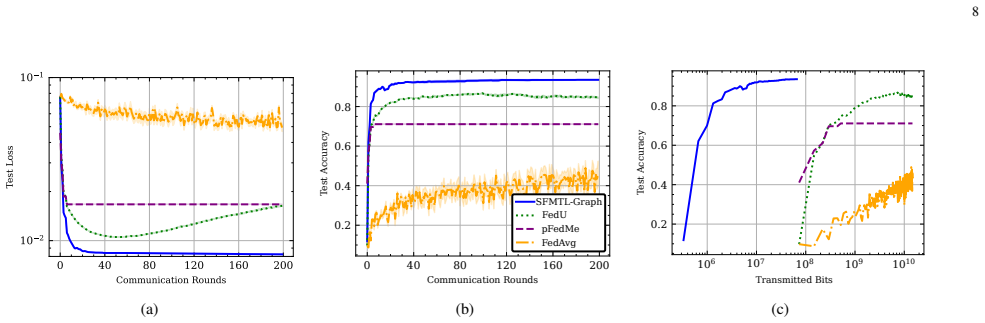
The central claim is that selective collaboration through community detection outperforms unselective collaboration and global averaging in federated multi-task learning. On Heterogeneous CIFAR-10, the proposed SFMTL-Graph reaches about 0.92 mean accuracy, roughly 9 percentage points above the closest baseline FedU, while transmitting less than $10^{8}$ bits over 200 rounds; FedU, FedAvg, and pFedMe each transmit over $10^{10}$ bits, more than SFMTL-Graph's cumulative total in a single round. The authors attribute the gain to a similarity weight that combines functional similarity of classification heads (cosine similarity of their logits evaluated on both clients' feature anchors) with representational similarity of anchors, followed by Louvain community detection that restricts the regularized head update to peers inside the same community. On Rotated & Masked MNIST the method again ranks first, with a smaller margin, and the fairness analysis reports the lowest variance in client accuracies and the best mean accuracy for the worst 10% of clients.
Load-bearing premise
The method rests on the premise that the cosine-similarity weights in Eq. (7) correctly rank how related two clients' tasks are, together with the assumption that every client has the same number of local classes so class-wise anchor comparisons are valid; if either fails, communities will group incompatible clients and collaboration will push models the wrong way.
Editorial extensions
If this is right
- On Heterogeneous CIFAR-10, SFMTL-Graph's mean accuracy of about 0.92 exceeds the closest baseline FedU by roughly 9 points, and it is the top method on Rotated & Masked MNIST as well.
- Cumulative communication over 200 rounds stays below 10^8 bits, less than a single round of any baseline, because clients transmit only a small anchor (1024 values) and a 512 by 10 head.
- Local compute stays at the level of FedAvg and FedU (about 1.25 times 10^8 FLOPS on CIFAR-10), while pFedMe's inner-loop optimization costs roughly 1.5 times 10^10 FLOPS for the same task.
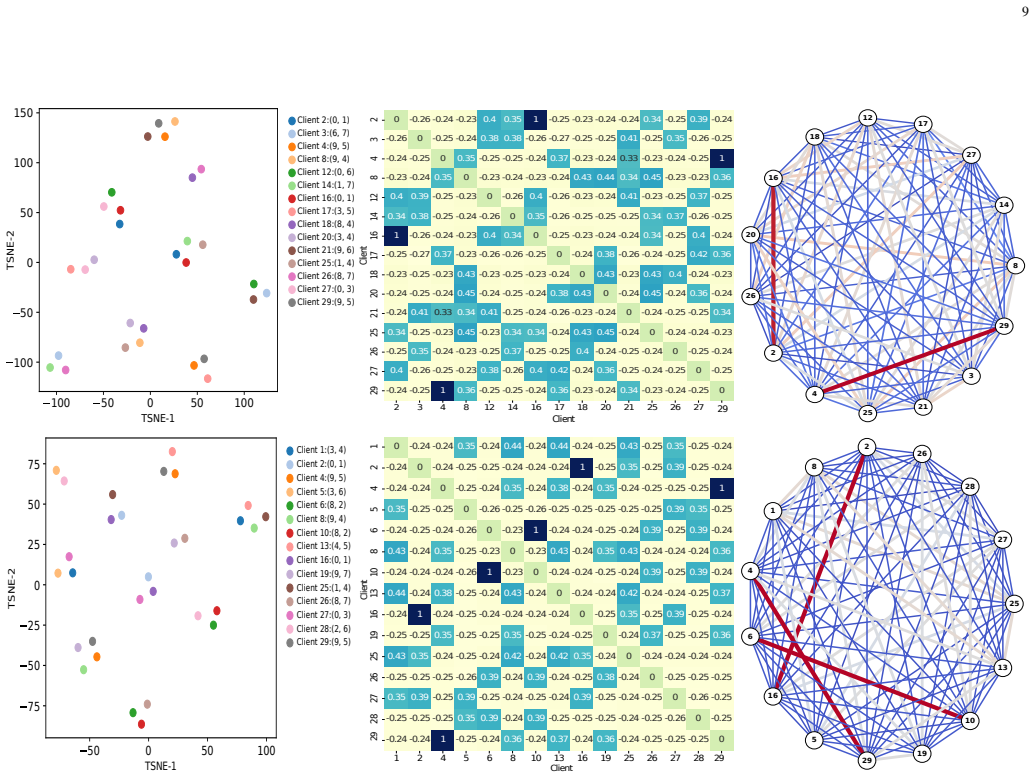
- Fairness improves: the worst-10% mean accuracy is 0.75 with standard deviation 0.11, the standard deviation across clients is the lowest at 0.08, and clients sharing the same label set move closer in representation space over rounds.
Reading between the lines
- An implication the authors leave implicit is that the communication budget scales with the number of local classes and the head width, not the backbone size, so the scheme becomes increasingly attractive for large backbones; whether the accuracy gap survives on harder tasks such as ImageNet-scale heterogeneity is untested.
- The similarity proxy is never calibrated against ground-truth task distances; a direct test would construct a synthetic federated benchmark with known label distributions and check whether Louvain communities recover the true clusters, and whether randomizing the edge weights collapses the accuracy gain.
- Because clients need the same number of local classes for the class-wise anchor comparison, the method as stated cannot handle clients with different label sets; a natural extension is to allow partial class overlap by comparing only shared classes or by aligning anchor sets with optimal transport.
- The hard community assignment could be relaxed to soft membership, letting a client interpolate between its own head and a global mixture; the paper does not explore this, but it would test whether the sharp community boundary is what drives the gain or whether a soft version is equally effective.
Editorial analysis
A structured set of objections, weighed in public.
Referee Report
Summary. The paper proposes SFMTL-Graph, a federated multi-task learning method in which clients share only a compact feature anchor and a lightweight classification head with the server. The server builds a dynamic similarity graph from cosine similarities between anchors and between head responses on anchors, partitions clients into communities using the Louvain modularity heuristic, and performs per-community aggregation and Laplacian-style head regularization. The authors report experiments on two heterogeneous image classification benchmarks (CIFAR-10 with 30 clients and Rotated & Masked MNIST with 40 clients), claiming superior personalized accuracy, lower communication cost, and better fairness than FedAvg, pFedMe, and FedU. They also provide a qualitative analysis of the dynamic graph and community structure.
Significance. If the claims were fully supported, the paper would make a useful contribution to personalized federated learning by combining communication-efficient anchors with community-restricted collaboration. The idea of using functional similarity of classification heads on shared feature anchors is sensible, and the paper ships a public code repository, which aids reproducibility. However, the central communication-efficiency claim is internally inconsistent with the paper's own stated model sizes, and the client-side anchor update appears not to be computed as described. These issues affect the two headline contributions: communication efficiency and the dynamic similarity graph. The work is therefore not yet ready for publication in its current form, but the core approach is defensible and could be acceptably revised.
major comments (4)
- [Section V-C] The claim that SFMTL-Graph transmits 'less than 10^8 bits cumulatively' over 200 rounds is contradicted by the paper's own stated quantities. With dh = 512, Ck = 2, head size 512×10, and 32-bit floats, each client transmits 5120 + 1024 = 6144 floats = 196,608 bits per round. For 30 clients and 200 rounds this is 30 × 200 × 196,608 ≈ 1.18×10^9 bits, more than an order of magnitude above the claimed 10^8. The related statement that cumulative traffic is less than one baseline round also lacks the baseline model sizes needed to verify it. This is an internal arithmetic inconsistency in a headline contribution; please correct the accounting or report the exact participation counts and payload sizes used to produce Figures 2c and 3c.
- [Algorithm 1 and Eq. (5)] The feature anchor sent to the server is not actually 'newly computed' from local features. In Algorithm 1, line 11 initializes the local anchor h_k^(t) to the received community anchor h_cj, and lines 14–17 update only the model parameters w via the local loss; the anchor h is never updated during local training. Therefore the quantity sent in line 18, h_{k,R}, is just the community anchor received at the start of the round, not a data-dependent summary of the client's learned features. This breaks the definition in Eq. (5), where g_k(θ_k) uses class-wise anchors as targets, and it makes the representation similarity in Eq. (10) largely a measure of prior community identity rather than current feature alignment. Please specify how h is recomputed locally, or revise the algorithm and the similarity construction accordingly.
- [Section V-B and Table II] The text states that FedU, the closest baseline, is 'around 9% less in accuracy' than SFMTL-Graph on Heterogeneous CIFAR-10. Table II reports mean accuracies of 0.92 ± 0.06 for SFMTL-Graph and 0.91 ± 0.08 for FedU, a difference of 0.01, i.e., about 1% relative, and well within one standard deviation. The claim as written is not supported by the reported numbers. Please either report the accuracy gap as a percentage in a way that is consistent with Table II, or provide per-client accuracy distributions and a significance test that justifies the 'significantly superior' wording.
- [Eqs. (7)–(10) and Section V-D] The similarity weights in Eq. (7) combine cosine similarity of head logits on the two clients' anchors and cosine similarity of the anchors themselves, but the paper does not calibrate this proxy against ground-truth task relatedness. The qualitative t-SNE analysis in Section V-D is suggestive, but it does not quantify whether the resulting communities consistently group clients with the same or overlapping label sets, nor whether misgrouped clients suffer negative transfer. Please add a quantitative evaluation of the similarity metric (e.g., correlation with label-overlap ground truth, or an ablation with a known-correct similarity oracle) to substantiate the load-bearing premise that the graph correctly orders task relatedness.
minor comments (4)
- [Eq. (11)] The indicator function I(C_k^(t), C_ℓ^(t)) is used before the community partition has been formally defined; please define the community assignment function before Eq. (11) or rewrite the indicator in terms of the partition C^(t).
- [Algorithm 1] In the Parameters line, the learning rate η appears twice (once as learning rate and once inside the server-side update τ = η × R). Please use distinct symbols for the local learning rate and the server learning rate.
- [Section V-A] The description of pFedMe's local rounds is confusing: the text says 'uses 20 local rounds' and then 'we make 30 inner rounds for pFedMe'. Please clarify the number of local updates and inner-loop iterations used for pFedMe.
- [Overall] Several typos and grammatical errors appear in Sections V-D and the figure captions (e.g., 'reprentation', 'similairty', 'simmilarity'), and the t-SNE plots in Figure 4 would benefit from higher resolution and a legend that distinguishes client classes.
Circularity Check
No circular derivation of the central claims: accuracy and communication results are empirical and benchmarked; only a non-load-bearing self-citation and a mildly self-confirming similarity-graph feedback loop prevent a perfect score.
full rationale
The paper's substantive claims are empirical rather than derived: SFMTL-Graph's accuracy, fairness, and communication costs are measured against FedAvg, pFedMe, and FedU on two datasets, with code and hyperparameters reported, so the central comparison does not reduce to a fitted input or to a self-citation. The only overlapping-author citation, [27], appears in related work as a sheaf-based method and is not used to justify the Louvain construction, the similarity weights, or any theorem, so it is not load-bearing. The dynamic graph in Eqs. (7)-(15) has a modestly self-confirming character: Eq. (14) averages anchors within each community and Eq. (15) pulls classification heads toward community members, so the similarity weights recomputed in the next round from these already-pulled quantities partly reflect the algorithm's own collaboration rather than an independent measurement of task relatedness. Section V-D's observation that same-label clients cluster is therefore weaker evidence than presented, but this is a feedback loop and a limitation, not an equation equal to its input by construction. Separately, the Section V-C claim that SFMTL-Graph transmits less than 10^8 bits over 200 rounds is difficult to reconcile with the paper's own stated quantities (dh=512, head 512x10, 32-bit floats, 30 clients, 200 rounds); that is an internal arithmetic inconsistency and a correctness risk, not a circularity. On the circularity axis, the result is therefore near zero, with only the minor self-reinforcement caveat above.
Assumptions & free parameters
free parameters (2)
- lambda =
Not reported in experiments
- alpha =
0.49
assumptions (4)
- domain assumption All clients have the same number of local classes C_k.
- domain assumption Cosine similarity of head logits on anchors and cosine similarity of anchors correctly capture task relatedness.
- domain assumption Maximizing modularity with the Louvain heuristic yields communities where knowledge transfer is positive.
- domain assumption Tasks share underlying structure that makes feature alignment useful.
Cite this review
Pith. "Pith review of Learning to Collaborate Over Graphs: A Selective Federated Multi-Task Learning Approach." pith.science (2026). https://pith.science/paper/GHRXX7VE
@misc{pith2026250610102,
  author       = {Pith},
  title        = {Pith review of: Learning to Collaborate Over Graphs: A Selective Federated Multi-Task Learning Approach},
  year         = {2026},
  howpublished = {\url{https://pith.science/paper/GHRXX7VE}},
  note         = {Machine review of arXiv:2506.10102}
}
read the original abstract
We present a novel federated multi-task learning method that leverages cross-client similarity to enable personalized learning for each client. To avoid transmitting the entire model to the parameter server, we propose a communication-efficient scheme that introduces a feature anchor, a compact vector representation that summarizes the features learned from the client's local classes. This feature anchor is shared with the server to account for local clients' distribution. In addition, the clients share the classification heads, a lightweight linear layer, and perform a graph-based regularization to enable collaboration among clients. By modeling collaboration between clients as a dynamic graph and continuously updating and refining this graph, we can account for any drift from the clients. To ensure beneficial knowledge transfer and prevent negative collaboration, we leverage a community detection-based approach that partitions this dynamic graph into homogeneous communities, maximizing the sum of task similarities, represented as the graph edges' weights, within each community. This mechanism restricts collaboration to highly similar clients within their formed communities, ensuring positive interaction and preserving personalization. Extensive experiments on two heterogeneous datasets demonstrate that our method significantly outperforms state-of-the-art baselines. Furthermore, we show that our method exhibits superior computation and communication efficiency and promotes fairness across clients.
Figures


Figures from the paper (1 more)
Reference graph
Works this paper leans on
-
[1]
Communication-efficient learning of deep networks from decentralized data,
B. McMahan, E. Moore, D. Ramage, S. Hampson, and B. A. y Arcas, “Communication-efficient learning of deep networks from decentralized data,” in Artificial intelligence and statistics . PMLR, 2017, pp. 1273– 1282
2017
-
[2]
Deep learning,
Y . LeCun, Y . Bengio, and G. Hinton, “Deep learning,” nature, vol. 521, no. 7553, pp. 436–444, 2015
2015
-
[3]
Federated learning for health- care applications,
A. Chaddad, Y . Wu, and C. Desrosiers, “Federated learning for health- care applications,” IEEE Internet of Things Journal , vol. 11, no. 5, pp. 7339–7358, 2024
work page 2024
-
[4]
Efficient and secure federated learning for financial applications,
T. Liu, Z. Wang, H. He, W. Shi, L. Lin, R. An, and C. Li, “Efficient and secure federated learning for financial applications,” Applied Sciences , vol. 13, no. 10, p. 5877, 2023
work page 2023
-
[5]
Federated learning for mobile keyboard prediction (2018),
A. Hard, K. Rao, R. Mathews, S. Ramaswamy, F. Beaufays, S. Augen- stein, H. Eichner, C. Kiddon, and D. Ramage, “Federated learning for mobile keyboard prediction (2018),” arXiv preprint arXiv:1811.03604 , 1811
arXiv 2018
-
[6]
Federated learning for industrial internet of things in future industries,
D. C. Nguyen, M. Ding, P. N. Pathirana, A. Seneviratne, J. Li, D. Niyato, and H. V . Poor, “Federated learning for industrial internet of things in future industries,” IEEE Wireless Communications , vol. 28, no. 6, pp. 192–199, 2021
work page 2021
-
[7]
Scaffold: Stochastic controlled averaging for federated learn- ing,
S. P. Karimireddy, S. Kale, M. Mohri, S. Reddi, S. Stich, and A. T. Suresh, “Scaffold: Stochastic controlled averaging for federated learn- ing,” in International conference on machine learning . PMLR, 2020, pp. 5132–5143
2020
-
[8]
Advances and open problems in federated learning,
P. Kairouz et al., “Advances and open problems in federated learning,” Foundations and Trends® in Machine Learning , vol. 14, no. 1–2, pp. 1–210, 2021
work page 2021
Show all 37 references
-
[9]
Robust and communication-efficient federated learning from non-iid data,
F. Sattler, S. Wiedemann, K.-R. M ¨uller, and W. Samek, “Robust and communication-efficient federated learning from non-iid data,” IEEE transactions on neural networks and learning systems , vol. 31, no. 9, pp. 3400–3413, 2019
2019
-
[10]
Adaptive personalized federated learning,
Y . Deng, M. M. Kamani, and M. Mahdavi, “Adaptive personalized federated learning,” arXiv preprint arXiv:2003.13461 , 2020
2003 arXiv
-
[11]
Privacy-preserving federated learning for detecting fraudulent financial transactions in japanese banks,
S. Kanamori, T. Abe, T. Ito, K. Emura, L. Wang, S. Yamamoto, L. T. Phong, K. Abe, S. Kim, R. Nojima, S. Ozawa, and S. Moriai, “Privacy-preserving federated learning for detecting fraudulent financial transactions in japanese banks,” Journal of Information Processing , vol. 30,...
2022
-
[12]
Research on modeling of e-banking fraud account identification based on federated learning,
B. Lv, P. Cheng, C. Zhang, H. Ye, X. Meng, and X. Wang, “Research on modeling of e-banking fraud account identification based on federated learning,” in 2021 IEEE Intl Conf on Dependable, Autonomic and Secure Computing, Intl Conf on Pervasive Intelligence and Computing, Intl C...
2021
-
[13]
Ditto: Fair and robust federated learning through personalization,
T. Li, S. Hu, A. Beirami, and V . Smith, “Ditto: Fair and robust federated learning through personalization,” in International conference on machine learning . PMLR, 2021, pp. 6357–6368
2021
-
[14]
Personalized federated learning with moreau envelopes,
C. T Dinh, N. Tran, and J. Nguyen, “Personalized federated learning with moreau envelopes,” Advances in neural information processing systems, vol. 33, pp. 21 394–21 405, 2020
2020
-
[15]
One model to learn them all,
L. Kaiser, A. N. Gomez, N. Shazeer, A. Vaswani, N. Parmar, L. Jones, and J. Uszkoreit, “One model to learn them all,” arXiv preprint arXiv:1706.05137, 2017
2017 arXiv
-
[16]
Distilling the knowledge in a neural network,
G. Hinton, O. Vinyals, and J. Dean, “Distilling the knowledge in a neural network,” arXiv preprint arXiv:1503.02531 , 2015
2015 arXiv
-
[17]
Multi-task learning with deep neural networks: A survey,
M. Crawshaw, “Multi-task learning with deep neural networks: A survey,” arXiv preprint arXiv:2009.09796 , 2020
2009 arXiv
-
[18]
Clustered federated learning: Model-agnostic distributed multitask optimization under privacy con- straints,
F. Sattler, K.-R. M ¨uller, and W. Samek, “Clustered federated learning: Model-agnostic distributed multitask optimization under privacy con- straints,” IEEE transactions on neural networks and learning systems , vol. 32, no. 8, pp. 3710–3722, 2020
2020
-
[19]
A new look and convergence rate of federated multitask learning with laplacian regularization,
C. T. Dinh, T. T. Vu, N. H. Tran, M. N. Dao, and H. Zhang, “A new look and convergence rate of federated multitask learning with laplacian regularization,” IEEE Transactions on Neural Networks and Learning Systems, vol. 35, no. 6, pp. 8075–8085, 2024
2024
-
[20]
Collabora- tion equilibrium in federated learning,
S. Cui, J. Liang, W. Pan, K. Chen, C. Zhang, and F. Wang, “Collabora- tion equilibrium in federated learning,” in Proceedings of the 28th ACM SIGKDD conference on knowledge discovery and data mining , 2022, pp. 241–251
2022
-
[21]
Bold but cautious: Unlocking the potential of personalized federated learning through cautiously aggressive collaboration,
X. Wu, X. Liu, J. Niu, G. Zhu, and S. Tang, “Bold but cautious: Unlocking the potential of personalized federated learning through cautiously aggressive collaboration,” in Proceedings of the IEEE/CVF international conference on computer vision , 2023, pp. 19 375–19 384
2023
-
[22]
Feder- ated learning with compression: Unified analysis and sharp guarantees,
F. Haddadpour, M. M. Kamani, A. Mokhtari, and M. Mahdavi, “Feder- ated learning with compression: Unified analysis and sharp guarantees,” in International Conference on Artificial Intelligence and Statistics . PMLR, 2021, pp. 2350–2358
2021
-
[23]
Personalized federated learning with feature alignment and classifier collaboration,
J. Xu, X. Tong, and S.-L. Huang, “Personalized federated learning with feature alignment and classifier collaboration,” arXiv preprint arXiv:2306.11867, 2023. 11
2023 arXiv
-
[24]
Fedfa: Federated learning with feature anchors to align features and classifiers for heterogeneous data,
T. Zhou, J. Zhang, and D. H. Tsang, “Fedfa: Federated learning with feature anchors to align features and classifiers for heterogeneous data,” IEEE Transactions on Mobile Computing, vol. 23, no. 6, pp. 6731–6742, 2023
2023
-
[25]
Federated multi-task learning,
V . Smith, C.-K. Chiang, M. Sanjabi, and A. S. Talwalkar, “Federated multi-task learning,” Advances in neural information processing systems, vol. 30, 2017
2017
-
[26]
Federated Multi-Task Learning under a Mixture of Distributions
O. Marfoq, G. Neglia, A. Bellet, L. Kameni, and R. Vidal, “Federated Multi-Task Learning under a Mixture of Distributions.”
-
[27]
Tackling feature and sample heterogeneity in decentralized multi-task learning: A sheaf- theoretic approach,
C. Ben Issaid, P. Vepakomma, and M. Bennis, “Tackling feature and sample heterogeneity in decentralized multi-task learning: A sheaf- theoretic approach,” Transactions on Machine Learning Research, 2025
2025
-
[28]
Detecting community structure in networks,
M. E. Newman, “Detecting community structure in networks,” The European physical journal B , vol. 38, pp. 321–330, 2004
2004
-
[29]
Discovering communities with clustered federated learning,
M. Bettinelli, A. Benoit, and K. Grandjean, “Discovering communities with clustered federated learning,” in 2024 IEEE International Confer- ence on Big Data (BigData) . IEEE, 2024, pp. 7648–7657
2024
-
[30]
Exact Clustering via Integer Programming and Maximum Satisfiability,
A. Miyauchi, T. Sonobe, and N. Sukegawa, “Exact Clustering via Integer Programming and Maximum Satisfiability,” Proceedings of the AAAI Conference on Artificial Intelligence , vol. 32, no. 1, Apr. 2018
2018
-
[31]
The clique-partitioning problem,
J. Bhasker and T. Samad, “The clique-partitioning problem,” Computers & Mathematics with Applications , vol. 22, no. 6, pp. 1–11, 1991
1991
-
[32]
Networks: An introduction by mej newman: Oxford, uk: Oxford university press
S. Yang, “Networks: An introduction by mej newman: Oxford, uk: Oxford university press.” 2013
2013
-
[33]
Fast unfolding of communities in large networks,
V . D. Blondel, J.-L. Guillaume, R. Lambiotte, and E. Lefebvre, “Fast unfolding of communities in large networks,” Journal of Statistical Mechanics: Theory and Experiment , vol. 2008, no. 10, p. P10008, Oct. 2008
2008
-
[34]
Learning multiple layers of features from tiny images.(2009),
A. Krizhevsky, G. Hinton et al. , “Learning multiple layers of features from tiny images.(2009),” 2009
2009
-
[35]
Gradient-based learning applied to document recognition,
Y . LeCun, L. Bottou, Y . Bengio, and P. Haffner, “Gradient-based learning applied to document recognition,” Proceedings of the IEEE , vol. 86, no. 11, pp. 2278–2324, 1998
1998
-
[36]
Visualizing data using t-sne
L. Van der Maaten and G. Hinton, “Visualizing data using t-sne.” Journal of machine learning research , vol. 9, no. 11, 2008
2008
-
[37]
Learning to Collaborate in Decentralized Learning of Personalized Models,
S. Li, T. Zhou, X. Tian, and D. Tao, “Learning to Collaborate in Decentralized Learning of Personalized Models,” in 2022 IEEE/CVF Conference on Computer Vision and Pattern Recognition (CVPR). New Orleans, LA, USA: IEEE, Jun. 2022, pp. 9756–9765
2022
Reviewed August 7, 2026 · model on record in the stance chip above.
Discussion (0). Sign in to comment.