REVIEW 5 major objections 6 minor 1 cited by
RoCA: Robust Cross-Domain End-to-End Autonomous Driving
T0 review · 5 major / 6 minor · reviewed 2026-08-07 · deepseek-v4-flash
Pith's one-line read RoCA claims that a Gaussian-process codebook of driving tokens lets end-to-end planners generalize and adapt across cities and simulators without extra inference cost.
desk verdict Broad, useful empirical study of a GP-style codebook teacher for E2E driving; the math is loose and there's no code, but the gains look real and it deserves review. read the letter →
The pith
A machine-rendered reading of the paper's core claim, the machinery that carries it, and where it could break.
The reading
What carries the argument
The load-bearing object is the GP codebook: $N_{\mathrm{code}}$ groups of learnable $D$-dimensional basis tokens $\{b_{j,k}\}$, each group paired with trajectories $\{w_{j,k}\}$ clustered from source ground truth so that each basis token encodes a driving maneuver. An RBF kernel $\kappa$ measures similarity between the current ego/agent tokens and the basis tokens; the closed-form GP posterior then yields reconstructed tokens and predicted trajectories, with predictive variance $\sigma^2$ as an uncertainty estimate. Variance-weighted reconstruction, supervision, triplet, and KL losses push the base E2E planner's predictions toward the GP teacher, which is how the codebook transfers domain knowledge.
What would settle it
On target-domain data, measure the kernel distance from each ego/agent token to its nearest basis token and compare GP predictive variance against actual trajectory error; if target tokens fall systematically far outside the source codebook's range and variance does not track error, the transfer mechanism is not doing the work. Alternatively, replace the GP posterior mean with the nearest-basis-token trajectory; if planning performance does not drop, the Gaussian-process interpolation is incidental rather than load-bearing.
Extended reading notes
Core claim
The central claim is that a Gaussian process defined over a learned codebook of ego and agent tokens, with each basis token one-to-one paired with a representative trajectory, captures a joint distribution that generalizes across driving domains. On source data, RoCA learns the codebook by reconstructing the base model's tokens from the basis and by supervising GP-predicted trajectories against ground truth; it then finetunes the base model so its predictions align with the GP's probabilistic output. On a target domain, the frozen GP generates pseudo-targets and uncertainty weights that let the base model adapt with or without ground-truth labels. The paper reports consistent gains across Bench2Drive closed-loop routes, sim-to-real transfer to nuScenes, cross-city transfer between Boston and Singapore, and degraded-image conditions, with uncertainty-based active learning improving over random sampling and direct finetuning.
Load-bearing premise
The method assumes the basis tokens learned on the source domain still sit near the ego and agent tokens of the target domain, so that similarity scores between new tokens and the stored basis tokens remain informative; if domain shift moves the token representation too far, the predicted trajectories and uncertainty estimates become unreliable and the whole regularization and active-learning mechanism loses meaning.
Editorial extensions
If this is right
- Any tokenized E2E planner can gain cross-domain robustness from RoCA without extra inference latency, because the GP module is used only in training and adaptation.
- A target domain can be adapted without ground-truth waypoint labels, using the GP as teacher, and the paper reports this unsupervised adaptation outperforming direct finetuning with ground truth in most cross-city cases.
- The GP's predictive variance identifies the most informative target samples, so active learning at 5–15% labeling budgets beats random selection and standard uncertainty estimators.
- The same regularization improves in-domain planning and long-tail maneuvers, not just cross-domain transfer.
Reading between the lines
- Beyond the paper, the GP variance could be used at runtime as an out-of-distribution detector, triggering a conservative fallback policy when the codebook is not confident; the paper only uses variance during training and adaptation.
- The codebook's transferability suggests a testable extension: if target tokens are projected onto the source codebook with a learned linear alignment, cross-domain gains could increase further; the paper does not attempt this alignment.
- Because the codebook is built from clustered ground-truth trajectories, RoCA could be extended to new maneuver types by adding basis groups from target logs without retraining the base planner, though the paper does not demonstrate incremental codebook growth.
Editorial analysis
A structured set of objections, weighed in public.
Referee Report
Summary. The paper proposes RoCA, a module that learns a codebook of basis tokens and associated trajectories from the ego/agent tokens of a base end-to-end driving model, using kernel similarities in a Gaussian-process-like formulation. RoCA is used as a teacher to regularize source-domain training, and during target-domain adaptation it provides pseudo-labels (unsupervised) or auxiliary supervision (supervised), plus a variance-based active-learning criterion. The method is evaluated on Bench2Drive, nuScenes, NAVSIM, and DriveArena with multiple base models (VAD, SSR, SparseDrive, ORION), reporting improvements in closed-loop and open-loop planning metrics, as well as domain-adaptation and active-learning gains.
Significance. If the technical issues are resolved, RoCA is a practical plug-in module: it improves cross-domain generalization without changing the deployed planner, supports uncertainty-guided data selection, and shows broad empirical gains across several recent end-to-end driving models. The evaluation is extensive, including closed-loop and open-loop settings, multiple simulators, ablations of loss terms, kernel choice, and codebook size, and comparisons with MC Dropout and Deep Ensembles. The paper also provides detailed training procedures. However, the validity of the probabilistic formulation and the transferability of the source-trained basis tokens to target domains need to be established before the central claims are fully supported.
major comments (5)
- [Section 3.2.2, Eqs. (2)-(3)] Equation (2) is dimensionally inconsistent: token e is a D-dimensional vector while B_{c_e} is a C×D matrix, so a joint Gaussian over [e; B_{c_e}] is not well-defined with cross-covariance blocks of the sizes written. The predictive formula in Eq. (3) is, in effect, the posterior mean of a multi-output kernel ridge regression with training inputs {b_{j,k}} and outputs {b_{j,k}} (after centering), not a posterior over the random variable e. Please rewrite the probabilistic model as a standard Gaussian process over the trajectory outputs (e.g., a multi-output GP with training inputs B and targets W), and then derive Eqs. (3) and (5) from that model, or revise the text so that the 'joint probabilistic distribution' claim is not made. As written, the derivation does not support the claimed GP formalism.
- [Section 3.3.2, Algorithm 2] Algorithm 2, line 9 states 'Update θ_st and θ_h using both the standard trajectory losses and L_gp', but the algorithm is labeled 'unsupervised adaptation' and Section 3.3.2 says that without ground-truth waypoints 'we use L_gp to update the base E2E model'. The algorithm therefore cannot be executed as an unsupervised method. Please correct the algorithm (or the text) to match the reported experiments, and specify exactly which loss terms are used in the unsupervised versus supervised adaptation settings.
- [Section 3.3.2 and Section 4.8] The cross-domain mechanism rests on the assumption that the source-trained basis tokens B remain representative of target-domain ego/agent tokens, since B and θ_g are frozen during adaptation and the GP pseudo-labels and variances are computed from kernel similarities to B. The paper provides no quantitative evidence for this assumption: no measurement of token shift between source and target (e.g., average kernel similarity of target tokens to the nearest basis, maximum mean discrepancy), no reliability/calibration analysis of the GP variances on target data, and no analysis of how the GP predictive variance behaves as a function of domain shift. The t-SNE figures (Figures 3 and 4) demonstrate qualitative clustering but do not show that target tokens are close to the source basis. Please provide such an analysis, or explicitly discuss and test the failure mode where target tokens move off the source manifold.
- [Section 4.7, Table 4] The active-learning comparison conflates two factors: the GP variance is used both as the acquisition function and as the loss weight in L_sup/L_gp (Eqs. 5-7). 'RoCA random' uses variance-weighted training but random sampling, while 'Direct finetune random' uses neither; the difference between them therefore reflects the loss-weighting scheme, not the sample-selection strategy. To support the claim that GP-based uncertainty improves sample selection, please add an experiment where the training loss is held fixed (e.g., the RoCA loss) and only the sampling strategy changes between random and variance-based selection, or otherwise isolate the effect of the acquisition function.
- [Section 3.3.2 and Tables 2, 3, 5] The unsupervised adaptation procedure in Section 3.3.2 is a form of self-training with GP-generated pseudo-labels, but the paper does not compare against standard self-training baselines (e.g., using the base model's own top-confidence predictions as pseudo-labels, or a confidence-thresholded variant). Without such a baseline, it is unclear whether the reported gains in Tables 2, 3, and 5 come from the GP teacher specifically or from self-training in general. Please add at least one standard self-training baseline for the unsupervised adaptation results.
minor comments (6)
- [Section 4.4] NA VSIM should be written NAVSIM, both in the text and in Table 6.
- [Section 4.2] The text says 'improving driving score from 77.76 to 80.38 with ORION as the base model', but Table 1 lists the ORION baseline DS as 77.74. Please correct this inconsistency.
- [Section 4.7] The sentence 'active learning reduces annotation and adaptation costs if the the most informative samples' contains a duplicated 'the'.
- [Appendix A.5.1] 'rotational quadratic kernel' should read 'rational quadratic kernel' to match standard terminology.
- [Section 3.2.2] The MLP used to classify tokens from the kernel vector κ(e,B) is not described in terms of architecture, input dimensionality, or normalization. Please provide these details for reproducibility.
- [Abstract and Section 4.5] The claim 'without requiring extra inference computation' refers to the regularization-only deployment; the optional GP trajectory-prediction mode described in Appendix A.2 increases latency (Table 10). Please make this distinction explicit in the main text and abstract.
Circularity Check
No circularity: the RoCA GP teacher is trained on source-domain ground truth, and its use in source regularization, target adaptation, and active learning is a standard fixed-teacher self-training/prediction pipeline rather than a re-statement of its own inputs.
full rationale
RoCA's derivation chain is self-contained. The basis tokens and GP parameters are trained in Sections 3.2.2 and 3.2.3 using the reconstruction loss L_rec (Eq. 4) with the base model's tokens held fixed and the supervised trajectory loss L_sup (Eq. 6) with ground-truth waypoints; the trajectory codebook is sampled and clustered from source ground-truth data. During source finetuning, L_gp (Eq. 7) treats the trained RoCA as a fixed teacher: B and theta_g are frozen (Algorithm 1, lines 20-23), so the regularization is a teacher-student distillation, not a self-justifying circular step. In unsupervised target adaptation (Algorithm 2), the same frozen GP provides pseudo-labels without any target ground-truth; the base model is updated against these fixed pseudo-labels, which is a standard self-training loop. The GP variance in Eq. 5 is a kernel-distance quantity used both as a loss weight and as an active-learning score; this is a modeling choice, and any weakness in its calibration is a correctness or robustness concern, not a circular reduction of the prediction to the input. The only self-citations (Yasarla et al. GP works) are motivational in the related work and provide no load-bearing theorem or uniqueness claim. No equation or algorithm step restates its own inputs as an output, and the central cross-domain results are benchmarked against external baselines on held-out data. Accordingly, no circular step is present.
Assumptions & free parameters
free parameters (3)
- Codebook sizes (Nego, Nagent, C, D) =
Nego=48, Nagent=64, C=64, D=256
- Kernel and noise hyperparameters =
Not reported
- Variance weighting schedule =
1/sigma^2 and log(sigma) terms in losses
assumptions (4)
- standard math The joint distribution of tokens and trajectories follows the GP equations in Eq. 2-5
- domain assumption The base model's ego and agent tokens encode sufficient information for trajectory prediction
- domain assumption The source-domain codebook transfers to target domains
- domain assumption The GP predictive variance is a calibrated uncertainty estimate
Cite this review
Pith. "Pith review of RoCA: Robust Cross-Domain End-to-End Autonomous Driving." pith.science (2026). https://pith.science/paper/XNCSCXZK
@misc{pith2026250610145,
  author       = {Pith},
  title        = {Pith review of: RoCA: Robust Cross-Domain End-to-End Autonomous Driving},
  year         = {2026},
  howpublished = {\url{https://pith.science/paper/XNCSCXZK}},
  note         = {Machine review of arXiv:2506.10145}
}
read the original abstract
End-to-end (E2E) autonomous driving has recently emerged as a new paradigm, offering significant potential. However, few studies have looked into the practical challenge of deployment across domains (e.g., cities). Although several works have incorporated Large Language Models (LLMs) to leverage their open-world knowledge, LLMs do not guarantee cross-domain driving performance and may incur prohibitive retraining costs during domain adaptation. In this paper, we propose RoCA, a novel framework for robust cross-domain E2E autonomous driving. RoCA formulates the joint probabilistic distribution over the tokens that encode ego and surrounding vehicle information in the E2E pipeline. Instantiating with a Gaussian process (GP), RoCA learns a set of basis tokens with corresponding trajectories, which span diverse driving scenarios. Then, given any driving scene, it is able to probabilistically infer the future trajectory. By using RoCA together with a base E2E model in source-domain training, we improve the generalizability of the base model, without requiring extra inference computation. In addition, RoCA enables robust adaptation on new target domains, significantly outperforming direct finetuning. We extensively evaluate RoCA on various cross-domain scenarios and show that it achieves strong domain generalization and adaptation performance.
Figures

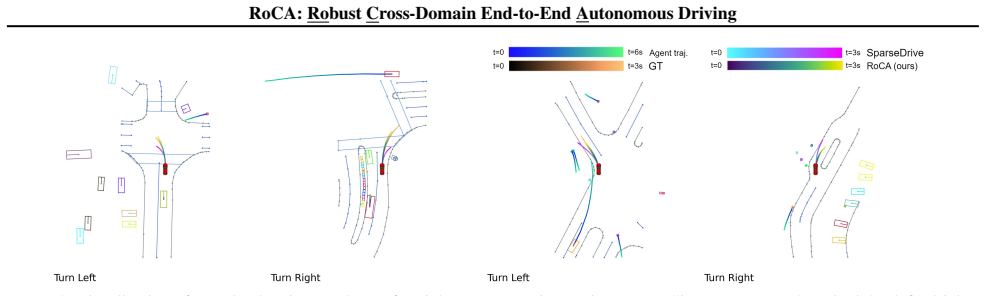

Figures from the paper (5 more)


Forward citations
Cited by 1 Pith paper
-
FrozenDrive: Zero-Shot Text-Guided Driving Scene Generation and Data Augmentation with Parameter-Free Frozen Diffusion Model
FrozenDrive enables zero-shot text-guided generation of consistent multi-view driving scenes via a parameter-free frozen diffusion backbone with spatio-temporal attention, improving autonomous driving models on advers...
Reference graph
Works this paper leans on
-
[1]
write newline
" write newline "" before.all 'output.state := FUNCTION n.dashify 't := "" t empty not t #1 #1 substring "-" = t #1 #2 substring "--" = not "--" * t #2 global.max substring 't := t #1 #1 substring "-" = "-" * t #2 global.max substring 't := while if t #1 #1 substring * t #2 global.max substring 't := if while FUNCTION format.date year duplicate empty "emp...
-
[2]
nuscenes: A multimodal dataset for autonomous driving
Holger Caesar, Varun Bankiti, Alex H Lang, Sourabh Vora, Venice Erin Liong, Qiang Xu, Anush Krishnan, Yu Pan, Giancarlo Baldan, and Oscar Beijbom. nuscenes: A multimodal dataset for autonomous driving. In Proceedings of the IEEE/CVF conference on computer vision and pattern recognition , pages 11621--11631, 2020
work page 2020
-
[3]
Mp3: A unified model to map, perceive, predict and plan
Sergio Casas, Abbas Sadat, and Raquel Urtasun. Mp3: A unified model to map, perceive, predict and plan. In Proceedings of the IEEE/CVF Conference on Computer Vision and Pattern Recognition , pages 14403--14412, 2021
work page 2021
-
[4]
Multipath: Multiple probabilistic anchor trajectory hypotheses for behavior prediction
Yuning Chai, Benjamin Sapp, Mayank Bansal, and Dragomir Anguelov. Multipath: Multiple probabilistic anchor trajectory hypotheses for behavior prediction. arXiv preprint arXiv:1910.05449 , 2019
arXiv 1910
- [5]
-
[6]
Neat: Neural attention fields for end-to-end autonomous driving
Kashyap Chitta, Aditya Prakash, and Andreas Geiger. Neat: Neural attention fields for end-to-end autonomous driving. In Proceedings of the IEEE/CVF International Conference on Computer Vision , pages 15793--15803, 2021
work page 2021
-
[7]
Transfuser: Imitation with transformer-based sensor fusion for autonomous driving
Kashyap Chitta, Aditya Prakash, Bernhard Jaeger, Zehao Yu, Katrin Renz, and Andreas Geiger. Transfuser: Imitation with transformer-based sensor fusion for autonomous driving. IEEE Transactions on Pattern Analysis and Machine Intelligence , 45(11):12878--12895, 2022
work page 2022
-
[8]
Exploring the limitations of behavior cloning for autonomous driving
Felipe Codevilla, Eder Santana, Antonio M L \'o pez, and Adrien Gaidon. Exploring the limitations of behavior cloning for autonomous driving. In Proceedings of the IEEE/CVF international conference on computer vision , pages 9329--9338, 2019
work page 2019
Show all 50 references
-
[9]
Carla: An open urban driving simulator
Alexey Dosovitskiy, German Ros, Felipe Codevilla, Antonio Lopez, and Vladlen Koltun. Carla: An open urban driving simulator. In Conference on robot learning , pages 1--16. PMLR, 2017
2017
-
[10]
Large scale interactive motion forecasting for autonomous driving: The waymo open motion dataset
Scott Ettinger, Shuyang Cheng, Benjamin Caine, Chenxi Liu, Hang Zhao, Sabeek Pradhan, Yuning Chai, Ben Sapp, Charles R Qi, Yin Zhou, et al. Large scale interactive motion forecasting for autonomous driving: The waymo open motion dataset. In Proceedings of the IEEE/CVF Internat...
2021
-
[11]
Gaussian process-based transfer kernel learning for unsupervised domain adaptation
Pengfei Ge and Yesen Sun. Gaussian process-based transfer kernel learning for unsupervised domain adaptation. Mathematics , 11(22):4695, 2023
2023
-
[12]
Distilling multi-modal large language models for autonomous driving
Deepti Hegde, Rajeev Yasarla, Hong Cai, Shizhong Han, Apratim Bhattacharyya, Shweta Mahajan, Litian Liu, Risheek Garrepalli, Vishal M Patel, and Fatih Porikli. Distilling multi-modal large language models for autonomous driving. arXiv preprint arXiv:2501.09757 , 2025
2025 arXiv
-
[13]
St-p3: End-to-end vision-based autonomous driving via spatial-temporal feature learning
Shengchao Hu, Li Chen, Penghao Wu, Hongyang Li, Junchi Yan, and Dacheng Tao. St-p3: End-to-end vision-based autonomous driving via spatial-temporal feature learning. In European Conference on Computer Vision , pages 533--549. Springer, 2022
2022
-
[14]
Planning-oriented autonomous driving
Yihan Hu, Jiazhi Yang, Li Chen, Keyu Li, Chonghao Sima, Xizhou Zhu, Siqi Chai, Senyao Du, Tianwei Lin, Wenhai Wang, et al. Planning-oriented autonomous driving. In Proceedings of the IEEE/CVF Conference on Computer Vision and Pattern Recognition , pages 17853--17862, 2023
2023
-
[15]
Tailored meta-learning for dual trajectory transformer: advancing generalized trajectory prediction
Feilong Huang, Zide Fan, Xiaohe Li, Wenhui Zhang, Pengfei Li, Ying Geng, and Keqing Zhu. Tailored meta-learning for dual trajectory transformer: advancing generalized trajectory prediction. Complex & Intelligent Systems , 11(3):174, 2025
2025
-
[16]
Emma: End-to-end multimodal model for autonomous driving
Jyh-Jing Hwang, Runsheng Xu, Hubert Lin, Wei-Chih Hung, Jingwei Ji, Kristy Choi, Di Huang, Tong He, Paul Covington, Benjamin Sapp, et al. Emma: End-to-end multimodal model for autonomous driving. arXiv preprint arXiv:2410.23262 , 2024
-
[17]
Vad: Vectorized scene representation for efficient autonomous driving
Bo Jiang, Shaoyu Chen, Qing Xu, Bencheng Liao, Jiajie Chen, Helong Zhou, Qian Zhang, Wenyu Liu, Chang Huang, and Xinggang Wang. Vad: Vectorized scene representation for efficient autonomous driving. In Proceedings of the IEEE/CVF International Conference on Computer Vision , p...
2023
-
[18]
Unsupervised visual domain adaptation: A deep max-margin gaussian process approach
Minyoung Kim, Pritish Sahu, Behnam Gholami, and Vladimir Pavlovic. Unsupervised visual domain adaptation: A deep max-margin gaussian process approach. In Proceedings of the IEEE/CVF Conference on Computer Vision and Pattern Recognition , pages 4380--4390, 2019
2019
-
[19]
Blip-2: Bootstrapping language-image pre-training with frozen image encoders and large language models
Junnan Li, Dongxu Li, Silvio Savarese, and Steven Hoi. Blip-2: Bootstrapping language-image pre-training with frozen image encoders and large language models. In International conference on machine learning , pages 19730--19742. PMLR, 2023
2023
-
[20]
Bevformer: Learning bird’s-eye-view representation from multi-camera images via spatiotemporal transformers
Zhiqi Li, Wenhai Wang, Hongyang Li, Enze Xie, Chonghao Sima, Tong Lu, Yu Qiao, and Jifeng Dai. Bevformer: Learning bird’s-eye-view representation from multi-camera images via spatiotemporal transformers. In European conference on computer vision , pages 1--18. Springer, 2022
2022
-
[21]
Distribution optimization under gaussian hypothesis for domain adaptive semantic segmentation
Chen Liang, Weihua Chen, Xin Zhao, Junyan Wang, Lijun Cao, and Junge Zhang. Distribution optimization under gaussian hypothesis for domain adaptive semantic segmentation. In 2025 IEEE/CVF Winter Conference on Applications of Computer Vision (WACV) , pages 9280--9290. IEEE, 2025
2025
-
[22]
Effective adaptation in multi-task co-training for unified autonomous driving
Xiwen Liang, Yangxin Wu, Jianhua Han, Hang Xu, Chunjing Xu, and Xiaodan Liang. Effective adaptation in multi-task co-training for unified autonomous driving. Advances in Neural Information Processing Systems , 35:19645--19658, 2022
2022
-
[23]
Visual instruction tuning
Haotian Liu, Chunyuan Li, Qingyang Wu, and Yong Jae Lee. Visual instruction tuning. Advances in neural information processing systems , 36, 2024
2024
-
[24]
Multimodal motion prediction with stacked transformers
Yicheng Liu, Jinghuai Zhang, Liangji Fang, Qinhong Jiang, and Bolei Zhou. Multimodal motion prediction with stacked transformers. In Proceedings of the IEEE/CVF conference on computer vision and pattern recognition , pages 7577--7586, 2021
2021
-
[25]
Cross-domain transfer learning using attention latent features for multi-agent trajectory prediction
Jia Quan Loh, Xuewen Luo, Fan Ding, Hwa Hui Tew, Junn Yong Loo, Ze Yang Ding, Susilawati Susilawati, and Chee Pin Tan. Cross-domain transfer learning using attention latent features for multi-agent trajectory prediction. In 2024 IEEE International Conference on Systems, Man, a...
2024
-
[26]
Scene transformer: A unified architecture for predicting multiple agent trajectories
Jiquan Ngiam, Benjamin Caine, Vijay Vasudevan, Zhengdong Zhang, Hao-Tien Lewis Chiang, Jeffrey Ling, Rebecca Roelofs, Alex Bewley, Chenxi Liu, Ashish Venugopal, et al. Scene transformer: A unified architecture for predicting multiple agent trajectories. arXiv preprint arXiv:21...
2021 arXiv
-
[27]
Vlp: Vision language planning for autonomous driving
Chenbin Pan, Burhaneddin Yaman, Tommaso Nesti, Abhirup Mallik, Alessandro G Allievi, Senem Velipasalar, and Liu Ren. Vlp: Vision language planning for autonomous driving. In Proceedings of the IEEE/CVF Conference on Computer Vision and Pattern Recognition , pages 14760--14769, 2024
2024
-
[28]
Lift, splat, shoot: Encoding images from arbitrary camera rigs by implicitly unprojecting to 3d
Jonah Philion and Sanja Fidler. Lift, splat, shoot: Encoding images from arbitrary camera rigs by implicitly unprojecting to 3d. In Computer Vision--ECCV 2020: 16th European Conference, Glasgow, UK, August 23--28, 2020, Proceedings, Part XIV 16 , pages 194--210. Springer, 2020
2020
-
[29]
Adaptraj: A multi-source domain generalization framework for multi-agent trajectory prediction
Tangwen Qian, Yile Chen, Gao Cong, Yongjun Xu, and Fei Wang. Adaptraj: A multi-source domain generalization framework for multi-agent trajectory prediction. In 2024 IEEE 40th International Conference on Data Engineering (ICDE) , pages 5048--5060. IEEE, 2024
2024
-
[30]
Facenet: A unified embedding for face recognition and clustering
Florian Schroff, Dmitry Kalenichenko, and James Philbin. Facenet: A unified embedding for face recognition and clustering. In Proceedings of the IEEE conference on computer vision and pattern recognition , pages 815--823, 2015
2015
-
[31]
Gaussian processes for machine learning
Matthias Seeger. Gaussian processes for machine learning. International journal of neural systems , 14(02):69--106, 2004
2004
-
[32]
Drivelm: Driving with graph visual question answering
Chonghao Sima, Katrin Renz, Kashyap Chitta, Li Chen, Hanxue Zhang, Chengen Xie, Ping Luo, Andreas Geiger, and Hongyang Li. Drivelm: Driving with graph visual question answering. arXiv preprint arXiv:2312.14150 , 2023
2023 arXiv
-
[33]
Large trajectory models are scalable motion predictors and planners
Qiao Sun, Shiduo Zhang, Danjiao Ma, Jingzhe Shi, Derun Li, Simian Luo, Yu Wang, Ningyi Xu, Guangzhi Cao, and Hang Zhao. Large trajectory models are scalable motion predictors and planners. arXiv preprint arXiv:2310.19620 , 2023
-
[34]
Sparsedrive: End-to-end autonomous driving via sparse scene representation
Wenchao Sun, Xuewu Lin, Yining Shi, Chuang Zhang, Haoran Wu, and Sifa Zheng. Sparsedrive: End-to-end autonomous driving via sparse scene representation. arXiv preprint arXiv:2405.19620 , 2024
2024 arXiv
-
[35]
Tokenize the world into object-level knowledge to address long-tail events in autonomous driving
Ran Tian, Boyi Li, Xinshuo Weng, Yuxiao Chen, Edward Schmerling, Yue Wang, Boris Ivanovic, and Marco Pavone. Tokenize the world into object-level knowledge to address long-tail events in autonomous driving. arXiv preprint arXiv:2407.00959 , 2024
2024 arXiv
-
[36]
Drivevlm: The convergence of autonomous driving and large vision-language models
Xiaoyu Tian, Junru Gu, Bailin Li, Yicheng Liu, Chenxu Hu, Yang Wang, Kun Zhan, Peng Jia, Xianpeng Lang, and Hang Zhao. Drivevlm: The convergence of autonomous driving and large vision-language models. arXiv preprint arXiv:2402.12289 , 2024
2024 arXiv
-
[37]
Omnidrive: A holistic llm-agent framework for autonomous driving with 3d perception, reasoning and planning
Shihao Wang, Zhiding Yu, Xiaohui Jiang, Shiyi Lan, Min Shi, Nadine Chang, Jan Kautz, Ying Li, and Jose M Alvarez. Omnidrive: A holistic llm-agent framework for autonomous driving with 3d perception, reasoning and planning. arXiv preprint arXiv:2405.01533 , 2024
2024 arXiv
-
[38]
Drivemlm: Aligning multi-modal large language models with behavioral planning states for autonomous driving
Wenhai Wang, Jiangwei Xie, ChuanYang Hu, Haoming Zou, Jianan Fan, Wenwen Tong, Yang Wen, Silei Wu, Hanming Deng, Zhiqi Li, et al. Drivemlm: Aligning multi-modal large language models with behavioral planning states for autonomous driving. arXiv preprint arXiv:2312.09245 , 2023
2023
-
[39]
Domain generalization for vision-based driving trajectory generation
Yunkai Wang, Dongkun Zhang, Yuxiang Cui, Zexi Chen, Wei Jing, Junbo Chen, Rong Xiong, and Yue Wang. Domain generalization for vision-based driving trajectory generation. In 2022 International Conference on Robotics and Automation (ICRA) , pages 8950--8956. IEEE, 2022
2022
-
[40]
Bridging the gap: Improving domain generalization in trajectory prediction
Zhibo Wang, Jiayu Guo, Haiqiang Zhang, Ru Wan, Junping Zhang, and Jian Pu. Bridging the gap: Improving domain generalization in trajectory prediction. IEEE Transactions on Intelligent Vehicles , 9(1):1780--1791, 2023
2023
-
[41]
Mv2dfusion: Leveraging modality-specific object semantics for multi-modal 3d detection
Zitian Wang, Zehao Huang, Yulu Gao, Naiyan Wang, and Si Liu. Mv2dfusion: Leveraging modality-specific object semantics for multi-modal 3d detection. arXiv preprint arXiv:2408.05945 , 2024
2024 arXiv
-
[42]
Chain-of-thought prompting elicits reasoning in large language models
Jason Wei, Xuezhi Wang, Dale Schuurmans, Maarten Bosma, Fei Xia, Ed Chi, Quoc V Le, Denny Zhou, et al. Chain-of-thought prompting elicits reasoning in large language models. Advances in neural information processing systems , 35:24824--24837, 2022
2022
-
[43]
Para-drive: Parallelized architecture for real-time autonomous driving
Xinshuo Weng, Boris Ivanovic, Yan Wang, Yue Wang, and Marco Pavone. Para-drive: Parallelized architecture for real-time autonomous driving. In Proceedings of the IEEE/CVF Conference on Computer Vision and Pattern Recognition , pages 15449--15458, 2024
2024
-
[44]
Gaussian processes for machine learning , volume 2
Christopher KI Williams and Carl Edward Rasmussen. Gaussian processes for machine learning , volume 2. MIT press Cambridge, MA, 2006
2006
-
[45]
Trajectory-guided control prediction for end-to-end autonomous driving: A simple yet strong baseline
Penghao Wu, Xiaosong Jia, Li Chen, Junchi Yan, Hongyang Li, and Yu Qiao. Trajectory-guided control prediction for end-to-end autonomous driving: A simple yet strong baseline. Advances in Neural Information Processing Systems , 35:6119--6132, 2022
2022
-
[46]
Improving the generalizability of trajectory prediction models with frenet-based domain normalization
Luyao Ye, Zikang Zhou, and Jianping Wang. Improving the generalizability of trajectory prediction models with frenet-based domain normalization. In 2023 IEEE International Conference on Robotics and Automation (ICRA) , pages 11562--11568. IEEE, 2023
2023
-
[47]
Center-based 3d object detection and tracking
Tianwei Yin, Xingyi Zhou, and Philipp Krahenbuhl. Center-based 3d object detection and tracking. In Proceedings of the IEEE/CVF conference on computer vision and pattern recognition , pages 11784--11793, 2021
2021
-
[48]
End-to-end interpretable neural motion planner
Wenyuan Zeng, Wenjie Luo, Simon Suo, Abbas Sadat, Bin Yang, Sergio Casas, and Raquel Urtasun. End-to-end interpretable neural motion planner. In Proceedings of the IEEE/CVF Conference on Computer Vision and Pattern Recognition , pages 8660--8669, 2019
2019
-
[49]
Rethinking the open-loop evaluation of end-to-end autonomous driving in nuscenes
Jiang-Tian Zhai, Ze Feng, Jinhao Du, Yongqiang Mao, Jiang-Jiang Liu, Zichang Tan, Yifu Zhang, Xiaoqing Ye, and Jingdong Wang. Rethinking the open-loop evaluation of end-to-end autonomous driving in nuscenes. arXiv preprint arXiv:2305.10430 , 2023
2023 arXiv
-
[50]
Beverse: Unified perception and prediction in birds-eye-view for vision-centric autonomous driving
Yunpeng Zhang, Zheng Zhu, Wenzhao Zheng, Junjie Huang, Guan Huang, Jie Zhou, and Jiwen Lu. Beverse: Unified perception and prediction in birds-eye-view for vision-centric autonomous driving. arXiv preprint arXiv:2205.09743 , 2022
2022 arXiv
Reviewed August 7, 2026 · model on record in the stance chip above.
Discussion (0). Sign in to comment.