REVIEW 5 major objections 7 minor 1 cited by
Edit360: 2D Image Edits to 3D Assets from Any Angle
T0 review · 5 major / 7 minor · reviewed 2026-08-07 · deepseek-v4-flash
Pith's one-line read Edit360 claims that one 2D edit from any chosen viewpoint can be propagated, without training, into a multi-view-consistent 3D asset that preserves the object's identity.
desk verdict New propagation mechanism, but the arbitrary-view editing claim is under-tested; the paper needs code and a proper evaluation with edited anchors. read the letter →
The pith
A machine-rendered reading of the paper's core claim, the machinery that carries it, and where it could break.
The reading
What carries the argument
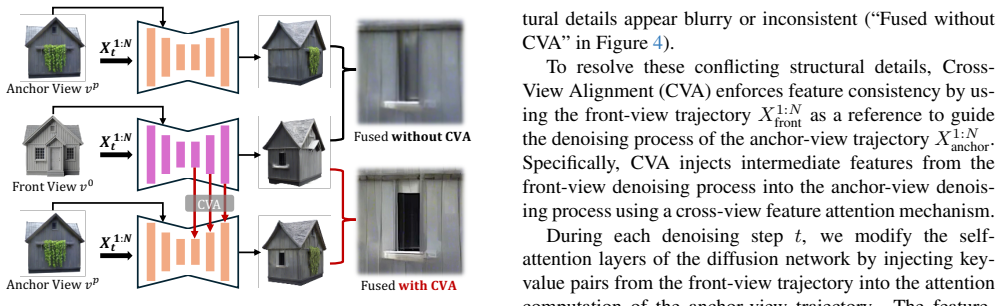
The load-bearing component is Anchor-View Editing Propagation, a dual-stream denoising mechanism built on a video 3D diffusion model. It consists of Spatial Progressive Fusion (SPF) and Cross-View Alignment (CVA): SPF circular-shifts the anchor-view trajectory into the coordinate frame of the front-view trajectory and blends the two streams with a proximity-based weight, so edits dominate near the anchor and fade smoothly away; CVA concatenates key/value features from the front-view denoising stream into the anchor-view self-attention, forcing shared structure and preventing ghosting where the two streams disagree. Together they propagate the 2D edit while holding the object's identity in place.
What would settle it
Take an edit that deliberately shifts an object's position or changes its aspect ratio in the anchor view, run Edit360, and render the reconstructed asset from several angles: ghosting, duplicated edges, or identity drift beyond the edit itself would show that the alignment assumption fails.
Extended reading notes
Core claim
The central claim is that a single edited anchor view can drive multi-view-consistent editing across a full 360-degree orbit. A second camera trajectory starts at the anchor view, where the user's 2D edit has been applied, while the original front-view trajectory is kept unedited as an identity reference. At every denoising step the two trajectories are spatially aligned by a circular shift, fused with weights that decay as views move away from the anchor, and then reconciled by injecting the front-view stream's attention keys and values into the anchor-view stream. The result, the paper argues, is a dense sequence of edited views that reconstructs a high-quality 3D asset while preserving identity and geometric structure, enabling local element edits, global style transfer, and multi-view conditional generation.
Load-bearing premise
The method assumes the 2D editor changes only the edited region and leaves the object's pose, scale, and framing in the anchor image exactly as they were, so the two view sequences line up point-by-point; if the edit warps or moves the object, the fusion will blend mismatched views.
Editorial extensions
If this is right
- Users can specify the angle that best shows the change, or let a language model pick it, and the edit carries across all views of the reconstructed asset.
- Edits that are only visible from the back or side, such as wings, capes, or rear decorations, no longer require the front view to show them.
- Because propagation happens during denoising rather than through training, the mechanism can be dropped onto different video 3D diffusion models without retraining.
- Reconstruction from the edited multi-view sequence works with either neural-surface or Gaussian-splatting backends, so the output can feed standard 3D pipelines.
- Supplying additional ground-truth views as anchors raises reconstruction quality, indicating that the framework scales with the number of anchor views.
Reading between the lines
- Editorial extension: if the alignment assumption holds, the same dual-stream propagation could chain several anchor edits in one pass, replacing multiple sequential edits with a single fused generation.
- Editorial extension: the circular-shift alignment ties the method to a fixed-elevation orbit; extending it to arbitrary camera paths or changing elevation would require a more general spatial alignment than cyclic shift.
- Editorial extension: the paper reports a two-ground-truth-view upper bound, so a natural next test is whether automatically selecting non-front anchors, rather than random ones, closes more of that gap.
Editorial analysis
A structured set of objections, weighed in public.
Referee Report
Summary. The paper presents Edit360, a training-free framework for propagating a 2D edit made on an arbitrary 'anchor view' of an object into a full 360-degree multi-view sequence generated by a video 3D diffusion model (V3DM) such as SV3D or V3D. The core mechanism is Anchor-View Editing Propagation, consisting of Spatial Progressive Fusion (SPF), which circularly shifts the anchor-conditioned trajectory and blends it with the front-view trajectory using a distance-based weight, and Cross-View Alignment (CVA), which injects front-trajectory key/value features into the anchor trajectory's attention layers. The edited dense-view sequence is then used to reconstruct a 3D asset via NeuS or 3DGS. The paper reports quantitative novel-view synthesis results on GSO and OmniObject3D (Table 2), an ablation (Table 3), a 50-participant user study against Tailor3D (Table 1), and qualitative examples of local edits and style transfer.
Significance. If the claims are correct, Edit360 would be a practical, tuning-free way to extend 2D image editing to 3D assets with edits specified from any viewpoint. The proposed dual-trajectory fusion is simple and novel, and the quantitative NVS results (Table 2: Edit-SV3D 22.17 PSNR vs. 21.14 for SV3D) show consistent gains over strong baselines. The paper is also honest in reporting an upper-bound experiment with two ground-truth views. However, the main load-bearing claim—editing from arbitrary viewpoints with structural coherence—lacks direct quantitative validation: the user study has no inferential statistics, the NVS evaluation uses unedited anchor views generated by the base model, and the alignment assumption behind Eq. (4) is not tested.
major comments (5)
- [Section 4.1, Eq. (4)] The circular-shift alignment in Eq. (4) assumes that the anchor-conditioned V3DM trajectory follows exactly the same camera orbit as the front trajectory, so that frame i of CS(X_anchor) matches frame i of X_front in camera pose. V3DMs such as SV3D and V3D take a single image as conditioning and do not accept an explicit camera-pose label; when the conditioning image is an edited side or back view, the model has no way to know the azimuth or elevation of that view. The paper provides no experiment validating this alignment for edited anchors from arbitrary viewpoints. Table 2 uses anchor views generated by the same V3DM from the front view, so both trajectories share the model's front-view assumption; this does not test the claimed regime. Because Eq. (5) blends latents from these aligned frames, any misalignment directly propagates into the fused sequence and into the reconstructed 3D asset.
- [Section 4.1, Eq. (5)] The spatial weight alpha_i, which is central to SPF, is never defined. The text only states that it decreases with cyclic distance to the anchor view; no formula, schedule, or default value is given. Likewise, 'In later diffusion stages, SPF integrates edge and texture information' is not specified in terms of timestep ranges or integration operations. These omissions make the method impossible to reproduce exactly and undermine the ablation in Table 3, since the baseline and ablations depend on unspecified choices.
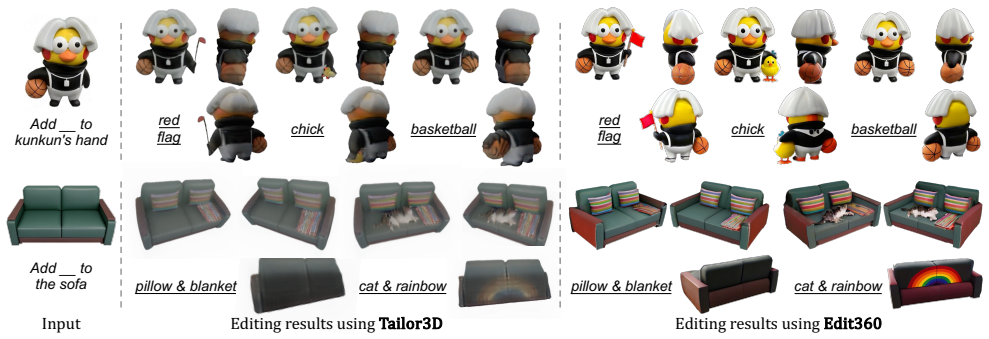
- [Section 5.2, Table 1] The user study is the principal quantitative evidence for the editing claim, but the paper reports only mean Likert scores (4.52 vs. 3.02 overall) without standard deviations, confidence intervals, or any inferential test. With 50 participants and 8 examples, the reported differences could be within noise; no paired t-test, Wilcoxon signed-rank test, or inter-rater agreement is reported. The paper also does not describe how participants were recruited, whether the comparison was blinded, or whether the same 3D outputs were shown for both methods. Without this information, the 'clearly demonstrate the superiority' statement is not supported.
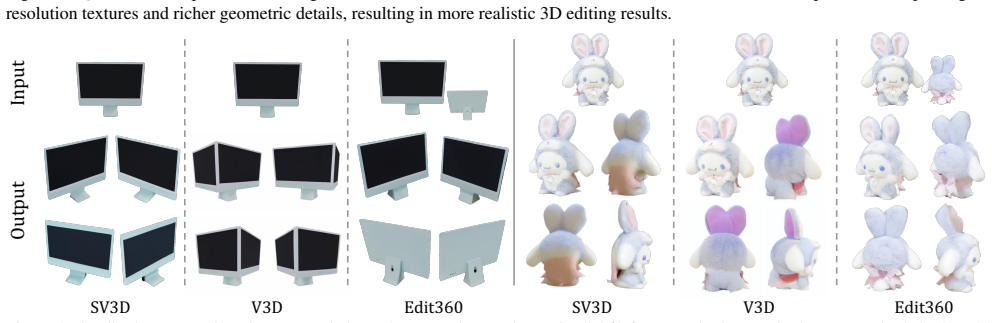
- [Section 5.3, Table 2] The quantitative NVS evaluation does not actually evaluate the editing pipeline. In the 'Edit-SV3D (v0&vi)' rows, the additional anchor view is generated by the base V3DM from the original front view (Sec. 5.3: 'an additional anchor view v_i for Edit360 is generated using the original single front-view input V3DM model'), so the anchor is geometrically consistent with the front view by construction. The 2GT row (26.32 PSNR) shows that much of the gain comes from simply conditioning on an extra view, not from propagating an edit. The paper therefore does not provide a quantitative test of the claim that edits from arbitrary viewpoints are propagated with structural coherence; a direct evaluation would require, e.g., editing the anchor with a known ground-truth 3D edit and measuring the correspondence of the edited region across views.
- [Section 3.2] The pipeline assumes that an off-the-shelf 2D editor (ControlNet/InstantStyle) produces an anchor image that is geometrically faithful to the original 3D object. The text states 'After editing the anchor view' without any investigation of whether the editor preserves pose, proportions, lighting, and camera intrinsics. Diffusion-based editors often alter these attributes; if they do, the fusion in Eq. (5) blends misaligned geometry and CVA may suppress the edit itself. The manuscript provides no failure analysis or quantitative measure of edit fidelity (e.g., CLIP directional score), so the identity-preservation promise is not demonstrated.
minor comments (7)
- [Figure 7 caption] The caption cites 'Tailor3D [48]', but the Tailor3D reference is [34] in the reference list; [48] is SV3D.
- [Section 5.3, Table 2] The notation 'v0&vi' in Table 2 is not defined in the table; the text defines it only later in Sec. 5.3. Please move the definition to the table caption or introduce it before the table.
- [Section 5.1] The description 'filtering out 300 objects with significant shape differences' is vague; please specify the filtering criterion (e.g., human inspection, a similarity metric, or a fixed procedure) so the evaluation can be replicated.
- [Section 3.2] The term 'Dual-Stream Diffusion Network' appears only in the Figure 3 caption and not in the body text. Please define it in the text or remove it from the caption.
- [Abstract and Section 1] The phrase 'from any angle' is stronger than what is evaluated, since all experiments use 0-degree elevation orbits. Please qualify the claim to horizontal orbits or add experiments with varying elevations.
- [Section 5.2] The user study description does not say whether participants saw the two methods' outputs side-by-side or sequentially, or whether the order was randomized. Please provide these details.
- [References] Reference [35] is cited for DALL·E in Figure 5, but the title 'Text to Image Generator with Latent Diffusion Models' does not match DALL·E. Please clarify the actual model used.
Circularity Check
No circularity: the edit-propagation chain is a composition of external V3DMs and hand-designed fusion heuristics, with all quantitative comparisons against external baselines.
full rationale
The paper's central derivation chain is: an off-the-shelf 2D editor modifies an anchor view; the modified anchor view is fed to an external V3DM (SV3D or V3D, both cited from other groups) to produce an anchor-view trajectory; Eq. (4) circularly aligns that trajectory to the front-view trajectory by index shift; Eq. (5) blends latents with hand-designed proximity weights; Eq. (6) injects front-trajectory keys/values into anchor-trajectory attention; and the final dense sequence is reconstructed with NeuS/3DGS. None of these steps fits a parameter to the evaluation data or renames an input as a prediction. The circular-shift alignment in Eq. (4) is an explicit geometric convention, not a conclusion derived from the data; it assumes both trajectories follow the same predefined camera orbit, which is an empirical precondition for the method's correctness, not a tautology. All reported quantitative comparisons are against external baselines on external datasets (GSO, OmniObject3D), and the '2GT input' row in Table 2 is explicitly presented as an upper-bound study rather than the method's claimed prediction. No load-bearing self-citation appears: the cited V3DMs, Tailor3D, and image editors are external works, and no uniqueness theorem or prior result by the authors is invoked to force the design. The main scientific risk is that 2D editors may not preserve geometry for arbitrary anchor viewpoints, so Eq. (4) could align misregistered views, but that is a correctness/robustness concern, not circularity. The derivation is therefore self-contained and the reported improvements are empirically substantive.
Assumptions & free parameters
free parameters (3)
- spatial proximity weight alpha_i =
undefined schedule (decreases with cyclic distance)
- late-stage diffusion timesteps for edge/texture integration =
undefined ('later diffusion stages')
- LLM prompt for anchor view selection =
not evaluated
assumptions (4)
- domain assumption Video 3D diffusion models (SV3D, V3D) generate 3D-consistent dense view sequences from a single front-view input.
- domain assumption Off-the-shelf 2D image editors (ControlNet, InstantStyle) produce high-quality edits without altering object geometry or identity.
- ad hoc to paper Circular-shift alignment (Eq. 4) exactly matches camera positions between the front and anchor trajectories.
- domain assumption Cross-view attention key-value injection (Eq. 6) acts as a structural prior that does not erase the edit content.
Cite this review
Pith. "Pith review of Edit360: 2D Image Edits to 3D Assets from Any Angle." pith.science (2026). https://pith.science/paper/UBGC5XHJ
@misc{pith2026250610507,
  author       = {Pith},
  title        = {Pith review of: Edit360: 2D Image Edits to 3D Assets from Any Angle},
  year         = {2026},
  howpublished = {\url{https://pith.science/paper/UBGC5XHJ}},
  note         = {Machine review of arXiv:2506.10507}
}
read the original abstract
Recent advances in diffusion models have significantly improved image generation and editing, but extending these capabilities to 3D assets remains challenging, especially for fine-grained edits that require multi-view consistency. Existing methods typically restrict editing to predetermined viewing angles, severely limiting their flexibility and practical applications. We introduce Edit360, a tuning-free framework that extends 2D modifications to multi-view consistent 3D editing. Built upon video diffusion models, Edit360 enables user-specific editing from arbitrary viewpoints while ensuring structural coherence across all views. The framework selects anchor views for 2D modifications and propagates edits across the entire 360-degree range. To achieve this, Edit360 introduces a novel Anchor-View Editing Propagation mechanism, which effectively aligns and merges multi-view information within the latent and attention spaces of diffusion models. The resulting edited multi-view sequences facilitate the reconstruction of high-quality 3D assets, enabling customizable 3D content creation.
Figures


Figures from the paper (6 more)



Forward citations
Cited by 1 Pith paper
-
Droplet3D: Commonsense Priors from Videos Facilitate 3D Generation
A video diffusion backbone fine-tuned on 4M densely captioned 360-degree renderings generates spatially consistent multi-view images for 3D assets from image plus detailed text input.
Reference graph
Works this paper leans on
-
[1]
Andreas Blattmann, Tim Dockhorn, Sumith Kulal, Daniel Mendelevitch, Maciej Kilian, Dominik Lorenz, Yam Levi, Zion English, Vikram V oleti, Adam Letts, et al. Stable video diffusion: Scaling latent video diffusion models to large datasets.arXiv preprint arXiv:2311.15127, 2023. 2
arXiv 2023
-
[2]
Generic 3d diffusion adapter using controlled multi-view editing, 2024
Hansheng Chen, Ruoxi Shi, Yulin Liu, Bokui Shen, Ji- ayuan Gu, Gordon Wetzstein, Hao Su, and Leonidas Guibas. Generic 3d diffusion adapter using controlled multi-view editing, 2024. 3
work page 2024
-
[3]
Anydoor: Zero-shot object-level im- age customization
Xi Chen, Lianghua Huang, Yu Liu, Yujun Shen, Deli Zhao, and Hengshuang Zhao. Anydoor: Zero-shot object-level im- age customization. InCVPR, 2024. 2
work page 2024
-
[4]
Control3D: Towards Controllable Text-to-3D Generation
Yang Chen, Yingwei Pan, Yehao Li, Ting Yao, and Tao Mei. Control3D: Towards Controllable Text-to-3D Generation. In ACMM, 2023. 3
work page 2023
-
[5]
Learning Implicit Fields for Generative Shape Modeling
Zhiqin Chen and Hao Zhang. Learning Implicit Fields for Generative Shape Modeling. InCVPR, 2019. 3
work page 2019
-
[6]
V3d: Video diffusion models are effective 3d generators.arXiv preprint arXiv:2403.06738, 2024
Zilong Chen, Yikai Wang, Feng Wang, Zhengyi Wang, and Huaping Liu. V3d: Video diffusion models are effective 3d generators.arXiv preprint arXiv:2403.06738, 2024. 2, 3, 4, 5, 7, 8
arXiv 2024
-
[7]
Matt Deitke, Ruoshi Liu, Matthew Wallingford, Huong Ngo, Oscar Michel, Aditya Kusupati, Alan Fan, Christian Laforte, Vikram S. V oleti, Samir Yitzhak Gadre, Eli VanderBilt, Aniruddha Kembhavi, Carl V ondrick, Georgia Gkioxari, Kiana Ehsani, Ludwig Schmidt, and Ali Farhadi. Objaverse- XL: A Universe of 10M+ 3D Objects. InNeurIPS, 2023. 8
work page 2023
-
[8]
Objaverse: A Universe of Annotated 3D Objects
Matt Deitke, Dustin Schwenk, Jordi Salvador, Luca Weihs, Oscar Michel, Eli VanderBilt, Ludwig Schmidt, Kiana Ehsani, Aniruddha Kembhavi, and Ali Farhadi. Objaverse: A Universe of Annotated 3D Objects. InCVPR, 2023. 5
work page 2023
Show all 62 references
-
[9]
Objaverse-xl: A universe of 10m+ 3d objects.NeurIPS, 2024
Matt Deitke, Ruoshi Liu, Matthew Wallingford, Huong Ngo, Oscar Michel, Aditya Kusupati, Alan Fan, Christian Laforte, Vikram V oleti, Samir Yitzhak Gadre, et al. Objaverse-xl: A universe of 10m+ 3d objects.NeurIPS, 2024. 2
2024
-
[10]
Google Scanned Objects: A High-Quality Dataset of 3D Scanned Household Items
Laura Downs, Anthony Francis, Nate Koenig, Bran- don Kinman, Ryan Michael Hickman, Krista Reymann, Thomas Barlow McHugh, and Vincent Vanhoucke. Google Scanned Objects: A High-Quality Dataset of 3D Scanned Household Items. InICRA, 2022. 7
2022
-
[11]
I. Y . Fogel and Dov Sagi. Gabor filters as texture discrimi- nator. InBiological Cybernetics, 1989. 5
1989
-
[12]
Efficient and flexible deformation representation for data-driven surface modeling
Lin Gao, Yu-Kun Lai, Dun Liang, Shu-Yu Chen, and Shi- hong Xia. Efficient and flexible deformation representation for data-driven surface modeling. InACM Transactions on Graphics (TOG), 2016. 3
2016
-
[13]
Sparse data driven mesh deformation
Lin Gao, Yu-Kun Lai, Jie Yang, Ling-Xiao Zhang, Shihong Xia, and Leif Kobbelt. Sparse data driven mesh deformation. InIEEE transactions on visualization and computer graph- ics, 2019. 3
2019
-
[14]
Emu video: Factoriz- ing text-to-video generation by explicit image conditioning
Rohit Girdhar, Mannat Singh, Andrew Brown, Quentin Du- val, Samaneh Azadi, Sai Saketh Rambhatla, Akbar Shah, Xi Yin, Devi Parikh, and Ishan Misra. Emu video: Factoriz- ing text-to-video generation by explicit image conditioning. arXiv preprint arXiv:2311.10709, 2023. 2
2023 arXiv
-
[15]
Vfusion3d: Learning scalable 3d generative models from video diffusion models
Junlin Han, Filippos Kokkinos, and Philip Torr. Vfusion3d: Learning scalable 3d generative models from video diffusion models. InECCV. Springer, 2025. 3, 5
2025
-
[16]
Jain, and Pieter Abbeel
Jonathan Ho, AjayN. Jain, and Pieter Abbeel. Denoising diffusion probabilistic models.NeurIPS, 2020. 1
2020
-
[17]
Fast automatic skinning transformations
Alec Jacobson, Ilya Baran, Ladislav Kavan, Jovan Popovi ´c, and Olga Sorkine. Fast automatic skinning transformations. InACM Transactions on Graphics (ToG), 2012. 3
2012
-
[18]
Kanopoulos, N
N. Kanopoulos, N. Vasanthavada, and R.L. Baker. Design of an image edge detection filter using the Sobel operator. In IEEE Journal of Solid-State Circuits, 1988. 5
1988
-
[19]
3d gaussian splatting for real-time radiance field rendering
Bernhard Kerbl, Georgios Kopanas, Thomas Leimk ¨uhler, and George Drettakis. 3d gaussian splatting for real-time radiance field rendering. InACM TOG, 2023. 4
2023
-
[20]
Xin Kong, Shikun Liu, Xiaoyang Lyu, Marwan Taher, Xiao- juan Qi, and Andrew J. Davison. Eschernet: A generative model for scalable view synthesis. InCVPR, 2024. 8
2024
-
[21]
A content transformation block for image style transfer
Dmytro Kotovenko, Artsiom Sanakoyeu, Pingchuan Ma, Sabine Lang, and Bjorn Ommer. A content transformation block for image style transfer. InCVPR, 2019. 2
2019
-
[22]
Vivid-1-to-3: Novel view synthesis with video diffusion models
Jeong-gi Kwak, Erqun Dong, Yuhe Jin, Hanseok Ko, Shweta Mahajan, and Kwang Moo Yi. Vivid-1-to-3: Novel view synthesis with video diffusion models. InCVPR, 2024. 3
2024
-
[23]
Magic3d: High-resolution text-to-3d content creation
Chen-Hsuan Lin, Jun Gao, Luming Tang, Towaki Takikawa, Xiaohui Zeng, Xun Huang, Karsten Kreis, Sanja Fidler, Ming-Yu Liu, and Tsung-Yi Lin. Magic3d: High-resolution text-to-3d content creation. InCVPR, 2023. 2
2023
-
[24]
Neuroskinning: Automatic skin binding for production characters with deep graph networks
Lijuan Liu, Youyi Zheng, Di Tang, Yi Yuan, Changjie Fan, and Kun Zhou. Neuroskinning: Automatic skin binding for production characters with deep graph networks. InACM Transactions on Graphics (ToG), 2019. 3
2019
-
[25]
Zero-1-to-3: Zero-shot one image to 3d object
Ruoshi Liu, Rundi Wu, Basile Van Hoorick, Pavel Tok- makov, Sergey Zakharov, and Carl V ondrick. Zero-1-to-3: Zero-shot one image to 3d object. InICCV, 2023. 2, 8
2023
-
[26]
Editing conditional radiance fields
Steven Liu, Xiuming Zhang, Zhoutong Zhang, Richard Zhang, Jun-Yan Zhu, and Bryan Russell. Editing conditional radiance fields. InICCV, 2021. 3
2021
-
[27]
Sync- dreamer: Generating multiview-consistent images from a single-view image.ICLR, abs/2309.03453, 2024
Yuan Liu, Chu-Hsing Lin, Zijiao Zeng, Xiaoxiao Long, Lingjie Liu, Taku Komura, and Wenping Wang. Sync- dreamer: Generating multiview-consistent images from a single-view image.ICLR, abs/2309.03453, 2024. 2
2024 arXiv
-
[28]
Joint-dependent local deformations for hand anima- tion and object grasping
Thalmann Magnenat, Richard Laperri `ere, and Daniel Thal- mann. Joint-dependent local deformations for hand anima- tion and object grasping. InProceedings of Graphics Inter- face’88, 1988. 3 9
1988
-
[29]
Hexagen3d: Stablediffusion is just one step away from fast and diverse text-to-3d generation.arXiv preprint arXiv:2401.07727, 2024
Antoine Mercier, Ramin Nakhli, Mahesh Reddy, Rajeev Yasarla, Hong Cai, Fatih Porikli, and Guillaume Berger. Hexagen3d: Stablediffusion is just one step away from fast and diverse text-to-3d generation.arXiv preprint arXiv:2401.07727, 2024. 2
2024 arXiv
-
[30]
Latent-nerf for shape-guided generation of 3d shapes and textures
Gal Metzer, Elad Richardson, Or Patashnik, Raja Giryes, and Daniel Cohen-Or. Latent-nerf for shape-guided generation of 3d shapes and textures. InCVPR, 2023. 2
2023
-
[31]
Envision3d: One image to 3d with anchor views inter- polation.arXiv preprint arXiv:2403.08902, 2024
Yatian Pang, Tanghui Jia, Yujun Shi, Zhenyu Tang, Junwu Zhang, Xinhua Cheng, Xing Zhou, Francis EH Tay, and Li Yuan. Envision3d: One image to 3d with anchor views inter- polation.arXiv preprint arXiv:2403.08902, 2024. 3, 5
2024 arXiv
-
[32]
DeepSDF: Learning Continuous Signed Distance Functions for Shape Represen- tation
Jeong Joon Park, Peter Florence, Julian Straub, Richard Newcombe, and Steven Lovegrove. DeepSDF: Learning Continuous Signed Distance Functions for Shape Represen- tation. InCVPR, 2019. 3
2019
-
[33]
Dreamfusion: Text-to-3d using 2d diffusion
Ben Poole, Ajay Jain, Jonathan T Barron, and Ben Milden- hall. Dreamfusion: Text-to-3d using 2d diffusion. InICLR,
-
[34]
Tailor3d: Customized 3d assets edit- ing and generation with dual-side images.arXiv preprint arXiv:2407.06191, 2024
Zhangyang Qi, Yunhan Yang, Mengchen Zhang, Long Xing, Xiaoyang Wu, Tong Wu, Dahua Lin, Xihui Liu, Jiaqi Wang, and Hengshuang Zhao. Tailor3d: Customized 3d assets edit- ing and generation with dual-side images.arXiv preprint arXiv:2407.06191, 2024. 3
2024 arXiv
-
[35]
Text to Image Generator with Latent Diffusion Models
Apoorva Rauniyar, Aryan Raj, Ashish Kumar, Ashish Ku- mar Kandu, Astha Singh, and Anjani Gupta. Text to Image Generator with Latent Diffusion Models. InCICTN, 2023. 4, 5
2023
-
[36]
High-Resolution Image Synthesis with Latent Diffusion Models
Robin Rombach, Andreas Blattmann, Dominik Lorenz, Patrick Esser, and Bjorn Ommer. High-Resolution Image Synthesis with Latent Diffusion Models. InCVPR, 2022. 1
2022
-
[37]
Dreambooth: Fine tuning text-to-image diffusion models for subject-driven generation
Nataniel Ruiz, Yuanzhen Li, Varun Jampani, Yael Pritch, Michael Rubinstein, and Kfir Aberman. Dreambooth: Fine tuning text-to-image diffusion models for subject-driven generation. InCVPR, 2023. 2
2023
-
[38]
Photorealistic text-to-image diffusion models with deep language understanding.NeurIPS, 2022
Chitwan Saharia, William Chan, Saurabh Saxena, Lala Li, Jay Whang, Emily L Denton, Kamyar Ghasemipour, Raphael Gontijo Lopes, Burcu Karagol Ayan, Tim Salimans, et al. Photorealistic text-to-image diffusion models with deep language understanding.NeurIPS, 2022. 1
2022
-
[39]
Free-form deforma- tion of solid geometric models
Thomas W Sederberg and Scott R Parry. Free-form deforma- tion of solid geometric models. InACM SIGGRAPH Com- puter Graphics, 1986. 3
1986
-
[40]
Score-based generative modeling through stochastic differential equa- tions.arXiv preprint arXiv:2011.13456, 2020
Yang Song, Jascha Sohl-Dickstein, Diederik P Kingma, Ab- hishek Kumar, Stefano Ermon, and Ben Poole. Score-based generative modeling through stochastic differential equa- tions.arXiv preprint arXiv:2011.13456, 2020. 1
2011 arXiv
-
[41]
Laplacian mesh processing
Olga Sorkine. Laplacian mesh processing. InEurographics (State of the Art Reports), 2005. 3
2005
-
[42]
As-rigid-as-possible surface modeling
Olga Sorkine and Marc Alexa. As-rigid-as-possible surface modeling. InSymposium on Geometry processing, 2007. 3
2007
-
[43]
Stable Zero123.https://stabilityai
StabilityAI. Stable Zero123.https://stabilityai. com/stable-zero123, 2023. Accessed: 2023-XX-XX. 8
2023
-
[44]
Mesh-based inverse kinematics
Robert W Sumner, Matthias Zwicker, Craig Gotsman, and Jovan Popovi ´c. Mesh-based inverse kinematics. InACM transactions on graphics (TOG), 2005. 3
2005
-
[45]
Vari- ational autoencoders for deforming 3d mesh models
Qingyang Tan, Lin Gao, Yu-Kun Lai, and Shihong Xia. Vari- ational autoencoders for deforming 3d mesh models. In CVPR, 2018. 3
2018
-
[46]
Mvdiffusion++: A dense high- resolution multi-view diffusion model for single or sparse- view 3d object reconstruction
Shitao Tang, Jiacheng Chen, Dilin Wang, Chengzhou Tang, Fuyang Zhang, Yuchen Fan, Vikas Chandra, Yasutaka Fu- rukawa, and Rakesh Ranjan. Mvdiffusion++: A dense high- resolution multi-view diffusion model for single or sparse- view 3d object reconstruction. InECCV, 2024. 2
2024
-
[47]
Mcvd-masked conditional video diffusion for prediction, generation, and interpolation.NeurIPS, 35, 2022
Vikram V oleti, Alexia Jolicoeur-Martineau, and Chris Pal. Mcvd-masked conditional video diffusion for prediction, generation, and interpolation.NeurIPS, 35, 2022. 2
2022
-
[48]
Sv3d: Novel multi-view syn- thesis and 3d generation from a single image using latent video diffusion
Vikram V oleti, Chun-Han Yao, Mark Boss, Adam Letts, David Pankratz, Dmitry Tochilkin, Christian Laforte, Robin Rombach, and Varun Jampani. Sv3d: Novel multi-view syn- thesis and 3d generation from a single image using latent video diffusion. InECCV, 2024. 2, 3, 4, 5, 7, 8
2024
-
[49]
Instantstyle: Free lunch towards style-preserving in text-to-image generation.arXiv preprint arXiv:2404.02733, 2024
Haofan Wang, Matteo Spinelli, Qixun Wang, Xu Bai, Zekui Qin, and Anthony Chen. Instantstyle: Free lunch towards style-preserving in text-to-image generation.arXiv preprint arXiv:2404.02733, 2024. 2
2024 arXiv
-
[50]
NeuS: Learning Neural Im- plicit Surfaces by V olume Rendering for Multi-view Recon- struction
Peng Wang, Lingjie Liu, Yuan Liu, Christian Theobalt, Taku Komura, and Wenping Wang. NeuS: Learning Neural Im- plicit Surfaces by V olume Rendering for Multi-view Recon- struction. InNeurIPS, 2021. 4
2021
-
[51]
Bovik, H.R
Zhou Wang, A.C. Bovik, H.R. Sheikh, and E.P. Simoncelli. Image quality assessment: from error visibility to structural similarity. InIEEE Transactions on Image Processing, 2004. 7
2004
-
[52]
Prolificdreamer: High-fidelity and diverse text-to-3d generation with variational score distilla- tion.NeurIPS, 2024
Zhengyi Wang, Cheng Lu, Yikai Wang, Fan Bao, Chongxuan Li, Hang Su, and Jun Zhu. Prolificdreamer: High-fidelity and diverse text-to-3d generation with variational score distilla- tion.NeurIPS, 2024. 2
2024
-
[53]
Novel view synthesis with diffusion models.arXiv preprint arXiv:2210.04628, 2022
Daniel Watson, William Chan, Ricardo Martin-Brualla, Jonathan Ho, Andrea Tagliasacchi, and Mohammad Norouzi. Novel view synthesis with diffusion models.arXiv preprint arXiv:2210.04628, 2022. 2
2022 arXiv
-
[54]
Omniobject3d: Large-vocabulary 3d object dataset for realistic perception, reconstruction and generation
Tong Wu, Jiarui Zhang, Xiao Fu, Yuxin Wang, Jiawei Ren, Liang Pan, Wayne Wu, Lei Yang, Jiaqi Wang, Chen Qian, et al. Omniobject3d: Large-vocabulary 3d object dataset for realistic perception, reconstruction and generation. InCVPR,
-
[55]
RigNet: Neural Rigging for Articu- lated Characters
Zhan Xu, Yang Zhou, Evangelos Kalogerakis, Chris Lan- dreth, and Karan Singh. RigNet: Neural Rigging for Articu- lated Characters. InSIGGRAPH, 2020. 3
2020
-
[56]
Learning object-compositional neural radiance field for ed- itable scene rendering
Bangbang Yang, Yinda Zhang, Yinghao Xu, Yijin Li, Han Zhou, Hujun Bao, Guofeng Zhang, and Zhaopeng Cui. Learning object-compositional neural radiance field for ed- itable scene rendering. InICCV, 2021. 3
2021
-
[57]
Neural cages for detail-preserving 3d deformations
Wang Yifan, Noam Aigerman, Vladimir G Kim, Siddhartha Chaudhuri, and Olga Sorkine-Hornung. Neural cages for detail-preserving 3d deformations. InCVPR, 2020. 3
2020
-
[58]
A revisit of shape editing techniques: From the geomet- ric to the neural viewpoint
Yu-Jie Yuan, Yu-Kun Lai, Tong Wu, Lin Gao, and Ligang Liu. A revisit of shape editing techniques: From the geomet- ric to the neural viewpoint. InJournal of Computer Science and Technology, 2021. 3
2021
-
[59]
Nerf-editing: geometry editing of neural radiance fields
Yu-Jie Yuan, Yang-Tian Sun, Yu-Kun Lai, Yuewen Ma, Rongfei Jia, and Lin Gao. Nerf-editing: geometry editing of neural radiance fields. InCVPR, 2022. 3 10
2022
-
[60]
Adding Conditional Control to Text-to-Image Diffusion Models
Lvmin Zhang, Anyi Rao, and Maneesh Agrawala. Adding Conditional Control to Text-to-Image Diffusion Models. In ICCV, 2023. 1, 2
2023
-
[61]
Efros, Eli Shecht- man, and Oliver Wang
Richard Zhang, Phillip Isola, Alexei A. Efros, Eli Shecht- man, and Oliver Wang. The Unreasonable Effectiveness of Deep Features as a Perceptual Metric. InCVPR, 2018. 7
2018
-
[62]
Free3D: Consistent Novel View Synthesis without 3D Representation
Chuanxia Zheng and Andrea Vedaldi. Free3D: Consistent Novel View Synthesis without 3D Representation. InCVPR,
Reviewed August 7, 2026 · model on record in the stance chip above.
Discussion (0). Sign in to comment.