REVIEW 3 major objections 4 minor 2 cited by
Fine-tuned video model turns one image into a full 3D orbit.
Reviewed by Pith at T0; open to challenge. T0 means a machine referee read the full paper against a public rubric. the ladder, T0–T4 →
A video diffusion backbone fine-tuned on 4M densely captioned 360-degree renderings generates spatially consistent multi-view images for 3D assets from image plus detailed text input.
T0 review reviewed 2026-08-05 challenge →
load-bearing objection The dataset is the real contribution; the evaluation tables don't back the paper's own claims, so the superiority story needs a rewrite. the 3 major comments →
Droplet3D: Commonsense Priors from Videos Facilitate 3D Generation
The pith
A machine-rendered reading of the paper's core claim, the machinery that carries it, and where it could break.
The reading
Core claim
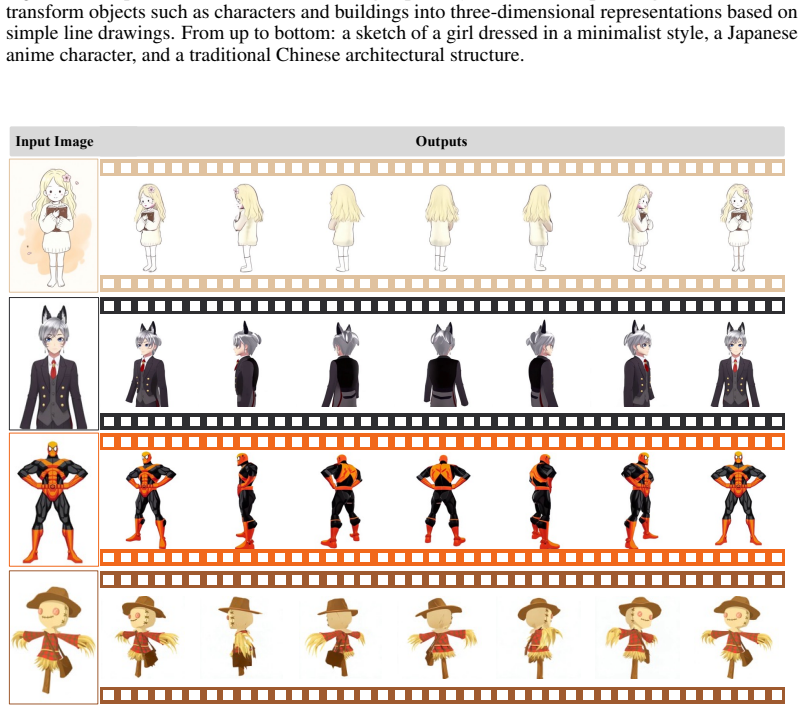
The central claim is that video-derived commonsense priors significantly facilitate 3D creation. Concretely, the authors claim that fine-tuning DropletVideo—a video diffusion model with integral spatio-temporal consistency—on Droplet3D-4M yields a generator that, from an input image and dense text, produces 85 spatially consistent multi-view frames covering a full 360-degree orbit. They further claim that the dense multi-view captions preserve the backbone's semantic understanding, enabling controlled edits (e.g., swapping a character's backpack for a QR code or a crystal orb) and generalization to stylized images such as sketches and comics, as well as scene-level lifting into 3D Gaussian s
What carries the argument
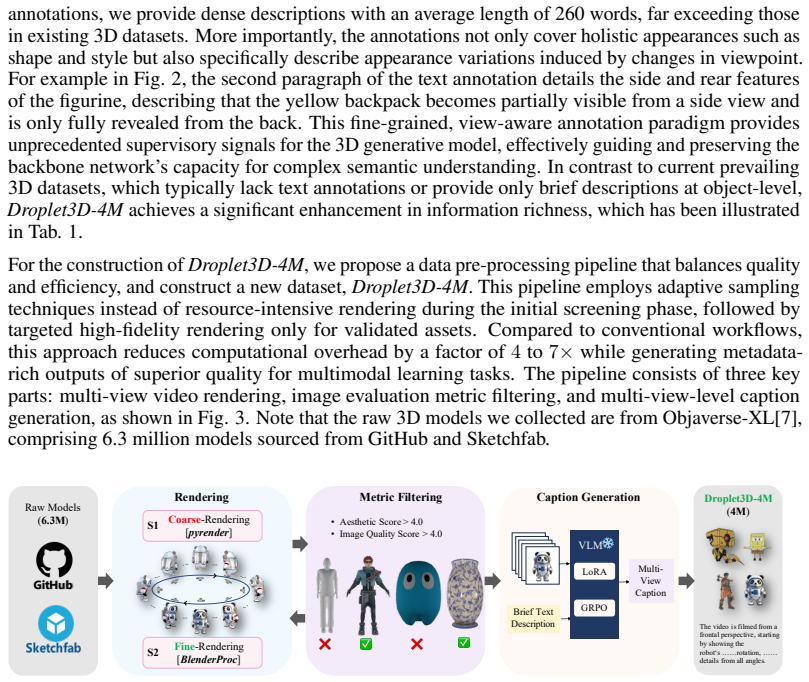
The load-bearing mechanism is the pairing of Droplet3D-4M with a video-diffusion backbone. Droplet3D-4M converts native 3D meshes into a video-native format: 85 frames rendered along a circular camera path with less than 5 degrees between adjacent views, accompanied by two-paragraph captions that first describe the object globally and then describe viewpoint-specific appearance changes. This format lets Droplet3D inherit spatial-consistency priors from DropletVideo while the dense text supervision preserves the model's semantic knowledge. The architecture adds a 3D causal VAE for spatio-temporal latent encoding and a modality-expert transformer for fusing text and video features, plus an inp
Load-bearing premise
The central superiority claim rests on metrics computed once on a hand-selected 200-sample subset of the GSO dataset, and one of the reported numbers (SSIM) actually favors a baseline, so if that evaluation is not representative, the claim that video priors outperform existing methods loses its support.
What would settle it
Re-run the comparison on a random, larger sample of GSO with multiple seeds and report confidence intervals; if Droplet3D's PSNR and CLIP gains over LGM and MVControl do not reproduce outside the selected subset, the central claim fails. Additionally, fine-tune a non-video image-based multi-view diffusion model on the same Droplet3D-4M clips and check whether the gains persist without the video backbone's temporal prior.
If this is right
- If the claim holds, 3D generators can be built by fine-tuning existing video models rather than collecting native 3D data at the scale of image or text datasets.
- Dense multi-view captions provide a supervisory signal that lets the model keep semantic concepts absent from 3D corpora, such as QR codes and stylized accessories.
- The same 85-view orbit supports both textured-mesh and Gaussian-splatting reconstruction, so a single generator can feed multiple downstream 3D representations.
- Scene-level 3D generation from a single image becomes possible even when the training data contains only object-level orbital videos, implying the scene ability is inherited from video pretraining.
- Arbitrary input viewpoints can be aligned to canonical views, loosening the input constraints that typically limit image-to-3D systems.
Where Pith is reading between the lines
- A testable extension is ablating the second, viewpoint-aware caption paragraph: if removing it degrades cross-view consistency, the paper's attribution of spatial consistency to video priors would be tangled with the effect of dense text supervision.
- The dataset's aesthetic and quality filters (scores above 4.0) bias Droplet3D-4M toward clean, well-lit renderings; models trained on it may transfer less well to noisy or in-the-wild imagery, and the scene-level claim suggests this bias was not fatal but deserves direct measurement.
- Comparing Droplet3D against an image-based multi-view diffusion model fine-tuned on the same rendered clips would isolate whether the video backbone's temporal prior is the causal ingredient or whether the dataset alone drives the gains.
- The canonical-view alignment module was trained on only 200 manually curated examples; scaling that set is a natural next step for robust handling of arbitrary real-world viewpoints.
Editorial analysis
A structured set of objections, weighed in public.
Referee Report
Summary. The paper proposes a video-driven paradigm for 3D generation. It introduces Droplet3D-4M, a dataset of about 4M objects from Objaverse-XL, each rendered as an 85-frame 360-degree orbital video with dense multi-view-level captions averaging 260 words. It then fine-tunes the authors' DropletVideo backbone to produce Droplet3D, a model that takes an image and a dense text prompt as input and generates 85 surrounding views, which are lifted to textured meshes or 3D Gaussian splatting. The central claim is that commonsense priors from video models improve spatial consistency and semantic fidelity in 3D generation, and that this enables even scene-level generation despite no scene-level training data. The dataset, code, and weights are open-sourced.
Significance. If the quantitative claims were supported, this would be a significant contribution: a 4M-scale rendered-video dataset with detailed multi-view captions, a video-to-3D fine-tuning recipe, and a demonstration that video backbones can transfer spatial and semantic priors to 3D generation are all valuable to the community. The authors should be credited for releasing resources and for the substantial dataset-construction effort, including the GRPO-based captioning pipeline. However, the paper's core evidence is currently weakened by internal metric inconsistencies and by the lack of statistical rigor in the comparisons. The claimed superiority over baselines and the attribution of that superiority to video priors are not yet established.
major comments (3)
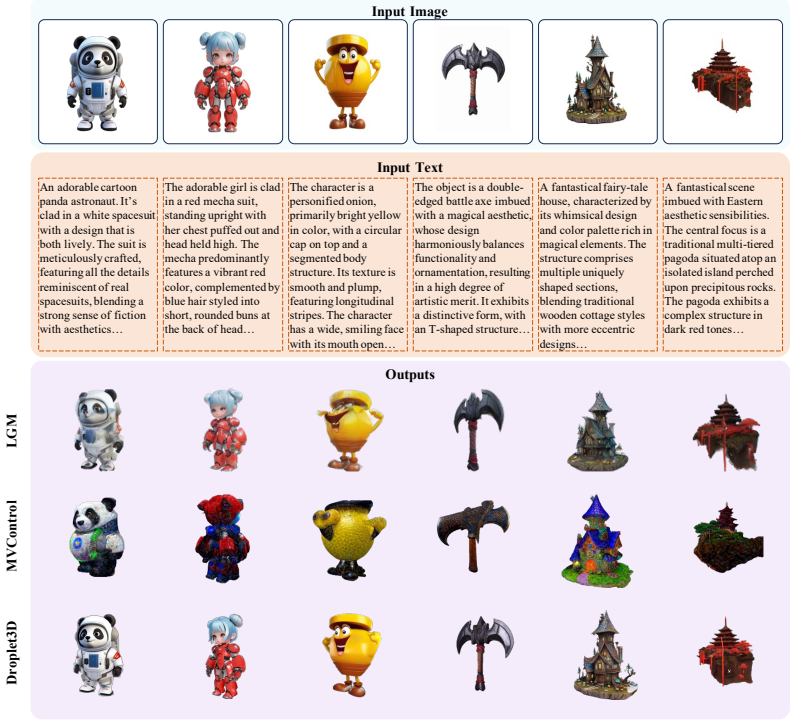
- [§5.2.1, Table 2 and Table 3] There is a direct internal inconsistency between the reported numbers and the prose. In Table 2, Droplet3D has SSIM 0.76, while LGM has 0.84 and MVControl has 0.88, yet the text states that “PSNR and SSIM confirm that the content generated by Droplet3D is of higher quality and closer to the ground truth.” In Table 3, fine-tuning from DropletVideo lowers SSIM from 0.87 to 0.76 while the surrounding text claims “improved generation consistency.” SSIM is presented as a quality/reconstruction metric, so a drop of this size must either be explained (e.g., a different evaluation protocol, reference views, or camera alignment) or the claims must be revised. As written, the table contradicts the central quantitative claim.
- [§5.2.1, Tables 2–4] All quantitative results are single-run point estimates on a hand-selected 200-sample subset of GSO, with no error bars, no significance tests, and no description of how camera viewpoints or reference views are aligned across methods. The text states the subset was selected to cover all categories and to be “confirmed uniform,” but this does not replace repeated sampling or statistical comparison. Since PSNR/SSIM/LPIPS can vary substantially with viewpoint alignment and reconstruction protocol, the claimed superiority over LGM and MVControl is not supported without this information. Please report means with standard deviations over multiple runs or bootstrapped subsets, and state the exact evaluation protocol for each baseline.
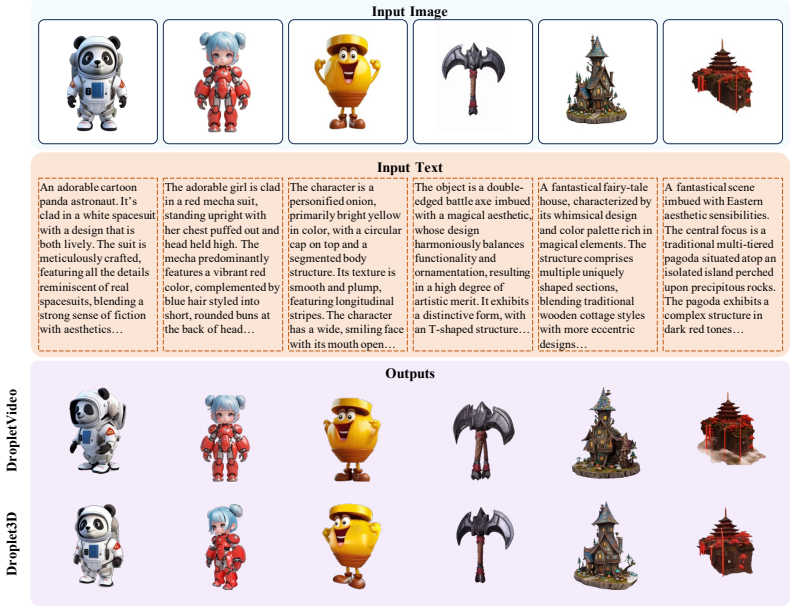
- [§4.1, §5.2.2, and abstract] The central attribution to “commonsense priors from videos” is not cleanly isolated. Droplet3D differs from DropletVideo not only in fine-tuning data but also in using the 85-view rendered videos, the dense multi-view captions, a longer text token length (400 vs. 226), and a canonical-view alignment module. Table 3 compares Droplet3D-5B with DropletVideo-5B, but this conflates the effect of the video backbone with the effect of continued training on Droplet3D-4M. Table 4 evaluates zero-shot video-generation ability and does not establish that a video backbone is what makes fine-tuning successful. A control that fine-tunes a third-party video backbone on the same Droplet3D-4M data, or that trains Droplet3D from a non-video initialization on the same data, is needed to support the paper's stated claim that video priors significantly facilitate 3D creation.
minor comments (4)
- [§3.3.2] Typographical issues: “funtions” should be “functions”; “multiview-match” and “Multi-view pattern” formatting is inconsistent. The reward formulas in Eqs. (1)–(4) are not clearly tied to the five claimed dimensions (Subject, material, Functional, Details, OCR), which makes the caption-quality reward difficult to reproduce.
- [§4.2.2] “anonical viewpoint” should be “canonical viewpoint”; the same typo appears in the module name. Also, the 200-example dataset for view alignment is described very briefly; please clarify how the four orthogonal ground-truth views were selected and whether the same images were used in evaluation.
- [§5.3.5] The scene-level results are qualitative only, and the claim that this capability is “entirely inherited” from DropletVideo is stronger than the evidence supports. Without quantitative consistency metrics or a controlled comparison, the text should be tempered or supplemented with measurements.
- [General] The paper would benefit from a limitations subsection. For example, the dataset is derived entirely from Objaverse-XL and filtered by aesthetic/quality thresholds; the implications of this distribution for downstream generalization are not discussed. Also, several references appear only as arXiv identifiers and some related concurrent video-to-3D works are not discussed in detail.
Circularity Check
No significant circularity: the derivation is empirical (render dataset, fine-tune video backbone, evaluate on GSO), and the self-cited backbone is independently benchmarked against third-party models; the SSIM contradiction is a correctness issue, not circularity.
full rationale
The paper's chain is: construct Droplet3D-4M from Objaverse-XL renderings; initialize Droplet3D from the authors' own DropletVideo backbone [74]; fine-tune on Droplet3D-4M; evaluate on 200 GSO samples. None of these steps defines its output in terms of its input. The only self-citation is the choice of DropletVideo as backbone (Section 4.1: 'DropletVideo[74] is a video generation model that considers integral spatio-temporal consistency... Therefore, we conduct secondary training based on its weights.'). This is not load-bearing because Table 4 independently compares DropletVideo with Cogvideox-Fun, Wan2.1-I2V, and Step-Video-TI2V on the same GSO task, and Section 5.2.2 reports concrete numbers; the backbone's suitability is thus tested in this paper, not merely assumed from [74]. The central claim that video priors facilitate 3D generation is falsifiable: it would fail if fine-tuning a non-video backbone on the same data performed equally, and the paper provides some (though incomplete) backbone comparison. No fitted parameter is renamed as a prediction: the model is trained on a large external-derived dataset and evaluated on GSO, not on its training set. The dataset and captions are self-constructed, but that is a matter of data provenance, not circular reasoning. The evaluation does contain an internal contradiction: Section 5.2.1 claims 'PSNR and SSIM confirm that the content generated by Droplet3D is of higher quality and closer to the ground truth,' while Table 2 lists Droplet3D SSIM 0.76 versus LGM 0.84 and MVControl 0.88, and Table 3 shows SSIM dropping from 0.87 (DropletVideo) to 0.76 (Droplet3D) while the text claims improved consistency. This undermines the quantitative support for superiority and the attribution to video priors, but it is a benchmarking/reporting flaw, not a circular derivation. Similarly, the scene-level claim (Section 5.3.5: 'the training set, Droplet3D-4M, contains no scene-level samples. Therefore, this capability can be considered entirely inherited from its ancestral source, the DropletVideo video generation model') is an under-supported causal attribution (no ablation of DropletVideo alone on scene inputs), but absence of scene samples in the training set does not by definition imply the capability comes from DropletVideo. Overall, the paper's derivation is not equivalent to its inputs by construction; the observed issues belong to correctness and experimental control rather than circularity.
Axiom & Free-Parameter Ledger
free parameters (4)
- aesthetic/quality filter thresholds =
4.0 / 4.0
- camera radial distance range =
1.6 to 2.0 units
- classifier-free guidance scale =
6.5
- max text token length =
400
axioms (6)
- domain assumption Objaverse-XL is a valid source of 3D models, and filtering by aesthetics/quality preserves diversity while removing bad geometry
- domain assumption Rendered 360-degree videos with fixed 0-degree elevation and varying radius provide sufficient multi-view consistency signal for 3D generation
- domain assumption Automatically generated 260-word captions from fine-tuned VLMs are accurate and detailed enough to supervise viewpoint-dependent generation
- domain assumption The evaluation metrics (PSNR, SSIM, LPIPS, MSE, CLIP-S) on a 200-sample GSO subset measure the qualities the paper claims
- domain assumption DropletVideo's pretrained weights are a suitable basis for transferring video priors to 3D
- domain assumption The training set Droplet3D-4M contains no scene-level samples
Cite this review
Pith. "Pith review of Droplet3D: Commonsense Priors from Videos Facilitate 3D Generation." pith.science (2026). https://pith.science/paper/5N6ADO44
@misc{pith2026250820470,
  author       = {Pith},
  title        = {Pith review of: Droplet3D: Commonsense Priors from Videos Facilitate 3D Generation},
  year         = {2026},
  howpublished = {\url{https://pith.science/paper/5N6ADO44}},
  note         = {Machine review of arXiv:2508.20470}
}
read the original abstract
Scaling laws have validated the success and promise of large-data-trained models in creative generation across text, image, and video domains. However, this paradigm faces data scarcity in the 3D domain, as there is far less of it available on the internet compared to the aforementioned modalities. Fortunately, there exist adequate videos that inherently contain commonsense priors, offering an alternative supervisory signal to mitigate the generalization bottleneck caused by limited native 3D data. On the one hand, videos capturing multiple views of an object or scene provide a spatial consistency prior for 3D generation. On the other hand, the rich semantic information contained within the videos enables the generated content to be more faithful to the text prompts and semantically plausible. This paper explores how to apply the video modality in 3D asset generation, spanning datasets to models. We introduce Droplet3D-4M, the first large-scale video dataset with multi-view level annotations, and train Droplet3D, a generative model supporting both image and dense text input. Extensive experiments validate the effectiveness of our approach, demonstrating its ability to produce spatially consistent and semantically plausible content. Moreover, in contrast to the prevailing 3D solutions, our approach exhibits the potential for extension to scene-level applications. This indicates that the commonsense priors from the videos significantly facilitate 3D creation. We have open-sourced all resources including the dataset, code, technical framework, and model weights: https://dropletx.github.io/.
Figures








Forward citations
Cited by 2 Pith papers
-
Global Pose Control for Generative View Synthesis in Normalized Object Coordinate Space
A diffusion image-editing model conditioned on Plücker ray-map tokens and text-defined NOCS fronts generates high-fidelity novel views with absolute global pose control from unposed inputs.
-
Animator-Centric Skeleton Generation on Objects with Fine-Grained Details
An animator-centric skeleton generation method that uses semantic-aware tokenization and a learnable density interval module to produce controllable, high-quality skeletons on complex 3D meshes.
Reference graph
Works this paper leans on
-
[1]
AIGC-Apps. Cogvideox-fun. https://github.com/aigc-apps/CogVideoX-Fun , 2024
work page 2024
-
[2]
Stable video diffusion: Scaling latent video diffusion models to large datasets
Andreas Blattmann, Tim Dockhorn, Sumith Kulal, Daniel Mendelevitch, Maciej Kilian, Do- minik Lorenz, Yam Levi, Zion English, Vikram V oleti, Adam Letts, et al. Stable video diffusion: Scaling latent video diffusion models to large datasets. arXiv preprint arXiv:2311.15127, 2023
Pith/arXiv arXiv 2023
-
[3]
Shapenet: An information-rich 3d model repository
Angel X Chang, Thomas Funkhouser, Leonidas Guibas, Pat Hanrahan, Qixing Huang, Zimo Li, Silvio Savarese, Manolis Savva, Shuran Song, Hao Su, et al. Shapenet: An information-rich 3d model repository. arXiv preprint arXiv:1512.03012, 2015. 25
Pith/arXiv arXiv 2015
-
[4]
V3d: Video diffusion models are effective 3d generators
Zilong Chen, Yikai Wang, Feng Wang, Zhengyi Wang, and Huaping Liu. V3d: Video diffusion models are effective 3d generators. arXiv preprint arXiv:2403.06738, 2024
Pith/arXiv arXiv 2024
-
[5]
Lu- ciddreamer: Domain-free generation of 3d gaussian splatting scenes
Jaeyoung Chung, Suyoung Lee, Hyeongjin Nam, Jaerin Lee, and Kyoung Mu Lee. Lu- ciddreamer: Domain-free generation of 3d gaussian splatting scenes. arXiv preprint arXiv:2311.13384, 2023
Pith/arXiv arXiv 2023
-
[7]
Objaverse-xl: A universe of 10m+ 3d objects
Matt Deitke, Ruoshi Liu, Matthew Wallingford, Huong Ngo, Oscar Michel, Aditya Kusupati, Alan Fan, Christian Laforte, Vikram V oleti, Samir Yitzhak Gadre, et al. Objaverse-xl: A universe of 10m+ 3d objects. Advances in Neural Information Processing Systems, 36:35799–35813, 2023
2023
-
[8]
Objaverse: A universe of annotated 3d objects
Matt Deitke, Dustin Schwenk, Jordi Salvador, Luca Weihs, Oscar Michel, Eli VanderBilt, Ludwig Schmidt, Kiana Ehsani, Aniruddha Kembhavi, and Ali Farhadi. Objaverse: A universe of annotated 3d objects. In Proceedings of the IEEE/CVF conference on computer vision and pattern recognition, pages 13142–13153, 2023
2023
-
[9]
Anymate: A dataset and baselines for learning 3d object rigging
Yufan Deng, Yuhao Zhang, Chen Geng, Shangzhe Wu, and Jiajun Wu. Anymate: A dataset and baselines for learning 3d object rigging. In Proceedings of the Special Interest Group on Computer Graphics and Interactive Techniques Conference Conference Papers, pages 1–10, 2025
work page 2025
-
[10]
8-bit optimizers via block-wise quantization
Tim Dettmers, Mike Lewis, Sam Shleifer, and Luke Zettlemoyer. 8-bit optimizers via block-wise quantization. arXiv preprint arXiv:2110.02861, 2021
Pith/arXiv arXiv 2021
-
[11]
Google scanned objects: A high-quality dataset of 3d scanned household items
Laura Downs, Anthony Francis, Nate Koenig, Brandon Kinman, Ryan Hickman, Krista Rey- mann, Thomas B McHugh, and Vincent Vanhoucke. Google scanned objects: A high-quality dataset of 3d scanned household items. In 2022 International Conference on Robotics and Automation (ICRA), pages 2553–2560. IEEE, 2022
work page 2022
-
[12]
Scaling rectified flow trans- formers for high-resolution image synthesis, 2024
Patrick Esser, Sumith Kulal, Andreas Blattmann, Rahim Entezari, Jonas Müller, Harry Saini, Yam Levi, Dominik Lorenz, Axel Sauer, Frederic Boesel, et al. Scaling rectified flow trans- formers for high-resolution image synthesis, 2024. URL https://arxiv. org/abs/2403.03206, 2
Pith/arXiv arXiv 2024
-
[13]
Video-r1: Reinforcing video reasoning in mllms
Kaituo Feng, Kaixiong Gong, Bohao Li, Zonghao Guo, Yibing Wang, Tianshuo Peng, Junfei Wu, Xiaoying Zhang, Benyou Wang, and Xiangyu Yue. Video-r1: Reinforcing video reasoning in mllms. arXiv preprint arXiv:2503.21776, 2025
Pith/arXiv arXiv 2025
-
[14]
3d-future: 3d furniture shape with texture
Huan Fu, Rongfei Jia, Lin Gao, Mingming Gong, Binqiang Zhao, Steve Maybank, and Dacheng Tao. 3d-future: 3d furniture shape with texture. International Journal of Computer Vision, 129:3313–3337, 2021
work page 2021
-
[15]
Deepseek-r1: Incentivizing reasoning capability in llms via reinforcement learning
Daya Guo, Dejian Yang, Haowei Zhang, Junxiao Song, Ruoyu Zhang, Runxin Xu, Qihao Zhu, Shirong Ma, Peiyi Wang, Xiao Bi, et al. Deepseek-r1: Incentivizing reasoning capability in llms via reinforcement learning. arXiv preprint arXiv:2501.12948, 2025
Pith/arXiv arXiv 2025
-
[16]
Vfusion3d: Learning scalable 3d generative models from video diffusion models
Junlin Han, Filippos Kokkinos, and Philip Torr. Vfusion3d: Learning scalable 3d generative models from video diffusion models. In European Conference on Computer Vision, pages 333–350. Springer, 2024
work page 2024
-
[17]
Xiaoguang Han, Yushuang Wu, Luyue Shi, Haolin Liu, Hongjie Liao, Lingteng Qiu, Weihao Yuan, Xiaodong Gu, Zilong Dong, and Shuguang Cui. Mvimgnet2. 0: A larger-scale dataset of multi-view images. arXiv preprint arXiv:2412.01430, 2024
Pith/arXiv arXiv 2024
-
[18]
Cogvideo: Large-scale pretraining for text-to-video generation via transformers
Wenyi Hong, Ming Ding, Wendi Zheng, Xinghan Liu, and Jie Tang. Cogvideo: Large-scale pretraining for text-to-video generation via transformers. arXiv preprint arXiv:2205.15868, 2022
Pith/arXiv arXiv 2022
-
[19]
Lrm: Large reconstruction model for single image to 3d
Yicong Hong, Kai Zhang, Jiuxiang Gu, Sai Bi, Yang Zhou, Difan Liu, Feng Liu, Kalyan Sunkavalli, Trung Bui, and Hao Tan. Lrm: Large reconstruction model for single image to 3d. arXiv preprint arXiv:2311.04400, 2023. 26
Pith/arXiv arXiv 2023
-
[20]
Lora: Low-rank adaptation of large language models
Edward J Hu, Yelong Shen, Phillip Wallis, Zeyuan Allen-Zhu, Yuanzhi Li, Shean Wang, Lu Wang, and Weizhu Chen. Lora: Low-rank adaptation of large language models. arXiv preprint arXiv:2106.09685, 2021
Pith/arXiv arXiv 2021
-
[21]
Edit360: 2d image edits to 3d assets from any angle
Junchao Huang, Xinting Hu, Zhuotao Tian, Shaoshuai Shi, and Li Jiang. Edit360: 2d image edits to 3d assets from any angle. arXiv preprint arXiv:2506.10507, 2025
Pith/arXiv arXiv 2025
-
[22]
Epidiff: Enhancing multi-view synthesis via localized epipolar-constrained diffusion
Zehuan Huang, Hao Wen, Junting Dong, Yaohui Wang, Yangguang Li, Xinyuan Chen, Yan-Pei Cao, Ding Liang, Yu Qiao, Bo Dai, et al. Epidiff: Enhancing multi-view synthesis via localized epipolar-constrained diffusion. In Proceedings of the IEEE/CVF Conference on Computer Vision and Pattern Recognition, pages 9784–9794, 2024
work page 2024
-
[23]
Hunyuan3d 2.1: From images to high-fidelity 3d assets with production-ready pbr material
Team Hunyuan3D, Shuhui Yang, Mingxin Yang, Yifei Feng, Xin Huang, Sheng Zhang, Zebin He, Di Luo, Haolin Liu, Yunfei Zhao, et al. Hunyuan3d 2.1: From images to high-fidelity 3d assets with production-ready pbr material. arXiv preprint arXiv:2506.15442, 2025
Pith/arXiv arXiv 2025
-
[24]
Aaron Jaech, Adam Kalai, Adam Lerer, Adam Richardson, Ahmed El-Kishky, Aiden Low, Alec Helyar, Aleksander Madry, Alex Beutel, Alex Carney, et al. Openai o1 system card. arXiv preprint arXiv:2412.16720, 2024
Pith/arXiv arXiv 2024
-
[25]
Animate3d: Animating any 3d model with multi-view video diffusion
Yanqin Jiang, Chaohui Yu, Chenjie Cao, Fan Wang, Weiming Hu, and Jin Gao. Animate3d: Animating any 3d model with multi-view video diffusion. arXiv preprint arXiv:2407.11398, 2024
Pith/arXiv arXiv 2024
-
[26]
Shap-e: Generating conditional 3d implicit functions
Heewoo Jun and Alex Nichol. Shap-e: Generating conditional 3d implicit functions. arXiv preprint arXiv:2305.02463, 2023
Pith/arXiv arXiv 2023
-
[27]
Consistent Zero-shot 3D Texture Synthesis Using Geometry-aware Diffusion and Temporal Video Models
Donggoo Kang, Jangyeong Kim, Dasol Jeong, Junyoung Choi, Jeonga Wi, Hyunmin Lee, Joonho Gwon, and Joonki Paik. Consistent zero-shot 3d texture synthesis using geometry-aware diffusion and temporal video models. arXiv preprint arXiv:2506.20946, 2025
work page internal anchor Pith review Pith/arXiv arXiv 2025
-
[28]
3d gaussian splatting for real-time radiance field rendering
Bernhard Kerbl, Georgios Kopanas, Thomas Leimkühler, and George Drettakis. 3d gaussian splatting for real-time radiance field rendering. ACM Trans. Graph., 42(4):139–1, 2023
2023
-
[29]
Adam: A method for stochastic optimization
Diederik P Kingma. Adam: A method for stochastic optimization. arXiv preprint arXiv:1412.6980, 2014
Pith/arXiv arXiv 2014
-
[30]
Black Forest Labs, Stephen Batifol, Andreas Blattmann, Frederic Boesel, Saksham Consul, Cyril Diagne, Tim Dockhorn, Jack English, Zion English, Patrick Esser, et al. Flux. 1 kontext: Flow matching for in-context image generation and editing in latent space. arXiv preprint arXiv:2506.15742, 2025
Pith/arXiv arXiv 2025
-
[31]
Hunyuan3d 2.5: Towards high-fidelity 3d assets generation with ultimate details
Zeqiang Lai, Yunfei Zhao, Haolin Liu, Zibo Zhao, Qingxiang Lin, Huiwen Shi, Xianghui Yang, Mingxin Yang, Shuhui Yang, Yifei Feng, et al. Hunyuan3d 2.5: Towards high-fidelity 3d assets generation with ultimate details. arXiv preprint arXiv:2506.16504, 2025
Pith/arXiv arXiv 2025
-
[32]
Image content generation with causal reasoning
Xiaochuan Li, Baoyu Fan, Runze Zhang, Liang Jin, Di Wang, Zhenhua Guo, Yaqian Zhao, and Rengang Li. Image content generation with causal reasoning. In Proceedings of the AAAI Conference on Artificial Intelligence, volume 38, pages 13646–13654, 2024
work page 2024
-
[33]
Controllable text-to-3d generation via surface-aligned gaussian splatting
Zhiqi Li, Yiming Chen, Lingzhe Zhao, and Peidong Liu. Controllable text-to-3d generation via surface-aligned gaussian splatting. arXiv preprint arXiv:2403.09981, 2024
Pith/arXiv arXiv 2024
-
[34]
Magic3d: High-resolution text-to-3d content creation
Chen-Hsuan Lin, Jun Gao, Luming Tang, Towaki Takikawa, Xiaohui Zeng, Xun Huang, Karsten Kreis, Sanja Fidler, Ming-Yu Liu, and Tsung-Yi Lin. Magic3d: High-resolution text-to-3d content creation. In Proceedings of the IEEE/CVF conference on computer vision and pattern recognition, pages 300–309, 2023
2023
-
[35]
Objaverse++: Curated 3d object dataset with quality annotations
Chendi Lin, Heshan Liu, Qunshu Lin, Zachary Bright, Shitao Tang, Yihui He, Minghao Liu, Ling Zhu, and Cindy Le. Objaverse++: Curated 3d object dataset with quality annotations. arXiv preprint arXiv:2504.07334, 2025
Pith/arXiv arXiv 2025
-
[36]
Kiss3dgen: Repurposing image diffusion models for 3d asset generation
Jiantao Lin, Xin Yang, Meixi Chen, Yingjie Xu, Dongyu Yan, Leyi Wu, Xinli Xu, Lie Xu, Shunsi Zhang, and Ying-Cong Chen. Kiss3dgen: Repurposing image diffusion models for 3d asset generation. In Proceedings of the Computer Vision and Pattern Recognition Conference, pages 5870–5880, 2025
work page 2025
-
[37]
Zero-1-to-3: Zero-shot one image to 3d object
Ruoshi Liu, Rundi Wu, Basile Van Hoorick, Pavel Tokmakov, Sergey Zakharov, and Carl V ondrick. Zero-1-to-3: Zero-shot one image to 3d object. In Proceedings of the IEEE/CVF international conference on computer vision, pages 9298–9309, 2023. 27
work page 2023
-
[38]
Xingchen Liu, Piyush Tayal, Jianyuan Wang, Jesus Zarzar, Tom Monnier, Konstantinos Tertikas, Jiali Duan, Antoine Toisoul, Jason Y Zhang, Natalia Neverova, et al. Uncommon objects in 3d. In Proceedings of the Computer Vision and Pattern Recognition Conference , pages 14102–14113, 2025
work page 2025
-
[39]
Orientation matters: Making 3d generative models orientation-aligned
Yichong Lu, Yuzhuo Tian, Zijin Jiang, Yikun Zhao, Yuanbo Yang, Hao Ouyang, Haoji Hu, Huimin Yu, Yujun Shen, and Yiyi Liao. Orientation matters: Making 3d generative models orientation-aligned. arXiv preprint arXiv:2506.08640, 2025
arXiv 2025
-
[40]
Scalable 3d captioning with pretrained models
Tiange Luo, Chris Rockwell, Honglak Lee, and Justin Johnson. Scalable 3d captioning with pretrained models. Advances in Neural Information Processing Systems , 36:75307–75337, 2023
work page 2023
-
[41]
Im-3d: Iterative multiview diffusion and reconstruction for high-quality 3d generation
Luke Melas-Kyriazi, Iro Laina, Christian Rupprecht, Natalia Neverova, Andrea Vedaldi, Oran Gafni, and Filippos Kokkinos. Im-3d: Iterative multiview diffusion and reconstruction for high-quality 3d generation. arXiv preprint arXiv:2402.08682, 2024
Pith/arXiv arXiv 2024
-
[42]
Point-e: A system for generating 3d point clouds from complex prompts
Alex Nichol, Heewoo Jun, Prafulla Dhariwal, Pamela Mishkin, and Mark Chen. Point-e: A system for generating 3d point clouds from complex prompts. arXiv preprint arXiv:2212.08751, 2022
Pith/arXiv arXiv 2022
-
[43]
Gpt-4 technical report, 2023
OpenAI. Gpt-4 technical report, 2023
2023
- [44]
-
[45]
Dreamfusion: Text-to-3d using 2d diffusion
Ben Poole, Ajay Jain, Jonathan T Barron, and Ben Mildenhall. Dreamfusion: Text-to-3d using 2d diffusion. arXiv preprint arXiv:2209.14988, 2022
Pith/arXiv arXiv 2022
-
[46]
Improving language understanding by generative pre-training
Alec Radford, Karthik Narasimhan, Tim Salimans, Ilya Sutskever, et al. Improving language understanding by generative pre-training. 2018
2018
-
[47]
Exploring the limits of transfer learning with a unified text-to-text transformer
Colin Raffel, Noam Shazeer, Adam Roberts, Katherine Lee, Sharan Narang, Michael Matena, Yanqi Zhou, Wei Li, and Peter J Liu. Exploring the limits of transfer learning with a unified text-to-text transformer. Journal of machine learning research, 21(140):1–67, 2020
2020
-
[48]
Deepspeed: System optimizations enable training deep learning models with over 100 billion parameters
Jeff Rasley, Samyam Rajbhandari, Olatunji Ruwase, and Yuxiong He. Deepspeed: System optimizations enable training deep learning models with over 100 billion parameters. In Proceedings of the 26th ACM SIGKDD International Conference on Knowledge Discovery & Data Mining, pages 3505–3506, 2020
2020
-
[49]
Common objects in 3d: Large-scale learning and evaluation of real-life 3d category reconstruction
Jeremy Reizenstein, Roman Shapovalov, Philipp Henzler, Luca Sbordone, Patrick Labatut, and David Novotny. Common objects in 3d: Large-scale learning and evaluation of real-life 3d category reconstruction. In Proceedings of the IEEE/CVF international conference on computer vision, pages 10901–10911, 2021
work page 2021
-
[50]
High- resolution image synthesis with latent diffusion models
Robin Rombach, Andreas Blattmann, Dominik Lorenz, Patrick Esser, and Björn Ommer. High- resolution image synthesis with latent diffusion models. In Proceedings of the IEEE/CVF conference on computer vision and pattern recognition, pages 10684–10695, 2022
2022
-
[51]
Laion- 5b: An open large-scale dataset for training next generation image-text models
Christoph Schuhmann, Romain Beaumont, Richard Vencu, Cade Gordon, Ross Wightman, Mehdi Cherti, Theo Coombes, Aarush Katta, Clayton Mullis, Mitchell Wortsman, et al. Laion- 5b: An open large-scale dataset for training next generation image-text models. Advances in Neural Information Processing Systems, 35:25278–25294, 2022
2022
-
[52]
Deepseekmath: Pushing the limits of mathematical reasoning in open language models
Zhihong Shao, Peiyi Wang, Qihao Zhu, Runxin Xu, Junxiao Song, Xiao Bi, Haowei Zhang, Mingchuan Zhang, YK Li, Y Wu, et al. Deepseekmath: Pushing the limits of mathematical reasoning in open language models. arXiv preprint arXiv:2402.03300, 2024
Pith/arXiv arXiv 2024
-
[53]
Vlm-r1: A stable and generalizable r1-style large vision-language model
Haozhan Shen, Peng Liu, Jingcheng Li, Chunxin Fang, Yibo Ma, Jiajia Liao, Qiaoli Shen, Zilun Zhang, Kangjia Zhao, Qianqian Zhang, et al. Vlm-r1: A stable and generalizable r1-style large vision-language model. arXiv preprint arXiv:2504.07615, 2025
Pith/arXiv arXiv 2025
-
[54]
Zero123++: a single image to consistent multi-view diffusion base model
Ruoxi Shi, Hansheng Chen, Zhuoyang Zhang, Minghua Liu, Chao Xu, Xinyue Wei, Linghao Chen, Chong Zeng, and Hao Su. Zero123++: a single image to consistent multi-view diffusion base model. arXiv preprint arXiv:2310.15110, 2023
Pith/arXiv arXiv 2023
-
[55]
Mvdream: Multi- view diffusion for 3d generation
Yichun Shi, Peng Wang, Jianglong Ye, Mai Long, Kejie Li, and Xiao Yang. Mvdream: Multi- view diffusion for 3d generation. arXiv preprint arXiv:2308.16512, 2023
Pith/arXiv arXiv 2023
-
[56]
Lgm: Large multi-view gaussian model for high-resolution 3d content creation
Jiaxiang Tang, Zhaoxi Chen, Xiaokang Chen, Tengfei Wang, Gang Zeng, and Ziwei Liu. Lgm: Large multi-view gaussian model for high-resolution 3d content creation. In European Conference on Computer Vision, pages 1–18. Springer, 2024. 28
work page 2024
-
[57]
Make-it-3d: High-fidelity 3d creation from a single image with diffusion prior
Junshu Tang, Tengfei Wang, Bo Zhang, Ting Zhang, Ran Yi, Lizhuang Ma, and Dong Chen. Make-it-3d: High-fidelity 3d creation from a single image with diffusion prior. In Proceedings of the IEEE/CVF international conference on computer vision, pages 22819–22829, 2023
work page 2023
-
[58]
Sv3d: Novel multi-view synthesis and 3d generation from a single image using latent video diffusion
Vikram V oleti, Chun-Han Yao, Mark Boss, Adam Letts, David Pankratz, Dmitry Tochilkin, Christian Laforte, Robin Rombach, and Varun Jampani. Sv3d: Novel multi-view synthesis and 3d generation from a single image using latent video diffusion. In European Conference on Computer Vision, pages 439–457. Springer, 2024
work page 2024
-
[59]
Nova-3d: Non-overlapped views for 3d anime character reconstruction
Hongsheng Wang, Xinrui Zhou, and Feng Lin. Nova-3d: Non-overlapped views for 3d anime character reconstruction. In Proceedings of the 6th ACM International Conference on Multimedia in Asia Workshops, pages 1–7, 2024
work page 2024
-
[60]
Pro- lificdreamer: High-fidelity and diverse text-to-3d generation with variational score distillation
Zhengyi Wang, Cheng Lu, Yikai Wang, Fan Bao, Chongxuan Li, Hang Su, and Jun Zhu. Pro- lificdreamer: High-fidelity and diverse text-to-3d generation with variational score distillation. Advances in Neural Information Processing Systems, 36:8406–8441, 2023
2023
-
[61]
Haoning Wu, Erli Zhang, Liang Liao, Chaofeng Chen, Jingwen Hou, Annan Wang, Wenxiu Sun, Qiong Yan, and Weisi Lin. Exploring video quality assessment on user generated contents from aesthetic and technical perspectives. In Proceedings of the IEEE/CVF International Conference on Computer Vision, pages 20144–20154, 2023
work page 2023
-
[62]
Genfusion: Closing the loop between reconstruction and generation via videos
Sibo Wu, Congrong Xu, Binbin Huang, Andreas Geiger, and Anpei Chen. Genfusion: Closing the loop between reconstruction and generation via videos. In Proceedings of the Computer Vision and Pattern Recognition Conference, pages 6078–6088, 2025
work page 2025
-
[63]
Tong Wu, Jiarui Zhang, Xiao Fu, Yuxin Wang, Jiawei Ren, Liang Pan, Wayne Wu, Lei Yang, Jiaqi Wang, Chen Qian, et al. Omniobject3d: Large-vocabulary 3d object dataset for realistic perception, reconstruction and generation. In Proceedings of the IEEE/CVF Conference on Computer Vision and Pattern Recognition, pages 803–814, 2023
work page 2023
-
[64]
Structured 3d latents for scalable and versatile 3d generation
Jianfeng Xiang, Zelong Lv, Sicheng Xu, Yu Deng, Ruicheng Wang, Bowen Zhang, Dong Chen, Xin Tong, and Jiaolong Yang. Structured 3d latents for scalable and versatile 3d generation. In Proceedings of the Computer Vision and Pattern Recognition Conference, pages 21469–21480, 2025
2025
-
[65]
Jiale Xu, Weihao Cheng, Yiming Gao, Xintao Wang, Shenghua Gao, and Ying Shan. In- stantmesh: Efficient 3d mesh generation from a single image with sparse-view large reconstruc- tion models. arXiv preprint arXiv:2404.07191, 2024
Pith/arXiv arXiv 2024
-
[66]
FlexGen: Flexible Multi-View Generation from Text and Image Inputs
Xinli Xu, Wenhang Ge, Jiantao Lin, Jiawei Feng, Lie Xu, HanFeng Zhao, Shunsi Zhang, and Ying-Cong Chen. Flexgen: Flexible multi-view generation from text and image inputs. arXiv preprint arXiv:2410.10745, 2024
work page internal anchor Pith review Pith/arXiv arXiv 2024
-
[67]
Dmv3d: Denoising multi-view diffusion using 3d large reconstruction model
Yinghao Xu, Hao Tan, Fujun Luan, Sai Bi, Peng Wang, Jiahao Li, Zifan Shi, Kalyan Sunkavalli, Gordon Wetzstein, Zexiang Xu, et al. Dmv3d: Denoising multi-view diffusion using 3d large reconstruction model. arXiv preprint arXiv:2311.09217, 2023
Pith/arXiv arXiv 2023
-
[68]
Hi3d: Pursuing high-resolution image-to-3d generation with video diffusion models
Haibo Yang, Yang Chen, Yingwei Pan, Ting Yao, Zhineng Chen, Chong-Wah Ngo, and Tao Mei. Hi3d: Pursuing high-resolution image-to-3d generation with video diffusion models. In Proceedings of the 32nd ACM International Conference on Multimedia , pages 6870–6879, 2024
work page 2024
-
[69]
Tv-3dg: Mastering text-to-3d customized generation with visual prompt
Jiahui Yang, Donglin Di, Baorui Ma, Jianxun Cui, Xun Yang, Yongjia Ma, Wenzhang Sun, Wei Chen, Zhou Xue, Meng Wang, et al. Tv-3dg: Mastering text-to-3d customized generation with visual prompt. IEEE Transactions on Pattern Analysis and Machine Intelligence, 2025
work page 2025
-
[70]
Cogvideox: Text-to-video diffusion models with an expert transformer
Zhuoyi Yang, Jiayan Teng, Wendi Zheng, Ming Ding, Shiyu Huang, Jiazheng Xu, Yuanming Yang, Wenyi Hong, Xiaohan Zhang, Guanyu Feng, et al. Cogvideox: Text-to-video diffusion models with an expert transformer. arXiv preprint arXiv:2408.06072, 2024
Pith/arXiv arXiv 2024
-
[71]
Gaussiandreamer: Fast generation from text to 3d gaussians by bridging 2d and 3d diffusion models
Taoran Yi, Jiemin Fang, Junjie Wang, Guanjun Wu, Lingxi Xie, Xiaopeng Zhang, Wenyu Liu, Qi Tian, and Xinggang Wang. Gaussiandreamer: Fast generation from text to 3d gaussians by bridging 2d and 3d diffusion models. In Proceedings of the IEEE/CVF Conference on Computer Vision and Pattern Recognition, pages 6796–6807, 2024
work page 2024
-
[72]
Gaussiandreamerpro: Text to manipulable 3d gaussians with highly enhanced quality
Taoran Yi, Jiemin Fang, Zanwei Zhou, Junjie Wang, Guanjun Wu, Lingxi Xie, Xiaopeng Zhang, Wenyu Liu, Xinggang Wang, and Qi Tian. Gaussiandreamerpro: Text to manipulable 3d gaussians with highly enhanced quality. arXiv preprint arXiv:2406.18462, 2024. 29
Pith/arXiv arXiv 2024
-
[73]
Mvimgnet: A large-scale dataset of multi-view images
Xianggang Yu, Mutian Xu, Yidan Zhang, Haolin Liu, Chongjie Ye, Yushuang Wu, Zizheng Yan, Chenming Zhu, Zhangyang Xiong, Tianyou Liang, et al. Mvimgnet: A large-scale dataset of multi-view images. In Proceedings of the IEEE/CVF conference on computer vision and pattern recognition, pages 9150–9161, 2023
work page 2023
-
[74]
DropletVideo: A Dataset and Approach to Explore Integral Spatio-Temporal Consistent Video Generation
Runze Zhang, Guoguang Du, Xiaochuan Li, Qi Jia, Liang Jin, Lu Liu, Jingjing Wang, Cong Xu, Zhenhua Guo, Yaqian Zhao, et al. Dropletvideo: A dataset and approach to explore integral spatio-temporal consistent video generation. arXiv preprint arXiv:2503.06053, 2025
work page internal anchor Pith review Pith/arXiv arXiv 2025
-
[75]
Texverse: A universe of 3d objects with high-resolution textures
Yibo Zhang, Li Zhang, Rui Ma, and Nan Cao. Texverse: A universe of 3d objects with high-resolution textures. arXiv preprint arXiv:2508.10868, 2025
Pith/arXiv arXiv 2025
-
[76]
Mmvu: Measuring expert-level multi-discipline video understanding
Yilun Zhao, Haowei Zhang, Lujing Xie, Tongyan Hu, Guo Gan, Yitao Long, Zhiyuan Hu, Weiyuan Chen, Chuhan Li, Zhijian Xu, et al. Mmvu: Measuring expert-level multi-discipline video understanding. In Proceedings of the Computer Vision and Pattern Recognition Confer- ence, pages 8475–8489, 2025
work page 2025
-
[77]
Hunyuan3d 2.0: Scaling diffusion models for high resolution textured 3d assets generation
Zibo Zhao, Zeqiang Lai, Qingxiang Lin, Yunfei Zhao, Haolin Liu, Shuhui Yang, Yifei Feng, Mingxin Yang, Sheng Zhang, Xianghui Yang, et al. Hunyuan3d 2.0: Scaling diffusion models for high resolution textured 3d assets generation. arXiv preprint arXiv:2501.12202, 2025
Pith/arXiv arXiv 2025
-
[78]
Thingi10k: A dataset of 10,000 3d-printing models
Qingnan Zhou and Alec Jacobson. Thingi10k: A dataset of 10,000 3d-printing models. arXiv preprint arXiv:1605.04797, 2016
Pith/arXiv arXiv 2016
-
[79]
High-fidelity 3d textured shapes generation by sparse encoding and adversarial decoding
Qi Zuo, Xiaodong Gu, Yuan Dong, Zhengyi Zhao, Weihao Yuan, Lingteng Qiu, Liefeng Bo, and Zilong Dong. High-fidelity 3d textured shapes generation by sparse encoding and adversarial decoding. In European Conference on Computer Vision, pages 52–69. Springer, 2024
work page 2024
-
[80]
Videomv: Consistent multi-view generation based on large video generative model
Qi Zuo, Xiaodong Gu, Lingteng Qiu, Yuan Dong, Weihao Yuan, Rui Peng, Siyu Zhu, Liefeng Bo, Zilong Dong, Qixing Huang, et al. Videomv: Consistent multi-view generation based on large video generative model. 2024. 30
work page 2024
This paper was first reviewed by deepseek-v4-flash on August 5, 2026.
discussion (0)
Sign in with ORCID, Apple, or X to comment. Anyone can read and Pith papers without signing in.