REVIEW 3 major objections 4 minor 60 references
Extracting Knowledge Graphs from User Stories using LangChain
T0 review · 3 major / 4 minor · reviewed 2026-08-15 · deepseek-v4-flash
Pith's one-line read A fully automated LangChain-based module, USGT, turns user stories into queryable Neo4j knowledge graphs and improves entity extraction by 16 percent on average over the prior LLM method, while remaining model-agnostic.
desk verdict A useful, reproducible incremental extension of Arulmohan et al., but the headline 16% improvement over the repository baseline is not secured because evaluation equivalence is never demonstrated. read the letter →
The pith
A machine-rendered reading of the paper's core claim, the machinery that carries it, and where it could break.
The reading
What carries the argument
The load-bearing mechanism is the UserStoryGraphTransformer (USGT) module, a customized version of LangChain's LLMGraphTransformer. It splits extraction into two prompts: the main prompt asks the LLM to name one persona, all actions and entities, and the TRIGGERS and TARGETS relationships among them, while a separate benefit prompt extracts only the optional "so that" benefit sentence, avoiding a failure mode where the model emitted a benefit but dropped the associated action and entity. A Graph Transformer component then adds the user story itself as a node and derives the HAS_* relationships from the node types already present, so the LLM only does the semantically hard relationship work. LangChain's LCEL chains, output parsers, and Neo4jGraph integration supply the automation and provider abstraction, letting the same module call function-capable models like GPT-4o mini and non-function-capable models like Llama 3.
What would settle it
Run the benchmark's original prompt and the USGT module with the exact same LLM, model version, date, and temperature on the same cleaned dataset; if the original prompt matches or beats USGT's F-measures, the claimed improvement is not attributable to the USGT design.
Extended reading notes
Core claim
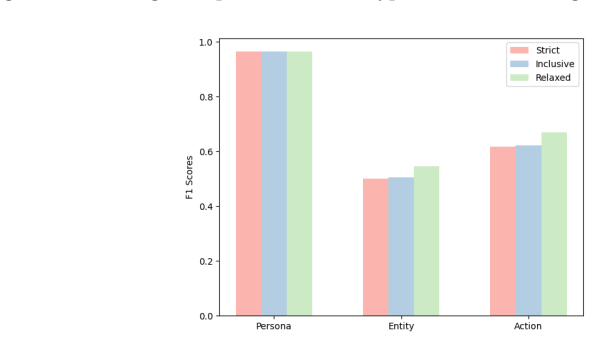
The paper's central claim is that the USGT module outperforms the earlier LLM-based extraction method on the same cleaned annotated dataset. In the strict comparison, GPT-4-turbo run through USGT achieves average F-measures of 0.99 for persona, 0.80 for entity, and 0.79 for action, against the benchmark's 0.98, 0.69, and 0.73; entity extraction therefore improves by 16% on average. The module asks the LLM for only the ontology's core components: a main prompt extracts persona, action, and entity nodes plus TRIGGERS and TARGETS relationships, while a separate prompt extracts the optional benefit node. The Graph Transformer component then adds the user story itself as a node and derives the HAS_PERSONA, HAS_ACTION, HAS_ENTITY, and HAS_BENEFIT links by logical inference, yielding a complete Graph Document written directly into Neo4j. The thesis also claims the solution is model-agnostic, having run with GPT-4o mini, which supports function calls, and Llama 3, which does not, and it still trails the trained CRF baseline, though by a narrower margin than the earlier LLM method.
Load-bearing premise
The load-bearing premise is that the earlier published benchmark scores are a fair baseline for the new module's results, even though the winning numbers come from a different model generation tested later; if the model's progress, not the module's design, explains the gain, the central comparison collapses.
Editorial extensions
If this is right
- A product backlog can be converted into a queryable Neo4j knowledge graph end to end, with no manual modeling step and no NLP tooling beyond the LLM call.
- Teams are not locked into a single LLM provider; swapping GPT-4o mini for Llama 3 is a configuration change, at a measurable accuracy cost in exact-match extraction.
- The accuracy gap between LLM-based extraction and a trained CRF model narrows, making LLM-based requirements modeling competitive for projects that cannot afford a training phase.
- Reusable evaluation machinery, including comparison modes, precision, recall, F-measure, and BERTScore, lets future extraction methods be measured against the same ground truth and compared directly.
- Including benefit nodes in evaluation extends coverage of the ontology beyond the earlier benchmark, so reported scores reflect a fuller user-story structure.
Reading between the lines
- Going beyond the paper, the 16% entity gain could be driven by prompt decomposition rather than by the module's graph plumbing; a direct test would be to run the benchmark's original prompt on GPT-4o mini and Llama 3 against the same dataset.
- The dual-prompt split, hard nodes first and optional benefit later, is a general recipe: any ontology-constrained extraction task with an optional component could benefit from isolating that component, a hypothesis the thesis does not itself test.
- Shared persona and entity nodes across stories in the resulting graph could be used to detect dependencies, overlaps, and conflicts in the backlog; the thesis visualizes this potential but does not quantify it.
Signed reviews
Editorial analysis
A structured set of objections, weighed in public.
Referee Report
Summary. The manuscript (a Master's thesis posted to arXiv) proposes the UserStoryGraphTransformer (USGT), a LangChain-based module that uses an LLM to extract node and relationship components from user stories according to the ontology of Arulmohan et al. [1]. It splits extraction into a main prompt (persona, actions, entities, TRIGGERS, TARGETS) and a benefit prompt, enriches outputs with a user-story node and logically inferred HAS_* relationships, and stores the resulting graph in Neo4j. The evaluation compares USGT with Llama 3 and GPT-4o mini on a cleaned 1,459-story annotated dataset under strict, inclusive, relaxed, and BERTScore matching, and compares GPT-4-turbo USGT results against benchmark repository scores for GPT-4-turbo and CRF. The central claim is that USGT is fully automated, model-agnostic, and improves entity extraction by 16% over the earlier LLM-based method.
Significance. The paper's practical contributions are real: a reusable implementation, an automated evaluation script, use of standard precision/recall/F-measure plus BERTScore, and reuse of an externally annotated dataset with high inter-annotator agreement, which keeps circularity low. If the comparative results are confirmed under a single evaluation pipeline, the USGT would be a useful, low-cost alternative to NLP-based user-story modeling and would meaningfully close the gap with CRF. However, the headline claim currently rests on an unverified comparison with repository scores, and no relationship-level metrics are reported even though the first research question concerns relationship extraction.
major comments (3)
- [Section 5.4, Table 5.5] Section 5.2 documents exactly two USGT experiments (Llama 3 and GPT-4o mini) and does not describe a GPT-4-turbo run, yet Table 5.5 reports a 'GPT-4-turbo using USGT' column and Section 5.4 uses it to claim a 16% entity-extraction improvement. The text says the earlier results were 'found' in repository [39], but it never states that the repository outputs and the USGT outputs were scored with the same evaluation.py, the same cleaned backlog subset, and the same strict-mode matching rules. Unless this evaluation-equivalence is demonstrated, ideally by running both output sets through one script and publishing the outputs, the reported improvement is not secured. This is load-bearing for RQ1 and for the headline comparison.
- [Section 5.3, Tables 5.1-5.4, and RQ1 in Section 1.3] RQ1 asks about the accuracy of both nodes and relationships, and Section 5.1 describes TP/FP/FN counting for KG components, but Section 5.3 and Tables 5.1-5.4 report F-measures only for Persona, Entity, Action, and Benefit. No precision/recall/F-measure for TRIGGERS or TARGETS is given anywhere, and Table 5.5 also omits relationships. The claim in Section 5.4 that the solution 'successfully extracts nodes and relationships' is therefore unsupported by the reported evidence. The authors should either add relationship-level metrics or explicitly limit all claims to node extraction and revise the RQ1 answer accordingly.
- [Section 7.3 and Table 5.5] Section 7.3 acknowledges that LLM outputs are non-deterministic even with temperature set to zero, but Table 5.5 reports single numbers per backlog with no repeated runs or variance measures. Since the headline comparison is an average over 21 backlogs, run-to-run variability could affect the size of the reported gap. The paper should at least report the number of runs behind each score and, if possible, provide multiple runs or confidence intervals before presenting the 16% improvement as a stable result.
minor comments (4)
- [Section 5.4] The phrase 'entity extraction improved by 16% on average' is ambiguous: the table shows 0.69 to 0.80, which is an increase of 11 percentage points, or approximately 16% relative. Please state both values explicitly.
- [Table 5.5 caption] The caption uses 'GPT-4-turbo from Benchmark' while the text refers to 'GPT-4-0125-preview (also referred to as GPT-4-turbo)'. Please use one consistent model name throughout the table and text.
- [Section 5.3] The sentence 'Moving to the inclusive and (Table 5.2) relaxed (Table 5.3) modes' is grammatically incomplete; it should read 'Moving to the inclusive (Table 5.2) and relaxed (Table 5.3) modes'.
- [Section 7.3] The threats-to-validity discussion is helpful, but it does not mention the comparison-equivalence threat that affects Table 5.5; adding it would improve transparency about the central comparison.
Circularity Check
No significant circularity: the central evaluation is measured against an external annotated dataset, and the derived HAS_* edges are a design convenience rather than a claimed predictive result.
full rationale
The paper's core empirical claim, the 16% improvement in entity F-measure in Section 5.4, is a comparison between the USGT module's outputs and scores taken from an external repository [39] for the earlier LLM-based method, both measured against the same externally annotated dataset [49]. The benchmark numbers are not fitted parameters of this thesis, nor are they derived from the USGT outputs, so the comparison cannot be circular by construction. The HAS_* relationships generated by the Graph Transformer (Section 4.2.1, Listing 4.10) are logically inferred from the presence of extracted nodes, so they are correct by construction; however, the evaluation tables report node-level F-measures and do not use these inferred edges as evidence of predictive performance, so this design choice does not support a circularity finding. The thesis also adopts the ontology and comparison modes from Arulmohan et al. [1], but sharing the benchmark's ontology and metrics is what makes the comparison meaningful rather than circular. The remaining concern, that repository baseline scores and USGT scores may not have been produced by a single identically configured evaluation pipeline, is a validity and fairness threat, not a self-definitional or fitted-input circularity. The thesis's own limitations section similarly flags prompt subjectivity and LLM nondeterminism, which are external-validity issues, not circular reasoning. No load-bearing step reduces to its own inputs.
Assumptions & free parameters
free parameters (1)
- LLM temperature =
0.0
assumptions (4)
- domain assumption Arulmohan et al. ontology is the correct target structure for representing user stories.
- domain assumption The annotated Ace-design/qualified-user-stories dataset is a trustworthy ground truth.
- domain assumption The cleaned 87% dataset subset is representative and suitable for comparison.
- domain assumption Temperature-zero LLM outputs are stable enough for single-run evaluation.
Cite this review
Pith. "Pith review of Extracting Knowledge Graphs from User Stories using LangChain." pith.science (2026). https://pith.science/paper/IK25RLK7
@misc{pith2026250611020,
  author       = {Pith},
  title        = {Pith review of: Extracting Knowledge Graphs from User Stories using LangChain},
  year         = {2026},
  howpublished = {\url{https://pith.science/paper/IK25RLK7}},
  note         = {Machine review of arXiv:2506.11020}
}
read the original abstract
This thesis introduces a novel methodology for the automated generation of knowledge graphs from user stories by leveraging the advanced capabilities of Large Language Models. Utilizing the LangChain framework as a basis, the User Story Graph Transformer module was developed to extract nodes and relationships from user stories using an LLM to construct accurate knowledge graphs.This innovative technique was implemented in a script to fully automate the knowledge graph extraction process. Additionally, the evaluation was automated through a dedicated evaluation script, utilizing an annotated dataset for assessment. By enhancing the visualization and understanding of user requirements and domain concepts, this method fosters better alignment between software functionalities and user expectations, ultimately contributing to more effective and user-centric software development processes.
Figures


Figures from the paper (9 more)


Reference graph
Works this paper leans on
-
[39]
Extracting domain models from user stories- repository, 2023
S´ ebastien Mosser and Sathurshan Arulmohan. Extracting domain models from user stories- repository, 2023. Repository available on: https://github.com/ace- design/qualified-user-stories
work page 2023
-
[1]
Extracting do- main models from textual requirements in the era of large language models
Sathurshan Arulmohan, Marie-Jean Meurs, and S´ ebastien Mosser. Extracting do- main models from textual requirements in the era of large language models. In 2023 ACM/IEEE International Conference on Model Driven Engineering Languages and Systems Companion (MODELS-C) , pages 580–587. IEEE, 2023
work page 2023
-
[2]
Promptner: Prompting for named entity recognition
Dhananjay Ashok and Zachary C Lipton. Promptner: Prompting for named entity recognition. arXiv preprint arXiv:2305.15444 , 2023
arXiv 2023
-
[3]
An ontology-based approach to automate the software development process
Kathirgamasegaran Athiththan, Selvaratnam Rovinsan, Srijeevahan Sathveegan, Nahanaa Gunasekaran, Kamila SAW Gunawardena, and Dharshana Kasthuri- rathna. An ontology-based approach to automate the software development process. In 2018 ieee international conference on information and automation for sustain- ability (iciafs), pages 1–6. IEEE, 2018
work page 2018
-
[4]
Kent Beck, Mike Beedle, Arie Van Bennekum, Alistair Cockburn, Ward Cunning- ham, Martin Fowler, James Grenning, Jim Highsmith, Andrew Hunt, Ron Jeffries, et al. The agile manifesto, 2001
work page 2001
-
[5]
De- riving domain models from user stories: Human vs
Maxim Bragilovski, Ashley T Van Can, Fabiano Dalpiaz, and Arnon Sturm. De- riving domain models from user stories: Human vs. machines. In 2024 IEEE 32nd International Requirements Engineering Conference (RE), pages 31–42. IEEE, 2024
work page 2024
-
[6]
Domain modeling and domain engineering: Key tasks in require- ments engineering
Manfred Broy. Domain modeling and domain engineering: Key tasks in require- ments engineering. Perspectives on the Future of Software Engineering: Essays in Honor of Dieter Rombach , pages 15–30, 2013
work page 2013
-
[7]
Jumping nlp curves: A review of natural language processing research
Erik Cambria and Bebo White. Jumping nlp curves: A review of natural language processing research. IEEE Computational intelligence magazine , 9(2):48–57, 2014
work page 2014
Show all 60 references
-
[8]
A survey on evaluation of large language models
Yupeng Chang, Xu Wang, Jindong Wang, Yuan Wu, Linyi Yang, Kaijie Zhu, Hao Chen, Xiaoyuan Yi, Cunxiang Wang, Yidong Wang, et al. A survey on evaluation of large language models. ACM Transactions on Intelligent Systems and Technology , 2023
2023
-
[9]
Langchain, 2022
Harrison Chase. Langchain, 2022. https://github.com/langchain-ai/langchain. Ac- cessed on 2024-10-10
2022
-
[10]
Llmgraphtransformer, 2023
Harrison Chase. Llmgraphtransformer, 2023. 71
2023
-
[11]
Generative ai for requirements engineering: A systematic literature review
Haowei Cheng, Jati H Husen, Sien Reeve Peralta, Bowen Jiang, Nobukazu Yosh- ioka, Naoyasu Ubayashi, and Hironori Washizaki. Generative ai for requirements engineering: A systematic literature review. arXiv preprint arXiv:2409.06741, 2024
2024
-
[12]
Know your customers’ jobs to be done
Clayton M Christensen, Taddy Hall, Karen Dillon, and David S Duncan. Know your customers’ jobs to be done. Harvard business review, 94(9):54–62, 2016
2016
-
[13]
User stories applied: For agile software development
Mike Cohn. User stories applied: For agile software development . Addison-Wesley Professional, 2004
2004
-
[14]
Software Engineering Technical Committee
IEEE Computer Society. Software Engineering Technical Committee. IEEE Stan- dard Glossary of Software Engineering Terminology , volume 729. IEEE, 1983
1983
-
[15]
Extracting knowledge graphs from user stories using langchain, 2024
Thayn´ a Camargo da Silva. Extracting knowledge graphs from user stories using langchain, 2024. https://zenodo.org/record/14254058
2024
-
[16]
Requirements data sets (user stories), July 2018
Fabiano Dalpiaz. Requirements data sets (user stories), July 2018. dataset
2018
-
[17]
Detecting terminological ambiguity in user stories: Tool and experimentation
Fabiano Dalpiaz, Ivor Van Der Schalk, Sjaak Brinkkemper, Fatma Ba¸ sak Aydemir, and Garm Lucassen. Detecting terminological ambiguity in user stories: Tool and experimentation. Information and Software Technology, 110:3–16, 2019
2019
-
[18]
Requirements engineering tools: Capa- bilities, survey and assessment
Juan M Carrillo De Gea, Joaqu´ ın Nicol´ as, Jos´ e L Fern´ andez Alem´ an, Ambrosio Toval, Christof Ebert, and Aurora Vizca´ ıno. Requirements engineering tools: Capa- bilities, survey and assessment. Information and Software Technology, 54(10):1142– 1157, 2012
2012
-
[19]
Bert: Pre-training of deep bidirectional transformers for language understanding
Jacob Devlin. Bert: Pre-training of deep bidirectional transformers for language understanding. arXiv preprint arXiv:1810.04805 , 2018
2018 arXiv
-
[20]
Automatic generation of uml se- quence diagrams from user stories in scrum process
Meryem Elallaoui, Khalid Nafil, and Raja Touahni. Automatic generation of uml se- quence diagrams from user stories in scrum process. In 2015 10th international con- ference on intelligent systems: theories and applications (SITA) , pages 1–6. IEEE, 2015
2015
-
[21]
Automatic transformation of user stories into uml use case diagrams using nlp techniques
Meryem Elallaoui, Khalid Nafil, and Raja Touahni. Automatic transformation of user stories into uml use case diagrams using nlp techniques. Procedia computer science, 130:42–49, 2018
2018
-
[22]
Formalizing natural language intent into program specifications via large language models
Madeline Endres, Sarah Fakhoury, Saikat Chakraborty, and Shuvendu K Lahiri. Formalizing natural language intent into program specifications via large language models. arXiv preprint arXiv:2310.01831 , 2023
2023 arXiv
-
[23]
Large language models for software engineering: Survey and open problems
Angela Fan, Beliz Gokkaya, Mark Harman, Mitya Lyubarskiy, Shubho Sengupta, Shin Yoo, and Jie M Zhang. Large language models for software engineering: Survey and open problems. In 2023 IEEE/ACM International Conference on Software Engineering: Future of Software Engineering (IC...
2023
-
[24]
Knowledge graphs methodology, tools and selected use cases (2020)
D Fensel, U Simsek, K Angele, E Huaman, E K¨arle, O Panasiuk, I Toma, J Umbrich, and A Wahler. Knowledge graphs methodology, tools and selected use cases (2020)
2020
-
[25]
Transformerranker: A tool for effi- ciently finding the best-suited language models for downstream classification tasks
Lukas Garbas, Max Ploner, and Alan Akbik. Transformerranker: A tool for effi- ciently finding the best-suited language models for downstream classification tasks. arXiv preprint arXiv:2409.05997 , 2024
2024 arXiv
-
[26]
Connecting user stories and code for test development
Adrian Genaid et al. Connecting user stories and code for test development. In 2012 third international workshop on recommendation systems for software engineering (rsse), pages 33–37. IEEE, 2012
2012
-
[27]
Facts and fallacies of software engineering
Robert L Glass. Facts and fallacies of software engineering . Addison-Wesley Pro- fessional, 2002
2002
-
[28]
Large language models for software engineering: A systematic literature review
Xinyi Hou, Yanjie Zhao, Yue Liu, Zhou Yang, Kailong Wang, Li Li, Xiapu Luo, David Lo, John Grundy, and Haoyu Wang. Large language models for software engineering: A systematic literature review. arXiv preprint arXiv:2308.10620, 2023
2023 arXiv
-
[29]
Unveiling llm evaluation focused on metrics: Chal- lenges and solutions
Taojun Hu and Xiao-Hua Zhou. Unveiling llm evaluation focused on metrics: Chal- lenges and solutions. arXiv preprint arXiv:2404.09135 , 2024
2024 arXiv
-
[30]
A study on the implementation method of an agent-based advanced rag system using graph
Cheonsu Jeong. A study on the implementation method of an agent-based advanced rag system using graph. arXiv preprint arXiv:2407.19994 , 2024
2024 arXiv
-
[31]
Research trends for the interplay between large lan- guage models and knowledge graphs
Hanieh Khorashadizadeh, Fatima Zahra Amara, Morteza Ezzabady, Fr´ ed´ eric Ieng, Sanju Tiwari, Nandana Mihindukulasooriya, Jinghua Groppe, Soror Sahri, Farah Benamara, and Sven Groppe. Research trends for the interplay between large lan- guage models and knowledge graphs. arXi...
2024 arXiv
-
[32]
Extracting queryable knowledge graphs from user stories: An empirical evaluation
Ayodeji Ladeinde, Chetan Arora, Hourieh Khalajzadeh, Tanjila Kanij, and John Grundy. Extracting queryable knowledge graphs from user stories: An empirical evaluation. In International Conference on Evaluation of Novel Approaches to Soft- ware Engineering 2023, pages 684–692. S...
2023
-
[33]
Conditional random fields: Probabilistic models for segmenting and labeling sequence data
John Lafferty, Andrew McCallum, Fernando Pereira, et al. Conditional random fields: Probabilistic models for segmenting and labeling sequence data. In Icml, volume 1, page 3. Williamstown, MA, 2001
2001
-
[34]
Improving agile requirements: the quality user story framework and tool
Garm Lucassen, Fabiano Dalpiaz, Jan Martijn EM van der Werf, and Sjaak Brinkkemper. Improving agile requirements: the quality user story framework and tool. Requirements engineering, 21:383–403, 2016
2016
-
[35]
Extracting conceptual models from user stories with visual narrator
Garm Lucassen, Marcel Robeer, Fabiano Dalpiaz, Jan Martijn EM Van Der Werf, and Sjaak Brinkkemper. Extracting conceptual models from user stories with visual narrator. Requirements Engineering, 22:339–358, 2017
2017
-
[36]
An approach for knowledge graphs-based user stories in agile methodologies
Marco Mancuso and Emanuele Laurenzi. An approach for knowledge graphs-based user stories in agile methodologies. In International Conference on Business Infor- matics Research, pages 133–141. Springer, 2023. 73
2023
-
[37]
Transforming conversational ai
Michael McTear and Marina Ashurkina. Transforming conversational ai. 2024
2024
-
[38]
Modelling agile back- logs as composable artifacts to support developers and product owners
S´ ebastien Mosser, Corinne Pulgar, and Vladimir Reinhar. Modelling agile back- logs as composable artifacts to support developers and product owners. J. Object Technol., 21(3):3–1, 2022
2022
-
[40]
Natural language processing: an introduction
Prakash M Nadkarni, Lucila Ohno-Machado, and Wendy W Chapman. Natural language processing: an introduction. Journal of the American Medical Informatics Association, 18(5):544–551, 2011
2011
-
[41]
doccano: Text annotation tool for human, 2018
Hiroki Nakayama, Takahiro Kubo, Junya Kamura, Yasufumi Taniguchi, and Xu Liang. doccano: Text annotation tool for human, 2018. Software available from https://github.com/doccano/doccano
2018
-
[42]
Towards a generation of class diagram from user stories in agile methods
Samia Nasiri, Yassine Rhazali, and Mohammed Lahmer. Towards a generation of class diagram from user stories in agile methods. In Advancements in Model-Driven Architecture in Software Engineering, pages 135–159. IGI Global, 2021
2021
-
[43]
Neo4j - the world’s leading graph database, 2024
Neo4j. Neo4j - the world’s leading graph database, 2024. https://neo4j.com/. Accessed on 2024-06-12
2024
-
[44]
Prompt engineering, 2023
OpenAI. Prompt engineering, 2023. https://platform.openai.com/docs/guides/prompt- engineering?ref=blef.fr. Accessed on 2024-09-07
2023
-
[45]
Chatgpt: Openai language model, 2024
OpenAI. Chatgpt: Openai language model, 2024. https://platform.openai.com/docs/models/gpt-4. Accessed on 2024-07-14
2024
-
[46]
Requirements engineering: An overview
Klaus Pohl. Requirements engineering: An overview . Citeseer, 1996
1996
-
[47]
User stories and natural language processing: A systematic literature review
Indra Kharisma Raharjana, Daniel Siahaan, and Chastine Fatichah. User stories and natural language processing: A systematic literature review. IEEE access, 9:53811–53826, 2021
2021
-
[48]
Automated extraction of conceptual models from user stories via nlp
Marcel Robeer, Garm Lucassen, Jan Martijn EM Van Der Werf, Fabiano Dalpiaz, and Sjaak Brinkkemper. Automated extraction of conceptual models from user stories via nlp. In 2016 IEEE 24th international requirements engineering conference (RE), pages 196–205. IEEE, 2016
2016
-
[49]
ace- design/qualified-user-stories: Version 1.0, July 2023
Sathurshan Arulmohan, S´ ebastien Mosser, and Marie-Jean Meurs. ace- design/qualified-user-stories: Version 1.0, July 2023. Annotated dataset
2023
-
[50]
The scrum guide
Ken Schwaber and Jeff Sutherland. The scrum guide. Scrum Alliance, 21(1):1–38, 2011. 74
2011
-
[51]
Revolu- tionizing mental health care through langchain: A journey with a large language model
Aditi Singh, Abul Ehtesham, Saifuddin Mahmud, and Jong-Hoon Kim. Revolu- tionizing mental health care through langchain: A journey with a large language model. In 2024 IEEE 14th Annual Computing and Communication Workshop and Conference (CCWC), pages 0073–0078. IEEE, 2024
2024
-
[52]
Software engineering (ed.)
Ian Sommerville. Software engineering (ed.). America: Pearson Education Inc , 2011
2011
-
[53]
Handbook on ontologies
Steffen Staab and Rudi Studer. Handbook on ontologies. Springer Science & Business Media, 2013
2013
-
[54]
Attention is all you need
Ashish Vaswani, Noam Shazeer, Niki Parmar, Jakob Uszkoreit, Llion Jones, Aidan N Gomez, Lukasz Kaiser, and Illia Polosukhin. Attention is all you need. Advances in neural information processing systems , 30, 2017
2017
-
[55]
Unleashing chatgpt’s power: A case study on optimizing information retrieval in flipped classrooms via prompt engineering
Mo Wang, Minjuan Wang, Xin Xu, Lanqing Yang, Dunbo Cai, and Minghao Yin. Unleashing chatgpt’s power: A case study on optimizing information retrieval in flipped classrooms via prompt engineering. IEEE Transactions on Learning Tech- nologies, 17:629–641, 2024
2024
-
[56]
Chatgpt prompt patterns for improving code quality, refactoring, requirements elic- itation, and software design
Jules White, Sam Hays, Quchen Fu, Jesse Spencer-Smith, and Douglas C Schmidt. Chatgpt prompt patterns for improving code quality, refactoring, requirements elic- itation, and software design. In Generative AI for Effective Software Development , pages 71–108. Springer, 2024
2024
-
[57]
Fundamentals of codes, graphs, and iterative decoding, volume 714
Stephen B Wicker and Saejoon Kim. Fundamentals of codes, graphs, and iterative decoding, volume 714. Springer Science & Business Media, 2002
2002
-
[58]
Bertscore: Evaluating text generation with bert
Tianyi Zhang, Varsha Kishore, Felix Wu, Kilian Q Weinberger, and Yoav Artzi. Bertscore: Evaluating text generation with bert. arXiv preprint arXiv:1904.09675 , 2019
1904 arXiv
-
[59]
Natural language pro- cessing for requirements engineering: A systematic mapping study.ACM Computing Surveys (CSUR), 54(3):1–41, 2021
Liping Zhao, Waad Alhoshan, Alessio Ferrari, Keletso J Letsholo, Muideen A Ajagbe, Erol-Valeriu Chioasca, and Riza T Batista-Navarro. Natural language pro- cessing for requirements engineering: A systematic mapping study.ACM Computing Surveys (CSUR), 54(3):1–41, 2021
2021
-
[60]
Univer- salner: Targeted distillation from large language models for open named entity recognition
Wenxuan Zhou, Sheng Zhang, Yu Gu, Muhao Chen, and Hoifung Poon. Univer- salner: Targeted distillation from large language models for open named entity recognition. arXiv preprint arXiv:2308.03279 , 2023. 75
2023 arXiv
Reviewed August 15, 2026 · model on record in the stance chip above.
Discussion (0). Continue with ORCID to comment.