REVIEW 3 major objections 7 minor 2 cited by
Output Scaling: YingLong-Delayed Chain of Thought in a Large Pretrained Time Series Forecasting Model
T0 review · 3 major / 7 minor · reviewed 2026-08-07 · deepseek-v4-flash
Pith's one-line read The paper claims that a non-causal, encoder-only time series transformer exhibits output scaling: extending the total forecast duration beyond the target horizon improves accuracy for the fixed target, an effect it names delayed…
desk verdict A genuinely new empirical effect—longer outputs improve fixed-horizon forecasts—buried under an unsupported 'delayed chain-of-thought' story; the finding deserves careful scrutiny, the mechanism does not. read the letter →
The pith
A machine-rendered reading of the paper's core claim, the machinery that carries it, and where it could break.
The reading
What carries the argument
The mechanism that carries the argument is a masked-token joint forecasting architecture: an encoder-only transformer with fully dense (non-causal) bidirectional attention over the concatenation of input patches and masked output patches, trained by randomly masking 20% of patches and recovering them with a weighted quantile loss. At test time, the masked positions are extended to include the full requested output length, and because attention is non-causal, every output token—including those to the right of the target horizon—can influence the target. This is what enables delayed chain-of-thought. The architecture also includes a U-shaped transformer with token merging and long skip connections and a multi-input ensemble with temporal mirroring, but the paper's ablations indicate the joint forecasting and DCoT design, not the U-shaped backbone, is the main source of gains.
What would settle it
Take the 300M YingLong model and compare DCoT lengths 0 and 4096 on phase-randomized or shuffled versions of the GIFT-Eval datasets, which preserve the marginal distribution but destroy periodic and low-frequency structure; if the DCoT explanation is correct, the large and consistent MASE/CRPS improvement seen on the original data should largely disappear because future points no longer provide predictable anchors. A cleaner architectural check is to run the same joint forecasting model with a causal attention mask instead of bidirectional attention; if the mechanism is delayed chain-of-thought, output scaling should not occur under the causal mask.
Extended reading notes
Core claim
The core claim is that in joint forecasting, longer outputs improve predictions of shorter, fixed targets. Formally, the paper proposes the delayed chain-of-thought effect: with a non-causal bidirectional encoder, tokens placed after the target can serve as 'thoughts' that increase the conditional probability of the target, just as chain-of-thought tokens before an answer do in language models. The authors argue that time series contain periodic and low-frequency structures that make some future points more predictable, so those points can anchor the forecast of earlier horizons. In their evaluation, output lengths of 1024, 2048, and 4096 produce progressively larger gains over the no-DCoT baseline on the GIFT-Eval benchmark, with a reduction of up to 10.5% in MASE and 11.9% in CRPS, and the same pattern appears in vanilla transformer baselines, indicating the effect survives architectural changes. The paper also claims this effect is distinct from direct and recursive paradigms, where extending output does not affect earlier predictions.
Load-bearing premise
The load-bearing premise is that the extra future points generated beyond the target horizon are predictable enough and correlated with the target to act as informative anchors; if those points are essentially noise or unrelated to the target, the output-scaling gain should vanish or reverse.
Editorial extensions
If this is right
- At inference, practitioners can improve a fixed target horizon by asking the model for a longer output window, with no retraining; in the reported experiments longer DCoT lengths consistently beat shorter ones.
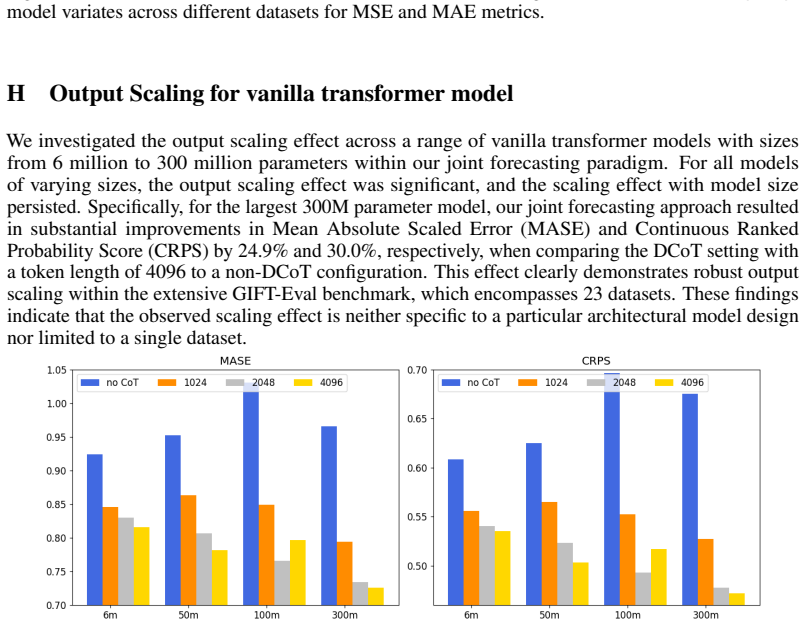
- The effect is not tied to the U-shaped architecture: vanilla transformers trained in the joint paradigm show output scaling too, and larger models benefit more, so output length acts like an additional scaling axis.
- The error reduction comes mostly from trend components in an STL decomposition, implying the gain is about capturing low-frequency structure rather than seasonal or residual detail.
- When combined with the multi-input ensemble, the gains stack: variable lookback lengths with sign-mirrored inputs buy an additional 1–4% accuracy.
- Because direct and recursive paradigms cannot let later outputs influence earlier ones, they should not exhibit this scaling; this gives a clean way to distinguish the DCoT mechanism in practice.
Reading between the lines
- If output scaling is general, then inference-time compute—the number of generated future tokens—becomes a tunable accuracy knob for time series foundation models, parallel to how more reasoning tokens can help in language models; this is an implied but not tested use of the paper's result.
- The DCoT mechanism depends on future points being predictable anchors, so gains should shrink on datasets with weak autocorrelation or chaotic dynamics; a direct cross-dataset correlation between autocorrelation length and DCoT benefit would test this.
- The mirrored-input ensemble suggests that any invertible transformation of the input (not only sign flip) could serve as a consistency constraint; one could extend the ensemble to phase shifts or scaling transforms and measure whether ensemble diversity further reduces variance.
- The paper's framing implies that adding DCoT at pretraining time, rather than only at inference time, might teach the model to rely on future anchors more strongly; a training curriculum that always includes long outputs could amplify the effect.
Editorial analysis
A structured set of objections, weighed in public.
Referee Report
Summary. The paper proposes YingLong, a non-causal encoder-only transformer for time series forecasting trained with masked token recovery under a 'joint forecasting' paradigm that predicts all horizons in parallel. The central claim is a novel 'output scaling' effect: extending the output sequence beyond the target horizon improves accuracy for a fixed target horizon, which the authors attribute to 'delayed chain-of-thought' (DCoT) reasoning. The authors also propose a multi-input ensemble that averages forecasts over multiple lookback lengths with temporal mirroring. They release four models (6M-300M) and evaluate zero-shot on ETT/Weather and on the GIFT-Eval benchmark (23 datasets), reporting that the 300M model achieves the best rank among all baselines and that DCoT yields up to a 10.5% MASE reduction on GIFT-Eval. The paper includes structural ablations, an analysis attributing DCoT gains mainly to trend errors, and an appendix with extensive per-domain and per-frequency results.
Significance. If the output scaling effect is genuine and specifically attributable to future tokens acting as 'conditional anchors,' it would be a practically useful form of inference-time scaling for time series foundation models, analogous to chain-of-thought in LLMs. The paper's strengths include a broad benchmark evaluation on GIFT-Eval, the release of pretrained models, and ablation evidence that the scaling trend persists across model sizes and with a vanilla transformer architecture. However, the causal role of the delayed tokens is not established: the probabilistic justification in Section 5.1 is invalid as a general statement, and the DCoT ablation in Figure 4/Table 12 does not rule out masking or positional artifacts. The empirical effect is plausible and deserves further study, but the mechanistic interpretation currently outruns the evidence.
major comments (3)
- [Section 5.1, 'Probabilistic Interpretation of CoT'] The inequality P(target=truth | prompt, CoT) >= P(target=truth | prompt) is not valid for arbitrary CoT tokens; conditioning on additional random variables can decrease the probability of the target when those variables are uninformative or misleading. This inequality is the only theoretical justification for DCoT in the paper, and as stated it does not constitute a proof. The authors should either derive explicit conditions under which the inequality holds for delayed tokens (for example, when the CoT tokens are drawn from the true conditional distribution of the future given the past), or clearly present the argument as an intuition rather than a probabilistic theorem.
- [Section 6.5, Figure 4, Appendix Table 12] The DCoT ablation varies only the number of masked future tokens while holding the target length fixed, which confounds the number of masked positions, the total sequence length, the position of the target tokens within the sequence, and the information content of the extra tokens. The observed monotone improvement is also consistent with (a) better alignment with the training mask ratio rho=0.2, (b) positional-encoding effects from shifting target tokens earlier in the sequence, or (c) a general benefit of additional context tokens. To support the DCoT interpretation, the authors should add control experiments such as random placeholder tokens in the future positions, ground-truth future tokens (oracle upper bound), and extra masked tokens inserted before the prompt to control for sequence length and mask count without future information.
- [Section 6.5, GIFT-Eval reporting] The paper reports point estimates for MASE/CRPS/Rank without confidence intervals or significance tests, and the maximum DCoT length of 4096 appears to be selected because it gives the best GIFT-Eval results. Given the 23 datasets and the effect sizes (e.g., 6.4% MASE reduction at 1024 vs. 10.5% at 4096 for the 300M model), the authors should report variability across datasets (e.g., per-dataset win/loss counts) and ideally pre-register or hold out the DCoT-length choice. The monotonicity across model sizes and lengths makes pure noise unlikely, but selection on the test benchmark remains a concern for the magnitude of the claimed improvement.
minor comments (7)
- [Abstract] There is a missing space in 'respectively.The pretrained 300M model'.
- [Section 1] The benchmark name is misspelled: 'NLU METE Benchmark' should be 'NLU MTEB Benchmark'.
- [Section 3, Eq. (1)] The direct forecasting negative log-likelihood expression is not well-formed: the index j is not quantified, and the summation limits appear inconsistent with a direct multi-horizon objective.
- [Table 1] The 'Rank' row contains two numbers per model column (e.g., '5.45 5.00'), which is confusing; clarify that these are the ranks for MSE and MAE respectively.
- [Appendix Table 6] There are several typos in the table, such as '0.262 0305' and '5.857,9', which make the results hard to read.
- [Appendix Table 7] The domain entry 'Salses' should be 'Sales', and the frequency for 'Kaggle Web Traffic Weekly' is listed as 'D' but should be 'W' (weekly).
- [Appendix D] The sentence 'The addition results aggregated in prediction lengths...' should read 'The additional results...'.
Circularity Check
No significant circularity: the output-scaling effect is measured on held-out benchmarks, and the DCoT label is an interpretive name, not a fitted input or self-citation.
full rationale
YingLong's central empirical claim is the output-scaling effect: fixing the target horizon, longer overall output length improves accuracy. This is established by the ablation in Figure 4 and Section 6.5 on the GIFT-Eval benchmark, which is external to the pretraining data and not used to fit any parameter in the model. The gains are reported for multiple model sizes and also for vanilla transformers (Appendix H), so the effect is not an artifact of a single fitted architecture. No load-bearing step reduces by construction to its inputs: the prediction head in Eq. (4) and the loss in Eq. (5) are standard quantile objectives, and the DCoT variable is simply the number of masked future tokens, whose effect is measured rather than fitted. The paper contains no load-bearing self-citation chain: its benchmark reference (Aksu et al. 2024) and architectural citations are external, and none of the cited works supplies a "uniqueness theorem" or ansatz that the present conclusions depend on. The main caveat is interpretive: Section 5.1 asserts P(target=truth | prompt, CoT) >= P(target=truth | prompt) as a premise, which is not a general probabilistic theorem, and Section 7 concedes that the delayed thought process remains hidden in latent space. This is an explanatory gap or a correctness risk, not a circular reduction, because the empirical output-scaling curve stands independently of the DCoT interpretation placed on it. No equation is equivalent to the claimed result by definition, and no fitted value is renamed as a prediction.
Assumptions & free parameters
free parameters (4)
- DCoT output length =
4096 tokens
- Multi-input ensemble lookback lengths =
512, 1024, 2048, 4096
- Masking ratio rho =
0.2
- Patch size =
32
assumptions (4)
- ad hoc to paper Conditioning on extra DCoT tokens increases target likelihood: P(target=truth|prompt,CoT) >= P(target=truth|prompt).
- domain assumption Future points beyond the target horizon are predictable enough to serve as anchors via periodic and low-frequency structure.
- domain assumption Time series forecasting aligns more with natural language understanding than with natural language generation, so non-causal masked recovery is a suitable pretraining objective.
- domain assumption Masked token recovery pretraining with random masked patches transfers to inference where target and extra tokens are all masked placeholders.
invented entities (1)
-
Delayed chain-of-thought (DCoT) latent reasoning process
Cite this review
Pith. "Pith review of Output Scaling: YingLong-Delayed Chain of Thought in a Large Pretrained Time Series Forecasting Model." pith.science (2026). https://pith.science/paper/BKC5MG6K
@misc{pith2026250611029,
  author       = {Pith},
  title        = {Pith review of: Output Scaling: YingLong-Delayed Chain of Thought in a Large Pretrained Time Series Forecasting Model},
  year         = {2026},
  howpublished = {\url{https://pith.science/paper/BKC5MG6K}},
  note         = {Machine review of arXiv:2506.11029}
}
read the original abstract
We present a joint forecasting framework for time series prediction that contrasts with traditional direct or recursive methods. This framework achieves state-of-the-art performance for our designed foundation model, YingLong, and reveals a novel scaling effect: longer outputs significantly enhance model accuracy due to delayed chain-of-thought reasoning in our non-causal approach. YingLong is a non-causal, bidirectional attention encoder-only transformer trained through masked token recovery, aligning more effectively with language understanding tasks than with generation tasks. Additionally, we boost performance by tackling output variance with a multi-input ensemble. We release four foundation models ranging from 6M to 300M parameters, demonstrating superior results in zero-shot tasks on the ETT and Weather datasets. YingLong achieves more than 60% best performance. To ensure generalizability, we assessed the models using the GIFT-Eval benchmark, which comprises 23 time series datasets across 7 domains. Yinglong significantly outperformed the best time-series foundation models, end-to-end trained models by 14% and 44% in rank respectively.The pretrained 300M model is available at https://huggingface.co/qcw1314/YingLong_300m
Figures


Figures from the paper (4 more)


Forward citations
Cited by 2 Pith papers
-
CITRAS-FM: Tiny Time Series Foundation Model for Covariate-Informed Zero-Shot Forecasting
CITRAS-FM is a 7M-param decoder-only Transformer TSFM with Shifted Attention and CovSynth synthetic covariate pretraining that claims SOTA zero-shot accuracy among sub-10M models on fev-bench with sub-0.1s CPU inference.
-
Beyond Accuracy: Are Time Series Foundation Models Well-Calibrated?
Time-series foundation models are better calibrated than ARIMA and N-BEATS baselines on the tested datasets, and their calibration does not show the systematic overconfidence seen in image and language models.
Reference graph
Works this paper leans on
-
[1]
Gift-eval: A benchmark for general time series forecasting model evaluation
Aksu, T., Woo, G., Liu, J., Liu, X., Liu, C., Savarese, S., Xiong, C., and Sahoo, D. Gift-eval: A benchmark for general time series forecasting model evaluation. arxiv preprint arxiv:2410.10393,
-
[6]
Freitag, M. and Al-Onaizan, Y . Beam search strategies for neural machine translation.arXiv preprint arXiv:1702.01806,
-
[7]
We consider mean absolute scaled error (MASE), continuous ranked probability score (CRPS) and Rank as metrics. MASE = m − s n · Pm+n t=m+1 |ˆxt − xt| Pm−s t |xt − xt+s| , 14 where m in the lookback length, n is the forecasting length, and s is the seasonality parameter. In this work, we follow the setting in Aksu et al. (2024) and use weighted quantile lo...
work page 2024
-
[9]
B., Müller, S., Salinas, D., and Hutter, F
10 Hoo, S. B., Müller, S., Salinas, D., and Hutter, F. The tabular foundation model tabpfn outperforms spe- cialized time series forecasting models based on simple features. arXiv preprint arXiv:2501.02945,
-
[11]
Towards general text embeddings with multi-stage contrastive learning
Li, Z., Zhang, X., Zhang, Y ., Long, D., Xie, P., and Zhang, M. Towards general text embeddings with multi-stage contrastive learning. arXiv preprint arXiv:2308.03281,
-
[13]
itransformer: Inverted transformers are effective for time series forecasting
Liu, Y ., Hu, T., Zhang, H., Wu, H., Wang, S., Ma, L., and Long, M. itransformer: Inverted transformers are effective for time series forecasting. In The Twelfth International Conference on Learning Representations, 2024a. Liu, Y ., Qin, G., Huang, X., Wang, J., and Long, M. Autotimes: Autoregressive time series forecasters via large language models. arXi...
-
[14]
Mteb: Massive text embedding benchmark
Muennighoff, N., Tazi, N., Magne, L., and Reimers, N. Mteb: Massive text embedding benchmark. arXiv preprint arXiv:2210.07316,
-
[15]
H., Constant, N., Ma, J., Hall, K
Ni, J., Abrego, G. H., Constant, N., Ma, J., Hall, K. B., Cer, D., and Yang, Y . Sentence-t5: Scalable sentence encoders from pre-trained text-to-text models. arXiv preprint arXiv:2108.08877,
Show all 27 references
-
[16]
H., Sinthong, P., and Kalagnanam, J
Nie, Y ., Nguyen, N. H., Sinthong, P., and Kalagnanam, J. A time series is worth 64 words: Long- term forecasting with transformers. In The Eleventh International Conference on Learning Representations, 2023a. URL https://openreview.net/forum?id=Jbdc0vTOcol. Nie, Y ., Nguyen, ...
-
[18]
Statistical characterization of business-critical workloads hosted in cloud datacenters
Shen, S., Van Beek, V ., and Iosup, A. Statistical characterization of business-critical workloads hosted in cloud datacenters. In 2015 15th IEEE/ACM international symposium on cluster, cloud and grid computing, pp. 465–474. IEEE,
2015
-
[19]
Accelerating auto- regressive text-to-image generation with training-free speculative jacobi decoding
Teng, Y ., Shi, H., Liu, X., Ning, X., Dai, G., Wang, Y ., Li, Z., and Liu, X. Accelerating auto- regressive text-to-image generation with training-free speculative jacobi decoding. arXiv preprint arXiv:2410.01699,
-
[20]
Attention is all you need
Vaswani, A. Attention is all you need. arXiv preprint arXiv:1706.03762,
-
[21]
ISBN 9781450386647
Association for Computing Machinery. ISBN 9781450386647. doi: 10.1145/3474717.3483923. URL https://doi.org/ 10.1145/3474717.3483923. Wei, J., Wang, X., Schuurmans, D., Bosma, M., Xia, F., Chi, E., Le, Q. V ., Zhou, D., et al. Chain-of- thought prompting elicits reasoning in la...
-
[22]
Do large language models latently perform multi-hop reasoning? arXiv preprint arXiv:2402.16837,
12 Yang, S., Gribovskaya, E., Kassner, N., Geva, M., and Riedel, S. Do large language models latently perform multi-hop reasoning? arXiv preprint arXiv:2402.16837,
-
[23]
Least-to-most prompting enables complex reasoning in large language models
Zhou, D., Schärli, N., Hou, L., Wei, J., Scales, N., Wang, X., Schuurmans, D., Cui, C., Bousquet, O., Le, Q., et al. Least-to-most prompting enables complex reasoning in large language models. arXiv preprint arXiv:2205.10625, 2022a. Zhou, H., Zhang, S., Peng, J., Zhang, S., Li...
-
[24]
Film: Frequency improved legendre memory model for long-term time series forecasting
Zhou, T., Ma, Z., Wen, Q., Sun, L., Yao, T., Yin, W., Jin, R., et al. Film: Frequency improved legendre memory model for long-term time series forecasting. Advances in neural information processing systems, 35:12677–12690, 2022b. Zhou, T., Ma, Z., Wen, Q., Wang, X., Sun, L., a...
2022
-
[26]
2021 Energy 30T 1153584Bitcoin Godahewa et al
Table 3: Pretraining Datasets Dataset Source domain Frequency # Length Australian Electricity Demand Godahewa et al. 2021 Energy 30T 1153584Bitcoin Godahewa et al. 2021 Econ/Fin D 68927Cif 2016 Godahewa et al. 2021 Econ/Fin M 7108Cif 2016 Godahewa et al. 2021 Econ/Fin M 7108Fr...
2021
-
[27]
This presents a scalable ’free lunch’ approach, yielding post-training improvements through simple ensemble averaging
Our input-ensemble strategy consistently enhances accuracy by 1% to 4% without necessitating additional model training. This presents a scalable ’free lunch’ approach, yielding post-training improvements through simple ensemble averaging. When compared to the single-worst comp...
-
[2015]
T., Rubinstein, M., et al
Chang, H., Zhang, H., Barber, J., Maschinot, A., Lezama, J., Jiang, L., Yang, M.-H., Murphy, K., Freeman, W. T., Rubinstein, M., et al. Muse: Text-to-image generation via masked generative transformers. arXiv preprint arXiv:2301.00704,
-
[2017]
Retrieval-augmented generation for large language models: A survey
Gao, Y ., Xiong, Y ., Gao, X., Jia, K., Pan, J., Bi, Y ., Dai, Y ., Sun, J., and Wang, H. Retrieval-augmented generation for large language models: A survey. arXiv preprint arXiv:2312.10997,
-
[2018]
Nv-embed: Improved techniques for training llms as generalist embedding models
Lee, C., Roy, R., Xu, M., Raiman, J., Shoeybi, M., Catanzaro, B., and Ping, W. Nv-embed: Improved techniques for training llms as generalist embedding models. arXiv preprint arXiv:2405.17428,
-
[2019]
Glu variants improve transformer
Shazeer, N. Glu variants improve transformer. arXiv preprint arXiv:2002.05202,
2002 arXiv
-
[2020]
Ansari, A
URL http://jmlr.org/papers/v21/19-820.html. Ansari, A. F., Stella, L., Turkmen, C., Zhang, X., Mercado, P., Shen, H., Shchur, O., Rangapuram, S. S., Arango, S. P., Kapoor, S., et al. Chronos: Learning the language of time series. arXiv preprint arXiv:2403.07815,
-
[2021]
Moe-llava: Mixture of experts for large vision-language models
Lin, B., Tang, Z., Ye, Y ., Cui, J., Zhu, B., Jin, P., Zhang, J., Ning, M., and Yuan, L. Moe-llava: Mixture of experts for large vision-language models. arXiv preprint arXiv:2401.15947,
-
[2022]
Y ., Rozière, B., Lopez-Paz, D., and Synnaeve, G
Gloeckle, F., Idrissi, B. Y ., Rozière, B., Lopez-Paz, D., and Synnaeve, G. Better & faster large language models via multi-token prediction. arXiv preprint arXiv:2404.19737,
-
[2023]
J., Sun, J., and Liu, C
Chen, M., Shen, L., Li, Z., Wang, X. J., Sun, J., and Liu, C. Visionts: Visual masked autoencoders are free-lunch zero-shot time series forecasters. arXiv preprint arXiv:2408.17253,
-
[2024]
Long-term forecasting with tide: Time-series dense encoder
Das, A., Kong, W., Leach, A., Mathur, S., Sen, R., and Yu, R. Long-term forecasting with tide: Time-series dense encoder. arXiv preprint arXiv:2304.08424,
Reviewed August 7, 2026 · model on record in the stance chip above.
Discussion (0). Sign in to comment.