REVIEW 3 major objections 4 minor 1 cited by
Angle Domain Guidance: Latent Diffusion Requires Rotation Rather Than Extrapolation
T0 review · 3 major / 4 minor · reviewed 2026-08-07 · deepseek-v4-flash
Pith's one-line read Classifier-free guidance oversaturates images at high weights because it stretches latent vectors; this paper shows that rotating the latent direction instead keeps text alignment without the color blowout.
desk verdict Useful drop-in guidance method for latent text-to-image, but the rotation-vs-norm story is missing its key control and the Theorem 3.2 proof doesn't match the paper's own CFG definition. read the letter →
The pith
A machine-rendered reading of the paper's core claim, the machinery that carries it, and where it could break.
The reading
What carries the argument
The operative object is the angle $\gamma_t$ between the two clean-latent predictions the model makes at each denoising step: $\hat{x}_0^{(c)}$ with the text condition and $\hat{x}_0^{(\emptyset)}$ without it, where $\hat{x}_0 = (x_t - \sqrt{1-\bar{\alpha}_t}\,\epsilon_\theta(x_t,t,\cdot))/\sqrt{\bar{\alpha}_t}$. The paper's reading of CFG is that its guidance term is a scaled copy of the difference $(\hat{x}_0^{(c)} - \hat{x}_0^{(\emptyset)})$ added to the unconditional score, so the guidance weight $\omega$ appears as a length multiplier. ADG removes that multiplier from the magnitude and reapplies it to the angle, rotating $\hat{x}_0^{(c)}$ by $\gamma_\omega = \min((\omega-1)\gamma, \pi/3)$ in the plane spanned by $\hat{x}_0^{(c)}$ and its component perpendicular to $\hat{x}_0^{(\emptyset)}$, then feeding the rotated prediction $\hat{x}_{0,\omega}$ into the standard DDIM-style step; because every sampler is a weighted combination of $x_t$, $\hat{x}_0$, and noise, substituting $\hat{x}_{0,\omega}$ is the whole recipe, and the rotation carries over to flow matching. The proofs run on the score identity of Lemma 3.4 (taken from Huang et al.), which expresses the score as an expectation of the tilted conditional distribution, letting Theorems 3.2 and 3.3 be reduced to the geometry of surface classes. The paper is explicit that this theoretical support covers CFG's failure mode, while ADG itself remains a heuristic.
What would settle it
The paper defines an untested baseline, 'Simplified ADG' (Algorithm 8), which applies CFG's linear extrapolation and then rescales the result to the original latent norm; running it on the same COCO10k, SD v3.5, 10-NFE setup would directly show whether norm control alone reproduces ADG's reported ImageReward of about 0.97 at $\omega=10$. If it does, the angular mechanism is not the active ingredient and the rotation formula itself is unnecessary; if it does not, the angle truly carries the alignment signal.
Extended reading notes
Core claim
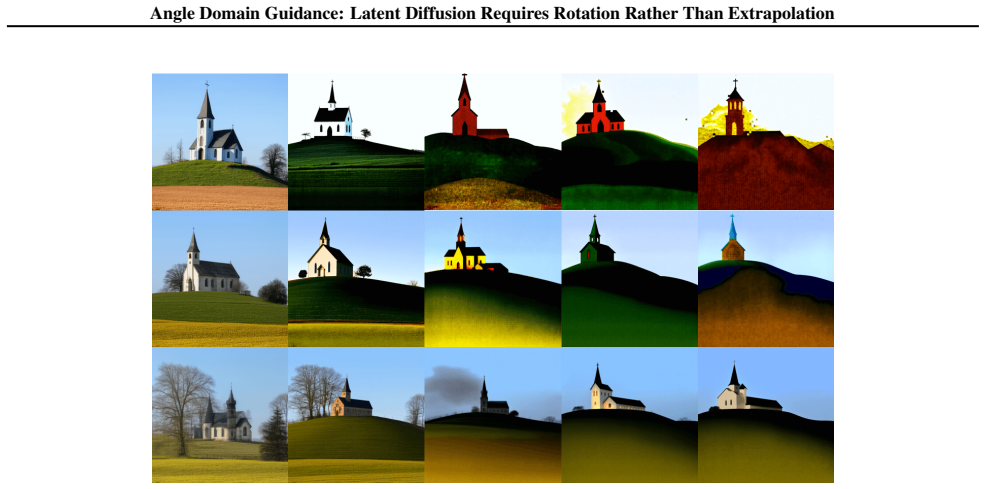
The central discovery is that guidance in latent diffusion should change the direction of the predicted clean latent, not its length. CFG's update is equivalent to replacing the conditional prediction $\hat{x}_0^{(c)}$ with the extrapolation $\hat{x}_0^{(c)} + (\omega-1)(\hat{x}_0^{(c)} - \hat{x}_0^{(\emptyset)})$ (equation 16 of the paper), so raising $\omega$ stretches the latent along the difference between conditional and unconditional predictions. The paper shows that when the data is a Gaussian mixture, this stretch is systematically stronger for surface classes — components on the outer face of the mixture — where the score-based flow of CFG pushes samples outside the conditional distribution (Theorem 3.2) and even into regions where the update points toward lower probability density (Theorem 3.3). ADG instead rotates $\hat{x}_0^{(c)}$ in the plane it spans with its component orthogonal to $\hat{x}_0^{(\emptyset)}$, by the angle $\gamma_\omega = \mathrm{threshold}((\omega-1)\gamma, \pi/3)$, where $\gamma = \arccos\!\big((\hat{x}_0^{(\emptyset)})^\top \hat{x}_0^{(c)} / (\|\hat{x}_0^{(\emptyset)}\|\,\|\hat{x}_0^{(c)}\|)\big)$; Proposition 4.1 bounds the resulting norm by $\|\hat{x}_{0,\omega}\| \le \sqrt{2}\,\|\hat{x}_0^{(c)}\|$, so the growth with $\omega$ is capped. On the paper's own terms, the theorems diagnose CFG while ADG itself is presented as a heuristic, and the experimental claim is that on COCO10k at 10 function evaluations ADG beats CFG, CFG++, and APG on CLIP and ImageReward at high guidance weights while staying competitive on FID.
Load-bearing premise
The load-bearing premise is that in the latent space of a text-to-image model the angle between the conditional and unconditional predictions carries the semantic alignment signal, while the difference in their lengths is only saturation noise — so that rotating the prediction by that angle, instead of lengthening it, loses nothing.
Editorial extensions
If this is right
- At $\omega = 10$ on COCO10k with SD v3.5, ADG holds CLIP at 0.322 and ImageReward at 0.970, while CFG drops to 0.304 and $-0.142$; at $\omega = 15$ CFG's ImageReward falls to $-0.659$ while ADG stays at 0.940.
- The $\pi/3$ cap on the rotation angle is load-bearing: removing it collapses performance to CLIP 0.275, ImageReward $-0.782$, and FID 28.6 at $\omega = 8$, against 0.322, 0.970, and 16.7 for ADG.
- Rescaling ADG's output back to the exact original norm barely changes results (CLIP 0.322, ImageReward 0.958), which the paper reads as confirmation that ADG already keeps magnitudes in check and that the angular update is the effective mechanism.
- ADG transfers across samplers and model versions: with SD v2.1 and DPM-Solver at 25 NFE it raises CLIP from 0.313 to 0.322 and ImageReward from 0.399 to 0.467 at equal FID 16.6.
- Because a sampler step is a weighted combination of $x_t$, $\hat{x}_0$, and noise, replacing $\hat{x}_0$ with the rotated $\hat{x}_{0,\omega}$ extends ADG to stochastic samplers and to flow-matching models, for which the paper gives the explicit update in the appendix.
Reading between the lines
- A natural extension the authors do not pursue is an adaptive turning-angle cap: since the ablation shows the fixed $\pi/3$ cap is what prevents catastrophic drift when $(\omega-1)\gamma$ exceeds $\pi$, a per-step cap that tracks the actual angle statistics could widen ADG's stable guidance range beyond $\omega = 10$.
- If the norm-amplification account is the general cause of high-guidance artifacts, the same rotation trick should also suppress the texture 'burn-in' artifacts seen at $\omega = 20$, which the paper displays only qualitatively; measuring texture metrics there would test whether length growth is the whole story.
- The theorems are proven for Gaussian mixtures, so the empirical wins on Stable Diffusion are the current evidence for the mechanism; collecting the actual distributions of $\gamma$ and of $\|\hat{x}_0^{(c)}\|/\|\hat{x}_0^{(\emptyset)}\|$ over COCO prompts would show whether the surface-class geometry that motivates ADG is really present in a trained latent space.
Editorial analysis
A structured set of objections, weighed in public.
Referee Report
Summary. The paper identifies norm amplification in the latent space as the source of color distortions under high classifier-free guidance (CFG) weights, develops a Gaussian-mixture analysis of CFG norm growth and anomalous diffusion (Theorems 3.2 and 3.3), and proposes Angle Domain Guidance (ADG): instead of the CFG extrapolation xhat_0^(c) + (omega-1)(xhat_0^(c) - xhat_0^(∅)), ADG rotates xhat_0^(c) by (omega-1)gamma in the plane spanned by the conditional/unconditional directions, clamps the turning angle at pi/3, and bounds the resulting norm (Proposition 4.1). Experiments on COCO10k with SD v3.5 and SD v2.1 compare ADG with CFG, CFG++, and APG on CLIP, ImageReward, and FID, reporting large ImageReward gains and a small CLIP advantage at high guidance weights, with competitive FID.
Significance. If taken at face value, the paper offers a useful and inexpensive modification to latent-diffusion samplers and provides a plausible geometric explanation for CFG oversaturation. The authors are appropriately modest that ADG is a heuristic, and the empirical protocol uses standard external benchmarks and metrics. The main barriers are evidentiary: the norm-only baseline needed to isolate the rotation mechanism is defined but never run, and the proof of the headline norm-amplification theorem is not derived from the CFG ODE as written. With those fixed, the contribution would be a solid empirical paper with a motivation-level theory.
major comments (3)
- [Appendix B, Eq. (21); Section 2.2, Eq. (8)] The proof of Theorem 3.2 does not analyze the CFG ODE defined in Eq. (8). Eq. (21) uses the score combination -(1+omega) log p_t(z|c*) + omega log p_t(z), whereas the CFG score from Eq. (8) is (1-omega) log p_t(·|∅) + omega log p_t(·|c). The subsequent comparison in Eqs. (24)-(27) therefore proves a statement about a different dynamical system. The claimed inequality may still be recoverable with the correct coefficient, but the theorem is not proved as written.
- [Section 5.2, Table 2; Appendix E, Algorithm 8] The central claim that rotation, not norm control, preserves text-image alignment at high guidance weights is not tested. Algorithm 7 ('ADG w normalization') still performs the full rotation and only rescales afterward, so it cannot distinguish rotation from norm control. Algorithm 8, which applies CFG and then rescales xhat_{0,CFG} to the norm of xhat_0^(c), is defined in Appendix E but never evaluated. Add an Algorithm 8 row to Table 2; without it, the empirical case that angular rotation is the active ingredient is incomplete.
- [Appendix D, Proposition 4.1 proof] The proof of Proposition 4.1 contains an invalid inequality: the step from sqrt(1 + sin(2gamma_omega) <xhat_asist, xhat_0^(c)> / ||xhat_0^(c)||^2) to sqrt(1 + sin(2gamma_omega)) is not valid in general because sin(2gamma_omega) can be negative and the inner-product ratio can be less than 1. The stated sqrt(2) bound is likely salvageable because the ratio equals sin(gamma), but the argument as written needs correction.
minor comments (4)
- [Section 2.2, Eq. (9)] Equation (9) omits the beta(t)/2 factor that appears in the reverse-time ODE (5), while the proof in Appendix B reintroduces it; please make the notation consistent.
- [Appendix C, Eq. (44)] The first term of Eq. (44) appears to retain a spurious 1/bar_beta_t factor after substituting the difference of expectations from Eq. (43); the sign analysis is unaffected, but the algebra should be corrected.
- [Section 4.2, Algorithm 1] The pi/3 maximum turning angle clamp is introduced without a sensitivity study; since Section 5.2 shows that removing the clamp is catastrophic, report at least a small sweep around pi/3 to justify the choice.
- [Section 5.1, Table 1] At low guidance weights the CLIP and FID differences between ADG and APG are small; please report standard deviations or multiple-seed results so the reader can judge whether these differences are meaningful.
Circularity Check
No significant circularity: theory is derived from an explicit Gaussian mixture model, the algorithm is evaluated on external benchmarks, and the only self-citation is not load-bearing.
full rationale
The paper's derivation chain is self-contained. The theoretical analysis of CFG norm amplification (Theorem 3.2) and anomalous diffusion (Theorem 3.3) is proven from an explicit Gaussian mixture model with closed-form score functions (Eqs. 11, 15, 22-27, 34-54), not from fitted parameters or from the predictions of the proposed algorithm. Lemma 3.4 is imported from independent prior work (Huang et al., 2023), and the remaining steps are direct mathematical derivations. The ADG algorithm is constructed from the algebraic decomposition of CFG in Eq. (16), and Proposition 4.1 verifies a norm bound for that construction rather than assuming the desired conclusion. The experimental evaluation uses external benchmarks (COCO10k, CLIP, FID, ImageReward) and compares against CFG, CFG++, and APG, so the central performance claims are externally grounded rather than being enforced by the definition of the method. The only self-citation (Zhang et al., 2024, with overlapping authors) appears in a passing list of downstream tasks in the Introduction and is not load-bearing for any derivation or experimental claim. The absence of the norm-only baseline (Algorithm 8) from the ablation is an empirical gap that weakens the causal attribution of the gains to rotation, but it is not circularity: no quantity in ADG is defined in terms of the reported outcome, and no fitted parameter is renamed as a prediction. Likewise, the apparent sign discrepancy in Eq. (21) relative to Eq. (8) is a proof-consistency issue, not a circularity, and it does not make the theoretical results equivalent to their inputs by construction.
Assumptions & free parameters
free parameters (1)
- maximum turning angle clamp pi/3 =
pi/3 ≈ 1.0472 rad
assumptions (3)
- domain assumption Data follows a Gaussian mixture p0(x) = sum_c pi_c N(x|mu_c, I) and the target class is a surface class (Definition 3.1), with a supporting hyperplane.
- domain assumption The latent space is approximately a high-dimensional isotropic Gaussian, concentrating on a sphere (Section 4.1, citing Kingma 2013 and Wainwright 2019).
- standard math The score decomposition in Lemma 3.4 (Lemma 1 of Huang et al. 2023) is valid and used to rewrite CFG.
Cite this review
Pith. "Pith review of Angle Domain Guidance: Latent Diffusion Requires Rotation Rather Than Extrapolation." pith.science (2026). https://pith.science/paper/NNM6JEGC
@misc{pith2026250611039,
  author       = {Pith},
  title        = {Pith review of: Angle Domain Guidance: Latent Diffusion Requires Rotation Rather Than Extrapolation},
  year         = {2026},
  howpublished = {\url{https://pith.science/paper/NNM6JEGC}},
  note         = {Machine review of arXiv:2506.11039}
}
read the original abstract
Classifier-free guidance (CFG) has emerged as a pivotal advancement in text-to-image latent diffusion models, establishing itself as a cornerstone technique for achieving high-quality image synthesis. However, under high guidance weights, where text-image alignment is significantly enhanced, CFG also leads to pronounced color distortions in the generated images. We identify that these distortions stem from the amplification of sample norms in the latent space. We present a theoretical framework that elucidates the mechanisms of norm amplification and anomalous diffusion phenomena induced by classifier-free guidance. Leveraging our theoretical insights and the latent space structure, we propose an Angle Domain Guidance (ADG) algorithm. ADG constrains magnitude variations while optimizing angular alignment, thereby mitigating color distortions while preserving the enhanced text-image alignment achieved at higher guidance weights. Experimental results demonstrate that ADG significantly outperforms existing methods, generating images that not only maintain superior text alignment but also exhibit improved color fidelity and better alignment with human perceptual preferences.
Figures


Figures from the paper (11 more)




Forward citations
Cited by 1 Pith paper
-
Momentum Guidance: Plug-and-Play Guidance for Flow Models
Momentum Guidance improves flow-model sample quality by extrapolating the current velocity away from an exponential moving average of past velocities, with no extra model evaluations.
Reference graph
Works this paper leans on
-
[1]
Anderson, B. D. Reverse-time diffusion equation models. Stochastic Processes and their Applications, 12 0 (3): 0 313--326, 1982
1982
-
[2]
Bradley, A. and Nakkiran, P. Classifier-free guidance is a predictor-corrector. arXiv preprint arXiv:2408.09000, 2024
arXiv 2024
-
[3]
What does guidance do? a fine-grained analysis in a simple setting
Chidambaram, M., Gatmiry, K., Chen, S., Lee, H., and Lu, J. What does guidance do? a fine-grained analysis in a simple setting. In The Thirty-eighth Annual Conference on Neural Information Processing Systems, 2024
work page 2024
-
[4]
Chung, H., Kim, J., Park, G. Y., Nam, H., and Ye, J. C. CFG ++: Manifold-constrained classifier free guidance for diffusion models. arXiv preprint arXiv:2406.08070, 2024
arXiv 2024
-
[5]
Scaling rectified flow transformers for high-resolution image synthesis
Esser, P., Kulal, S., Blattmann, A., Entezari, R., M \"u ller, J., Saini, H., Levi, Y., Lorenz, D., Sauer, A., Boesel, F., et al. Scaling rectified flow transformers for high-resolution image synthesis. In Forty-first International Conference on Machine Learning, 2024
2024
-
[6]
GANs trained by a two time-scale update rule converge to a local nash equilibrium
Heusel, M., Ramsauer, H., Unterthiner, T., Nessler, B., and Hochreiter, S. GANs trained by a two time-scale update rule converge to a local nash equilibrium. Advances in neural information processing systems, 30, 2017
work page 2017
-
[7]
and Salimans, T
Ho, J. and Salimans, T. Classifier-free diffusion guidance. In NeurIPS 2021 Workshop on Deep Generative Models and Downstream Applications, 2021
2021
-
[8]
Denoising diffusion probabilistic models
Ho, J., Jain, A., and Abbeel, P. Denoising diffusion probabilistic models. Advances in neural information processing systems, 33: 0 6840--6851, 2020
2020
Show all 34 references
-
[9]
Reverse diffusion monte carlo
Huang, X., Dong, H., Yifan, H., Ma, Y., and Zhang, T. Reverse diffusion monte carlo. In The Twelfth International Conference on Learning Representations, 2023
2023
-
[10]
Kingma, D. P. Auto-encoding variational bayes. arXiv preprint arXiv:1312.6114, 2013
2013 arXiv
-
[11]
Labs, B. F. Flux. https://github.com/black-forest-labs/flux, 2024
2024
-
[12]
and Cai, C
Li, G. and Cai, C. Provable acceleration for diffusion models under minimal assumptions. arXiv preprint arXiv:2410.23285, 2024
2024 arXiv
-
[13]
Magic3d: High-resolution text-to-3d content creation
Lin, C.-H., Gao, J., Tang, L., Takikawa, T., Zeng, X., Huang, X., Kreis, K., Fidler, S., Liu, M.-Y., and Lin, T.-Y. Magic3d: High-resolution text-to-3d content creation. In Proceedings of the IEEE/CVF conference on computer vision and pattern recognition, pp.\ 300--309, 2023
2023
-
[14]
Lin, T.-Y., Maire, M., Belongie, S., Hays, J., Perona, P., Ramanan, D., Doll \'a r, P., and Zitnick, C. L. Microsoft coco: Common objects in context. In Computer vision--ECCV 2014: 13th European conference, zurich, Switzerland, September 6-12, 2014, proceedings, part v 13, pp....
2014
-
[15]
T., Ben-Hamu, H., Nickel, M., and Le, M
Lipman, Y., Chen, R. T., Ben-Hamu, H., Nickel, M., and Le, M. Flow matching for generative modeling. arXiv preprint arXiv:2210.02747, 2022
2022 arXiv
-
[16]
Sora: A review on background, technology, limitations, and opportunities of large vision models
Liu, Y., Zhang, K., Li, Y., Yan, Z., Gao, C., Chen, R., Yuan, Z., Huang, Y., Sun, H., Gao, J., et al. Sora: A review on background, technology, limitations, and opportunities of large vision models. arXiv preprint arXiv:2402.17177, 2024
2024 arXiv
-
[17]
DPM -solver: A fast ODE solver for diffusion probabilistic model sampling in around 10 steps
Lu, C., Zhou, Y., Bao, F., Chen, J., Li, C., and Zhu, J. DPM -solver: A fast ODE solver for diffusion probabilistic model sampling in around 10 steps. Advances in Neural Information Processing Systems, 35: 0 5775--5787, 2022 a
2022
-
[18]
DPM -solver++: Fast solver for guided sampling of diffusion probabilistic models
Lu, C., Zhou, Y., Bao, F., Chen, J., Li, C., and Zhu, J. DPM -solver++: Fast solver for guided sampling of diffusion probabilistic models. arXiv preprint arXiv:2211.01095, 2022 b
2022 arXiv
-
[19]
Exploring diffusion and flow matching under generator matching
Patel, Z., DeLoye, J., and Mathias, L. Exploring diffusion and flow matching under generator matching. arXiv preprint arXiv:2412.11024, 2024
2024 arXiv
-
[20]
W., Hallacy, C., Ramesh, A., Goh, G., Agarwal, S., Sastry, G., Askell, A., Mishkin, P., Clark, J., et al
Radford, A., Kim, J. W., Hallacy, C., Ramesh, A., Goh, G., Agarwal, S., Sastry, G., Askell, A., Mishkin, P., Clark, J., et al. Learning transferable visual models from natural language supervision. In International conference on machine learning, pp.\ 8748--8763. PMLR, 2021
2021
-
[21]
Hierarchical text-conditional image generation with clip latents
Ramesh, A., Dhariwal, P., Nichol, A., Chu, C., and Chen, M. Hierarchical text-conditional image generation with clip latents. arXiv preprint arXiv:2204.06125, 1 0 (2): 0 3, 2022
2022 arXiv
-
[22]
High-resolution image synthesis with latent diffusion models
Rombach, R., Blattmann, A., Lorenz, D., Esser, P., and Ommer, B. High-resolution image synthesis with latent diffusion models. In Proceedings of the IEEE/CVF conference on computer vision and pattern recognition, pp.\ 10684--10695, 2022
2022
-
[23]
Sadat, S., Hilliges, O., and Weber, R. M. Eliminating oversaturation and artifacts of high guidance scales in diffusion models. In The Thirteenth International Conference on Learning Representations, 2024
2024
-
[24]
Denoising diffusion implicit models
Song, J., Meng, C., and Ermon, S. Denoising diffusion implicit models. arXiv preprint arXiv:2010.02502, 2020
2010 arXiv
-
[25]
P., Kumar, A., Ermon, S., and Poole, B
Song, Y., Sohl-Dickstein, J., Kingma, D. P., Kumar, A., Ermon, S., and Poole, B. Score-based generative modeling through stochastic differential equations. In International Conference on Learning Representations, 2021
2021
-
[26]
Diffusion-based depth inpainting for transparent and reflective objects
Sun, T., Hu, D., Dai, Y., and Wang, G. Diffusion-based depth inpainting for transparent and reflective objects. IEEE Transactions on Circuits and Systems for Video Technology, 35 0 (1): 0 394--404, 2025. doi:10.1109/TCSVT.2024.3434740
2025
-
[27]
Wainwright, M. J. High-dimensional statistics: A non-asymptotic viewpoint, volume 48. Cambridge university press, 2019
2019
-
[28]
Theoretical insights for diffusion guidance: A case study for gaussian mixture models
Wu, Y., Chen, M., Li, Z., Wang, M., and Wei, Y. Theoretical insights for diffusion guidance: A case study for gaussian mixture models. In Forty-first International Conference on Machine Learning, 2024
2024
-
[29]
Rectified diffusion guidance for conditional generation
Xia, M., Xue, N., Shen, Y., Yi, R., Gong, T., and Liu, Y.-J. Rectified diffusion guidance for conditional generation. arXiv preprint arXiv:2410.18737, 2024
2024
-
[30]
Image R eward: Learning and evaluating human preferences for text-to-image generation
Xu, J., Liu, X., Wu, Y., Tong, Y., Li, Q., Ding, M., Tang, J., and Dong, Y. Image R eward: Learning and evaluating human preferences for text-to-image generation. Advances in Neural Information Processing Systems, 36, 2024
2024
-
[31]
Unleashing the denoising capability of diffusion prior for solving inverse problems
Zhang, J., Zhuang, J., Jin, C., Li, G., and Gu, Y. Unleashing the denoising capability of diffusion prior for solving inverse problems. In The Thirty-eighth Annual Conference on Neural Information Processing Systems, 2024
2024
-
[32]
Adding conditional control to text-to-image diffusion models
Zhang, L., Rao, A., and Agrawala, M. Adding conditional control to text-to-image diffusion models. In Proceedings of the IEEE/CVF International Conference on Computer Vision, pp.\ 3836--3847, 2023
2023
-
[33]
Zhao, S., Chen, D., Chen, Y.-C., Bao, J., Hao, S., Yuan, L., and Wong, K.-Y. K. Uni-controlnet: All-in-one control to text-to-image diffusion models. Advances in Neural Information Processing Systems, 36, 2024
2024
-
[34]
write newline
" write newline "" before.all 'output.state := FUNCTION n.dashify 't := "" t empty not t #1 #1 substring "-" = t #1 #2 substring "--" = not "--" * t #2 global.max substring 't := t #1 #1 substring "-" = "-" * t #2 global.max substring 't := while if t #1 #1 substring * t #2 gl...
Reviewed August 7, 2026 · model on record in the stance chip above.
Discussion (0). Sign in to comment.