REVIEW 4 major objections 5 minor 10 references
PRISM: A Transformer-based Language Model of Structured Clinical Event Data
T0 review · 4 major / 5 minor · reviewed 2026-08-07 · deepseek-v4-flash
Pith's one-line read The paper claims that a small decoder-only transformer can learn the next step in a patient's cardiac diagnostic timeline from tokenized clinical events, reaching validation perplexity 2.01 on a 10,000-token vocabulary.
desk verdict Validation perplexity 2.01 with only a uniform-random baseline cannot support the claim of capturing complex clinical dependencies, but the paper is an honest feasibility study that deserves refereeing with mandatory baseline comparisons. read the letter →
The pith
A machine-rendered reading of the paper's core claim, the machinery that carries it, and where it could break.
The reading
What carries the argument
The central mechanism is the tokenized patient timeline: a deterministic, chronological serialization of clinical events into text-like tokens, produced by a batch pipeline that relabels event entries, sorts them by timestamp, and breaks ties with a fixed event precedence (admission to outpatient measurement to lab to microbiology to diagnosis to discharge), followed by alphabetical sorting within each event type. This converts the clinical record into a sequence that a causal transformer can learn on, so that the language-modeling objective — predict the next token — becomes the model of clinical decision-making. The architecture is a small decoder-only transformer with learned positional embeddings, a 10,000-token frequency-pruned vocabulary with reserved padding and unknown tokens, and a cross-entropy training objective.
What would settle it
Re-tokenize the same 3,164-patient cohort with simultaneous events given random or permuted orderings, retrain the identical architecture, and compare validation perplexity and generated sequences; if perplexity remains near 2.01 with equally plausible outputs, the model is learning the sorting artifact, not latent clinical reasoning. A complementary check is fitting a simple n-gram or Markov baseline on the same tokens; if it achieves comparable perplexity, the transformer-specific dependency claim is not established.
Extended reading notes
Core claim
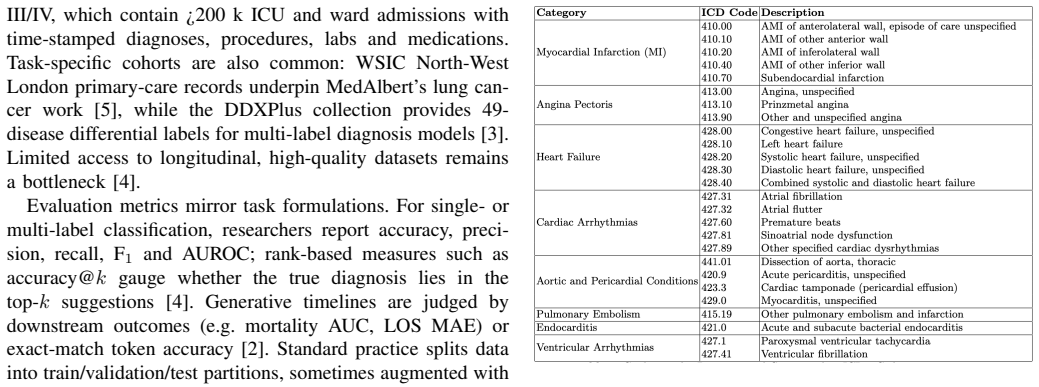
PRISM is a GPT-2-inspired decoder-only transformer with 6 layers, 8 attention heads, and 256-dimensional embeddings, trained with a causal language-modeling objective on tokenized timelines of 3,164 public electronic health record patients who presented with unspecified chest pain and later received a confirmed cardiac diagnosis. The tokenization pipeline converts six classes of events — demographics, admissions and discharges, laboratory results, outpatient measurements, microbiology cultures, and ICD-coded diagnoses — into text-like tokens, sorted first by timestamp and then by a fixed event precedence and alphabetical order. On a held-out validation split, the best checkpoint reaches cross-entropy 0.7000, corresponding to a perplexity of 2.01, which the authors interpret as narrowing a uniform 10,000-way choice to roughly two plausible next events and removing more than 92 percent of the sequence entropy. The paper also shows qualitative next-token generation examples in which the model emits clinically coherent continuations, such as serial cardiac biomarker testing after suspected acute coronary syndrome and a nephrology workup after elevated creatinine.
Load-bearing premise
The load-bearing premise is that the fixed, alphabetical tie-breaking order assigned to events recorded at the same timestamp reflects the true sequence of clinical decisions; if the real order is not sequential, the next-token task is partly learning the sorting rule rather than clinical reasoning.
Editorial extensions
If this is right
- Next-token probabilities can be used to rank candidate next diagnostic actions, enabling a top-k clinical decision-support list for chest-pain and cardiac workups.
- The trained model can generate synthetic patient trajectories that follow standard care pathways, providing material for medical education and for stress-testing downstream decision-support pipelines.
- The tokenized timeline representation yields a dense, contextual embedding of a patient's state, which can be reused for risk stratification, anomaly detection, or cohort comparison beyond next-token prediction.
- A validation perplexity of about 2 shows that much of the routine diagnostic workflow is regular and protocol-driven, so large deviations from predicted sequences can serve as flags for unusual or potentially unsafe care.
Reading between the lines
- The paper does not implement an n-gram, Markov, or recurrent baseline, so its implicit claim that a transformer is specifically needed for these sequences remains untested; a simple local baseline on the same tokens could plausibly match perplexity around 2 because clinical protocols are highly local.
- Because the deterministic tie-breaking sorts simultaneous events alphabetically, part of the predictive signal may come from the sorting rule itself; retraining with random tie orders would quantify how much of the reported perplexity reflects the ordering artifact the paper concedes in its third limitation.
- The cohort is restricted to patients who began with unspecified chest pain and ended with a cardiac diagnosis, so the claim about capturing complex longitudinal dependencies is demonstrated only within one narrow, protocol-heavy pathway; extending to diverse presentations and non-cardiac outcomes is an open question.
- If the next-token probabilities are shown to remain stable under perturbed event orderings, the model could be used not only to suggest next tests but to identify which historical events actually drive each suggestion, giving an explanation layer through attention weights.
Editorial analysis
A structured set of objections, weighed in public.
Referee Report
Summary. The paper introduces PRISM, a decoder-only transformer trained on tokenized MIMIC-IV clinical event sequences for patients whose trajectories begin with unspecified chest pain and progress to a confirmed cardiac diagnosis. The tokenization pipeline converts six event classes (demographics, admissions/discharges, labs, outpatient measurements, microbiology, and ICD diagnoses) into a 10,000-token vocabulary, with events sorted chronologically and, for simultaneous events, by a fixed event-type and alphabetical ordering. The model is trained with a causal language modeling objective and evaluated by next-token perplexity, attaining a validation perplexity of 2.01. The authors interpret this as a substantial improvement over a uniform random baseline and support the claim with three qualitative next-token generation examples. The paper explicitly acknowledges the limitations of its narrow cohort, the exclusion of procedures and medications, and the artificial ordering imposed on co-occurring events.
Significance. If the central claims were supported, the paper would demonstrate a useful proof-of-concept for applying generative language modeling to structured EHR data, with potential applications in decision support, simulation, and education. The work is clearly motivated, uses a publicly available dataset, and provides a transparent description of its tokenization and training pipeline. However, the current evidence is insufficient to establish the main claim: the only quantitative comparison is a uniform baseline, the generation results are qualitative and hand-picked, and the deterministic ordering of simultaneous events confounds clinical interpretation. The manuscript would be of significantly greater value if the evaluation included standard sequence-modeling baselines, test-set metrics, and a systematic assessment of generated sequences.
major comments (4)
- [Section IV.B (Table I) and Section IV.C] The only quantitative comparator is a uniform distribution over the 10,000-token vocabulary. In a cohort that is already homogeneous (chest pain progressing to cardiac disease; Section III) and whose tokenization imposes a fixed event-type order, a model that learns even the event template or the most frequent tests can outperform uniform random by a wide margin. The paper itself states that no n-gram or recurrent baselines were implemented. Reporting perplexity 2.01 against uniform therefore cannot support the central claims of 'substantial improvements' or capturing 'complex dependencies across longitudinal patient timelines.' Please add at least a trigram/Kneser-Ney baseline, an LSTM, or a frequency-based template model trained on the same tokenization and split.
- [Section III (Tokenization Strategy) and Discussion, limitation 3] The paper concedes that events sharing a timestamp were assigned a fixed deterministic order based on event type and alphabetical sorting, introducing an artificial ordinality. As a result, the next-token prediction task is partly a task of learning this sorting rule rather than genuine clinical decision-making. Please quantify this confound, for example by comparing against a permutation-invariant or set-based formulation (such as DPSS, cited as [10]), or by evaluating on shuffled orderings. The clinical-reasoning interpretation should be tempered unless this ordering effect is shown to be minor.
- [Section IV (Next-Token Generation Experiments)] The three scenarios in Figure 4 are interpreted narratively, with no quantitative scoring, no comparison with baseline-generated sequences, no error analysis, and no clinician evaluation. These hand-picked examples do not support the statement that PRISM 'internalizes complex clinical reasoning patterns.' Please supplement with automatic metrics (e.g., top-k accuracy on held-out continuations, repetition rate, diversity) or blinded clinician ratings, and report results over a representative sample of prompts rather than a hand-selected subset.
- [Section III (Training Procedure) and Section IV.B] The data were split 80/10/10, but only validation metrics are reported, and the best checkpoint is selected by validation loss. Without test-set perplexity, confidence intervals, or subject-level variability estimates, the reported 2.01 validation perplexity cannot be assessed for statistical significance. Given the relatively small cohort (3,164 patients) and 10,000-token vocabulary, please report test-set performance with uncertainty estimates.
minor comments (5)
- [Abstract and Section IV.C] The phrase 'random baselines' is used without specifying what the baseline is; clarify that it is a uniform distribution over the vocabulary and add a non-uniform baseline.
- [Figure 1 and Section II.C] There is a typo in the Figure 1 caption ('CARDIOV ASCULAR'), and the text '¿200 k' in Section II.C appears to be an encoding artifact that should be corrected.
- [References] Several references are anonymous preprints or non-archival sources (e.g., [1] is a company blog and [2]-[5] are anonymous); consider replacing them with peer-reviewed publications or providing full author and venue information.
- [Section IV.A] The text attributes the training/validation loss gap to 'dropout and weight decay,' but the Training Procedure section does not report dropout or weight-decay hyperparameters; please specify them.
- [Section III, Patient Selection] The statement that 'temporal ordering of events was verified using timestamped diagnosis records' should include the verification rule and how timestamp ties or inconsistencies were handled.
Circularity Check
No significant circularity: the central validation metric is measured on held-out data, and the acknowledged artificial ordering is a validity concern, not a circular reduction.
full rationale
The paper's central quantitative claim is a validation perplexity of 2.01 (Section IV.B, Table I), computed on a held-out split of tokenized MIMIC-IV patient timelines. This is not a fitted value: the model was randomly initialized, trained with cross-entropy loss, and evaluated on a separate validation set, so the perplexity reports genuine out-of-sample prediction under the authors' tokenization scheme. The only comparator is a uniform 10,000-way baseline (Section IV.C), and the paper explicitly notes that no n-gram or recurrent baselines were implemented; this is an evidentiary weakness in supporting the 'complex dependencies' claim, but it is not circularity because the metric is not constructed from the claim. The deterministic ordering of simultaneous events (Methods, Tokenization; Discussion, limitation 3) is acknowledged by the authors as introducing artificial ordinality, and it does mean the model partly learns the authors' imposed sort order rather than true clinical timing; however, this is a construct-validity limitation that the paper itself flags, not a derivation that reduces to its own inputs. The generated-sequence examples are hand-picked qualitative illustrations without quantitative scoring, but they are not used as a fitted input. No load-bearing self-citation chain or imported uniqueness theorem appears; the architecture is standard GPT-style, the tokenization is described in full, and the empirical evaluation is self-contained against an external public dataset. Accordingly, no circular step satisfying the required quote-and-reduction standard is present.
Assumptions & free parameters
free parameters (6)
- vocabulary size N =
10,000
- maximum sequence length =
512
- embedding dimension =
256
- number of decoder layers =
6
- learning rate =
5e-4
- epochs =
5
assumptions (4)
- standard math Transformer attention mechanisms can learn conditional dependencies between tokenized clinical events.
- domain assumption The deterministic chronological ordering of events by timestamp and alphabetical sorting faithfully represents the clinical decision process.
- domain assumption The filtered cohort of patients with unspecified chest pain followed by a cardiac diagnosis forms a coherent training signal for diagnostic trajectories.
- domain assumption Cross-entropy and perplexity on held-out tokens are meaningful proxies for clinical usefulness.
Cite this review
Pith. "Pith review of PRISM: A Transformer-based Language Model of Structured Clinical Event Data." pith.science (2026). https://pith.science/paper/K3BSUFBT
@misc{pith2026250611082,
  author       = {Pith},
  title        = {Pith review of: PRISM: A Transformer-based Language Model of Structured Clinical Event Data},
  year         = {2026},
  howpublished = {\url{https://pith.science/paper/K3BSUFBT}},
  note         = {Machine review of arXiv:2506.11082}
}
read the original abstract
We introduce PRISM (Predictive Reasoning in Sequential Medicine), a transformer-based architecture designed to model the sequential progression of clinical decision-making processes. Unlike traditional approaches that rely on isolated diagnostic classification, PRISM frames clinical trajectories as tokenized sequences of events - including diagnostic tests, laboratory results, and diagnoses - and learns to predict the most probable next steps in the patient diagnostic journey. Leveraging a large custom clinical vocabulary and an autoregressive training objective, PRISM demonstrates the ability to capture complex dependencies across longitudinal patient timelines. Experimental results show substantial improvements over random baselines in next-token prediction tasks, with generated sequences reflecting realistic diagnostic pathways, laboratory result progressions, and clinician ordering behaviors. These findings highlight the feasibility of applying generative language modeling techniques to structured medical event data, enabling applications in clinical decision support, simulation, and education. PRISM establishes a foundation for future advancements in sequence-based healthcare modeling, bridging the gap between machine learning architectures and real-world diagnostic reasoning.
Figures


Figures from the paper (1 more)

Reference graph
Works this paper leans on
-
[10]
Diag- nostic Prediction with Sequence-of-Sets Representation Learning for Clinical Events
Yue Zhang, Liwei Chen, and Debashis Ghosh. “Diag- nostic Prediction with Sequence-of-Sets Representation Learning for Clinical Events”. In: Proceedings of the ACM Conference on Health, Inference, and Learning . 2020
work page 2020
-
[1]
Transforming Disease Prediction with LotusAI-Predict: A Fine-Tuned LLaMA Model
Lotus Health AI. Transforming Disease Prediction with LotusAI-Predict: A Fine-Tuned LLaMA Model . https : //lotushealth.ai/blog/transforming- disease- prediction- with-lotusai-predict. Accessed 11 Apr 2025. 2025
work page 2025
-
[2]
A Transformer-Based Model for Zero- Shot Health Trajectory Prediction
Anonymous. “A Transformer-Based Model for Zero- Shot Health Trajectory Prediction”. In: medRxiv (2024). medRxiv: 2024.02.29.24303512
work page 2024
-
[3]
Automatic Differential Diagnosis using Transformer-Based Multi-Label Sequence Classification
Anonymous. “Automatic Differential Diagnosis Using Transformer-Based Multi-Label Sequence Classifica- tion”. In: arXiv preprint (2024). arXiv: 2408.15827
work page Pith review arXiv 2024
-
[4]
Sequential Diagnosis Prediction with Transformer and Ontological Representation
Anonymous. “Sequential Diagnosis Prediction with Transformer and Ontological Representation”. In: IEEE Journal of Biomedical and Health Informatics (2023). Accessed 11 Apr 2025
work page 2023
-
[5]
Transformer-Based Deep Learning Model for the Diagnosis of Lung Cancer in Primary Care
Anonymous. “Transformer-Based Deep Learning Model for the Diagnosis of Lung Cancer in Primary Care”. In: npj Digital Medicine (2024). Accessed 11 Apr 2025
work page 2024
-
[6]
Variational probabilistic inference and the QMR-DT network
Tommi S Jaakkola and Michael I Jordan. “Variational probabilistic inference and the QMR-DT network”. In: Journal of artificial intelligence research 10 (1999), pp. 291–322
work page 1999
-
[7]
MIMIC-IV, a freely ac- cessible electronic health record dataset
Alistair E. W. Johnson et al. “MIMIC-IV, a freely ac- cessible electronic health record dataset”. In: Scientific Data 10.1 (2023), pp. 1–18. DOI: 10.1038/s41597-022- 01899-x. URL: https://www.nature.com/articles/s41597- 022-01899-x
Show all 10 references
-
[8]
Artificial Intelligence and Internet of Things Enabled Disease Diagnosis Model for Smart Healthcare Systems
Romany Fouad Mansour et al. “Artificial Intelligence and Internet of Things Enabled Disease Diagnosis Model for Smart Healthcare Systems”. In: IEEE Access 9 (2021), pp. 45137–45146. DOI: 10.1109/ACCESS. 2021.3066365
2021
-
[9]
Empirical evalua- tion of performance degradation of machine learning- based predictive models–A case study in healthcare information systems
Zachary Young and Robert Steele. “Empirical evalua- tion of performance degradation of machine learning- based predictive models–A case study in healthcare information systems”. In: International Journal of Information Management Data Insights 2.1 (2022), p. 100070
2022
Reviewed August 7, 2026 · model on record in the stance chip above.
Discussion (0). Sign in to comment.