REVIEW 3 major objections 6 minor 87 references
DBNets2.0: simulation-based inference for planet-induced dust substructures in protoplanetary discs
T0 review · 3 major / 6 minor · reviewed 2026-08-07 · deepseek-v4-flash
Pith's one-line read This paper shows that a single dust-continuum image of a protoplanetary disc gap can be mapped to a calibrated four-dimensional posterior over planet mass, disc viscosity, scale height, and dust Stokes number.
desk verdict A genuinely useful SBI pipeline with well-calibrated posteriors on synthetic data; the population-level planet masses rest on a single-planet model that the paper's own confidence score cannot flag. read the letter →
The pith
A machine-rendered reading of the paper's core claim, the machinery that carries it, and where it could break.
The reading
What carries the argument
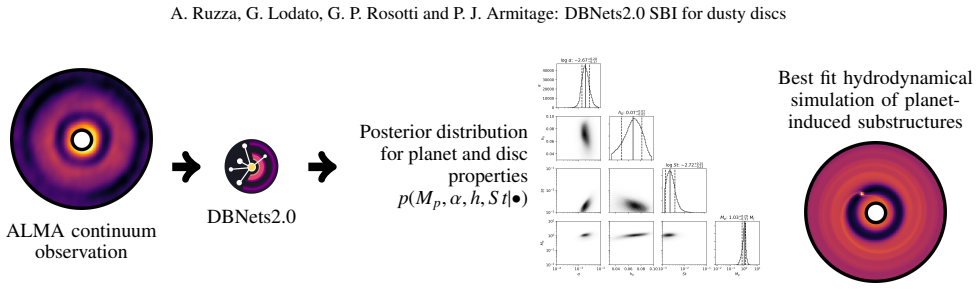
The pipeline is a CNN-plus-normalizing-flow architecture: a convolutional network turns the input image (with its resolution as an extra conditioning input) into low-dimensional summary statistics, and masked autoregressive flows perform neural posterior estimation on those summaries. The CNN is trained with augmentation that randomizes beam size and outer disc boundary, which is what makes the tool's accuracy independent of observational resolution; Monte Carlo dropout generates 1500 summary-statistic samples per image, and a confidence score built on Fourier-domain comparison with the training set provides a recommended rejection threshold of 0.6.
What would settle it
Create two-planet synthetic observations with the same FARGO3D setup and known masses, run DBNets2.0, and check the confidence scores: the paper already reports that all such images score above the recommended 0.6 threshold, so a corrected confidence metric that actually rejects these out-of-model images — or, alternatively, a PDS 70 run whose planet-mass posterior brackets the directly measured companion masses — would settle whether the reliability claims hold.
Extended reading notes
Core claim
The central claim is that DBNets2.0, a two-stage simulation-based inference pipeline, produces well-calibrated posteriors for the planet-to-star mass ratio $M_p/M_\star$, the disc $\alpha$-viscosity, the aspect ratio $h$, and the dust Stokes number $St$ from a single ALMA dust continuum image of a disc with substructure. The first stage is a CNN that compresses each image, together with its beam size, into a set of summary statistics via Monte Carlo dropout; the second stage is an ensemble of masked autoregressive normalizing flows that learn the posterior $p(M_p, \alpha, h, St \mid x, b)$. On a held-out synthetic test set the full four-dimensional posteriors pass a TARP coverage test, with the planet mass recovered most precisely. Applied to 49 observed gaps in 34 discs, the tool infers generally low viscosities and scale heights, and planet masses below one Jupiter mass in 83% of cases.
Load-bearing premise
Everything rests on the training-set premise that each observed gap is carved by exactly one planet in a locally isothermal, viscous disc with pressureless dust and no feedback, self-gravity, migration or accretion; the paper's own test shows the confidence score cannot flag two-planet systems, so if real gaps are multi-planet or non-planar, the inferred masses and disc properties are not reliable.
Editorial extensions
If this is right
- A single ALMA image of a gap can be converted into a calibrated four-dimensional posterior, so degeneracies such as the planet-mass–viscosity correlation are exposed rather than hidden inside a point estimate.
- Independent constraints on one disc property, such as a measured $\alpha$, can be folded in as a prior; the paper demonstrates a roughly 15% reduction in planet-mass error and uncertainty when $\alpha$ is constrained this way.
- The 49-gap survey implies low local viscosities and long viscous timescales, and a planet population that is 83% sub-Jupiter, which explains why direct imaging surveys have mostly failed to detect these putative planets.
- Because the tool is public and returns full posteriors rather than point estimates, it can be re-run with different priors or applied to new observations without retraining.
Reading between the lines
- The systematic offset the paper finds between local $\alpha$ inferred from gap morphology and global accretion-based viscous timescales, if it survives selection effects, is evidence for an additional angular-momentum-loss channel such as disc winds; the paper notes this possibility but stops short of making it a quantitative claim.
- The confidence score's failure to reject two-planet synthetic images — all scores stay above the recommended 0.6 threshold — suggests that the tool as designed cannot detect the most likely alternative to the single-planet model, so a multi-planet extension or a joint posterior over multiple gaps is needed before multi-gap discs are fitted independently.
- A natural validation that the paper does not perform explicitly is to run DBNets2.0 on PDS 70, whose two embedded planets have direct mass measurements, and check whether the inferred mass posteriors bracket those measurements; the paper's published PDS 70 estimate is consistent, but a dedicated validation with updated masses would tighten the test.
- The same summary-statistics-plus-normalizing-flows recipe could be applied to other disc observables, such as gas kinematics or scattered-light polarization, wherever a forward simulator exists; that template is implicit in the paper's design but not pursued.
Editorial analysis
A structured set of objections, weighed in public.
Referee Report
Summary. This paper presents DBNets2.0, a simulation-based inference pipeline that compresses ALMA-like dust continuum images with a CNN and fits the four-dimensional posterior p(Mp, alpha, h, St | x) with normalizing flows. The training and test data are single-planet FARGO3D simulations with a locally isothermal gas and pressureless dust, augmented with noise, beam convolution, and masking. The authors validate on a held-out synthetic test set with TARP coverage tests, rmse/r2 metrics, and three posterior predictive checks; they then apply the pipeline to 49 gaps in 34 observed discs and report generally low alpha, low h, and a population with 83% masses below 1 MJ.
Significance. The central methodological contribution is solid: the 4D TARP curve is well calibrated (ks-pval 0.999), the planet-mass rmse is 0.07 in normalized units, the code is public, and the paper is honest about many limitations. If the validation transfers to real observations, the tool will be useful for interpreting dust substructures and for Bayesian integration of external constraints such as direct imaging limits. The main limitation is that this transfer is not demonstrated: the confidence-score metric fails to flag the paper's own two-planet simulations, and the observational population results depend on a single-planet model that real discs may violate.
major comments (3)
- [Appendix A.1 / Sect. 6] The two-planet test in Fig. A.4 shows that every two-planet image receives a confidence score above the recommended 0.6 threshold, and Table E.1 shows that all 49 real observations also score above 0.6. Since Sect. 6 interprets each of these observations as a single embedded planet, the confidence score does not protect the results against the most likely excluded scenario, multiple planets per gap. I acknowledge the caveats in Sect. 3.4 and 8, but the abstract and Sect. 6 present the 83% sub-Jupiter population without this qualification. Please either add an OOD test that demonstrates measurable degradation on two-planet systems or explicitly rephrase the Sect. 6 population results as conditional on the single-planet model.
- [Sect. 4.1 / Sect. 3.1] The test-set size is stated inconsistently: Sect. 3.1 reports 534 test observations, while Sect. 4.1 reports that 900 synthetic observations were selected for the test set. Please clarify that the 534 are the filtered subset of the 900 snapshots from the 300 held-out simulations, and state explicitly that no snapshot from a simulation contributing to the training or validation folds appears in the test set. Without this clarification, the reported TARP and rmse results cannot be independently verified against leakage between snapshots of the same simulation.
- [Sect. 3.1 / Sect. 4.2] The validation is entirely in-distribution: the test simulations use the same hydrodynamics code, the same single-planet and locally isothermal assumptions, and the same LHS parameter ranges as the training simulations. A calibrated posterior under this forward model does not by itself quantify the risk that real gaps were not generated by that model. The confidence score was intended to address this, but its two-planet test does not flag the excluded scenario. Please make the model-conditional nature of the Sect. 6 inferences explicit in the abstract and conclusions, or provide a quantitative OOD validation (e.g., coverage or posterior error on two-planet and non-planar simulations) that bounds the misspecification error for the real-data claims.
minor comments (6)
- [Sect. 4.2, Eq. (5)] The r2-score definition is missing squared terms in the printed equation; as written it is 1 - Sum(theta - theta_hat)/Sum(theta - theta_bar), which is dimensionally inconsistent and not the standard coefficient of determination. Please correct it to 1 - Sum(theta - theta_hat)^2 / Sum(theta - theta_bar)^2.
- [Sect. 4.2] The description of TARP curve shapes appears reversed: an overconfident posterior typically gives ECP below the diagonal for all alpha_TARP, whereas an underconfident posterior gives ECP above the diagonal at low alpha_TARP. Please check the wording.
- [Sect. 3.3] The stopping criterion for the normalizing-flow training ('no longer improve') should specify the patience and the validation metric used, to make the procedure reproducible.
- [Sect. 7.2] The simulated external priors in the constraint-integration test are unbiased by construction (their means are drawn around the true value of the constrained property), so the reported improvements are optimistic relative to real external constraints that may be biased; please state this caveat explicitly.
- [Appendix A] The confidence score uses linear interpolation on the training images as a surrogate for simulations; this makes the score sensitive to training-set density and interpolation details. A sentence describing the interpolation scheme and its limitations should be added.
- [Fig. 16 / Table E.1] The caption of Fig. 16 refers to 'HD14266', which does not match the object 'HD 142666' in Table E.1; please correct the typo.
Circularity Check
No circularity: the SBI pipeline is trained and tested under the stated forward model; self-citations are data-source references, and the two-planet confidence-score failure is a robustness limitation, not a circular reduction.
full rationale
The derivation chain is self-contained with respect to the paper's actual claims. The posterior estimator is trained on a forward model stated explicitly in Sect. 3.1 (FARGO3D simulations with one planet, locally isothermal equation of state, pressureless dust, and no migration, accretion, self-gravity, or dust feedback), and its accuracy is measured on a held-out test set of 300 additional simulations that is never used for hyperparameter tuning (Sect. 4.1). The TARP test (Sect. 4.2) is an external calibration criterion from Lemos et al. 2023a; the reported ks-pval = 0.999 is a measured outcome, not an identity forced by construction, and no fitted parameter is renamed as a prediction. The CNN and normalizing flows are trained by minimizing MSE and negative log-likelihood (Eqs. 2 and 3), and the rmse/r2 metrics are evaluated on held-out synthetic observations, so the accuracy claim is an empirical benchmark internal to the model family rather than a circular prediction. Citations to Ruzza et al. 2024 are data-source and comparison citations; the physical assumptions are restated in this paper rather than imported as an unverified uniqueness or ansatz result. The paper itself flags the key limitations: Sect. 3.4 states that the inferred distributions 'cannot account for scenarios which are not included in our model, e.g. presence of other planets,' and Appendix A.1 shows that all two-planet simulations receive confidence scores above the recommended 0.6 threshold while conceding that the metric 'cannot point out degeneracies with OOD systems.' These are model-misspecification and robustness limitations that weaken the real-data population claims in Sect. 6, but they do not make any derived quantity equal to an input by the paper's own equations. Accordingly, no circular step can be exhibited and the appropriate circularity score is 0.
Assumptions & free parameters
free parameters (4)
- Training parameter priors =
log-uniform alpha in [1e-4,1e-2], St in [1e-3,1e-1], Mp in [1e-5,1e-2]; linear h in [0.03,0.1]
- MC dropout rate =
0.20
- Augmentation Gaussian noise variance =
0.1
- Confidence score rejection threshold =
0.6
assumptions (4)
- ad hoc to paper Each dust substructure is caused by a single embedded planet in a locally isothermal viscous disc.
- domain assumption Dust is a pressureless fluid subject to gas drag, without dust feedback, self-gravity, planet migration, or accretion.
- domain assumption The CNN summary statistics are sufficient statistics for the four target parameters.
- standard math TARP coverage is a valid necessary-and-sufficient probe of posterior accuracy for this finite test set.
Cite this review
Pith. "Pith review of DBNets2.0: simulation-based inference for planet-induced dust substructures in protoplanetary discs." pith.science (2026). https://pith.science/paper/R5ETDSXG
@misc{pith2026250611200,
  author       = {Pith},
  title        = {Pith review of: DBNets2.0: simulation-based inference for planet-induced dust substructures in protoplanetary discs},
  year         = {2026},
  howpublished = {\url{https://pith.science/paper/R5ETDSXG}},
  note         = {Machine review of arXiv:2506.11200}
}
abstract
Dust substructures in protoplanetary discs can be signatures of embedded young planets whose detection and characterisation would provide a better understanding of planet formation. Traditional techniques used to link substructures' morphology to the properties of putative embedded planets present several limitations that the use of deep learning methods has partly overcome. In our previous work, we developed DBNets, a tool exploiting an ensemble of Convolutional Neural Networks (CNNs) to estimate the mass of putative planets in disc dust substructures. This inference problem, however, is degenerate as planets of different masses could produce the same rings and gaps if other physical disc properties were different. In this paper, we address this issue improving our simulation-based inference pipeline to estimate the full posterior distribution for the planet mass and three additional disc properties: the disc $\alpha$-viscosity, the scale height and the dust Stokes number. We also address some minor issues of our previous tool. The new pipeline involves a CNN that summarises the input images in a set of summary statistics, followed by an ensemble of normalising flows that model the inferred posterior for the target properties. We tested our pipeline on a dedicated set of synthetic observations using the TARP test and standard metrics, demonstrating its accuracy and precision. Additionally, we use the results obtained on the test set to study the degeneracies between pairs of parameters. Finally, we apply the developed pipeline to a set of 49 gaps in 34 protoplanetary discs' continuum observations. The results show typically low values of $\alpha$-viscosity, disc scale heights, and planet masses, with 83% of them being lower than 1M$_J$. These low masses are consistent with the non-detections of these putative planets in direct imaging surveys. Our tool is publicly available.
Figures


Figures from the paper (10 more)



Reference graph
Works this paper leans on
-
[1]
2015, TensorFlow: Large-Scale Machine Learning on Heterogeneous Distributed Systems
Abadi, M., Agarwal, A., Barham, P., et al. 2015, TensorFlow: Large-Scale Machine Learning on Heterogeneous Distributed Systems
2015
-
[2]
M., Huang, J., P \' e rez, L
Andrews, S. M., Huang, J., P \' e rez, L. M., et al. 2018, ApJL, 869, L41
2018
-
[3]
M., Wilner, D
Andrews, S. M., Wilner, D. J., Zhu, Z., et al. 2016, AJ, 820, L40
2016
-
[4]
2021, A & A, 652, A101
Asensio-Torres, R., Henning, T., Cantalloube, F., et al. 2021, A & A, 652, A101
2021
-
[5]
Auddy , S., Dey , R., Lin , M.-K., Carrera , D., & Simon , J. B. 2022, , 936, 93
2022
-
[6]
Auddy, S., Dey, R., Lin, M.-K., & Hall, C. 2021
2021
-
[7]
& Lin, M.-K
Auddy, S. & Lin, M.-K. 2020, AJ, 900, 62
2020
-
[8]
2023, in Astronomical Society of the Pacific Conference Series, Vol
Bae , J., Isella , A., Zhu , Z., et al. 2023, in Astronomical Society of the Pacific Conference Series, Vol. 534, Protostars and Planets VII, ed. S. Inutsuka , Y. Aikawa , T. Muto , K. Tomida , & M. Tamura , 423
2023
Show all 87 references
-
[9]
L., & Previn-Ratnasingam, R
Barge, P., Ricci, L., Carilli, C. L., & Previn-Ratnasingam, R. 2017, A & A, 605, A122
2017
-
[10]
2019, MNRAS, 486, 304
Baruteau, C., Barraza, M., P \' e rez, S., et al. 2019, MNRAS, 486, 304
2019
-
[11]
2021, ApJL, 916, L2
Benisty, M., Bae, J., Facchini, S., et al. 2021, ApJL, 916, L2
2021
-
[12]
Ben \' i tez-Llambay, P., Krapp, L., & Pessah, M. E. 2019, AJ Supplement Series, 241, 25
2019
-
[13]
& Masset, F
Benitez-Llambay, P. & Masset, F. S. 2016, AJ Supplement Series, 223, 11
2016
-
[14]
2015, Keras
Chollet et al., F. 2015, Keras
2015
-
[15]
2019, ApJL, 877, L33
Christiaens, V., Cantalloube, F., Casassus, S., et al. 2019, ApJL, 877, L33
2019
-
[16]
J., Tazzari, M., Juhasz, A., et al
Clarke, C. J., Tazzari, M., Juhasz, A., et al. 2018, AJ, 866, L6
2018
-
[17]
2022, Nat
Currie, T., Lawson, K., Schneider, G., et al. 2022, Nat. Astron., 6, 751
2022
-
[18]
& Laibe, G
Dipierro, G. & Laibe, G. 2017, MNRAS, 469, 1932
2017
-
[19]
2015, MNRAS: Letters, 453, L73
Dipierro, G., Price, D., Laibe, G., et al. 2015, MNRAS: Letters, 453, L73
2015
-
[20]
& Fung, J
Dong, R. & Fung, J. 2017, AJ, 835, 146
2017
-
[21]
2018, AJ, 866, 110
Dong, R., Li, S., Chiang, E., & Li, H. 2018, AJ, 866, 110
2018
-
[22]
Duffell, P. C. & Macfadyen, A. I. 2013, AJ, 769, 41
2013
-
[23]
Dullemond, C. P. & Penzlin, A. B. T. 2018, A & A, 609, A50
2018
-
[24]
2020, A & A, 639, A121
Facchini, S., Benisty, M., Bae, J., et al. 2020, A & A, 639, A121
2020
-
[25]
2023, A & A, 672
Fedele, D., Bollati, F., & Lodato, G. 2023, A & A, 672
2023
-
[26]
2018, A & A, 610, A24
Fedele, D., Tazzari, M., Booth, R., et al. 2018, A & A, 610, A24
2018
-
[27]
M., Simon, J
Flaherty, K., Hughes, A. M., Simon, J. B., et al. 2020, AJ, 895, 109
2020
-
[28]
M., Simon, J
Flaherty, K., Hughes, A. M., Simon, J. B., et al. 2024, MNRAS, 532, 363
2024
-
[29]
M., Hughes, A
Flaherty, K. M., Hughes, A. M., Rosenfeld, K. A., et al. 2015, AJ, 813, 99
2015
-
[30]
2019, J R Stat Soc Ser A Stat Soc), 182, 389
Gabry, J., Simpson, D., Vehtari, A., Betancourt, M., & Gelman, A. 2019, J R Stat Soc Ser A Stat Soc), 182, 389
2019
-
[31]
& Ghahramani, Z
Gal, Y. & Ghahramani, Z. 2015
2015
-
[32]
2019, A & A, 623, A140
Gratton, R., Ligi, R., Sissa, E., et al. 2019, A & A, 623, A140
2019
-
[33]
Y., Bohn, A
Haffert, S. Y., Bohn, A. J., de Boer, J., et al. 2019, Nat. Astron., 3, 749
2019
-
[34]
J., et al
Hammond, I., Christiaens, V., Price, D. J., et al. 2023, MNRAS: Letters, 522, L51
2023
-
[35]
2021, AJ, 911, 5
Hashimoto, J., Muto, T., Dong, R., et al. 2021, AJ, 911, 5
2021
-
[36]
Hawley, J. F. 2001, AJ, 554, 534
2001
-
[37]
2016, in 2016 IEEE Conference on Computer Vision and Pattern Recognition (CVPR, 1
He , K., Zhang , X., Ren , S., & Sun , J. 2016, in 2016 IEEE Conference on Computer Vision and Pattern Recognition (CVPR, 1
2016
-
[38]
2019, , 885, 36
Hu , X., Zhu , Z., Okuzumi , S., et al. 2019, , 885, 36
2019
-
[39]
M., Dullemond, C
Huang, J., Andrews, S. M., Dullemond, C. P., et al. 2020 a , AJ, 891, 48
2020
-
[40]
M., \" O berg, K
Huang, J., Andrews, S. M., \" O berg, K. I., et al. 2020 b , AJ, 898, 140
2020
-
[41]
2019, AJ, 879, L25
Isella, A., Benisty, M., Teague, R., et al. 2019, AJ, 879, L25
2019
-
[42]
2016, PRL, 117, 251101
Isella, A., Guidi, G., Testi, L., et al. 2016, PRL, 117, 251101
2016
-
[43]
D., Muto, T., Tanaka, H., et al
Kanagawa, K. D., Muto, T., Tanaka, H., et al. 2016, PASJ, 68, 43
2016
-
[44]
D., Tanaka, H., Muto, T., Tanigawa, T., & Takeuchi, T
Kanagawa, K. D., Tanaka, H., Muto, T., Tanigawa, T., & Takeuchi, T. 2015, MNRAS, 448, 994
2015
-
[45]
& Gal, Y
Kendall, A. & Gal, Y. 2017, Advances in Neural Information Processing Systems, 2017-December, 5575
2017
-
[46]
2019, A & A, 625, A118
Keppler, M., Teague, R., Bae, J., et al. 2019, A & A, 625, A118
2019
-
[47]
2020, AJ, 888, 72
Kim, S., Takahashi, S., Nomura, H., et al. 2020, AJ, 888, 72
2020
-
[48]
2021, arXiv e-prints, arXiv:2110.04286
Le Folgoc , L., Baltatzis , V., Desai , S., et al. 2021, arXiv e-prints, arXiv:2110.04286
2021 arXiv
-
[49]
2023 a , 40th International Conference on Machine Learning, 202, 19256
Lemos , P., Coogan , A., Hezaveh , Y., & Perreault-Levasseur , L. 2023 a , 40th International Conference on Machine Learning, 202, 19256
2023
-
[50]
H., Hahn , C., et al
Lemos , P., Parker , L. H., Hahn , C., et al. 2023 b , in Machine Learning for Astrophysics, 18
2023
-
[51]
2019, MNRAS, 486, 453
Lodato, G., Dipierro, G., Ragusa, E., et al. 2019, MNRAS, 486, 453
2019
-
[52]
2022, MNRAS, 518, 4481
Lodato, G., Rampinelli, L., Viscardi, E., et al. 2022, MNRAS, 518, 4481
2022
-
[53]
J., et al
Long, F., Pinilla, P., Herczeg, G. J., et al. 2018, AJ, 869, 17
2018
-
[54]
2025, ApJL, 984, L17
Longarini, C., Lodato, G., Rosotti, G., et al. 2025, ApJL, 984, L17
2025
-
[55]
F., Ansdell, M., Rosotti, G
Manara, C. F., Ansdell, M., Rosotti, G. P., et al. 2023, ASPC, 534, 539
2023
-
[56]
F., Testi, L., Natta, A., et al
Manara, C. F., Testi, L., Natta, A., et al. 2014, A & A, 568, A18
2014
-
[57]
2023, ApJL, 950, L12
Mao, S., Dong, R., Lu, L., et al. 2023, ApJL, 950, L12
2023
-
[58]
M., et al
Mao , S., Dong , R., Yi , K. M., et al. 2024, , 976, 200
2024
-
[59]
2021, MNRAS, 503, 5100
Marino, S. 2021, MNRAS, 503, 5100
2021
-
[60]
2024, A & A, 686, A9
Martire, P., Longarini, C., Lodato, G., et al. 2024, A & A, 686, A9
2024
-
[61]
2019, A & A, 632, A25
Mesa, D., Keppler, M., Cantalloube, F., et al. 2019, A & A, 632, A25
2019
-
[62]
A., Clarke, C
Nazari, P., Booth, R. A., Clarke, C. J., et al. 2019, MNRAS, 485, 5914
2019
-
[63]
L., De Rosa, R
Nielsen, E. L., De Rosa, R. J., Macintosh, B., et al. 2019, AJ, 158, 13
2019
-
[64]
I., Guzm \'a n , V
\"O berg , K. I., Guzm \'a n , V. V., Walsh , C., et al. 2021, , 257, 1
2021
-
[65]
2023, ASPC, 534, 567
Pascucci, I., Cabrit, S., Edwards, S., et al. 2023, ASPC, 534, 567
2023
-
[66]
2019, AJ, 158, 15
P \' e rez, S., Casassus, S., Baruteau, C., et al. 2019, AJ, 158, 15
2019
-
[67]
2019, Nat
Pinte, C., van der Plas, G., M \' e nard, F., et al. 2019, Nat. Astron., 3, 1109
2019
-
[68]
R., Chauvin, G., et al
Reggiani, M., Meyer, M. R., Chauvin, G., et al. 2016, A & A, 586, A147
2016
-
[69]
Rosotti, G. P. 2023, New Astron. Rev., 96, 101674
2023
-
[70]
P., Juhasz, A., Booth, R
Rosotti, G. P., Juhasz, A., Booth, R. A., & Clarke, C. J. 2016, MNRAS, 459, 2790
2016
-
[71]
Ruzza, A., Lodato, G., & Rosotti, G. P. 2024, A & A, 685, A65
2024
-
[72]
E., Clarke, C
Scardoni, C. E., Clarke, C. J., Rosotti, G. P., et al. 2022, MNRAS, 514, 5478
2022
-
[73]
2016, A & A, 592, A49
Teague, R., Guilloteau, S., Semenov, D., et al. 2016, A & A, 592, A49
2016
-
[74]
Tejero-Cantero, A., Boelts, J., Deistler, M., et al. 2020, J. Open Source Softw., 5, 2505
2020
-
[75]
2020, MNRAS, 499, 2015
Toci, C., Lodato, G., Christiaens, V., et al. 2020, MNRAS, 499, 2015
2020
-
[76]
2019, AJ, 888, L4
Toci, C., Lodato, G., Fedele, D., Testi, L., & Pinte, C. 2019, AJ, 888, L4
2019
-
[77]
E., van Dishoeck, E
van Terwisga, S. E., van Dishoeck, E. F., Ansdell, M., et al. 2018, A & A, 616, A88
2018
-
[78]
2020, in European Planetary Science Congress, 2020--398
Veronesi, B., Ragusa, E., Lodato, G., et al. 2020, in European Planetary Science Congress, 2020--398
2020
-
[79]
2021, A & A, 651, A72
Vigan, A., Fontanive, C., Meyer, M., et al. 2021, A & A, 651, A72
2021
-
[80]
B., Close, L
Wagner, K., Follette, K. B., Close, L. M., et al. 2018, ApJL, 863, L8
2018
-
[81]
L., Ruffio , J.-B., Ruane , G., et al
Wallack , N. L., Ruffio , J.-B., Ruane , G., et al. 2024, , 168, 78
2024
-
[82]
D., & Suto, Y
Wang, S., Kanagawa, K. D., & Suto, Y. 2021, AJ, 923, 165
2021
-
[83]
2018, AJ, 869, L47
Zhang, S., Zhu, Z., Huang, J., et al. 2018, AJ, 869, L47
2018
-
[84]
2022, MNRAS, 510, 4473
Zhang, S., Zhu, Z., & Kang, M. 2022, MNRAS, 510, 4473
2022
-
[85]
P., Wagner, K
Zhou, Y., Bowler, B. P., Wagner, K. R., et al. 2021, AJ, 161, 244
2021
-
[86]
, " * write output.state after.block = add.period write newline
ENTRY address archiveprefix author booktitle chapter edition editor howpublished institution eprint journal key month note number organization pages publisher school series title type volume year label extra.label sort.label short.list INTEGERS output.state before.all mid.sent...
-
[87]
write newline
" write newline "" before.all 'output.state := FUNCTION n.dashify 't := "" t empty not t #1 #1 substring "-" = t #1 #2 substring "--" = not "--" * t #2 global.max substring 't := t #1 #1 substring "-" = "-" * t #2 global.max substring 't := while if t #1 #1 substring * t #2 gl...
Reviewed August 7, 2026 · model on record in the stance chip above.
Discussion (0). Continue with ORCID to comment.