REVIEW 3 major objections 5 minor 66 references
Manifestation of quantum entanglement between harmonic oscillators in de Sitter
T0 review · 3 major / 5 minor · reviewed 2026-08-07 · deepseek-v4-flash
Pith's one-line read In de Sitter spacetime, two harmonic oscillators exchanging a massless scalar field become entangled at late times only when they lie within the Hubble horizon and oscillate at a rate comparable to the expansion rate of the universe.
desk verdict A timely question and a clean flat-spacetime limit, but the central late-time concurrence rests on an unjustified analytic continuation of a divergent integral. read the letter →
The pith
A machine-rendered reading of the paper's core claim, the machinery that carries it, and where it could break.
The reading
What carries the argument
The argument is carried by the effective two-oscillator Hamiltonian obtained after tracing out the scalar field, which in cosmological coordinates takes the form $\hat{H}^{(t)}_{AB} = \frac{\sqrt{3}\,m^2}{8\pi\, a(t)\,d} \exp\!\left(-|x_{0i}|\, a(t)\,d\,H\right)$, where $a(t) = e^{Ht}$ is the scale factor and $d$ the coordinate separation. The exponential factor, whose argument is the ratio of the proper distance to the Hubble radius, is what suppresses entanglement for distant or fast oscillators. The late-time concurrence follows from a Gamma-function integral, $\Gamma(-1 + 2i\Omega/H)$, produced by the change of variable $u = |x_{0i}| d H e^{Ht'}$ in the time integral for the excitation amplitude.
What would settle it
Compute the integral in Eq. (36) numerically with a finite lower cutoff $t_0$ (as the finite duration of the de Sitter phase requires) and check whether it approaches the continued Gamma-function expression as $t_0 \to -\infty$; if the finite-time result differs materially from Eq. (38), the asymptotic claim fails. Alternatively, re-derive the interaction Hamiltonian retaining the $\hat{T}_{00}\hat{T}_{11}$ terms to see whether the exponential damping factor in Eq. (30) survives a more complete non-relativistic reduction.
Extended reading notes
Core claim
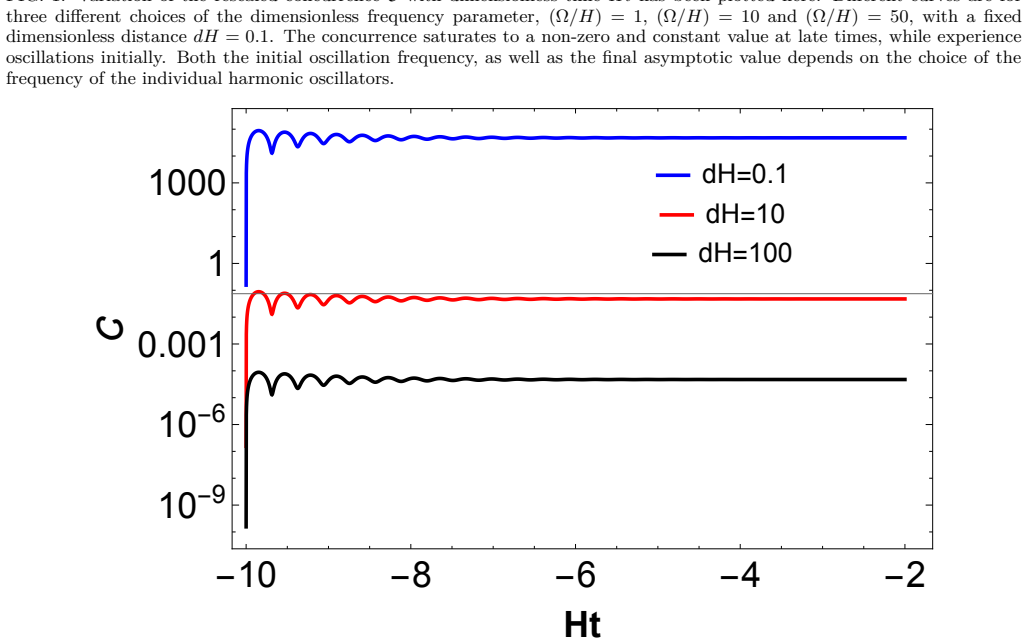
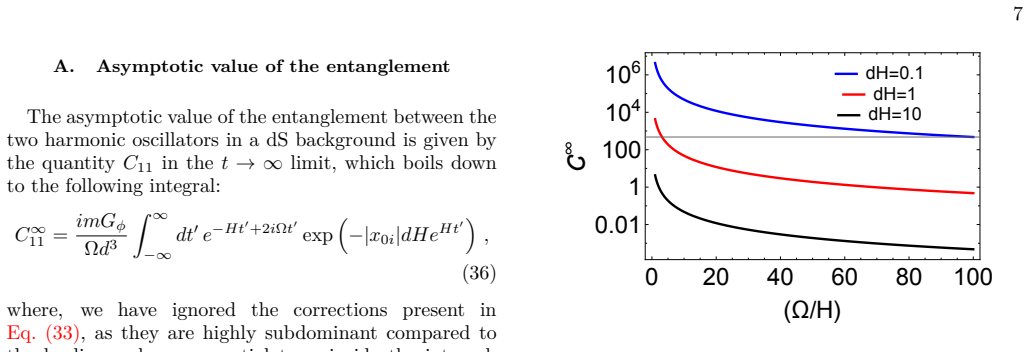
The central claim is that in de Sitter spacetime, two identical harmonic oscillators interacting through a massless scalar field acquire a late-time concurrence that is non-zero and significant for $\Omega \sim H$ and $dH \ll 1$, and negligible for $\Omega \gg H$ or $dH \gg 1$. The asymptotic concurrence is given by $C_\infty = \frac{|x_{0i}|}{\Omega (Hd)^2} \left[ \frac{2\pi H/\Omega}{\sinh(2\pi \Omega/H)} \left(1 + \frac{4\Omega^2}{H^2}\right) \right]^{1/2}$, where $H$ is the de Sitter expansion rate, $\Omega$ the oscillator frequency, $d$ the coordinate separation, and $x_{0i}$ a constant root of $x^2 = -(\sqrt{3}-1)/2$ on the positive imaginary axis. The same evolution holds for graviton exchange with the coupling constant shifted by Newton's constant, so the result also bears on probing the quantum nature of gravity in a cosmological setting.
Load-bearing premise
The late-time concurrence is obtained by analytically continuing an integral that diverges as the lower time limit goes to minus infinity; if that analytic continuation is not valid, the asymptotic concurrence formula is not defined.
Editorial extensions
If this is right
- For oscillators with $\Omega \sim H$ and $d \lesssim H^{-1}$, the late-time concurrence is non-negligible; for $\Omega \gg H$ it decays roughly as $\sqrt{H/\Omega}\, e^{-\pi\Omega/H}$, and for $d \gg H^{-1}$ it decays as $(dH)^{-2}$.
- In the flat-space limit $H \to 0$, the concurrence reduces to $\approx (2mG_\phi/\Omega d^3)\,\sin(\Omega t/2)$, matching earlier results for scalar-mediated entanglement.
- Because the de Sitter phase of the actual universe has finite duration, the exact late-time result involves an incomplete Gamma function; the closed form of Eq. (38) is the infinite-duration limit.
- Graviton exchange between the oscillators leads to the same concurrence evolution, with the coupling $G_\phi$ replaced by $G_\phi + G_N$.
- High-frequency modes of cosmological perturbations, such as those observed in the cosmic microwave background, would have effectively undetectable entanglement, while low-frequency sub-horizon modes might retain significant entanglement.
Reading between the lines
- The exponential damping factor in the interaction Hamiltonian suggests that any cosmological background with a scale factor growing faster than de Sitter would suppress late-time entanglement even more strongly; a direct extension would be to repeat the computation for power-law or other inflationary geometries.
- The analytic continuation of the divergent late-time integral to $\Gamma(-1 + 2i\Omega/H)$ is the most fragile step; a numerical evaluation of Eq. (36) with a finite lower cutoff, as the authors themselves note is realistic, would reveal whether the asymptotic formula is robust or an artefact of continuation.
- The treatment neglects back-reaction of the oscillators on the scalar-field mode functions; including this could modify the effective Hamiltonian at late times and hence the entanglement saturation value.
Editorial analysis
A structured set of objections, weighed in public.
Referee Report
Summary. The paper studies two identical harmonic oscillators, separated by a fixed coordinate distance d in a de Sitter background, interacting through a massless scalar field. After expressing the scalar field in conformal coordinates and using second-order perturbation theory to integrate out the scalar, the authors obtain a time-dependent interaction Hamiltonian H_AB (Eq. (30)) that decays exponentially in proper distance. They then compute the concurrence of the two-oscillator state, evaluate its late-time limit in Eq. (38), and conclude that entanglement is significant when Ω∼H and d≲H^{-1}, and negligible when Ω≫H or d≫H^{-1}.
Significance. The question addressed is interesting and timely: extending entanglement-based tests of quantum interactions to expanding spacetimes could provide a new observational window. The paper's compact analytic framework and the explicit flat-space consistency check (H→0) are assets. If Eq. (38) were rigorously established, the predicted scaling C∞∼(Ω/H)^{-2} for Ω≪H and exponential suppression for Ω≫H would be a concrete falsifiable target. However, the central derivation is not currently sound: the late-time integral is divergent and its value is assigned by analytic continuation, the contour choice in Sec. III builds in the decaying behavior that is later used as the main physical conclusion, and the reduced Hamiltonian in Eq. (24) relies on instantaneous energy denominators without a controlled adiabatic or in-in justification. These are not presentation issues; they concern the existence and meaning of the central result.
major comments (3)
- [Sec. IV.A, Eqs. (36)-(38)] The integral in Eq. (36) diverges at the lower limit t'→-∞: with u=|x0i|dH e^{Ht'}, the leading integrand behaves as u^{-2+2iΩ/H} e^{-u} near u=0, and ∫_0^∞ u^{-2+2iΩ/H} e^{-u} du does not converge. Replacing it by Γ(-1+2iΩ/H) is an analytic continuation, not an evaluation. A finite lower cutoff changes the value and the result is cutoff-dependent as the cutoff is removed, so the asymptotic concurrence in Eq. (38) is not defined by the derivation. The remark that the de Sitter phase is finite does not fix this; the finite-time incomplete Gamma function is plotted but never shown to approach Eq. (38) in a controlled limit.
- [Sec. III, after Eq. (28)] The real-axis poles are excluded because an oscillatory Hamiltonian 'does not make sense physically', and the contour is chosen to yield exponential decay. This is close to assuming the main qualitative conclusion (that the interaction decays with growing proper distance) before deriving it. The contour prescription should be derived from a definite propagator choice in the field-theoretic reduction, or the final result should be shown to be independent of the prescription; otherwise the exponential factor in Eq. (30) is partly put in by hand.
- [Sec. III, Eq. (24)] The reduction to the two-oscillator Hamiltonian uses second-order perturbation theory with instantaneous energy denominators E0-Ek for a time-dependent background. Since the scalar field Hamiltonian and its eigenstates depend on η, and H_int(η) does not define a stationary transition between field eigenstates, Eq. (24) needs an explicit justification (e.g., slow variation of the background, or an in-in/Schrödinger-picture derivation). Without this, the derivation of Eqs. (27)-(30) is not self-contained.
minor comments (5)
- [Eq. (1)] The two oscillators are both written at -d/2; the second position should be +d/2.
- [Sec. III, before Eq. (15)] The word 'Besel' should be 'Bessel' in the sentence introducing the mode functions.
- [Eq. (32)] The final state is written with C00=1, but the perturbation also generates a correction to the |00⟩ amplitude; the normalization should be carried consistently or this approximation should be stated explicitly.
- [Figs. 1-3] The vertical axes are not labeled in the figures; the captions should define the rescaled concurrence and its asymptotic value.
- [Abstract] The abstract contains a grammatical error ('with their frequencies are comparable'); it should read 'with their frequencies comparable to'.
Circularity Check
No significant circularity: the concurrence is derived from a first-principles interaction Hamiltonian and first-order perturbation theory, with no fitted parameters and no load-bearing self-citation.
full rationale
The derivation chain is self-contained. The scalar field is quantized on de Sitter with the Bunch-Davies vacuum (Eqs. 12-15); the matter-field interaction is introduced through the standard A_int = ∫ d^4x √(-g) φ T^μν g_μν (Eq. 19), citing the authors' earlier [35] but not relying on any unverified uniqueness claim; the effective two-oscillator Hamiltonian is computed in Eqs. (24)-(30) within the paper. The retarded-contour choice at Eqs. (28)-(30) is a physical boundary condition (causal decay with proper distance), not a parameter fitted to the desired answer; it does not by construction determine the frequency dependence, the (dH)^{-2} prefactor, or the significant-entanglement region Ω∼H, d≲H^{-1}, which emerge from the Gamma-function expression in Eqs. (36)-(38). The time-dependent perturbation theory and concurrence measure are standard and applied, not tuned. The flat-spacetime limit is checked against [35], which is consistency, not input. The two flagged concerns are not circularity: (i) the physically motivated contour choice imports an expectation of decay, but that is a standard causal prescription, and (ii) the asymptotic integral in Eq. (36) diverges at t'→-∞ and Eq. (37) uses Γ(-1+2iΩ/H) as an analytic continuation; this is an unstated regularization/rigor gap, not a reduction of the prediction to its inputs. The paper itself notes the finite dS phase means the lower limit should be finite, and only plots incomplete-Gamma behavior without proving convergence to Eq. (38); that weakens support but does not make the derivation circular.
Assumptions & free parameters
assumptions (6)
- domain assumption The two oscillators are point-like, with energy-momentum tensor given by Eq. (21): T_hat_mu_nu = p_hat_mu p_hat_nu / (sqrt(-g) p0) times [delta^3(x-xA) + delta^3(x-xB)].
- domain assumption The scalar field is massless and initially in the Bunch-Davies vacuum, with mode functions Eq. (15).
- ad hoc to paper The scalar-mediated interaction between the oscillators can be obtained from instantaneous second-order perturbation theory, Eq. (24), even though H_int is time-dependent.
- ad hoc to paper The pole prescription in Eq. (28) is the retarded one, dropping the real-axis poles to avoid an oscillatory Hamiltonian.
- ad hoc to paper The divergent late-time integral Eq. (36) is assigned the value Gamma(-1 + 2 i Omega / H) by analytic continuation.
- domain assumption Only the T00 T00 component is kept in the non-relativistic limit; T01 and T11 contributions are dropped.
Cite this review
Pith. "Pith review of Manifestation of quantum entanglement between harmonic oscillators in de Sitter." pith.science (2026). https://pith.science/paper/7IZKJNKV
@misc{pith2026250611422,
  author       = {Pith},
  title        = {Pith review of: Manifestation of quantum entanglement between harmonic oscillators in de Sitter},
  year         = {2026},
  howpublished = {\url{https://pith.science/paper/7IZKJNKV}},
  note         = {Machine review of arXiv:2506.11422}
}
read the original abstract
Two harmonic oscillators interacting through the exchange of a quantum field leads to non-zero entanglement between the two, which is absent for classical interaction. In this work, we determine the entanglement between two such harmonic oscillators living in an expanding universe. It turns out that, if the oscillators are within the Hubble horizon, with their frequencies are comparable to the rate of expansion of the universe, the entanglement is non-zero and significant. While, for oscillators outside the Hubble horizon, with oscillation frequencies much higher than the expansion rate, the entanglement is negligibly small.
Figures

Reference graph
Works this paper leans on
-
[1]
M. Horodecki, P. Horodecki, and R. Horodecki, Physics Letters, Section A: General, Atomic and Solid State Physics 223 (1996), 10.1016/S0375-9601(96)00706-2
-
[2]
P. Calabrese and J. Cardy, Journal of Statistical Me- chanics: Theory and Experiment (2004), 10.1088/1742- 5468/2004/06/P06002
doi:10.1088/1742- 2004
-
[3]
H. Casini and M. Huerta, J. Phys. A42, 504007 (2009), arXiv:0905.2562 [hep-th]
arXiv 2009
-
[4]
M. A. Metlitski, C. A. Fuertes, and S. Sachdev, Phys. Rev. B80, 115122 (2009), arXiv:0904.4477 [cond- mat.stat-mech]
work page Pith review arXiv 2009
-
[5]
M. P. Hertzberg, Journal of Physics A: Mathematical and Theoretical 46, 015402 (2013)
work page 2013
-
[6]
S. Seki, I. Y. Park, and S. J. Sin, Physics Letters, Sec- tion B: Nuclear, Elementary Particle and High-Energy Physics 743 (2015), 10.1016/j.physletb.2015.02.028
- [7]
-
[8]
H. Casini and M. Huerta, PoST ASI2021, 002 (2023), arXiv:2201.13310 [hep-th]
arXiv 2023
Show all 66 references
- [10]
-
[11]
S.FedidaandA.Serafini,PhysicalReviewD 107,116007 (2023)
2023
-
[12]
Fedida, A
S. Fedida, A. Mazumdar, S. Bose, and A. Serafini, Phys. Rev. D 109, 065028 (2024), arXiv:2401.10332 [hep-th]
2024
-
[13]
Casini, M
H. Casini, M. Huerta, and R. C. Myers, JHEP05, 036 (2011), arXiv:1102.0440 [hep-th]
2011 arXiv
-
[14]
Rangamani and T
M. Rangamani and T. Takayanagi, Holographic Entanglement Entropy , Vol. 931 (Springer, 2017) arXiv:1609.01287 [hep-th]
2017 arXiv
-
[15]
J. D. Bekenstein, Phys. Rev. D23, 287 (1981)
1981
-
[16]
Bombelli, R
L. Bombelli, R. K. Koul, J. Lee, and R. D. Sorkin, Phys. Rev. D 34, 373 (1986)
1986
-
[17]
Srednicki, Phys
M. Srednicki, Phys. Rev. Lett.71, 666 (1993), arXiv:hep- th/9303048
1993
-
[18]
’t Hooft, Conf
G. ’t Hooft, Conf. Proc. C930308, 284 (1993), arXiv:gr- qc/9310026
1993
-
[19]
Balasubramanian, M
V. Balasubramanian, M. B. McDermott, and M. Van Raamsdonk, Phys. Rev. D 86, 045014 (2012), arXiv:1108.3568 [hep-th]
2012 arXiv
-
[20]
Peschanski and S
R. Peschanski and S. Seki, Physics Letters, Section B: Nuclear, Elementary Particle and High-Energy Physics 758 (2016), 10.1016/j.physletb.2016.04.063
2016 doi
-
[21]
Peschanski and S
R. Peschanski and S. Seki, Physical Review D 100, 076012 (2019)
2019
-
[22]
A. Bose, P. Haldar, A. Sinha, P. Sinha, and S. Tiwari, SciPost Physics 9, 081 (2020)
2020
- [23]
-
[24]
U. K. B. Vinckers, A. de la Cruz-Dombriz, and A. Mazumdar, Phys. Rev. D 107, 124036 (2023), arXiv:2303.17640 [gr-qc]
2023 arXiv
-
[25]
S. Bose, A. Mazumdar, G. W. Morley, H. Ulbricht, M. Toroš, M. Paternostro, A. Geraci, P. Barker, M. S. Kim, and G. Milburn, Phys. Rev. Lett. 119, 240401 (2017), arXiv:1707.06050 [quant-ph]
2017 arXiv
-
[26]
Bose, https://www.youtube.com/watch?v= 0Fv-0k13s_k (2016), accessed 1/11/22
S. Bose, https://www.youtube.com/watch?v= 0Fv-0k13s_k (2016), accessed 1/11/22
2016
-
[27]
Marletto and V
C. Marletto and V. Vedral, Phys. Rev. Lett.119, 240402 (2017)
2017
-
[28]
R. J. Marshman, A. Mazumdar, and S. Bose, Phys. Rev. A 101, 052110 (2020), arXiv:1907.01568 [quant-ph]
2020 arXiv
-
[29]
Carney, P
D. Carney, P. C. E. Stamp, and J. M. Taylor, Class. Quant. Grav. 36, 034001 (2019)
2019
-
[30]
S. Bose, A. Mazumdar, M. Schut, and M. Toroš, Phys. Rev. D 105, 106028 (2022), arXiv:2201.03583 [gr-qc]
2022 arXiv
-
[31]
Biswas, S
D. Biswas, S. Bose, A. Mazumdar, and M. Toroš, Phys. Rev. D 108, 064023 (2023), arXiv:2209.09273 [gr-qc]
2023 arXiv
- [32]
-
[33]
S. G. Elahi and A. Mazumdar, Phys. Rev. D108, 035018 (2023), arXiv:2303.07371 [gr-qc]
2023 arXiv
-
[34]
Hanif, D
F. Hanif, D. Das, J. Halliwell, D. Home, A. Mazumdar, H. Ulbricht, and S. Bose, Phys. Rev. Lett.133, 180201 (2024), arXiv:2307.08133 [gr-qc]
2024 arXiv
-
[35]
Chakraborty, A
S. Chakraborty, A. Mazumdar, and R. Pradhan, Phys. Rev. D 108, L121505 (2023), arXiv:2310.06899 [gr-qc]
2023 arXiv
-
[36]
D. L. Danielson, G. Satishchandran, and R. M. Wald, Physical Review D105, 086001 (2022)
2022
-
[37]
J. J. Halliwell, Phys. Lett. B196, 444 (1987)
1987
-
[38]
R. H. Brandenberger, R. Laflamme, and M. Mijic, Mod. Phys. Lett. A5, 2311 (1990). 9
1990
-
[39]
Albrecht, P
A. Albrecht, P. Ferreira, M. Joyce, and T. Prokopec, Phys. Rev. D50, 4807 (1994), arXiv:astro-ph/9303001
1994 arXiv
-
[40]
Polarski and A
D. Polarski and A. A. Starobinsky, Class. Quant. Grav. 13, 377 (1996), arXiv:gr-qc/9504030
1996 arXiv
-
[41]
Calzetta and B
E. Calzetta and B. L. Hu, Phys. Rev. D52, 6770 (1995), arXiv:gr-qc/9505046
1995 arXiv
-
[42]
Lesgourgues, D
J. Lesgourgues, D. Polarski, and A. Starobinsky, Nuclear Physics B 497, 479–508 (1997)
1997
-
[43]
Kiefer, D
C. Kiefer, D. Polarski, and A. A. Starobinsky, Int. J. Mod. Phys. D7, 455 (1998), arXiv:gr-qc/9802003
1998 arXiv
-
[44]
Nambu, Physics Letters B276, 11 (1992)
Y. Nambu, Physics Letters B276, 11 (1992)
1992
-
[45]
Barvinsky, A
A. Barvinsky, A. Kamenshchik, C. Kiefer, and I. Mishakov, Nuclear Physics B551, 374 (1999)
1999
-
[46]
Kiefer, I
C. Kiefer, I. Lohmar, D. Polarski, and A. A. Starobin- sky, Class. Quant. Grav. 24, 1699 (2007), arXiv:astro- ph/0610700
2007
-
[47]
Martineau, Class
P. Martineau, Class. Quant. Grav. 24, 5817 (2007), arXiv:astro-ph/0601134
2007 arXiv
-
[48]
Martin, V
J. Martin, V. Vennin, and P. Peter, Phys. Rev. D86, 103524 (2012), arXiv:1207.2086 [hep-th]
2012 arXiv
-
[49]
Martin and V
J. Martin and V. Vennin, JCAP 05, 063 (2018), arXiv:1801.09949 [astro-ph.CO]
2018 arXiv
-
[50]
Martin, A
J. Martin, A. Micheli, and V. Vennin, JCAP 04, 051 (2022), arXiv:2112.05037 [quant-ph]
2022 arXiv
-
[51]
Burgess, T
C. Burgess, T. Colas, R. Holman, G. Kaplanek, and V. Vennin, Journal of Cosmology and Astroparticle Physics 2024, 042 (2024)
2024
-
[52]
C. P. Burgess, T. Colas, R. Holman, and G. Ka- planek, Journal of High Energy Physics 2025 (2025), 10.1007/jhep02(2025)204
2025 doi
-
[53]
C. P. Burgess, R. Holman, and D. Hoover, Phys. Rev. D 77, 063534 (2008)
2008
- [54]
-
[55]
Colas, J
T. Colas, J. Grain, and V. Vennin, Europhysics Letters 142, 69002 (2023)
2023
-
[56]
Brahma, O
S. Brahma, O. Alaryani, and R. Brandenberger, Phys. Rev. D 102, 043529 (2020), arXiv:2005.09688 [hep-th]
2020 arXiv
-
[57]
Quantum signatures and de- coherence during inflation from deep subhorizon pertur- bations,
F. Lopez and N. Bartolo, “Quantum signatures and de- coherence during inflation from deep subhorizon pertur- bations,” (2025), arXiv:2503.23150 [astro-ph.CO]
2025 arXiv
-
[58]
False and genuine decoherence in the early universe: a local observer and time-averaged observables,
F. Sano and J. Tokuda, “False and genuine decoherence in the early universe: a local observer and time-averaged observables,” (2025), arXiv:2504.10472 [hep-th]
2025 arXiv
-
[59]
R. N. Raveendran and S. Chakraborty, Gen. Rel. Grav. 56, 55 (2024), arXiv:2302.02584 [astro-ph.CO]
2024 arXiv
-
[60]
Rajeev, S
K. Rajeev, S. Chakraborty, and T. Padmanabhan, Phys. Rev. D 100, 045019 (2019), arXiv:1904.03207 [gr-qc]
2019 arXiv
-
[61]
Rajeev, S
K. Rajeev, S. Chakraborty, and T. Padmanabhan, Gen. Rel. Grav. 50, 116 (2018), arXiv:1712.06617 [gr-qc]
2018 arXiv
-
[62]
Rajeev, S
K. Rajeev, S. Chakraborty, and T. Padmanabhan, Eur. Phys. J. C78, 836 (2018), arXiv:1712.06621 [gr-qc]
2018 arXiv
-
[63]
W. K. Wootters, Physical Review Letters 80 (1998), 10.1103/PhysRevLett.80.2245
1998 doi
-
[64]
Hill and W
S. Hill and W. K. Wootters, Physical Review Letters78 (1997), 10.1103/PhysRevLett.78.5022
1997 doi
-
[65]
Rungta, V
P. Rungta, V. Bužek, C. M. Caves, M. Hillery, and G. J. Milburn, Physical Review A 64 (2001), 10.1103/phys- reva.64.042315
2001 doi
-
[66]
Mukhanov, H
V. Mukhanov, H. Feldman, and R. Brandenberger, Physics Reports 215, 203 (1992)
1992
-
[67]
Ashoorioon, P
A. Ashoorioon, P. S. Bhupal Dev, and A. Mazumdar, Mod. Phys. Lett. A29, 1450163 (2014), arXiv:1211.4678 [hep-th]
2014 arXiv
Reviewed August 7, 2026 · model on record in the stance chip above.
Discussion (0). Sign in to comment.