REVIEW 4 major objections 5 minor 1 cited by
In-Plane Ni-O-Ni Bond Angles as Structural Fingerprints of Superconductivity in Layered Nickelates: Effects of Pressure, Strain, Layering, and Correlations
T0 review · 4 major / 5 minor · reviewed 2026-08-07 · deepseek-v4-flash
Pith's one-line read In-plane Ni-O-Ni bond angles correlate with the superconducting dome in layered nickelates and can serve as a structural proxy for Tc.
desk verdict The central bond-angle/Tc proxy is likely a relaxation artifact: the claimed I4/mmm phase cannot have an in-plane Ni-O-Ni angle of 177°, so the computed dome is internally inconsistent. read the letter →
The pith
A machine-rendered reading of the paper's core claim, the machinery that carries it, and where it could break.
The reading
What carries the argument
The central object is the in-plane Ni-O-Ni bond angle, the angle formed by a Ni-O-Ni linkage within a NiO2 plane. The argument is carried by the way this angle responds to pressure, strain, layering, and Hubbard U: it straightens as octahedral tilting is suppressed, peaks at the structural transition, and bends again at higher pressure, forming a dome that correlates with the measured Tc dome. The associated phase transition from orthorhombic Amam to tetragonal I4/mmm, where the out-of-plane angle locks to 180 degrees, marks the optimal in-plane geometry, and the evolution of this in-plane angle is what the authors propose as a proxy for superconductivity.
What would settle it
High-pressure X-ray or neutron diffraction that resolves the in-plane Ni-O-Ni bond angle in La3Ni2O7 across the full superconducting pressure window: if the angle does not peak and then decline at the same pressures as Tc, the bond-angle fingerprint is falsified.
Extended reading notes
Core claim
The central claim is that the in-plane Ni-O-Ni bond angle in La3Ni2O7 and related layered nickelates is a structural fingerprint of superconductivity: under hydrostatic pressure the angle increases from about 169 degrees at ambient conditions to a maximum of about 177 degrees near the structural transition from orthorhombic Amam to tetragonal I4/mmm at roughly 15 GPa, then decreases at higher pressures, producing a dome that matches the experimentally observed Tc dome with its maximum near 83 K. Under compressive biaxial strain the angle straightens to a maximum near 2% strain, the strain at which ambient-pressure superconductivity has been reported in thin films, and the maximum angle is more bent than under optimal pressure, consistent with a lower Tc. The authors extend the same analysis to the monolayer-trilayer (1-3) polymorph of La3Ni2O7, trilayer La4Ni3O10, and Pr-substituted Pr3Ni2O7, finding that extra layers and heavier rare earths raise the pressure required to reach the optimal straight-bond configuration. They further find that increasing the Hubbard U delays the structural transition and stabilizes high-spin states, so moderate correlation strength appears optimal for superconductivity, while stronger correlation prevents the bond geometry associated with superconductivity from forming.
Load-bearing premise
The load-bearing premise is that the ferromagnetic state is a faithful stand-in for the actual magnetic state of the material in the pressure range of interest; if the real material is antiferromagnetic there, the computed bond-angle dome shifts by 5-10 GPa and the correlation with Tc would be anchored to the wrong magnetic reference.
Editorial extensions
If this is right
- The in-plane Ni-O-Ni bond angle can be used as a computational screening criterion: a candidate nickelate whose calculated bond-angle dome peaks near the experimentally known Tc maximum is a promising superconductor, without needing to compute pairing itself.
- Epitaxial compressive strain of about 2% on a suitable substrate should reproduce a favorable bond geometry at ambient pressure, though with a lower Tc than the pressure-optimized bulk compound.
- Syntheses targeting higher Tc should avoid heavier A-site rare earths and thicker perovskite stacks unless higher pressure is applied, since both raise the pressure at which bond straightening occurs.
- Correlation strength is a tuning knob: materials with very strong on-site Coulomb interactions resist the structural transition, so optimal superconductivity may require a moderate U regime rather than the largest possible correlation.
- The pressure window for superconductivity is set by the structural phase transition: the maximum in-plane bond angle coincides with the orthorhombic-to-tetragonal transition, so structural measurements at pressure can bracket the superconducting dome.
Reading between the lines
- If the bond-angle proxy holds, it could be used to map candidate phases before synthesis: computing the pressure and strain dependence of the in-plane angle for new nickelate families would give a first-pass estimate of the thermodynamic conditions required for superconductivity, a protocol the paper does not itself claim to establish.
- The bond-angle dome may be a common structural signature linking nickelate and cuprate superconductivity, since cuprates also exhibit a doping-driven structural transition near the superconducting dome; the paper does not develop this cross-family comparison.
- The ferromagnetic-proxy assumption points to a concrete experiment: determining the true magnetic ground state of La3Ni2O7 under pressure would validate or invalidate the structural fingerprint, because the dome shifts by 5-10 GPa in antiferromagnetic calculations.
- The strain result implies a testable prediction: growing La3Ni2O7 films on substrates delivering 2-3% compressive strain and measuring both the in-plane bond angle and Tc should show a systematic correlation across different substrates, a test the paper does not report.
Editorial analysis
A structured set of objections, weighed in public.
Referee Report
Summary. The manuscript uses DFT+U to study the structural evolution of bilayer La3Ni2O7 and related nickelates under hydrostatic pressure and epitaxial strain. It reports that the in-plane Ni-O-Ni bond angle exhibits a dome-shaped pressure dependence that the authors compare visually with the experimentally measured Tc dome, and they propose this angle as a structural proxy for superconductivity. The paper also examines the effects of Hubbard U, magnetic ordering, layer count, and Pr substitution, and predicts that approximately 2% compressive strain produces bond straightening consistent with recent thin-film experiments.
Significance. If the proposed correlation is quantitatively robust and free of structural artifacts, the in-plane Ni-O-Ni angle would be a cheap, useful descriptor for optimizing pressure, strain, and chemistry in layered nickelates. The computational campaign is systematic, covering multiple pressures, U values from 0 to 5 eV, three antiferromagnetic configurations, two La3Ni2O7 polymorphs, trilayer La4Ni3O10, and Pr3Ni2O7; the U=0 and U=2 calculations reproduce the experimentally reported ~15 GPa transition pressure of bilayer La3Ni2O7. However, the central correlation is currently qualitative, is calibrated on the same experimental data it claims to predict, and rests on a structural assignment that is internally inconsistent with the reported in-plane bond-angle dome. These issues must be resolved before the proxy can be considered established.
major comments (4)
- [Structural Analysis; Fig. 3(b)] The central structural result is internally inconsistent: Fig. 3(b) reports a dome in the in-plane Ni-O-Ni angle with a maximum of about 177 degrees near the pressure where the structure is assigned to I4/mmm, yet in I4/mmm the in-plane oxygen sits at the midpoint between Ni atoms and this angle is pinned at exactly 180 degrees by symmetry. A 177 degree value implies residual in-plane octahedral rotation and a lower-symmetry space group (e.g., P4/mbm), not I4/mmm. The authors should identify the actual space group of the relaxed structures with a symmetry finder, tighten the force/energy thresholds and k-mesh, and either show that the in-plane angle is 180 degrees in the high-pressure phase or revise the space-group assignment. With the present data, the dome-shaped angle-pressure curve and the Tc correlation may be numerical artifacts.
- [Fig. 1; Structural Analysis] The claim of a strong correlation with the experimental Tc dome is supported only by an overlay of computed angles and digitized experimental Tc values. No quantitative correlation coefficient, error bars, or sensitivity analysis are reported, and the same experimental dataset (Ref. 7) is used both to identify the correlation and to validate it, so the agreement is circular as a test of predictive power. The authors should quantify the correlation (e.g., Pearson or Spearman with uncertainties from digitization and structural relaxation) and test the proxy on conditions not used for calibration, such as the strained thin-film data of Ref. 42 or the Pr/trilayer compounds if Tc data become available.
- [Antiferromagnetic Ordering Effect; Figs. 6(c)-6(f)] The use of the ferromagnetic state as a proxy for the paramagnetic state is load-bearing for the reported 15 GPa transition and the associated bond-angle dome. At U=2 eV, AFM-A and AFM-G shift the transition to about 20 GPa and AFM-C to about 25 GPa, while at U=0 eV AFM-C and AFM-G also require higher pressures than FM. The paper gives no evidence that La3Ni2O7 is ferromagnetic in the pressure range of interest, and Ref. 43 concerns NdNiO3 rather than this nickelate. The authors should either justify the FM approximation for this material with a dedicated paramagnetic or noncollinear calculation, or show that the dome structure, after rescaling pressure, is robust across magnetic configurations.
- [Compressive Strain Effect; Fig. 9] The prediction of a significantly lower Tc in strained films is an inference from the lower peak bond angle at about 2% strain compared with the hydrostatic-pressure peak. No quantitative mapping from bond angle to Tc is established, because the correlation is qualitative even under pressure, and the strain calculations include no uncertainty estimates or comparison with a second experimental strain value. Either provide a quantitative angle-Tc relationship or soften the claim to a qualitative trend.
minor comments (5)
- [Table 1 and accompanying text] The text says the dz2 eigenvalue decreases from 1.35 to 1.44 and dx2-y2 from 1.34 to 1.45, but both numbers increase; clarify the intended statement (e.g., 'increase in occupation' rather than 'decrease').
- [Figure captions] The Fig. 3 caption refers to 'Figure 1d' but should refer to 'Figure 2d', and the Fig. 8 caption contains a typo ('representts') and an incomplete parenthetical.
- [Computational Methods] 'cell dofreeparameter' should be 'cell_dofree parameter'; please also state whether the strain calculations include any residual hydrostatic pressure component and provide pseudopotential identifiers or input-file availability for reproducibility.
- [Magnetic-configuration nomenclature] The notation for antiferromagnetic configurations is inconsistent: AFM-A, AFM-C, and AFM-G appear in the text and Fig. 5 caption, while A-AFM, C-AFM, and G-AFM appear elsewhere; please unify.
- [Fig. 1] The experimental Tc dataset should specify the pressure range and whether Tc values are onsets, midpoints, or zero-resistance values, and the figure should be cited in the main text at the point of comparison.
Circularity Check
No significant circularity: the computed bond-angle dome is derived from DFT+U relaxations without Tc input, and the correlation with the experimental Tc dome is a post-hoc comparison rather than a fitted prediction.
full rationale
The central quantity, the in-plane Ni-O-Ni bond angle as a function of pressure and strain, is obtained from DFT+U variable-cell relaxations starting from a Materials Project structure. The energy functional, relaxation procedure, and structural outputs contain no experimental Tc data; the experimental Tc dome is introduced only afterward for comparison. The dome shape of the in-plane angle is reported at all U values and for several magnetic orderings, so it is not a one-parameter fit to the Tc dome. The choice of U=2 eV is justified by agreement with the experimental transition pressure and magnetic-moment collapse, but the angle-vs-pressure dome is not constructed from that agreement. The strain and layer-count statements are applications of the computed structural trends, not circular redefinitions: 'optimal' strain is defined by the computed angle maximum and then compared with an independent experimental report. The FM state as a proxy for the paramagnetic state is an approximation supported by an external citation (Ref 43), and the paper explicitly quantifies how AFM order shifts the transition pressure; this is a stated limitation, not a circular step. No load-bearing self-citations, imported uniqueness theorems, or ansatz-smuggling citations from the authors' prior work are present. The skeptical concern about the in-plane angle reaching only 177° in a claimed I4/mmm structure is a physical-consistency question about the relaxation results, not an instance of the derivation reducing to its own inputs. Accordingly, no circular step meeting the quotation-and-reduction standard can be identified, and the score is 0.
Assumptions & free parameters
free parameters (1)
- Hubbard U =
2 eV (tested 0-5 eV)
assumptions (4)
- domain assumption DFT+U with ultrasoft pseudopotentials and a 40 Ry cutoff is sufficiently accurate for the structural properties of layered nickelates.
- domain assumption The ferromagnetic state is used as a proxy for the paramagnetic state.
- domain assumption The experimental Tc dome from reference 7 is an accurate benchmark for superconductivity in La3Ni2O7.
- ad hoc to paper The in-plane Ni-O-Ni bond angle is directly associated with superconductivity and can be used as a proxy.
Cite this review
Pith. "Pith review of In-Plane Ni-O-Ni Bond Angles as Structural Fingerprints of Superconductivity in Layered Nickelates: Effects of Pressure, Strain, Layering, and Correlations." pith.science (2026). https://pith.science/paper/V4YKBFVV
@misc{pith2026250611427,
  author       = {Pith},
  title        = {Pith review of: In-Plane Ni-O-Ni Bond Angles as Structural Fingerprints of Superconductivity in Layered Nickelates: Effects of Pressure, Strain, Layering, and Correlations},
  year         = {2026},
  howpublished = {\url{https://pith.science/paper/V4YKBFVV}},
  note         = {Machine review of arXiv:2506.11427}
}
abstract
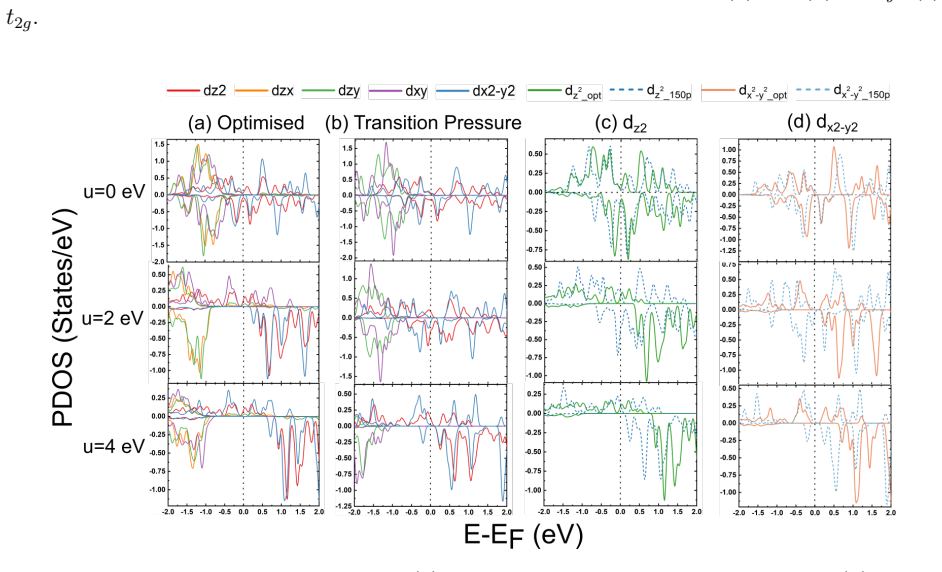
We investigate the structural and electronic conditions conducive to superconductivity in layered nickelates using density functional theory with Hubbard corrections (DFT+$U$). For both the bilayer and 1-3 polymorphs of La$_3$Ni$_2$O$_7$, we find that the in-plane Ni-O-Ni bond angles under pressure strongly correlate with the experimentally observed superconducting transition temperature ($T_c$) dome, and may serve as a reasonable proxy. Under compressive strain, the bond angles straighten, peaking near 2\% strain-consistent with experimental reports of superconductivity in strained bilayer thin films. However, the bond angles at this strain are more bent than those achieved under hydrostatic pressure, correlating with a lower $T_c$. We show that increasing the number of NiO$_2$ layers, as in La$_4$Ni$_3$O$_{10}$, or substituting heavier rare-earth elements (e.g., Pr) raises the pressure required to reach the structural configuration associated with superconductivity. Our results indicate that these systems require higher external pressure to achieve in-plane bond straightening. Varying the on-site Coulomb interaction $U$ reveals that stronger electronic correlations delay the structural transition and favor high-spin states. This suggests that moderate correlation strength may be optimal for superconductivity, with stronger correlation preventing the formation of favorable bond geometries. Electronic structure analysis shows that the Ni $e_g$ orbitals dominate near the Fermi level and shift downward with pressure, enhancing Ni-O hybridization. These results highlight how pressure and strain tune structural features that may be essential for engineering high-$T_c$ phases in nickelate superconductors.
Figures


Figures from the paper (10 more)



Forward citations
Cited by 1 Pith paper
-
Superexchanges and Charge Transfer in the La$_3$Ni$_2$O$_7$ Thin Films
In La3Ni2O7 thin films, the interlayer d3z2-r2 antiferromagnetic coupling is about 27% weaker than in bulk, in-plane coupling is nearly unchanged, and hole/electron doping is particle-hole asymmetric.
Reference graph
Works this paper leans on
-
[1]
Y.; Osada, M.; Crossley, S.; Lee, H
Li, D.; Lee, K.; Wang, B. Y.; Osada, M.; Crossley, S.; Lee, H. R.; Cui, Y.; Hikita, Y.; Hwang, H. Y. Superconductivity in an infinite-layer nickelate. Nature 2019, 572, 624--627
work page 2019
-
[2]
Osada, M.; Wang, B. Y.; Goodge, B. H.; Lee, K.; Yoon, H.; Sakuma, K.; Li, D.; Miura, M.; Kourkoutis, L. F.; Hwang, H. Y. A superconducting praseodymium nickelate with infinite layer structure. Nano letters 2020, 20, 5735--5740
work page 2020
-
[3]
Osada, M.; Wang, B. Y.; Goodge, B. H.; Harvey, S. P.; Lee, K.; Li, D.; Kourkoutis, L. F.; Hwang, H. Y. Nickelate superconductivity without rare-earth magnetism:(La, Sr) NiO2. Advanced Materials 2021, 33, 2104083
work page 2021
-
[4]
E.; Cao, Y.; Zhang, Z.; Tang, C
Zeng, S.; Li, C.; Chow, L. E.; Cao, Y.; Zhang, Z.; Tang, C. S.; Yin, X.; Lim, Z. S.; Hu, J.; Yang, P.; others Superconductivity in infinite-layer nickelate La1- xCaxNiO2 thin films. Science advances 2022, 8, eabl9927
work page 2022
-
[5]
A.; Ferenc Segedin, D.; LaBollita, H.; Song, Q.; Nica, E
Pan, G. A.; Ferenc Segedin, D.; LaBollita, H.; Song, Q.; Nica, E. M.; Goodge, B. H.; Pierce, A. T.; Doyle, S.; Novakov, S.; C \'o rdova Carrizales, D.; others Superconductivity in a quintuple-layer square-planar nickelate. Nature materials 2022, 21, 160--164
work page 2022
-
[6]
Botana, A. S.; Norman, M. R. Similarities and differences between LaNiO 2 and CaCuO 2 and implications for superconductivity. Physical Review X 2020, 10, 011024
work page 2020
-
[7]
Li, J. et al. Identification of the superconductivity in bilayer nickelate La _3 Ni _2 O _7 upon 100 GPa. 2025; https://arxiv.org/abs/2404.11369
arXiv 2025
-
[8]
Parzyck, C. T. et al. Superconductivity in the parent infinite-layer nickelate NdNiO _2 . 2024; https://arxiv.org/abs/2410.02007
arXiv 2024
Show all 49 references
-
[9]
Y.; Lee, K.; Li, D.; Hwang, H
Osada, M.; Wang, B. Y.; Lee, K.; Li, D.; Hwang, H. Y. Phase diagram of infinite layer praseodymium nickelate Pr 1- x Sr x NiO 2 thin films. Physical Review Materials 2020, 4, 121801
2020
-
[10]
Y.; Lee, K.; Harvey, S
Li, D.; Wang, B. Y.; Lee, K.; Harvey, S. P.; Osada, M.; Goodge, B. H.; Kourkoutis, L. F.; Hwang, H. Y. Superconducting dome in Nd 1- x Sr x NiO 2 infinite layer films. Physical Review Letters 2020, 125, 027001
2020
-
[11]
Nature 2023, 621, 493--498
Sun, H.; Huo, M.; Hu, X.; Li, J.; Liu, Z.; Han, Y.; Tang, L.; Mao, Z.; Yang, P.; Wang, B.; others Signatures of superconductivity near 80 K in a nickelate under high pressure. Nature 2023, 621, 493--498
2023
-
[12]
Zhang, Y. et al. High-temperature superconductivity with zero resistance and strange-metal behaviour in La3Ni2O7- . Nature Physics 2024, 20, 1269--1273
2024
-
[13]
Investigations of key issues on the reproducibility of high-Tc superconductivity emerging from compressed La3Ni2O7
Zhou, Y.; Guo, J.; Cai, S.; Sun, H.; Wang, P.; Zhao, J.; Han, J.; Chen, X.; Chen, Y.; Wu, Q.; Ding, Y.; Xiang, T.; kwang Mao, H.; Sun, L. Investigations of key issues on the reproducibility of high-Tc superconductivity emerging from compressed La3Ni2O7. 2025; https://arxiv.org...
2025 arXiv
-
[14]
Unlikelihood of a phonon mechanism for the high-temperature superconductivity in La3Ni2O7
You, J.-Y.; Zhu, Z.; Del Ben, M.; Chen, W.; Li, Z. Unlikelihood of a phonon mechanism for the high-temperature superconductivity in La3Ni2O7. npj Computational Materials 2025, 11, 3
2025
-
[15]
Wang, G. et al. Pressure-Induced Superconductivity In Polycrystalline La _ 3 Ni _ 2 O _ 7 - . Phys. Rev. X 2024, 14, 011040
2024
-
[16]
Journal of the American Chemical Society 2024, 146, 7506--7514
Wang, L.; Li, Y.; Xie, S.-Y.; Liu, F.; Sun, H.; Huang, C.; Gao, Y.; Nakagawa, T.; Fu, B.; Dong, B.; others Structure responsible for the superconducting state in La3Ni2O7 at high-pressure and low-temperature conditions. Journal of the American Chemical Society 2024, 146, 7506--7514
2024
-
[17]
G.; Ajiro, M
Yamaura, K.; Oh, S. G.; Ajiro, M. S.; Tsuboi, T.; Takano, M. La3Ni2O7: A Mixed-Valence Nickel Oxide with an Intermediate Oxidation State of Ni. Journal of Solid State Chemistry 1999, 145, 99--104
1999
-
[18]
Tofield, S. A. M.; Lander, G. H.; Shapiro, S. M. Electronic structure and magnetic properties of La3Ni2O7. Journal of Solid State Chemistry 1992, 100, 95--100
1992
-
[19]
Science China Physics, Mechanics & Astronomy 2023, 66, 217411
Liu, Z.; Sun, H.; Huo, M.; Ma, X.; Ji, Y.; Yi, E.; Li, L.; Liu, H.; Yu, J.; Zhang, Z.; others Evidence for charge and spin density waves in single crystals of La3Ni2O7 and La3Ni2O6. Science China Physics, Mechanics & Astronomy 2023, 66, 217411
2023
-
[20]
arXiv preprint arXiv:2412.18343 2024,
Cai, S.; Zhou, Y.; Sun, H.; Zhang, K.; Zhao, J.; Huo, M.; Nataf, L.; Wang, Y.; Li, J.; Guo, J.; others Low-temperature mean valence of nickel ions in pressurized La \_3 Ni \_2 O \_7 . arXiv preprint arXiv:2412.18343 2024,
2024 arXiv
-
[21]
Charge and spin instabilities in superconducting La 3 Ni 2 O 7
Chen, X.; Jiang, P.; Li, J.; Zhong, Z.; Lu, Y. Charge and spin instabilities in superconducting La 3 Ni 2 O 7. Physical Review B 2025, 111, 014515
2025
-
[22]
Lechermann, F.; Gondolf, J.; B \"o tzel, S.; Eremin, I. M. Electronic correlations and superconducting instability in La 3 Ni 2 O 7 under high pressure. Physical Review B 2023, 108, L201121
2023
-
[23]
Correlated electronic structure of La 3 Ni 2 O 7 under pressure
Christiansson, V.; Petocchi, F.; Werner, P. Correlated electronic structure of La 3 Ni 2 O 7 under pressure. Physical Review Letters 2023, 131, 206501
2023
-
[24]
Electron correlations and superconductivity in La 3 Ni 2 O 7 under pressure tuning
Liao, Z.; Chen, L.; Duan, G.; Wang, Y.; Liu, C.; Yu, R.; Si, Q. Electron correlations and superconductivity in La 3 Ni 2 O 7 under pressure tuning. Physical Review B 2023, 108, 214522
2023
-
[25]
LaBollita, H.; Bag, S.; Kapeghian, J.; Botana, A. S. Electronic correlations, layer distinction, and electron doping in the alternating single-layer--trilayer La 3 Ni 2 O 7 polymorph. Physical Review B 2024, 110, 155145
2024
-
[26]
Effective Bi-Layer Model Hamiltonian and Density-Matrix Renormalization Group Study for the High-Tc Superconductivity in La3Ni2O7 under High Pressure
Shen, Y.; Qin, M.; Zhang, G.-M. Effective Bi-Layer Model Hamiltonian and Density-Matrix Renormalization Group Study for the High-Tc Superconductivity in La3Ni2O7 under High Pressure. Chinese Physics Letters 2023, 40, 127401
2023
-
[27]
Nature Communications 2024, 15, 4373
Yang, J.; Sun, H.; Hu, X.; Xie, Y.; Miao, T.; Luo, H.; Chen, H.; Liang, B.; Zhu, W.; Qu, G.; others Orbital-dependent electron correlation in double-layer nickelate La3Ni2O7. Nature Communications 2024, 15, 4373
2024
-
[28]
Electronic structure, dimer physics, orbital-selective behavior, and magnetic tendencies in the bilayer nickelate superconductor La 3 Ni 2 O 7 under pressure
Zhang, Y.; Lin, L.-F.; Moreo, A.; Dagotto, E. Electronic structure, dimer physics, orbital-selective behavior, and magnetic tendencies in the bilayer nickelate superconductor La 3 Ni 2 O 7 under pressure. Physical Review B 2023, 108, L180510
2023
-
[29]
Interplay of two E g orbitals in superconducting La 3 Ni 2 O 7 under pressure
Lu, C.; Pan, Z.; Yang, F.; Wu, C. Interplay of two E g orbitals in superconducting La 3 Ni 2 O 7 under pressure. Physical Review B 2024, 110, 094509
2024
-
[30]
Interlayer-coupling-driven high-temperature superconductivity in La 3 Ni 2 O 7 under pressure
Lu, C.; Pan, Z.; Yang, F.; Wu, C. Interlayer-coupling-driven high-temperature superconductivity in La 3 Ni 2 O 7 under pressure. Physical Review Letters 2024, 132, 146002
2024
-
[31]
C.; Adroja, D.; Yu, D.; Shen, B.; others Strong interlayer magnetic exchange coupling in La3Ni2O7- revealed by inelastic neutron scattering
Xie, T.; Huo, M.; Ni, X.; Shen, F.; Huang, X.; Sun, H.; Walker, H. C.; Adroja, D.; Yu, D.; Shen, B.; others Strong interlayer magnetic exchange coupling in La3Ni2O7- revealed by inelastic neutron scattering. Science Bulletin 2024, 69, 3221--3227
2024
-
[32]
Possible High T_c Superconductivity in La3Ni2O7 under High Pressure through Manifestation of a Nearly Half-Filled Bilayer Hubbard Model
Sakakibara, H.; Kitamine, N.; Ochi, M.; Kuroki, K. Possible High T_c Superconductivity in La3Ni2O7 under High Pressure through Manifestation of a Nearly Half-Filled Bilayer Hubbard Model. Physical Review Letters 2024, 132
2024
-
[33]
Possible s^ + \\ - -wave superconductivity in La3Ni2O7
Yang, Q.-G.; Wang, D.; Wang, Q.-H. Possible s^ + \\ - -wave superconductivity in La3Ni2O7. Physical Review B 2023, 108
2023
-
[34]
Effective model and pairing tendency in bilayer Ni-based superconductor La _3 Ni _2 O _7
Gu, Y.; Le, C.; Yang, Z.; Wu, X.; Hu, J. Effective model and pairing tendency in bilayer Ni-based superconductor La _3 Ni _2 O _7 . 2023; https://arxiv.org/abs/2306.07275
2023 arXiv
-
[35]
Lechermann, F.; Gondolf, J.; Bötzel, S.; Eremin, I. M. Electronic correlations and superconducting instability in La3Ni2O7 under high pressure. Physical Review B 2023, 108
2023
-
[36]
Spin excitations in bilayer La 3 Ni 2 O 7 superconductors with interlayer pairing
Lu, M.; Zhou, T. Spin excitations in bilayer La 3 Ni 2 O 7 superconductors with interlayer pairing. Physical Review B 2025, 111, 094504
2025
-
[37]
Superexchange and charge transfer in the nickelate superconductor La3Ni2O7 under pressure
Wú, W.; Luo, Z.; Yao, D.-X.; Wang, M. Superexchange and charge transfer in the nickelate superconductor La3Ni2O7 under pressure. Science China Physics, Mechanics & Astronomy 2024, 67
2024
-
[38]
Effective model and electron correlations in trilayer nickelate superconductor La4Ni3O10
Tian, P.-F.; Ma, H.-T.; Ming, X.; Zheng, X.-J.; Li, H. Effective model and electron correlations in trilayer nickelate superconductor La4Ni3O10. Journal of Physics: Condensed Matter 2024, 36, 355602
2024
-
[39]
Superexchange and charge transfer in the nickelate superconductor La3Ni2O7 under pressure
W \'u , W.; Luo, Z.; Yao, D.-X.; Wang, M. Superexchange and charge transfer in the nickelate superconductor La3Ni2O7 under pressure. Science China Physics, Mechanics & Astronomy 2024, 67, 117402
2024
-
[40]
J.; Haverkort, M
Green, R. J.; Haverkort, M. W.; Sawatzky, G. A. Bond disproportionation and dynamical charge fluctuations in the perovskite rare-earth nickelates. Physical Review B 2016, 94, 195127
2016
-
[41]
s^ + \\ - -Wave Pairing and the Destructive Role of Apical-Oxygen Deficiencies in La _3 Ni _2 O _7 under Pressure
Liu, Y.-B.; Mei, J.-W.; Ye, F.; Chen, W.-Q.; Yang, F. s^ + \\ - -Wave Pairing and the Destructive Role of Apical-Oxygen Deficiencies in La _3 Ni _2 O _7 under Pressure. Physical Review Letters 2023, 131
2023
-
[42]
K.; Yu, Y.; Liu, Y.; Bhatt, L.; Li, J.; Thampy, V.; Kuo, C.-T.; Wang, B
Ko, E. K.; Yu, Y.; Liu, Y.; Bhatt, L.; Li, J.; Thampy, V.; Kuo, C.-T.; Wang, B. Y.; Lee, Y.; Lee, K.; others Signatures of ambient pressure superconductivity in thin film La3Ni2O7. Nature 2025, 638, 935--940
2025
-
[43]
Physical Review B 2022, 106, 165104
Stoica, V.; Puggioni, D.; Zhang, J.; Singla, R.; Dakovski, G.; Coslovich, G.; Seaberg, M.; Kareev, M.; Middey, S.; Kissin, P.; others Magnetic order driven ultrafast phase transition in NdNiO 3. Physical Review B 2022, 106, 165104
2022
-
[44]
The pseudogap in high-temperature superconductors: an experimental survey
Timusk, T.; Statt, B. The pseudogap in high-temperature superconductors: an experimental survey. Reports on Progress in Physics 1999, 62, 61
1999
-
[45]
R.; Botana, A
LaBollita, H.; Pardo, V.; Norman, M. R.; Botana, A. S. Electronic structure and magnetic properties of La _ 3 Ni _ 2 O _ 7 under pressure: active role of the Ni- d_ x^2-y^2 orbitals. 2024; https://arxiv.org/abs/2309.17279
2024 arXiv
-
[46]
Bulk superconductivity in pressurized trilayer nickelate Pr4Ni3O10 single crystals
Zhang, E.; Peng, D.; Zhu, Y.; Chen, L.; Cui, B.; Wang, X.; Wang, W.; Zeng, Q.; Zhao, J. Bulk superconductivity in pressurized trilayer nickelate Pr4Ni3O10 single crystals. 2025; https://arxiv.org/abs/2501.17709
2025 arXiv
-
[47]
QUANTUM ESPRESSO: a modular and open-source software project for quantum simulations of materials
Giannozzi, P.; Andreussi, O.; Bristot, M.; Cavazzoni, A.; et al. QUANTUM ESPRESSO: a modular and open-source software project for quantum simulations of materials. 2009; Version 7, URL: https://www.quantum-espresso.org
2009
-
[48]
Soft self-consistent pseudopotentials in a generalized eigenvalue formalism
Vanderbilt, D. Soft self-consistent pseudopotentials in a generalized eigenvalue formalism. Physical Review B 1990, 41, 7892--7895
1990
-
[49]
superconducting dome
Project, T. M. La3Ni2O7. https://next-gen.materialsproject.org/materials/mp-18926?formula=La3Ni2O7, 2025; Accessed: 2024-03-11 mcitethebibliography achemso-demo.tex0000664000000000000000000013512015022707603012645 0ustar rootroot [journal=jacsat,manuscript=article] achemso ule...
2025
Reviewed August 7, 2026 · model on record in the stance chip above.
Discussion (0). Sign in to comment.