REVIEW 3 major objections 5 minor 39 references
AutoGen Driven Multi Agent Framework for Iterative Crime Data Analysis and Prediction
T0 review · 3 major / 5 minor · reviewed 2026-08-07 · deepseek-v4-flash
Pith's one-line read AI chat loop lifts crime scores from 0.04 to 0.94
desk verdict The paper's central claim of agent self-improvement is an artifact of a scoring metric with a built-in epoch-dependent boost, though the framework description and honest limitations section give it some salvageable value. read the letter →
The pith
A machine-rendered reading of the paper's core claim, the machinery that carries it, and where it could break.
The reading
What carries the argument
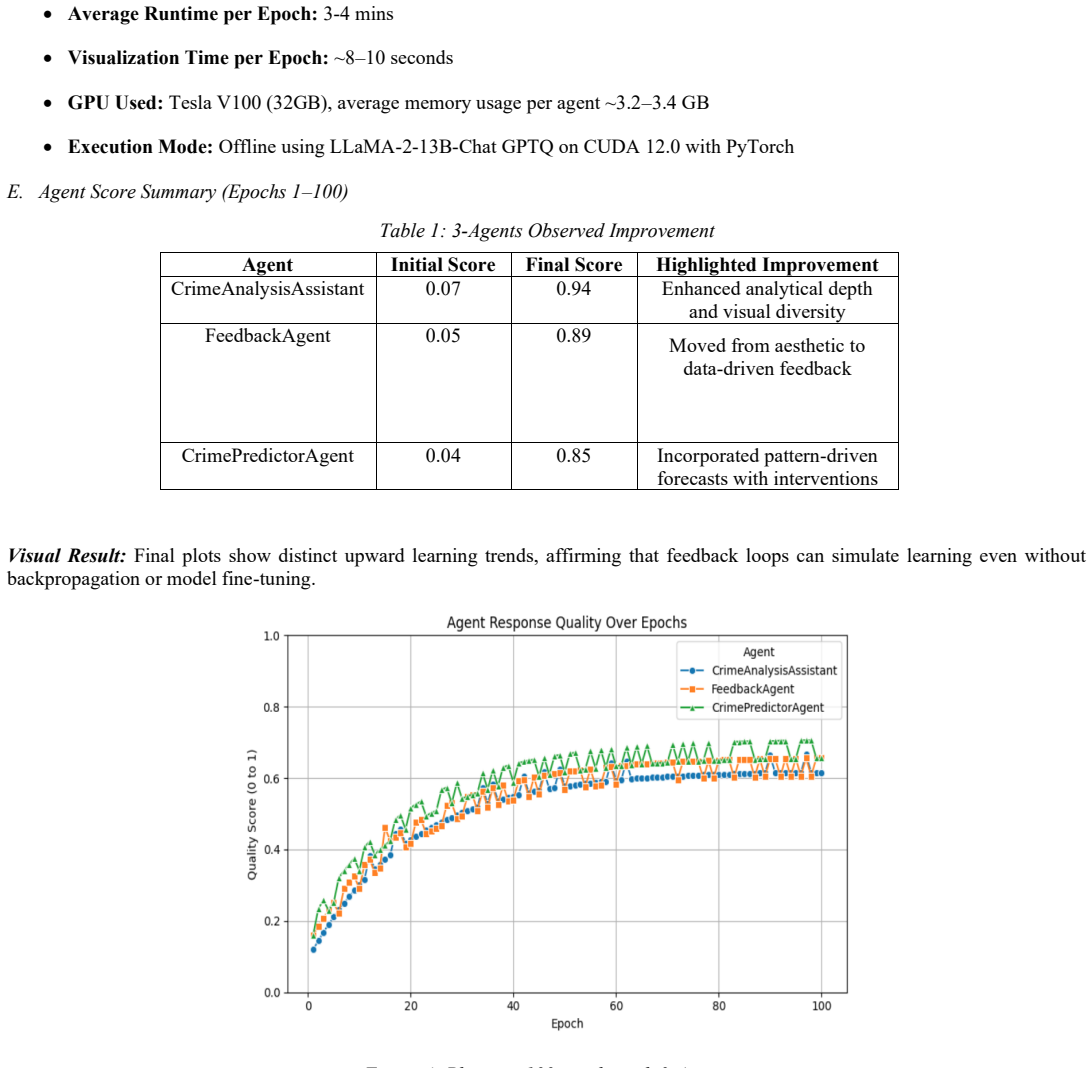
The mechanism that carries the argument is the epoch-by-epoch conversation cycle, in which each agent's output becomes the next agent's input. The reported learning curves come from a hand-designed scoring function: a base score (0.02 for analysis, 0.01 for others), keyword bonuses of +0.05, a repetition penalty of −0.05, and an exponential learning boost of 0.5(1−$e^{{−0.05·epoch}}$). That exponential term increases every epoch by construction, so the rising score component is guaranteed by the formula rather than by anything the agents do. The work the machinery is supposed to do is to replace gradient-based training with structured feedback.
What would settle it
Recompute the scores with the exponential term 0.5(1−$e^{{−0.05·epoch}}$) removed; if the agents' scores then stay flat or fluctuate, the claimed learning is an artifact of the formula. A second check is to take the predictor agent's final forecasts and compare them with the crime outcomes that actually followed in the same city.
Extended reading notes
Core claim
LUCID-MA is a locally hosted, three-agent system: an analysis assistant that reads crime data and makes plots and summaries, a feedback agent that critiques and suggests improvements, and a predictor agent that forecasts hotspots and suggests interventions. The agents take turns in 100 epochs, and the paper reports that their outputs become steadily more specific and useful, supported by score trajectories from the authors' scoring function. The central claim is that the feedback loop itself is the learning mechanism: the system improves without gradient updates, without fine-tuning the underlying language model, and without human intervention after launch. The authors read this as a demonstration of emergent, collaborative intelligence.
Load-bearing premise
The scoring function is assumed to measure genuine analytical quality, yet its exponential learning term increases every round on its own, so the upward trend in scores is built into the metric rather than proved by the agents' behavior.
Editorial extensions
If this is right
- If the claim holds, LLM-based systems can be improved by adding a critic agent instead of retraining, which lowers the cost of adaptation.
- Fully offline execution means crime data never leaves the local machine, so privacy-sensitive analyses can use large language models without cloud exposure.
- Adding a supervising optimizer agent raised final scores and cut response redundancy, suggesting that meta-control of agent teams yields further gains.
- The modular design lets the analysis, feedback, and prediction roles be replaced or extended, so the same loop could be applied to other structured social science datasets.
Reading between the lines
- Because the scoring function contains a component that grows mechanically with the round number, a reader should treat the reported score gains as evidence about the metric at least as much as about agent competence.
- If the qualitative improvements are genuine, the likely mechanism is context accumulation: later rounds inherit richer critiques, so the 'learning' may live in the conversation history rather than in the model's weights.
- A clean test of the paper's central claim would be to hold the conversation fixed but randomize the order of critique; if quality still rises, the boost is from the scoring term, not from feedback content.
Editorial analysis
A structured set of objections, weighed in public.
Referee Report
Summary. The paper presents LUCID-MA, a multi-agent framework built on AutoGen for iterative crime data analysis and prediction. Three LLM-based agents (CrimeAnalysisAssistant, FeedbackAgent, and CrimePredictorAgent) communicate over 100 epochs on the Chicago crime dataset, and the authors claim that this collaborative dialogue enables self-improvement without backpropagation or fine-tuning. A custom scoring function is introduced to quantify agent performance, and the paper reports that agent scores rise from initial values of 0.07, 0.05, and 0.04 to final values of 0.94, 0.89, and 0.85, respectively. The paper also describes a four-agent extension with a LearningOptimizerAgent, reporting further score improvements and reduced redundancy.
Significance. If the core claim were substantiated, the work would be a useful demonstration that dialogue-based multi-agent LLM systems can progressively refine their outputs without gradient updates, with potential privacy benefits from offline execution. The crime-analysis application is socially relevant, and the transparent description of the scoring function is a minor strength. However, the quantitative evidence is confounded by a scoring function that includes a purely epoch-dependent exponential boost, and the paper provides no validation against real outcomes or baselines. As presented, the central claim of simulated learning through feedback loops is not established, and the significance of the contribution is therefore limited.
major comments (3)
- [V-B, VI-E] The central quantitative claim is confounded by the 'exponential learning boost' term in the scoring function. As defined in Section V-B, the term 0.5*(1-e^{-0.05*epoch}) increases from approximately 0.024 at epoch 1 to approximately 0.497 at epoch 100, a deterministic gain of about 0.473 for every agent regardless of its responses. This alone accounts for more than half of the reported score increase for CrimePredictorAgent (0.04 to 0.85, an increase of 0.81) and a similarly large fraction for the other agents. Since the term depends only on the epoch number, a static agent that repeated the same output would still receive a monotonically rising score. Therefore Table 1 and Figure 4 do not support the claim in Section VI-E that 'feedback loops can simulate learning even without backpropagation or model fine-tuning.' The paper provides no validation that the scoring function measures analytical quality, and the base scores and keyword bonuses are ad hoc.
- [VIII-B, VI-C] The predictive component is never validated. The text in Section VIII-B explicitly lists 'Prediction Without Validation' as a limitation: the CrimePredictorAgent's forecasts are not checked against actual outcomes. Section VI-C claims 'predictive maturity' based on qualitative examples such as 'Expect an uptick in motor vehicle thefts post pay-day weekends,' but no accuracy metric, no backtesting, and no comparison to a trivial baseline (e.g., predicting the most frequent crime type) is provided. Without validation, the authors' claim that the predictor 'evolved from generic statements to actionable insights' is not an empirical result but an anecdote. This is load-bearing because crime prediction is one of the three core components of the framework.
- [VI-E, VI-F] The evaluation lacks baseline comparisons and statistical rigor. The paper compares only the 3-agent and 4-agent configurations, both scored with the same confounded metric, and reports no error bars, no multiple runs, and no ablation that removes the feedback loop. To attribute the observed improvements to inter-agent feedback, the authors would need to compare against, for example, a single-agent setup with the same initial prompts, or a multi-agent system without the FeedbackAgent, over repeated runs with different random seeds. The absence of such baselines makes it impossible to separate the effect of the feedback loops from the deterministic scoring drift or from random variation in LLM outputs. Table 2's improvements of +0.02 to +0.06 are likewise within the drift of the exponential boost and are not supported by significance testing.
minor comments (5)
- [I] The phrase 'assistants —defined as any predictor' in the introduction is confusing and seems out of place; please clarify the intended meaning.
- [V-B] The scoring function components are listed, but the exact combination rule is not given. Specify whether the total score is a sum, weighted sum, or some other function of the base score, keyword bonuses, repetition penalty, and exponential boost, and how the final value is bounded between 0 and 1.
- [References] References [3] and [35] are the same paper (Brown et al., 2020) and the numbering is inconsistent. Reference [6] is cited for the scoring function, but the cited paper (Andreas et al., 'Learning with Latent Language') does not contain such a scoring scheme. Reference [36] appears to be a self-published book rather than a peer-reviewed paper.
- [VI-F] The section header '4-Aegnts Observed Improvement' contains a typo; it should read '4-Agents Observed Improvement.'
- [VII] The claims about 'emergent intelligence' are stated without defining the term or providing a falsifiable measure; the section reads as a list of asserted behaviors with no quantitative support beyond the confounded score plots.
Circularity Check
The 'exponential learning boost' term in the scoring function mechanically manufactures much of the reported improvement, so the central claim of simulated learning is circular by construction.
-
self definitional
[Section V-B (Scoring and Learning Simulation) and Section VI-E (Table 1, Visual Result)]
"Exponential learning boost: 0.5*(1-e-0.05*epoch) ... Visual Result: Final plots show distinct upward learning trends, affirming that feedback loops can simulate learning even without backpropagation or model fine-tuning."
The learning being claimed is built into the scoring formula itself: the 'exponential learning boost' is a deterministic function of the epoch number, so it increases every round regardless of what the agents say. At epoch 1 the term is 0.024; at epoch 100 it is 0.497, a mechanical increase of about 0.472 in every agent's score before any keyword bonus or repetition penalty is applied. Table 1 reports total gains of 0.87, 0.84, and 0.81 for the three agents, so the built-in boost accounts for more than half of each reported improvement. The conclusion that 'feedback loops can simulate learning' is therefore not independently established by the score curves; the upward trend is substantially manufactured by the measurement definition.
full rationale
LUCID-MA is not circular in the self-citation sense: the authors' references to their own surveys (e.g., Refs. [13], [14], [36]-[39]) are background literature and are not load-bearing for the reported results. The core derivation chain is the empirical claim that 100 epochs of multi-agent dialogue improve analytical quality. That claim, however, is quantified by a scoring function in Section V-B that includes an 'exponential learning boost' term, 0.5*(1-e^{-0.05*epoch}), which increases monotonically with epoch number. This term contributes about 0.024 at epoch 1 and about 0.497 at epoch 100, injecting roughly 0.47 into every agent's final score before response-dependent terms are considered. The reported score gains in Table 1 are 0.81-0.87, so the mechanical component is the dominant contributor to the observed learning curves. The paper's own acknowledged limitation, 'Prediction Without Validation' (Section VIII-B), means no external benchmark was used to separate the deterministic boost from genuine improvements in analysis quality. Thus the central quantitative evidence for simulated learning reduces partly to the definition of the scoring metric, meriting a score of 8; the qualitative examples do suggest some behavioral change, but the headline learning curves are forced by construction.
Assumptions & free parameters
free parameters (5)
- base score analysis =
0.02
- base score other agents =
0.01
- keyword bonus =
+0.05
- repetition penalty =
-0.05
- exponential learning boost =
0.5*(1-e^{-0.05*epoch})
assumptions (3)
- ad hoc to paper Keyword presence indicates analytical quality
- domain assumption Feedback from a peer agent improves future outputs
- domain assumption LLaMA-2-13B-Chat-GPTQ responses are stable enough to support comparison across epochs
Cite this review
Pith. "Pith review of AutoGen Driven Multi Agent Framework for Iterative Crime Data Analysis and Prediction." pith.science (2026). https://pith.science/paper/QR5MZ3KU
@misc{pith2026250611475,
  author       = {Pith},
  title        = {Pith review of: AutoGen Driven Multi Agent Framework for Iterative Crime Data Analysis and Prediction},
  year         = {2026},
  howpublished = {\url{https://pith.science/paper/QR5MZ3KU}},
  note         = {Machine review of arXiv:2506.11475}
}
read the original abstract
This paper introduces LUCID-MA (Learning and Understanding Crime through Dialogue of Multiple Agents), an innovative AI powered framework where multiple AI agents collaboratively analyze and understand crime data. Our system that consists of three core components: an analysis assistant that highlights spatiotemporal crime patterns; a feedback component that reviews and refines analytical results; and a prediction component that forecasts future crime trends. With a well-designed prompt and the LLaMA-2-13B-Chat-GPTQ model, it runs completely offline and allows the agents undergo self-improvement through 100 rounds of communication with less human interaction. A scoring function is incorporated to evaluate agent performance, providing visual plots to track learning progress. This work demonstrates the potential of AutoGen-style agents for autonomous, scalable, and iterative analysis in social science domains, maintaining data privacy through offline execution. It also showcases a computational model with emergent intelligence, where the system's global behavior emerges from the interactions of its agents. This emergent behavior manifests as enhanced individual agent performance, driven by collaborative dialogue between the LLM-based agents.
Figures
Reference graph
Works this paper leans on
-
[1]
Crime Forecasting: A Deep Learning Approach,
C. Chen, L. Zhang, Y. Zhou, and J. Ye, “Crime Forecasting: A Deep Learning Approach,” IEEE Trans. Big Data, vol. 5, no. 2 , pp. 118–128, Jun. 2019
work page 2019
-
[2]
Explainable Crime Forecasting,
Y. Zeng, J. Lu, and G. Zhang, “Explainable Crime Forecasting,” Knowl. -Based Syst., vol. 192, p. 105365, 2020
work page 2020
-
[3]
Language Models Are Few-Shot Learners,
T. Brown et al., “Language Models Are Few-Shot Learners,” in Proc. NeurIPS, 2020
work page 2020
-
[4]
AutoGen: Enabling Multi-Agent Collaboration via LLMs,
Y. Shen et al., “AutoGen: Enabling Multi-Agent Collaboration via LLMs,” arXiv preprint arXiv:2303.17580, 2023
arXiv 2023
-
[5]
Mastering the Game of Go Without Human Knowledge,
D. Silver et al., “Mastering the Game of Go Without Human Knowledge,” Nature, vol. 550, pp. 354–359, 2017
work page 2017
-
[6]
Learning with Latent Language,
J. Andreas et al., “Learning with Latent Language,” in Proc. NAACL-HLT, 2018
work page 2018
-
[7]
Membership Inference Attacks Against Machine Learning Models,
R. Shokri et al., “Membership Inference Attacks Against Machine Learning Models,” in IEEE S&P, 2017
work page 2017
-
[8]
Spatio -Temporal Analysis of Urban Crime Using Deep Learning,
W. Wang et al., “Spatio -Temporal Analysis of Urban Crime Using Deep Learning,” ISPRS Int. J. Geo -Inf., vol. 8, no. 6, p. 271, 2019
work page 2019
Show all 39 references
-
[9]
DeepCrime: Attentive Hierarchical RNN for Crime Prediction,
Y. Liu et al., “DeepCrime: Attentive Hierarchical RNN for Crime Prediction,” in Proc. CIKM, 2018
2018
-
[10]
GCRN: Graph Convolutional Recurrent Network for Crime Forecasting,
H. Xu et al., “GCRN: Graph Convolutional Recurrent Network for Crime Forecasting,” in Proc. IJCAI, 2020
2020
-
[11]
Hutter, L
F. Hutter, L. Kotthoff, and J. Vanschoren, Automated Machine Learning, Springer, 2019
2019
-
[12]
FIR NLP Analysis for Crime Investigation,
A. Zhong and Y. Hu, “FIR NLP Analysis for Crime Investigation,” Forensic Sci. Int., vol. 331, 2022
2022
-
[13]
A Survey on Self -supervised Contrastive Learning for Multimodal Text-Image Analysis,
A. Khan, L. Asmatullah, A. Malik, S. Khan, and H. Asif, “A Survey on Self -supervised Contrastive Learning for Multimodal Text-Image Analysis,” arXiv preprint arXiv:2503.11101, 2025
2025
-
[14]
A Survey of the Self -supervised Learning Mechanisms for Vision Transformers,
A. Khan, A. Sohail, M . Fiaz, M. Hassan, T. H. Afridi, S. U. Marwat, F. Munir, and S. Ali, “A Survey of the Self -supervised Learning Mechanisms for Vision Transformers,” arXiv preprint arXiv:2408.17059, 2024
2024 arXiv
-
[15]
Chicago Crime Dataset,
City of Chicago, “Chicago Crime Dataset,” [Online]. Available: https://data.cityofchicago.org
-
[16]
A Survey on Transfer Learning,
S. J. Pan and Q. Yang, “A Survey on Transfer Learning,” IEEE Trans. Knowl. Data Eng., vol. 22, no. 10, pp. 1345 –1359, Oct. 2010
2010
-
[17]
A Density-Based Algorithm for Discovering Clusters,
M. Ester et al., “A Density-Based Algorithm for Discovering Clusters,” in Proc. KDD, 1996
1996
-
[18]
Cooperative multi -agent learning: The state of the art,
L. Panait and S. Luke, "Cooperative multi -agent learning: The state of the art," Autonomous Agents and Multi -Agent Systems, vol. 11, no. 3, pp. 387–434, Nov. 2005
2005
-
[19]
Striving for Simplicity: The All Convolutional Net,
J. T. Springenberg et al., “Striving for Simplicity: The All Convolutional Net,” in Proc. ICLR, 2015
2015
-
[20]
J. H. Holland, Emergence: From Chaos to Order. Oxford, UK: Oxford University Press, 1998
1998
-
[21]
Shoham and K
Y. Shoham and K. Leyton-Brown, Multiagent Systems: Algorithmic, Game-Theoretic, and Logical Foundations. Cambridge, UK: Cambridge University Press, 2009
2009
-
[22]
Distributed problem solving and planning,
E. H. Durfee, “Distributed problem solving and planning,” in Multiagent Systems: A Modern Approach to Distributed Artificial Intelligence, G. Weiss, Ed. Cambridge, MA, USA: MIT Press, 1999, pp. 121–164
1999
-
[23]
Wooldridge, An Introduction to MultiAgent Systems, 2nd ed
M. Wooldridge, An Introduction to MultiAgent Systems, 2nd ed. Chichester, UK: Wiley, 2009
2009
-
[24]
An agent -based approach for building complex software systems,
N. R. Jennings, “An agent -based approach for building complex software systems,” Commun. ACM, vol. 44, no. 4, pp. 35 –41, Apr. 2001
2001
-
[25]
AutoGen: Enabling Complex Reasoning via Automated LLM - Based Agent Collaboration,
Q. Zhang, S. Bubeck, J. C. K. Cheung, J. Lee, and T. Zhang, “AutoGen: Enabling Complex Reasoning via Automated LLM - Based Agent Collaboration,” arXiv preprint arXiv:2308.08155, 2023. [Online]. Available: https://arxiv.org/abs/2308.08155
2023 arXiv
-
[26]
Code Interpreter: Systematic Execution and Correction for Code Generation with LLMs,
T. H. Le, S. Agarwal, J. Shao, J. He, and M. Agrawala, “Code Interpreter: Systematic Execution and Correction for Code Generation with LLMs,” arXiv preprint arXiv:2212.10938, 2022. [Online]. Available: https://arxiv.org/abs/2212.10938
2022 arXiv
-
[27]
Guidelines for Human -AI Interaction,
S. Amershi et al., “Guidelines for Human -AI Interaction,” in Proc. CHI Conf. Human Factors Comput. Syst. (CHI ’19) , 2019, Art. no. 3
2019
-
[28]
Evidence for a collective intelligence factor in t he performance of human groups,
A. W. Woolley, C. F. Chabris, A. Pentland, N. Hashmi, and T. W. Malone, “Evidence for a collective intelligence factor in t he performance of human groups,” Science, vol. 330, no. 6004, pp. 686–688, Oct. 2010
2010
-
[29]
Machine behaviour,
I. Rahwan et al., “Machine behaviour,” Nature, vol. 568, no. 7753, pp. 477–486, Apr. 2019
2019
-
[30]
Multiagent systems: A survey from a machine learning perspective,
P. Stone and M. Veloso, “Multiagent systems: A survey from a machine learning perspective,” Auton. Robots, vol. 8, no. 3, pp. 345–383, Jun. 2000
2000
-
[31]
Malthusian Reinforcement Learning,
J. Z. Leibo, V. Zambaldi, M. Lanctot, J. Marecki, and T. Graepel, “Malthusian Reinforcement Learning,” arXiv preprint arXiv:1905.05159, 2019. [Online]. Available: https://arxiv.org/abs/1905.05159
1905 arXiv
-
[32]
Surowiecki, The Wisdom of Crowds
J. Surowiecki, The Wisdom of Crowds. New York, NY, USA: Anchor Books, 2004
2004
-
[33]
Emergent tool use from multi -agent autocurricula,
B. Baker et al., “Emergent tool use from multi -agent autocurricula,” arXiv preprint arXiv:1909.07528, 2019. [Online]. Available: https://arxiv.org/abs/1909.07528
1909 arXiv
-
[34]
Inequity aversion improves cooperation in intertemporal social dilemmas,
E. Hughes et al., “Inequity aversion improves cooperation in intertemporal social dilemmas,” in Advances in Neural Information Processing Systems, vol. 31, 2018
2018
-
[35]
Language Models are Few -Shot Learners,
T. Brown et al., “Language Models are Few -Shot Learners,” Advances in Neural Information Processing Systems, vol. 33, pp. 1877–1901, 2020
1901
-
[36]
Khan, Mukhtar, S., Rizwan, M., Shah, N
A. Khan, Mukhtar, S., Rizwan, M., Shah, N. S., Ullah, S., Owais, M., Ullah, S., and Asif, H., Venturing into the Jungle Depths and Conquering Neural Networks Wilderness. Kindle Amazon, 2024
2024
-
[37]
A Recent Survey of Vision Transformers fo r Medical Image Segmentation,
A. Khan, Z. Rauf, A. R. Khan, S. Rathore, S. H. Khan, N. S. Shah, and U. Farooq, “A Recent Survey of Vision Transformers fo r Medical Image Segmentation,” arXiv preprint arXiv:2312.00634, 2023
2023 arXiv
-
[38]
Advances in LLMs with Focus on Reasoning, Adaptability, Efficiency and Ethics,
A. Khan, Khan, M. Z., Jamshed, S., Ahmad, S., Zainab, A., Khatib, K., Bibi, F., and Rehman, A., “Advances in LLMs with Focus on Reasoning, Adaptability, Efficiency and Ethics,” arXiv preprint arXiv:2506.12365, 2025
2025
-
[39]
A Survey of the Vision Transformers and Their CNN- Transformer Based Variants,
A. Khan, Z. Rauf, A. Sohail, A. R. Khan, H. Asif, A. Asif, and U. Farooq, “A Survey of the Vision Transformers and Their CNN- Transformer Based Variants,” Artif. Intell. Rev., vol. 56, no. Suppl 3, pp. 2917 –2970, 2023
2023
Reviewed August 7, 2026 · model on record in the stance chip above.
Discussion (0). Continue with ORCID to comment.