REVIEW 5 major objections 6 minor 18 references
Revealing Political Bias in LLMs through Structured Multi-Agent Debate
T0 review · 5 major / 6 minor · reviewed 2026-08-07 · deepseek-v4-flash
Pith's one-line read Simulated political debates between LLM personas show a consistent leftward drift and can form echo chambers when a neutral agent is present.
desk verdict A transparent debate study whose headline findings all rest on one unvalidated LLM judge; deserves review but not citation until that is fixed. read the letter →
The pith
A machine-rendered reading of the paper's core claim, the machinery that carries it, and where it could break.
The reading
What carries the argument
The machinery is a three-agent structured debate protocol (opening, ten rebuttal rounds, closing) with personas built from demographic prompts, trusted media sources, and generated narratives, plus an external LLM-as-a-judge that scores each round's statement on a 1-7 agreement scale. The judge (Mistral 7B) is what turns free-text debate output into the attitude curves that underlie every finding. Reversion ratios measure whether agents snap back to their opening attitude when the final round is announced, and echo-chamber formation is operationalized as the linear-regression slope of mean attitude scores diverging from the neutral value of 4.
What would settle it
Take the stored debate transcripts and re-score all attitude prompts with a different judge, for example GPT-4o or human raters with political-knowledge screening, without changing anything else. If Neutral agents no longer sit closer to Democrats, Republican agents no longer shift toward center, or same-affiliation groups no longer show intensifying slopes, the reported political bias is a property of the Mistral 7B evaluator, not of the debate dynamics.
Extended reading notes
Core claim
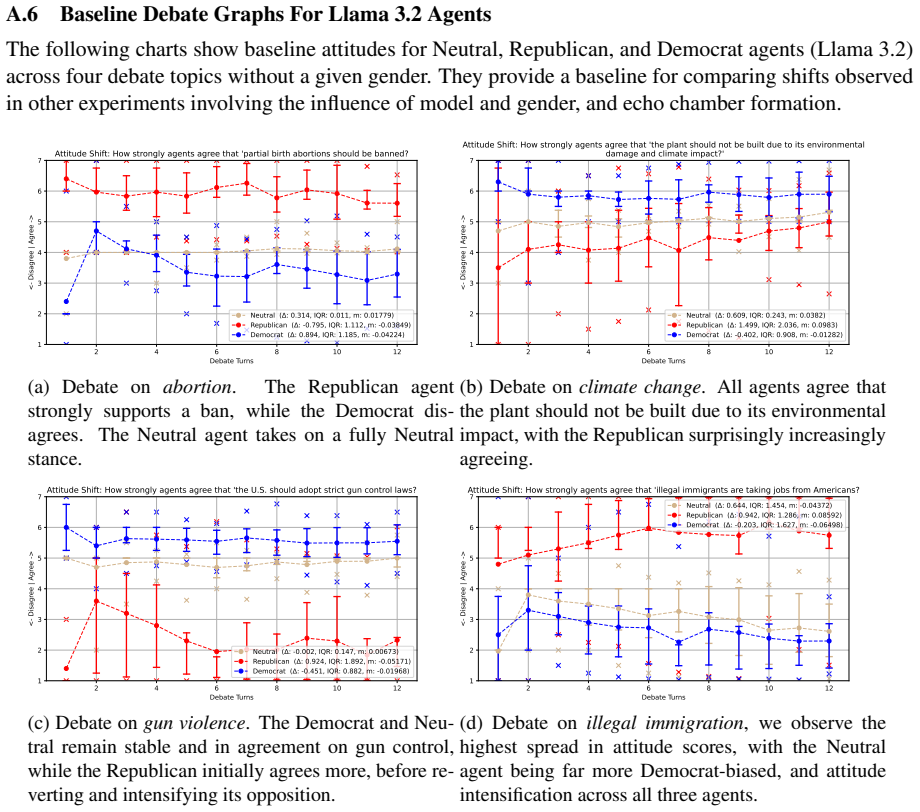
The central claim is that LLM agents in structured multi-agent debates exhibit a systematic, model-independent political bias: Neutral personas consistently align more with Democrat perspectives, Republican personas shift toward the Neutral/centrist position over ten rounds, and Democrat personas remain stable. Gender attribution changes these dynamics mainly when agents know one another's gender, with Female Republicans softening in male-dominated groups and Female Democrats leaning further left. The paper also claims that, contrary to prior work, echo chambers do form: pairs of same-affiliation agents with a Neutral present intensify their attitudes on some topics, and the effect is stronger when gender is disclosed. The closing-round experiments add that Republican agents revert toward Democrat positions when the final turn is announced, which the authors read as anchoring bias from pretraining leaning Democrat.
Load-bearing premise
The load-bearing premise is that the Mistral 7B judge gives valid, unbiased 1-to-7 political-attitude scores for any debate statement; if that judge carries its own partisan leanings, every headline result, including Neutral alignment with Democrats, Republican centering, and echo-chamber detection, could be an artifact of the judge rather than of the debating agents.
Editorial extensions
If this is right
- Neutral personas cannot be treated as unbiased baselines in LLM social simulations; they inherit a Democrat-leaning prior even when prompted to be apolitical.
- Debate outcomes depend on who speaks first: a Republican opener shifts all agents right and a Democrat opener shifts them left, so debate order must be controlled or reported.
- Gender-aware debate groups are less ideologically rigid in some configurations, so demographic disclosure is a variable, not a constant, in agent-based simulation.
- Homogeneous same-affiliation groups with a neutral present can polarize, so prior claims that LLM debates never form echo chambers do not generalize to all group compositions.
- Closing-statement prompts induce attitude reversion, especially for Republican personas, meaning the final frame of a debate changes measured attitudes.
Reading between the lines
- If the leftward drift is driven by the judge rather than the debaters, a judge swap, for example a second independent LLM or human raters, is the direct test; the paper's reliance on Mistral 7B for both persona validation and attitude scoring makes this the first thing to probe.
- The speaking-order effect suggests a mechanism beyond stated alignment: agents may be treating the first argument as an anchor, which would imply that debate-context framing, not only pretraining, sets the political baseline.
- A testable extension is to vary the neutral persona's trusted news sources, for example Center-left versus Center-right feeds, to see whether neutral drift tracks media diet rather than model internals.
- The echo-chamber result may be an artifact of the judge's scoring distribution, so re-running with per-topic calibration of the 1-7 scale against human raters would separate genuine polarization from scoring inflation.
Editorial analysis
A structured set of objections, weighed in public.
Referee Report
Summary. This paper proposes a structured multi-agent debate framework in which Neutral, Republican, and Democrat personas debate four politically sensitive topics while the authors vary the underlying LLM, the agents' gender attributes and gender awareness, and the group composition. Attitudes are measured by an external LLM-as-a-judge (Mistral 7B) that assigns a 1-7 agreement score to each debate statement. The paper reports that Neutral agents align with Democrats, Republican agents shift toward the Neutral position, gender awareness moderates attitude expression, and same-affiliation groups can form echo chambers in certain topic/group combinations. It also reports speaking-order effects and a final-round attitude reversion phenomenon.
Significance. If the measurements are valid, the paper makes a useful empirical contribution to LLM-based social simulation and political-bias research: it extends prior work by Taubenfeld et al. (2024), adds systematic variation across five LLMs, includes a speaking-order permutation check, and provides an open-source implementation. The persona-generation protocol and the decision to use an external judge rather than self-report are also thoughtful design choices. However, all headline findings depend on a single unvalidated judge model, and several statistical decisions are under-specified; until those issues are addressed, the strength of the empirical claims is not yet established.
major comments (5)
- [§3.4, Appendix A.2] All attitude scores—the sole dependent variable for every headline result—are produced by a single Mistral 7B judge. The paper does not calibrate this judge against human political-attitude ratings on this specific 1-7 agreement task, nor does it report inter-judge agreement with a second model. The cited Thakur et al. (2025) result concerns general judge-human alignment, not 1-7 scoring of politically directional debate statements. Because the evaluation prompts are directional (e.g., 'the plant should not be built' or 'partial birth abortions should be banned'), a systematic lean in Mistral's ratings could produce the observed Democrat-leaning drift of Neutral agents, the Republican shift toward Neutral, and the apparent echo-chamber slopes. Please provide human-rated validation on a sample of debate responses, an inter-judge agreement analysis, or a robustness check with an alternative judge.
- [§3.1] The same Mistral 7B judge is used both to validate persona alignment and to score debate attitudes, so the persona-alignment heatmaps in Figures 2 and 7 do not provide independent evidence that the personas behave as intended. The paper reports that a random 10% of ~1,250 responses and all 'Not Aligned' responses were manually reviewed, but no agreement statistic (e.g., Cohen's kappa) is given. Without this, the validation step cannot rule out the possibility that the judge's own political leanings shaped both the persona checks and the outcome measures. Please report the manual-review agreement and, ideally, validate personas with a different model or human labels.
- [§4, §5.2, Table 5] The echo-chamber operationalization is under-specified: the paper states that an echo chamber is formed when linear-regression gradients 'diverged from the neutral baseline of 4,' but no threshold, confidence interval, or significance test is given, and a slope of 0.03 versus 0.09 are both treated as evidence of divergence. Moreover, many ANOVAs are reported at P<0.05 without multiple-comparison correction (e.g., the gender analyses in §5.2 and the twelve tests in Table 5), which inflates the false-positive rate. Please report regression slopes with confidence intervals for all topic/group combinations and apply a correction for multiple comparisons or clearly justify the unadjusted tests.
- [§5.3] The echo-chamber conclusion is based on a selected subset of topic/group combinations: illegal immigration for two Republicans plus a Neutral, and gun violence and abortion for two Democrats plus a Neutral. Other combinations are reported not to show intensification, but the paper does not provide a complete factorial table of slopes and significance values. The abstract's claim that 'agents with shared political affiliations can form echo chambers' is therefore a partial-pattern claim; its scope should be stated precisely, and the negative cases should be reported with equal prominence. The comparison with Taubenfeld et al. (2024) is also complicated by differences in judge, prompts, and debate format, which should be acknowledged explicitly.
- [Eq. (2), §5.1] The attitude reversion ratio R in Eq. (2) is undefined when A_mean equals A_first, and the condition 'if A_ref = A_first' refers to a quantity A_ref that is never defined. The definition should be completed, the degenerate case handled, and the notation made consistent with the text around Table 2.
minor comments (6)
- [Figure captions and Figures 1-17] The figure captions use symbols such as 'σ' and 'm' without defining them; please state explicitly that these are the standard deviation and the linear-regression slope of the attitude scores across rounds.
- [Figure 5a caption] There is a typo in the caption: 'An echi chamber is formed' should be 'An echo chamber is formed.'
- [Table 3] The evaluation-prompt template in Appendix A.2 includes placeholders 'TOPIC' and 'EVALUATION_PROMPT' that are not consistently filled in Table 3; please make the mapping between topics, scenarios, and evaluation prompts explicit.
- [§3.2] Replacing the topic 'racism' with 'abortion' is motivated by database coverage, but the paper should discuss whether the resulting four-topic set remains directly comparable to Taubenfeld et al. (2024).
- [Throughout] The term 'ANOVA' is typeset as 'ANOV A' in several places; please correct the formatting.
- [§7] The Limitations section mentions computational and scope constraints but does not discuss the validity of the LLM-as-a-judge, which is the main threat to the paper's conclusions; please add this to the limitations.
Circularity Check
No significant circularity: the paper's results are empirical observations from debate simulations, with no fitted parameters, self-citation chains, or definitional reductions.
full rationale
The paper does not derive its headline claims from the same data by construction. Attitudes are measured by an external Mistral 7B judge that is not one of the debating agents; the judge's scores are an outcome variable, not a fitted input. Persona validation also uses this judge, but that does not make the debate-attitude measurements definitionally circular: the validation step establishes that agents respond according to their assigned personas, while the debate scoring independently measures agreement with topic prompts. No parameter is fitted to a subset of data and then renamed a prediction. The paper's echo-chamber criterion (gradients from linear regressions diverging from neutral) is an operational definition, not a circular derivation. The cited works (Taubenfeld et al., Thakur et al., Lou and Sun, etc.) are external; there are no load-bearing self-citations. The only significant concern is judge validity: if Mistral 7B has systematic partisan leanings or scale biases, the reported attitude scores could be confounded. That is a measurement-validity risk, not a circularity of the derivation chain, and it does not make the results equivalent to the judge by construction.
Assumptions & free parameters
free parameters (2)
- Echo chamber gradient threshold =
unspecified divergence from neutral baseline of 4
- Sampling temperature =
0.35
assumptions (4)
- domain assumption Mistral 7B LLM-as-a-judge provides valid, unbiased political-attitude scores on a 1-7 scale
- ad hoc to paper A score of 4 on the 1-7 Likert scale is a meaningful neutral baseline
- domain assumption The fixed speaking order (Neutral, Republican, Democrat) does not distort headline results
- standard math ANOVA and Levene test assumptions hold for the 10-run attitude score distributions
Cite this review
Pith. "Pith review of Revealing Political Bias in LLMs through Structured Multi-Agent Debate." pith.science (2026). https://pith.science/paper/PVRTUSVG
@misc{pith2026250611825,
  author       = {Pith},
  title        = {Pith review of: Revealing Political Bias in LLMs through Structured Multi-Agent Debate},
  year         = {2026},
  howpublished = {\url{https://pith.science/paper/PVRTUSVG}},
  note         = {Machine review of arXiv:2506.11825}
}
read the original abstract
Large language models (LLMs) are increasingly used to simulate social behaviour, yet their political biases and interaction dynamics in debates remain underexplored. We investigate how LLM type and agent gender attributes influence political bias using a structured multi-agent debate framework, by engaging Neutral, Republican, and Democrat American LLM agents in debates on politically sensitive topics. We systematically vary the underlying LLMs, agent genders, and debate formats to examine how model provenance and agent personas influence political bias and attitudes throughout debates. We find that Neutral agents consistently align with Democrats, while Republicans shift closer to the Neutral; gender influences agent attitudes, with agents adapting their opinions when aware of other agents' genders; and contrary to prior research, agents with shared political affiliations can form echo chambers, exhibiting the expected intensification of attitudes as debates progress.
Figures


Figures from the paper (14 more)




Reference graph
Works this paper leans on
-
[1]
URL: " 'urlintro :=
ENTRY address author booktitle chapter edition editor howpublished institution journal key month note number organization pages publisher school series title type volume year eprint doi pubmed url lastchecked label extra.label sort.label short.list INTEGERS output.state before.all mid.sentence after.sentence after.block STRINGS urlintro eprinturl eprintpr...
-
[2]
write newline
" write newline "" before.all 'output.state := FUNCTION n.dashify 't := "" t empty not t #1 #1 substring "-" = t #1 #2 substring "--" = not "--" * t #2 global.max substring 't := t #1 #1 substring "-" = "-" * t #2 global.max substring 't := while if t #1 #1 substring * t #2 global.max substring 't := if while FUNCTION word.in bbl.in capitalize " " * FUNCT...
-
[3]
AllSides Technologies Inc. 2025. Allsides: Media bias ratings. https://www.allsides.com. Accessed on March 21, 2025
work page 2025
-
[4]
Morton B Brown and Alan B Forsythe. 1974. Robust tests for the equality of variances. Journal of the American statistical association, 69(346):364--367
work page 1974
-
[5]
Yun-Shiuan Chuang, Agam Goyal, Nikunj Harlalka, Siddharth Suresh, Robert Hawkins, Sijia Yang, Dhavan Shah, Junjie Hu, and Timothy T Rogers. 2023. https://doi.org/10.48550/arXiv.2311.09618 Simulating opinion dynamics with networks of llm-based agents . arXiv preprint arXiv:2311.09618
-
[6]
Stefano De Paoli. 2023. http://arxiv.org/abs/2310.06391 Improved prompting and process for writing user personas with llms, using qualitative interviews: Capturing behaviour and personality traits of users . arXiv
arXiv 2023
-
[7]
Gizem Gezici, Aldo Lipani, Yucel Saygin, and Emine Yilmaz. 2021. https://doi.org/10.1007/s10791-020-09386-w Evaluation metrics for measuring bias in search engine results . Information Retrieval Journal, 24(2):85--113
-
[8]
Rune Karlsen, Kari Steen-Johnsen, Dag Wolleb k, and Bernard Enjolras. 2017. Echo chamber and trench warfare dynamics in online debates. European journal of communication, 32(3):257--273
work page 2017
Show all 18 references
-
[9]
Ming Li, Jiuhai Chen, Lichang Chen, and Tianyi Zhou. 2024. http://arxiv.org/abs/2402.10614 Can llms speak for diverse people? tuning llms via debate to generate controllable controversial statements
2024 arXiv
-
[10]
Jiaxu Lou and Yifan Sun. 2024. https://arxiv.org/abs/2412.06593 Anchoring bias in large language models: An experimental study . arXiv preprint arXiv:2412.06593
2024 arXiv
-
[11]
Montgomery
Douglas C. Montgomery. 2017. Design and Analysis of Experiments, 9 edition. John Wiley & Sons
2017
-
[12]
Jeffrey Morgan and Michael Chiang. 2023. Ollama. https://ollama.com/
2023
-
[13]
Pew Research Center . 2025. https://www.pewresearch.org/ Pew Research Center: Numbers, Facts, and Trends Shaping Your World . [Accessed: 10-April-2025]
2025
-
[14]
Sunstein
Cass R. Sunstein. 2002. https://doi.org/https://doi.org/10.1111/1467-9760.00148 The law of group polarization . Journal of Political Philosophy, 10(2):175--195
2002
-
[15]
Amir Taubenfeld, Yaniv Dover, Roi Reichart, and Ariel Goldstein. 2024. https://doi.org/10.18653/v1/2024.emnlp-main.16 Systematic biases in llm simulations of debates . arXiv preprint arXiv:2402.04049
2024 arXiv
-
[16]
Aman Singh Thakur, Kartik Choudhary, Venkat Srinik Ramayapally, Sankaran Vaidyanathan, and Dieuwke Hupkes. 2025. http://arxiv.org/abs/2406.12624 Judging the judges: Evaluating alignment and vulnerabilities in llms-as-judges . arXiv preprint arXiv:2406.12624
2025 arXiv
- [17]
-
[18]
Caleb Ziems, William Held, Omar Shaikh, Jiaao Chen, Zhehao Zhang, and Diyi Yang. 2024. Can large language models transform computational social science? Computational Linguistics, 50(1):237--291
2024
Reviewed August 7, 2026 · model on record in the stance chip above.
Discussion (0). Sign in to comment.