REVIEW 4 major objections 6 minor 75 references
How do Probabilistic Graphical Models and Graph Neural Networks Look at Network Data?
T0 review · 4 major / 6 minor · reviewed 2026-08-07 · deepseek-v4-flash
Pith's one-line read This paper asks when classical probabilistic graphical models (PGMs) outperform graph neural networks (GNNs) on the same network task, using link prediction as a common benchmark on synthetic and real networks.
desk verdict A useful but flawed benchmark: the PGM-vs-GNN link-prediction comparison is extensive, yet the low-dimensional feature claim is confounded by feature-source mismatch and test-edge leakage. read the letter →
The pith
A machine-rendered reading of the paper's core claim, the machinery that carries it, and where it could break.
The reading
What carries the argument
The comparison runs on a single link-prediction protocol applied to off-the-shelf models from both families: three stochastic block model variants (MULTITENSOR, MTCOV, BNP) and four GNN architectures (GAT, GAE, VGAE, H2GCN). The crux is controlled manipulation of the input features—full attribute vectors, adjacency-matrix rows, K-means-clustered one-dimensional labels, and shuffled noise—so that both families are tested under identical information conditions, with AUC on held-out edges as the shared metric.
What would settle it
Re-run the structure-feature experiment with adjacency rows built only from training edges, never touching validation or test edges; if GNNs no longer match PGMs, the reported structure-feature advantage is leakage, not signal.
Extended reading notes
Core claim
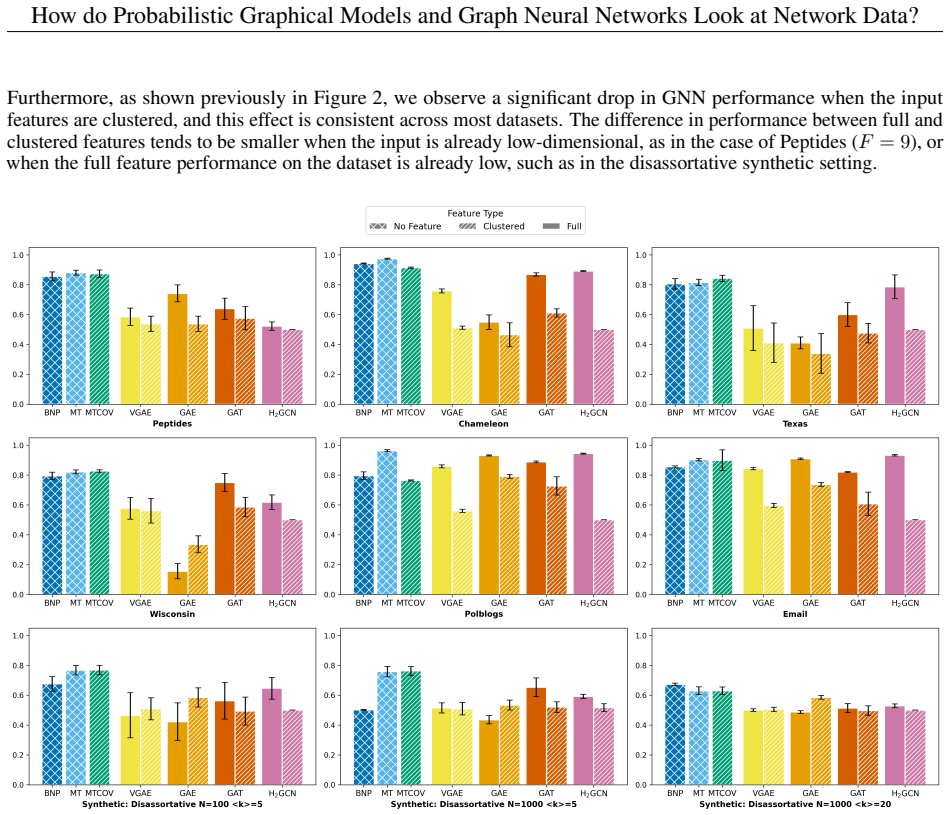
On its own terms, the paper establishes that for link prediction, stochastic-block-model PGMs are the safer choice when node attributes are sparse, low-dimensional, or corrupted. GNNs match or approach PGM performance when given high-dimensional features, whether attribute vectors or adjacency-matrix rows, but drop sharply when features are compressed to a one-dimensional cluster label or randomly shuffled. Under increasing heterophily, PGMs remain more competitive, and GNNs recover some lost ground only when fed structure-based adjacency-row features, not when a heterophily-aware architecture is used. The authors interpret this as evidence that GNNs cannot fall back on topology alone the way PGMs can, and that architectural tweaks are less decisive than feature choice.
Load-bearing premise
The conclusion that structure-based features help GNNs assumes the adjacency-row features do not accidentally reveal the held-out test edges, since the validation and test rows progressively include the very links being predicted.
Editorial extensions
If this is right
- In practical link-prediction settings where node attributes are scalar or unreliable, a PGM should be the default choice.
- GNN users should treat feature engineering as a first-class design step: adjacency-row features can close the gap to PGMs on heterophilic graphs.
- Adding uninformative or noisy features can hurt GNN performance, so feature selection deserves the same attention as architecture selection.
- A heterophily-aware GNN architecture (H2GCN) does not consistently beat PGMs, suggesting that input features are the binding constraint.
Reading between the lines
- A natural extension is to test the same protocol with GNNs that include explicit feature-selection or denoising layers; the paper's results imply such modules could be worth more than new message-passing schemes.
- The complexity comparison suggests a trade-off: PGM cost scales with community count K, while GNN cost scales with hidden dimension and layers, so on very large graphs the ranking could shift even if the accuracy pattern holds.
- The link-prediction focus likely understates PGM advantages: on node classification, where labels are the target, previous work cited by the paper already shows GNNs losing to a contextual stochastic block model, so the gap may generalize.
- Practitioners using adjacency-row features for GNNs should check for target leakage; the paper's own validation protocol is susceptible, and the structure-feature advantage may be partly an artifact.
Editorial analysis
A structured set of objections, weighed in public.
Referee Report
Summary. This paper compares three probabilistic graphical models (MULTITENSOR, MTCOV, BNP) with four graph neural networks (GAT, GAE, VGAE, H2GCN) on a link prediction task, using synthetic networks and ten real-world datasets. The three main experiments vary the type and dimensionality of input features, corrupt node features, and increase graph heterophily; a final section compares interpretability and computational complexity. The paper concludes that GNNs are outperformed by PGMs when input features are low-dimensional or noisy, that PGMs are more robust than GNNs when heterophily increases, and that feature choice can matter more than GNN architecture for heterophilic graphs.
Significance. The paper addresses a real gap: a direct, controlled comparison of PGM and GNN frameworks on a common task, across a reasonably broad set of datasets and architectures. The computational complexity table and the interpretability discussion are useful for practitioners. If the main empirical claims were established, the paper would be a valuable benchmark. However, the central experiments contain feature-information confounds and a test-edge leakage issue that undermine the headline conclusions. The comparison is nevertheless potentially repairable, because the issues are experimental-design problems rather than irreparable theoretical flaws.
major comments (4)
- [Section 6, Figure 2 and Appendix Figure 8] The low-dimensional-feature comparison is confounded by feature source and information content. On synthetic data, MTCOV receives the argmax of the ground-truth membership vector as its one-dimensional feature, whereas GNNs receive a K-means cluster label of their attribute vectors; on real data, MTCOV's scalar feature is a K-means cluster label of the adjacency-matrix row, whereas GNNs' scalar feature clusters node attributes. The observed GNN drop at F=1 could therefore be caused by lossy clustering of attributes or by label leakage in the synthetic setting, rather than by dimensionality per se. The claim that GNNs are outperformed by PGMs when input features are low-dimensional is not established by this design.
- [Section 6, case 1 and Figure 1] The structure-based feature experiment leaks test links into the model input. The text states that, when constructing the adjacency-matrix-row feature, 'for validation and test we progressively include the validation and test set links.' Because these rows are used as node features for GNNs, the model receives information about the very edges it is asked to predict, potentially inflating GNN performance. This invalidates the feature-type comparison in Figure 1 and the specific observation about Peptides, and it also affects the heterophily analysis in Figure 4, where structure-based features are used.
- [Section 7, Figure 3] The noise-robustness experiment applies different corruptions to the two frameworks. GNN features are corrupted by permuting entries of the attribute vector, while MTCOV's scalar feature is replaced by a uniformly random cluster label; moreover, MTCOV's scalar feature is itself a K-means label of the adjacency-matrix row, not the attribute feature used by GNNs. The comparison therefore measures different quantities and does not isolate robustness to feature noise. The claim that PGMs are more robust to noisy features is not cleanly supported.
- [Section 8, Figure 4] Including H2GCN contradicts the stated 'off-the-shelf' design principle in Section 4, since H2GCN is explicitly designed for heterophily. The conclusion that 'architectural adaptations alone may not fully address the challenges posed by heterophilic graphs' is based on a single architecture and is not supported by a controlled comparison; the reported result is also affected by the feature-source confound from Section 6. This weakens the heterophily pillar of the paper's headline claim.
minor comments (6)
- [Introduction, Section 1] The text refers to the 'Stochastic Block Model (SMB)'; the standard abbreviation is SBM. Please correct this typo.
- [Section 6, Figure 2 caption] The caption says MTCOV takes one-dimensional (Clustered) features by design, but on synthetic data the feature is the argmax of the ground-truth membership vector, not a K-means cluster label. Please clarify the caption to match the actual protocol.
- [References] References [13] and [39] are the same paper (Zhu et al., 'Beyond homophily in graph neural networks'); one of the two entries should be removed or cross-referenced.
- [Throughout] The word 'heteropilic' appears several times and should be 'heterophilic'.
- [Section 9.2, Table 2] The BNP complexity is listed as O(N ln(N^2)); this looks like a typo for O(N ln N), but if it is intentional, please explain the origin of the factor of 2.
- [General] There is no code or data availability statement. For reproducibility, please include one or state clearly whether code and data will be released.
Circularity Check
The structure-based feature comparison is circular because test-set edges are included in the input features; the headline low-dimensional/noisy and heterophily conclusions are not themselves forced by this step.
-
self definitional
[Section 6, 'The role of input features', case 1 (structure-based feature) cross-validation paragraph]
"We stress that, when splitting the graph in training, validation and test set in our cross-validation link prediction routine, we take into account the masking of the edges, and we feed the node with the masked adjacency matrix row. Indeed, the training set feature only contains the links between nodes in the training set graph, while for validation and test we progressively include the validation and test set links."
The structure-based feature is the adjacency-matrix row A_i, and for validation/test rows it includes the validation/test edges, which are exactly the edges the link-prediction task asks the model to predict. For a candidate edge (i,j) in the test set, the value A_ij appears in the input feature of both endpoints, so the model can read the target from its input rather than predict it. Any reported AUC gain from 'structure-based features' in Figures 1, 7, and the structure-feature panels of Figure 4 is therefore partly a lookup of the label by construction rather than a measured predictive ability. This does not force the main low-dimensional/noisy-feature results, which use attribute-based clustered features, but it is a genuine circularity in the structure-feature leg of the benchmark.
full rationale
The paper contains no formal derivation chain; its claims are empirical comparisons, so most circularity categories do not apply. The PGM models MULTITENSOR and MTCOV are self-cited, but they are used off-the-shelf from independently published work, and the GNN baselines and datasets are external, so this is ordinary self-reference rather than load-bearing circularity. The one genuine circularity is in the structure-based feature protocol in Section 6, case 1: for validation and test, the adjacency-row feature is said to 'progressively include the validation and test set links,' so the link-prediction target is present in the model input by construction; the reported AUC in Figures 1, 7, and the structure-feature panels of Figure 4 is therefore partly a lookup, not a prediction. This affects the supporting claim that structure-based features make GNNs competitive, but it works against, rather than for, the paper's headline that PGMs are more robust, so the central conclusions still have independent content from the attribute-based and noise experiments. A separate validity concern—on synthetic data MTCOV's one-dimensional feature is the argmax of the ground-truth membership vector, unlike the K-means-clustered features given to GNNs—is an experimental confound in the low-dimensional comparison, but it is not a derivational circularity under the strict definition used here. Overall circularity is partial and localized rather than pervasive.
Assumptions & free parameters
free parameters (3)
- Number of communities K (MULTITENSOR, MTCOV) =
cross-validated per dataset
- gamma (MTCOV) =
cross-validated per dataset
- GNN hyperparameter set (learning rate, weight decay, dropout, hidden dimension, number of layers) =
tuned by grid search on a validation split
assumptions (4)
- domain assumption Synthetic networks generated from the MULTITENSOR generative model are representative of network data for comparing PGMs and GNNs.
- domain assumption The link-prediction task with AUC as metric is a fair common ground for comparing the two frameworks.
- ad hoc to paper Node features derived from adjacency-matrix rows do not contain information about test edges when used as model input.
- standard math Standard results in graph theory and probability (e.g., SBM edge likelihood, message-passing updates) are correct.
Cite this review
Pith. "Pith review of How do Probabilistic Graphical Models and Graph Neural Networks Look at Network Data?." pith.science (2026). https://pith.science/paper/3PDXLHM3
@misc{pith2026250611869,
  author       = {Pith},
  title        = {Pith review of: How do Probabilistic Graphical Models and Graph Neural Networks Look at Network Data?},
  year         = {2026},
  howpublished = {\url{https://pith.science/paper/3PDXLHM3}},
  note         = {Machine review of arXiv:2506.11869}
}
read the original abstract
Graphs are a powerful data structure for representing relational data and are widely used to describe complex real-world systems. Probabilistic Graphical Models (PGMs) and Graph Neural Networks (GNNs) can both leverage graph-structured data, but their inherent functioning is different. The question is how do they compare in capturing the information contained in networked datasets? We address this objective by solving a link prediction task and we conduct three main experiments, on both synthetic and real networks: one focuses on how PGMs and GNNs handle input features, while the other two investigate their robustness to noisy features and increasing heterophily of the graph. PGMs do not necessarily require features on nodes, while GNNs cannot exploit the network edges alone, and the choice of input features matters. We find that GNNs are outperformed by PGMs when input features are low-dimensional or noisy, mimicking many real scenarios where node attributes might be scalar or noisy. Then, we find that PGMs are more robust than GNNs when the heterophily of the graph is increased. Finally, to assess performance beyond prediction tasks, we also compare the two frameworks in terms of their computational complexity and interpretability.
Figures


Figures from the paper (5 more)


Reference graph
Works this paper leans on
-
[1]
An introduction to probabilistic graphical models, 2003
Michael I Jordan. An introduction to probabilistic graphical models, 2003
work page 2003
-
[2]
Holland, Kathryn Blackmond Laskey, and Samuel Leinhardt
Paul W. Holland, Kathryn Blackmond Laskey, and Samuel Leinhardt. Stochastic blockmodels: First steps. Social Networks, 5(2):109–137, 1983
1983
-
[3]
Yuchung J. Wang and George Y . Wong. Stochastic blockmodels for directed graphs.Journal of the American Statistical Association, 82(397):8–19, 1987
work page 1987
-
[4]
Estimation and prediction for stochastic blockmodels for graphs with latent block structure
Tom Snijders and Krzysztof Nowicki. Estimation and prediction for stochastic blockmodels for graphs with latent block structure. Journal of Classification, 14:75–100, 01 1997
work page 1997
-
[5]
Community detection and stochastic block models: recent developments
Emmanuel Abbe. Community detection and stochastic block models: recent developments. J. Mach. Learn. Res., 18(1):6446–6531, January 2017
work page 2017
-
[6]
The graph neural network model
Franco Scarselli, Marco Gori, Ah Chung Tsoi, Markus Hagenbuchner, and Gabriele Monfardini. The graph neural network model. IEEE Transactions on Neural Networks, 20(1):61–80, 2009. 10 How do Probabilistic Graphical Models and Graph Neural Networks Look at Network Data?
work page 2009
-
[7]
Convolutional neural networks on graphs with fast localized spectral filtering
Micha¨el Defferrard, Xavier Bresson, and Pierre Vandergheynst. Convolutional neural networks on graphs with fast localized spectral filtering. In Proceedings of the 30th International Conference on Neural Information Processing Systems, NIPS’16, page 3844–3852, Red Hook, NY , USA, 2016. Curran Associates Inc
work page 2016
-
[8]
Federico Monti, Davide Boscaini, Jonathan Masci, Emanuele Rodol`a, Jan Svoboda, and Michael M. Bronstein. Geometric deep learning on graphs and manifolds using mixture model cnns. In 2017 IEEE Conference on Computer Vision and Pattern Recognition (CVPR), pages 5425–5434, 2017
work page 2017
Show all 75 references
-
[9]
Message passing all the way up, 2022
Petar Veli ˇckovi´c. Message passing all the way up, 2022
2022
-
[10]
Revisiting heterophily for graph neural networks
Sitao Luan, Chenqing Hua, Qincheng Lu, Jiaqi Zhu, Mingde Zhao, Shuyuan Zhang, Xiao-Wen Chang, and Doina Precup. Revisiting heterophily for graph neural networks. In Proceedings of the 36th International Conference on Neural Information Processing Systems, NIPS ’22, Red Hook, N...
2022
-
[11]
Bronstein
Francesco Di Giovanni, James Rowbottom, Benjamin Paul Chamberlain, Thomas Markovich, and Michael M. Bronstein. Understanding convolution on graphs via energies. Transactions on Machine Learning Research, 2023
2023
-
[12]
Understanding heterophily for graph neural networks
Junfu Wang, Yuanfang Guo, Liang Yang, and Yunhong Wang. Understanding heterophily for graph neural networks. In Ruslan Salakhutdinov, Zico Kolter, Katherine Heller, Adrian Weller, Nuria Oliver, Jonathan Scarlett, and Felix Berkenkamp, editors, Proceedings of the 41st Internati...
2024
-
[13]
Beyond homophily in graph neural networks: current limitations and effective designs
Jiong Zhu, Yujun Yan, Lingxiao Zhao, Mark Heimann, Leman Akoglu, and Danai Koutra. Beyond homophily in graph neural networks: current limitations and effective designs. In Proceedings of the 34th International Conference on Neural Information Processing Systems, NIPS ’20, Red ...
2020
-
[14]
Finding global homophily in graph neural networks when meeting heterophily
Xiang Li, Renyu Zhu, Yao Cheng, Caihua Shan, Siqiang Luo, Dongsheng Li, and Weining Qian. Finding global homophily in graph neural networks when meeting heterophily. InInternational Conference on Machine Learning, pages 13242–13256. PMLR, 2022
2022
-
[15]
The heterophilic graph learning handbook: Benchmarks, models, theoretical analysis, applications and challenges
Sitao Luan, Chenqing Hua, Qincheng Lu, Liheng Ma, Lirong Wu, Xinyu Wang, Minkai Xu, Xiao-Wen Chang, Doina Precup, Rex Ying, et al. The heterophilic graph learning handbook: Benchmarks, models, theoretical analysis, applications and challenges. arXiv preprint arXiv:2407.09618, 2024
2024 arXiv
-
[16]
On the impact of feature heterophily on link prediction with graph neural networks
Jiong Zhu, Gaotang Li, Yao-An Yang, Jing Zhu, Xuehao Cui, and Danai Koutra. On the impact of feature heterophily on link prediction with graph neural networks. arXiv preprint arXiv:2409.17475, 2024
2024 arXiv
-
[17]
Insights from network science can advance deep graph learning
Christopher Bl¨ocker, Martin Rosvall, Ingo Scholtes, and Jevin D West. Insights from network science can advance deep graph learning. arXiv preprint arXiv:2502.01177, 2025
2025
-
[18]
Stochastic blockmodels meet graph neural networks
Nikhil Mehta, Lawrence Carin, and Piyush Rai. Stochastic blockmodels meet graph neural networks. ArXiv, abs/1905.05738, 2019
1905 arXiv
-
[19]
The deep latent position block model for the block clustering and latent representation of networks, 2024
R´emi Boutin, Pierre Latouche, and Charles Bouveyron. The deep latent position block model for the block clustering and latent representation of networks, 2024
2024
-
[20]
Gnninterpreter: A probabilistic generative model-level explanation for graph neural networks
Xiaoqi Wang and Han-Wei Shen. Gnninterpreter: A probabilistic generative model-level explanation for graph neural networks. In International Conference on Learning Representations (ICLR), 2023
2023
-
[21]
Inference in probabilistic graphical models by graph neural networks
KiJung Yoon, Renjie Liao, Yuwen Xiong, Lisa Zhang, Ethan Fetaya, Raquel Urtasun, Richard Zemel, and Xaq Pitkow. Inference in probabilistic graphical models by graph neural networks. In 2019 53rd Asilomar Conference on Signals, Systems, and Computers, pages 868–875, 2019
2019
-
[22]
GNNs getting comfy: Community and feature similarity guided rewiring
Celia Rubio-Madrigal, Adarsh Jamadandi, and Rebekka Burkholz. GNNs getting comfy: Community and feature similarity guided rewiring. In The Thirteenth International Conference on Learning Representations, 2025
2025
-
[23]
Revisiting graph neural networks: All we have is low-pass filters, 2019
Hoang NT and Takanori Maehara. Revisiting graph neural networks: All we have is low-pass filters, 2019
2019
-
[24]
On the bottleneck of graph neural networks and its practical implications
Uri Alon and Eran Yahav. On the bottleneck of graph neural networks and its practical implications. In International Conference on Learning Representations (ICLR), 2021
2021
-
[25]
Graph clustering with graph neural networks
Anton Tsitsulin, John Palowitch, Bryan Perozzi, and Emmanuel M ¨uller. Graph clustering with graph neural networks. Journal of Machine Learning Research, 24(127):1–21, 2023
2023
-
[26]
Duranthon and Lenka Zdeborov’a
O. Duranthon and Lenka Zdeborov’a. Optimal inference in contextual stochastic block models. Trans. Mach. Learn. Res., 2024, 2023
2024
-
[27]
The ground truth about metadata and community detection in networks
Leto Peel, Daniel B Larremore, and Aaron Clauset. The ground truth about metadata and community detection in networks. Science advances, 3(5):e1602548, 2017
2017
-
[28]
Structure and inference in annotated networks
Mark EJ Newman and Aaron Clauset. Structure and inference in annotated networks. Nature communications, 7(1):11863, 2016. 11 How do Probabilistic Graphical Models and Graph Neural Networks Look at Network Data?
2016
-
[29]
Community detection with node attributes in multilayer networks
Martina Contisciani, Eleanor Power, and Caterina De Bacco. Community detection with node attributes in multilayer networks. Scientific reports, 10:15736, 09 2020
2020
-
[30]
Structure and inference in hypergraphs with node attributes
Anna Badalyan, Nicol `o Ruggeri, and Caterina De Bacco. Structure and inference in hypergraphs with node attributes. Nature Communications, 15(1):7073, 2024
2024
-
[31]
Power, Daniel B
Caterina De Bacco, Eleanor A. Power, Daniel B. Larremore, and Cristopher Moore. Community detection, link prediction, and layer interdependence in multilayer networks. Phys. Rev. E, 95:042317, Apr 2017
2017
-
[32]
Efficient monte carlo and greedy heuristic for the inference of stochastic block models
Tiago P Peixoto. Efficient monte carlo and greedy heuristic for the inference of stochastic block models. Physical Review E, 89(1):012804, 2014
2014
-
[33]
Pairre: Knowledge graph embeddings via paired relation vectors
Linlin Chao, Jianshan He, Taifeng Wang, and Wei Chu. Pairre: Knowledge graph embeddings via paired relation vectors. In Annual Meeting of the Association for Computational Linguistics, 2020
2020
-
[34]
Automated concatenation of embeddings for structured prediction
Xinyu Wang, Yong Jiang, Nguyen Bach, Tao Wang, Zhongqiang Huang, Fei Huang, and Kewei Tu. Automated concatenation of embeddings for structured prediction. In Annual Meeting of the Association for Computational Linguistics, 2020
2020
-
[35]
MacQueen
J. MacQueen. Some methods for classification and analysis of multivariate observations. In Proceedings of the 5th Berkeley Symposium on Mathematical Statistics and Probability, pages 281–297, 1967
1967
-
[36]
S. Lloyd. Least squares quantization in pcm. IEEE Transactions on Information Theory, 28(2):129–137, 1982
1982
-
[37]
Graph Attention Networks
Petar Veliˇckovi´c, Guillem Cucurull, Arantxa Casanova, Adriana Romero, Pietro Li`o, and Yoshua Bengio. Graph Attention Networks. International Conference on Learning Representations, 2018
2018
-
[38]
Kipf and Max Welling
Thomas N. Kipf and Max Welling. Variational graph autoencoders. In Proceedings of the NeurIPS Workshop on Bayesian Deep Learning, 2016
2016
-
[39]
Beyond homophily in graph neural networks: Current limitations and effective designs
Jiong Zhu, Yujun Yan, Lingxiao Zhao, Mark Heimann, Leman Akoglu, and Danai Koutra. Beyond homophily in graph neural networks: Current limitations and effective designs. In Proceedings of the 34th International Conference on Neural Information Processing Systems, NIPS ’20, Red ...
2020
-
[40]
Konstantin Rusch, Michael M
T. Konstantin Rusch, Michael M. Bronstein, and Siddhartha Mishra. A survey on oversmoothing in graph neural networks, 2023
2023
-
[41]
Demystifying oversmoothing in attention-based graph neural networks
Xinyi Wu, Amir Ajorlou, Zihui Wu, and Ali Jadbabaie. Demystifying oversmoothing in attention-based graph neural networks. In Proceedings of the 37th International Conference on Neural Information Processing Systems, NIPS ’23, Red Hook, NY , USA, 2023. Curran Associates Inc
2023
-
[42]
Graph neural networks exponentially lose expressive power for node classification
Kenta Oono and Taiji Suzuki. Graph neural networks exponentially lose expressive power for node classification. arXiv: Learning, 2019
2019
-
[43]
A note on over-smoothing for graph neural networks
Chen Cai and Yusu Wang. A note on over-smoothing for graph neural networks. ArXiv, abs/2006.13318, 2020
2006 arXiv
-
[44]
Cohen, and Ruslan Salakhutdinov
Zhilin Yang, William W. Cohen, and Ruslan Salakhutdinov. Revisiting semi-supervised learning with graph embeddings. In Proceedings of the 33rd International Conference on International Conference on Machine Learning - Volume 48, ICML’16, page 40–48. JMLR.org, 2016
2016
-
[45]
Predicting multicellular function through multi-layer tissue networks
Marinka Zitnik, Monu Agrawal, and Jure Leskovec. Predicting multicellular function through multi-layer tissue networks. Bioinformatics, 33(14):1916–1923, 2017
1916
-
[46]
Long range graph benchmark
Vijay Prakash Dwivedi, Ladislav Ramp´aˇsek, Mikhail Galkin, Ali Parviz, Guy Wolf, Anh Tuan Luu, and Dominique Beaini. Long range graph benchmark. In Proceedings of the 36th International Conference on Neural Information Processing Systems, NIPS ’22, Red Hook, NY , USA, 2022. C...
2022
-
[47]
Vishwanathan
Pinar Yanardag and S.V .N. Vishwanathan. Deep graph kernels. In Proceedings of the 21th ACM SIGKDD International Conference on Knowledge Discovery and Data Mining, KDD ’15, page 1365–1374, New York, NY , USA, 2015. Association for Computing Machinery
2015
-
[48]
Adamic and Natalie Glance
Lada A. Adamic and Natalie Glance. The political blogosphere and the 2004 u.s. election: divided they blog. In Proceedings of the 3rd International Workshop on Link Discovery, LinkKDD ’05, page 36–43, New York, NY , USA, 2005. Association for Computing Machinery
2004
-
[49]
Benson, Jure Leskovec, and David F
Hao Yin, Austin R. Benson, Jure Leskovec, and David F. Gleich. Local higher-order graph clustering. In Proceedings of the 23rd ACM SIGKDD International Conference on Knowledge Discovery and Data Mining, KDD ’17, page 555–564, New York, NY , USA, 2017. Association for Computing...
2017
-
[50]
Geom-gcn: Geometric graph convolutional networks
Hongbin Pei, Bingzhen Wei, Kevin Chen-Chuan Chang, Yu Lei, and Bo Yang. Geom-gcn: Geometric graph convolutional networks. ArXiv, abs/2002.05287, 2020. 12 How do Probabilistic Graphical Models and Graph Neural Networks Look at Network Data?
2002 arXiv
-
[51]
Kingma and Jimmy Ba
Diederik P. Kingma and Jimmy Ba. Adam: A method for stochastic optimization. CoRR, abs/1412.6980, 2014
2014 arXiv
-
[52]
The expressive power of graph neural networks
Pan Li and Jure Leskovec. The expressive power of graph neural networks. Graph Neural Networks: Foundations, Frontiers, and Applications, pages 63–98, 2022
2022
-
[53]
A fair comparison of graph neural networks for graph classification
Federico Errica, Marco Podda, Davide Bacciu, and Alessio Micheli. A fair comparison of graph neural networks for graph classification. ArXiv, abs/1912.09893, 2019
1912 arXiv
-
[54]
Hamilton, Rex Ying, and Jure Leskovec
William L. Hamilton, Rex Ying, and Jure Leskovec. Inductive representation learning on large graphs. In Proceedings of the 31st International Conference on Neural Information Processing Systems , NIPS’17, page 1025–1035, Red Hook, NY , USA, 2017. Curran Associates Inc
2017
-
[55]
How powerful are graph neural networks? ArXiv, abs/1810.00826, 2018
Keyulu Xu, Weihua Hu, Jure Leskovec, and Stefanie Jegelka. How powerful are graph neural networks? ArXiv, abs/1810.00826, 2018
2018 arXiv
-
[56]
On positional and structural node features for graph neural networks on non-attributed graphs
Hejie Cui, Zijie Lu, Pan Li, and Carl Yang. On positional and structural node features for graph neural networks on non-attributed graphs. In Proceedings of the 31st ACM International Conference on Information & Knowledge Management, CIKM ’22, page 3898–3902, New York, NY , US...
2022
-
[57]
Tenorio, Madeline Navarro, Santiago Segarra, and Antonio G
Victor M. Tenorio, Madeline Navarro, Santiago Segarra, and Antonio G. Marques. Recovering missing node features with local structure-based embeddings. In ICASSP 2024 - 2024 IEEE International Conference on Acoustics, Speech and Signal Processing (ICASSP), pages 9931–9935, 2024
2024
-
[58]
Graph convolutional networks for graphs containing missing features
Hibiki Taguchi, Xin Liu, and Tsuyoshi Murata. Graph convolutional networks for graphs containing missing features. Future Generation Computer Systems, 117:155–168, 2021
2021
-
[59]
Graph neural networks can recover the hidden features solely from the graph structure
Ryoma Sato. Graph neural networks can recover the hidden features solely from the graph structure. In Proceedings of the 40th International Conference on Machine Learning, ICML’23. JMLR.org, 2023
2023
-
[60]
Asymptotic analysis of the stochastic block model for modular networks and its algorithmic applications
Aurelien Decelle, Florent Krzakala, Cristopher Moore, and Lenka Zdeborov ´a. Asymptotic analysis of the stochastic block model for modular networks and its algorithmic applications. Physical Review E—Statistical, Nonlinear, and Soft Matter Physics, 84(6):066106, 2011
2011
-
[61]
Community detection in large hypergraphs
Nicol`o Ruggeri, Martina Contisciani, Federico Battiston, and Caterina De Bacco. Community detection in large hypergraphs. Science Advances, 9(28):eadg9159, 2023
2023
-
[62]
Broad spectrum structure discovery in large-scale higher-order networks, 2025
John Hood, Caterina De Bacco, and Aaron Schein. Broad spectrum structure discovery in large-scale higher-order networks, 2025
2025
-
[63]
Link prediction under heterophily: A physics-inspired graph neural network approach
Andrea Giuseppe Di Francesco, Francesco Caso, Maria Sofia Bucarelli, and Fabrizio Silvestri. Link prediction under heterophily: A physics-inspired graph neural network approach. arXiv, 2024
2024
-
[64]
Is homophily a necessity for graph neural networks? arXiv preprint arXiv:2106.06134, 2021
Yao Ma, Xiaorui Liu, Neil Shah, and Jiliang Tang. Is homophily a necessity for graph neural networks? arXiv preprint arXiv:2106.06134, 2021
2021 arXiv
-
[65]
Ordered gnn: Ordering message passing to deal with heterophily and over-smoothing, 02 2023
Song Yunchong, Chenghu Zhou, Xinbing Wang, and Zhouhan Lin. Ordered gnn: Ordering message passing to deal with heterophily and over-smoothing, 02 2023
2023
-
[66]
Bastian Epping, Alexandre Ren´e, Moritz Helias, and Michael T. Schaub. Graph neural networks do not always oversmooth. In Proceedings of the 38th International Conference on Neural Information Processing Systems, NIPS ’24, Red Hook, NY , USA, 2025. Curran Associates Inc
2025
-
[67]
Interpretable deep learning: Interpretation, interpretability, trustworthiness, and beyond
Xuhong Li, Haoyi Xiong, Xingjian Li, Xuanyu Wu, Xiao Zhang, Ji Liu, Jiang Bian, and Dejing Dou. Interpretable deep learning: Interpretation, interpretability, trustworthiness, and beyond. Knowledge and Information Systems, 64(12):3197–3234, 2022
2022
-
[68]
Graphlime: Local interpretable model explanations for graph neural networks
Qiang Huang, Makoto Yamada, Yuan Tian, Dinesh Singh, and Yi Chang. Graphlime: Local interpretable model explanations for graph neural networks. IEEE Transactions on Knowledge and Data Engineering, 35(7):6968– 6972, 2022
2022
-
[69]
Learning deep representations for graph clustering
Fei Tian, Bin Gao, Qing Cui, Enhong Chen, and Tie-Yan Liu. Learning deep representations for graph clustering. In Proceedings of the Twenty-Eighth AAAI Conference on Artificial Intelligence, AAAI’14, page 1293–1299. AAAI Press, 2014
2014
-
[70]
Attributed graph clustering: a deep attentional embedding approach
Chun Wang, Shirui Pan, Ruiqi Hu, Guodong Long, Jing Jiang, and Chengqi Zhang. Attributed graph clustering: a deep attentional embedding approach. In Proceedings of the 28th International Joint Conference on Artificial Intelligence, IJCAI’19, page 3670–3676. AAAI Press, 2019
2019
-
[71]
Deep k-means clustering based on graph neural networks: Leveraging cohesion and separation in graph nodes
Hyesoo Shin and Ki Yong Lee. Deep k-means clustering based on graph neural networks: Leveraging cohesion and separation in graph nodes. In 2024 IEEE International Conference on Big Data and Smart Computing (BigComp), pages 190–193, 2024. 13 How do Probabilistic Graphical Model...
2024
-
[72]
Viualizing data using t-sne.Journal of Machine Learning Research, 9:2579–2605, 11 2008
Laurens van der Maaten and Geoffrey Hinton. Viualizing data using t-sne.Journal of Machine Learning Research, 9:2579–2605, 11 2008
2008
-
[73]
Flexible inference in heterogeneous and attributed multilayer networks
Martina Contisciani, Marius Hobbhahn, Eleanor A Power, Philipp Hennig, and Caterina De Bacco. Flexible inference in heterogeneous and attributed multilayer networks. PNAS Nexus, 4(1):pgaf005, 01 2025
2025
-
[74]
How powerful are spectral graph neural networks
Xiyuan Wang and Muhan Zhang. How powerful are spectral graph neural networks. In International conference on machine learning, pages 23341–23362. PMLR, 2022
2022
-
[75]
On the equivalence between positional node embeddings and structural graph representations
Balasubramaniam Srinivasan and Bruno Ribeiro. On the equivalence between positional node embeddings and structural graph representations. arXiv preprint arXiv:1910.00452, 2019. 14 How do Probabilistic Graphical Models and Graph Neural Networks Look at Network Data? A Additiona...
1910 arXiv
Reviewed August 7, 2026 · model on record in the stance chip above.
Discussion (0). Sign in to comment.