REVIEW 3 major objections 5 minor 97 references
Orbital Pumping in Ferrimagnetic Insulators
T0 review · 3 major / 5 minor · reviewed 2026-08-07 · deepseek-v4-flash
Pith's one-line read This paper shows that the ferrimagnetic insulator BiYIG pumps pure orbital currents, generated by coherent and thermal magnons, directly into adjacent metals without any spin-to-orbital converter layer.
desk verdict First direct orbital pumping from a ferrimagnetic insulator, credible but with a control that needs sharper quantification. read the letter →
The pith
A machine-rendered reading of the paper's core claim, the machinery that carries it, and where it could break.
The reading
What carries the argument
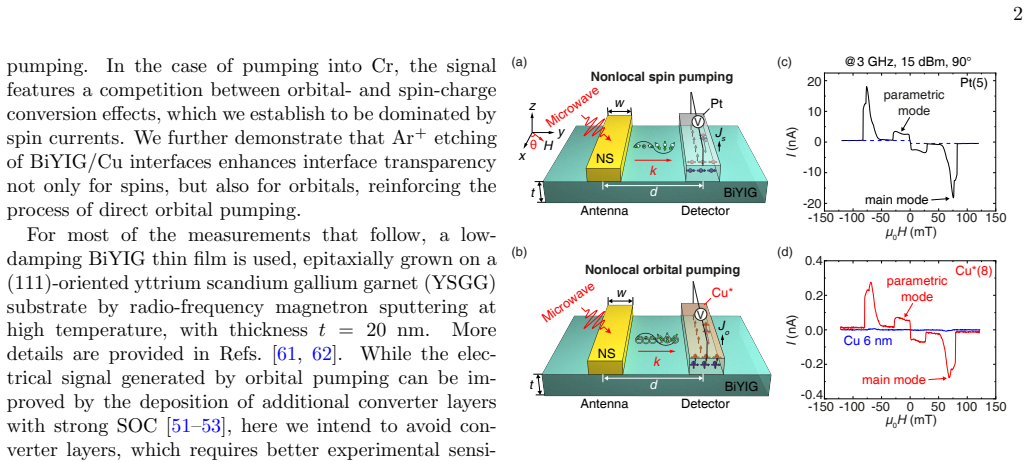
The load-bearing mechanism is the precessing orbital magnetization of the ferrimagnetic insulator BiYIG, which acts as a source of orbital angular-momentum current; its finite orbital character is indicated by the g-factor exceeding 2. The detection is carried out by the inverse orbital Rashba-Edelstein effect at a Cu/CuOx interface, which converts an orbital current into a transverse charge voltage without requiring spin-to-charge conversion. The experimental platform is a nonlocal nano-stripe device in which a microwave antenna excites both coherent propagating magnons and thermal magnons in BiYIG, and separate detector stripes of Pt, Cr, pure Cu, and naturally oxidized Cu convert the pumped angular-momentum currents; comparing signal sizes and signs across detectors separates the orbital and spin channels.
What would settle it
Insert a 1–2 nm spacer between BiYIG and Cu* that is known to transmit spin currents but block orbital currents, and measure the nonlocal converted voltage; if the pure-orbital signal survives, the claim that it comes from direct orbital pumping is falsified.
Extended reading notes
Core claim
The core claim is that the orbital component of magnetization dynamics in BiYIG directly pumps a pure orbital current into an adjacent metal, detected as a charge voltage via the inverse orbital Rashba-Edelstein effect at a Cu/CuOx interface. The evidence is comparative: BiYIG/Cu* shows a large coherent and thermal signal; YIG/Cu* is small; pure Cu detectors are negligible; and Cr detectors, which have opposite signs for spin and orbital Hall conductivities, give a negative signal, showing that spin pumping still dominates the total angular-momentum current. Because BiYIG is an insulator and because the g-factor of BiYIG (about 2.03) is larger than that of YIG (about 2.01), the authors assign the orbital signal to the finite orbital magnetization of BiYIG itself. They further show that Ar+ etching of the interface enhances both spin and orbital pumping efficiencies by roughly an order of magnitude.
Load-bearing premise
The argument stands on the premise that spin-to-orbital conversion requires conduction electrons, so a spin current leaving an insulator cannot become an orbital current at the copper interface; if the metal interface could perform that conversion, the Cu* signal would not by itself prove that the orbital current originated from the insulator's magnetization dynamics.
Editorial extensions
If this is right
- Orbital currents can be generated and detected from insulating magnon systems without converter layers, extending orbitronics beyond metallic magnets.
- Naturally oxidized Cu acts as a near-pure orbital detector, giving a simple experimental way to separate orbital from spin transport.
- In BiYIG the orbital current is a minority component of the pumped angular-momentum current, since Cr detectors show the negative spin Hall effect dominating the positive orbital Hall effect.
- Interface treatments such as Ar+ etching improve transparency for both spin and orbital currents, increasing pumping efficiencies by about an order of magnitude.
- Doping that increases orbital magnetization, such as Bi substitution in YIG, is a practical handle for turning on orbital pumping from an insulator.
Reading between the lines
- The same nonlocal pumping geometry could be used to search for orbital pumping in other insulators with finite orbital moments, including antiferromagnetic insulators; the paper's note added points to recent terahertz evidence from alpha-Fe2O3 that supports this direction.
- The paper does not derive a quantitative scaling of the orbital pumping amplitude with the g-factor shift; measuring a Bi-substitution series would test whether the signal tracks the orbital moment and would harden the direct-pumping assignment.
- Because spin currents dominate in BiYIG, devices that want pure orbital currents may need to suppress spin transmission through interface engineering rather than simply maximize total transparency.
- If orbital and spin mixing conductances respond differently to surface treatments, then Ar+ etching could be used to tune the orbital-to-spin ratio of the pumped current, a possibility the paper leaves open.
Editorial analysis
A structured set of objections, weighed in public.
Referee Report
Summary. The paper reports experiments on nonlocal angular-momentum pumping from the ferrimagnetic insulator BiYIG into nanoscale detectors made of Pt, Cr, Cu, and naturally oxidized Cu (Cu*). The authors claim to detect pure orbital currents generated by both coherent and thermal magnons in BiYIG, and attribute the signal to direct orbital pumping from the orbital magnetization dynamics of BiYIG rather than to spin-to-orbital conversion. Evidence includes the contrast between Cu* (large signal) and pure Cu (negligible signal), the comparison between BiYIG and unsubstituted YIG (negligible in YIG), the sign analysis for Cr detectors, and the enhancement of signals upon Ar+ etching of the garnet/metal interface.
Significance. If the interpretation is correct, the paper provides the first demonstration of direct orbital pumping from a magnetic insulator without a converter layer, establishing the orbital magnetization dynamics of BiYIG as a source of pure orbital currents. The experimental methodology, based on broad-wavevector nonlocal pumping, enables detection of small signals and is supported by multiple controls: Cu vs Cu*, YIG vs BiYIG, angle and power dependence, and Cr sign analysis. The data are made openly available. The central claim is important for orbitronics and magnon transport, and the experimental approach is a useful contribution even independently of the interpretation.
major comments (3)
- [Introduction and section 3 (paragraph beginning "These results lead to two important deductions")] The argument that spin-to-orbital conversion cannot occur because "the latter process is not active in insulators due to the absence of conduction electrons" addresses conversion only inside the insulator. It does not rule out conversion of the pumped spin current into an orbital current at the metallic Cu/CuOx detector interface or within the Cu layer, where conduction electrons and interfacial spin-orbit coupling are present. The Cr result shows that spin currents are the majority angular-momentum channel pumped from BiYIG, so a spin-to-orbital conversion in the detector would produce the same charge signal as direct orbital pumping. The YIG/Cu* control is the only empirical guard against this alternative, but its validity requires that YIG injects a spin current comparable in magnitude to BiYIG through a comparable interface. The paper does not provide a direct measurement of the spin mixing conductance for YIG/Cu* versus BiYIG/Cu*, nor does it quantify the upper bound on the YIG/Cu* signal against the signal expected if Cu* converted spin to orbital with a realistic efficiency. Please provide either a YIG/Cu(5)/Pt(5) control with the same etched interface to establish comparable spin injection, or a quantitative estimate of the expected YIG/Cu* signal under the spin-to-orbital-conversion hypothesis and show that the observed null lies well below that expectation.
- [Section 3, Fig. 3 and accompanying text] The normalization of coherent and thermal pumping signals by α_eff^2 and α, respectively, accounts for differences in damping, but it implicitly assumes that the spin mixing conductance (and thus the proportionality constant between precession angle and pumped spin current) is the same for YIG and BiYIG. The paper states that unequal magnetic dissipation is considered, but the spin mixing conductance can differ between YIG and BiYIG due to different electronic structure, lattice matching, and interface properties. If the spin current injected by YIG into Cu* is much smaller than that from BiYIG after the stated normalizations, the null YIG/Cu* signal would be consistent with spin-to-orbital conversion in the detector rather than with the absence of direct orbital pumping. Please provide evidence, for instance from a Cu(5)/Pt(5) detector on YIG with the same etched interface, that the spin injection efficiency from YIG is comparable to that from BiYIG after the α normalizations, or explicitly discuss the uncertainty introduced by unknown mixing-conductance ratios.
- [Section 3, sentence beginning "Furthermore, a Cu(5)/Pt(5) detector with an identically etched interface"] The text states that a Cu(5)/Pt(5) detector with an identically etched interface exhibits a large signal, thereby ensuring that interfacial transparency in the YIG or BiYIG/Cu or Cu* devices is substantial. However, the sentence does not specify whether this Cu(5)/Pt(5) control was fabricated on YIG, on BiYIG, or on both. If the control was performed only on BiYIG, it does not constrain the YIG/Cu* interface transparency, and the vanishing YIG/Cu* signal could be due to a poor YIG/Cu* interface rather than to the absence of spin-to-orbital conversion in Cu*. Please clarify which interfaces were used for this control and, if not already done, provide the equivalent YIG/Cu(5)/Pt(5) measurement.
minor comments (5)
- [Section 3] There is a typo: "unsubtituted YIG" should be "unsubstituted YIG".
- [Reference list] Reference [94] (Lyalin and Kawakami, "Interface transparency to orbital current") is cited as Phys. Rev. B 110, 104418 (2014); the volume number 110 corresponds to 2024, so the year should be corrected to 2024.
- [Figure 3] The axis labels in Fig. 3 (e.g., "α2effκp (10-6 × nA/mW)") are difficult to read because of the mix of superscripts and Greek letters; please format them more clearly, for example with explicit multiplication symbols and parentheses.
- [Figure 4] The ×10 annotations in Fig. 4 are unclear; please specify whether they indicate scaling factors for the plotted values or for the axes, and ensure all panel labels are consistent with the units stated in the text.
- [References] Reference [96] (Huang et al., "Orbital Current Pumping From Ultrafast Light-driven Antiferromagnetic Insulator") lacks volume and page information; please complete the citation.
Circularity Check
No circularity: the central claim rests on a differential YIG/BiYIG measurement and externally established detector properties, not on a self-referential derivation.
full rationale
The paper reports a differential experimental measurement rather than a derivation. It does not derive an equation whose output equals an input: the charge-generation efficiencies kappa_p,SE are directly measured slopes I_p,SE/P, not fitted parameters. The central assignment, direct orbital pumping from BiYIG into Cu*, is supported by the contrast between BiYIG/Cu* (large) and YIG/Cu* (small) after damping normalization, together with the externally established negligible spin-to-charge conversion of CuO_x and the known spin-pumping behavior of YIG. The statement that spin-to-orbital conversion is not active in insulators due to the absence of conduction electrons is an assumption, but it is not used to define the measured signal; the YIG control independently tests the alternative channel empirically. Self-citations, such as the g-factor of BiYIG reported in the Supplementary Material, are corroborated by external literature and are not the sole support for the orbital-magnetization claim. No fitted input is renamed as a prediction and no self-citation chain forces the conclusion. The possible concern that spin-to-orbital conversion at the Cu/CuO_x interface could mimic the signal is a correctness or alternative-explanation issue, not circularity, because it is addressed by a separate control rather than by construction of the observable.
Assumptions & free parameters
assumptions (4)
- domain assumption Spin-to-orbital interconversion is inactive in insulators because they lack conduction electrons.
- domain assumption Naturally oxidized Cu (Cu*) performs strong orbital-to-charge conversion via the inverse orbital Rashba-Edelstein effect and negligible spin-to-charge conversion.
- domain assumption For comparing YIG and BiYIG, coherent pumping efficiency scales as alpha_eff^-2 and thermal (Seebeck) efficiency scales as alpha^-1, with garnet thickness smaller than the magnon relaxation length.
- domain assumption The spin Hall conductivity of Cr is negative and its orbital Hall conductivity is positive, so the sign of the converted current identifies the dominant channel.
Cite this review
Pith. "Pith review of Orbital Pumping in Ferrimagnetic Insulators." pith.science (2026). https://pith.science/paper/5NZTEYVV
@misc{pith2026250611878,
  author       = {Pith},
  title        = {Pith review of: Orbital Pumping in Ferrimagnetic Insulators},
  year         = {2026},
  howpublished = {\url{https://pith.science/paper/5NZTEYVV}},
  note         = {Machine review of arXiv:2506.11878}
}
read the original abstract
We report the detection of pure orbital currents generated by both coherent and thermal magnons in the magnetic insulator Bi-doped yttrium iron garnet (BiYIG). The pumping of orbital and spin currents is jointly investigated in nano-devices made of naturally oxidized Cu, pure Cu, Pt, and Cr. The absence of charge conduction in BiYIG and the negligible spin-to-charge conversion of oxidized Cu allows us to disambiguate the orbital current contribution. Comparative measurements on YIG and BiYIG show that the origin of the orbital pumping in BiYIG/oxidized Cu is the dynamics of the orbital magnetization in the magnetic insulator. In Cr, the pumping signal is dominated by the negative spin Hall effect rather than the positive orbital Hall effect, indicating that orbital currents represent a minority of the total angular momentum current pumped from the magnetic insulator. Our results also evidence that improving the interfacial transparency significantly enhances pumping efficiencies not only for spin, but also for orbital currents.
Figures


Figures from the paper (1 more)

Reference graph
Works this paper leans on
-
[1]
Manchon, J
A. Manchon, J. ˇZelezn´ y, I. M. Miron, T. Jungwirth, J. Sinova, A. Thiaville, K. Garello, and P. Gambardella, Current-induced spin-orbit torques in ferromagnetic and antiferromagnetic systems, Rev. Mod. Phys.91, 035004 (2019)
2019
-
[2]
A. V. Chumak, V. I. Vasyuchka, A. A. Serga, and B. Hillebrands, Magnon spintronics, Nat. Phys.11, 453-461 (2015)
2015
-
[3]
V. E. Demidov, S. Urazhdin, G. de Loubens, O. Klein, V. Cros, A. Anane, and S. O. Demokritov, Magnetization oscillations and waves driven by pure spin currents, Phys. Rep.673, 1-31 (2017)
2017
-
[4]
G. E. W. Bauer, E. Saitoh, and B. J. van Wees, Spin caloritronics, Nat. Mater.11, 391-399 (2012)
2012
-
[5]
Maekawa, T
S. Maekawa, T. Kikkawa, H. Chudo, J. Ieda, and E. Saitoh, Spin and spin current—From fundamentals to recent progress featured, J. Appl. Phys.133, 020902 (2023)
2023
-
[6]
Sinova, S
J. Sinova, S. O. Valenzuela, J. Wunderlich, C. H. Back, and T. Jungwirth, Rev. Mod. Phys.87, 1213-1259 (2015)
2015
-
[7]
Bihlmayer, P
G. Bihlmayer, P. No¨ el, D. V. Vyalikh, E. V. Chulkov, and A. Manchon, Rashba-like physics in condensed matter, Nat. Rev. Phys.4, 642-659 (2022)
2022
-
[8]
D. C. Ralph and M. D. Stiles, Spin transfer torques, J. Magn. Magn. Mater.320, 1190-1216 (2008)
2008
Show all 97 references
-
[9]
Tserkovnyak, A
Y. Tserkovnyak, A. Brataas, G. E. W. Bauer, and B. I. Halperin, Nonlocal magnetization dynamics in ferromag- netic heterostructures, Rev. Mod. Phys.77, 1375 (2005)
2005
-
[10]
Harder, Y
M. Harder, Y. Gui, and C.-M. Hu, Electrical detection 6 of magnetization dynamics via spin rectification effects, Phys. Rep.661, 1-59 (2016)
2016
-
[11]
Yang and P
F. Yang and P. C. Hammel, FMR-driven spin pumping in Y 3Fe5O12-based structures, J. Phys. D: Appl. Phys. 51, 25LT01 (2018)
2018
-
[12]
Tombros, C
N. Tombros, C. Jozsa, M. Popinciuc, H. T. Jonkman, and B. J. van Wees, Electronic spin transport and spin precession in single graphene layers at room temperature, Nature448, 571-574 (2007)
2007
-
[13]
Kajiwara, K
Y. Kajiwara, K. Harii, S. Takahashi, J. Ohe, K. Uchida, M. Mizuguchi, H. Umezawa, H. Kawai, K. Ando, K. Takanashi, S. Maekawa, and E. Saitoh, Transmission of electrical signals by spin-wave interconversion in a mag- netic insulator, Nature464, 262-266 (2010)
2010
-
[14]
I. M. Miron, K. Garello, G. Gaudin, P. J. Zermatten, M. V. Costache, S. Auffret, S. Bandiera, B. Rodmacq, A. Schuhl, and P. Gambardella, Perpendicular switching of a single ferromagnetic layer induced by in-plane current injection, Nature476, 189-193 (2011)
2011
-
[15]
T. Yang, T. Kimura, and Y. Otani, Giant spin- accumulation signal and pure spin-current-induced re- versible magnetization switching, Nat. Phys.4, 851-854 (2008)
2008
-
[16]
L. Liu, C. F. Pai, Y. Li, H. W. Tseng, D. C. Ralph, R. A. Buhrman, Spin-torque switching with the giant spin Hall effect of tantalum, Science336(6081), 555-558 (2012)
2012
-
[17]
Caretta, M
L. Caretta, M. Mann, F. B¨ uttner, K. Ueda, B. Pfau, C. M. G¨ unther, P. Hessing, A. Churikova, C. Klose, M. Schneider, D. Engel, C. Marcus, D. Bono, K. Bagschik, S. Eisebitt, and G. S. D. Beach, Fast current-driven domain walls and small skyrmions in a compensated ferrimagnet...
2018
-
[18]
Grimaldi, V
E. Grimaldi, V. Krizakova, G. Sala, F. Yasin, S. Couet, G. S. Kar, K. Garello, and P. Gambardella, Single-shot dynamics of spin–orbit torque and spin transfer torque switching in three-terminal magnetic tunnel junctions, Nat. Nanotechnol.15, 111-117 (2020)
2020
-
[19]
Torrejon, M
J. Torrejon, M. Riou, F. A. Araujo, S. Tsunegi, G. Khalsa, D. Querlioz, P. Bortolotti, V. Cros, K. Yakushiji, A. Fukushima, H. Kubota, S. Yuasa, M. D. Stiles, and J. Grollier, Neuromorphic computing with nanoscale spin- tronic oscillators, Nature547, 428 (2017)
2017
-
[20]
Krizakova, M
V. Krizakova, M. Perumkunnil, S. Couet, P. Gam- bardella, and K. Garello, Spin-orbit torque switching of magnetic tunnel junctions for memory applications, J. Magn. Magn. Mater.562, 169692 (2022)
2022
-
[21]
J. Z. Sun, Spin-transfer torque switched magnetic tun- nel junction for memory technologies, J. Magn. Magn. Mater.559, 169479 (2022)
2022
-
[22]
Bl¨ asing, A
R. Bl¨ asing, A. A. Khan, P. Ch. Filippou, C. Garg, F. Hameed, and J. Castrillon, Magnetic Racetrack Mem- ory: From Physics to the Cusp of Applications Within a Decade, Proceedings of the IEEE108, 1303-1321 (2020)
2020
-
[23]
Z. Luo, A. Hrabec, T. P. Dao, G. Sala, S. Finizio, J. Feng, S. Mayr, J. Raabe, P. Gambardella, and L. J. Hey- derman, Current-driven magnetic domain-wall logic, Na- ture579, 214-218 (2020)
2020
-
[24]
B. A. Bernevig, T. L. Hughes, and S. C. Zhang, Orbi- tronics: The intrinsic orbital current in p-doped silicon, Phys. Rev. Lett.95, 066601 (2005)
2005
-
[25]
Tanaka, H
T. Tanaka, H. Kontani, M. Naito, T. Naito, D. S. Hi- rashima, K. Yamada, and J. Inoue, Intrinsic spin Hall effect and orbital Hall effect in 4d and 5d transition met- als, Phys. Rev. B77, 165117 (2008)
2008
-
[26]
Kontani, T
H. Kontani, T. Tanaka, D. S. Hirashima, K. Yamada, and J. Inoue, Giant orbital Hall effect in transition metals: Origin of large spin and anomalous Hall effects, Phys. Rev. Lett.102, 016601 (2009)
2009
-
[27]
D. Go, D. Jo, C. Kim, and H.-W. Lee, Intrinsic Spin and Orbital Hall Effects from Orbital Texture, Phys. Rev. Lett.121, 086602 (2018)
2018
-
[28]
Han, H.-W
S. Han, H.-W. Lee, and K.-W. Kim, Orbital Dynamics in Centrosymmetric Systems, Phys. Rev. Lett.128, 176601 (2022)
2022
-
[29]
Salemi and P
L. Salemi and P. M. Oppeneer, First-principles theory of intrinsic spin and orbital Hall and Nernst effects in metal- lic monoatomic crystals, Phys. Rev. Mater.6, 095001 (2022)
2022
-
[30]
Pezo, J.-M
A. Pezo, J.-M. George, and H. Jaffr´ es, Theory of spin and orbital charge conversion at the surface states of Bi1−xSbx topological insulator, arXiv:2407.03120 (2024)
2024 arXiv
-
[31]
Y.-G. Choi, D. Jo, K.-H. Ko, D. Go, K.-H. Kim, H. G. Park, C. Kim, B.-C. Min, G.-M. Choi, and H.-W. Lee, Observation of the orbital Hall effect in a light metal Ti, Nature619, 52-56 (2023)
2023
-
[32]
Lyalin, S
I. Lyalin, S. Alikhah, M. Berritta, P. M. Oppeneer, and R. K. Kawakami, Magneto-Optical Detection of the Or- bital Hall Effect in Chromium, Phys. Rev. Lett.131, 156702 (2023)
2023
-
[33]
G. Sala, H. Wang, W. Legrand, and P. Gambardella, Or- bital Hanle Magnetoresistance in a 3d Transition Metal, Phys. Rev. Lett.131, 156703 (2023)
2023
-
[34]
S. Ding, Z. Liang, D. Go, C. Yun, M. Xue, Z. Liu, S. Becker, W. Yang, H. Du, C. Wang, Y. Yang, G. Jakob, M. Kl¨ aui, Y. Mokrousov, and J. Yang, Observation of the Orbital Rashba-Edelstein Magnetoresistance, Phys. Rev. Lett.128, 067201 (2022)
2022
-
[35]
Go and H.-W
D. Go and H.-W. Lee, Orbital torque: Torque generation by orbital current injection, Phys. Rev. Res.2, 013177 (2020)
2020
-
[36]
T. Gao, A. Qaiumzadeh, H. An, A. Musha, Y. Kageyama, J. Shi, and K. Ando, Intrinsic spin-orbit torque arising from the Berry curvature in a metallic-magnet/Cu-oxide interface, Phys. Rev. Lett.121, 017202 (2018)
2018
-
[37]
D. Go, D. Jo, K.-W. Kim, S. Lee, M.-G. Kang, B.-G. Park, S. Bl¨ ugel, H.-W. Lee, and Y. Mokrousov, Long- Range Orbital Torque by Momentum-Space Hotspots, Phys. Rev. Lett.130, 246701 (2023)
2023
-
[38]
Hayashi, D
H. Hayashi, D. Jo, D. Go, T. Gao, S. Haku, Y. Mokrousov, H.-W. Lee, and K. Ando, Observation of long-range orbital transport and giant orbital torque, Commun. Phys.6, 32 (2023)
2023
-
[39]
D. Lee, D. Go, H.-J. Park, W. Jeong, H.-W. Ko, D. Yun, D. Jo, S. Lee, G. Go, J. H. Oh, K.-J. Kim, B.-G. Park, B.-C. Min, H. C. Koo, H.-W. Lee, O. Lee, and K.-J. Lee, Orbital torque in magnetic bilayers, Nat. Commun.12, 6710 (2021)
2021
-
[40]
Sala and P
G. Sala and P. Gambardella, Giant orbital Hall effect and orbital-to-spin conversion in 3d, 5d, and 4f metallic heterostructures, Phys. Rev. Res.4, 033037 (2022)
2022
-
[41]
S. Ding, A. Ross, D. Go, L. Baldrati, Z. Ren, F. Freimuth, S. Becker, F. Kammerbauer, J. Yang, G. Jakob, Y. Mokrousov, and M. Kl¨ aui, Harnessing Orbital-to-Spin Conversion of Interfacial Orbital Currents for Efficient Spin-Orbit Torques, Phys. Rev. Lett.125, 177201 (2020)
2020
-
[42]
Lee, M.-G
S. Lee, M.-G. Kang, D. Go, D. Kim, J.-H. Kang, T. Lee, G.-H. Lee, J. Kang, N. J. Lee, Y. Mokrousov, S. Kim, K.- J. Kim, K.-J. Lee, and B.-G. Park, Efficient conversion of 7 orbital Hall current to spin current for spin-orbit torque switching, Commun. Phys.4, 234 (2021)
2021
-
[43]
S. A. Nikolaev, M. Chshiev, F. Ibrahim, S. Krishnia, N. Sebe, J.-M. George, V. Cros, H. Jaffr´ es, and A. Fert, Large chiral orbital texture and orbital Edelstein effect in Co/Al heterostructure, Nano Lett.24, 13465–13472 (2024)
2024
-
[44]
Ding, M.-G
S. Ding, M.-G. Kang, W. Legrand, and P. Gambardella, Orbital Torque in Rare-Earth Transition-Metal Ferri- magnets, Phys. Rev. Lett.132, 236702 (2024)
2024
-
[45]
Z. C. Zheng, Q. X. Guo, D. Jo, D. Go, L. H. Wang, H. C. Chen, W. Yin, X. M. Wang, G. H. Yu, W. He, H.- W. Lee, J. Teng, and T. Zhu, Magnetization switching driven by current-induced torque from weakly spin-orbit coupled Zr, Phys. Rev. Res.2, 013127 (2020)
2020
-
[46]
Y. Yang, P. Wang, J. Chen, D. Zhang, C. Pan, S. Hu, T. Wang, W. Yue, C. Chen, W. Jiang, L. Zhu, X. Qiu, Y. Yao, Y. Li, W. Wang, and Y. Jiang, Orbital torque switching in perpendicularly magnetized materials, Nat. Commun.15, 8645 (2024)
2024
-
[47]
D. Go, K. Ando, A. Pezo, S. Bl¨ ugel, A. Manchon, and Y. Mokrousov, Orbital Pumping by Magnetization Dynam- ics in Ferromagnets, arXiv:2309.14817 (2023)
2023 arXiv
-
[48]
S. Han, H. W. Ko, J. H. Oh, H. W. Lee, K. J. Lee, and K. W. Kim, Theory of Orbital Pumping, arXiv:2311.00362 (2023)
2023 arXiv
-
[49]
Hayashi, D
H. Hayashi, D. Go, S. Haku, Y. Mokrousov, K. Ando, Observation of orbital pumping, Nat. Electron.7, 646- 652 (2024)
2024
-
[50]
El Hamdi, J.-Y
A. El Hamdi, J.-Y. Chauleau, M. Boselli, C. Thibault, C. Gorini, A. Smogunov, C. Barreteau, S. Gariglio, J.- M. Triscone, and M. Viret, Observation of the orbital In- verse Rashba-Edelstein effect, Nat. Phys.19, 1855-1860 (2023)
2023
-
[51]
Santos, J
E. Santos, J. E. Abr˜ ao, A. S. Vieira, J. B. S. Mendes, R. L. Rodr ´ ıguez-Su´ arez, and A. Azevedo, Exploring orbital- charge conversion mediated by interfaces with CuO x, Phys. Rev. B109, 014420 (2024)
2024
-
[52]
Santos, J
E. Santos, J. E. Abr˜ ao, Dongwook Go, L. K. de Assis, Yuriy Mokrousov, J. B. S. Mendes, and A. Azevedo, In- verse Orbital Torque via Spin-Orbital Intertwined States, Phys. Rev. Applied19, 014069 (2023)
2023
-
[53]
E. S. Santos, J. E. Abr˜ ao, J. L. Costa, J. G. S. San- tos, K. R. Mello, A. S. Vieira, T. C. R. Rocha, T. J. A. Mori, R. O. R. Cunha, J. B. S. Mendes, and A. Azevedo, Bulk and Interface Effects Based on Rashba-like States in Ti and Ru Nanoscale-Thick Films: Implications for O...
2024
-
[54]
J. A. Mendoza-Rodarte, M. Cosset-Ch´ eneau, B. J. van Wees, and M. H. D. Guimar˜ aes, Efficient Magnon In- jection and Detection via the Orbital Rashba-Edelstein Effect, Phys. Rev. Lett.132, 226704 (2024)
2024
-
[55]
J. Kim, J. Uzuhashi, M. Horio, T. Senoo, D. Go, D. Jo, T. Sumi, T. Wada, I. Matsuda, T. Ohkubo, S. Mitani, H. W. Lee, and Y. Otani, Oxide layer dependent orbital torque efficiency in ferromagnet/Cu/oxide heterostruc- tures, Phys. Rev. Mater.7, L111401 (2023)
2023
-
[56]
Kageyama, Y
Y. Kageyama, Y. Tazaki, H. An, T. Harumoto, T. Gao, J. Shi, and K. Ando, Spin-Orbit Torque Manipulated by Fine-Tuning of Oxygen-Induced Orbital Hybridization, Sci. Adv.5, eaax4278 (2019)
2019
-
[57]
D. Go, D. Jo, T. Gao, K. Ando, S. Bl¨ ugel, H.-W. Lee, and Y. Mokrousov, Orbital Rashba Effect in a Surface- Oxidized Cu Film, Phys. Rev. B103, L121113 (2021)
2021
-
[58]
J. Kim, D. Go, H. S. Tsai, D. Jo, K. Kondou, H. W. Lee, and Y. Otani, Nontrivial torque generation by orbital angular momentum injection in ferromagnetic- metal/Cu/Al/O trilayers, Phys. Rev. B103, L020407 (2021)
2021
-
[59]
Krishnia, B
S. Krishnia, B. Bony, E. Rongione, L. M. Vicente-Arche, T. Denneulin, A. Pezo, Y. Lu, R. E. Dunin-Borkowski, S. Collin, A. Fert, J. M. George, N. Reyren, V. Cros, and H. Jaffr´ es, Quantifying the large contribution from orbital Rashba-Edelstein effect to the effective damping...
2024
-
[60]
S. Ding, H. Wang, W. Legrand, P. No¨ el, and P. Gambardella, Mitigation of Gilbert Damping in the CoFe/CuOx Orbital Torque System, Nano Lett.24, 33, 10251-10257 (2024)
2024
-
[61]
Legrand, Y
W. Legrand, Y. Kemna, S. Sch¨ aren, H. Wang, D. Pet- rosyan, L. Siegl, R. Schlitz, M. Lammel, and P. Gam- bardella, Lattice-tunable substituted iron garnets for low-temperature magnonics, arxiv: 2407.06850 (2024)
2024 arXiv
-
[62]
See Supplementary Material for: Sample growth and characterization; Fabrication details of metallic nano- stripe; Rationale for non-local measurements; Estimation of magnetic resonance-induced heating power; Angle- and frequency-dependent currents in Cu* 8 nm; The details of m...
-
[63]
B. A. Kalinikos and A. N. Slavin, Theory of dipole- exchange spin wave spectrum for ferromagnetic films with mixed exchange boundary conditions, J. Phys. C: Solid State Phys.19, 7013 (1986)
1986
-
[64]
Mosendz, J
O. Mosendz, J. E. Pearson, F. Y. Fradin, G. E. W. Bauer, S. D. Bader, and A. Hoffmann, Quantifying Spin Hall Angles from Spin Pumping: Experiments and Theory, Phys. Rev. Lett.104, 046601 (2010)
2010
-
[65]
S. M. Rezende, R. L. Rodr ´ ıguez-Su´ arez, R. O. Cunha, A. R. Rodrigues, F. L. A. Machado, G. A. Fonseca Guerra, J. C. Lopez Ortiz, and A. Azevedo, Magnon spin-current theory for the longitudinal spin-Seebeck effect, Phys. Rev. B89, 014416 (2014)
2014
-
[66]
Chang, P
H. Chang, P. A. Praveen Janantha, J. Ding, T. Liu, K. Cline, J. N. Gelfand, W. Li, M. C. Marconi, and M. Wu, Role of damping in spin Seebeck effect in yttrium iron garnet thin films, Sci. Adv.3, e1601614 (2017)
2017
-
[67]
J. Wang, H. Wang, J. Chen, W. Legrand, P. Chen, L. Sheng, J. Xia, G. Lan, Y. Zhang, R. Yuan, J. Dong, X. Han, J.-P. Ansermet, and H. Yu, Broad-wave-vector spin pumping of flat-band magnons, Phys. Rev. Applied21, 044024 (2024)
2024
-
[68]
Foldover
H. Suhl, “Foldover” effects caused by spin wave inter- actions in ferromagnetic resonance, J. Appl. Phys.31, 935-936 (1960)
1960
-
[69]
Elyasi, Y
M. Elyasi, Y. M. Blanter, and G. E. W. Bauer, Resources of nonlinear cavity magnonics for quantum information, Phys. Rev. B101, 054402 (2020)
2020
-
[70]
Ando and E
K. Ando and E. Saitoh, Spin Pumping Driven by Bistable Exchange Spin Waves, Phys. Rev. Lett.109, 026602 (2012)
2012
-
[71]
Q. Wang, R. Verba, B. Heinz, M. Schneider, O. Wojew- 8 oda, K. Dav ´ ıdkov´ a, K. Levchenko, C. Dubs, N. J. Mauser, M. Urb´ anek, P. Pirro, and A. V. Chumak, Deeply non- linear excitation of self-normalized short spin waves, Sci. Adv.9, eadg4609 (2023)
2023
-
[72]
S. Tu, M. Bia lek, Y. Zhang, W. Zhao, H. Yu, and J.-P. Ansermet, Bolometric detection of ferromagnetic reso- nance in YIG slab, J. Magn. Magn. Mater.439, 53–56 (2017)
2017
-
[73]
C. W. Sandweg, Y. Kajiwara, A. V. Chumak, A. A. Serga, V. I. Vasyuchka, M. B. Jungfleisch, E. Saitoh, and B. Hillebrands, Spin Pumping by Parametrically Excited Exchange Magnons, Phys. Rev. Lett.106, 216601 (2011)
2011
-
[74]
Sheng, M
L. Sheng, M. Elyasi, J. Chen, W. He, Y. Wang, H. Wang, H. Feng, Y. Zhang, I. Medlej, S. Liu, W. Jiang, X. Han, D. Yu, J.-P. Ansermet, G. E. W. Bauer, and H. Yu, Non- local Detection of Interlayer Three-Magnon Coupling, Phys. Rev. Lett.130, 046701 (2023)
2023
-
[75]
Uchida, J
K. Uchida, J. Xiao, H. Adachi, J. Ohe, S. Takahashi, J. Ieda, T. Ota, Y. Kajiwara, H. Umezawa, H. Kawai, G. E. W. Bauer, S. Maekawa, and E. Saitoh, Spin Seebeck insulator, Nat. Mater.9, 894–897 (2010)
2010
-
[76]
Rogalev, J
A. Rogalev, J. Goulon, F. Wilhelm, Ch. Brouder, A. Yaresko, J. Ben Youssef, and M.V. Indenbom, Element selective X-ray magnetic circular and linear dichroisms in ferrimagnetic yttrium iron garnet films, J. Magn. Magn. Mater.321, 3945-3962 (2009)
2009
-
[77]
Li and G.-Y
W.-K. Li and G.-Y. Guo, First-principles study on magneto-optical effects in the ferromagnetic semiconduc- tors Y3Fe5O12 and Bi3Fe5O12, Phys. Rev. B103, 014439 (2021)
2021
-
[78]
H. B. Vasili, B. Casals, R. Cichelero, F. Maci´ a, J. Ge- shev, P. Gargiani, M. Valvidares, J. Herrero-Martin, E. Pellegrin, J. Fontcuberta, and G. Herranz, Direct obser- vation of multivalent states and 4f→3dcharge transfer in Ce-doped yttrium iron garnet thin films, Phys. Re...
2017
-
[79]
Cheshire, P
D. Cheshire, P. Bencok, D. Gianolio, G. Cibin, V. K. Lazarov, G. van der Laan, and S. A. Cavill, Absence of Spin-Mixed States in Ferrimagnet Yttrium Iron Garnet, J. Appl. Phys.132, 103902 (2022)
2022
-
[80]
P¨ utter, S
S. P¨ utter, S. Gepr¨ ags, R. Schlitz, M. Althammer, A. Erb, R. Gross, and S. T. B. Goennenwein, Impact of the interface quality of Pt/YIG(111) hybrids on their spin Hall magnetoresistance, Appl. Phys. Lett.110, 012403 (2017)
2017
-
[81]
H. Yang, B. Zhang, X. Zhang, X. Yan, W. Cai, Y. Zhao, J. Sun, K. L. Wang, D. Zhu, and W. Zhao, Giant charge- to-spin conversion efficiency in SrTiO3-based electron gas interface, Phys. Rev. Applied12, 034004 (2019)
2019
-
[82]
Iguchi and E
R. Iguchi and E. Saitoh, Measurement of Spin Pumping Voltage Separated from Extrinsic Microwave Effects, J. Phys. Soc. Jpn.86, 011003 (2017)
2017
-
[83]
J. T. Brangham, K.-Y. Meng, A. S. Yang, J. C. Gal- lagher, B. D. Esser, S. P. White, S. Yu, D. W. McComb, P. C. Hammel, and F. Yang, Thickness dependence of spin Hall angle of Au grown on Y3Fe5O12 epitaxial films, Phys. Rev. B94, 054418 (2016)
2016
-
[84]
Iwasaki, I
Y. Iwasaki, I. Takeuchi, V. Stanev, A. G. Kusne, M. Ishida, A. Kirihara, K. Ihara, R. Sawada, K. Terashima, H. Someya, K. Uchida, E. Saitoh, and S. Yorozu, Machine-learning guided discovery of a new thermoelec- tric material, Sci. Rep.9, 2751 (2019)
2019
-
[85]
C. Du, H. Wang, F. Yang, and P. C. Hammel, En- hancement of pure spin currents in spin pumping Y3Fe5O12/Cu/metal trilayers through spin conductance matching, Phys. Rev. Applied1, 044004 (2014)
2014
-
[86]
L. Bi, J. Hu, P. Jiang, D. H. Kim, G. F. Dionne, L. C. Kimerling, and C. A. Ross, On-chip optical isolation in monolithically integrated non-reciprocal optical res- onators, Nat. Photonics5, 758-762 (2011)
2011
-
[87]
Fakhrul, S
T. Fakhrul, S. Tazlaru, L. Beran, Y. Zhang, M. Veis, and C. A. Ross, Magneto-optical Bi: YIG films with high figure of merit for nonreciprocal photonics, Adv. Opt. Mater.7, 1900056 (2019)
2019
-
[88]
Emori, R
S. Emori, R. E. Maizel, G. T. Street, J. L. Jones, D. A. Arena, P. Shafer, and C. Klewe, Quantifying the Orbital- to-Spin Moment Ratio under Dynamic Excitation, Appl. Phys. Lett.124, 122404 (2024)
2024
-
[89]
Z. Zhu, X. Xu, K. Meng, Y. Wu, and Y. Jiang, Orbital Angular Momentum Contribution to Angular Depen- dent Magnetoresistance in Tm 3Fe5O12/Pt/CuOx Films, Appl. Phys. Lett.124, 222405 (2024)
2024
-
[90]
Z. Zhu, L. Cheng, C. Li, C. Dou, M. Li, K. Meng, Y. Wu, J. Chen, X. Xu, and Y. Jiang, Study on the Magnetore- sistance Caused by Orbital Angular Momentum, IEEE Trans. Magnetics,59, 4400605 (2023)
2023
-
[91]
C. Du, H. Wang, F. Yang, and P. C. Hammel, System- atic variation of spin-orbit coupling withd-orbital fill- ing: Large inverse spin Hall effect in 3dtransition metals, Phys. Rev. B90, 140407(R) (2014)
2014
-
[92]
D. Jo, D. Go, and H.-W. Lee, Gigantic intrinsic orbital Hall effects in weakly spin-orbit coupled metals, Phys. Rev. B98, 214405 (2018)
2018
-
[93]
M. B. Jungfleisch, V. Lauer, R. Neb, A. V. Chumak, and B. Hillebrands, Improvement of the yttrium iron gar- net/platinum interface for spin pumping-based applica- tions, Appl. Phys. Lett.103, 022411 (2013)
2013
-
[94]
Lyalin, R
I. Lyalin, R. K. Kawakami, Interface transparency to or- bital current, Phys. Rev. B110, 104418 (2014)
2014
-
[95]
J. Han, R. Cheng, L. Liu, H. Ohno, and S. Fukami, Coherent antiferromagnetic spintronics, Nat. Mater.22, 684–695 (2023)
2023
-
[96]
Huang, D
L. Huang, D. Tian, L. Liao, H. Qiu, H. Bai, Q. Wang, F. Pan, C. Zhang, B. Jin, and C. Song, Orbital Current Pumping From Ultrafast Light-driven Antiferromagnetic Insulator, Adv. Mater. 2402063 (2024)
2024
-
[97]
Wang, M.-G
H. Wang, M.-G. Kang, D. Petrosyan, S. Ding, R. Schlitz, L. J. Riddiford, W. Legrand, and P. Gambardella, Or- bital pumping in ferrimagnetic insulators, 10.3929/ethz- b-000704982
Reviewed August 7, 2026 · model on record in the stance chip above.
Discussion (0). Sign in to comment.