REVIEW 4 major objections 5 minor 1 cited by
Hilbert subspace imprint: a new mechanism for non-thermalization
T0 review · 4 major / 5 minor · reviewed 2026-08-07 · deepseek-v4-flash
Pith's one-line read Hilbert subspace imprint lets some quantum states sidestep thermalization.
desk verdict A useful diagnostic and engineering protocol for weak ergodicity breaking, but the 'fundamental mechanism' claim outstrips the numerical evidence. read the letter →
The pith
A machine-rendered reading of the paper's core claim, the machinery that carries it, and where it could break.
The reading
What carries the argument
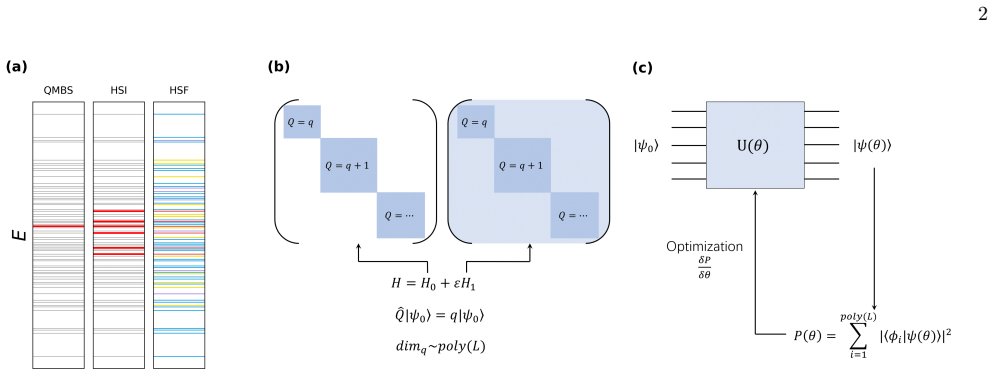
The central object is the Hilbert subspace imprint itself: the subset of eigenstates onto which an initial state projects, together with the diagnostic $N(L)$, defined as the minimum number of eigenstates needed to capture $80\%$ of the initial-state weight. Thermalizing behavior corresponds to $N(L)\sim e^L$, while HSI corresponds to $N(L)\sim\mathrm{poly}(L)$. Two mechanisms carry the construction. Weak symmetry breaking uses a symmetric $H_0$ with polynomially large charge sectors and relies on adiabatic continuity of the relevant eigenstates when a weak symmetry-breaking term is added. Initial-state engineering uses a shallow parameterized circuit whose angles are varied to maximize the overlap $\sum_{i=1}^{\mathrm{poly}(L)}|\langle\phi_i|\psi(\theta)\rangle|^2$. The proof-of-principle bound on the observable expectation value uses the overlap deficit $\Delta^2$ to control the deviation from non-thermal dynamics, which is what makes HSI detectable by local measurements.
What would settle it
Compute $N(L)$ for the single-spin-flip ferromagnetic state at $\gamma=0.9$ for $L=16,18,20$; exponential growth of the minimum eigenstate count needed to capture $80\%$ of the initial weight would falsify the adiabatic-continuity assumption behind HSI.
Extended reading notes
Core claim
The paper's claim is that Hilbert subspace imprint is a non-thermalization mechanism in its own right, not a special case of quantum many-body scars or Hilbert-space fragmentation. In the weak-symmetry-breaking route, the unperturbed Hamiltonian $H_0$ has a charge sector of dimension $\mathrm{poly}(L)$ that contains the ferromagnetic initial state; adding a weak perturbation $H_1$ leaves the descendant eigenstates adiabatically connected to those of $H_0$, so the initial state keeps its weight on $\mathcal{O}(L)$ eigenstates. Exact diagonalization shows that the ferromagnetic state has essentially constant $N(L)$ and that a single-spin-flip ferromagnetic state has polynomial $N(L)$, while antiferromagnetic states from the same Hamiltonian have exponential $N(L)$ and thermalize; breaking a $\mathbb{Z}_2$ symmetry does not produce HSI because both parity sectors are exponentially large. In the engineered route, a shallow variational circuit is optimized to maximize the overlap with the target subspace, reaching $97\%$ with five layers and near-unity overlap with deeper circuits. A supplementary bound shows that when a fraction $\Delta^2$ of the state leaks outside the subspace, a bounded observable deviates from its non-thermal value only by an amount controlled by $\Delta$, so local measurements can certify the mechanism.
Load-bearing premise
The mechanism assumes that when a small symmetry-breaking term is added, the eigenstates descending from the small symmetry sector stay isolated from the thermal bulk instead of hybridizing with it.
Editorial extensions
If this is right
- Ferromagnetic initial states, including those with a single spin flip, remain non-thermal under weak $U(1)$ breaking, with $N(L)$ constant or polynomial, while antiferromagnetic states thermalize under the same Hamiltonian.
- Weak $\mathbb{Z}_2$ breaking does not generate HSI for the states tested, indicating that the dimension of the symmetry sector controls whether the mechanism operates.
- A shallow variational circuit can concentrate more than $97\%$ of the initial-state weight in an $\mathcal{O}(L)$-sized target subspace, giving an experimentally preparable state with near-perfect HSI.
- HSI gives initial-state-dependent partial fragmentation: only selected eigenstate subspaces remain dynamically closed, without requiring low entanglement, special energy spacings, or an exact decomposition of the full Hilbert space.
- Charge-sector populations and entanglement-entropy dynamics provide experimentally accessible signatures that distinguish HSI from thermalization on current quantum hardware.
Reading between the lines
- This treatment suggests that any Hamiltonian with a symmetry sector of polynomial dimension should display HSI-like non-thermalization when that symmetry is weakly broken, so the two models studied here are instances of a broader design principle.
- One could make the mechanism testable in a sharper way by preparing the variational state and monitoring the full charge-sector distribution at intermediate times; persistent concentration in the small sector would confirm the imprint, while early spreading would reveal the breakdown of adiabatic continuity.
- Because HSI confines the dynamics to a small subspace, it is natural to expect it to interact with symmetry-restoration anomalies such as the quantum Mpemba effect; the paper lists this as an open direction.
- The $N(L)$ diagnostic could be used as a cheap pre-screening tool on small quantum simulators before scaling up, since the scaling class (polynomial or exponential) can be estimated from modest system sizes.
Editorial analysis
A structured set of objections, weighed in public.
Referee Report
Summary. The paper proposes Hilbert subspace imprint (HSI) as a mechanism for non-thermalization: an initial state evades thermalization when it has significant overlap with only a polynomially (in system size) small set of eigenstates. The authors define a diagnostic N(L), the minimum number of eigenstates needed to capture 80% of the initial-state weight, and claim that thermalizing states show N ~ exp(L) while HSI states show N ~ poly(L). They demonstrate HSI in two ways: (i) weak symmetry breaking, where a ferromagnetic state and a single-spin-flip ferromagnetic state in a weakly U(1)-broken spin chain show non-thermal dynamics, while antiferromagnetic states thermalize, and a disordered Z2-broken model shows thermalization for both; and (ii) initial-state engineering, where a variational quantum circuit enhances overlap with a target small eigenstate subspace. The paper interprets HSI as a mechanism that interpolates between quantum many-body scars (QMBS) and Hilbert space fragmentation (HSF).
Significance. If the central claim were firmly established, HSI would provide a useful organizing principle and a simple, computable diagnostic for a class of initial-state-dependent non-thermal behavior. The paper is clearly written, the numerical data are presented in a reproducible style with a stated data-availability link, and the variational-circuit approach gives a concrete experimental route. The distinction between the scar limit (N = O(1)) and multi-state HSI (N = poly(L)) is conceptually appealing. However, the evidence for the mechanism is currently limited: the numerical systems are small (L ≤ 14), the analytical bound in the Supplementary Material assumes the HSI subspace rather than deriving it, and the polynomial-versus-exponential classification rests on an arbitrary 80% threshold and on disorder-averaged data without error bars. The manuscript would be strengthened by a perturbative estimate of the leakage, larger-scale or more careful finite-size analysis, and a sensitivity study of the diagnostic.
major comments (4)
- [Setup, Fig. 3(a)] The Setup states that under weak symmetry breaking 'the eigenstates of the full Hamiltonian H = H0 + H1 remain adiabatically connected to those of H0.' This is the load-bearing step for the weak-symmetry-breaking realization, but it is not proved and no small-parameter estimate is supplied. For the single-spin-flip F state, the H0 charge sector has dimension O(L), so N(L) is bounded by L already at the unperturbed level; the data in Fig. 3(a) for L = 8, 10, 12, 14 cannot distinguish a polynomial trend from an exponential one with a small base. Please provide either an analytic bound on the leakage Delta(L) or a large-L numerical test (for example via tensor-network or Krylov methods) before the mechanism claim is accepted.
- [Supplementary Material, Section IV, Eqs. (S2)-(S14)] The analytical derivation assumes an exact decomposition of the initial state into a component |phi> inside a non-thermal subspace that is invariant under time evolution and a leakage component |phi_perp> outside it, with Delta fixed. Since the HSI subspace is by definition spanned by exact eigenstates of H, this is a restatement of the HSI condition rather than an independent demonstration that weak symmetry breaking produces HSI. The bound also assumes that Delta does not grow with L; without an independent estimate of Delta(L), the derivation does not support the central claim. It would be appropriate to reposition this section as a diagnostic consistency check or to derive Delta(L) from perturbation theory.
- [Setup, definition of N] The 80% threshold used to define N is arbitrary and no sensitivity analysis is provided. Because the entire exponential-versus-polynomial classification rests on the scaling of N, the authors should report N for several thresholds (for instance 50%, 90%, and 95%) and show that the polynomial/exponential distinction is stable. If the classification changes with the threshold, the claim of a robust diagnostic is weakened.
- [Fig. 4 and SM Figs. S4-S5] The disorder-averaged N data are presented as single curves without error bars or any measure of realization-to-realization spread. With 400 realizations the statistical error can in principle be made small, but without such estimates the claimed distinction between polynomial and exponential growth in the disordered Z2 and disordered U(1) models is not quantitatively supported. Please add error bars or a distribution measure (for example, percentiles) to these figures.
minor comments (5)
- [Equation (1)] Equation (1) is not well defined as printed: P_Q(t) is written as a sum over 'q = Q', which is circular. It should presumably be a sum over all basis states in sector Q, or simply the squared overlap with the sector-Q projection. Please rewrite the definition.
- [Abstract and Setup] The abstract says HSI occurs when initial states 'overlap exclusively' with a polynomial set of eigenstates, but the Setup defines approximate HSI as more than 80% weight. These statements are inconsistent and should be aligned, since the 20% leakage is part of the mechanism as analyzed in the SM.
- [Setup, Hamiltonian (2)] The parameter region 1 - gamma = 0.1 is described as 'weak' symmetry breaking, but no quantitative smallness condition is stated. Given that the dynamics at 1 - gamma = 0.1 and 0.7 differ sharply, the text should define what 'weak' means in perturbation-theoretic terms.
- [Data availability, Ref. [99]] The data availability statement refers to Ref. [99], but that reference is given only as 'Data available in zenodo for publication' without a DOI or URL. Please include the actual link so the data are accessible.
- [Fig. 4 caption] The labels F and AF are used for the same initial-state names in different models; please define them explicitly in each figure caption or in a notation table to avoid ambiguity in Fig. 4 and the SM figures.
Circularity Check
No significant circularity: HSI is a definitional organizing concept, but the numerical realizations and the conditional bound are self-contained rather than fitted or self-citation-driven.
full rationale
The paper's central concept, HSI, is defined by the scaling of N, the number of eigenstates capturing 80% of the initial state weight. The analytical derivation in SM Section IV starts from a state already decomposed as mostly inside a small non-thermal eigenstate subspace with small leakage, and derives that expectation values remain close to the non-thermal value. This is a valid conditional consequence of the definition, not an independent mechanism; however, the paper does not use this bound to prove that HSI occurs. The existence of HSI is demonstrated by exact diagonalization numerics for concrete Hamiltonians (N(L), PQ(t), and entanglement entropy), which are independent inputs and not fitted parameters. The weak-symmetry-breaking realization relies on an unproved adiabatic-continuity assumption, stated in the Setup, and the system sizes are limited to L=12-14, so the asymptotic distinction between polynomial and slowly growing exponential scaling is a correctness risk rather than circularity. The initial-state-engineering section optimizes the overlap with a predetermined non-thermal subspace, and the resulting high overlap is the optimization objective itself; the paper presents this as constructive engineering, not as a prediction, so it is not a hidden circular step. Self-citations (e.g., TensorCircuit and quantum Mpemba references) are not load-bearing for the central claim, and no uniqueness theorem is imported from the authors' prior work to force the choice. Overall, the paper's explanatory label is close to its definition, but the numerical phenomena and the conditional bound provide independent content, so no significant circularity is found.
Assumptions & free parameters
free parameters (4)
- 80% weight threshold in N diagnostic =
0.8
- small longitudinal field h =
10^-7
- anisotropy gamma =
0.9 (weak breaking) and 0.3 (strong breaking)
- single spin-flip position at L/2 =
center of chain
assumptions (3)
- domain assumption Eigenstate thermalization hypothesis (ETH) holds for the thermal part of the Hilbert space
- domain assumption Adiabatic continuity of eigenstates under weak symmetry breaking
- domain assumption The subspace spanned by the selected O(L) eigenstates is closed under time evolution (exact eigenstates)
Cite this review
Pith. "Pith review of Hilbert subspace imprint: a new mechanism for non-thermalization." pith.science (2026). https://pith.science/paper/I7RXLBTV
@misc{pith2026250611922,
  author       = {Pith},
  title        = {Pith review of: Hilbert subspace imprint: a new mechanism for non-thermalization},
  year         = {2026},
  howpublished = {\url{https://pith.science/paper/I7RXLBTV}},
  note         = {Machine review of arXiv:2506.11922}
}
read the original abstract
The search for non-ergodic mechanisms in quantum many-body systems has become a frontier area of research in non-equilibrium physics. In this Letter, we introduce Hilbert subspace imprint (HSI)-a novel mechanism that enables evasion of thermalization and bridges the gap between quantum many-body scars (QMBS) and Hilbert space fragmentation (HSF). HSI manifests when initial states overlap exclusively with a polynomial scaling (with system size) set of eigenstates. We demonstrate this phenomenon through two distinct approaches: weak symmetry breaking and initial state engineering. In the former case, we observe that ferromagnetic states including those with a single spin-flip display non-thermal behavior under weak U(1) breaking, while antiferromagnetic states thermalize. In contrast, the Z2-symmetric model shows thermalization for both ferromagnetic and antiferromagnetic states. In the latter case, we engineer the initial state prepared by shallow quantum circuits that enhance the overlap with the small target subspace. Our results establish HSI as a mechanism equally fundamental to non-thermalization as QMBS and HSF.
Figures


Forward citations
Cited by 1 Pith paper
-
Size Operator and Spectral Clustering in the Two Coupled SYK Model
The finite-N spectrum of the two coupled SYK model organizes into operator-size clusters that underlie the conformal towers, revival dynamics, and wormhole-black hole transition.
Reference graph
Works this paper leans on
-
[1]
J. M. Deutsch, Quantum statistical mechanics in a closed system, Physical review A 43, 2046 (1991)
1991
-
[2]
Rigol, V
M. Rigol, V. Dunjko, and M. Olshanii, Thermalization and its mechanism for generic isolated quantum systems, Nature 481, 224 (2012)
2012
-
[3]
Srednicki, Chaos and quantum thermalization, Physical review E 50, 888 (1994)
M. Srednicki, Chaos and quantum thermalization, Physical review E 50, 888 (1994)
1994
-
[4]
D’Alessio, Y
L. D’Alessio, Y. Kafri, A. Polkovnikov, and M. Rigol, From quantum chaos and eigenstate thermalization to statistical mechanics and thermodynamics, Advances in Physics 65, 239 (2016)
2016
-
[5]
J. M. Deutsch, Eigenstate thermalization hypothesis, Reports on Progress in Physics 81, 082001 (2018)
2018
-
[6]
Olshanetsky and A
M. Olshanetsky and A. Perelomov, Quantum integrable systems related to lie algebras, Physics Reports 94, 313 (1983)
1983
-
[7]
Franchini et al
F. Franchini et al. , An introduction to integrable techniques for one-dimensional quantum systems , Vol. 940 (Springer, 2017)
2017
-
[8]
R. J. Baxter, One-dimensional anisotropic heisenberg chain, Annals of Physics 70, 323 (1972)
1972
Show all 107 references
-
[9]
E. H. Lieb and W. Liniger, Exact analysis of an interacting bose gas. i. the general solution and the ground state, Physical Review 130, 1605 (1963)
1963
-
[10]
Bethe, Zur theorie der metalle: I
H. Bethe, Zur theorie der metalle: I. eigenwerte und eigenfunktionen der linearen atomkette, Zeitschrift für Physik 71, 205 (1931)
1931
-
[11]
Nandkishore and D
R. Nandkishore and D. A. Huse, Many-body localization and thermalization in quantum statistical mechanics, Annu. Rev. Condens. Matter Phys. 6, 15 (2015)
2015
-
[12]
Altman and R
E. Altman and R. Vosk, Universal dynamics and renormalization in many-body-localized systems, Annu. Rev. Condens. Matter Phys. 6, 383 (2015)
2015
-
[13]
D. A. Abanin and Z. Papić, Recent progress in many- body localization, Annalen der Physik 529, 1700169 (2017)
2017
-
[14]
D. A. Abanin, E. Altman, I. Bloch, and M. Serbyn, Colloquium: Many-body localization, thermalization, and entanglement, Reviews of Modern Physics 91, 021001 (2019)
2019
-
[15]
Alet and N
F. Alet and N. Laflorencie, Many-body localization: An introduction and selected topics, Comptes Rendus Physique 19, 498 (2018)
2018
-
[16]
Žnidarič, T
M. Žnidarič, T. Prosen, and P. Prelovšek, Many-body localization in the heisenberg xxz magnet in a random field, Physical Review B 77, 064426 (2008)
2008
-
[17]
Pal and D
A. Pal and D. A. Huse, Many-body localization phase transition, Physical Review B 82, 174411 (2010)
2010
-
[18]
S. Iyer, V. Oganesyan, G. Refael, and D. A. Huse, Many- 6 body localization in a quasiperiodic system, Physical Review B 87, 134202 (2013)
2013
-
[19]
Khemani, D
V. Khemani, D. Sheng, and D. A. Huse, Two universality classes for the many-body localization transition, Physical review letters 119, 075702 (2017)
2017
-
[20]
Zhang and H
S.-X. Zhang and H. Yao, Universal properties of many- body localization transitions in quasiperiodic systems, Physical review letters 121, 206601 (2018)
2018
-
[21]
J. H. Bardarson, F. Pollmann, and J. E. Moore, Unbounded growth of entanglement in models of many- body localization, Physical review letters 109, 017202 (2012)
2012
-
[22]
D.-L. Deng, X. Li, J. Pixley, Y.-L. Wu, and S. Das Sarma, Logarithmic entanglement lightcone in many-body localized systems, Physical Review B 95, 024202 (2017)
2017
-
[23]
Huang, Y.-L
Y. Huang, Y.-L. Zhang, and X. Chen, Out-of-time- ordered correlators in many-body localized systems, Annalen der Physik 529, 1600318 (2017)
2017
-
[24]
R. Fan, P. Zhang, H. Shen, and H. Zhai, Out-of-time- order correlation for many-body localization, Science bulletin 62, 707 (2017)
2017
-
[25]
X. Chen, T. Zhou, D. A. Huse, and E. Fradkin, Out-of-time-order correlations in many-body localized and thermal phases, Annalen der Physik 529, 1600332 (2017)
2017
-
[26]
M. C. Bañuls, N. Yao, S. Choi, M. D. Lukin, and J. I. Cirac, Dynamics of quantum information in many-body localized systems, Physical Review B 96, 174201 (2017)
2017
-
[27]
Y.-Q. Chen, S. Liu, and S.-X. Zhang, Subsystem information capacity in random circuits and hamiltonian dynamics, arXiv preprint arXiv:2405.05076 (2024)
2024 arXiv
-
[28]
Serbyn, Z
M. Serbyn, Z. Papić, and D. A. Abanin, Local conservation laws and the structure of the many-body localized states, Physical review letters 111, 127201 (2013)
2013
-
[29]
D. A. Huse, R. Nandkishore, and V. Oganesyan, Phenomenology of fully many-body-localized systems, Physical Review B 90, 174202 (2014)
2014
-
[30]
Berges, S
J. Berges, S. Borsányi, and C. Wetterich, Prethermalization, Physical review letters 93, 142002 (2004)
2004
-
[31]
T. Mori, T. N. Ikeda, E. Kaminishi, and M. Ueda, Thermalization and prethermalization in isolated quantum systems: a theoretical overview, Journal of Physics B: Atomic, Molecular and Optical Physics 51, 112001 (2018)
2018
-
[32]
Mierzejewski, P
M. Mierzejewski, P. Prelovšek, and T. Prosen, Identifying local and quasilocal conserved quantities in integrable systems, Physical Review Letters 114, 140601 (2015)
2015
-
[33]
Ilievski, M
E. Ilievski, M. Medenjak, and T. Prosen, Quasilocal conserved operators in the isotropic heisenberg spin-1/2 chain, Physical review letters 115, 120601 (2015)
2015
-
[34]
S.-K. Jian, S. Yin, and B. Swingle, Universal prethermal dynamics in gross-neveu-yukawa criticality, Physical review letters 123, 170606 (2019)
2019
-
[35]
Kuwahara, T
T. Kuwahara, T. Mori, and K. Saito, Floquet–magnus theory and generic transient dynamics in periodically driven many-body quantum systems, Annals of Physics 367, 96 (2016)
2016
-
[36]
T. Mori, T. Kuwahara, and K. Saito, Rigorous bound on energy absorption and generic relaxation in periodically driven quantum systems, Physical review letters 116, 120401 (2016)
2016
-
[37]
D. A. Abanin, W. De Roeck, W. W. Ho, and F. Huveneers, Effective hamiltonians, prethermalization, and slow energy absorption in periodically driven many-body systems, Physical Review B 95, 014112 (2017)
2017
-
[38]
Serbyn, D
M. Serbyn, D. A. Abanin, and Z. Papić, Quantum many- body scars and weak breaking of ergodicity, Nature Physics 17, 675 (2021)
2021
-
[39]
Chandran, T
A. Chandran, T. Iadecola, V. Khemani, and R. Moessner, Quantum many-body scars: A quasiparticle perspective, Annual Review of Condensed Matter Physics 14, 443 (2023)
2023
-
[40]
Moudgalya, B
S. Moudgalya, B. A. Bernevig, and N. Regnault, Quantum many-body scars and hilbert space fragmentation: A review of exact results, Reports on Progress in Physics 85, 086501 (2022)
2022
-
[41]
C. J. Turner, A. A. Michailidis, D. A. Abanin, M. Serbyn, and Z. Papić, Weak ergodicity breaking from quantum many-body scars, Nature Physics 14, 745 (2018)
2018
-
[42]
Turner, A
C. Turner, A. Michailidis, D. Abanin, M. Serbyn, and Z. Papić, Quantum scarred eigenstates in a rydberg atom chain: Entanglement, breakdown of thermalization, and stability to perturbations, Physical Review B 98, 155134 (2018)
2018
-
[43]
Lesanovsky and H
I. Lesanovsky and H. Katsura, Interacting fibonacci anyons in a rydberg gas, Physical Review A 86, 041601 (2012)
2012
-
[44]
Fendley, K
P. Fendley, K. Sengupta, and S. Sachdev, Competing density-wave orders in a one-dimensional hard-boson model, Physical Review B 69, 075106 (2004)
2004
-
[45]
Bernien, S
H. Bernien, S. Schwartz, A. Keesling, H. Levine, A. Omran, H. Pichler, S. Choi, A. S. Zibrov, M. Endres, M. Greiner, et al. , Probing many-body dynamics on a 51-atom quantum simulator, Nature 551, 579 (2017)
2017
-
[46]
F. M. Surace, P. P. Mazza, G. Giudici, A. Lerose, A. Gambassi, and M. Dalmonte, Lattice gauge theories and string dynamics in rydberg atom quantum simulators, Physical Review X 10, 021041 (2020)
2020
-
[47]
Iadecola, M
T. Iadecola, M. Schecter, and S. Xu, Quantum many- body scars from magnon condensation, Physical Review B 100, 184312 (2019)
2019
-
[48]
Lin and O
C.-J. Lin and O. I. Motrunich, Exact quantum many- body scar states in the rydberg-blockaded atom chain, Physical review letters 122, 173401 (2019)
2019
-
[49]
Rozon, M
P.-G. Rozon, M. J. Gullans, and K. Agarwal, Constructing quantum many-body scar hamiltonians from floquet automata, Physical Review B 106, 184304 (2022)
2022
-
[50]
Giudici, F
G. Giudici, F. M. Surace, and H. Pichler, Unraveling pxp many-body scars through floquet dynamics, Physical Review Letters 133, 190404 (2024)
2024
-
[51]
Windt and H
B. Windt and H. Pichler, Squeezing quantum many- body scars, Physical Review Letters 128, 090606 (2022)
2022
-
[52]
Szołdra, P
T. Szołdra, P. Sierant, M. Lewenstein, and J. Zakrzewski, Unsupervised detection of decoupled subspaces: many-body scars and beyond, Physical Review B 105, 224205 (2022)
2022
-
[53]
Ljubotina, J.-Y
M. Ljubotina, J.-Y. Desaules, M. Serbyn, and Z. Papić, Superdiffusive energy transport in kinetically constrained models, Physical Review X 13, 011033 (2023). 7
2023
-
[54]
Desaules, A
J.-Y. Desaules, A. Hudomal, D. Banerjee, A. Sen, Z. Papić, and J. C. Halimeh, Prominent quantum many- body scars in a truncated schwinger model, Physical Review B 107, 205112 (2023)
2023
-
[55]
Desaules, D
J.-Y. Desaules, D. Banerjee, A. Hudomal, Z. Papić, A. Sen, and J. C. Halimeh, Weak ergodicity breaking in the schwinger model, Physical Review B 107, L201105 (2023)
2023
-
[56]
Kerschbaumer, M
A. Kerschbaumer, M. Ljubotina, M. Serbyn, and J.-Y. Desaules, Quantum many-body scars beyond the pxp model in rydberg simulators, Physical Review Letters 134, 160401 (2025)
2025
-
[57]
H.-R. Wang, D. Yuan, S.-Y. Zhang, Z. Wang, D.-L. Deng, and L.-M. Duan, Embedding quantum many- body scars into decoherence-free subspaces, Physical Review Letters 132, 150401 (2024)
2024
-
[58]
Zhang, D
S.-Y. Zhang, D. Yuan, T. Iadecola, S. Xu, and D.-L. Deng, Extracting quantum many-body scarred eigenstates with matrix product states, Physical Review Letters 131, 020402 (2023)
2023
-
[59]
J. Ren, C. Liang, and C. Fang, Quasisymmetry groups and many-body scar dynamics, Physical Review Letters 126, 120604 (2021)
2021
-
[60]
Moudgalya, N
S. Moudgalya, N. Regnault, and B. A. Bernevig, ¸- pairing in hubbard models: From spectrum generating algebras to quantum many-body scars, Physical Review B 102, 085140 (2020)
2020
-
[61]
J. Ren, A. Hallam, L. Ying, and Z. Papić, Scarfinder: a detector of optimal scar trajectories in quantum many-body dynamics, arXiv preprint arXiv:2504.12383 (2025)
2025
-
[62]
K. Bull, A. Hallam, Z. Papić, and I. Martin, Tuning between continuous time crystals and many-body scars in long-range xyz spin chains, Physical Review Letters 129, 140602 (2022)
2022
-
[63]
Gotta, S
L. Gotta, S. Moudgalya, and L. Mazza, Asymptotic quantum many-body scars, Physical Review Letters 131, 190401 (2023)
2023
-
[64]
Z. Yao, L. Pan, S. Liu, and H. Zhai, Quantum many- body scars and quantum criticality, Physical Review B 105, 125123 (2022)
2022
-
[65]
Ren, Y.-P
J. Ren, Y.-P. Wang, and C. Fang, Quasi-nambu- goldstone modes in many-body scar models, Physical Review B 110, 245101 (2024)
2024
-
[66]
J. Ren, C. Liang, and C. Fang, Deformed symmetry structures and quantum many-body scar subspaces, Physical Review Research 4, 013155 (2022)
2022
-
[67]
P. Sala, T. Rakovszky, R. Verresen, M. Knap, and F. Pollmann, Ergodicity breaking arising from hilbert space fragmentation in dipole-conserving hamiltonians, Physical Review X 10, 011047 (2020)
2020
-
[68]
Khemani, M
V. Khemani, M. Hermele, and R. Nandkishore, Localization from hilbert space shattering: From theory to physical realizations, Physical Review B 101, 174204 (2020)
2020
-
[69]
Scherg, T
S. Scherg, T. Kohlert, P. Sala, F. Pollmann, B. Hebbe Madhusudhana, I. Bloch, and M. Aidelsburger, Observing non-ergodicity due to kinetic constraints in tilted fermi-hubbard chains, Nature Communications 12, 4490 (2021)
2021
-
[70]
Z.-C. Yang, F. Liu, A. V. Gorshkov, and T. Iadecola, Hilbert-space fragmentation from strict confinement, Physical review letters 124, 207602 (2020)
2020
-
[71]
Herviou, J
L. Herviou, J. H. Bardarson, and N. Regnault, Many-body localization in a fragmented hilbert space, Physical Review B 103, 134207 (2021)
2021
-
[72]
D. Hahn, P. A. McClarty, and D. J. Luitz, Information dynamics in a model with hilbert space fragmentation, SciPost Physics 11, 074 (2021)
2021
-
[73]
Moudgalya and O
S. Moudgalya and O. I. Motrunich, Hilbert space fragmentation and commutant algebras, Physical Review X 12, 011050 (2022)
2022
-
[74]
Moudgalya, A
S. Moudgalya, A. Prem, R. Nandkishore, N. Regnault, and B. A. Bernevig, Thermalization and its absence within krylov subspaces of a constrained hamiltonian, in Memorial Volume for Shoucheng Zhang (World Scientific, 2022) pp. 147–209
2022
-
[75]
S. Pai, M. Pretko, and R. M. Nandkishore, Localization in fractonic random circuits, Physical Review X 9, 021003 (2019)
2019
-
[76]
De Tomasi, D
G. De Tomasi, D. Hetterich, P. Sala, and F. Pollmann, Dynamics of strongly interacting systems: From fock-space fragmentation to many-body localization, Physical Review B 100, 214313 (2019)
2019
-
[77]
C. M. Langlett and S. Xu, Hilbert space fragmentation and exact scars of generalized fredkin spin chains, Physical Review B 103, L220304 (2021)
2021
-
[78]
Richter and A
J. Richter and A. Pal, Anomalous hydrodynamics in a class of scarred frustration-free hamiltonians, Physical Review Research 4, L012003 (2022)
2022
-
[79]
Zadnik and M
L. Zadnik and M. Fagotti, The folded spin-1/2 xxz model: I. diagonalisation, jamming, and ground state properties, SciPost Physics Core 4, 010 (2021)
2021
-
[80]
Read and H
N. Read and H. Saleur, Enlarged symmetry algebras of spin chains, loop models, and s-matrices, Nuclear Physics B 777, 263 (2007)
2007
-
[81]
Schulz, C
M. Schulz, C. Hooley, R. Moessner, and F. Pollmann, Stark many-body localization, Physical review letters 122, 040606 (2019)
2019
-
[82]
Feldmeier, P
J. Feldmeier, P. Sala, G. De Tomasi, F. Pollmann, and M. Knap, Anomalous diffusion in dipole-and higher- moment-conserving systems, Physical Review Letters 125, 245303 (2020)
2020
-
[83]
Morningstar, V
A. Morningstar, V. Khemani, and D. A. Huse, Kinetically constrained freezing transition in a dipole- conserving system, Physical Review B 101, 214205 (2020)
2020
-
[84]
Iaconis, S
J. Iaconis, S. Vijay, and R. Nandkishore, Anomalous subdiffusion from subsystem symmetries, Physical Review B 100, 214301 (2019)
2019
-
[85]
Iaconis, A
J. Iaconis, A. Lucas, and R. Nandkishore, Multipole conservation laws and subdiffusion in any dimension, Physical Review E 103, 022142 (2021)
2021
-
[86]
It relies on confinement to a Krylov subspace spanned by product states
While also initiated from a product state, the non- thermalization from weak Hilbert space fragmentation [ 100] is distinct. It relies on confinement to a Krylov subspace spanned by product states. In contrast, HSI can describe confinement to a subspace of energy eigenstates, wh...
-
[87]
Zhang, J
S.-X. Zhang, J. Allcock, Z.-Q. Wan, S. Liu, J. Sun, H. Yu, X.-H. Yang, J. Qiu, Z. Ye, Y.-Q. Chen, et al. , Tensorcircuit: a quantum software framework for the nisq era, Quantum 7, 912 (2023)
2023
-
[88]
This state can be understood as a localized wavepacket formed by a superposition of the quasi-Nambu- Goldstone modes identified in Ref. [ 65]. While a 8 single quasi-Nambu-Goldstone mode is a delocalized momentum state, the localized product state in our case serves as an exper...
-
[89]
M. A. Nielsen and I. L. Chuang, Quantum computation and quantum information (Cambridge university press, 2010)
2010
-
[90]
M. P. Fisher, V. Khemani, A. Nahum, and S. Vijay, Random quantum circuits, Annual Review of Condensed Matter Physics 14, 335 (2023)
2023
-
[91]
Bharti, A
K. Bharti, A. Cervera-Lierta, T. H. Kyaw, T. Haug, S. Alperin-Lea, A. Anand, M. Degroote, H. Heimonen, J. S. Kottmann, T. Menke, et al. , Noisy intermediate- scale quantum algorithms, Reviews of Modern Physics 94, 015004 (2022)
2022
-
[92]
Cerezo, A
M. Cerezo, A. Arrasmith, R. Babbush, S. C. Benjamin, S. Endo, K. Fujii, J. R. McClean, K. Mitarai, X. Yuan, L. Cincio, et al. , Variational quantum algorithms, Nature Reviews Physics 3, 625 (2021)
2021
-
[93]
F. Ares, S. Murciano, and P. Calabrese, Entanglement asymmetry as a probe of symmetry breaking, Nature Communications 14, 2036 (2023)
2023
-
[94]
F. Ares, P. Calabrese, and S. Murciano, The quantum mpemba effects, arXiv preprint arXiv:2502.08087 (2025)
2025 arXiv
-
[95]
Yu, Z.-X
H. Yu, Z.-X. Li, and S.-X. Zhang, Symmetry breaking dynamics in quantum many-body systems, arXiv preprint arXiv:2501.13459 (2025)
2025
-
[96]
Liu, H.-K
S. Liu, H.-K. Zhang, S. Yin, and S.-X. Zhang, Symmetry restoration and quantum mpemba effect in symmetric random circuits, Physical Review Letters 133, 140405 (2024)
2024
-
[97]
Liu, H.-K
S. Liu, H.-K. Zhang, S. Yin, S.-X. Zhang, and H. Yao, Quantum mpemba effects in many-body localization systems, arXiv preprint arXiv:2408.07750 (2024)
2024
-
[98]
Chang, S
W.-X. Chang, S. Yin, S.-X. Zhang, and Z.-X. Li, Imaginary-time mpemba effect in quantum many-body systems, arXiv preprint arXiv:2409.06547 (2024)
2024
-
[99]
H. Yu, J. Hu, and S.-X. Zhang, Data available in zenodo for publication
-
[100]
Hilbert subspace imprint: a new mechanism for non-thermalization
Y. Fan, M. Matteo, and P. Hannes, Constructing quantum many-body scars from hilbert space fragmentation, arXiv preprint arXiv:2506.10806 (2025). Supplemental Material for “Hilbert subspace imprint: a new mechanism for non-thermalization” Hui Yu, 1 Jiangping Hu, 1, 2, 3, ∗ and ...
2025 arXiv
-
[101]
7, the F state begins to thermalize, as supported by the exponential growth of N withL and a significantly broader charge distribution shown in Fig. S4(c). B. Thermalization properties for the antiferromagnetic state at different γ In contrast to the F state, AF initial state sh...
-
[102]
M. Lee, T. R. Look, S.-P. Lim, and D. Sheng, Many-body localization in spin chain systems with quasiperiodic fields, Physical Review B 96, 075146 (2017)
2017
-
[103]
Chandran and C
A. Chandran and C. Laumann, Localization and symmetry breaking in the quantum quasiperiodic ising glass, Physical Review X 7, 031061 (2017)
2017
-
[104]
Nag and A
S. Nag and A. Garg, Many-body mobility edges in a one-dimensional system of interacting fermions, Physical Review B 96, 060203 (2017)
2017
-
[105]
Y. B. Lev, D. M. Kennes, C. Klöckner, D. R. Reichman, and C. Karrasch, Transport in quasiperiodic interacting systems: From superdiffusion to subdiffusion, Europhysics Letters 119, 37003 (2017)
2017
-
[106]
Žnidarič and M
M. Žnidarič and M. Ljubotina, Interaction instability of localization in quasiperiodic systems, Proceedings of the National Academy of Sciences 115, 4595 (2018)
2018
-
[107]
Crowley, A
P. Crowley, A. Chandran, and C. Laumann, Quasiperiodic quantum ising transitions in 1d, Physical review letters 120, 175702 (2018)
2018
Reviewed August 7, 2026 · model on record in the stance chip above.
Discussion (0). Sign in to comment.