REVIEW 3 major objections 4 minor 1 cited by
Achieving Optimal Locomotion using Self-Generated Waves
T0 review · 3 major / 4 minor · reviewed 2026-08-07 · deepseek-v4-flash
Pith's one-line read Waves alone can propel a vessel at perfect efficiency
desk verdict Clean optimal-control template for wave-driven thrust, with a strong bounded-power result; the acceleration claim in Section 7 needs a formal quasi-static justification. read the letter →
The pith
A machine-rendered reading of the paper's core claim, the machinery that carries it, and where it could break.
The reading
What carries the argument
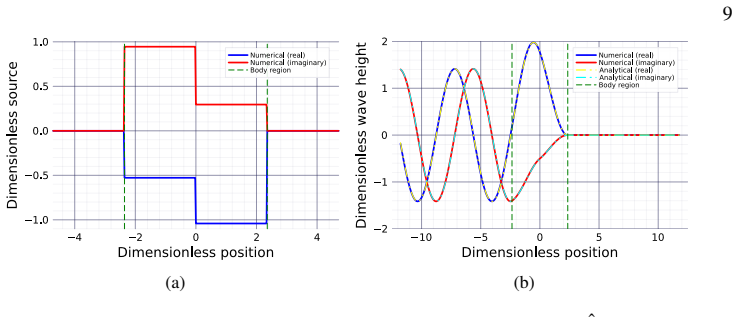
The load-bearing object is the radiation-stress thrust identity $\bar F_T = \langle \hat Q, \hat h' \rangle = -\tfrac12 [k|\hat h|^2]_-^+$, which equates the thrust to the time-averaged difference of fore-aft wave amplitude squared, derived by multiplying the wave equation by $\hat h'$ and integrating. The optimal-control mechanism is the variational calculus with the power bound $\langle \hat Q, i\hat h\rangle - v\langle \hat Q, \hat h'\rangle \le \delta$, whose Euler-Lagrange condition reduces to a first-order eigenvalue ODE with eigenvalues $\lambda = \pm 1$, selecting a single Doppler-shifted travelling wave. This is what forces the optimal source to radiate only aft, and it is what converts the optimisation into a linear constraint problem with infinitely many solutions, e.g., step-function pressure distributions.
What would settle it
Measure the thrust and the injected power of a real oscillating pressure source on a shallow water tank while resolving the fore and aft wave amplitudes. If the maximum achievable thrust-to-power ratio falls below 1 once surface tension, viscosity, and 2D losses are present, or if the optimal source cannot be made to emit zero wave ahead, the efficiency-1 claim fails.
Extended reading notes
Core claim
The central discovery is that, in a linear 1D shallow-water model, the thrust from self-generated waves is the fore-aft difference of wave amplitude squared (radiation stress), and when the injected power is bounded the optimal pressure source is a purely aft-travelling wave. This yields dimensionless thrust equal to the power bound, $\bar F_T = \delta$, and formal efficiency $\eta = 1$ for all drift velocities $v \ge 0$, because no power is wasted on a forward wave. The optimum holds across the subcritical, critical, and supercritical regimes, defined by $v = U/c$ with $c = \sqrt{gH}$, and in the supercritical case both waves travel leftward in the body frame yet the aft choice still achieves $\bar F_T = \delta$.
Load-bearing premise
The central claim rests on the linear 1D shallow-water wave model with no surface tension, viscosity, or 2D effects, and the acceleration recipe further assumes that the speed changes slowly enough for the periodic optimal solutions to hold at every instant.
Editorial extensions
If this is right
- In the bounded-power case, the optimal time-averaged thrust is exactly equal to the power bound, $\bar F_T = \delta$, at every drift velocity, so propulsive efficiency is 1 across subcritical, critical, and supercritical motion.
- The optimal pressure source radiates no wave ahead of the body: all injected power goes into the aft wave, and this remains true for every value of the drift velocity.
- Modulating the power bound $\delta$ changes the cruising velocity according to $v_* = \sqrt{2H\delta/(L C_D)}$, so a slowly accelerating body can be driven from rest to supercritical speeds by increasing the injected power.
- In the bounded-norm case, there are resonant velocities where the forward wave vanishes and efficiency reaches 1, but away from these resonances efficiency drops, so the bounded-power case is the one that guarantees optimal efficiency continuously.
- There are infinitely many optimal pressure distributions satisfying the bounded-power conditions, including simple step functions, so the optimal strategy is a family rather than a unique waveform.
Reading between the lines
- The 'no forward wave' principle suggests a general design rule for wave-propelled craft: regardless of speed, shape and oscillate the body so that all emitted wave energy is directed opposite to the direction of travel.
- The same optimal-control template, with a Galilean transform and Doppler-shifted wavenumbers, might be applied to other linear wave-bearing media; a plausible inference is that efficiency-1 optimality extends to any energy-conserving linear wave equation without dissipation.
- Adding surface tension, viscosity, or finite-depth dispersion would likely break the exact efficiency-1 result, so a testable extension is to compute the optimal fore-aft wave balance for gravity-capillary waves and check how much the aft-only rule changes.
Editorial analysis
A structured set of objections, weighed in public.
Referee Report
Summary. The paper studies optimal wave-driven propulsion in a 1D shallow-water model where a periodically oscillating pressure source acts as the body. The authors derive expressions for time-averaged thrust and power directly from the wave equation, then solve two constrained optimal-control problems (bounded norm and bounded power) for the start-up, subcritical, critical, and supercritical velocity regimes. The main analytical result is that in the bounded-power case, the optimal thrust equals the power bound (F_T = delta), yielding efficiency eta = 1 for all v > 0. Using a quadratic drag law, the paper derives a cruising velocity v* = sqrt(2H delta/(L C_D)) and argues that slow modulation of the power bound accelerates the body from rest to supercritical velocities. Numerical validation with Ipopt/JuMP is reported for the optimality conditions and thrust values.
Significance. If the results stand, the paper provides a clean analytical template for optimal wave-driven propulsion in a simplified setting, with self-contained derivations of thrust and power from the wave equation rather than imported formulas. The numerical validation is a genuine strength: the analytical optima are checked against an independent discretized optimization, with relative errors mostly below 0.1%, and the authors provide a repository for the code. The bounded-power result that an aft-travelling wave achieves F_T = delta and eta = 1 across all velocity regimes is elegant and intuitively appealing. However, the quantitative reach is limited by the acknowledged idealizations (shallow water, no surface tension, no viscosity, 1D), and the prefactor discrepancy with the classical radiation-stress formula (1.1) means the dimensional cruising-velocity prediction (7.4) should be treated as model-internal unless that factor is resolved.
major comments (3)
- [Section 7, Eq. (7.4)] The claim that modulating the power bound delta accelerates the body from rest to supercritical velocities is not supported by the analysis. Equation (7.4) is an algebraic balance F_T = F_D, which defines the terminal cruising velocity for a fixed delta, not an equation of motion. To demonstrate acceleration, the manuscript must state and use the body momentum balance m dv/dt = F_T(v,delta) - F_D(v) and show that a slowly varying delta(t) tracks the instantaneous equilibrium v*(delta(t)). This requires an additional timescale separation, essentially m/(rho L^2 c) being much longer than the modulation timescale; the stated condition \ddot{U} << omega c does not by itself ensure that the body velocity follows v*(delta). Without this step, the central demonstration in Section 7 is incomplete.
- [Section 7, Eqs. (4.3) and (4.5)] The quasi-static use of the periodic optimal solutions during acceleration needs a rigorous error bound or a multiple-timescale derivation. The Galilean transformation (4.2) maps between inertial frames and is only valid for constant v; when v = v(t), the wave equation in the moving frame contains additional terms involving dv/dt, and the Sommerfeld boundary conditions (4.5) are not exact. The condition \ddot{U} << omega c is asserted but never derived from the transformed PDE. A concrete test would be to substitute v(t) = v0 + epsilon t into the original wave equation and estimate the size of the neglected terms relative to the leading-order optimal solution. As written, the paper does not establish that the periodic optimal solutions remain valid instantaneously during the proposed acceleration protocol.
- [Section 2, Eqs. (1.1), (2.10), and (7.2)-(7.4)] The prefactor discrepancy between the derived thrust (2.10) and the classical radiation-stress formula (1.1) is acknowledged but then set aside. This is acceptable for the dimensionless optimization results, but it is load-bearing for the dimensional cruising-velocity prediction in Section 7: if the physically correct thrust is the classical 3/4 rho g [h^2] result rather than the 1/2 [k|h|^2] version, then v* in (7.4) changes by a factor sqrt(3/2). The manuscript should either incorporate the correct prefactor into the dimensional force balance or explicitly state that (7.4) is only a model-internal estimate, not a quantitative physical prediction.
minor comments (4)
- [Section 3.1, Eq. (3.5)] The text reports a relative error of 0.003% for 'lambda|D_L|^2' but the surrounding equations and text elsewhere refer to lambda^2|D_L|^2; please check the exponent and make the notation consistent.
- [Section 3.2, Eq. (3.17)] The step-function ansatz is presented as representative, but the manuscript does not explain how it was chosen among the infinite family of optimal sources; a brief remark that the optimality conditions are underdetermined would clarify that the shown solution is one example, not a unique optimum.
- [Section 6, Eq. (6.7)] The resonance condition is written for all integers n in Z\{0}, but the subcritical resonances are only physical when 0 < n < l/pi, while supercritical resonances require n < 0; the statement 'for all possible n' is slightly misleading and could be rephrased to specify the allowed ranges.
- [Section 7, Fig. 8] The caption for Figure 8 does not explain the colour scheme beyond 'blue' and 'red'; it would help to state explicitly that the first and second halves of the period are plotted in blue and red, respectively.
Circularity Check
No significant circularity: thrust and power are derived from the wave equation, and the bounded-power optimum is a genuine variational result; Section 7's quasi-static extension is a stated assumption, not a circular prediction.
full rationale
The paper's central derivation chain is self-contained and does not reduce to its inputs by construction. The thrust F_T = <Q,h'> and the power Pow = <Q,i h> - v<Q,h'> are derived from the 1D wave equation (2.3) through the identities (2.10) and (A.16), rather than being imported as assumed inputs. The bounded-power optimal condition is obtained from variational calculus in Appendix B.2, which produces the eigenvalue problem (B.21) and the two solutions lambda = -1 and lambda = 1; selecting the purely aft-travelling wave (C_R = 0) is a derived extremality condition, not an ansatz dressed as a result. Substituting that condition into the independently defined thrust and power expressions gives F_T = delta and eta = 1, which is algebra following from a genuine optimality condition rather than a definitional tautology. The numerical Ipopt/JuMP solutions independently reproduce the analytical conditions to small relative errors, supporting internal consistency. The only self-citations, to Benham et al. (2022) and Benham et al. (2024), are contextual or concern a simplifying drag-model choice ('Similar to Benham et al. (2024), we will neglect oscillatory drag'), and neither is load-bearing for the main derivation. Section 7 reuses the paper's own periodic optimal solutions to argue that slow modulation of the power bound changes the cruising velocity, but this is explicitly flagged as a quasi-static assumption ('A dimensional acceleration such that U_ddot << omega c permits the use of the previous results'; Section 8: 'A small acceleration U_ddot << omega c is required to maintain the periodic assumption'). The cruising-velocity relation (7.4) is a steady force balance, not a derived acceleration law, so the dynamical extrapolation is limited but not circular. Overall, no prediction in the paper is equivalent to a fitted parameter or to a self-citation chain, and the bounded-power eta = 1 result follows from the derived optimality structure rather than from the problem setup by definition.
Assumptions & free parameters
free parameters (3)
- norm bound epsilon =
1 (dimensionless)
- power bound delta =
1 for main results; general delta in Sec. 7
- drag coefficient C_D =
unspecified (general)
assumptions (7)
- domain assumption Linear shallow-water wave equation (2.1) obtained from the Euler equations at leading order in aspect ratio epsilon = H/L_w << 1, with h << H and no surface tension, viscosity, or vortices.
- domain assumption Source and wave field are strictly periodic with a single frequency omega (Eq. 2.4); quasi-periodic modulation in Section 7 requires acceleration U_ddot << omega*c.
- domain assumption Sommerfeld radiation boundary conditions (2.7): waves only radiate away from the source; in the supercritical case both radiated waves are left-traveling in the moving frame (6.1)-(6.2).
- standard math Galilean transformation (4.2) maps the lab frame to the body frame, with wave speed c constant and the medium at rest in the lab frame.
- domain assumption Thrust is identified with the radiation-stress difference (1/2)[k|h|^2] (Eq. 2.10), and the 3/2 prefactor difference relative to the Longuet-Higgins-Stewart formula (1.1) is set aside as irrelevant.
- ad hoc to paper Simple quadratic drag law F_D = (1/2)*C_D*rho*U^2*L (7.1), with no wave drag, form drag, or oscillatory components.
- ad hoc to paper The step-function source (3.17) is representative of the optimal solutions in the bounded-power case.
Cite this review
Pith. "Pith review of Achieving Optimal Locomotion using Self-Generated Waves." pith.science (2026). https://pith.science/paper/C2LARECM
@misc{pith2026250611961,
  author       = {Pith},
  title        = {Pith review of: Achieving Optimal Locomotion using Self-Generated Waves},
  year         = {2026},
  howpublished = {\url{https://pith.science/paper/C2LARECM}},
  note         = {Machine review of arXiv:2506.11961}
}
abstract
An oscillating body floating at the water surface produces a wave-field of self-generated waves. When the oscillation induces a difference in fore-aft wave amplitude squared, these self-generated waves can be used as a mechanism to propel the body horizontally across the surface (Longuet-Higgins and Stewart 1964). The optimisation of this wave-driven propulsion (WDP) is the interest of this work. To study the conditions necessary to produce optimal thrust we will utilise a shallow water set-up where a periodically oscillating pressure source acts as the body. In this framework, an expression for the thrust is derived by relation to the aforementioned difference in fore-aft amplitude squared. The conditions on the source for maximal thrust are explored both analytically and numerically in two optimal control problems. The first case is where a bound is imposed on the norm of the control function to regularise it. Secondly, a more physically motivated case is studied where the power injected by the source is bounded. The body is permitted to have a drift velocity $U$. When scaled with the wave speed $c$, the dimensionless velocity $v=U/c$ divides the study into subcritical, critical and supercritical regimes and the optimal conditions are presented for each. The result in the bounded power case is then used to demonstrate how the modulation of power injected can slowly change the cruising velocity from rest to supercritical velocities.
Figures


Figures from the paper (5 more)


Forward citations
Cited by 1 Pith paper
-
Propulsion and interaction of wave-propelled interfacial particles
A review of wave-propelled interfacial particles, describing how self-generated capillary waves drive motion and long-range interactions.
Reference graph
Works this paper leans on
-
[1]
, " * write output.state after.block = add.period write newline
ENTRY address author booktitle chapter edition editor howpublished institution journal key month note number organization pages publisher school series title type volume year eprint label extra.label sort.label short.list INTEGERS output.state before.all mid.sentence after.sentence after.block FUNCTION init.state.consts #0 'before.all := #1 'mid.sentence ...
-
[2]
write newline
" write newline "" before.all 'output.state := FUNCTION n.dashify 't := "" t empty not t #1 #1 substring "-" = t #1 #2 substring "--" = not "--" * t #2 global.max substring 't := t #1 #1 substring "-" = "-" * t #2 global.max substring 't := while if t #1 #1 substring * t #2 global.max substring 't := if while FUNCTION word.in bbl.in capitalize " " * FUNCT...
-
[3]
Barotta, J.W , Thomson, S.J. , Alventosa, L.F.L. , Lewis, M. & Harris, D.M. 2023 Bidirectional wave-propelled capillary spinners . Commun. Physics 6 (1), 87
work page 2023
-
[4]
Benham, G.P. , Devauchelle, O. , Morris, S.W. & Neufeld, J.A. 2022 Gunwale bobbing . Phys. Rev. Fluids 7 (7), 074804
work page 2022
-
[5]
Benham, G.P. , Devauchelle, O. & Thomson, S.J. 2024 On wave-driven propulsion . J. Fluid Mech. 987 , A44
work page 2024
- [6]
- [7]
-
[8]
2007 Impulsive fluid forcing and water strider locomotion
Bühler, O. 2007 Impulsive fluid forcing and water strider locomotion . J. Fluid Mech. 573 , 211–236
work page 2007
Show all 24 references
-
[9]
Ship Technology Research 44 , 32--36
Doctors, L.J 1997 Optimal pressure distributions for river-based air-cushion vehicles . Ship Technology Research 44 , 32--36
1997
-
[10]
& Sharma, S.D
Doctors, L.J. & Sharma, S.D. 1972 The wave resistance of an air-cushion vehicle in steady and accelerated motion . J. Ship Research 16 (04), 248--260
1972
-
[11]
, Carmigniani, R
Dode, A. , Carmigniani, R. , Cohen, C. , Clanet, C. & Bocquet, L. 2022 Wave drag during an unsteady motion . J. Fluid Mech. 951 , A15
2022
-
[12]
& Feng, J.J
Gao, P. & Feng, J.J. 2011 A numerical investigation of the propulsion of water walkers . J. Fluid Mech. 668 , 363–383
2011
-
[13]
, Pucci, G
Ho, I. , Pucci, G. , Oza, A.U. & Harris, D.M. 2023 Capillary surfers: Wave-driven particles at a vibrating fluid interface . Phys. Rev. Fluids 8 , L112001
2023
-
[14]
, Chan, B
Hu, D.L. , Chan, B. & Bush, J.W.M. 2003 The hydrodynamics of water strider locomotion . Nature 424 (6949), 663–666
2003
-
[15]
& Stewart, R.W
Longuet-Higgins, M.S. & Stewart, R.W. 1964 Radiation stresses in water waves; a physical discussion, with applications . Deep Sea Research and Oceanographic Abstracts 11 (4), 529--562
1964
-
[16]
Longuet-Higgins , M. S. 1977 The Mean Forces Exerted by Waves on Floating or Submerged Bodies with Applications to Sand Bars and Wave Power Machines . Proc. R. Soc. Lon. A 352 (1671), 463--480
1977
-
[17]
, Dowson, O
Lubin, M. , Dowson, O. , Dias Garcia , F. , Huchette, J. , Legat, B. & Vielma, J.P. 2023 JuMP 1.0: R ecent improvements to a modeling language for mathematical optimization . Math. Prog. Comp. 15 , 581--589
2023
-
[18]
, Ben Amar, M
Pucci, G. , Ben Amar, M. & Couder, Y. 2015 Faraday instability in floating drops . Phys. of Fluids 27 (9), 091107
2015
-
[19]
, Hunt, R
Rhee, E. , Hunt, R. , Thomson, S. & Harris, D.M. 2022 Surferbot: a wave-propelled aquatic vibrobot . Bioinspir. and Biomim. 17 (5), 055001
2022
-
[20]
& Gharib, M
Roh, C. & Gharib, M. 2019 Honeybees use their wings for water surface locomotion . Proc. Natl Acad. Sci. USA 116 (49), 24446--24451
2019
-
[21]
, Arutkin, M
Steinmann, T. , Arutkin, M. , Cochard, P. , Raphaël, E. , Casas, J. & Benzaquen, M. 2018 Unsteady wave pattern generation by water striders . J. Fluid Mech. 848 , 370–387
2018
-
[22]
, Cribellier, A
Steinmann, T. , Cribellier, A. & Casas, J. 2021 Singularity of the water strider propulsion mechanisms . J. Fluid Mech. 915 , A118
2021
-
[23]
Tuck, E. O. & Lazauskas, L. 1998 Optimum hull spacing of a family of multihulls . Ship Technol. Res.-Schiffstechnik 45 (4), 180
1998
-
[24]
, Jia, L
Yuan, Z.M , Chen, M. , Jia, L. , Ji, C. & Incecik, A. 2021 Wave-riding and wave-passing by ducklings in formation swimming . J. Fluid Mech. 928 , R2
2021
Reviewed August 7, 2026 · model on record in the stance chip above.
Discussion (0). Continue with ORCID to comment.