REVIEW 4 major objections 6 minor 15 references
LCD: Advancing Extreme Low-Bit Clustering for Large Language Models via Knowledge Distillation
T0 review · 4 major / 6 minor · reviewed 2026-08-07 · deepseek-v4-flash
Pith's one-line read Clustering plus distillation lets a large language model run at 2–3 bits with near-full accuracy.
desk verdict A plausible empirical package undermined by a vacuous core optimization and an unsupported distillation claim; desk reject in current form. read the letter →
The pith
A machine-rendered reading of the paper's core claim, the machinery that carries it, and where it could break.
The reading
What carries the argument
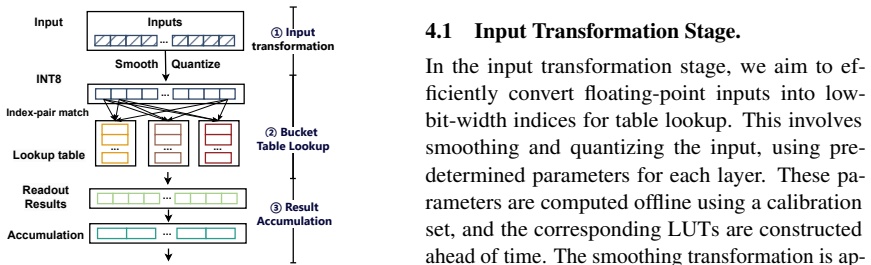
The machinery is a Hessian-guided centroid-update rule. Starting from the second-order Taylor expansion of the loss under the weight perturbation $\Delta W$, LCD keeps only $\Delta W^T H(W) \Delta W$ and approximates $H$ by its diagonal; the update $W_{t+1} = W_t - \eta \nabla L / \operatorname{diag}(H')$ moves centroids by the gradient scaled by the inverse diagonal Hessian. This objective is coupled with Density-Based Centroid Initialization (DBCI), a density-based clustering step that produces about 15–20 seed centroids, and with progressive and speculative centroid merging driven by the Hessian trace. A separate adaptive smoothing pass picks a per-layer scaling factor so activations fit 8-bit integer quantization, and the inference path stores precomputed products in bucket lookup tables keyed by centroid index and input index, replacing multiplications with table reads and accumulations.
What would settle it
Run a controlled comparison on a small model where the true per-layer loss change from a centroid perturbation can be computed exactly: if $\Delta W^T \operatorname{diag}(H) \Delta W$ does not rank-order the perturbations the same way the true $\Delta L$ does, the surrogate is not valid. The paper gives no such correlation check, so that measurement would settle the central modeling claim.
Extended reading notes
Core claim
On its own terms, the paper claims that weight clustering is the right compression primitive for ultra-low-bit LLMs, provided the centroids are learned rather than chosen by k-means. LCD takes the full-precision model as its own teacher and minimizes the expected change in the task loss caused by replacing weights with centroids; with the gradient assumed negligible at a local optimum, this reduces to minimizing $\Delta W^T H \Delta W$, approximated by the diagonal Hessian. A density-based initialization seeds clusters, and progressive and speculative searches shrink the centroid count while watching the Hessian trace. Smoothing the activations makes them quantizable to 8-bit integers without changing the centroid count, and a bucket lookup table turns the compressed weights and activations into index-pair reads. The paper's conclusion is that this preserves accuracy comparable to the full model and beats existing low-bit methods on the same benchmarks.
Load-bearing premise
The load-bearing premise is that the model is already at a flat optimum, so the direct gradient of the loss can be ignored, and that a cheap diagonal approximation of the loss curvature accurately predicts how much clustering will hurt; if either is wrong, the centroid updates chase the wrong objective.
Editorial extensions
If this is right
- Model memory for a 7B-parameter model drops to roughly a fifth of its 16-bit size when weights use 8 centroids, making local deployment more plausible.
- Inference cost shifts from arithmetic to memory reads: with 16 or fewer centroids, weights fit 4-bit indices and LUT buckets stay small enough for parallel lookup.
- Joint activation smoothing means both weights and activations can be handled without dequantization during accumulation, simplifying the compute pipeline.
- The method's training overhead remains substantial, so it is a practical alternative when the one-time distillation cost is acceptable relative to repeated inference savings.
- Layer-wise dynamic centroid counts improve the trade-off: earlier layers keep more centroids while the average stays near 6, reducing total model size.
Reading between the lines
- If the diagonal-Hessian assumption holds broadly, the same centroid-distillation recipe should transfer to other large autoregressive models and possibly to vision transformers, since the objective is architecture-agnostic.
- The fixed per-layer smoothing factor is calibrated offline; a testable extension would adapt it online to input distribution shift, at the cost of the inference simplicity the paper relies on.
- One could stress-test the method by applying it right after partial fine-tuning, where the gradient is not negligible; the paper's assumption predicts degraded centroid quality there, and the experiment would separate the Hessian term's contribution from plain knowledge distillation.
- The LUT design suggests a natural pairing with retrieval or mixture-of-experts models, where shared centroid tables could be reused across many experts rather than rebuilt per layer.
Editorial analysis
A structured set of objections, weighed in public.
Referee Report
Summary. The paper proposes LCD, a clustering-based weight quantization method for large language models that aims to preserve accuracy at 2-3 bits by combining density-based centroid initialization, Hessian-guided centroid optimization, activation smoothing, and LUT-based inference. The authors report perplexity and zero-shot accuracy results on LLaMA-2-7B, BERT-large, and GPT2-XL, and claim up to 6.2x end-to-end inference speedup. The core methodological claims are presented in Section 3, with experiments in Section 5.
Significance. If the method worked as described, it would be a practical contribution to ultra-low-bit LLM deployment, since clustering with a flexible number of centroids and table-lookup inference could reduce memory and latency. The paper does not provide code, and the central optimization is not actually derived: the key problem statement in Eq. (3) is vacuous, and the 'knowledge distillation' framing is unsupported by any teacher-student loss. The reported empirical results therefore cannot be independently verified or reproduced from the manuscript as written, which substantially weakens the contribution.
major comments (4)
- [3.2, Eq. (3)] The optimization problem as stated is vacuous: the constraint ΔW=0 forces the objective ΔW^T H ΔW to be identically zero, so the problem does not select any centroid update. The intended constraint (for example, that the entries of W' be drawn from a small centroid set C) is never written, and the Lagrange step leading to Eq. (4) is not shown. Because Section 3.2 explicitly replaces KL divergence with the metric in Eq. (4), the entire 'distillation' objective is underived and cannot be reproduced.
- [3.1, Eq. (1)] The formula for σ divides the sum of six percentile values by 12, which is inconsistent with averaging six values; the intended denominator is 6. The notation w+σ, w−σ, etc., is also not defined precisely (for instance, whether each term is the 68.27th, 95.44th, or 99.74th percentile of the sorted positive and negative weights). Since σ determines eps and MinPts for the DBSCAN initialization, this arithmetic error propagates to the first step of the method.
- [3.2, Eq. (7)] The centroid update formula has mismatched dimensions and no summation ranges. The first term appears to sum per-weight increments ΔwCi, while the second and third terms add centroid differences (Ci+1 − Ci) combined with per-weight increments ΔwCi+1 and ΔwCi−1; these quantities are of different types (scalar centroid offsets versus weight updates), so the equation is not well-formed and cannot be implemented as written.
- [3.2 and Figure 3] The method is called knowledge distillation, but no distillation loss is ever defined. The text states that instead of KL divergence, the metric in Eq. (4) is used to update weights; the teacher and student logits shown in Figure 3 do not appear in any equation. Thus the claimed unification of clustering with knowledge distillation is unsupported; the actual mechanism is Hessian-guided clustering, and renaming it 'distillation' does not make it one.
minor comments (6)
- [5.1] The calibration set is only 128 random samples for BERT, GPT2-XL, and LLaMA-2; no details are given for the C4 perplexity evaluation (e.g., tokenization, stride, or number of tokens) or for the zero-shot QA evaluation protocol, which limits reproducibility.
- [4.1, Eq. (10)] The quantization range q ∈ [-2^b, 2^b − 1] is incorrect for a b-bit signed integer; it should be [-2^{b-1}, 2^{b-1} − 1] or equivalently scaled, and the current expression implies a range that is not representable in b bits.
- [5.3, Table 3] The FP16 baseline perplexity for LLaMA-2-7B is listed as 5.75 in Table 3, but Tables 1 and 2 report 5.47 for the same model; this discrepancy is not explained.
- [Figure 6] No latency measurement methodology (batch size, sequence length, GPU, number of runs) is provided for the reported 6.2x, 4.8x, and 4.7x speedups, and the comparison mixes bit-widths (4-bit baselines vs. the claimed 2-3 bit for LCD), making the speedup comparison difficult to interpret.
- [3.3] The criterion 'when the Hessian trace no longer changes monotonically' is not quantified; no threshold or formal definition of 'stabilizes' is given for the progressive and speculative centroid optimization stopping conditions.
- [5.2, Table 2] The table header 'bits(#C)' is ambiguous: for the FP16 row the entry '16 16' suggests both bit-width and centroid count, but the units are not clearly separated; please clarify the notation for equivalent bits versus number of centroids.
Circularity Check
No significant circularity: the accuracy and speedup claims are externally benchmarked; the Section 3.2 Hessian step is an omitted-proof/derivation gap rather than a circular prediction, and the only self-citation is not load-bearing.
full rationale
The central accuracy claims for LCD are established by held-out perplexity on WikiText-2 and C4, zero-shot QA benchmarks, and GLUE, measured against FP16 baselines and existing quantization methods. These numbers are not generated by evaluating the method on its own fitted parameters, so they do not reduce to the method's inputs by construction. The smoothing factors in Eq. (9) are fit to a calibration set to minimize reconstruction MSE, but the reported perplexities are external test-set measurements, which is standard data fitting rather than a fitted input disguised as a prediction. The only self-citation with author overlap is Liu et al. 2024a (INSPIRE), cited in Section 2.2 and used as prior work for index-pair lookup-table encoding. This supports the LUT/inference design, but the claimed speedups are measured on A100 GPUs against QServe, TVM, and LUT-NN, and the accuracy improvements do not depend on that self-citation. It is therefore not load-bearing for the main claims. There is, however, a serious derivation gap in Section 3.2 that should be weighed separately: Eq. (3) imposes the constraint ΔW=0, which makes the quadratic objective identically zero, and Eq. (4), the actual weighted centroid objective, is asserted rather than derived from Eq. (3) as printed. This is an omitted proof or typographical/incomplete constraint, not a circular reduction of the benchmark results: the empirical validation remains independent of the broken derivation step. The Limitation section only mentions training inefficiency and does not address this gap, but the gap affects reproducibility and the explanatory claim that the centroid updates are Hessian-derived, not the circularity of the experimental claims.
Assumptions & free parameters
free parameters (6)
- Hessian trace threshold theta =
not specified
- Accuracy threshold Theta =
not specified
- Speculative search iterations p =
not specified
- Training round limit T =
not specified
- Learning rate eta =
not specified
- Layer-wise smoothing factor m =
chosen per layer
assumptions (4)
- domain assumption Pretrained LLM weights are at a local optimum so the gradient g(W) is negligible.
- domain assumption A diagonal approximation of the Hessian is sufficient for centroid optimization.
- domain assumption The Taylor expansion around the pretrained weights is valid and the Hessian captures quantization impact.
- ad hoc to paper DBSCAN with sigma-derived eps and MinPts provides a good initialization for LLM weight distributions.
Cite this review
Pith. "Pith review of LCD: Advancing Extreme Low-Bit Clustering for Large Language Models via Knowledge Distillation." pith.science (2026). https://pith.science/paper/GFFOXOXR
@misc{pith2026250612038,
  author       = {Pith},
  title        = {Pith review of: LCD: Advancing Extreme Low-Bit Clustering for Large Language Models via Knowledge Distillation},
  year         = {2026},
  howpublished = {\url{https://pith.science/paper/GFFOXOXR}},
  note         = {Machine review of arXiv:2506.12038}
}
read the original abstract
Large language models (LLMs) have achieved significant progress in natural language processing but face challenges in deployment due to high memory and computational requirements. Weight quantization is a common approach to address these issues, yet achieving effective low-bit compression remains challenging. This paper presents LCD, which unifies the learning of clustering-based quantization within a knowledge distillation framework. Using carefully designed optimization techniques, LCD preserves LLM performance even at ultra-low bit widths of 2-3 bits. Additionally, LCD compresses activations through smoothing and accelerates inference with a LUT-based design. Experimental results show that LCD outperforms existing methods and delivers up to a 6.2x speedup in inference. Notably, LCD is shown to be more cost-effective, making it a practical solution for real-world applications.
Figures


Figures from the paper (4 more)



Reference graph
Works this paper leans on
-
[3]
Elias Frantar, Saleh Ashkboos, Torsten Hoefler, and Dan Alistarh
Bitdistiller: Unleashing the potential of sub-4-bit llms via self- distillation.arXiv preprint arXiv:2402.10631. Elias Frantar, Saleh Ashkboos, Torsten Hoefler, and Dan Alistarh
-
[8]
9 Alec Radford, Jeffrey Wu, Rewon Child, David Luan, Dario Amodei, Ilya Sutskever, and 1 others
Lut tensor core: Lookup table enables efficient low-bit llm inference acceleration.arXiv preprint arXiv:2408.06003. 9 Alec Radford, Jeffrey Wu, Rewon Child, David Luan, Dario Amodei, Ilya Sutskever, and 1 others
-
[9]
Ji Lin, Jiaming Tang, Haotian Tang, Shang Yang, Wei- Ming Chen, Wei-Chen Wang, Guangxuan Xiao, Xingyu Dang, Chuang Gan, and Song Han. 2024a. Awq: Activation-aware weight quantization for on- device llm compression and acceleration.Proceed- ings of Machine Learning and Systems, 6:87–100. Yujun Lin, Haotian Tang, Shang Yang, Zhekai Zhang, Guangxuan Xiao, Ch...
-
[10]
Xiaohu Tang, Yang Wang, Ting Cao, Li Lyna Zhang, Qi Chen, Deng Cai, Yunxin Liu, and Mao Yang
Omniquant: Omnidirectionally calibrated quantization for large language models.arXiv preprint arXiv:2308.13137. Xiaohu Tang, Yang Wang, Ting Cao, Li Lyna Zhang, Qi Chen, Deng Cai, Yunxin Liu, and Mao Yang
-
[11]
Albert Tseng, Jerry Chee, Qingyao Sun, V olodymyr Kuleshov, and Christopher De Sa
Llama 2: Open foun- dation and fine-tuned chat models.arXiv preprint arXiv:2307.09288. Albert Tseng, Jerry Chee, Qingyao Sun, V olodymyr Kuleshov, and Christopher De Sa
-
[12]
Quip#: Even better llm quantization with hadamard in- coherence and lattice codebooks.arXiv preprint arXiv:2402.04396. Mart van Baalen, Andrey Kuzmin, Markus Nagel, Pe- ter Couperus, Cedric Bastoul, Eric Mahurin, Tijmen Blankevoort, and Paul Whatmough
-
[13]
arXiv preprint arXiv:2402.15319
Gptvq: The blessing of dimensionality for llm quantization. arXiv preprint arXiv:2402.15319. Alex Wang
-
[14]
arXiv preprint arXiv:1804.07461
Glue: A multi-task benchmark and analysis platform for natural language understanding. arXiv preprint arXiv:1804.07461. Jianyu Wei, Shijie Cao, Ting Cao, Lingxiao Ma, Lei Wang, Yanyong Zhang, and Mao Yang
Show all 15 references
-
[15]
Guangxuan Xiao, Ji Lin, Mickael Seznec, Hao Wu, Julien Demouth, and Song Han
T- mac: Cpu renaissance via table lookup for low-bit llm deployment on edge.Preprint, arXiv:2407.00088. Guangxuan Xiao, Ji Lin, Mickael Seznec, Hao Wu, Julien Demouth, and Song Han
-
[2016]
Zhiwen Mo, Lei Wang, Jianyu Wei, Zhichen Zeng, Shi- jie Cao, Lingxiao Ma, Naifeng Jing, Ting Cao, Jilong Xue, Fan Yang, and 1 others
Pointer sentinel mixture mod- els.arXiv preprint arXiv:1609.07843. Zhiwen Mo, Lei Wang, Jianyu Wei, Zhichen Zeng, Shi- jie Cao, Lingxiao Ma, Naifeng Jing, Ting Cao, Jilong Xue, Fan Yang, and 1 others
-
[2018]
Tim Dettmers and Luke Zettlemoyer
Think you have solved question an- swering? try arc, the ai2 reasoning challenge.ArXiv, abs/1803.05457. Tim Dettmers and Luke Zettlemoyer
-
[2019]
Hellaswag: Can a machine really finish your sentence?arXiv preprint arXiv:1905.07830. 10
1905 arXiv
-
[2022]
arXiv preprint arXiv:2210.17323
Gptq: Accurate post-training quantization for generative pre-trained transformers. arXiv preprint arXiv:2210.17323. Amir Gholami, Sehoon Kim, Zhen Dong, Zhewei Yao, Michael W Mahoney, and Kurt Keutzer
-
[2023]
Stephen Merity, Caiming Xiong, James Bradbury, and Richard Socher
Llm-qat: Data-free quantization aware training for large language models.arXiv preprint arXiv:2305.17888. Stephen Merity, Caiming Xiong, James Bradbury, and Richard Socher
-
[2024]
Yonatan Bisk, Rowan Zellers, Jianfeng Gao, Yejin Choi, and 1 others
Skim: Any-bit quantization pushing the limits of post-training quantization.arXiv preprint arXiv:2412.04180. Yonatan Bisk, Rowan Zellers, Jianfeng Gao, Yejin Choi, and 1 others
Reviewed August 7, 2026 · model on record in the stance chip above.
Discussion (0). Sign in to comment.