Accelerated Inchworm Method with Tensor-Train Bath Influence Functional
Pith reviewed 2026-05-19 09:34 UTC · model grok-4.3
The pith
Approximating the bath influence functional as a tensor train turns high-dimensional perturbative integrals into efficient deterministic computations for open quantum system dynamics.
A machine-rendered reading of the paper's core claim, the machinery that carries it, and where it could break.
Core claim
By expressing the bath influence functional in a tensor-train format with low-rank structure, the high-dimensional integrals appearing in the perturbative expansion of the reduced dynamics can be evaluated accurately using deterministic quadrature rules rather than Monte Carlo methods, yielding an algorithm whose complexity grows linearly with dimensionality and that supports long-time evolution when combined with tensor transfer.
What carries the argument
The tensor-train representation of the bath influence functional, which captures its low-rank structure to permit efficient deterministic integration of the perturbative series.
If this is right
- Replaces stochastic Monte Carlo sampling with accurate deterministic quadrature for the integrals in the inchworm expansion.
- Computational cost scales linearly rather than exponentially with the number of dimensions.
- Supports coupling to the tensor transfer method for stable long-time simulations of the system dynamics.
Where Pith is reading between the lines
- This approach may enable treatment of open quantum systems with more bath modes or higher-dimensional interactions than previously practical.
- Deterministic evaluation could reduce statistical errors compared to Monte Carlo in computing reduced density matrices.
- The linear scaling suggests potential for extension to other high-dimensional integral problems in quantum dynamics.
Load-bearing premise
The bath influence functional has a low-rank tensor-train structure that allows accurate approximation without deviating significantly from the original perturbative series.
What would settle it
A numerical test on a standard spin-boson model where the tensor-train quadrature results differ substantially from converged Monte Carlo results or where the approximation error fails to decrease with higher tensor-train ranks.
Figures


read the original abstract
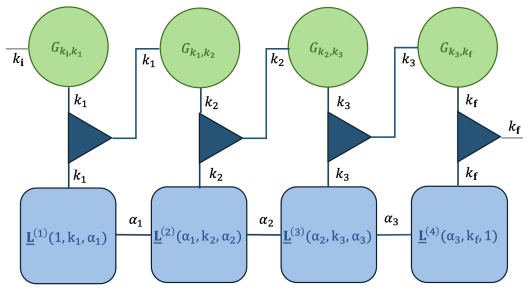
We propose an efficient tensor-train-based algorithm for simulating open quantum systems with the inchworm method, where the reduced dynamics of the open quantum system is expressed as a perturbative series of high-dimensional integrals. Instead of evaluating the integrals with Monte Carlo methods, we approximate the costly bath influence functional (BIF) in the integrand as a tensor train, allowing accurate deterministic numerical quadrature schemes implemented in an iterative manner. Thanks to the low-rank structure of the tensor train, our proposed method has a complexity that scales linearly with the number of dimensions. Our method couples seamlessly with the tensor transfer method, allowing long-time simulations of the dynamics.
Editorial analysis
A structured set of objections, weighed in public.
Referee Report
Summary. The manuscript proposes an accelerated inchworm algorithm for open quantum systems in which the bath influence functional (BIF) appearing in the perturbative expansion is approximated by a tensor-train representation. This approximation is said to permit deterministic quadrature in place of Monte Carlo sampling and to yield an overall complexity that scales linearly with the number of time slices (dimensions) because of the low-rank structure of the tensor train. The method is formulated iteratively and is combined with a tensor-transfer technique to reach long simulation times.
Significance. If the tensor-train ranks remain bounded and the approximation error can be controlled uniformly across the inchworm iteration, the approach would supply a deterministic, non-stochastic route to high-dimensional integrals that arise in open-system perturbation theory. Such a result would be of clear practical value for regimes where Monte Carlo sampling becomes expensive.
major comments (2)
- [Abstract] Abstract and the paragraph describing the approximation step: the central claim of linear scaling with the number of dimensions rests on the assertion that the BIF admits a sufficiently low-rank tensor-train representation. No rank bounds, no scaling of the TT ranks with perturbative order or number of time slices, and no a-priori error estimate for the truncated quadrature are supplied. Without these controls it is impossible to verify that the deterministic scheme remains faithful to the original series or that the advertised linear complexity is realized.
- [Method section (iterative procedure)] The description of the iterative inchworm procedure: it is stated that the tensor-train approximation is inserted into the inchworm iteration, yet no analysis is given of how truncation errors propagate through successive iterations or whether the low-rank property is preserved under the inchworm update rule.
minor comments (1)
- [Abstract / Introduction] Notation for the tensor-train cores and the quadrature nodes should be introduced once and used consistently; several symbols appear without prior definition in the abstract and early paragraphs.
Simulated Author's Rebuttal
We thank the referee for the careful reading and constructive feedback on our manuscript. We address the major comments point by point below. Where analysis was missing, we agree that additions are warranted and will revise the manuscript accordingly to strengthen the presentation of rank behavior and error control.
read point-by-point responses
-
Referee: [Abstract] Abstract and the paragraph describing the approximation step: the central claim of linear scaling with the number of dimensions rests on the assertion that the BIF admits a sufficiently low-rank tensor-train representation. No rank bounds, no scaling of the TT ranks with perturbative order or number of time slices, and no a-priori error estimate for the truncated quadrature are supplied. Without these controls it is impossible to verify that the deterministic scheme remains faithful to the original series or that the advertised linear complexity is realized.
Authors: We acknowledge that the original manuscript relies primarily on numerical evidence rather than rigorous a priori bounds for TT ranks. In the revised version we will add a dedicated subsection (and supporting figures) that reports the observed scaling of TT ranks with both the number of time slices and perturbative order across several model parameters. We will also include a quantitative discussion of the quadrature error controlled by the singular-value truncation threshold, together with empirical bounds obtained from direct comparison with Monte Carlo reference data. While a general mathematical proof of rank bounds for arbitrary bath influence functionals lies outside the present scope, the practical linear complexity is substantiated by the consistently low ranks observed in all reported simulations. revision: yes
-
Referee: [Method section (iterative procedure)] The description of the iterative inchworm procedure: it is stated that the tensor-train approximation is inserted into the inchworm iteration, yet no analysis is given of how truncation errors propagate through successive iterations or whether the low-rank property is preserved under the inchworm update rule.
Authors: We agree that an explicit discussion of error propagation is needed. The revised manuscript will expand the method section with a short analysis showing that the inchworm update consists of tensor contractions that approximately preserve the low-rank structure when the truncation threshold is kept fixed. We will also add numerical diagnostics (error versus iteration count for small solvable systems) demonstrating that truncation errors do not accumulate catastrophically. These additions will clarify both the stability of the iteration and the continued validity of the linear-scaling claim. revision: yes
Circularity Check
No circularity; linear scaling follows from standard TT properties under stated low-rank assumption
full rationale
The derivation chain is an independent algorithmic construction: the perturbative series for reduced dynamics is given, the BIF is approximated by a tensor-train representation (an external numerical technique), and deterministic quadrature is applied iteratively. The claimed linear scaling in dimension count is a direct consequence of the standard O(d r^2) complexity of TT contractions when ranks r remain bounded, not a fitted parameter or self-definition. No equations reduce to their own inputs, no uniqueness theorems are imported from self-citations, and the low-rank assumption is explicitly stated as a prerequisite rather than derived from the method itself. The tensor-transfer coupling is presented as a compatible extension, not a load-bearing premise that collapses the argument.
Axiom & Free-Parameter Ledger
axioms (1)
- domain assumption The bath influence functional admits a low-rank tensor-train representation with controllable approximation error.
Lean theorems connected to this paper
-
IndisputableMonolith/Cost/FunctionalEquation.leanwashburn_uniqueness_aczel unclear?
unclearRelation between the paper passage and the cited Recognition theorem.
We approximate the costly bath influence functional (BIF) in the integrand as a tensor train... Thanks to the low-rank structure of the tensor train, our proposed method has a complexity that scales linearly with the number of dimensions.
-
IndisputableMonolith/Foundation/AbsoluteFloorClosure.leanabsolute_floor_iff_bare_distinguishability unclear?
unclearRelation between the paper passage and the cited Recognition theorem.
Lemma 1... Theorem 1... rank(B) ≤ min{N+1, 2L}
What do these tags mean?
- matches
- The paper's claim is directly supported by a theorem in the formal canon.
- supports
- The theorem supports part of the paper's argument, but the paper may add assumptions or extra steps.
- extends
- The paper goes beyond the formal theorem; the theorem is a base layer rather than the whole result.
- uses
- The paper appears to rely on the theorem as machinery.
- contradicts
- The paper's claim conflicts with a theorem or certificate in the canon.
- unclear
- Pith found a possible connection, but the passage is too broad, indirect, or ambiguous to say the theorem truly supports the claim.
Reference graph
Works this paper leans on
-
[1]
Grigorescu, Decoherence and dissipation in quantum two-state sys- tems, Phys
M. Grigorescu, Decoherence and dissipation in quantum two-state sys- tems, Phys. A: Stat. Mech. Appl. 256 (1-2) (1998) 149–162
work page 1998
-
[2]
Schlosshauer, Quantum decoherence, Phys
M. Schlosshauer, Quantum decoherence, Phys. Rep. 831 (2019) 1–57
work page 2019
- [3]
-
[4]
Weiss, Quantum dissipative systems, Vol
U. Weiss, Quantum dissipative systems, Vol. 13, World scientific, River Edge, NJ, 2012. 36
work page 2012
-
[5]
M. A. Nielsen, I. Chuang, Quantum computation and quantum infor- mation (2002)
work page 2002
-
[6]
Nakajima, On quantum theory of transport phenomena: Steady dif- fusion, Prog
S. Nakajima, On quantum theory of transport phenomena: Steady dif- fusion, Prog. Theor. Phys. 20 (6) (1958) 948–959
work page 1958
-
[7]
Zwanzig, Ensemble method in the theory of irreversibility, J
R. Zwanzig, Ensemble method in the theory of irreversibility, J. Chem. Phys. 33 (5) (1960) 1338–1341
work page 1960
- [8]
-
[9]
A. Montoya-Castillo, D. R. Reichman, Approximate but accurate quan- tum dynamics from the mori formalism: I. nonequilibrium dynamics, The Journal of Chemical Physics 144 (18) (2016)
work page 2016
- [10]
-
[11]
Lindblad, On the generators of quantum dynamical semigroups, Commun
G. Lindblad, On the generators of quantum dynamical semigroups, Commun. Math. Phys. 48 (2) (1976) 119–130
work page 1976
-
[12]
Y.Cao, J.Lu, Structure-preservingnumericalschemesforlindbladequa- tions, Journal of Scientific Computing 102 (1) (2025) 1–34
work page 2025
-
[13]
H. Wang, M. Thoss, Multilayer formulation of the multiconfiguration time-dependent hartree theory, The Journal of chemical physics 119 (3) (2003) 1289–1299
work page 2003
-
[14]
M. H. Beck, A. Jäckle, G. A. Worth, H.-D. Meyer, The multiconfig- uration time-dependent hartree (MCTDH) method: a highly efficient algorithm for propagating wavepackets, Phys. Rep. 324 (1) (2000) 1– 105
work page 2000
- [15]
- [16]
- [17]
-
[18]
G. Wang, Z. Cai, Differential equation based path integral for open quantum systems, SIAM J. Sci. Comput. 44 (3) (2022) B771–B804
work page 2022
-
[19]
Makri, Small matrix path integral for system-bath dynamics, J
N. Makri, Small matrix path integral for system-bath dynamics, J. Chem. Theory Comput. 16 (7) (2020) 4038–4049
work page 2020
-
[20]
Makri, Small matrix path integral for driven dissipative dynamics, J
N. Makri, Small matrix path integral for driven dissipative dynamics, J. Phys. Chem. A 125 (48) (2021) 10500–10506
work page 2021
-
[21]
Makri, Small matrix path integral with extended memory, J
N. Makri, Small matrix path integral with extended memory, J. Chem. Theory Comput. 17 (1) (2021) 1–6
work page 2021
-
[22]
G. Wang, Z. Cai, Tree-based implementation of the small matrix path integral for system-bath dynamics, Commun. Comput. Phys. 36 (2024) 389–418
work page 2024
-
[23]
N. Makri, Blip decomposition of the path integral: Exponential acceler- ation of real-time calculations on quantum dissipative systems, J. Chem. Phys. 141 (13) (2014) 134117
work page 2014
-
[24]
Y.-T. Huang, P.-C. Kuo, N. Lambert, M. Cirio, S. Cross, S.-L. Yang, F. Nori, Y.-N. Chen, An efficient Julia framework for hierarchical equa- tions of motion in open quantum systems, Commun. Phys. 6 (1) (2023) 313
work page 2023
-
[25]
Q. Shi, Y. Xu, Y. Yan, M. Xu, Efficient propagation of the hierarchical equations of motion using the matrix product state method, J. Chem. Phys. 148 (17) (2018)
work page 2018
-
[26]
M. Xu, J. Ankerhold, About the performance of perturbative treatments of the spin-boson dynamics within the hierarchical equations of motion approach, Eur. Phys. J. Spec. Top. 232 (20) (2023) 3209–3217. 38
work page 2023
-
[27]
A. Strathearn, B. W. Lovett, P. Kirton, Efficient real-time path inte- grals for non-Markovian spin-boson models, New J. Phys. 19 (9) (2017) 093009
work page 2017
-
[28]
A. Strathearn, P. Kirton, D. Kilda, J. Keeling, B. W. Lovett, Efficient non-Markovian quantum dynamics using time-evolving matrix product operators, Nat. Commun. 9 (1) (2018) 3322
work page 2018
-
[29]
M. R. Jørgensen, F. A. Pollock, Exploiting the causal tensor network structure of quantum processes to efficiently simulate non-Markovian path integrals, Phys. Rev. Lett. 123 (24) (2019) 240602
work page 2019
-
[30]
D. Gribben, A. Strathearn, J. Iles-Smith, D. Kilda, A. Nazir, B. W. Lovett, P. Kirton, Exact quantum dynamics in structured environments, Phys. Rev. Res. 2 (1) (2020) 013265
work page 2020
-
[31]
A. Bose, P. L. Walters, A multisite decomposition of the tensor network path integrals, J. Chem. Phys. 156 (2) (2022)
work page 2022
-
[32]
F. J. Dyson, The radiation theories of Tomonaga, Schwinger, and Feyn- man, Phys. Rev. 75 (3) (1949) 486
work page 1949
-
[33]
K. Van Houcke, E. Kozik, N. Prokof’ev, B. Svistunov, Diagrammatic monte carlo, Physics Procedia 6 (2010) 95–105
work page 2010
-
[34]
J. E. Y. Loh, J. Gubernatis, R. Scalettar, S. White, D. Scalapino, R. Sugar, Sign problem in the numerical simulation of many-electron systems, Phys. Rev. B 41 (13) (1990) 9301
work page 1990
-
[35]
N. Prokof’ev, B. Svistunov, Bold diagrammatic Monte Carlo technique: When the sign problem is welcome, Phys. Rev. Lett. 99 (25) (2007) 250201
work page 2007
-
[36]
N. Prokof’ev, B. Svistunov, Bold diagrammatic Monte Carlo: A generic sign-problem tolerant technique for polaron models and possibly inter- acting many-body problems, Phys. Rev. B 77 (12) (2008) 125101
work page 2008
-
[37]
H.-T. Chen, G. Cohen, D. R. Reichman, Inchworm Monte Carlo for exact non-adiabatic dynamics. i. theory and algorithms, J. Chem. Phys. 146 (5) (2017) 054105. 39
work page 2017
-
[38]
Z. Cai, J. Lu, S. Yang, Inchworm Monte Carlo method for open quantum systems, Commun. Pure Appl. Math. 73 (11) (2020) 2430–2472
work page 2020
-
[39]
Z. Cai, J. Lu, S. Yang, Numerical analysis for inchworm Monte Carlo method: Sign problem and error growth, Math. Comput. 92 (341) (2023) 1141–1209
work page 2023
-
[40]
H.-T. Chen, G. Cohen, D. R. Reichman, Inchworm Monte Carlo for exact non-adiabatic dynamics. ii. benchmarks and comparison with es- tablished methods, J. Chem. Phys. 146 (5) (2017) 054106
work page 2017
-
[41]
S. Yang, Z. Cai, J. Lu, Inclusion–exclusion principle for open quantum systems with bosonic bath, New J. Phys. 23 (6) (2021) 063049
work page 2021
-
[42]
Y. Núñez Fernández, M. Jeannin, P. T. Dumitrescu, T. Kloss, J. Kaye, O. Parcollet, X. Waintal, Learning Feynman diagrams with tensor trains, Phys. Rev. X 12 (4) (2022) 041018
work page 2022
-
[43]
A. Erpenbeck, W.-T. Lin, T. Blommel, L. Zhang, S. Iskakov, L. Bern- heimer, Y. Núñez-Fernández, G. Cohen, O. Parcollet, X. Waintal, E. Gull, Tensor train continuous time solver for quantum impurity mod- els, Phys. Rev. B 107 (24) (2023) 245135
work page 2023
-
[44]
C. Guo, R. Chen, Efficient construction of the Feynman-Vernon influ- ence functional as matrix product states, SciPost Phys. Core 7 (3) (2024) 063
work page 2024
- [45]
-
[46]
Wick, The evaluation of the collision matrix, Phys
G.-C. Wick, The evaluation of the collision matrix, Phys. Rev. 80 (2) (1950) 268
work page 1950
- [47]
- [48]
-
[49]
I. V. Oseledets, Tensor-train decomposition, SIAM J. Sci. Comput. 33 (5) (2011) 2295–2317
work page 2011
-
[50]
Y. Sun, G. Wang, Z. Cai, Simulation of spin chains with off-diagonal coupling using the inchworm method, J. Chem. Theory Comput. 20 (21) (2024) 9269–9758
work page 2024
- [51]
-
[52]
Z.Cai, J.Lu, S.Yang, Fastalgorithmsofbathcalculationsinsimulations of quantum system-bath dynamics, Comput. Phys. Commun. (2022) 108417
work page 2022
-
[53]
Z. Cai, G. Wang, S. Yang, The bold-thin-bold diagrammatic Monte Carlo method for open quantum systems, SIAM J. Sci. Comput. 45 (4) (2023) A1812–A1843
work page 2023
-
[54]
Q. Dong, I. Krivenko, J. Kleinhenz, A. E. Antipov, G. Cohen, E. Gull, Quantum Monte Carlo solution of the dynamical mean field equations in real time, Phys. Rev. B 96 (15) (2017) 155126
work page 2017
-
[55]
A. E. Antipov, Q. Dong, J. Kleinhenz, G. Cohen, E. Gull, Currents and green’s functions of impurities out of equilibrium: Results from inchworm quantum Monte Carlo, Phys. Rev. B 95 (2017) 085144
work page 2017
-
[56]
H. U. Strand, J. Kleinhenz, I. Krivenko, Inchworm quasi Monte Carlo for quantum impurities, Phys. Rev. B 110 (12) (2024) L121120
work page 2024
-
[57]
G. Wang, S. Yang, Z. Cai, Solving Caldeira-Leggett model by inchworm method with frozen Gaussian approximation, Quantum 9 (2025) 1667
work page 2025
-
[58]
G. Wang, Z. Cai, Real-time simulation of open quantum spin chains with the inchworm method, J. Chem. Theory Comput. 19 (23) (2023) 8523–8540
work page 2023
- [59]
-
[60]
P. R. Stein, C. J. Everett, On a class of linked diagrams ii. asymptotics, Discrete Math. 21 (3) (1978) 309–318. 41
work page 1978
-
[61]
R. P. Feynman, Space-time approach to non-relativistic quantum me- chanics, Rev. Mod. Phys. 20 (2) (1948) 367–387
work page 1948
-
[62]
Oseledets, A new tensor decomposition, in: Doklady Mathematics, Vol
I. Oseledets, A new tensor decomposition, in: Doklady Mathematics, Vol. 80, Springer, 2009, pp. 495–496
work page 2009
-
[63]
I. Oseledets, Compact matrix form of thed-dimensional tensor decom- position, IEICE Proceedings Series 43 (B2L-C2) (2009)
work page 2009
-
[64]
S. R. White, Density matrix formulation for quantum renormalization groups, Phys. Rev. Lett. 69 (19) (1992) 2863
work page 1992
-
[65]
S. R. White, Density-matrix algorithms for quantum renormalization groups, Phys. Rev. B 48 (14) (1993) 10345
work page 1993
- [66]
-
[67]
N. Lee, A. Cichocki, Fundamental tensor operations for large-scale data analysis using tensor network formats, Multidimens. Syst. Signal Pro- cess. 29 (2018) 921–960
work page 2018
-
[68]
A. Boag, E. Gull, G. Cohen, Inclusion-exclusion principle for many-body diagrammatics, Phys. Rev. B 98 (11) (2018) 115152
work page 2018
-
[69]
N. Makri, The linear response approximation and its lowest order cor- rections: An influence functional approach, J. Phys. Chem. B 103 (15) (1999) 2823–2829
work page 1999
-
[70]
J. Cerrillo, J. Cao, Non-Markovian dynamical maps: numerical pro- cessing of open quantum trajectories, Phys. Rev. Lett. 112 (11) (2014) 110401
work page 2014
-
[71]
R. Rosenbach, J. Cerrillo, S. F. Huelga, J. Cao, M. B. Plenio, Efficient simulation of non-Markovian system-environment interaction, New J. Phys. 18 (2) (2016) 023035
work page 2016
- [72]
-
[73]
I. Oseledets, E. Tyrtyshnikov, TT-cross approximation for multidimen- sional arrays, Lin. Algebra Appl. 432 (1) (2010) 70–88. 42
work page 2010
discussion (0)
Sign in with ORCID, Apple, or X to comment. Anyone can read and Pith papers without signing in.