REVIEW 5 major objections 6 minor 70 references
Adaptive Dropout: Unleashing Dropout across Layers for Generalizable Image Super-Resolution
T0 review · 5 major / 6 minor · reviewed 2026-08-07 · deepseek-v4-flash
Pith's one-line read Dropout, applied as a weighted blend of original and dropped features with a layer-wise annealing schedule, becomes a generalizable regularizer for blind super-resolution instead of a destabilizing one.
desk verdict A useful, clearly written empirical paper on adaptive dropout for blind SR, but its own Table 2 contradicts the claim that it beats Simple-Align on all synthetic datasets, and the missing error bars make the small margins hard to trust. read the letter →
The pith
A machine-rendered reading of the paper's core claim, the machinery that carries it, and where it could break.
The reading
What carries the argument
The key machinery is the adaptive dropout operation $f(x)=w x+(1-w)\operatorname{dropout}(x,p)$, treated as a convex combination of the faithful feature $x$ and its randomly masked version, with $w$ either learned or annealed per block. It does two jobs at once: by retaining a fraction of the original feature it reduces the training-testing variance shift, whose size the paper measures for standard dropout as $s_k=\frac{p}{1-p}\left(\frac{\mu^2}{\sigma^2}+1\right)$; and by letting the value of $w$ vary across layers it balances fitting ability against generalization, annealing perturbation out of shallow layers earlier and keeping deeper layers in a longer generalization stage.
What would settle it
Measure the PSNR of a blind super-resolution model trained with standard intermediate dropout whose output is rescaled so that training and inference variances match exactly; if that rescaling reproduces the Adaptive Dropout gains, the variance-shift mechanism is confirmed, and if it does not, the gains come from the interpolation or the annealing schedule rather than from variance alignment.
Extended reading notes
Core claim
The central claim is that dropout can be applied to intermediate layers of a blind super-resolution network if it is made adaptive rather than binary. The adaptive form $f(x)=w x+(1-w)\operatorname{dropout}(x,p)$ keeps the original feature path intact while the dropped path regularizes representations, shrinking the training-testing variance shift by a factor of $(1-w)^2$ relative to standard dropout. Because shallow layers supply general features that need little perturbation while deep layers encode degradation-specific information that needs strong regularization, the authors couple this format with a layer-wise annealing schedule that removes perturbation from shallow blocks first and keeps deep blocks perturbed longer. The resulting regularizer, attached at intermediate layers and still integrated with final-layer dropout, is what produces the reported gains across architectures and restoration tasks.
Load-bearing premise
The load-bearing premise is that the performance drop from applying dropout at intermediate layers is caused mainly by a training-versus-testing variance shift, quantified by $s_k$, and that the adaptive format's reduction of that shift is what produces the gains; the paper does not isolate this variance-shift effect from other changes such as reduced capacity or altered gradient flow.
Editorial extensions
If this is right
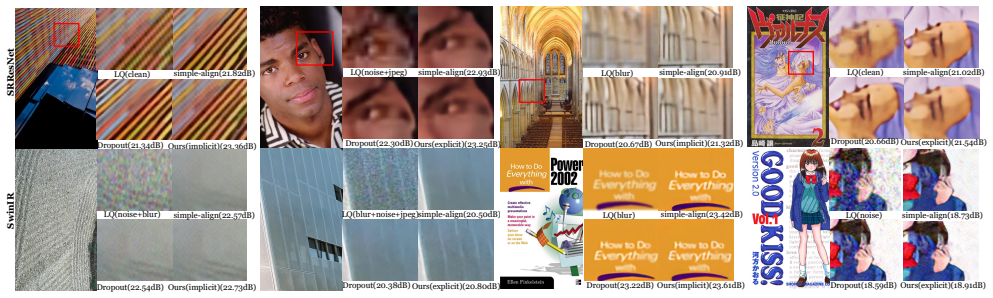
- A single plug-in training change gives consistent PSNR gains over no regularization and over final-layer-only dropout on SRResNet, SwinIR, and RRDB across clean, blur, noise, JPEG, and combined degradations.
- The layer-wise annealing schedule implies that deep layers, not shallow ones, should carry most of the regularization load in blind super-resolution, and that this asymmetry is what lets the method avoid the collapse that plain intermediate dropout causes.
- Because the method also improves GAN-based and diffusion-based restoration models, it can serve as a general training strategy for image restoration rather than a fix limited to one architecture.
- Adaptive Dropout integrates with the existing final-layer Dropout, yielding a unified regularization pipeline that explicitly constrains features at every depth.
Reading between the lines
- One testable extension is to vary $p$ and $w$ independently on the same degradation suite and check whether the measured variance-shift quantity $s_k$ predicts the PSNR gain; if it does not, the adaptive format's success is not explained by variance reduction alone.
- The convex-combination form is a learned interpolation between identity and noise injection, so the method may transfer to other regression tasks with distribution shift, such as depth estimation or deblurring, where intermediate features also mix general and task-specific content.
- If the annealing schedule is the active ingredient, a variant that removes perturbation according to layer depth rather than a hand-set iteration count would be a natural next test of the mechanism.
- The channel-ablation evidence suggests that explicit intermediate regularization, not final-layer regularization, rebalances channels; replicating that ablation with an independent protocol would confirm whether channel balance is the causal channel for the gains.
Editorial analysis
A structured set of objections, weighed in public.
Referee Report
Summary. The paper proposes Adaptive Dropout, a plug-in regularization method for blind super-resolution that replaces direct dropout at intermediate layers with a convex combination f(x)=w x+(1-w)dropout(x,p), trained with a layer-wise annealing schedule (implicit learnable weights or explicit block-by-block annealing). The authors derive a variance-shift quantity s_k, argue that direct dropout degrades intermediate features through training-testing inconsistency and unequal layer-wise generalization requirements, and report experiments on SRResNet, SwinIR, and RRDB across multiple synthetic and real-world datasets, as well as denoising, deraining, dehazing, and generative restoration tasks.
Significance. If the empirical claims are sustained, Adaptive Dropout would be a simple and broadly applicable regularizer for blind SR and adjacent restoration tasks, with code release, tests across several architectures, and consistent directional gains in many settings. The use of SRGA as an auxiliary generalization metric is also a positive feature. However, the central quantitative claim is contradicted by the paper's own Table 2, the variance-shift derivation is incomplete, and no repeated-seed statistics or error bars are reported, so the case as presented is not fully established.
major comments (5)
- [Section 5, Table 2] The text and abstract claim that Adaptive Dropout outperforms all past regularization methods on synthetic benchmarks, but Table 2 provides a direct counterexample: on Urban100, RRDB+Simple-Align achieves 21.05 dB, while RRDB+Explicit Adaptive Dropout achieves 21.00 dB and RRDB+Implicit Adaptive Dropout 20.96 dB. This is not a subtle rounding issue; it is a loss on one of the datasets highlighted in the text. The authors must either correct the claim or clarify the protocol, including how the synthetic columns are aggregated across degradations and where the per-degradation comparisons with Simple-Align are reported, since the referenced supplementary material is not included.
- [Section 3.2, Eq. (1)] The variance-shift calculation for adaptive dropout is not correct as written. If the dropout mask is Bernoulli as defined in the text, Var[x̂_k] is (1−p)σ²+p(1−p)μ², not the expression given in Section 3.2. If the authors intend inverted dropout with a 1/(1−p) scaling, then for f(x)=w x+(1−w)D(x) the variance includes a w²σ² term and a 2w(1−w)σ² cross-covariance term because the same x appears in both branches; the paper's s_k^ad formula drops these terms. Thus the claim that the adaptive format reduces the variance shift by a factor of (1−w)² is not established and the derivation should be redone with an explicit masking convention.
- [Section 3 and 4.2] The paper attributes the performance benefit to variance-shift reduction, but no experiment isolates variance shift from other effects of dropout, such as reduced effective capacity, altered gradient flow, or implicit ensembling. The learned/annealed schedule could be improving generalization through any of these channels. I recommend adding a control experiment: for example, compare adaptive dropout against standard dropout with matched expected mask density, or measure the variance shift directly during training and show that it predicts the observed relative performance across layers and schedules.
- [Section 5, Table 5] The ablation table is inconsistent with Table 1: Table 5 lists no dropout as 25.66 dB and standard dropout as 24.89 dB, whereas Table 1 reports SRResNet with no regularization as 24.89 dB on Set5 clean and Dropout as 25.67 dB. The caption does not state the dataset, degradation, or evaluation protocol, so the reader cannot verify the component contributions. Please specify the protocol and align the numbers with Table 1, or explain the discrepancy explicitly.
- [Section 5, Tables 1 and 2] No repeated-seed statistics or error bars are reported anywhere, yet many of the claimed advantages are 0.01–0.05 dB, which is within typical run-to-run variation for SR training. For the headline comparisons against Simple-Align and Dropout, please report mean ± std over at least three seeds, or clearly state if the reported numbers are single runs and adjust the strength of the claims accordingly.
minor comments (6)
- [Abstract] The phrase 'also highly effective in other image restoration tasks' is grammatically incomplete; it should read 'and is also highly effective in other image restoration tasks.'
- [Section 5] In the applications paragraph, 'image draining' should be 'image deraining.'
- [Figure 3] Algorithm 1 contains placeholder symbols (? and ???) instead of actual variable names; the algorithm should be typeset with the real variables so that the block-by-block annealing rule is understandable.
- [Table 2] The caption does not define the real-world columns 'mild,' 'difficult,' and 'wild,' nor does it state how the synthetic columns are aggregated over the eight degradation settings; please add the missing definitions.
- [Section 3.2] The text says 'the inconsistency is manifested as the shift at intermediate layers after applying dropout,' but the corresponding figure (Figure 2) is not described in enough detail to see the accumulation along layers; a clearer annotation of the measured shift would help.
- [References] The GitHub URL in the abstract contains a typo ('Adpative-Dropout'); if the repository name is intentionally misspelled this should be noted, otherwise the link should be corrected.
Circularity Check
No circularity found: the variance-shift derivation and the benchmark comparisons are self-contained. The layer-wise annealing schedule is reverse-engineered from a learnable-w variant, but it is a method design choice rather than a fitted prediction. Table 2's RRDB Urban100 entry contradicts the paper's 'all synthetic datasets' wording, but that is a correctness issue, not circularity.
full rationale
The paper's central derivation (Section 3.2) computes the variance shift s_k for standard dropout and s_ad_k for the adaptive form f(x)=w x+(1-w)dropout(x,p), and the reduction by a factor (1-w)^2 follows algebraically from the paper's own equations; this is a self-contained mathematical statement, not a restatement of the claimed generalization result. The layer-wise annealing schedule is inferred from a learnable-w exploration and then instantiated as the explicit variant, so it is reverse-engineered rather than independently predicted; nevertheless, the schedule is a method-design choice evaluated on held-out test benchmarks against external baselines (Dropout [29], Simple-Align [56]), so the empirical claim does not reduce to its input by construction. No load-bearing self-citation appears: the cited Dropout and Simple-Align works are external, and no uniqueness claim is imported from prior work by the same authors. The one notable discrepancy is that Section 5 states the method outperforms Simple-Align on all synthetic datasets, while Table 2 lists RRDB+Explicit Adaptive Dropout at 21.00 dB on Urban100 versus RRDB+Simple-Align at 21.05 dB; this contradicts the claim as written but is an accuracy and reporting consistency problem, not a circularity problem. Under the hard rules requiring an exhibited reduction, no circular step can be substantiated.
Assumptions & free parameters
free parameters (4)
- dropout rate p =
0.5
- weight w (initial or fixed for the implicit variant) =
0.7 for SRResNet, 0.9 for RRDB (Table 5)
- annealing interval t in explicit adaptive dropout =
not specified numerically
- shallow value w / deep vector w placement =
design choice
assumptions (3)
- domain assumption Features in shallow layers are more general and features in deep layers are more task- and degradation-specific.
- domain assumption Training-testing inconsistency caused by variance shift is the primary cause of the PSNR drop when dropout is applied at intermediate layers.
- standard math Channel dropout masks are independent of feature values, so the product variance formula applies.
Cite this review
Pith. "Pith review of Adaptive Dropout: Unleashing Dropout across Layers for Generalizable Image Super-Resolution." pith.science (2026). https://pith.science/paper/AWQPEK36
@misc{pith2026250612738,
  author       = {Pith},
  title        = {Pith review of: Adaptive Dropout: Unleashing Dropout across Layers for Generalizable Image Super-Resolution},
  year         = {2026},
  howpublished = {\url{https://pith.science/paper/AWQPEK36}},
  note         = {Machine review of arXiv:2506.12738}
}
read the original abstract
Blind Super-Resolution (blind SR) aims to enhance the model's generalization ability with unknown degradation, yet it still encounters severe overfitting issues. Some previous methods inspired by dropout, which enhances generalization by regularizing features, have shown promising results in blind SR. Nevertheless, these methods focus solely on regularizing features before the final layer and overlook the need for generalization in features at intermediate layers. Without explicit regularization of features at intermediate layers, the blind SR network struggles to obtain well-generalized feature representations. However, the key challenge is that directly applying dropout to intermediate layers leads to a significant performance drop, which we attribute to the inconsistency in training-testing and across layers it introduced. Therefore, we propose Adaptive Dropout, a new regularization method for blind SR models, which mitigates the inconsistency and facilitates application across intermediate layers of networks. Specifically, for training-testing inconsistency, we re-design the form of dropout and integrate the features before and after dropout adaptively. For inconsistency in generalization requirements across different layers, we innovatively design an adaptive training strategy to strengthen feature propagation by layer-wise annealing. Experimental results show that our method outperforms all past regularization methods on both synthetic and real-world benchmark datasets, also highly effective in other image restoration tasks. Code is available at \href{https://github.com/xuhang07/Adpative-Dropout}{https://github.com/xuhang07/Adpative-Dropout}.
Figures


Figures from the paper (3 more)


Reference graph
Works this paper leans on
-
[1]
Ntire 2017 challenge on single image super-resolution: Dataset and study
Eirikur Agustsson and Radu Timofte. Ntire 2017 challenge on single image super-resolution: Dataset and study. InThe IEEE Conference on Computer Vision and Pattern Recogni- tion (CVPR) Workshops, 2017. 6
work page 2017
-
[2]
Sefi Bell-Kligler, Assaf Shocher, and Michal Irani. Blind super-resolution kernel estimation using an internal-gan.Ad- vances in Neural Information Processing Systems, 32, 2019. 1, 2
work page 2019
-
[3]
Irwan Bello, William Fedus, Xianzhi Du, Ekin Dogus Cubuk, Aravind Srinivas, Tsung-Yi Lin, Jonathon Shlens, and Barret Zoph. Revisiting resnets: Improved training and scaling strategies.Advances in Neural Information Process- ing Systems, 34:22614–22627, 2021. 1
work page 2021
-
[4]
Low-complexity single-image super-resolution based on nonnegative neighbor embedding
Marco Bevilacqua, Aline Roumy, Christine Guillemot, and Marie Line Alberi-Morel. Low-complexity single-image super-resolution based on nonnegative neighbor embedding. British Machine Vision Conference, 2012. 6, 7
work page 2012
-
[5]
Understanding batch normalization.Advances in Neural Information Processing Systems, 31, 2018
Nils Bjorck, Carla P Gomes, Bart Selman, and Kilian Q Weinberger. Understanding batch normalization.Advances in Neural Information Processing Systems, 31, 2018. 2
work page 2018
-
[6]
Toward real-world single image super-resolution: A new benchmark and a new model
Jianrui Cai, Hui Zeng, Hongwei Yong, Zisheng Cao, and Lei Zhang. Toward real-world single image super-resolution: A new benchmark and a new model. InProceedings of the IEEE/CVF International Conference on Computer Vision, pages 3086–3095, 2019. 6, 7
work page 2019
-
[7]
Real-world blind super-resolution via feature matching with implicit high- resolution priors
Chaofeng Chen, Xinyu Shi, Yipeng Qin, Xiaoming Li, Xi- aoguang Han, Tao Yang, and Shihui Guo. Real-world blind super-resolution via feature matching with implicit high- resolution priors. InProceedings of the 30th ACM Interna- tional Conference on Multimedia, pages 1329–1338, 2022. 1
work page 2022
-
[8]
Masked image training for generalizable deep image denois- ing
Haoyu Chen, Jinjin Gu, Yihao Liu, Salma Abdel Magid, Chao Dong, Qiong Wang, Hanspeter Pfister, and Lei Zhu. Masked image training for generalizable deep image denois- ing. InProceedings of the IEEE/CVF Conference on Com- puter Vision and Pattern Recognition, pages 1692–1703,
Show all 70 references
-
[9]
Activating more pixels in image super- resolution transformer
Xiangyu Chen, Xintao Wang, Jiantao Zhou, Yu Qiao, and Chao Dong. Activating more pixels in image super- resolution transformer. InProceedings of the IEEE/CVF Conference on Computer Vision and Pattern Recognition, pages 22367–22377, 2023. 6
2023
-
[10]
Adam: A method for stochastic opti- mization.(No Title), 2014
P Kingma Diederik. Adam: A method for stochastic opti- mization.(No Title), 2014. 6
2014
-
[11]
Runmin Dong, Lichao Mou, Lixian Zhang, Haohuan Fu, and Xiao Xiang Zhu. Real-world remote sensing image super- resolution via a practical degradation model and a kernel- aware network.ISPRS Journal of Photogrammetry and Re- mote Sensing, 191:155–170, 2022. 2
2022
-
[12]
Dropblock: A regularization method for convolutional networks.Advances in Neural Information Processing Systems, 31, 2018
Golnaz Ghiasi, Tsung-Yi Lin, and Quoc V Le. Dropblock: A regularization method for convolutional networks.Advances in Neural Information Processing Systems, 31, 2018. 1, 2
2018
-
[13]
Blind super-resolution with iterative kernel correction
Jinjin Gu, Hannan Lu, Wangmeng Zuo, and Chao Dong. Blind super-resolution with iterative kernel correction. In Proceedings of the IEEE/CVF Conference on Computer Vi- sion and Pattern Recognition, pages 1604–1613, 2019. 1
2019
-
[14]
Masked autoencoders are scalable vision learners
Kaiming He, Xinlei Chen, Saining Xie, Yanghao Li, Piotr Doll´ar, and Ross Girshick. Masked autoencoders are scalable vision learners. InProceedings of the IEEE/CVF Conference on Computer Vision and Pattern Recognition, pages 16000– 16009, 2022. 2
2022
-
[15]
Drct: Saving image super-resolution away from information bottleneck.arXiv preprint arXiv:2404.00722, 2024
Chih-Chung Hsu, Chia-Ming Lee, and Yi-Shiuan Chou. Drct: Saving image super-resolution away from information bottleneck.arXiv preprint arXiv:2404.00722, 2024. 6
2024 arXiv
-
[16]
Squeeze-and-excitation networks
Jie Hu, Li Shen, and Gang Sun. Squeeze-and-excitation networks. InProceedings of the IEEE/CVF Conference on Computer Vision and Pattern Recognition, pages 7132– 7141, 2018. 6
2018
-
[17]
Single image super-resolution from transformed self-exemplars
Jia-Bin Huang, Abhishek Singh, and Narendra Ahuja. Single image super-resolution from transformed self-exemplars. In Proceedings of the IEEE/CVF Conference on Computer Vi- sion and Pattern Recognition, pages 5197–5206, 2015. 6, 7
2015
-
[18]
Un- folding the alternating optimization for blind super resolu- tion.Advances in Neural Information Processing Systems, 33:5632–5643, 2020
Yan Huang, Shang Li, Liang Wang, Tieniu Tan, et al. Un- folding the alternating optimization for blind super resolu- tion.Advances in Neural Information Processing Systems, 33:5632–5643, 2020. 1
2020
-
[19]
Learning degradation-invariant representation for ro- bust real-world person re-identification.International Jour- nal of Computer Vision, 130(11):2770–2796, 2022
Yukun Huang, Xueyang Fu, Liang Li, and Zheng-Jun Zha. Learning degradation-invariant representation for ro- bust real-world person re-identification.International Jour- nal of Computer Vision, 130(11):2770–2796, 2022. 1
2022
-
[20]
Structural and statistical texture knowledge distillation for semantic segmentation
Deyi Ji, Haoran Wang, Mingyuan Tao, Jianqiang Huang, Xian-Sheng Hua, and Hongtao Lu. Structural and statistical texture knowledge distillation for semantic segmentation. In Proceedings of the IEEE/CVF Conference on Computer Vi- sion and Pattern Recognition, pages 16876–16885, 2022. 2
2022
-
[21]
Deyi Ji, Feng Zhao, and Hongtao Lu. Guided patch-grouping wavelet transformer with spatial congruence for ultra-high resolution segmentation.International Joint Conference on Artificial Intelligence, pages 920–928, 2023. 2
2023
-
[22]
Ultra-high resolution segmentation with ultra-rich con- text: A novel benchmark
Deyi Ji, Feng Zhao, Hongtao Lu, Mingyuan Tao, and Jieping Ye. Ultra-high resolution segmentation with ultra-rich con- text: A novel benchmark. InProceedings of the IEEE/CVF Conference on Computer Vision and Pattern Recognition, pages 23621–23630, 2023. 2
2023
-
[23]
Ppt- former: Pseudo multi-perspective transformer for uav seg- mentation.International Joint Conference on Artificial In- telligence, pages 893–901, 2024
Deyi Ji, Wenwei Jin, Hongtao Lu, and Feng Zhao. Ppt- former: Pseudo multi-perspective transformer for uav seg- mentation.International Joint Conference on Artificial In- telligence, pages 893–901, 2024. 2
2024
-
[24]
Discrete latent perspective learning for seg- mentation and detection
Deyi Ji, Feng Zhao, Lanyun Zhu, Wenwei Jin, Hongtao Lu, and Jieping Ye. Discrete latent perspective learning for seg- mentation and detection. InInternational Conference on Ma- chine Learning, pages 21719–21730, 2024. 1
2024
-
[25]
Structural and statistical texture knowledge distillation and learning for segmentation.IEEE Transactions on Pattern Analysis and Machine Intelligence, pages 1–18, 2025
Deyi Ji, Feng Zhao, Hongtao Lu, Feng Wu, and Jieping Ye. Structural and statistical texture knowledge distillation and learning for segmentation.IEEE Transactions on Pattern Analysis and Machine Intelligence, pages 1–18, 2025. 1 9
2025
-
[26]
Multi-scale progressive fusion network for single image deraining
Kui Jiang, Zhongyuan Wang, Peng Yi, Chen Chen, Baojin Huang, Yimin Luo, Jiayi Ma, and Junjun Jiang. Multi-scale progressive fusion network for single image deraining. In Proceedings of the IEEE/CVF Conference on Computer Vi- sion and Pattern Recognition, pages 8346–8355, 2020. 8
2020
-
[27]
Inconsistency, instability, and generalization gap of deep neural network training.Ad- vances in Neural Information Processing Systems, 36, 2024
Rie Johnson and Tong Zhang. Inconsistency, instability, and generalization gap of deep neural network training.Ad- vances in Neural Information Processing Systems, 36, 2024. 3
2024
-
[28]
Lightweight prompt learning implicit degradation estimation network for blind super resolution.IEEE Transactions on Image Processing, 2024
Asif Hussain Khan, Christian Micheloni, and Niki Martinel. Lightweight prompt learning implicit degradation estimation network for blind super resolution.IEEE Transactions on Image Processing, 2024. 2
2024
-
[29]
Reflash dropout in image super-resolution
Xiangtao Kong, Xina Liu, Jinjin Gu, Yu Qiao, and Chao Dong. Reflash dropout in image super-resolution. InPro- ceedings of the IEEE/CVF Conference on Computer Vision and Pattern Recognition, pages 6002–6012, 2022. 1, 2, 3, 5, 6, 7
2022
-
[30]
Photo- realistic single image super-resolution using a generative ad- versarial network
Christian Ledig, Lucas Theis, Ferenc Husz´ar, Jose Caballero, Andrew Cunningham, Alejandro Acosta, Andrew Aitken, Alykhan Tejani, Johannes Totz, Zehan Wang, et al. Photo- realistic single image super-resolution using a generative ad- versarial network. InProceedings of the IEE...
2017
-
[31]
Benchmarking single- image dehazing and beyond.IEEE Transactions on Image Processing, 28(1):492–505, 2019
Boyi Li, Wenqi Ren, Dengpan Fu, Dacheng Tao, Dan Feng, Wenjun Zeng, and Zhangyang Wang. Benchmarking single- image dehazing and beyond.IEEE Transactions on Image Processing, 28(1):492–505, 2019. 8
2019
-
[32]
Learning detail-structure alternative opti- mization for blind super-resolution.IEEE Transactions on Multimedia, 25:2825–2838, 2022
Feng Li, Yixuan Wu, Huihui Bai, Weisi Lin, Runmin Cong, and Yao Zhao. Learning detail-structure alternative opti- mization for blind super-resolution.IEEE Transactions on Multimedia, 25:2825–2838, 2022. 2
2022
-
[33]
Under- standing the disharmony between dropout and batch normal- ization by variance shift
Xiang Li, Shuo Chen, Xiaolin Hu, and Jian Yang. Under- standing the disharmony between dropout and batch normal- ization by variance shift. InProceedings of the IEEE/CVF Conference on Computer Vision and Pattern Recognition, pages 2682–2690, 2019. 3
2019
-
[34]
Swinir: Image restoration us- ing swin transformer
Jingyun Liang, Jiezhang Cao, Guolei Sun, Kai Zhang, Luc Van Gool, and Radu Timofte. Swinir: Image restoration us- ing swin transformer. InProceedings of the IEEE/CVF Inter- national Conference on Computer Vision, pages 1833–1844,
-
[35]
Flow-based kernel prior with application to blind super-resolution
Jingyun Liang, Kai Zhang, Shuhang Gu, Luc Van Gool, and Radu Timofte. Flow-based kernel prior with application to blind super-resolution. InProceedings of the IEEE/CVF Conference on Computer Vision and Pattern Recognition, pages 10601–10610, 2021. 1, 2
2021
-
[36]
Efficient and degradation-adaptive network for real-world image super- resolution
Jie Liang, Hui Zeng, and Lei Zhang. Efficient and degradation-adaptive network for real-world image super- resolution. InEuropean Conference on Computer Vision, pages 574–591. Springer, 2022. 2
2022
-
[37]
Blind image super-resolution: A survey and beyond.IEEE Transactions on Pattern Analysis and Machine Intelligence, 45(5):5461–5480, 2022
Anran Liu, Yihao Liu, Jinjin Gu, Yu Qiao, and Chao Dong. Blind image super-resolution: A survey and beyond.IEEE Transactions on Pattern Analysis and Machine Intelligence, 45(5):5461–5480, 2022. 1
2022
-
[38]
Degradation-invariant enhance- ment of fundus images via pyramid constraint network
Haofeng Liu, Heng Li, Huazhu Fu, Ruoxiu Xiao, Yunshu Gao, Yan Hu, and Jiang Liu. Degradation-invariant enhance- ment of fundus images via pyramid constraint network. In International Conference on Medical Image Computing and Computer-Assisted Intervention, pages 507–516. Springer,
-
[39]
Evaluating the generalization ability of super- resolution networks.IEEE Transactions on pattern analysis and machine intelligence, 2023
Yihao Liu, Hengyuan Zhao, Jinjin Gu, Yu Qiao, and Chao Dong. Evaluating the generalization ability of super- resolution networks.IEEE Transactions on pattern analysis and machine intelligence, 2023. 8
2023
-
[40]
Transferable representation learning with deep adaptation networks.IEEE Transactions on Pat- tern Analysis and Machine Intelligence, 41(12):3071–3085,
Mingsheng Long, Yue Cao, Zhangjie Cao, Jianmin Wang, and Michael I Jordan. Transferable representation learning with deep adaptation networks.IEEE Transactions on Pat- tern Analysis and Machine Intelligence, 41(12):3071–3085,
-
[41]
A database of human segmented natural images and its application to evaluating segmentation algorithms and measuring ecological statistics
David Martin, Charless Fowlkes, Doron Tal, and Jitendra Malik. A database of human segmented natural images and its application to evaluating segmentation algorithms and measuring ecological statistics. InProceedings eighth IEEE international conference on computer vision. ICC...
2001
-
[42]
Sketch-based manga retrieval using manga109 dataset.Mul- timedia tools and applications, 76:21811–21838, 2017
Yusuke Matsui, Kota Ito, Yuji Aramaki, Azuma Fujimoto, Toru Ogawa, Toshihiko Yamasaki, and Kiyoharu Aizawa. Sketch-based manga retrieval using manga109 dataset.Mul- timedia tools and applications, 76:21811–21838, 2017. 6, 7
2017
-
[43]
Nonparametric blind super-resolution
Tomer Michaeli and Michal Irani. Nonparametric blind super-resolution. InProceedings of the IEEE International Conference on Computer Vision, pages 945–952, 2013. 1
2013
-
[44]
On the importance of single directions for generalization.arXiv preprint arXiv:1803.06959, 2018
Ari S Morcos, David GT Barrett, Neil C Rabinowitz, and Matthew Botvinick. On the importance of single directions for generalization.arXiv preprint arXiv:1803.06959, 2018. 3
2018 arXiv
-
[45]
Implicit regularization in deep learning
Behnam Neyshabur. Implicit regularization in deep learning. arXiv preprint arXiv:1709.01953, 2017. 1
2017 arXiv
-
[46]
In search of the real inductive bias: On the role of implicit regu- larization in deep learning.arXiv preprint arXiv:1412.6614,
Behnam Neyshabur, Ryota Tomioka, and Nathan Srebro. In search of the real inductive bias: On the role of implicit regu- larization in deep learning.arXiv preprint arXiv:1412.6614,
-
[47]
Super-resolution of remote sensing imagery using implicit degradation modeling
Han Oh, Dongjin Kim, Sun Gu Lee, and Daewon Chung. Super-resolution of remote sensing imagery using implicit degradation modeling. InIGARSS 2023-2023 IEEE Inter- national Geoscience and Remote Sensing Symposium, pages 5146–5149. IEEE, 2023. 2
2023
-
[48]
Effect of dropout layer on clas- sical regression problems
Atilla ¨Ozg¨ur and Fatih Nar. Effect of dropout layer on clas- sical regression problems. In2020 28th Signal Processing and Communications Applications Conference (SIU), pages 1–4. IEEE, 2020. 2
2020
-
[49]
Pointnext: Revisiting pointnet++ with improved training and scaling strategies.Advances in Neural Informa- tion Processing Systems, 35:23192–23204, 2022
Guocheng Qian, Yuchen Li, Houwen Peng, Jinjie Mai, Hasan Hammoud, Mohamed Elhoseiny, and Bernard Ghanem. Pointnext: Revisiting pointnet++ with improved training and scaling strategies.Advances in Neural Informa- tion Processing Systems, 35:23192–23204, 2022. 1
2022
-
[50]
Ffa-net: Feature fusion attention network for single image dehazing
Xu Qin, Zhilin Wang, Yuanchao Bai, Xiaodong Xie, and Huizhu Jia. Ffa-net: Feature fusion attention network for single image dehazing. InProceedings of the AAAI Confer- ence on Artificial Intelligence, pages 11908–11915, 2020. 8
2020
-
[51]
Multi-degradation super- 10 resolution reconstruction for remote sensing images with re- construction features-guided kernel correction.Remote Sens- ing, 16(16):2915, 2024
Yi Qin, Haitao Nie, Jiarong Wang, Huiying Liu, Jiaqi Sun, Ming Zhu, Jie Lu, and Qi Pan. Multi-degradation super- 10 resolution reconstruction for remote sensing images with re- construction features-guided kernel correction.Remote Sens- ing, 16(16):2915, 2024. 2
2024
-
[52]
Denoising diffusion probabilistic models for ro- bust image super-resolution in the wild.arXiv preprint arXiv:2302.07864, 2023
Hshmat Sahak, Daniel Watson, Chitwan Saharia, and David Fleet. Denoising diffusion probabilistic models for ro- bust image super-resolution in the wild.arXiv preprint arXiv:2302.07864, 2023. 1, 2
2023 arXiv
-
[53]
Dropout: a simple way to prevent neural networks from overfitting.The journal of machine learning research, 15(1):1929–1958, 2014
Nitish Srivastava, Geoffrey Hinton, Alex Krizhevsky, Ilya Sutskever, and Ruslan Salakhutdinov. Dropout: a simple way to prevent neural networks from overfitting.The journal of machine learning research, 15(1):1929–1958, 2014. 1, 2
1929
-
[54]
Ntire 2017 challenge on single image super-resolution: Methods and results
Radu Timofte, Eirikur Agustsson, Luc Van Gool, Ming- Hsuan Yang, and Lei Zhang. Ntire 2017 challenge on single image super-resolution: Methods and results. InProceed- ings of the IEEE/CVF Conference on Computer Vision and Pattern Recognition workshops, pages 114–125, 2017. 6, 7
2017
-
[55]
Rcdnet: An interpretable rain convolutional dictionary network for single image de- raining.IEEE Transactions on Neural Networks and Learn- ing Systems, 2023
Hong Wang, Qi Xie, Qian Zhao, Yuexiang Li, Yong Liang, Yefeng Zheng, and Deyu Meng. Rcdnet: An interpretable rain convolutional dictionary network for single image de- raining.IEEE Transactions on Neural Networks and Learn- ing Systems, 2023. 8
2023
-
[56]
Navigating beyond dropout: An intriguing solution towards generalizable image super resolution
Hongjun Wang, Jiyuan Chen, Yinqiang Zheng, and Tieyong Zeng. Navigating beyond dropout: An intriguing solution towards generalizable image super resolution. InProceed- ings of the IEEE/CVF Conference on Computer Vision and Pattern Recognition, pages 25532–25543, 2024. 1, 2, 3, 6, 7, 8
2024
-
[57]
Real-esrgan: Training real-world blind super-resolution with pure synthetic data
Xintao Wang, Liangbin Xie, Chao Dong, and Ying Shan. Real-esrgan: Training real-world blind super-resolution with pure synthetic data. InProceedings of the IEEE/CVF Inter- national Conference on Computer Vision, pages 1905–1914,
1905
-
[58]
Component divide- and-conquer for real-world image super-resolution
Pengxu Wei, Ziwei Xie, Hannan Lu, Zongyuan Zhan, Qixi- ang Ye, Wangmeng Zuo, and Liang Lin. Component divide- and-conquer for real-world image super-resolution. InCom- puter Vision–ECCV 2020: 16th European Conference, Glas- gow, UK, August 23–28, 2020, Proceedings, Part VIII 1...
2020
-
[59]
R-drop: Regularized dropout for neural networks.Advances in Neural Informa- tion Processing Systems, 34:10890–10905, 2021
Lijun Wu, Juntao Li, Yue Wang, Qi Meng, Tao Qin, Wei Chen, Min Zhang, Tie-Yan Liu, et al. R-drop: Regularized dropout for neural networks.Advances in Neural Informa- tion Processing Systems, 34:10890–10905, 2021. 1, 2
2021
-
[60]
Group normalization
Yuxin Wu and Kaiming He. Group normalization. InPro- ceedings of the European Conference on Computer Vision (ECCV), pages 3–19, 2018. 2
2018
-
[61]
Understanding and improving layer normaliza- tion.Advances in Neural Information Processing Systems, 32, 2019
Jingjing Xu, Xu Sun, Zhiyuan Zhang, Guangxiang Zhao, and Junyang Lin. Understanding and improving layer normaliza- tion.Advances in Neural Information Processing Systems, 32, 2019. 2
2019
-
[62]
Kgsr: A kernel guided net- work for real-world blind super-resolution.Pattern Recogni- tion, 147:110095, 2024
Qingsen Yan, Axi Niu, Chaoqun Wang, Wei Dong, Marcin Wo´zniak, and Yanning Zhang. Kgsr: A kernel guided net- work for real-world blind super-resolution.Pattern Recogni- tion, 147:110095, 2024. 2
2024
-
[63]
Image super-resolution via sparse representation
Jianchao Yang, John Wright, Thomas S Huang, and Yi Ma. Image super-resolution via sparse representation. IEEE Transactions on Image Processing, 19(11):2861–2873,
-
[64]
How transferable are features in deep neural networks?Ad- vances in Neural Information Processing Systems, 27, 2014
Jason Yosinski, Jeff Clune, Yoshua Bengio, and Hod Lipson. How transferable are features in deep neural networks?Ad- vances in Neural Information Processing Systems, 27, 2014. 5
2014
-
[65]
Blind image super-resolution with elaborate degradation modeling on noise and kernel
Zongsheng Yue, Qian Zhao, Jianwen Xie, Lei Zhang, Deyu Meng, and Kwan-Yee K Wong. Blind image super-resolution with elaborate degradation modeling on noise and kernel. In Proceedings of the IEEE/CVF Conference on Computer Vi- sion and Pattern Recognition, pages 2128–2138, 2022. 2
2022
-
[66]
Resshift: Efficient diffusion model for image super- resolution by residual shifting.Advances in Neural Infor- mation Processing Systems, 36:13294–13307, 2023
Zongsheng Yue, Jianyi Wang, and Chen Change Loy. Resshift: Efficient diffusion model for image super- resolution by residual shifting.Advances in Neural Infor- mation Processing Systems, 36:13294–13307, 2023. 8
2023
-
[67]
Restormer: Efficient transformer for high-resolution image restoration
Syed Waqas Zamir, Aditya Arora, Salman Khan, Mu- nawar Hayat, Fahad Shahbaz Khan, and Ming-Hsuan Yang. Restormer: Efficient transformer for high-resolution image restoration. InProceedings of the IEEE/CVF Conference on Computer Vision and Pattern Recognition, pages 5728– 5739, 2022. 8
2022
-
[68]
Designing a practical degradation model for deep blind image super-resolution
Kai Zhang, Jingyun Liang, Luc Van Gool, and Radu Timo- fte. Designing a practical degradation model for deep blind image super-resolution. InProceedings of the IEEE/CVF International Conference on Computer Vision, pages 4791– 4800, 2021. 1, 2
2021
-
[69]
Image super-resolution using very deep residual channel attention networks
Yulun Zhang, Kunpeng Li, Kai Li, Lichen Wang, Bineng Zhong, and Yun Fu. Image super-resolution using very deep residual channel attention networks. InProceedings of the European Conference on Computer Vision (ECCV), pages 286–301, 2018. 6
2018
-
[70]
Weakly-supervised con- trastive learning-based implicit degradation modeling for blind image super-resolution.Knowledge-Based Systems, 249:108984, 2022
Yongfei Zhang, Ling Dong, Hong Yang, Linbo Qing, Xi- aohai He, and Honggang Chen. Weakly-supervised con- trastive learning-based implicit degradation modeling for blind image super-resolution.Knowledge-Based Systems, 249:108984, 2022. 2 11
2022
Reviewed August 7, 2026 · model on record in the stance chip above.
Discussion (0). Sign in to comment.