REVIEW 4 major objections 5 minor 36 references
Transforming Chatbot Text: A Sequence-to-Sequence Approach
T0 review · 4 major / 5 minor · reviewed 2026-08-07 · deepseek-v4-flash
Pith's one-line read Fine-tuned T5-small and BART can rewrite GPT output so that six GPT-text classifiers lose up to about 19 percent relative accuracy, while retraining on the rewritten text restores detection to near-baseline levels.
desk verdict A competent but incremental attack study whose same-corpus evaluation limits the 'humanization' claim. read the letter →
The pith
A machine-rendered reading of the paper's core claim, the machinery that carries it, and where it could break.
The reading
What carries the argument
The central object is a fine-tuned encoder-decoder sequence-to-sequence transformation. A pretrained T5-small or BART model is fine-tuned in a supervised way on pairs where the input is a GPT-generated sentence prefixed with the instruction 'humanize' and the target is the corresponding human-written sentence from the same context. At inference the model rewrites GPT sentences into a style meant to resemble human prose, and the evaluation grid—six classifiers (logistic regression, random forest, XGBoost, MLP, DNN, LSTM) times three embeddings (Word2Vec, GloVe, BERT)—is what turns the rewrites into measurable accuracy changes.
What would settle it
Apply the same fine-tuning and evaluation to a second paired corpus with a different register, such as news or fiction, and compare the accuracy drop and the retrained accuracy. If the drop shrinks well below 19 percent or retrained classifiers fail to return to near-baseline accuracy, the paper's claim does not generalize. A complementary check: test the transformed text against a detector outside the six classifiers—a stronger pretrained detector or human judges—since the paper only evaluates the six classifiers trained on these embeddings.
Extended reading notes
Core claim
On its own terms, the paper claims that post-processing GPT-generated text with fine-tuned Seq2Seq models makes it measurably harder for trained classifiers to separate AI from human writing. Using T5-small and BART, each fine-tuned to map GPT sentences to paired human rewrites, the transformed GPT datasets lower detector accuracy from the 0.93-0.98 baseline range to as low as roughly 0.75 for word-vector embeddings and 0.72-0.91 for BERT embeddings, depending on the classifier. The method also shows a limit: when the same classifiers are retrained on the transformed text versus human text, accuracy returns to nearly baseline levels, with the best BERT plus deep-network configuration reaching about 0.98. The paper reads this as evidence that the transformation shifts the distribution of GPT text rather than erasing the difference, and that retraining on transformed text is a viable defense.
Load-bearing premise
The load-bearing premise is that each GPT-generated sentence in the training data has a valid human-written counterpart expressing the same content; if that pairing is loose or the WikiHow style is distinctive, the measured attack and defense numbers may describe one corpus rather than general human-likeness.
Editorial extensions
If this is right
- A detector that has never seen rewritten text can be degraded by post-processing, so evaluation benchmarks for AI-text detection should include transformed text as a separate test condition.
- Retraining on transformed text restores detection to near-baseline accuracy, so data augmentation with Seq2Seq-rewritten text is a usable defense against this attack.
- The accuracy drop appears across all three embeddings and all six classifiers tested, so the effect is not specific to one classifier or feature representation.
- The residual gap after retraining implies that the rewrite removes some GPT-like signals but leaves others that a classifier can still learn.
Reading between the lines
- The paired-corpus design means the attack is only as portable as the pairing: on text types without clean human rewrites, the same fine-tuning recipe may fail, and on stylistically uniform corpora the apparent drop could partly reflect a shift away from the training distribution rather than toward human style.
- One testable implication the author leaves implicit is that the residual signal learned by retrained classifiers is likely stylistic rather than semantic; measuring perplexity, vocabulary richness, or sentence-length variance before and after transformation would help isolate that signal.
- An adversarial loop that feeds classifier feedback back into the Seq2Seq fine-tuning—mentioned in the paper as future work—would directly test whether the defense's recovered accuracy can itself be eroded, turning the reported static attack into a co-evolution.
Editorial analysis
A structured set of objections, weighed in public.
Referee Report
Summary. The paper proposes fine-tuning T5-small and BART as sequence-to-sequence post-processors that rewrite GPT-generated text with the aim of making it more human-like, using paired human/GPT sentences from a WikiHow-derived dataset. It evaluates six classifiers (LR, RF, XGB, MLP, DNN, LSTM) with three embeddings (Word2Vec, GloVe, BERT) under three conditions: baseline human-vs-GPT classification, baseline classifiers tested on the Seq2Seq-transformed text, and classifiers retrained on the transformed text. The reported results show accuracy drops after transformation (Table 4), followed by a return to near-baseline accuracy after retraining (Table 5). The authors frame the transformation as both an adversarial attack on detectors and a data-augmentation defense, while acknowledging in Section 5.4 that the transformed text is not sufficiently human-like to evade retrained classifiers.
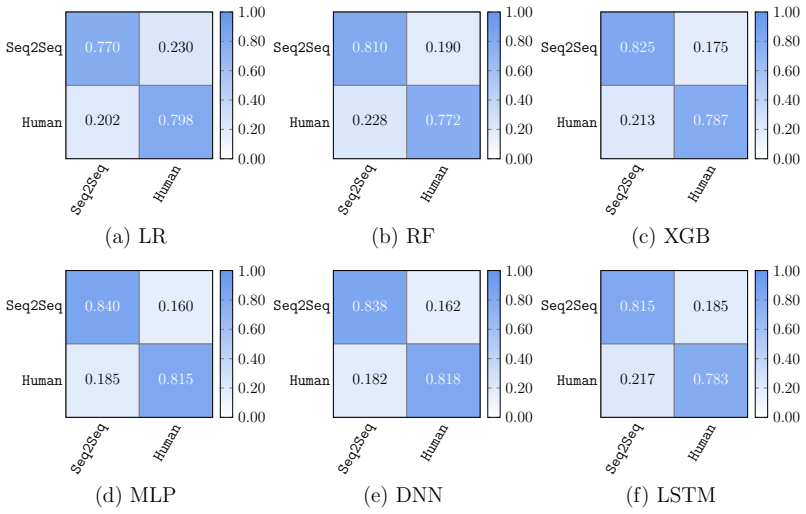
Significance. If the empirical claims hold, the paper demonstrates a useful and clearly reported result: fine-tuned Seq2Seq post-processing shifts GPT text out of the decision regions of static classifiers, while retraining on the shifted distribution restores detection. The systematic grid over six classifiers and three embeddings, with complete accuracy tables and confusion matrices, is a strength, as is the candid discussion in Section 5.4 that the transformed text remains distinguishable from human text. However, the closed-loop, single-corpus evaluation and the absence of control conditions mean the broader 'humanization' claim is not established; the evidence is best interpreted as a distribution-shift attack on static detectors rather than as evidence that the output is more human-like. The retraining results, especially BERT/DNN accuracy returning to 0.9845 after retraining, are informative for the attack/defense framing and give the paper value for the AI-text detection community.
major comments (4)
- [Section 5.2 / Table 4; Section 4] The accuracy drops in Table 4 are measured against human text drawn from the same WikiHow distribution that supplied the paired targets used to fine-tune the Seq2Seq models in Section 4. The transformed text is therefore optimized to resemble exactly the human distribution used as the 'human' class in the attack evaluation, so the observed drop could be a same-corpus distribution-shift artifact rather than evidence of general human-likeness. I ask for an out-of-corpus human test set and a control transformation (e.g., generic paraphrase or synonym substitution) to distinguish the humanization hypothesis from the hypothesis that the transformation simply moves GPT text outside the classifiers' training manifold.
- [Table 5 / Section 5.4] The retraining results are the clearest indicator of what the transformation actually does: after retraining on transformed text, the best models recover to essentially baseline accuracy (BERT/DNN: 0.9845 for T5 and 0.9825 for BART versus 0.9840 baseline). Section 5.4 correctly concedes that this shows the transformed text can still be distinguished from human text, which is the signature of a distribution shift, not of humanization. The abstract and Section 5.4 nevertheless describe the transformation as producing text that is 'more human-like'; this claim is not supported by the presented evidence and should be reframed or explicitly scoped to 'harder for static classifiers trained on the original GPT distribution.'
- [Section 4; Tables 3–5] The evaluation reports no variance, confidence intervals, or significance tests. Section 4 states that accuracies are based on 2,000 samples, and each entry in Tables 3–5 appears to come from a single run, yet the discussion treats small differences as meaningful (e.g., Table 5 BERT/MLP 0.9805 vs 0.9810). Because the headline claim is about significant degradation, the paper should report multiple runs with error bars and use a paired test such as McNemar's test for the key baseline-versus-transformed comparisons.
- [Table 4; Section 5.2] Even after the attack, the strongest detector (BERT/DNN) retains accuracy of 0.8940 for T5-transformed text and 0.9080 for BART-transformed text, which is far from evasion. The statement that the Seq2Seq approach 'significantly degrades' classifiers should be scoped to classifiers that have not been retrained and should explicitly acknowledge that the best detector still classifies nearly 90% of transformed samples correctly. In addition, the anomalously low BERT/LSTM baseline (0.8495 in Table 3) persists after retraining (0.8510 and 0.8390 in Table 5) and deserves an explanation, since that row drives the largest reported relative drops for BERT.
minor comments (5)
- [Section 3.1.1] The classifier is described as 'Linear Regression (LR)' in the opening sentence; it should be 'Logistic Regression' for consistency with the binary classification task.
- [Section 3.1.5] The definition of DNN as 'an MLP architecture with multiple hidden layers' is fine, but it would be clearer to state the exact number of layers used in the experiments, since the distinction between MLP and DNN is otherwise purely terminological.
- [Section 3.1.6] The acronym LSTM is defined in the section title but the term 'Long Short Term Memory' is used without a hyphen; consider standardizing to 'Long Short-Term Memory'.
- [Appendix] The appendix contains formatting issues such as 'T ransformed BAR T' and missing spaces after colons; these should be corrected in the final version.
- [Section 3.2.4 / 3.2.5] The subsection headers place T5-small and BART under 'Word Embeddings,' which is misleading; consider moving them to a separate 'Sequence-to-Sequence Models' subsection.
Circularity Check
Closed-loop evaluation: the 'human' test class is the same corpus used as the Seq2Seq fine-tuning target, so the attack drop measures in-corpus fit, not general human-likeness.
-
fitted input called prediction
[Section 3.3 (dataset [10]); Section 4 (paired fine-tuning); Section 5.2 (evaluation on same human data)]
""Each input is a GPT-generated sentence prefixed with a task-specific instruction (i.e., 'humanize') and the corresponding target is the human-written version which was taken from the same semantic context." ... "We then test each of the six classification models trained in the baseline case on these transformed samples, with the human-generated data again serving as the other class in each of these binary classification experiment.""
The transform is fine-tuned to map GPT sentences onto human-written targets from the [10]/WikiHow corpus, and the attack evaluation uses the same corpus's human-generated data as the human class. Table 4's accuracy drop therefore measures how well the generated text matches the exact training-target distribution: in the limit of perfect training, output converges to the human class by construction, so classifier misclassification is forced. The retraining experiment (Table 5) confirms the transformed text is a new, separable distribution, so the drop is a same-corpus distribution-shift effect, not evidence of general human-likeness. The 'humanization' prediction is fitted to and evaluated on the same data, with no independent human-text corpus or control transformation tested.
full rationale
The paper is an empirical attack/defense study rather than a derivation, and most of its machinery is non-circular: the classifiers, embeddings, and retraining control are real experiments, and the retraining results actually provide an honest internal check that the transformed text is not genuinely human-like. However, the central claim that Seq2Seq post-processing makes text 'more human-like' and degrades detectors is evaluated in a closed loop. The Seq2Seq models are trained to map GPT sentences to human-written sentences taken from [10]/WikiHow, and the 'human' class in the attack evaluation is the same human-generated data from [10]. Thus the accuracy drop in Table 4 is, by construction, a measure of how well the transformation reproduces its own training-target distribution; it does not establish human-likeness relative to any other human corpus. The retraining control (Table 5) supports this reading: once classifiers see the transformed distribution, they separate it from human text at baseline accuracy, showing the transformed text is its own machine-like distribution rather than a genuinely humanized one. The self-citation to [10] is not itself the circularity, since the dataset is externally constructed and described; the circularity lies in using the same corpus as both the fine-tuning target and the evaluation's human class. This is a partial, evaluation-level circularity rather than equation-level derivational circularity, so a mid-range score is appropriate.
Assumptions & free parameters
assumptions (3)
- domain assumption Paired human/GPT data from [10] provides valid humanized targets.
- domain assumption Classifier accuracy is a valid proxy for human-likeness.
- domain assumption The WikiHow and GPT datasets from [10] are representative of human and AI text respectively.
Cite this review
Pith. "Pith review of Transforming Chatbot Text: A Sequence-to-Sequence Approach." pith.science (2026). https://pith.science/paper/S6EKTPMB
@misc{pith2026250612843,
  author       = {Pith},
  title        = {Pith review of: Transforming Chatbot Text: A Sequence-to-Sequence Approach},
  year         = {2026},
  howpublished = {\url{https://pith.science/paper/S6EKTPMB}},
  note         = {Machine review of arXiv:2506.12843}
}
read the original abstract
Due to advances in Large Language Models (LLMs) such as ChatGPT, the boundary between human-written text and AI-generated text has become blurred. Nevertheless, recent work has demonstrated that it is possible to reliably detect GPT-generated text. In this paper, we adopt a novel strategy to adversarially transform GPT-generated text using sequence-to-sequence (Seq2Seq) models, with the goal of making the text more human-like. We experiment with the Seq2Seq models T5-small and BART which serve to modify GPT-generated sentences to include linguistic, structural, and semantic components that may be more typical of human-authored text. Experiments show that classification models trained to distinguish GPT-generated text are significantly less accurate when tested on text that has been modified by these Seq2Seq models. However, after retraining classification models on data generated by our Seq2Seq technique, the models are able to distinguish the transformed GPT-generated text from human-generated text with high accuracy. This work adds to the accumulating knowledge of text transformation as a tool for both attack -- in the sense of defeating classification models -- and defense -- in the sense of improved classifiers -- thereby advancing our understanding of AI-generated text.
Figures


Figures from the paper (2 more)


Reference graph
Works this paper leans on
-
[36]
Ying Zhou, Ben He, and Le Sun. Humanizing machine-generated content: Evading AI-text detection through adversarial attack. In Proceedings of the 2024 Joint International Conference on Computational Linguistics, Lan- guage Resources and Evaluation , LREC–COLING, pages 8427–8437, 2024. Appendix This appendix provides representative examples showing the orig...
work page 2024
-
[16]
Ahmed K. Kadhim, Lei Jiao, Rishad A. Shafik, and Ole-Christoffer Granmo. Adversarial attacks on AI-generated text detection models: A token probability-based approach using embeddings. https://arxiv.org/abs/ 2501.18998, 2025
arXiv 2025
-
[1]
Josh Achiam et al. GPT-4 technical report. https://arxiv.org/abs/ 2303.08774, 2024
arXiv 2024
-
[2]
Model card and evaluations for Claude models
Anthropic. Model card and evaluations for Claude models. https://www- cdn.anthropic.com/bd2a28d2535bfb0494cc8e2a3bf135d2e7523226/ Model-Card-Claude-2.pdf, 2023. 17
work page 2023
-
[3]
Ernest Yeboah Boateng and Daniel A. Abaye. A review of the logistic re- gression model with emphasis on medical research. Journal of Data Analysis and Information Processing , 7:190–207, 2019
work page 2019
-
[4]
Yaping Chai, Haoran Xie, and Joe S. Qin. Text data augmentation for large language models: A comprehensive survey of methods, challenges, and opportunities. https://arxiv.org/abs/2501.18845, 2025
arXiv 2025
-
[5]
XGBoost: A scalable tree boosting sys- tem
Tianqi Chen and Carlos Guestrin. XGBoost: A scalable tree boosting sys- tem. In Proceedings of the 22nd ACM SIGKDD International Conference on Knowledge Discovery and Data Mining , KDD ’16, pages 785–794, 2016
work page 2016
-
[6]
PaLM: Scaling language modeling with path- ways
Aakanksha Chowdhery et al. PaLM: Scaling language modeling with path- ways. Journal of Machine Learning Research , 24(1), 2023
work page 2023
Show all 36 references
-
[7]
Scaling instruction-finetuned language models
Hyung Won Chung et al. Scaling instruction-finetuned language models. Journal of Machine Learning Research , 25(1):1–53, 2024
2024
-
[8]
BERT: Pre-training of deep bidirectional transformers for language under- standing
Jacob Devlin, Ming-Wei Chang, Kenton Lee, and Kristina Toutanova. BERT: Pre-training of deep bidirectional transformers for language under- standing. In Proceedings of the 2019 Conference of the North American Chapter of the Association for Computational Linguistics: Human Lan...
2019
-
[9]
HotFlip: White- box adversarial examples for text classification
Javid Ebrahimi, Anyi Rao, Daniel Lowd, and Dejing Dou. HotFlip: White- box adversarial examples for text classification. In Proceedings of the 56th Annual Meeting of the Association for Computational Linguistics (Volume 2: Short Papers) , pages 31–36, 2018
2018
-
[10]
Dis- tinguishing chatbot from human
Gauri Anil Godghase, Rishit Agrawal, Tanush Obili, and Mark Stamp. Dis- tinguishing chatbot from human. In Mark Stamp and Martin Jureˇ cek, edi- tors, Machine Learning, Deep Learning, and AI for Cybersecurity . Springer, 2025
2025
-
[11]
Detection and moderation of detrimental content on social media platforms: Current status and future directions
Vaishali Gongane, Mousami Munot, and Devidas Anuse. Detection and moderation of detrimental content on social media platforms: Current status and future directions. Social Network Analysis and Mining , 12(1), 2022
2022
-
[12]
Garrido-Merch´ an
Roberto Gozalo-Brizuela and Eduardo C. Garrido-Merch´ an. A survey of generative AI applications. Journal of Computer Science , 20(8):801–818, 2024
2024
-
[13]
Devising and detecting phishing emails using large language models
Fredrik Heiding et al. Devising and detecting phishing emails using large language models. IEEE Access, 12:42131–42146, 2024
2024
-
[14]
AI, write an essay for me: A large-scale comparison of human-written versus ChatGPT-generated essays
Steffen Herbold et al. AI, write an essay for me: A large-scale comparison of human-written versus ChatGPT-generated essays. https://arxiv.org/ abs/2304.14276, 2023
2023 arXiv
-
[15]
Jiang et al
Albert Q. Jiang et al. Mistral 7B. https://arxiv.org/abs/2310.06825, 2023. 18
2023 arXiv
-
[17]
WikiHow: A large scale text summarization dataset
Mahnaz Koupaee and William Yang Wang. WikiHow: A large scale text summarization dataset. https://arxiv.org/abs/1810.09305, 2018
2018 arXiv
-
[18]
Miles McCain, and Miles Brundage
Sarah Kreps, R. Miles McCain, and Miles Brundage. All the news that’s fit to fabricate: AI-generated text as a tool of media misinformation. Journal of Experimental Political Science , 9(1):104–117, 2022
2022
-
[19]
BART: Denoising sequence-to-sequence pre-training for natural language generation, translation, and comprehension
Mike Lewis et al. BART: Denoising sequence-to-sequence pre-training for natural language generation, translation, and comprehension. InProceedings of the 58th Annual Meeting of the Association for Computational Linguis- tics, pages 7871–7880, 2020
2020
-
[20]
Decoupled weight decay regularization
Ilya Loshchilov and Frank Hutter. Decoupled weight decay regularization. https://arxiv.org/abs/1711.05101, 2019
2019 arXiv
-
[21]
Intellectual property rights and AI-generated content — issues in human authorship, fair use doctrine, and output liability
Adnan Masood. Intellectual property rights and AI-generated content — issues in human authorship, fair use doctrine, and output liability. https://medium.com/@adnanmasood/intellectual-property-rights- and-ai-generated-content-issues-in-human-authorship-fair-use- 8c7ec9d6fdc3, 2025
2025
-
[22]
Efficient esti- mation of word representations in vector space
Tomas Mikolov, Kai Chen, Greg Corrado, and Jeffrey Dean. Efficient esti- mation of word representations in vector space. https://arxiv.org/abs/ 1301.3781, 2013
2013 arXiv
-
[23]
GloVe: Global Vectors for Word Representation
Jeffrey Pennington, Richard Socher, and Christopher Manning. GloVe: Global Vectors for Word Representation. InProceedings of the 2014 Confer- ence on Empirical Methods in Natural Language Processing , EMNLP, pages 1532–1543, 2014
2014
-
[24]
Exploring the limits of transfer learning with a uni- fied text-to-text transformer
Colin Raffel et al. Exploring the limits of transfer learning with a uni- fied text-to-text transformer. Journal of Machine Learning Research , 21(1), 2020
2020
-
[25]
Adversarial training using feedback loops
Ali Haisam Muhammad Rafid and Adrian Sandu. Adversarial training using feedback loops. https://arxiv.org/abs/2308.11881, 2023
2023 arXiv
-
[26]
The power of human-like virtual-influencer- generated content: Impact on consumers’ willingness to follow and purchase intentions
Warinrampai Rungruangjit, Kulachet Mongkol, Intaka Piriyakul, and Kitti Charoenpornpanichkul. The power of human-like virtual-influencer- generated content: Impact on consumers’ willingness to follow and purchase intentions. Computers in Human Behavior Reports , 16:100523, 2024
2024
-
[27]
Introduction to Machine Learning with Applications in Infor- mation Security
Mark Stamp. Introduction to Machine Learning with Applications in Infor- mation Security. Chapman and Hall/CRC, 2nd edition, 2022
2022
-
[28]
Ilya Sutskever, Oriol Vinyals, and Quoc V. Le. Sequence to sequence learn- ing with neural networks. In Proceedings of the 28th International Con- ference on Neural Information Processing Systems — Volume 2 , NIPS’14, page 3104–3112, 2014. 19
2014
-
[29]
Llama 2: Open foundation and fine-tuned chat models
Hugo Touvron et al. Llama 2: Open foundation and fine-tuned chat models. https://arxiv.org/abs/2307.09288, 2023
2023 arXiv
-
[30]
Word representa- tions: A simple and general method for semi-supervised learning
Joseph Turian, Lev-Arie Ratinov, and Yoshua Bengio. Word representa- tions: A simple and general method for semi-supervised learning. In Pro- ceedings of the 48th Annual Meeting of the Association for Computational Linguistics, pages 384–394, 2010
2010
-
[31]
Long Short-term Memory RNN
Christian Bakke Vennerød, Adrian Kjærran, and Erling Stray Bugge. Long Short-term Memory RNN. https://arxiv.org/abs/2105.06756, 2021
2021 arXiv
-
[32]
Universal adversarial triggers for attacking and analyz- ing NLP
Eric Wallace et al. Universal adversarial triggers for attacking and analyz- ing NLP. In Proceedings of the 2019 Conference on Empirical Methods in Natural Language Processing and the 9th International Joint Conference on Natural Language Processing, EMNLP–IJCNLP, pages 2153–2...
2019
-
[33]
A survey on LLM-generated text detection: Necessity, methods, and future directions
Junchao Wu et al. A survey on LLM-generated text detection: Necessity, methods, and future directions. Computational Linguistics , 51(1):275–338, 2025
2025
-
[34]
Multi-layer perceptron trainability explained via variability
Yueyao Yu and Yin Zhang. Multi-layer perceptron trainability explained via variability. https://arxiv.org/abs/2105.08911, 2023
2023 arXiv
-
[35]
Defending against neural fake news
Rowan Zellers et al. Defending against neural fake news. https://arxiv. org/abs/1905.12616, 2020
1905 arXiv
Reviewed August 7, 2026 · model on record in the stance chip above.
Discussion (0). Sign in to comment.