REVIEW 3 major objections 3 minor 2 cited by
Flavor Symmetries and Winding Modes
T0 review · 3 major / 3 minor · reviewed 2026-08-07 · deepseek-v4-flash
Pith's one-line read The paper argues that orbifolding reduces the modular symmetry of the Kähler modulus from SL(2,Z) to the congruence subgroup Gamma(3), and that misaligned U(1)xU(1) gauge symmetries at six critical points leave behind Delta(27) and…
desk verdict The central Gamma(3) claim is unproven: the inequivalence argument is circular and the paper's own superpotential appears T-invariant. read the letter →
The pith
A machine-rendered reading of the paper's core claim, the machinery that carries it, and where it could break.
The reading
What carries the argument
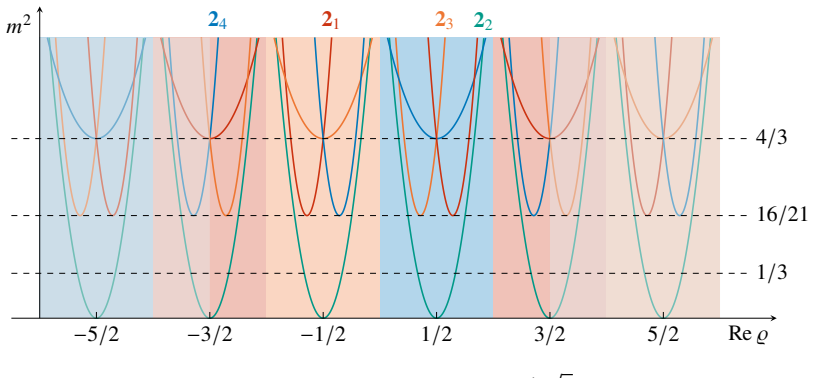
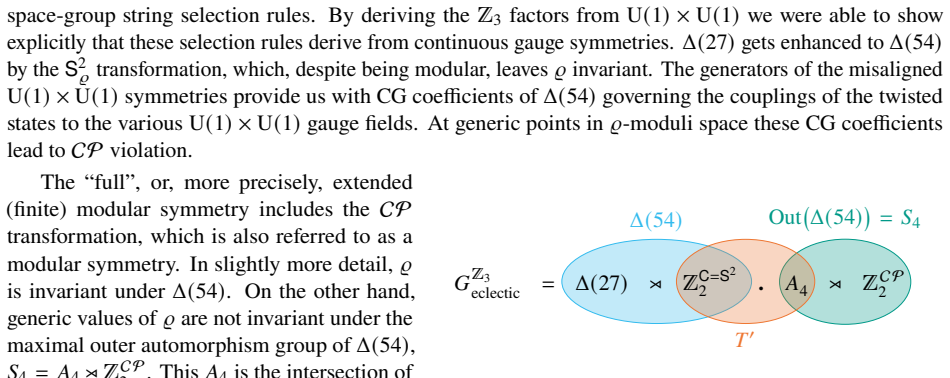
The machinery is a set of orbifold-invariant integers $(s_W,s_N)\mod 3$ and $(W^2,N^2,R^2)$ that label infinite towers of massive states; under the modular generators these transform as a $\mathbb{Z}_3\times\mathbb{Z}_3$ doublet and a three-vector, respectively. Members of the same tower are related by $\Gamma(3)$ transformations, while the remaining $\mathrm{SL}(2,\mathbb{Z})$ transformations connect different towers carrying different quantum numbers. The comparison of the $\mathrm{U}(1)\times\mathrm{U}(1)$ generator matrices $t_i^{(\varrho_{\rm crit})}$, together with the representation matrices $\rho(S)$ and $\rho(T)$ of the twisted fields, supplies the key evidence that the six critical points are inequivalent and that their misaligned residual symmetries generate $\Delta(27)\subset\Delta(54)$.
What would settle it
Compute correlation functions of the twisted fixed-point fields and the winding-mode gauge doublets at $\varrho=\omega$ and at $\varrho=\omega+1$, implementing the $T_\varrho$ transformation on the vertex operators; if the correlators coincide, the two critical points are the same vacuum and the non-commuting charge matrices are only a basis artifact, whereas if they differ, $\Gamma(3)$ is the correct modular symmetry.
Extended reading notes
Core claim
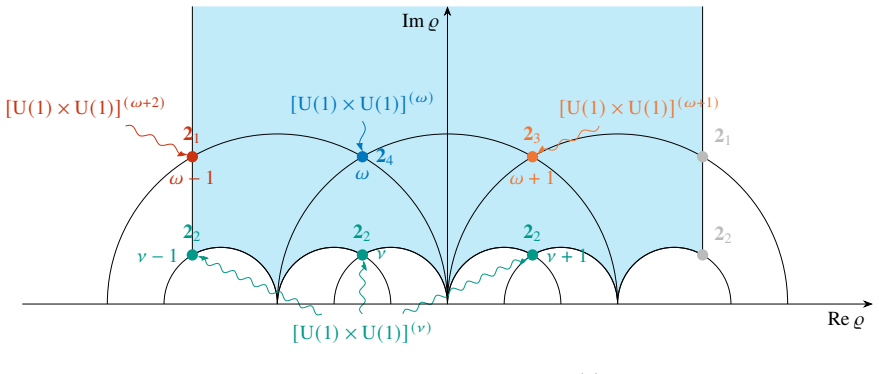
At the special values $\varrho=\omega$, $\omega+1$, $\omega+2$, $\nu$, $\nu+1$ and $\nu+2$, additional winding-mode gauge bosons become massless and produce $\mathrm{U}(1)\times\mathrm{U}(1)$ symmetries with generator matrices $t_i^{(\omega)}$, $t_i^{(\omega+1)}$, and so on in the basis of twisted localization eigenstates. The generators at $\varrho=\omega$ and $\varrho=\omega+1$ fail to commute, so the two Abelian symmetries couple to different linear combinations of the fixed-point fields and the critical points are physically inequivalent even though an $\mathrm{SL}(2,\mathbb{Z})$ transformation maps them into each other. Only transformations in $\Gamma(3)$ — generated by $T^3$, $(T^3S)^2S^2$ and $(T^2S)^3$ — leave the tower quantum numbers $(s_W,s_N)$ and $(W^2,N^2,R^2)$ invariant. The residual $\mathbb{Z}_3\times\mathbb{Z}_3$ symmetries left unbroken away from these points combine into $\Delta(27)$, and augmenting with the modular $\mathrm{S}^2$ transformation yields $\Delta(54)$; the $\mathrm{U}(1)$ generators act as Clebsch–Gordan coefficients for the $\Delta(54)$ contractions and introduce CP-violating phases.
Load-bearing premise
The load-bearing premise is that two $\mathrm{U}(1)\times\mathrm{U}(1)$ symmetries with non-commuting generator matrices describe physically different vacua; if the duality $T_\varrho$ that maps $\varrho=\omega$ to $\varrho=\omega+1$ is actually a symmetry of the full orbifold conformal field theory, the two points are equivalent and the $\Gamma(3)$ conclusion collapses.
Editorial extensions
If this is right
- The physical fundamental domain for the Kähler modulus is the one of $\Gamma(3)$, not of $\mathrm{SL}(2,\mathbb{Z})$, so model scans must cover all six inequivalent critical points.
- The point-group and space-group string selection rules of the $\mathbb{Z}_3$ orbifold are not accidental: they are discrete remnants of continuous $\mathrm{U}(1)\times\mathrm{U}(1)$ gauge symmetries, making the traditional flavor symmetry gauged.
- CP violation can persist even with all modulus-dependent Yukawa couplings removed, because the $\mathrm{U}(1)$ generators used as Clebsch–Gordan coefficients carry the phases.
- If the modulus sits near a critical point, $\mathrm{U}(1)\times\mathrm{U}(1)$ gauge bosons become light enough that direct or indirect searches at future colliders could test the scheme.
- Massive tower states, not just massless fields, determine when duality transformations are equivalences; modular transformations outside $\Gamma(3)$ act as outer automorphisms of $\Delta(54)$ rather than symmetries of the vacuum.
Reading between the lines
- Beyond the paper: the same non-commutation test on generator matrices could be applied to orbifolds with Wilson lines or extra moduli, giving a fast diagnosis of critical-point equivalence before a full conformal-field-theory calculation.
- Beyond the paper: if the result generalizes to other $\mathbb{Z}_N$ orbifolds, bottom-up modular flavor models built on the $\mathrm{SL}(2,\mathbb{Z})$ fundamental domain are missing physical quantum numbers that the finite modular group should encode.
- Beyond the paper: near-critical $\mathrm{U}(1)\times\mathrm{U}(1)$ gauge bosons would kinetically mix with Standard Model hypercharge, so existing searches for extra $Z'$ bosons can bound how close the modulus can be to a critical point.
Editorial analysis
A structured set of objections, weighed in public.
Referee Report
Summary. The paper analyzes T^2/Z_3 orbifolds of the heterotic string and claims that orbifolding breaks the SL(2,Z) Kähler-modulus duality to the congruence subgroup Γ(3). The central argument is that at the six critical points ϱ=ω,ω+1,ω+2,ν,ν+1,ν+2 different U(1)×U(1) gauge symmetries become exact, with generators that are 'misaligned'; their discrete Z_3×Z_3 remnants combine to Δ(27), enhanced by S^2 to Δ(54). The paper constructs explicit vertex operators, derives OPEs and charge assignments, introduces orbifold-invariant KK/winding quantum numbers organizing towers of massive states, and argues that the U(1) generators provide Δ(54) Clebsch–Gordan coefficients leading to a novel mechanism of CP violation. It concludes with phenomenological implications: near-critical moduli values yield light U(1)×U(1) gauge bosons and constrained Kähler potentials.
Significance. If the central Γ(3) claim is correct, the paper provides a top-down derivation of congruence subgroups in modular flavor symmetries from string orbifolds, a concrete stringy interpretation of Δ(27)/Δ(54) as remnants of misaligned Abelian gauge symmetries, and falsifiable predictions of light gauge bosons near critical points. The paper's strengths are its detailed and self-consistent OPE/vertex-operator analysis (Appendices C–E), explicit group-theoretic decompositions (Appendix B), and the construction of tower quantum numbers in Section 4; no parameters are fitted to data. However, the Γ(3) conclusion depends on a key physical-inequivalence claim that is not proven, which makes the significance conditional.
major comments (3)
- [Section 3.2.2, Eqs. (3.26)–(3.27)] The proof that ϱ=ω and ϱ=ω+1 are physically inequivalent is not conclusive. Equations (3.26)–(3.27) show t_i^(ω+1)=ρ(T)t_i^(ω)ρ(T)^{-1}; non-commutativity of the two sets of generators only means that the two Cartan subalgebras do not coincide in the localization basis. If ρ(T) is an exact symmetry of the orbifold CFT, this is exactly the expected action of an outer automorphism, and the critical points are identified. The text infers from the differing charge matrices that ρ(T) is not a symmetry, which is circular. The one explicit low-energy check in the manuscript supports T-invariance: combining Eq. (3.23) with the Table 4 entries maps W_{ω+1}(Φ) to W_ω(Φ). To support the central Γ(3) claim one must verify at the CFT level—e.g., twisted-sector OPEs, H-momentum locality, and partition function—whether T_ϱ is an exact symmetry, or exhibit an invariant that distinguishes the two vacua.
- [Sections 3.2.4 and 3.2.7] The statement 'physics repeats itself when shifting ϱ by 3' (Section 3.2.4) and the subsequent identification of Γ(3) (Eq. (3.48)) rest entirely on the unproven inequivalence of ω, ω+1, and ω+2. The Δ(54) doublet labels assigned to the gauge bosons in Figure 3 are defined relative to a basis tied to a specific critical point; under T_ϱ the labels transform as in Eq. (3.47b). Without a proof that T_ϱ is not a symmetry, the observation that different doublets become massless at different critical points is not a witness for inequivalence, since a symmetry transformation would precisely map one doublet to another. This missing step is load-bearing for the paper's main conclusion.
- [Section 3.2.6 and Eq. (4.9)] The distinction between ν, ν+1, and ν+2 is based on the pattern of quadratic versus linear couplings of the local axion to the doublets, as computed from Eq. (4.9). These couplings depend on the (W²,N²,R²) quantum numbers, which transform nontrivially under T_ϱ (Eq. (4.4b)). The paper does not specify the field redefinitions that would make the coupling pattern invariant under the T_ϱ transformation being tested; as written, the 'quadratic/linear' distinction is a basis-dependent statement. A T_ϱ transformation together with the modular action on the fields (Eq. (3.23)) may simply permute the coupling patterns, in which case ν and ν+1 would be equivalent.
minor comments (3)
- [Eq. (3.40a)] There is a typo in Eq. (3.40a): the second factor U^{(ω+1)} should presumably be U^{(ω+2)}.
- [Section 6, first sentence] The sentence 'In Section 6 contains a discussion...' is grammatically incomplete; it should read 'Section 6 contains...' or 'In Section 6 we discuss...'.
- [Eqs. (3.13b) and (3.56b)] The phase conventions for ρ(T) differ between Eq. (3.13b) (diag(ω²,1,1)) and Eq. (3.56b) (diag(ω,1)); the authors should either reconcile these conventions or state explicitly that they refer to different representations.
Circularity Check
Central Γ(3) claim rests on a question-begging inequivalence test: non-commuting charge matrices are conjugate under the same T_ρ used to define them.
-
self definitional
[Section 3.2.2, Eqs. (3.23)–(3.27); Section 3.2.7, Eq. (3.48)]
"Clearly, these generators do not commute with the previous ones, i.e. the t^(ω)_i of (3.15). This means that the corresponding gauge bosons couple to different linear combinations of the localization eigenstates than gauge bosons that are massless at ρ=ω do. ... Given that critical points related by SL(2,Z)_ρ transformations are physically distinct, it is clear that SL(2,Z)_ρ is not the symmetry of the low-energy effective field theory (EFT). Instead, the modular symmetry is given by congruence subgroup Γ(3)."
By Eq. (3.27), t^(ω+1)_i = ρ(T) t^(ω)_i ρ(T)^{-1}: the two charge-matrix pairs are conjugate under the very transformation (3.23) the paper itself uses to move twisted fields from ω to ω+1. Non-commutation in the fixed localization basis is exactly what any nontrivial automorphism ρ(T) would produce, so it cannot by itself show that ω and ω+1 are physically inequivalent. The paper never proves that ρ(T) fails to be a symmetry of the full orbifold CFT; it infers that failure from the very non-commutation that a symmetry action would generate. The subsequent conclusion that the modular group is Γ(3) rather than SL(2,Z) therefore depends on an equivalence criterion (same charge matrices in the same basis) that is chosen so that inequivalence follows by construction.
full rationale
The paper is largely self-contained in its group-theoretic and OPE computations: the Δ(27)/Δ(54) construction from misaligned Z3×Z3 generators, the tower quantum numbers, and the mass formulas are derived explicitly and do not reduce to fits or to data. The numerous self-citations (e.g., [12,30,32,33]) supply representation matrices, modular forms, and the Narain outer-automorphism picture, but those ingredients are not the load-bearing circular step. The circularity is concentrated in the central claim that SL(2,Z)_ρ is broken to Γ(3). The inequivalence of ω and ω+1 is established by comparing U(1) generators in the localization basis; however, Eq. (3.27) shows the two sets of generators are related by the modular transformation T_ρ itself. In a duality-symmetric theory, such conjugation is exactly the expected action of a symmetry, and the points would be identified rather than distinguished. The paper's argument assumes the conclusion by treating 'different matrices in a fixed basis' as synonymous with 'physically different vacua'. Thus the central modular-symmetry result is forced by the chosen equivalence criterion rather than derived from an independent check of the full CFT, giving partial circularity. Other predictions—such as the light U(1)×U(1) gauge bosons near critical points and the CP-violating CG coefficients—would survive even if the inequivalence were proved differently, so the score is moderate rather than maximal.
Assumptions & free parameters
assumptions (5)
- domain assumption The heterotic string on T2/Z3 orbifold is a consistent string vacuum and the vertex operator construction of its massless states is complete.
- domain assumption The orbifold twist acts on KK and winding numbers as in Eq. (3.2) and freezes the complex structure modulus at tau=omega.
- domain assumption Modular transformations of the upstairs torus that survive orbifolding are those that commute with the orbifold twist, and the physical moduli space is the fundamental domain of Gamma(3).
- domain assumption The low-energy effective theory at a critical point is correctly captured by the massless states and their U(1) charges.
- standard math Standard tools: SL(2,Z) and congruence subgroups, group theory of Delta(27) and Delta(54), free-boson OPEs and Frenkel-Kac-Segal construction.
Cite this review
Pith. "Pith review of Flavor Symmetries and Winding Modes." pith.science (2026). https://pith.science/paper/SGTJULSY
@misc{pith2026250612887,
  author       = {Pith},
  title        = {Pith review of: Flavor Symmetries and Winding Modes},
  year         = {2026},
  howpublished = {\url{https://pith.science/paper/SGTJULSY}},
  note         = {Machine review of arXiv:2506.12887}
}
read the original abstract
Modular flavor symmetries have been proposed as a new way to address the flavor problem. It is known that they can emerge from string compactifications. We discuss this connection in detail, and show how the congruence subgroups of SL(2,Z), which underlie many modular flavor symmetries, emerge from stringy duality symmetries by orbifolding. This requires an analysis of massive states, which reveals a picture that is more intricate than the well-known situation on the torus. It involves towers of states of different quantum numbers, related by modular transformations. Members of different towers become massless at different points in moduli space. We also show that, at least in the Z_3 orbifold, the string selection rules can be understood as discrete remnants of continuous gauge symmetries. Non-Abelian discrete flavor symmetries arise as relics of various, relatively misaligned, continuous Abelian gauge symmetries. The generators of these U(1) symmetries give rise to CP-violating Clebsch-Gordan coefficients. If the modulus settles close to a critical point, the corresponding gauge bosons may be light enough to be searched for at future colliders.
Figures


Figures from the paper (7 more)



Forward citations
Cited by 2 Pith papers
-
Moduli-Space Laplacians, Asymptotic Geometry, and the Emergent String Conjecture
Under the Emergent String Conjecture, the logarithm of any principal tower mass has a moduli-space Laplacian eigenvalue quantized to N/(D-d) for KK towers and N/2 for string oscillators, equal to the instanton-weighte...
-
Modular Flavor Symmetries and Fermion Mass Hierarchies
In modular flavor models, fermion mass hierarchies require the modulus to sit near the critical points i, i∞, or ω; the paper classifies the near-critical mass patterns for reducible 2⊕1 matter assignments.
Reference graph
Works this paper leans on
-
[1]
Target space duality in string theory,
A. Giveon, M. Porrati, and E. Rabinovici, “Target space duality in string theory,”Phys. Rept.244(1994) 77–202,arXiv:hep-th/9401139
arXiv 1994
-
[2]
Lectures on modular forms and strings,
E. D’Hoker and J. Kaidi, “Lectures on modular forms and strings,”arXiv:2208.07242 [hep-th]
-
[3]
Feruglio,Are neutrino masses modular forms?, pp
F. Feruglio,Are neutrino masses modular forms?, pp. 227–266. 2019.arXiv:1706.08749 [hep-ph]
arXiv 2019
-
[4]
F. Feruglio and A. Romanino, “Lepton flavor symmetries,”Rev. Mod. Phys.93no. 1, (2021) 015007, arXiv:1912.06028 [hep-ph]
arXiv 2021
-
[5]
Neutrino Flavor Model Building and the Origins of Flavor and CP Violation,
Y. Almumin, M.-C. Chen, M. Cheng, V. Knapp-Perez, Y. Li, A. Mondol, S. Ramos-Sanchez, M. Ratz, and S. Shukla, “Neutrino Flavor Model Building and the Origins of Flavor and CP Violation,”Universe 9no. 12, (2023) 512,arXiv:2204.08668 [hep-ph]
arXiv 2023
-
[6]
Modular flavor symmetric models,
T. Kobayashi and M. Tanimoto, “Modular flavor symmetric models,”Int. J. Mod. Phys. A39no. 09n10, (2024) 2441012,arXiv:2307.03384 [hep-ph]
arXiv 2024
-
[7]
Neutrino mass and mixing with modular symmetry,
G.-J. Ding and S. F. King, “Neutrino mass and mixing with modular symmetry,”Rept. Prog. Phys.87 no. 8, (2024) 084201,arXiv:2311.09282 [hep-ph]
arXiv 2024
-
[8]
The Flavor Puzzle: Textures and Symmetries
H. P. Nilles and S. Ramos-Sanchez, “The flavor puzzle: Textures and symmetries,”Int. J. Mod. Phys. A 39no. 09n10, (2024) 2441003,arXiv:2308.14810 [hep-ph]
work page Pith review arXiv 2024
Show all 73 references
-
[9]
The symmetry approach to quark and lepton masses and mixing,
G.-J. Ding and J. W. F. Valle, “The symmetry approach to quark and lepton masses and mixing,”Phys. Rept.1109(2025) 1–105,arXiv:2402.16963 [hep-ph]
2025 arXiv
-
[10]
Flavor’s Delight,
H. P. Nilles and S. Ramos-Sanchez, “Flavor’s Delight,”Entropy26no. 5, (2024) 355, arXiv:2404.16933 [hep-th]
2024 arXiv
-
[11]
Modular flavor symmetry and vector-valued modular forms,
X.-G. Liu and G.-J. Ding, “Modular flavor symmetry and vector-valued modular forms,”JHEP03 (2022) 123,arXiv:2112.14761 [hep-ph]
2022 arXiv
-
[12]
Duality and Landau-ginzburg Models,
E. J. Chun, J. Mas, J. Lauer, and H. P. Nilles, “Duality and Landau-ginzburg Models,”Phys. Lett. B233 (1989) 141–146
1989
-
[13]
Duality and the Role of Nonperturbative Effects on the World Sheet,
J. Lauer, J. Mas, and H. P. Nilles, “Duality and the Role of Nonperturbative Effects on the World Sheet,” Phys. Lett. B226(1989) 251–256. 44
1989
-
[14]
Duality Symmetries in𝑁=2 Landau-ginzburg Models,
W. Lerche, D. Lust, and N. P. Warner, “Duality Symmetries in𝑁=2 Landau-ginzburg Models,”Phys. Lett. B231(1989) 417–424
1989
-
[15]
Equivalence of Z(N) orbifolds and Landau–Ginzburg models,
E. J. Chun, J. Lauer, and H. P. Nilles, “Equivalence of Z(N) orbifolds and Landau–Ginzburg models,” Int. J. Mod. Phys. A7(1992) 2175–2192
1992
-
[16]
Lectures on superstring phenomenology,
F. Quevedo, “Lectures on superstring phenomenology,”AIP Conf. Proc.359(1996) 202–242, arXiv:hep-th/9603074
1996 arXiv
-
[17]
Lessons from eclectic flavor symmetries,
H. P. Nilles, S. Ramos-Sanchez, and P. K. S. Vaudrevange, “Lessons from eclectic flavor symmetries,” Nucl. Phys. B957(2020) 115098,arXiv:2004.05200 [hep-ph]
2020 arXiv
-
[18]
Eclectic flavor scheme from ten-dimensional string theory - II detailed technical analysis,
H. P. Nilles, S. Ramos–S ´anchez, and P. K. S. Vaudrevange, “Eclectic flavor scheme from ten-dimensional string theory - II detailed technical analysis,”Nucl. Phys. B966(2021) 115367, arXiv:2010.13798 [hep-th]
2021 arXiv
-
[19]
Top-down anatomy of flavor symmetry breakdown,
A. Baur, H. P. Nilles, S. Ramos-Sanchez, A. Trautner, and P. K. S. Vaudrevange, “Top-down anatomy of flavor symmetry breakdown,”Phys. Rev. D105no. 5, (2022) 055018, arXiv:2112.06940 [hep-th]
2022 arXiv
-
[20]
The eclectic flavor symmetries ofT 2/Z𝐾 orbifolds,
A. Baur, H. P. Nilles, S. Ramos-Sanchez, A. Trautner, and P. K. S. Vaudrevange, “The eclectic flavor symmetries ofT 2/Z𝐾 orbifolds,”JHEP09(2024) 159,arXiv:2405.20378 [hep-th]
2024 arXiv
-
[21]
The Swampland: Introduction and Review,
E. Palti, “The Swampland: Introduction and Review,”Fortsch. Phys.67no. 6, (2019) 1900037, arXiv:1903.06239 [hep-th]
2019 arXiv
-
[22]
Strings on Orbifolds,
L. J. Dixon, J. A. Harvey, C. Vafa, and E. Witten, “Strings on Orbifolds,”Nucl. Phys. B261(1985) 678–686
1985
-
[23]
Strings on Orbifolds. 2.,
L. J. Dixon, J. A. Harvey, C. Vafa, and E. Witten, “Strings on Orbifolds. 2.,”Nucl. Phys. B274(1986) 285–314
1986
-
[24]
Exploring the landscape of heterotic strings on Td,
A. Font, B. Fraiman, M. Gra ˜na, C. A. N´ u˜nez, and H. P. De Freitas, “Exploring the landscape of heterotic strings on Td,”Journal of High Energy Physics2020no. 10, (2020) 194. https://doi.org/10.1007/JHEP10(2020)194
2020 doi
-
[25]
Grand Unification in the Heterotic Brane World,
P. K. S. Vaudrevange, “Grand Unification in the Heterotic Brane World,”arXiv:0812.3503 [hep-th]
-
[26]
Towards Low Energy Physics from the Heterotic String,
S. Ramos-Sanchez, “Towards Low Energy Physics from the Heterotic String,”Fortsch. Phys.10(2009) 907–1036,arXiv:0812.3560 [hep-th]
2009 arXiv
-
[27]
The Operator Algebra of Orbifold Models,
R. Dijkgraaf, C. Vafa, E. P. Verlinde, and H. L. Verlinde, “The Operator Algebra of Orbifold Models,” Commun. Math. Phys.123(1989) 485
1989
-
[28]
Some Considerations About the Stringy Higgs Effect,
L. E. Ib ´a˜nez, W. Lerche, D. L¨ ust, and S. Theisen, “Some Considerations About the Stringy Higgs Effect,”Nucl. Phys. B352(1991) 435–450
1991
-
[29]
Gauge Origin of Discrete Flavor Symmetries in Heterotic Orbifolds,
F. Beye, T. Kobayashi, and S. Kuwakino, “Gauge Origin of Discrete Flavor Symmetries in Heterotic Orbifolds,”Phys. Lett. B736(2014) 433–437,arXiv:1406.4660 [hep-th]
2014 arXiv
-
[30]
Twisted sector representations of discrete background symmetries for two-dimensional orbifolds,
J. Lauer, J. Mas, and H. P. Nilles, “Twisted sector representations of discrete background symmetries for two-dimensional orbifolds,”Nucl. Phys. B351(1991) 353–424. 45
1991
-
[31]
Patterns of remnant discrete symmetries,
B. Petersen, M. Ratz, and R. Schieren, “Patterns of remnant discrete symmetries,”JHEP08(2009) 111, arXiv:0907.4049 [hep-ph]
2009 arXiv
-
[32]
Stringy origin of non-Abelian discrete flavor symmetries,
T. Kobayashi, H. P. Nilles, F. Pl¨oger, S. Raby, and M. Ratz, “Stringy origin of non-Abelian discrete flavor symmetries,”Nucl. Phys. B768(2007) 135–156,arXiv:hep-ph/0611020
2007 arXiv
-
[33]
A String Theory of Flavor andC P,
A. Baur, H. P. Nilles, A. Trautner, and P. K. S. Vaudrevange, “A String Theory of Flavor andC P,” Nucl. Phys. B947(2019) 114737,arXiv:1908.00805 [hep-th]
2019 arXiv
-
[34]
Discrete remnants of orbifolding,
S. Biermann, A. M¨ utter, E. Parr, M. Ratz, and P. K. S. Vaudrevange, “Discrete remnants of orbifolding,” Phys. Rev. D100no. 6, (2019) 066030,arXiv:1906.10276 [hep-ph]
2019 arXiv
-
[35]
Spontaneous breaking of SU(3) to finite family symmetries: a pedestrian’s approach,
C. Luhn, “Spontaneous breaking of SU(3) to finite family symmetries: a pedestrian’s approach,”JHEP 03(2011) 108,arXiv:1101.2417 [hep-ph]
2011 arXiv
-
[36]
Neutrino Masses and Mixing from Double Covering of Finite Modular Groups,
X.-G. Liu and G.-J. Ding, “Neutrino Masses and Mixing from Double Covering of Finite Modular Groups,”JHEP08(2019) 134,arXiv:1907.01488 [hep-ph]
2019 arXiv
-
[37]
CP violation and modular symmetries,
T. Dent, “CP violation and modular symmetries,”Phys. Rev. D64(2001) 056005, arXiv:hep-ph/0105285
2001 arXiv
-
[38]
Unification of Flavor, CP, and Modular Symmetries,
A. Baur, H. P. Nilles, A. Trautner, and P. K. S. Vaudrevange, “Unification of Flavor, CP, and Modular Symmetries,”Phys. Lett. B795(2019) 7–14,arXiv:1901.03251 [hep-th]
2019 arXiv
-
[39]
Generalised CP Symmetry in Modular-Invariant Models of Flavour,
P. P. Novichkov, J. T. Penedo, S. T. Petcov, and A. V. Titov, “Generalised CP Symmetry in Modular-Invariant Models of Flavour,”JHEP07(2019) 165,arXiv:1905.11970 [hep-ph]
2019 arXiv
-
[40]
Fricke,Die elliptischen Funktionen und ihre Anwendungen
R. Fricke,Die elliptischen Funktionen und ihre Anwendungen. B.G. Teubner, Leipzig, 1916
1916
-
[41]
CP and Discrete Flavour Symmetries,
M. Holthausen, M. Lindner, and M. A. Schmidt, “CP and Discrete Flavour Symmetries,”JHEP04 (2013) 122,arXiv:1211.6953 [hep-ph]
2013 arXiv
-
[42]
Lepton Mixing Parameters from Discrete and CP Symmetries,
F. Feruglio, C. Hagedorn, and R. Ziegler, “Lepton Mixing Parameters from Discrete and CP Symmetries,”JHEP07(2013) 027,arXiv:1211.5560 [hep-ph]
2013 arXiv
-
[43]
CP Violation from Finite Groups,
M.-C. Chen, M. Fallbacher, K. T. Mahanthappa, M. Ratz, and A. Trautner, “CP Violation from Finite Groups,”Nucl. Phys. B883(2014) 267–305,arXiv:1402.0507 [hep-ph]
2014 arXiv
-
[44]
CPviolation from string theory,
H. P. Nilles, M. Ratz, A. Trautner, and P. K. S. Vaudrevange, “CPviolation from string theory,”Phys. Lett. B786(2018) 283–287,arXiv:1808.07060 [hep-th]
2018 arXiv
-
[45]
Group Theoretical Origin of CP Violation,
M.-C. Chen and K. T. Mahanthappa, “Group Theoretical Origin of CP Violation,”Phys. Lett. B681 (2009) 444–447,arXiv:0904.1721 [hep-ph]
2009 arXiv
-
[46]
CPviolation with an unbrokenCPtransformation,
M. Ratz and A. Trautner, “CPviolation with an unbrokenCPtransformation,”JHEP02(2017) 103, arXiv:1612.08984 [hep-ph]
2017 arXiv
-
[47]
Gaugino Condensation and Duality Invariance,
H. P. Nilles and M. Olechowski, “Gaugino Condensation and Duality Invariance,”Phys. Lett. B248 (1990) 268–272
1990
-
[48]
Supersymmetry Breaking From Duality Invariant Gaugino Condensation,
A. Font, L. E. Ibanez, D. Lust, and F. Quevedo, “Supersymmetry Breaking From Duality Invariant Gaugino Condensation,”Phys. Lett. B245(1990) 401–408. 46
1990
-
[49]
Target space duality, supersymmetry breaking and the stability of classical string vacua,
M. Cvetic, A. Font, L. E. Ibanez, D. L¨ ust, and F. Quevedo, “Target space duality, supersymmetry breaking and the stability of classical string vacua,”Nucl. Phys. B361(1991) 194–232
1991
-
[50]
Breaking CP and supersymmetry with orbifold moduli dynamics,
T. Dent, “Breaking CP and supersymmetry with orbifold moduli dynamics,”Nucl. Phys. B623(2002) 73–96,arXiv:hep-th/0110110. [Erratum: Nucl.Phys.B 629, 493–493 (2002)]
2002 arXiv
-
[51]
Modular flavour symmetries and modulus stabilisation,
P. P. Novichkov, J. T. Penedo, and S. T. Petcov, “Modular flavour symmetries and modulus stabilisation,” JHEP03(2022) 149,arXiv:2201.02020 [hep-ph]
2022 arXiv
-
[52]
Heterotic de Sitter beyond modular symmetry,
J. M. Leedom, N. Righi, and A. Westphal, “Heterotic de Sitter beyond modular symmetry,”JHEP02 (2023) 209,arXiv:2212.03876 [hep-th]
2023 arXiv
-
[53]
Matter matters in moduli fixing and modular flavor symmetries,
V. Knapp-Perez, X.-G. Liu, H. P. Nilles, S. Ramos-Sanchez, and M. Ratz, “Matter matters in moduli fixing and modular flavor symmetries,”Phys. Lett. B844(2023) 138106,arXiv:2304.14437 [hep-th]
2023 arXiv
-
[54]
Eclectic Flavor Groups,
H. P. Nilles, S. Ramos-S ´anchez, and P. K. S. Vaudrevange, “Eclectic Flavor Groups,”JHEP02(2020) 045,arXiv:2001.01736 [hep-ph]
2020 arXiv
-
[55]
Universal Predictions of Modular Invariant Flavor Models near the Self-Dual Point,
F. Feruglio, “Universal Predictions of Modular Invariant Flavor Models near the Self-Dual Point,”Phys. Rev. Lett.130no. 10, (2023) 101801,arXiv:2211.00659 [hep-ph]
2023 arXiv
-
[56]
Fermion masses, critical behavior and universality,
F. Feruglio, “Fermion masses, critical behavior and universality,”JHEP03(2023) 236, arXiv:2302.11580 [hep-ph]
2023 arXiv
-
[57]
A4 modular flavour model of quark mass hierarchies close to the fixed point𝜏= i∞,
S. T. Petcov and M. Tanimoto, “A4 modular flavour model of quark mass hierarchies close to the fixed point𝜏= i∞,”JHEP08(2023) 086,arXiv:2306.05730 [hep-ph]
2023 arXiv
-
[58]
Quark-lepton mass relations from modular flavor symmetry,
M.-C. Chen, S. F. King, O. Medina, and J. W. F. Valle, “Quark-lepton mass relations from modular flavor symmetry,”JHEP02(2024) 160,arXiv:2312.09255 [hep-ph]
2024 arXiv
-
[59]
Hierarchy of Quark Masses, Cabibbo Angles and CP Violation,
C. D. Froggatt and H. B. Nielsen, “Hierarchy of Quark Masses, Cabibbo Angles and CP Violation,” Nucl. Phys. B147(1979) 277–298
1979
-
[60]
A note on the predictions of models with modular flavor symmetries,
M.-C. Chen, S. Ramos-S´anchez, and M. Ratz, “A note on the predictions of models with modular flavor symmetries,”Phys. Lett. B801(2020) 135153,arXiv:1909.06910 [hep-ph]
2020 arXiv
-
[61]
Mass matrix models,
M. Leurer, Y. Nir, and N. Seiberg, “Mass matrix models,”Nucl. Phys. B398(1993) 319–342, arXiv:hep-ph/9212278
1993 arXiv
-
[62]
Mass matrix models: The Sequel,
M. Leurer, Y. Nir, and N. Seiberg, “Mass matrix models: The Sequel,”Nucl. Phys. B420(1994) 468–504,arXiv:hep-ph/9310320
1994 arXiv
-
[63]
Yukawa matrices from a spontaneously broken Abelian symmetry,
E. Dudas, S. Pokorski, and C. A. Savoy, “Yukawa matrices from a spontaneously broken Abelian symmetry,”Phys. Lett. B356(1995) 45–55,arXiv:hep-ph/9504292
1995 arXiv
-
[64]
On predictions from spontaneously broken flavor symmetries,
M.-C. Chen, M. Fallbacher, M. Ratz, and C. Staudt, “On predictions from spontaneously broken flavor symmetries,”Phys. Lett. B718(2012) 516–521,arXiv:1208.2947 [hep-ph]
2012 arXiv
-
[65]
Predictivity of models with spontaneously broken non-Abelian discrete flavor symmetries,
M.-C. Chen, M. Fallbacher, Y. Omura, M. Ratz, and C. Staudt, “Predictivity of models with spontaneously broken non-Abelian discrete flavor symmetries,”Nucl. Phys. B873(2013) 343–371, arXiv:1302.5576 [hep-ph]. 47
2013 arXiv
-
[66]
The first string-derived eclectic flavor model with realistic phenomenology,
A. Baur, H. P. Nilles, S. Ramos-Sanchez, A. Trautner, and P. K. S. Vaudrevange, “The first string-derived eclectic flavor model with realistic phenomenology,”JHEP09(2022) 224, arXiv:2207.10677 [hep-ph]
2022 arXiv
-
[67]
Quasi–eclectic modular flavor symmetries,
M.-C. Chen, V. Knapp-Perez, M. Ramos-Hamud, S. Ramos-Sanchez, M. Ratz, and S. Shukla, “Quasi–eclectic modular flavor symmetries,”Phys. Lett. B824(2022) 136843,arXiv:2108.02240 [hep-ph]
2022 arXiv
-
[68]
A new twist on heterotic string compactifications,
B. Fraiman, M. Gra˜na, and C. A. N´ u˜nez, “A new twist on heterotic string compactifications,”JHEP09 (2018) 078,arXiv:1805.11128 [hep-th]
2018 arXiv
-
[69]
𝑅 parity violation from discrete𝑅 symmetries,
M.-C. Chen, M. Ratz, and V. Takhistov, “𝑅 parity violation from discrete𝑅 symmetries,”Nucl. Phys. B 891(2015) 322–345,arXiv:1410.3474 [hep-ph]
2015 arXiv
-
[70]
Blumenhagen, D
R. Blumenhagen, D. L¨ ust, and S. Theisen,Basic concepts of string theory. Theoretical and Mathematical Physics. Springer, Heidelberg, Germany, 2013
2013
-
[71]
An uplifting discussion of T-duality,
J. A. Harvey and G. W. Moore, “An uplifting discussion of T-duality,”Journal of High Energy Physics 2018no. 5, (May, 2018)
2018
-
[72]
Interactions on Orbifolds,
S. Hamidi and C. Vafa, “Interactions on Orbifolds,”Nucl. Phys. B279(1987) 465–513
1987
-
[73]
The Conformal Field Theory of Orbifolds,
L. J. Dixon, D. Friedan, E. J. Martinec, and S. H. Shenker, “The Conformal Field Theory of Orbifolds,” Nucl. Phys. B282(1987) 13–73. 48
1987
Reviewed August 7, 2026 · model on record in the stance chip above.
Discussion (0). Sign in to comment.