REVIEW 3 major objections 5 minor 24 references
DualFast: Dual-Speedup Framework for Fast Sampling of Diffusion Models
T0 review · 3 major / 5 minor · reviewed 2026-08-07 · deepseek-v4-flash
Pith's one-line read This paper argues that diffusion sampling error has a separate approximation component, and that mixing the pure-noise prediction from the final step into each noise estimate reduces total error at no extra function-evaluation cost.
desk verdict A simple, plausible training-free correction for few-step sampling, but the paper's derived coefficient and the one actually used in experiments diverge, and the central monotonicity premise is under-supported. read the letter →
The pith
A machine-rendered reading of the paper's core claim, the machinery that carries it, and where it could break.
The reading
What carries the argument
The load-bearing object is the dual-error disentanglement experiment and the mixing identity built from it. The experiment computes, over nine time periods covering $T=1000$ steps, an MSE curve between an error-free forward transition, a fine-step rollout (approximation error only), and a coarse-step rollout (both errors). The resulting curve is what supports the claims that approximation error dominates at most timesteps and declines monotonically as $t$ increases. The mixing identity is the corrected noise estimate $(1+c)\epsilon_\theta(x_t,t) - c\,\epsilon_\theta(x_\tau,\tau)$ with $c = 1/(e^{h_t}-1)$ and $\tau=T$. The coefficient $c$ grows as the step shrinks, so the pure-noise prediction gets more weight exactly when the current prediction is least reliable; in the paper's implementation $c$ follows a linear schedule from $0.5$ at step $0$ to $0.0$ at step $T$.
What would settle it
Take a diffusion model with a known closed-form score—for example, a Gaussian mixture where the true noise is computable—and measure the network's per-timestep prediction MSE against the true noise. If that error is not monotonically decreasing in $t$, or if at some timesteps the discretization error is the dominant term, the directional mixing in the corrected estimate should stop helping there. A cheaper check is an ablation on $\tau$: the paper predicts $\tau=T$ is optimal, so a mid-range $\tau$ that consistently beats $T$ would undercut the monotonicity story.
Extended reading notes
Core claim
The central claim is that the total sampling error decomposes into discretization error and approximation error, and that the approximation error can be reduced without extra network evaluations by exploiting its monotonic decrease with timestep. Concretely, DualFast replaces the noise prediction at step $t$ with $\epsilon^{\mathrm{new}}_\theta(x_t,t) = (1+c)\,\epsilon_\theta(x_t,t) - c\,\epsilon_\theta(x_\tau,\tau)$, where $c = 1/(e^{h_t}-1)$, $h_t$ is the log-SNR step size, and $\tau$ is a larger step—taken to be the largest step $T$, where the input is pure Gaussian noise. Because the pure-noise prediction is the most accurate, mixing it in corrects the less reliable predictions at small $t$. The paper derives this replacement for the 1-order DDIM update and integrates the same correction into DPM-Solver, DPM-Solver++, and UniPC by rewriting their noise- or data-prediction terms. With identical NFE, the corrected samplers consistently beat the base samplers on FID and human-preference metrics across unconditional, class-conditional, and text-conditional generation.
Load-bearing premise
The framework rests on the empirical claim, measured by comparing network rollouts at fine and coarse step sizes, that a diffusion network's noise-prediction error falls steadily as the timestep increases, making the pure-noise prediction at the largest step a reliable correction reference.
Editorial extensions
If this is right
- At the same NFE, DualFast lowers FID on unconditional and class-conditional ImageNet and LSUN Bedroom sampling; for example, DDIM's FID on LSUN Bedroom at NFE=5 drops from 51.482 to 36.288.
- The correction is independent of solver order: it improves 1-order DDIM, 2-order DPM-Solver and DPM-Solver++, and 3-order UniPC, so it can be added to future ODE solvers as well.
- Because the correction reuses the already computed pure-noise prediction $\epsilon_\theta(x_T,T)$, it adds no extra network evaluation per step, only a weighted average.
- The choice of reference step $\tau=T$ is supported by the ablation: larger $\tau$ consistently helps, and the linear $c$ schedule beats a constant one.
- The minimum number of steps needed for visually clean images drops, e.g. from 15 to 7 for DDIM and from 8 to 6 for DPM-Solver.
Reading between the lines
- As an extension, the same correction could be applied to other iterative generative models with a reliable terminal prediction, such as flow-matching or consistency trajectories, if their per-step approximation error also declines along the trajectory; the paper does not test this.
- A calibration-based schedule for $c$, estimated from a short MSE probe instead of a fixed linear rule, might push the gains further; the paper's ablations show the choice is forgiving, which leaves room for tuning.
- Since $\epsilon_\theta(x_T,T)$ is constant across all steps, it can be cached after the first evaluation, making DualFast's overhead essentially a single addition; this implementation detail is left implicit in the paper.
- The monotonicity claim is measured with the network standing in for the true score, so an independent check on a closed-form score model would tell whether the effect is a property of diffusion training or of the specific network; the paper does not provide that check.
Editorial analysis
A structured set of objections, weighed in public.
Referee Report
Summary. The paper proposes DualFast, a training-free framework that accelerates sampling of diffusion ODE solvers by splitting the total sampling error into discretization error and approximation error. The method modifies the noise prediction at each step into a mixture of the current prediction and the prediction at a fixed larger timestep τ=T, with a mixing coefficient c; it claims this reduces approximation error without extra function evaluations. The framework is integrated into DDIM, DPM-Solver, DPM-Solver++, and UniPC, and is evaluated with FID and human preference scores across pixel-space and latent-space models, unconditional and conditional sampling, and several guidance scales.
Significance. If the central claim is sound, DualFast would be a practically valuable plug-in: it promises consistent quality improvements over strong ODE solvers at identical NFE, with no training and no extra evaluations. The paper's empirical scope is a genuine strength: it covers multiple solvers, orders, prediction modes, model architectures, datasets, and guidance scales, and the reported gains are broadly consistent across Tables 2-5 and the qualitative figures. The paper is also candid about limitations and explicitly notes where the main-text coefficient differs from the derived one. However, the load-bearing theoretical mechanism is not established: the derivation in Appendix K uses a different coefficient from the experiments, and the monotonicity premise that motivates the correction is measured with the same type of MSE comparison used for validation. These issues must be addressed before the empirical gains can be attributed to the stated mechanism.
major comments (3)
- [Sec. 3.3, Eq. (12); Sec. 4.3; Appendix K, Eq. (22)] The mixing coefficient used in the experiments does not match the derived coefficient. Appendix K derives c=1/(e^{h_t}-1), which for backward steps (h_t<0) is negative, while Sec. 4.3 reports using a separately tuned linearly decreasing schedule from 0.5 to 0.0. The appendix itself states that the main-text coefficient 'is slightly different from this form, and we will modify it to this general form in the revised version.' This is not a cosmetic discrepancy: it means Tables 2-4 validate a tuned heuristic, not the form derived from the exponential-integrator expansion. The paper should either use the derived c in the experiments, or provide a separate derivation that justifies the linear schedule, and the unresolved sign convention for h_t must be clarified.
- [Sec. 3.2, Fig. 2 (right); Sec. 4.3, Table 1] The monotonic decrease of approximation error with increasing t is the premise that fixes the direction of the correction in Eq. (12), but the evidence for it is entangled with the validation. The curve in Fig. 2 (right) is computed by comparing NFE=111 and NFE=1 rollouts against a forward-marginal reference, and the text describes it as an illustrative curve without giving a reproducible protocol; Table 1 then validates DualFast with the same pseudo-ground-truth MSE comparison. The premise and the evidence therefore are not independent. The paper should provide a reproducible measurement protocol, or an independent confirmation of monotonicity, before the direction of the correction can be accepted as theoretically grounded.
- [Sec. 3.3, Eqs. (10)-(12)] The logical chain from Eq. (10) to Eq. (12) is missing. Equation (10) replaces the noise estimate εθ(xt,t) directly with εθ(xτ,τ), whereas Eq. (12) uses a combination (1+c)εθ(xt,t) - c εθ(xτ,τ). These are not equivalent operations, and the paper does not explain how the latter follows from the former. The derivation in Appendix K starts from a different assumption, xours_t = α_t x0 + σ_t εθ(xτ,τ), and leads to Eq. (22); the main text does not present that intermediate step. Because the claimed approximation-error reduction depends on which replacement is actually made, this gap is load-bearing and should be closed.
minor comments (5)
- [Sec. 3.2, Fig. 2 (right)] The right panel of Fig. 2 lacks axis labels, units, and a description of how the MSE is averaged over images and timesteps; adding these would make the disentanglement analysis interpretable and reproducible.
- [Sec. 4.3, ablation on c] The phrase 'linearly decreasing strategy (from 0.5 to 0.0), which starts from 0.5 at step 0 and reaches 0.0 at step T' is ambiguous: it should state explicitly whether c is a function of the current step t, i.e., c(t)=0.5(1 - t/T), and how this is applied at the first and last steps.
- [Appendix K, Eq. (22)] The sign convention for h_t should be stated explicitly; since sampling goes from larger to smaller t, h_t is negative in the standard notation of Eq. (5), which makes c=1/(e^{h_t}-1) negative. The paper should reconcile this with the positive coefficients used in the main text.
- [Sec. 1 and Sec. 4.3] There are several typos and imprecisions, including 'discretizaton error', 'bwtween', 'date prediction', and the sentence in Sec. 3.3 that refers to 'equation 9 and equation 9'; these should be corrected.
- [Table 1 and Tables 2-4] The quantitative tables report only point estimates without error bars or repeated-seed information; given the consistency of the claimed gains, reporting variance or at least stating the evaluation protocol (number of seeds, sampling of the 10k images) would strengthen the empirical claims.
Circularity Check
The mixing coefficient that Eq. 12 derives is not the coefficient used in experiments, and the monotonicity premise and its validation share the same private pseudo-GT MSE construction, making the reported approximation-error reduction partly a fitted result.
-
fitted input called prediction
[Sec. 4.3 'Ablation on the choices of c and τ' and Appendix K, Eq. 22]
"For the mixing coefficient c, based on the prior that approximation error linearly decreases with step, we adopt a linearly decreasing strategy (from 0.5 to 0.0), which starts from 0.5 at step 0 and reaches 0.0 at step T. ... The coefficient in the main manuscript is slightly different from this form, and we will modify it to this general form in the revised version."
The derivation in Appendix K fixes c = 1/(e^{h_t}-1), and Eq. 12 presents this as the mechanism that reduces approximation error. The experiments replace this derived coefficient by an ablated linear schedule (0.5 to 0.0). Consequently, the improvement in Tables 2-4 is not a confirmation of Eq. 12's derivation; it is the outcome of a tuned hyperparameter. The paper's own appendix concedes that the main-text coefficient is different and will be changed, so the 'derived' correction is not the input that produces the reported predictions.
-
other
[Sec. 3.2 (Fig. 2 right) and Sec. 4.3 'Reduced error' (Table 1)]
"For every time period, we adopt NFE=111 and NFE=1 to get x_s^t and x_l^t, respectively. Analysis of the MSE curve yields ... (3) The approximation error exhibits a strict decline as the step t increases, a principle that subsequently instructs the design of our approximation error reduction strategy."
The monotonicity that selects τ=T and the direction of the mixing correction is inferred from a private small-step/large-step MSE comparison against a forward-marginal reference. Table 1 then validates the framework by the same pseudo-GT MSE comparison ('the additional MSE error reduction stems from less approximation error brought by our DualFast'), so the premise and the success evidence share the same uncompared operationalization. The external FID/HPD results do not disentangle the monotonicity premise from the tuned c/τ choices.
full rationale
Two issues are concrete. First, the mixing coefficient that Eq. 12 derives is not the coefficient used; the appendix explicitly states the main-text coefficient is slightly different and will be modified, so the experimental gains are at least partly attributable to an ablated schedule rather than to the derivation. Second, the monotonicity premise motivating τ=T is established and validated with the same MSE-to-pseudo-GT apparatus, entangling premise and evidence. FID and HPD v2 evaluations are external benchmarks and would normally indicate independent content, and the Yu et al. (2023) self-citation is only supporting, so the score is not a full 8-10. However, because the central 'reduction' claim is not tested with its derived coefficient and the premise/validation share the same private MSE construction, the score is 6 (partial circularity).
Assumptions & free parameters
free parameters (2)
- mixing coefficient c =
linear schedule 0.5 -> 0.0 over the sampling schedule
- reference step τ =
T (the initial noise step)
assumptions (5)
- standard math With the exact score function, the probability-flow ODE marginal at time t equals the forward-process marginal (Eq. 1).
- domain assumption MSE between sample points is a valid proxy for distribution discrepancy in diffusion models.
- domain assumption The network's noise prediction error declines monotonically as t increases, so εθ(xτ,τ) at large τ is a more accurate estimate of the trajectory noise.
- standard math The approximation-error reduction can be reformulated across prediction modes via the exact relation x_t = α_t xθ + σ_t εθ (Eq. 17).
- ad hoc to paper An empirically decreasing approximation error justifies a linear mixing schedule from 0.5 to 0.
Cite this review
Pith. "Pith review of DualFast: Dual-Speedup Framework for Fast Sampling of Diffusion Models." pith.science (2026). https://pith.science/paper/BP4HJU6I
@misc{pith2026250613058,
  author       = {Pith},
  title        = {Pith review of: DualFast: Dual-Speedup Framework for Fast Sampling of Diffusion Models},
  year         = {2026},
  howpublished = {\url{https://pith.science/paper/BP4HJU6I}},
  note         = {Machine review of arXiv:2506.13058}
}
read the original abstract
Diffusion probabilistic models (DPMs) have achieved impressive success in visual generation. While, they suffer from slow inference speed due to iterative sampling. Employing fewer sampling steps is an intuitive solution, but this will also introduces discretization error. Existing fast samplers make inspiring efforts to reduce discretization error through the adoption of high-order solvers, potentially reaching a plateau in terms of optimization. This raises the question: can the sampling process be accelerated further? In this paper, we re-examine the nature of sampling errors, discerning that they comprise two distinct elements: the widely recognized discretization error and the less explored approximation error. Our research elucidates the dynamics between these errors and the step by implementing a dual-error disentanglement strategy. Building on these foundations, we introduce an unified and training-free acceleration framework, DualFast, designed to enhance the speed of DPM sampling by concurrently accounting for both error types, thereby minimizing the total sampling error. DualFast is seamlessly compatible with existing samplers and significantly boost their sampling quality and speed, particularly in extremely few sampling steps. We substantiate the effectiveness of our framework through comprehensive experiments, spanning both unconditional and conditional sampling domains, across both pixel-space and latent-space DPMs.
Figures


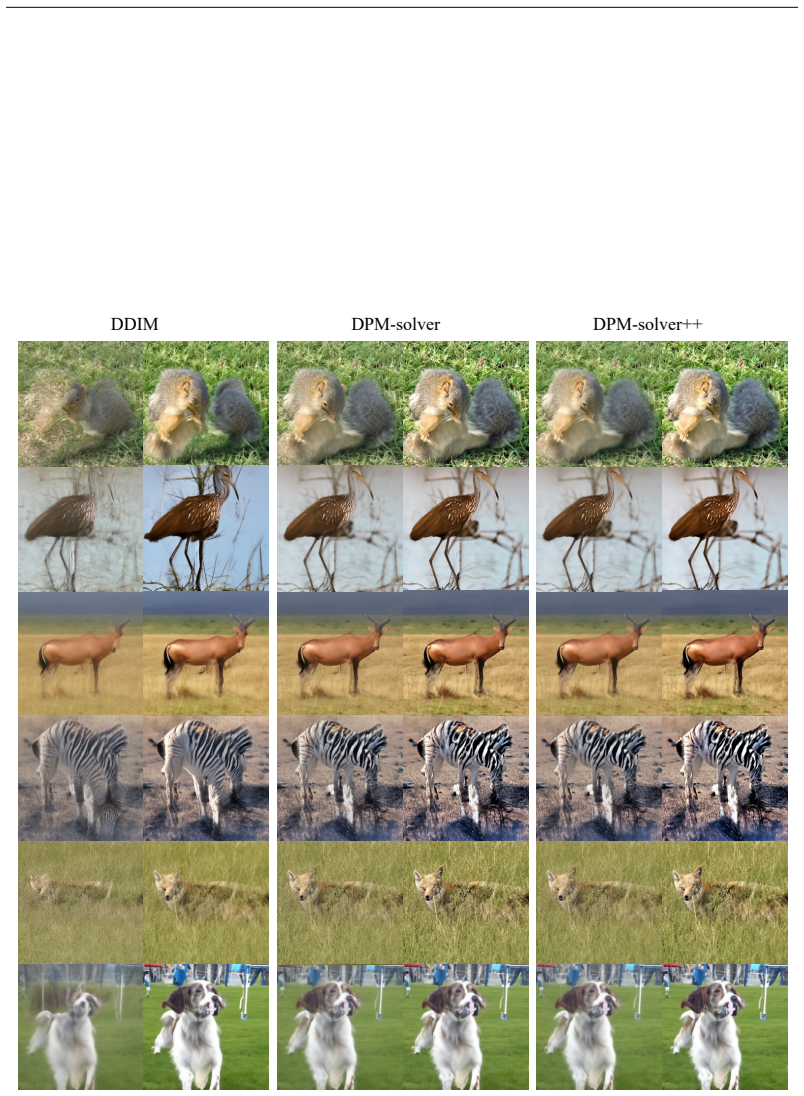
Figures from the paper (14 more)




Reference graph
Works this paper leans on
-
[1]
Andreas Blattmann, Tim Dockhorn, Sumith Kulal, Daniel Mendelevitch, Maciej Kilian, Dominik Lorenz, Yam Levi, Zion English, Vikram V oleti, Adam Letts, et al. Stable video diffusion: Scaling latent video diffusion models to large datasets.arXiv preprint arXiv:2311.15127,
-
[3]
Classifier-free diffusion guidance.arXiv preprint arXiv:2207.12598,
Jonathan Ho and Tim Salimans. Classifier-free diffusion guidance.arXiv preprint arXiv:2207.12598,
-
[4]
In Table 2, we depict the results of unconditional sampling with FID metric on LSUN Bedroom and ImageNet datasets. In Table 3, we show the results of class-conditional sampling with FID metric and different guidance scales. In Table 4, we show the results on text-conditional sampling with human preference score ↑, which is obtained from the sota human pre...
work page 2023
-
[6]
Table 6: Sample quality of unconditional sampling on ImageNet dataset with larger NFEs
DualFast improves the FID of DDIM from 28.906 to 20.559 when NFE=10, achieving two times acceleration (comparable to 20-step DDIM sampling). Table 6: Sample quality of unconditional sampling on ImageNet dataset with larger NFEs. Sampler DDIM(base) DPM-Solver(base) DDIM(ours) NFE 10 15 20 10 15 20 10 FID 28.906 22.781 20.344 21.250 20.004 19.533 20.559 E C...
work page 1992
-
[8]
Cheng Lu, Yuhao Zhou, Fan Bao, Jianfei Chen, Chongxuan Li, and Jun Zhu. Dpm-solver: A fast ode solver for diffusion probabilistic model sampling in around 10 steps.Advances in Neural Information Processing Systems, 35:5775–5787, 2022a. Cheng Lu, Yuhao Zhou, Fan Bao, Jianfei Chen, Chongxuan Li, and Jun Zhu. Dpm-solver++: Fast solver for guided sampling of ...
-
[9]
Aditya Ramesh, Prafulla Dhariwal, Alex Nichol, Casey Chu, and Mark Chen. Hierarchical text- conditional image generation with clip latents.arXiv preprint arXiv:2204.06125, 1(2):3,
-
[10]
Progressive distillation for fast sampling of diffusion models.arXiv preprint arXiv:2202.00512,
Tim Salimans and Jonathan Ho. Progressive distillation for fast sampling of diffusion models.arXiv preprint arXiv:2202.00512,
-
[11]
Denoising diffusion implicit models.arXiv preprint arXiv:2010.02502, 2020a
Jiaming Song, Chenlin Meng, and Stefano Ermon. Denoising diffusion implicit models.arXiv preprint arXiv:2010.02502, 2020a. Yang Song, Jascha Sohl-Dickstein, Diederik P Kingma, Abhishek Kumar, Stefano Ermon, and Ben Poole. Score-based generative modeling through stochastic differential equations.arXiv preprint arXiv:2011.13456, 2020b. Yang Song, Prafulla D...
arXiv 2010
Show all 24 references
-
[13]
Human preference score v2: A solid benchmark for evaluating human preferences of text-to-image synthesis.arXiv preprint arXiv:2306.09341,
Xiaoshi Wu, Yiming Hao, Keqiang Sun, Yixiong Chen, Feng Zhu, Rui Zhao, and Hongsheng Li. Human preference score v2: A solid benchmark for evaluating human preferences of text-to-image synthesis.arXiv preprint arXiv:2306.09341,
-
[14]
Restart sampling for improving generative processes.arXiv preprint arXiv:2306.14878,
Yilun Xu, Mingyang Deng, Xiang Cheng, Yonglong Tian, Ziming Liu, and Tommi Jaakkola. Restart sampling for improving generative processes.arXiv preprint arXiv:2306.14878,
-
[15]
Lsun: Construction of a large-scale image dataset using deep learning with humans in the loop.arXiv preprint arXiv:1506.03365,
12 Fisher Yu, Ari Seff, Yinda Zhang, Shuran Song, Thomas Funkhouser, and Jianxiong Xiao. Lsun: Construction of a large-scale image dataset using deep learning with humans in the loop.arXiv preprint arXiv:1506.03365,
-
[16]
Debias the training of diffusion models.arXiv preprint arXiv:2310.08442,
Hu Yu, Li Shen, Jie Huang, Man Zhou, Hongsheng Li, and Feng Zhao. Debias the training of diffusion models.arXiv preprint arXiv:2310.08442,
-
[17]
Fast sampling of diffusion models with exponential integrator
Qinsheng Zhang and Yongxin Chen. Fast sampling of diffusion models with exponential integrator. arXiv preprint arXiv:2204.13902,
-
[18]
gddim: Generalized denoising diffusion implicit models.arXiv preprint arXiv:2206.05564,
Qinsheng Zhang, Molei Tao, and Yongxin Chen. gddim: Generalized denoising diffusion implicit models.arXiv preprint arXiv:2206.05564,
-
[19]
Unipc: A unified predictor- corrector framework for fast sampling of diffusion models.arXiv preprint arXiv:2302.04867,
Wenliang Zhao, Lujia Bai, Yongming Rao, Jie Zhou, and Jiwen Lu. Unipc: A unified predictor- corrector framework for fast sampling of diffusion models.arXiv preprint arXiv:2302.04867,
-
[20]
Dpm-solver-v3: Improved diffusion ode solver with empirical model statistics.arXiv preprint arXiv:2310.13268,
Kaiwen Zheng, Cheng Lu, Jianfei Chen, and Jun Zhu. Dpm-solver-v3: Improved diffusion ode solver with empirical model statistics.arXiv preprint arXiv:2310.13268,
-
[23]
Our method significantly boosts the quality and speed of DDIM sampler, even achieving comparable visual results to DDIM of 50 NFEs with only 10 NFEs. G MSEFOR DISTRIBUTIONS MEASUREMENT IN DIFFUSION MODELS Adopting MSE to measure the distributions divergence in diffusion models...
2011
-
[24]
I SAMPLING DIVERSITY We also investigate the diversity of the images generated by DualFast
This validates the generality and robustness of DualFast. I SAMPLING DIVERSITY We also investigate the diversity of the images generated by DualFast. In Table 7, we compare the sampling diversity of DualFast and base samplers with the inception score (IS) metric on ImageNet da...
2023
-
[2010]
Fast inference through the reuse of attention maps in diffusion models.arXiv preprint arXiv:2401.01008,
Rosco Hunter, Łukasz Dudziak, Mohamed S Abdelfattah, Abhinav Mehrotra, Sourav Bhattacharya, and Hongkai Wen. Fast inference through the reuse of attention maps in diffusion models.arXiv preprint arXiv:2401.01008,
-
[2014]
Pseudo numerical methods for diffusion models on manifolds.arXiv preprint arXiv:2202.09778,
Luping Liu, Yi Ren, Zhijie Lin, and Zhou Zhao. Pseudo numerical methods for diffusion models on manifolds.arXiv preprint arXiv:2202.09778,
-
[2015]
Microsoft coco: Common objects in context
Tsung-Yi Lin, Michael Maire, Serge Belongie, James Hays, Pietro Perona, Deva Ramanan, Piotr Dollár, and C Lawrence Zitnick. Microsoft coco: Common objects in context. InComputer Vision– ECCV 2014: 13th European Conference, Zurich, Switzerland, September 6-12, 2014, Proceedings...
2014
-
[2017]
Boosting diffusion models with an adaptive momentum sampler.arXiv preprint arXiv:2308.11941,
Xiyu Wang, Anh-Dung Dinh, Daochang Liu, and Chang Xu. Boosting diffusion models with an adaptive momentum sampler.arXiv preprint arXiv:2308.11941,
-
[2022]
Auto-encoding variational bayes.arXiv preprint arXiv:1312.6114,
Diederik P Kingma and Max Welling. Auto-encoding variational bayes.arXiv preprint arXiv:1312.6114,
-
[2023]
Wavegrad: Estimating gradients for waveform generation.arXiv preprint arXiv:2009.00713,
Nanxin Chen, Yu Zhang, Heiga Zen, Ron J Weiss, Mohammad Norouzi, and William Chan. Wavegrad: Estimating gradients for waveform generation.arXiv preprint arXiv:2009.00713,
2009 arXiv
Reviewed August 7, 2026 · model on record in the stance chip above.
Discussion (0). Sign in to comment.