REVIEW 4 major objections 7 minor 40 references
Quantitative Comparison of Fine-Tuning Techniques for Pretrained Latent Diffusion Models in the Generation of Unseen SAR Images
T0 review · 4 major / 7 minor · reviewed 2026-08-15 · deepseek-v4-flash
Pith's one-line read A pretrained text-to-image diffusion model can be tuned to compose realistic, never-before-seen SAR radar scenes.
desk verdict Plausible hybrid fine-tuning recipe for SDXL-to-SAR, but the headline KL metric is partly trained into the best model and no uncertainty bounds are given. read the letter →
The pith
A machine-rendered reading of the paper's core claim, the machinery that carries it, and where it could break.
The reading
What carries the argument
The load-bearing object is Stable Diffusion XL's latent diffusion pipeline: a Variational Autoencoder maps images into latents, two text encoders produce token-level and global embeddings, and a UNet denoises latents conditioned on those embeddings through cross-attention. The fine-tuning recipe modifies this pipeline in three modular ways: full gradient updates of the UNet weights, LoRA low-rank adapter matrices on the text-encoder attention projections, and a learnable embedding for a new <SAR> token, plus a short low-noise refinement of the VAE decoder with a KL distribution-matching loss. LoRA updates frozen weights additively with rank-constrained factors, keeping adapter capacity small, while full UNet tuning absorbs the statistical shift that SAR's heavy-tailed amplitude distributions and slant-range geometry impose.
What would settle it
Take the 330 evaluation prompts, replace the auto-generated optical captions with independently verified radar-aware captions, and recompute the SAR-CLIP rank and similarity scores for the configurations in Table 2; if the ordering no longer puts the hybrid configurations on top, the reported advantage is an artifact of caption noise. A second check is to verify by geolocation or patch retrieval that the claimed novel scenes, such as a circular structure in a city center or a river through dense forest, are genuinely absent from the training set.
Extended reading notes
Core claim
The central claim is that a vision-language foundation model pretrained on optical images can be adapted to generate physically grounded SAR scenes, and that the optimal configuration is neither all-full nor all-LoRA but a hybrid. Full fine-tuning of the UNet captures SAR's low-level statistics (Rayleigh-distributed amplitudes, speckle, side-looking geometry), while LoRA on both text encoders preserves spatial relations and object semantics, and a learned <SAR> token shifts the caption embedding toward radar style. The paper reports that the hybrid model heart-rose-2 reaches a KL divergence of 0.23 against real amplitude distributions and attains the best SAR-CLIP ranks in most evaluated categories, while composing scenes the training set did not contain, such as a circular structure in a city center or a river through dense forest.
Load-bearing premise
The results stand or fall on the assumption that the captions automatically generated from optical imagery are faithful descriptions of the co-aligned SAR patch; if those captions miss radar-specific content, the semantic alignment scores no longer measure how well the generated SAR image matches the prompt.
Editorial extensions
If this is right
- Text prompts alone can control SAR scene composition, including spatial relations like 'near' and 'along', at 40 cm resolution.
- The same adapted model can be reused as an image conditioner: it sharpens 1.35 m TerraSAR-X images to 40 cm and adds physically plausible texture to outputs of the EMPRISE physics-based simulator.
- Rare or operationally relevant scenes absent from the training set, such as a bridge over a river or a circular structure in a city, can be synthesized on demand.
- The adaptation runs on a single H100 GPU, so the procedure is reproducible for other resolutions or other latent diffusion backbones.
Reading between the lines
- Inference: the same division of labor seen here—full backbone tuning for low-level statistics, low-rank adapters for language semantics, and a learned token for domain identity—likely transfers to other non-optical modalities with heavy-tailed statistics, such as sonar, lidar echo, or medical ultrasound.
- Inference: because semantic evaluation depends on auto-generated optical captions, re-running the rankings with manually verified or radar-native captions is a natural stress test; if configuration ordering changes, part of the hybrid's reported advantage is an artifact of caption noise.
- Inference: the learned <SAR> token probably behaves like textual inversion, meaning 'a <SAR> image of X' should inherit radar statistics even when X is an unseen concept; that compositional property is directly testable.
- Inference: the claim that generated scenes are 'unseen' relies on absence from the training split, so checking by geolocation or patch retrieval whether the composed scenes actually appear in training data would sharpen or weaken the out-of-distribution claim.
Signed reviews
Editorial analysis
A structured set of objections, weighed in public.
Referee Report
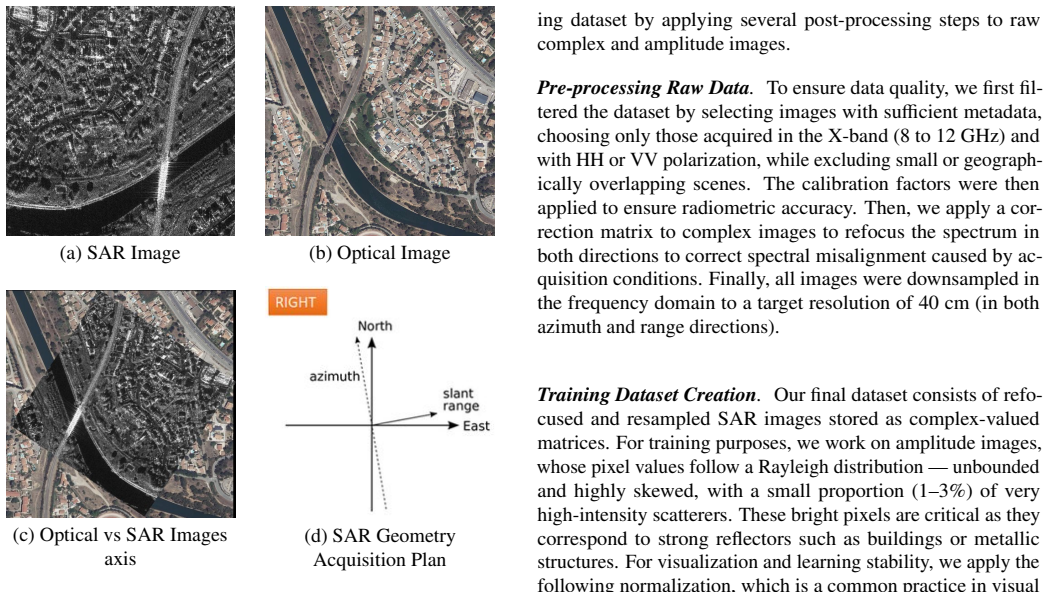
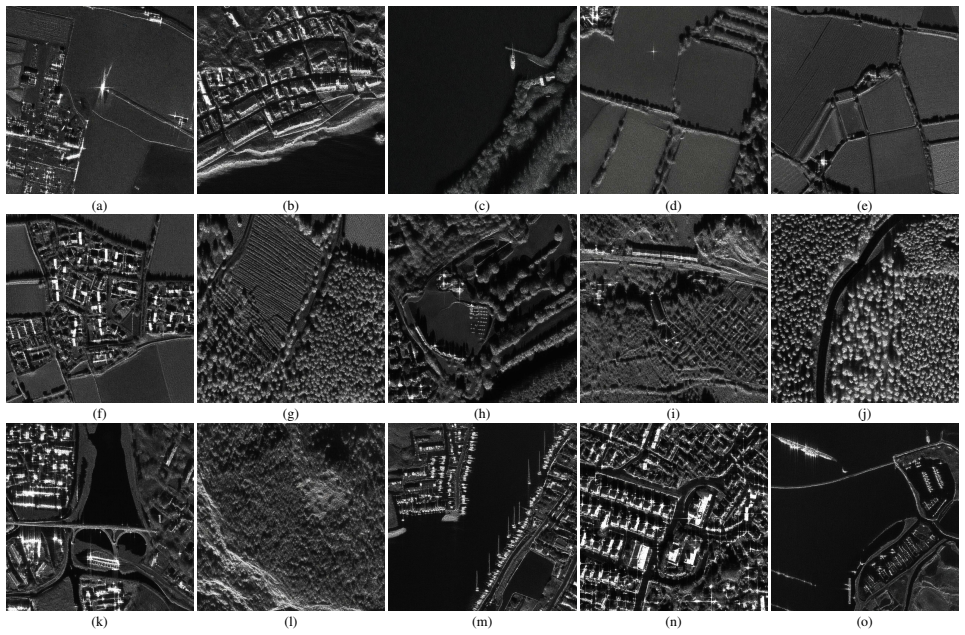
Summary. The paper adapts Stable Diffusion XL to high-resolution X-band SAR imagery. It curates 100k 1024x1024 patches from ONERA SETHI data, auto-generates captions from co-aligned optical images with CogVLM2, and compares fine-tuning configurations that vary full UNet fine-tuning, LoRA on the two text encoders, noise offset, batch size, VAE decoder refinement, and a learnable <SAR> token. Evaluation combines KL divergence between real and generated amplitude histograms, GLCM texture features, and a SAR-specialized CLIP rank/similarity. The central claim is that the hybrid configuration with full UNet tuning, LoRA on both text encoders, and the learned <SAR> token (heart-rose-2) best preserves SAR geometry and texture while maintaining prompt fidelity, and can compose scenes not present in the training set.
Significance. If the result holds, the paper would make a useful contribution: it demonstrates that a text-to-image foundation model can be transferred to a non-optical, physics-driven modality, and it provides a systematic comparison of full fine-tuning versus LoRA across model components. The proposed evaluation framework (KL, GLCM, SAR-CLIP) and the practical applications to TerraSAR-X and EMPRISE refinement are also valuable. However, the headline KL metric is also used as a training loss in the refinement phase, so the most emphasized advantage of the best model is not independent; the single-seed comparisons without uncertainty intervals further limit the strength of the ranking. The paper is within scope and the central idea is defensible, but the evidence as presented does not fully establish the ordering of configurations.
major comments (4)
- [5.5-5.6, Eqs. (10)-(11), Table 6] The primary statistical-fidelity metric is used as a training objective. Section 5.5 introduces L_refine = L_base + lambda_KL D_KL(Preal || Pgen), and Section 5.6 states that the <SAR> token embedding is updated with gradients from the diffusion objective and the distributional terms. The evaluation metric in Section 4.3, Eq. (4), is the same KL divergence between real and generated amplitude distributions. The best model heart-rose-2 is therefore trained to minimize the criterion on which it is judged, so its KL advantage over whale-north-8 (0.23 vs 0.35) is at least partially a consequence of optimizing the evaluation target rather than an independent measure of SAR realism. I recommend evaluating at least one configuration trained without the KL term, or reporting KL only as a secondary metric, so that the comparison is not self-referential.
- [5.2-5.6, Tables 2-6] All comparisons are single-seed, single-checkpoint runs at epoch 8, with no confidence intervals or significance tests. The differences between top models are small (e.g., CLIP rank 1.61 vs 1.74; KL 0.33 vs 0.35) and could plausibly lie within run-to-run variation. The paper selects the best configuration based on these point estimates, so the central claim is fragile without repeated seeds or bootstrap estimates. Please provide at least 3-5 seeds per configuration, or bootstrap over the 330 evaluation images, and state whether the reported differences are statistically distinguishable. The per-category results in Table 7 likewise lack any uncertainty quantification.
- [3 and 4.3] The prompt-fidelity evaluation depends on captions whose reliability is not established for the SAR modality. Section 3 states that textual descriptions were automatically generated from the co-aligned optical images using CogVLM2, and the same captions are used as prompts for generation and as ground truth for the CLIP rank and similarity scores in Section 4.3. If the optical captions miss radar-specific content, contain scene-label errors (Section 3 acknowledges possible mislabeling), or use generic phrasing that does not discriminate physical layout, the CLIP scores no longer measure SAR-prompt alignment. Please validate caption quality on a human-annotated SAR subset, or at least quantify caption noise and show that the ranking of configurations is robust to it.
- [4.3, Figure 15] The textural component of the central claim is not quantitatively established across configurations. The GLCM analysis is described in Section 4.3, but the results are presented only as qualitative panels in Figure 15 for heart-rose-2 versus real SAR images, and the caption mentions epoch 10 while the quantitative tables are at epoch 8. There is no per-configuration table of the four Haralick features. Please report the GLCM descriptors with means and standard deviations for all compared models (or at least for the configurations in Tables 2 and 6), and state whether the differences are statistically significant; otherwise the claim that the hybrid strategy best preserves SAR texture is not supported by the evidence as presented.
minor comments (7)
- [5.1 vs 5.2, Figure 5 and Table 2] There is a numeric inconsistency for the same configuration: Figure 5 reports rain-beach-6 with KL = 0.17, while Table 2 reports rain-beach-6 with KL = 1.17. Please reconcile these values or clarify that they refer to different checkpoints or evaluation conditions.
- [Tables 2 and 4] The model soleil-up-7 is reported with KL = 0.42 in Table 2 and KL = 0.43 in Table 4 under what appears to be the same configuration and epoch. Please specify the exact evaluation protocol or checkpoint used for each table so that the numbers are reproducible.
- [Figure 15] The caption states '(epoch 10)', while the rest of the experimental section reports results at epoch 8. Please clarify which checkpoint was used for the GLCM analysis and whether the visual comparison is representative of the quantitative comparisons.
- [3 and 5] Section 3 says captions were generated only for a subset of geo-aligned optical pairs, while Section 5 refers to a training dataset of 100,000 SAR image-caption pairs. Please clarify how many of the 100k samples have captions and how the remaining samples are used during training.
- [Appendix B] The caption of Figure B.2 says 'for 9 different models', but the figure shows only three models (whale-north-8, whale-north-8-refined, heart-rose-2). Please correct the caption.
- [5.3] The statement 'Contrary to what has been observed in the literature' would benefit from a supporting citation or a more precise description of the specific prior observations being compared.
- [General] The paper does not state whether code, trained checkpoints, or the evaluation dataset will be released. A data and code availability statement would strengthen the reproducibility claims made in Section 5.
Circularity Check
The KL-divergence metric is also the training objective of the refinement phase, so the reported fidelity gain of the best model is partly by construction.
-
fitted input called prediction
[Section 4.3 Eq. (4); Section 5.5 Eqs. (10)-(11); Tables 5 and 6]
"In addition, we add a Kullback–Leibler (KL) divergence term to the loss to minimize the divergence between the amplitude distribution of the generated image ˆx and that of the target image x: LKL = DKL(Preal(x)∥ Pgen(ˆx)). (10) The total loss used during refinement is Lrefine = Lbase + λKLLKL, (11)"
Equation (10) is the same D_KL(P∥Q) functional as the primary statistical-fidelity metric defined in Eq. (4). The refinement phase minimizes this quantity, and Table 5 then reports the refined model's lower KL (0.33 vs 0.35) as evidence of improved fidelity. The improvement is therefore partly a consequence of optimizing the evaluation target, not an independent measurement. The same applies to heart-rose-2 in Section 5.6 and Table 6, whose token embedding is updated with "our distributional terms" and then credited with the lowest KL (0.23). CLIP rank and GLCM metrics are not part of the training loss and provide independent partial support, so the circularity is partial rather than total.
full rationale
The paper's comparison is mostly self-contained: it compares fixed fine-tuning configurations with held-out generation and uses CLIP rank and GLCM features as external, non-optimized metrics. The one load-bearing circular step is the KL divergence. Section 5.5 adds D_KL to the refinement loss (Eqs. 10-11), and Sections 5.5-5.6 report reduced or lowest KL as evidence of realism (Tables 5-6). Since the evaluation KL of Eq. (4) is the same functional as the training term, the refined and <SAR>-token models are being graded on an objective they were explicitly trained to minimize. The reported improvements (0.35 to 0.33 and 0.35 to 0.23) are thus at least partly forced by construction. CLIP rank (Eqs. 5-6) and GLCM textural indicators are independent of the training losses and support the hybrid ranking, though GLCM results are not tabulated per configuration and no confidence intervals are given. Self-citations in Section 6 (Debuysère et al. 2024/2025, Trouve et al. 2024) concern applied ControlNet pipelines and are not load-bearing for the paper's central comparison. Overall: partial circularity in the headline statistical-fidelity comparison, not a fully circular derivation.
Assumptions & free parameters
free parameters (7)
- Noise offset gamma =
0.035
- LoRA rank and alpha for text encoders =
r = 8, alpha = 4
- UNet and text encoder learning rates =
5e-5 (UNet), 4e-5 (text encoders)
- KL loss weight lambda_KL =
not reported
- Batch size =
16 default, 64 best
- Low-noise refinement schedule fraction =
last 15% of reverse diffusion, one epoch
- Evaluation saturation exclusion threshold =
up to 3% of pixels excluded
assumptions (6)
- domain assumption Stable Diffusion XL pretrained on optical text-image pairs retains semantic and compositional priors that transfer to SAR.
- domain assumption Captions auto-generated by CogVLM2 from optical imagery accurately describe the geo-aligned SAR scene content.
- domain assumption The KL divergence between real and generated amplitude histograms, after excluding saturated pixels and renormalizing, is a valid measure of radiometric realism.
- domain assumption The authors' fine-tuned SAR-CLIP model is a valid proxy for semantic alignment between prompts and generated SAR images.
- domain assumption The random split into train, validation, and test sets prevents geographic or scene-level leakage between training and test patches.
- domain assumption SAR amplitude pixel values follow a Rayleigh distribution, used here as the physical target for statistical evaluation.
invented entities (1)
-
The <SAR> token embedding
Cite this review
Pith. "Pith review of Quantitative Comparison of Fine-Tuning Techniques for Pretrained Latent Diffusion Models in the Generation of Unseen SAR Images." pith.science (2026). https://pith.science/paper/5SS3EB23
@misc{pith2026250613307,
  author       = {Pith},
  title        = {Pith review of: Quantitative Comparison of Fine-Tuning Techniques for Pretrained Latent Diffusion Models in the Generation of Unseen SAR Images},
  year         = {2026},
  howpublished = {\url{https://pith.science/paper/5SS3EB23}},
  note         = {Machine review of arXiv:2506.13307}
}
read the original abstract
We present a framework for adapting a large pretrained latent diffusion model to high-resolution Synthetic Aperture Radar (SAR) image generation. The approach enables controllable synthesis and the creation of rare or out-of-distribution scenes beyond the training set. Rather than training a task-specific small model from scratch, we adapt an open-source text-to-image foundation model to the SAR modality, using its semantic prior to align prompts with SAR imaging physics (side-looking geometry, slant-range projection, and coherent speckle with heavy-tailed statistics). Using a 100k-image SAR dataset, we compare full fine-tuning and parameter-efficient Low-Rank Adaptation (LoRA) across the UNet diffusion backbone, the Variational Autoencoder (VAE), and the text encoders. Evaluation combines (i) statistical distances to real SAR amplitude distributions, (ii) textural similarity via Gray-Level Co-occurrence Matrix (GLCM) descriptors, and (iii) semantic alignment using a SAR-specialized CLIP model. Our results show that a hybrid strategy-full UNet tuning with LoRA on the text encoders and a learned token embedding-best preserves SAR geometry and texture while maintaining prompt fidelity. The framework supports text-based control and multimodal conditioning (e.g., segmentation maps, TerraSAR-X, or optical guidance), opening new paths for large-scale SAR scene data augmentation and unseen scenario simulation in Earth observation.
Figures


Figures from the paper (13 more)



Reference graph
Works this paper leans on
-
[1]
write newline
" write newline "" before.all 'output.state := FUNCTION n.dashify 't := "" t empty not t #1 #1 substring "-" = t #1 #2 substring "--" = not "--" * t #2 global.max substring 't := t #1 #1 substring "-" = "-" * t #2 global.max substring 't := while if t #1 #1 substring * t #2 global.max substring 't := if while FUNCTION word.in bbl.in ":" * " " * FUNCTION f...
-
[2]
K. Agrawal and R. Banerjee. Synthetic art generation and deepfake detection: A study on jamini roy inspired dataset. TechRxiv, Mar. 2025. doi:10.36227/techrxiv.174119231.19482547/v1. URL http://dx.doi.org/10.36227/techrxiv.174119231.19482547/v1
- [3]
-
[4]
R. Baqu \'e , P. Dreuillet, and H. M. Oriot. Sethi : Review of 10 years of development and experimentation of the remote sensing platform. 2019 International Radar Conference (RADAR), 2019
work page 2019
- [5]
-
[6]
W. Dai, L. Lu, and Z. Li. Diffusion-based synthetic data generation for visible-infrared person re-identification, 2025. URL https://arxiv.org/abs/2503.12472
work page Pith review arXiv 2025
-
[7]
S. Debuysère, N. Trouvé, N. Letheule, E. Colin, and O. Lévêque. Synthesizing sar images with generative ai: Expanding to large-scale imagery, October 2024. https://hal.science/hal-04786104
work page 2024
-
[8]
From Spaceborne to Airborne: SAR Image Synthesis Using Foundation Models for Multi-Scale Adaptation
S. Debuysère, N. Trouvé, N. Letheule, O. Lévêque, and E. Colin. From spaceborn to airborn: Sar image synthesis using foundation models for multi-scale adaptation, 2025. URL https://arxiv.org/abs/2505.03844
work page Pith review arXiv 2025
Show all 40 references
-
[9]
Dettmers, A
T. Dettmers, A. Pagnoni, A. Holtzman, and L. Zettlemoyer. Qlora: Efficient finetuning of quantized llms, 2023. URL https://arxiv.org/abs/2305.14314
2023 arXiv
-
[10]
R. Gal, Y. Alaluf, Y. Atzmon, O. Patashnik, A. H. Bermano, G. Chechik, and D. Cohen-Or. An image is worth one word: Personalizing text-to-image generation using textual inversion, 2022. URL https://arxiv.org/abs/2208.01618
2022 arXiv
-
[11]
D. Gao, X. Wu, Z. Wen, Y. Xu, and Z. Chen. Few-shot sar vehicle target augmentation based on generative adversarial networks. ISPRS Annals of the Photogrammetry, Remote Sensing and Spatial Information Sciences, X-1-2024: 0 83--90, 2024. doi:10.5194/isprs-annals-X-1-2024-83-202...
2024 doi
-
[12]
R. M. Haralick, K. Shanmugam, and I. Dinstein. Textural features for image classification. IEEE Transactions on Systems, Man, and Cybernetics, SMC-3 0 (6): 0 610--621, 1973. doi:10.1109/TSMC.1973.4309314
1973
-
[13]
W. Hong, W. Wang, M. Ding, W. Yu, Q. Lv, Y. Wang, Y. Cheng, S. Huang, J. Ji, Z. Xue, L. Zhao, Z. Yang, X. Gu, X. Zhang, G. Feng, D. Yin, Z. Wang, J. Qi, X. Song, P. Zhang, D. Liu, B. Xu, J. Li, Y. Dong, and J. Tang. Cogvlm2: Visual language models for image and video understan...
2024 arXiv
-
[14]
E. J. Hu, Y. Shen, P. Wallis, Z. Allen-Zhu, Y. Li, S. Wang, L. Wang, and W. Chen. Lora: Low-rank adaptation of large language models, 2021. URL https://arxiv.org/abs/2106.09685
2021 arXiv
-
[15]
M. Jia, L. Tang, B.-C. Chen, C. Cardie, S. Belongie, B. Hariharan, and S.-N. Lim. Visual prompt tuning, 2022. URL https://arxiv.org/abs/2203.12119
2022 arXiv
-
[16]
Khanna, P
S. Khanna, P. Liu, L. Zhou, C. Meng, R. Rombach, M. Burke, D. Lobell, and S. Ermon. Diffusionsat: A generative foundation model for satellite imagery, 2024. URL https://arxiv.org/abs/2312.03606
2024 arXiv
-
[17]
Kirillov, E
A. Kirillov, E. Mintun, N. Ravi, H. Mao, C. Rolland, L. Gustafson, T. Xiao, S. Whitehead, A. C. Berg, W.-Y. Lo, P. Dollár, and R. Girshick. Segment anything, 2023. URL https://arxiv.org/abs/2304.02643
2023 arXiv
-
[18]
B. F. Labs. Flux. https://github.com/black-forest-labs/flux, 2024
2024
-
[19]
C. Liu, K. Chen, R. Zhao, Z. Zou, and Z. Shi. Text2earth: Unlocking text-driven remote sensing image generation with a global-scale dataset and a foundation model, 2025. URL https://arxiv.org/abs/2501.00895
2025 arXiv
-
[20]
W. Liu , Y. Zhao , M. Liu , L. Dong , X. Liu , and M. Hui . Generating simulated SAR images using Generative Adversarial Network . In A. G. Tescher , editor, Applications of Digital Image Processing XLI, volume 10752 of Society of Photo-Optical Instrumentation Engineers (SPIE)...
2018 doi
-
[21]
Z. Ma, X. Xiao, S. Dong, P. Wang, H. Wang, and Q. Pan. Sarchat-bench-2m: A multi-task vision-language benchmark for sar image interpretation, 2025. URL https://arxiv.org/abs/2502.08168
2025 arXiv
-
[22]
L. Pang, X. Cao, D. Tang, S. Xu, X. Bai, F. Zhou, and D. Meng. Hsigene: A foundation model for hyperspectral image generation, 2024. URL https://arxiv.org/abs/2409.12470
2024 arXiv
-
[23]
Podell, Z
D. Podell, Z. English, K. Lacey, A. Blattmann, T. Dockhorn, J. Müller, J. Penna, and R. Rombach. Sdxl: Improving latent diffusion models for high-resolution image synthesis, 2023. URL https://arxiv.org/abs/2307.01952
2023 arXiv
-
[24]
Rombach, A
R. Rombach, A. Blattmann, D. Lorenz, P. Esser, and B. Ommer. High-resolution image synthesis with latent diffusion models, 2022. URL https://arxiv.org/abs/2112.10752
2022 arXiv
-
[25]
N. Ruiz, Y. Li, V. Jampani, Y. Pritch, M. Rubinstein, and K. Aberman. Dreambooth: Fine tuning text-to-image diffusion models for subject-driven generation, 2023. URL https://arxiv.org/abs/2208.12242
2023 arXiv
-
[26]
Saharia, W
C. Saharia, W. Chan, S. Saxena, L. Li, J. Whang, E. Denton, S. K. S. Ghasemipour, B. K. Ayan, S. S. Mahdavi, R. G. Lopes, T. Salimans, J. Ho, D. J. Fleet, and M. Norouzi. Photorealistic text-to-image diffusion models with deep language understanding, 2022. URL https://arxiv.or...
2022 arXiv
-
[27]
D. Tang, X. Cao, X. Hou, Z. Jiang, J. Liu, and D. Meng. Crs-diff: Controllable remote sensing image generation with diffusion model, 2024. URL https://arxiv.org/abs/2403.11614
2024 arXiv
-
[28]
C. Team. Chameleon: Mixed-modal early-fusion foundation models, 2025. URL https://arxiv.org/abs/2405.09818
2025 arXiv
-
[29]
Trouve, N
N. Trouve, N. Letheule, O. Leveque, I. Rami, and E. Colin. Sar image synthesis using text conditioned pre-trained generative ai models. In Proceedings of EUSAR 2024; 15th European Conference on Synthetic Aperture Radar, Munich, Germany, 2024. VDE, VDE,ITG
2024
-
[30]
Q. Wang, Y. Fan, J. Bao, H. Jiang, and Y. Song. Bora: Bi-dimensional weight-decomposed low-rank adaptation, 2024. URL https://arxiv.org/abs/2412.06441
2024 arXiv
-
[31]
Woollard, D
M. Woollard, D. Blacknell, H. Griffiths, and M. A. Ritchie. Sarcastic v2.0—high-performance sar simulation for next-generation atr systems. Remote Sensing, 14 0 (11), 2022. ISSN 2072-4292. doi:10.3390/rs14112561. URL https://www.mdpi.com/2072-4292/14/11/2561
2022 doi
-
[32]
H. Ye, J. Zhang, S. Liu, X. Han, and W. Yang. Ip-adapter: Text compatible image prompt adapter for text-to-image diffusion models, 2023. URL https://arxiv.org/abs/2308.06721
2023 arXiv
-
[33]
J. Yu, Z. Wang, V. Vasudevan, L. Yeung, M. Seyedhosseini, and Y. Wu. Coca: Contrastive captioners are image-text foundation models, 2022. URL https://arxiv.org/abs/2205.01917
2022 arXiv
-
[34]
L. Yu, B. Shi, R. Pasunuru, B. Muller, O. Golovneva, T. Wang, A. Babu, B. Tang, B. Karrer, S. Sheynin, C. Ross, A. Polyak, R. Howes, V. Sharma, P. Xu, H. Tamoyan, O. Ashual, U. Singer, S.-W. Li, S. Zhang, R. James, G. Ghosh, Y. Taigman, M. Fazel-Zarandi, A. Celikyilmaz, L. Zet...
2023 arXiv
-
[35]
Z. Yu, C. Liu, L. Liu, Z. Shi, and Z. Zou. Metaearth: A generative foundation model for global-scale remote sensing image generation, 2024. URL https://arxiv.org/abs/2405.13570
2024 arXiv
-
[36]
Zhang, A
L. Zhang, A. Rao, and M. Agrawala. Adding conditional control to text-to-image diffusion models, 2023. URL https://arxiv.org/abs/2302.05543
2023 arXiv
-
[37]
Zhang, T
Z. Zhang, T. Zhao, Y. Guo, and J. Yin. Rs5m and georsclip: A large-scale vision- language dataset and a large vision-language model for remote sensing. IEEE Transactions on Geoscience and Remote Sensing, 62: 0 1–23, 2024. ISSN 1558-0644. doi:10.1109/tgrs.2024.3449154. URL http...
2024
-
[38]
K. Zhou, J. Yang, C. C. Loy, and Z. Liu. Learning to prompt for vision-language models. International Journal of Computer Vision, 130 0 (9): 0 2337–2348, July 2022. ISSN 1573-1405. doi:10.1007/s11263-022-01653-1. URL http://dx.doi.org/10.1007/s11263-022-01653-1
2022 doi
-
[39]
L. Zou, H. Zhang, C. Wang, F. Wu, and F. Gu. Mw-acgan: Generating multiscale high-resolution sar images for ship detection. Sensors, 20 0 (22), 2020. ISSN 1424-8220. doi:10.3390/s20226673. URL https://www.mdpi.com/1424-8220/20/22/6673
2020 doi
-
[40]
write newline
" write newline "" before.all 'output.state := FUNCTION n.dashify 't := "" t empty not t #1 #1 substring "-" = t #1 #2 substring "--" = not "--" * t #2 global.max substring 't := t #1 #1 substring "-" = "-" * t #2 global.max substring 't := while if t #1 #1 substring * t #2 gl...
Reviewed August 15, 2026 · model on record in the stance chip above.
Discussion (0). Continue with ORCID to comment.