REVIEW 4 major objections 5 minor 80 references
Role of topotactic hydrogen in Superconductivity of Infinite-layer Nickelate NdNiO$_{2}$: A first-principles and variational Monte Carlo study
T0 review · 4 major / 5 minor · reviewed 2026-08-15 · deepseek-v4-flash
Pith's one-line read Hydrogen in NdNiO2 acts as a selective enhancer of the interstitial-orbital superconducting dome, not as a prerequisite for superconductivity.
desk verdict A solid DFT+VMC study of hydrogen in NdNiO2 whose central claim—that H selectively strengthens the interstitial-orbital dome—is physically plausible but rests on an imposed pairing symmetry that the paper never tests. read the letter →
The pith
A machine-rendered reading of the paper's core claim, the machinery that carries it, and where it could break.
The reading
What carries the argument
The central object is the two-band Hubbard model in a Wannier basis of Ni d_x2-y2 and an effective interstitial (IS) orbital per Ni site, with the IS orbital itself renormalized by hydrogen for the Ni site bound to hydrogen. The mechanism that carries the argument is the set of DFT-derived hopping parameters: hydrogenation substantially increases the first-neighbor IS-IS hopping at that Ni site while suppressing d_x2-y2-IS hopping, which in the variational Monte Carlo state translates into a stronger s-wave pairing scale J_s ~ $t_s^{2}$/U_s for the IS dome and a slightly weaker d-wave J_d. A second key ingredient is the pairing ansatz fixing s-wave symmetry on the IS orbital and d-wave symmetry on d_x2-y2, motivated by prior two-gap nickelate studies and by scanning tunneling microscopy and Hall data.
What would settle it
If a high-resolution measurement of the kz=pi Fermi surface showed the IS-derived electron pocket still present in hydrogenated NdNiO2, the paper's electronic-structure mechanism would fail; alternatively, a VMC calculation allowing d-wave pairing on the IS orbital that reproduces the same low-doping enhancement would show the conclusion depends on the fixed pairing ansatz rather than on hydrogen itself.
Extended reading notes
Core claim
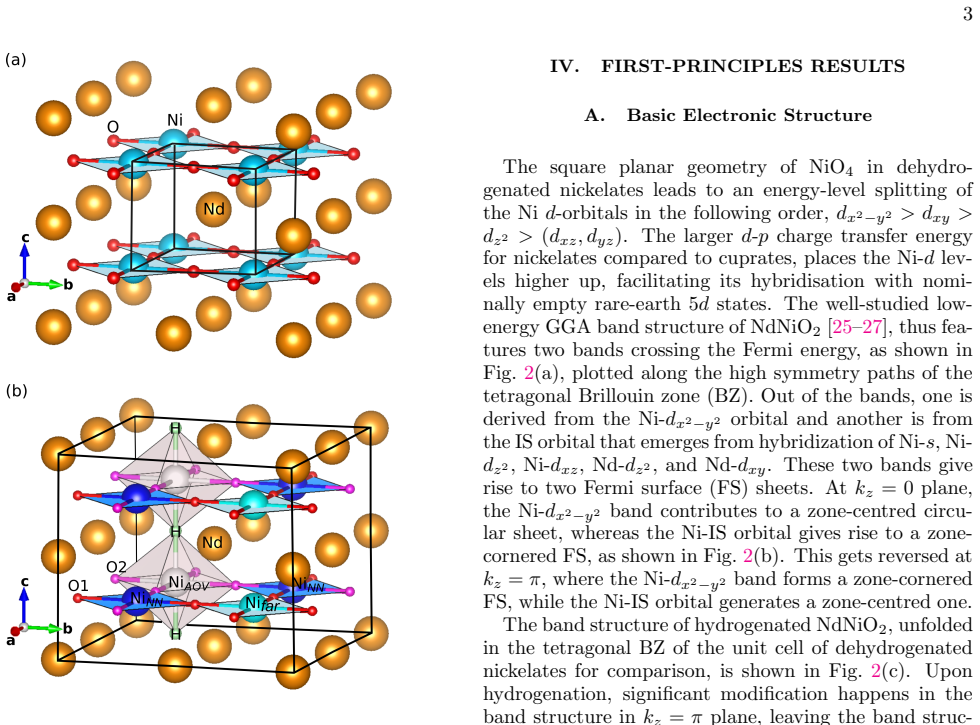
The central claim is that hydrogen sits at the apical oxygen vacancy in a negative charge state, forms a Ni-H-Ni chain, and acts as a selective enhancer of the interstitial-orbital superconductivity rather than as a prerequisite for superconductivity. Concretely, hydrogen changes only the local IS Wannier function at the Ni site bound to hydrogen, making it more localized in-plane and strongly bonded out-of-plane to H, while the d_x2-y2 Wannier function is essentially unchanged. This depletes the IS electron pocket at kz=pi but leaves the kz=0 Fermi surface intact, so the minimal two-band description survives hydrogenation. In the variational Monte Carlo solution of the DFT-derived two-band Hubbard model, superconductivity appears as two overlapping domes as a function of hole doping: an extended-s-wave dome from the IS orbital at lower hole doping and a d-wave dome from d_x2-y2 at higher doping. Hydrogenation raises the IS dome appreciably and suppresses the d_x2-y2 dome only marginally, a consequence the paper attributes to a hydrogen-induced increase in the nearest-neighbor IS-IS hopping (hence superexchange J_s) and a slight reduction in d_x2-y2 hopping.
Load-bearing premise
The computed selective enhancement of the IS superconducting dome rests on the assumption that the hydrogenated low-energy physics is faithfully captured by a two-orbital (d_x2-y2 and IS) Hubbard model with pairing symmetries fixed to s-wave on IS and d-wave on d_x2-y2; if additional orbitals or alternative pairing channels matter, the hydrogen-induced IS-dome enhancement could be an artifact of that truncation.
Editorial extensions
If this is right
- If correct, hydrogenated samples in the 0.22-0.28 hydrogen window should show a raised low-doping (IS, s-wave) superconducting dome compared with hydrogen-free samples, with little change at higher doping.
- The two-band model remains a valid minimal description even with hydrogen present, so future many-body studies of hydrogenated nickelates can keep the same d_x2-y2/IS basis.
- The near-disappearance of the kz=pi IS electron pocket gives a specific electronic-structure signature of hydrogenation that angle-resolved photoemission or quantum-oscillation experiments could look for.
- The results side with experimental reports that hydrogen incorporation is not necessary for superconductivity, while identifying a specific orbital channel through which hydrogen can nevertheless strengthen pairing.
Reading between the lines
- Because the enhancement traces to a single hopping integral (nearest-neighbor IS-IS), a testable extension would be to tune the hydrogen concentration and check whether the IS-dome height scales monotonically with that hopping, or to find other interstitial dopants that mimic hydrogen's Wannier reshaping.
- The double-dome structure persists in both compounds, suggesting the two-dome phenomenology is intrinsic to the two-orbital physics rather than to hydrogen; if so, strain or capping layers that alter only the IS orbital could selectively control the low-doping dome.
- The VMC result is obtained with a fixed pairing ansatz; if the IS pairing symmetry is allowed to vary and the hydrogen-induced enhancement disappears, the 'selective enhancer' conclusion would need to be reattributed to the ansatz rather than to the material physics.
Signed reviews
Editorial analysis
A structured set of objections, weighed in public.
Referee Report
Summary. The manuscript combines DFT, Wannier downfolding, and variational Monte Carlo (VMC) to address whether topotactic hydrogen affects superconductivity in infinite-layer nickelate NdNiO2. DFT in a 2x2x2 supercell with H at apical oxygen vacancy sites shows that hydrogen strongly modifies the interstitial (IS) Wannier function for the Ni bonded to H, suppresses the IS electron pocket at kz=pi, and leaves the two-band low-energy picture intact. The authors then solve a two-orbital Hubbard model (d_x2-y2 and IS) with interaction parameters U_d=3 eV, U_s/U_d=0.5, U_sd/U_d=0.2, and with pairing restricted to intra-orbital nearest-neighbor terms: extended s-wave for IS and d-wave for d_x2-y2. VMC yields two overlapping superconducting domes as a function of electron filling; hydrogenation increases the IS s-wave order parameter and slightly decreases the d_x2-y2 order parameter. The paper concludes that hydrogen, if present, selectively strengthens IS-derived superconductivity and is not a prerequisite for superconductivity.
Significance. If the central result holds, it offers a concrete microscopic mechanism for the conflicting experimental reports on hydrogen in nickelates: hydrogen can strengthen the interstitial-channel pairing while leaving the Ni-d_x2-y2 channel essentially unchanged. The DFT part is careful, and the Wannier-function analysis (Figs. 3-5) gives clear, quantitative evidence of the hydrogen-induced renormalization of the IS orbital. The VMC calculation is large-scale, and the two-dome structure in the order parameter is an interesting zero-temperature prediction. The main significance is conditional: the orbital-selective conclusion is not yet tested against alternative pairing symmetries in the IS channel, and the Hubbard parameters are chosen inputs rather than computed values. Nonetheless, the paper is a useful and falsifiable step: it predicts that hydrogen selectively enhances the IS-derived dome while leaving the d_x2-y2-derived dome nearly unchanged.
major comments (4)
- [Sec. V, Eq. (4) and Fig. 6(a)] The central claim that hydrogenation strengthens IS-derived superconductivity is obtained with the IS pairing symmetry imposed by input: Eq. (4) fixes extended s-wave pairing for the IS orbital (equal amplitude on x, y, and z bonds) and d-wave for the d_x2-y2 orbital. The VMC wavefunction of Eq. (2) can therefore only optimize the magnitudes of the imposed gaps; it cannot determine whether the leading IS pairing symmetry in the hydrogenated compound is still extended s-wave. Because hydrogenation strongly changes the IS Wannier function and the out-of-plane IS-IS hopping (Figs. 3 and 5), the momentum structure of the pairing interaction could plausibly change, and the enhanced Phi_s in Fig. 6(a) could be an artifact of the fixed ansatz. I request a variational comparison with alternative pairing symmetries for the IS channel (e.g., d-wave, nodal s-wave, s+/-), or an independent calculation of the pairing vertex, before the orbital-selective enhancement can be accepted.
- [Sec. V, Eq. (1)] The Hubbard parameters U_d=3 eV, U_s/U_d=0.5, and U_sd/U_d=0.2 are chosen rather than derived from the DFT calculation, and all quantitative results in Fig. 6(a) are presented for this single parameter set. The text states that variations of U_d over 1-2 eV and of the ratios by 0.2-0.3 leave the qualitative trend unchanged, but no such data are shown. Since the relative enhancement of Phi_s versus Phi_d is the paper's main quantitative conclusion, the robustness statement needs to be substantiated, for example with a supplementary figure showing the order parameters for several parameter sets.
- [Sec. V, Eq. (1)] The two-band Hubbard model omits spin-exchange and pair-hopping terms, and the paper notes this is done 'for numerical ease.' In a multi-orbital Hubbard model these terms are generically not small; for nickelates, Hund's-coupling-related physics is emphasized in the literature (e.g., Refs. 66-68). Their omission could alter the relative stability of s-wave versus d-wave pairing and hence the orbital-selective response to hydrogenation. At minimum, the authors should estimate the size of the omitted terms in their Wannier basis and discuss the possible impact on the order parameters; ideally, a calculation including these terms for at least one representative doping should be provided.
- [Sec. V, Fig. 6(a)] The comparison between the computed two-dome structure and the experimental T_c dome (Refs. 44-47) is qualitative: Phi_alpha is a zero-temperature VMC superconducting order parameter, not a critical temperature, and the theory finds superconductivity over a much broader doping range than experiment. The paper acknowledges this discrepancy in the Summary, but the text around Fig. 6(a) should be careful to state explicitly that the 'dome' comparison is suggestive rather than a quantitative match, and that finite-temperature or superfluid-stiffness calculations would be needed to connect Phi to T_c.
minor comments (5)
- [Abstract] The sentence 'show a two-hump superconductivity arising the two overlapping domes' is missing 'from' and should read 'arising from the two overlapping domes.'
- [Fig. 1 caption] The caption says 'square planner O coordination'; this should be 'square planar O coordination.'
- [Sec. VI] The word 'topotatic' should be 'topotactic' in the first sentence of the Summary and Discussion.
- [Fig. 6(b)] The dashed line is described as marking 'the fall of total electron density,' but the meaning is unclear; please state explicitly what the dashed line represents and why it is included.
- [Sec. V, Eq. (5)] The definition of Phi_alpha via the long-distance limit of the pair-pair correlation function is standard, but the notation F_alpha(r_i-r_j) is introduced without explicitly stating that the bond directions delta and delta' are fixed by the pairing symmetries in Eq. (4); clarifying this would help the reader.
Circularity Check
No significant circularity: the hydrogenation comparison is computed from DFT-derived hoppings with superconducting order parameters as variational outputs, not as fitted or definitional re-statements of the inputs.
full rationale
The paper's derivation chain is: DFT electronic structure -> Wannier downfolding to a two-orbital (d_x2-y2, IS) tight-binding model -> two-band Hubbard model with stated interaction parameters -> variational Monte Carlo solution with a BCS-plus-Jastrow wavefunction. The superconducting order parameters Phi_s and Phi_d in Fig. 6(a) are obtained from the long-range limit of pair-pair correlation functions, and their magnitudes are optimized variational outputs rather than quantities fitted to the experimental Tc dome or forced by the Hamiltonian parameters by construction. The pairing symmetries in Eq. (4) are imposed inputs, but they are explicitly stated and motivated by prior theory and experiment (Refs. 72-74), and the hydrogenation effect enters through the DFT-derived changes in hopping integrals and orbital character, so the conclusion is not merely a restatement of the ansatz. Self-citations to Refs. 30 and 31 motivate the two-band model and pairing symmetries, but independent theoretical work (Ref. 72) and experimental STM/Hall data provide external support, and the hydrogenated calculation is a genuinely new application of the framework. The legitimate concern that hydrogen might alter the preferred IS pairing symmetry away from extended s-wave is a robustness or correctness risk, not a circular reduction within the paper's own equations. Therefore no specific circular step can be exhibited, and the appropriate circularity score is 0.
Assumptions & free parameters
free parameters (3)
- Hubbard U_d =
3 eV
- Ratio U_s/U_d =
0.5
- Ratio U_sd/U_d =
0.2
assumptions (5)
- domain assumption GGA-PBE exchange-correlation gives an adequate band structure for NdNiO2 and NdNiO2H0.25.
- domain assumption The low-energy physics is captured by two orbitals per Ni: d_x2-y2 and an interstitial (IS) orbital; this two-band downfolding remains valid after hydrogenation.
- ad hoc to paper The Hubbard model with only intra- and inter-orbital density-density interactions (no spin-exchange or pair-hopping) is sufficient.
- domain assumption The BCS-Jastrow variational wavefunction with fixed particle number describes the ground state.
- ad hoc to paper Pairing is restricted to nearest-neighbour intra-orbital, with s-wave for IS and d-wave for d_x2-y2.
Cite this review
Pith. "Pith review of Role of topotactic hydrogen in Superconductivity of Infinite-layer Nickelate NdNiO$_{2}$: A first-principles and variational Monte Carlo study." pith.science (2026). https://pith.science/paper/3EXT55XJ
@misc{pith2026250613399,
  author       = {Pith},
  title        = {Pith review of: Role of topotactic hydrogen in Superconductivity of Infinite-layer Nickelate NdNiO$_2$: A first-principles and variational Monte Carlo study},
  year         = {2026},
  howpublished = {\url{https://pith.science/paper/3EXT55XJ}},
  note         = {Machine review of arXiv:2506.13399}
}
abstract
Employing combination of first-principles calculations, low-energy model construction, and variational Monte Carlo solution of the ab-initio derived Hubbard model, we study the effect of hydrogenation in the electronic structure and superconducting properties of infinite-layer nickelate, NdNiO$_2$. We find that the introduction of hydrogen at the apical oxygen vacancy position strongly influences the Wannier function corresponding to the effective interstitial orbital at the Ni site bound to the hydrogen. This results in the near disappearance of the electron pocket at the $k_z$ = $\pi$ Fermi surface, keeping that of $k_z$ = 0 unchanged, compared to the dehydrogenated case. The two-band model thus remains valid even in the presence of H. The calculated superconducting order parameters both in absence and presence of H, show a two-hump superconductivity arising the two overlapping domes, one arising from $d_{x^{2}-y^{2}}$ and another arising from interstitial orbital degree of freedom. Hydrogenation strengthens the latter, marginally affecting the former.
Figures


Figures from the paper (4 more)


Reference graph
Works this paper leans on
-
[1]
J. G. Bednorz and K. A. M¨ uller, Possible highTc super- conductivity in the Ba-La-Cu-O system, Zeitschrift f¨ ur Physik B Condensed Matter64, 189 (1986)
work page 1986
-
[2]
P. W. Anderson, The resonating valence bond state in La 2CuO4 and superconductivity, Science235, 1196 (1987)
1987
-
[3]
Dagotto, Correlated electrons in high-temperature su- perconductors, Rev
E. Dagotto, Correlated electrons in high-temperature su- perconductors, Rev. Mod. Phys.66, 763 (1994)
1994
-
[4]
C. C. Tsuei and J. R. Kirtley, Pairing symmetry in cuprate superconductors, Rev. Mod. Phys.72, 969 (2000)
2000
-
[5]
Taillefer, Scattering and Pairing in Cuprate Supercon- ductors, Annual Review of Condensed Matter Physics1, 51 (2010)
L. Taillefer, Scattering and Pairing in Cuprate Supercon- ductors, Annual Review of Condensed Matter Physics1, 51 (2010)
2010
-
[6]
T. Siegrist, S. M. Zahurak, D. W. Murphy, and R. S. Roth, The crystal structure of the superconducting com- pound La 2−xBaxCuO4, Nature334, 231 (1988)
work page 1988
-
[7]
G. Balestrino, P. G. Medaglia, P. Orgiani, A. Tebano, C. Aruta, S. Lavanga, and A. A. Varlamov, Evidence of Two-Dimensional Nernst Signal in Epitaxial Cuprate Thin Films, Physical Review Letters89, 156402 (2002)
work page 2002
-
[8]
D. Di Castro, C. Cantoni, F. Ridolfi, C. Aruta, A. Tebano, N. Yang, and G. Balestrino, Direct Obser- vation of Charge Density Wave in Cuprate Superconduc- tors, Physical Review Letters115, 147001 (2015)
work page 2015
Show all 80 references
-
[9]
Kamihara, H
Y. Kamihara, H. Hiramatsu, M. Hirano, R. Kawamura, H. Yanagi, T. Kamiya, and H. Hosono, Iron-Based Lay- ered Superconductor: LaOFeP, Journal of the American Chemical Society128, 10012 (2006)
2006
-
[10]
Kamihara, T
Y. Kamihara, T. Watanabe, M. Hirano, and H. Hosono, Iron-Based Layered Superconductor La[O 1−xFx]FeAs (x = 0.05-0.12) with T c = 26 K, Journal of the American Chemical Society130, 3296 (2008)
2008
-
[11]
Mizuguchi and Y
Y. Mizuguchi and Y. Takano, Review of Fe Chalcogenides as the Simplest Fe-Based Superconductor, Journal of the Physical Society of Japan79, 102001 (2010)
2010
-
[12]
G. R. Stewart, Superconductivity in iron compounds, Rev. Mod. Phys.83, 1589 (2011)
2011
-
[13]
Chaloupka and G
J. Chaloupka and G. Khaliullin, Orbital order and pos- sible superconductivity in LaNiO3/LaMO3 superlattices, Physical Review Letters100, 016404 (2008)
2008
-
[14]
Hansmann, X
P. Hansmann, X. Yang, A. Toschi, G. Khaliullin, O. K. Andersen, and K. Held, Turning a nickelate Fermi surface into a cupratelike one through heterostructuring, Physi- cal Review Letters103, 016401 (2009)
2009
-
[15]
V. V. Poltavets, K. A. Lokshin, S. Dikmen, M. Croft, T. Egami, and M. Greenblatt, La3Ni2O6: A New Double T’-type Nickelate with Infinite Ni 1+/2+O2 Layers, Jour- nal of the American Chemical Society128, 9050 (2006)
2006
-
[16]
V. V. Poltavets, K. A. Lokshin, M. Croft, T. K. Man- dal, T. Egami, and M. Greenblatt, Crystal Structures of Ln4Ni3O8 (Ln = La, Nd) Triple Layer T’-type Nickelates, Inorganic Chemistry46, 10887 (2007)
2007
-
[17]
Sarkar, I
S. Sarkar, I. Dasgupta, M. Greenblatt, and T. Saha- Dasgupta, Electronic and magnetic structures of bilayer La3Ni2O6 and trilayer La 4Ni3O8 nickelates from first principles, Phys. Rev. B84, 180411 (2011)
2011
-
[18]
D. Li, K. Lee, B. Y. Wang, M. Osada, S. Crossley, H. R. Lee, Y. Cui, Y. Hikita, and H. Y. Hwang, Supercon- ductivity in an infinite-layer nickelate, Nature572, 624 (2019)
2019
-
[19]
Nomura and R
Y. Nomura and R. Arita, Superconductivity in infinite- layer nickelates, Reports on Progress in Physics85, 052501 (2022)
2022
-
[20]
Osada, B
M. Osada, B. Y. Wang, B. H. Goodge, S. P. Harvey, K. Lee, D. Li, L. F. Kourkoutis, and H. Y. Hwang, Nick- elate Superconductivity without Rare-Earth Magnetism: (La,Sr)NiO2, Advanced Materials33, 2104083 (2021)
2021
-
[21]
M. R. Norman, Entering the Nickel Age of Superconduc- tivity, Physics13, 85 (2020)
2020
-
[22]
P. A. Lee, N. Nagaosa, and X.-G. Wen, Doping a Mott in- sulator: Physics of high-temperature superconductivity, Reviews of Modern Physics78, 17 (2006)
2006
-
[23]
Y.-T. Hsu, B. Y. Wang, M. Berben, D. Li, K. Lee, C. Duffy, T. Ottenbros, W. J. Kim, M. Osada, S. Wied- mann, H. Y. Hwang, and N. E. Hussey, Insulator-to- metal crossover near the edge of the superconducting dome in Nd 1−xSrxNiO2, Phys. Rev. Res.3, L042015 (2021)
2021
-
[24]
Rossi, H
M. Rossi, H. Lu, A. Nag, D. Li, M. Osada, K. Lee, B. Y. Wang, S. Agrestini, M. Garcia-Fernandez, J. J. Kas, Y.- D. Chuang, Z. X. Shen, H. Y. Hwang, B. Moritz, K.- J. Zhou, T. P. Devereaux, and W. S. Lee, Orbital and spin character of doped carriers in infinite-layer nicke- lat...
2021
-
[25]
Nomura, M
Y. Nomura, M. Hirayama, T. Tadano, Y. Yoshimoto, K. Nakamura, and R. Arita, Formation of a two- dimensional single-component correlated electron system and band engineering in the nickelate superconductor NdNiO2, Physical Review B100, 205138 (2019)
2019
-
[26]
Lee and W
K.-W. Lee and W. E. Pickett, Infinite-layer LaNiO 2: Ni1+ is not Cu 2+, Physical Review B70, 165109 (2004)
2004
-
[27]
A. S. Botana and M. R. Norman, Similarities and Differ- ences between LaNiO2 and CaCuO2 and Implications for Superconductivity, Physical Review X10, 011024 (2020)
2020
-
[28]
Sakakibara, H
H. Sakakibara, H. Usui, K. Suzuki, K. Takao, H. Aoki, and K. Kuroki, Model Construction and a Possibility of Cupratelike Pairing in a Newd 9 Nickelate Superconduc- tor (Nd,Sr)NiO 2, Physical Review Letters125, 077003 (2020)
2020
-
[29]
Hepting, D
M. Hepting, D. Li, C. J. Jia, H. Lu, E. Paris, Y. Tseng, X. Feng, M. Osada, E. Been, Y. Hikita, Y.-D. Chuang, Z. Hussain, K. J. Zhou, A. Nag, M. Garcia-Fernandez, M. Rossi, H. Y. Huang, D. J. Huang, Z. X. Shen, T. Schmitt, H. Y. Hwang, B. Moritz, J. Zaanen, T. P. Devereaux, an...
2020
-
[30]
Adhikary, S
P. Adhikary, S. Bandyopadhyay, T. Das, I. Dasgupta, and T. Saha-Dasgupta, Orbital-selective superconductivity in a two-band model of infinite-layer nickelates, Phys. Rev. B102, 100501 (2020)
2020
-
[31]
Bandyopadhyay, P
S. Bandyopadhyay, P. Adhikary, T. Das, I. Dasgupta, and T. Saha-Dasgupta, Superconductivity in infinite- layer nickelates: Role offorbitals, Phys. Rev. B102, 220502 (2020)
2020
-
[32]
Yamamoto and H
T. Yamamoto and H. Kageyama, Hydride Reductions of Transition Metal Oxides, Chemistry Letters42, 946 (2013)
2013
-
[33]
Matsumoto, K
J. Matsumoto, K. Hanzawa, M. Sasase, S. Haindl, T. Katase, H. Hiramatsu, and H. Hosono, Superconduc- tivity at 48 K of heavily hydrogen-doped SmFeAsO epi- 11 taxial films grown by topotactic chemical reaction using CaH2, Physical Review Materials3, 103401 (2019)
2019
-
[34]
Gainza, C
J. Gainza, C. A. L´ opez, F. Serrano-S´ anchez, J. E. F. Rodrigues, A. D. Rosa, M. I. Sobrados, N. M. Nemes, N. Biskup, M. T. Fern´ andez-D´ ıaz, J. L. Mart´ ınez, and J. A. Alonso, Evidence of hydrogen content and mono- valent Ni oxidation state in non-superconducting bulk an...
2023
-
[35]
X. Ding, C. C. Tam, X. Sui, Y. Zhao, M. Xu, J. Choi, H. Leng, J. Zhang, M. Wu, H. Xiao, X. Zu, M. Garcia- Fernandez, S. Agrestini, X. Wu, Q. Wang, P. Gao, S. Li, B. Huang, K.-J. Zhou, and L. Qiao, Critical Role of Hy- drogen for Superconductivity in Nickelates, Nature615, 244 (2023)
2023
-
[36]
P. P. Balakrishnan, D. F. Segedin, L. E. Chow, P. Quar- terman, S. Muramoto, M. Surendran, R. K. Patel, H. LaBollita, G. A. Pan, Q. Song, Y. Zhang, I. E. Bag- gari, K. Jagadish, Y.-T. Shao, B. H. Goodge, L. F. Kourkoutis, S. Middey, A. S. Botana, J. Ravichandran, A. Ariando, J...
2024
-
[37]
Gonzalez, A
M. Gonzalez, A. Ievlev, K. Lee, W. Kim, Y. Yu, J. Fowlie, and H. Y. Hwang, Absence of hydrogen insertion into highly crystalline superconducting infinite layer nicke- lates, Physical Review Materials8, 084804 (2024)
2024
-
[38]
K. Lee, B. H. Goodge, D. Li, M. Osada, B. Y. Wang, Y. Cui, L. F. Kourkoutis, and H. Y. Hwang, Aspects of the synthesis of thin film superconducting infinite-layer nickelates, APL Materials8, 041107 (2020)
2020
-
[39]
Krieger, L
G. Krieger, L. Martinelli, S. Zeng, L. E. Chow, K. Kum- mer, R. Arpaia, M. M. Sala, N. B. Brookes, A. Ariando, N. Viart, M. Salluzzo, G. Ghiringhelli, and D. Preziosi, Charge and Spin Correlations in Infinite-Layer Nickelate Superconductors, Physical Review Letters129, 027002 (2022)
2022
-
[40]
Krieger, A
G. Krieger, A. Raji, L. Schlur, G. Versini, C. Bouil- let, M. Lenertz, J. Robert, A. Gloter, N. Viart, and D. Preziosi, Synthesis of infinite-layer nickelates and in- fluence of the capping-layer on magnetotransport, Jour- nal of Physics D: Applied Physics56, 024003 (2022)
2022
-
[41]
C. T. Parzyck, V. Anil, Y. Wu, B. H. Goodge, M. Roddy, L. F. Kourkoutis, D. G. Schlom, and K. M. Shen, Synthe- sis of thin film infinite-layer nickelates by atomic hydro- gen reduction: Clarifying the role of the capping layer, APL Materials12, 031132 (2024)
2024
-
[42]
L. Si, W. Xiao, J. Kaufmann, J. M. Tomczak, Y. Lu, Z. Zhong, and K. Held, Topotactic Hydrogen in Nickelate Superconductors and Akin Infinite-Layer Oxides ABO 2, Physical Review Letters124, 166402 (2020)
2020
-
[43]
Y. Cui, G. Zhang, H. Li, H. Lin, X. Zhu, H.-H. Wen, G. Wang, J. Sun, M. Ma, Y. Li, D. Gong, T. Xie, Y. Gu, S. Li, H. Luo, P. Yu, and W. Yu, Protonation induced high-Tc phases in iron-based superconductors evidenced by NMR and magnetization measurements, Science Bul- letin63, 11 (2018)
2018
-
[44]
S. Zeng, C. S. Tang, X. Yin, C. Li, M. Li, Z. Huang, J. Hu, W. Liu, G. J. Omar, H. Jani, Z. S. Lim, K. Han, D. Wan, P. Yang, S. J. Pennycook, A. T. S. Wee, and A. Ariando, Phase Diagram and Superconducting Dome of Infinite-Layer Nd1−xSrxNiO2 Thin Films, Physical Re- view Lette...
2020
-
[45]
L. E. Chow and A. Ariando, Infinite-Layer Nickelate Superconductors: A Current Experimental Perspective of the Crystal and Electronic Structures, Frontiers in Physics10, 834658 (2022)
2022
-
[46]
D. Li, B. Y. Wang, K. Lee, S. P. Harvey, M. Osada, B. H. Goodge, L. F. Kourkoutis, and H. Y. Hwang, Supercon- ducting Dome in Nd 1−xSrxNiO2 Infinite Layer Films, Physical Review Letters125, 027001 (2020)
2020
-
[47]
Osada, B
M. Osada, B. Y. Wang, S. P. Harvey, K. Lee, D. Li, B. H. Goodge, L. F. Kourkoutis, and H. Y. Hwang, Field-Effect Modulation of Superconductivity in Designer Oxide Su- perlattices, Advanced Materials34, 2104083 (2022)
2022
-
[48]
J. P. Perdew, K. Burke, and M. Ernzerhof, Generalized Gradient Approximation Made Simple, Phys. Rev. Lett. 77, 3865 (1996)
1996
-
[49]
P. E. Bl¨ ochl, Projector augmented-wave method, Phys. Rev. B50, 17953 (1994)
1994
-
[50]
Tackett and N.A.W
A.R. Tackett and N.A.W. Holzwarth and G.E. Matthews, A Projector Augmented Wave (PAW) code for electronic structure calculations, Part II: pwpaw for periodic solids in a plane wave basis, Computer Physics Communica- tions135, 348 (2001)
2001
-
[51]
Paier, R
J. Paier, R. Hirschl, M. Marsman, and G. Kresse, The Perdew–Burke–Ernzerhof exchange-correlation func- tional applied to the G2-1 test set using a plane-wave basis set, The Journal of Chemical Physics122, 234102 (2005)
2005
-
[52]
A. A. Mostofi, J. R. Yates, G. Pizzi, Y.-S. Lee, I. Souza, D. Vanderbilt, and N. Marzari, An updated version of wannier90: A tool for obtaining maximally-localised Wannier functions, Computer Physics Communications 185, 2309 (2014)
2014
-
[53]
V. Wang, N. Xu, J.-C. Liu, G. Tang, and W.-T. Geng, VASPKIT: A user-friendly interface facilitating high- throughput computing and analysis using VASP code, Computer Physics Communications267, 108033 (2021)
2021
-
[54]
SHIBA and H
H. SHIBA and H. YOKOYAMA, VARIATIONAL MONTE CARLO STUDIES OF HIGHLY CORRE- LATED ELECTRON SYSTEMS, inProceedings of the Yamada Conference XVIII on Superconductivity in Highly Correlated Fermion Systems, edited by M. Tachiki, Y. Muto, and S. Maekawa (Elsevier, 1987) pp. 264–267
1987
-
[55]
Paramekanti, M
A. Paramekanti, M. Randeria, and N. Trivedi, High-T c superconductors: A variational theory of the supercon- ducting state, Phys. Rev. B70, 054504 (2004)
2004
-
[56]
Yokoyama and H
H. Yokoyama and H. Shiba, Variational Monte-Carlo Studies of Superconductivity in Strongly Correlated Elec- tron Systems, Journal of the Physical Society of Japan 57, 2482 (1988)
1988
-
[57]
Medhi, S
A. Medhi, S. Basu, and C. Y. Kadolkar, Coexistence of magnetism and superconductivity in at−jbilayer, Phys. Rev. B76, 235122 (2007)
2007
-
[58]
Tahara and M
D. Tahara and M. Imada, Variational Monte Carlo Method Combined with Quantum-Number Projection and Multi-Variable Optimization, Journal of the Phys- ical Society of Japan77, 114701 (2008)
2008
-
[59]
Sorella, Variational Monte Carlo and Markov Chains for Computational Physics, inStrongly Correlated Sys- tems: Numerical Methods, edited by A
S. Sorella, Variational Monte Carlo and Markov Chains for Computational Physics, inStrongly Correlated Sys- tems: Numerical Methods, edited by A. Avella and F. Mancini (Springer Berlin Heidelberg, Berlin, Heidel- berg, 2013) pp. 207–236
2013
-
[60]
M. T. H. Sarder and A. Medhi, Feed-forward neural net- work based variational wave function for the fermionic 12 Hubbard model in one dimension, Journal of Physics: Condensed Matter34, 375901 (2022)
2022
-
[61]
Sorella, Generalized Lanczos algorithm for variational quantum Monte Carlo, Phys
S. Sorella, Generalized Lanczos algorithm for variational quantum Monte Carlo, Phys. Rev. B64, 024512 (2001)
2001
-
[62]
Hayward and M.J
M.A. Hayward and M.J. Rosseinsky, Synthesis of the in- finite layer Ni(I) phase NdNiO 2+x by low temperature reduction of NdNiO 3 with sodium hydride, Solid State Sciences5, 839 (2003), international Conference on Inor- ganic Materials 2002
2003
-
[63]
Yanagisawa, S
T. Yanagisawa, S. Koike, M. Miyazaki, and K. Yamaji, Stripes and superconductivity in high-Tc superconduc- tors, Journal of Physics and Chemistry of Solids63, 1379 (2002), proceedings of the 8th ISSP International Sym- posium
2002
-
[64]
Watanabe, T
H. Watanabe, T. Shirakawa, K. Seki, H. Sakakibara, T. Kotani, H. Ikeda, and S. Yunoki, Unified description of cuprate superconductors using a four-bandd−pmodel, Phys. Rev. Res.3, 033157 (2021)
2021
-
[65]
M. T. Schmid, J.-B. Mor´ ee, R. Kaneko, Y. Yamaji, and M. Imada, Superconductivity Studied by Solving Ab Initio Low-Energy Effective Hamiltonians for Car- rier Doped CaCuO 2, Bi 2Sr2CuO6, Bi 2Sr2CaCu2O8, and HgBa2CuO4, Phys. Rev. X13, 041036 (2023)
2023
-
[66]
Di Cataldo, P
S. Di Cataldo, P. Worm, J. M. Tomczak, L. Si, and K. Held, Unconventional superconductivity without dop- ing in infinite-layer nickelates under pressure, Nature Communications15, 3952 (2024)
2024
-
[67]
Hausoel, S
A. Hausoel, S. D. Cataldo, M. Kitatani, O. Janson, and K. Held, Superconducting phase diagram of finite-layer nickelates Nd n+1NinO2n+2 (2025), arXiv:2502.12144 [cond-mat.str-el]
2025 arXiv
-
[68]
B. Kang, C. Melnick, P. Semon, S. Ryee, M. J. Han, G. Kotliar, and S. Choi, Infinite-layer nickelates as Ni-eg Hund’s metals, npj Quantum Materials8, 35 (2023)
2023
-
[69]
Zhang, Y.-f
G.-M. Zhang, Y.-f. Yang, and F.-C. Zhang, Self-doped Mott insulator for parent compounds of nickelate super- conductors, Phys. Rev. B101, 020501 (2020)
2020
-
[70]
Zhang and A
Y.-H. Zhang and A. Vishwanath, Type-IIt−Jmodel in superconducting nickelate Nd 1−xSrxNiO2, Phys. Rev. Res.2, 023112 (2020)
2020
-
[71]
Chang, J
J. Chang, J. Zhao, and Y. Ding, Hund-Heisenberg model in superconducting infinite-layer nickelates, The Euro- pean Physical Journal B93, 220 (2020)
2020
-
[72]
Choubey and I
P. Choubey and I. M. Eremin, Electronic theory for scan- ning tunneling microscopy spectra in infinite-layer nicke- late superconductors, Phys. Rev. B104, 144504 (2021)
2021
-
[73]
Q. Gu, Y. Li, S. Wan, H. Li, W. Guo, H. Yang, Q. Li, X. Zhu, X. Pan, Y. Nie, and H.-H. Wen, Single particle tunneling spectrum of superconducting Nd 1−xSrxNiO2 thin films, Nature Communications11, 6027 (2020)
2020
-
[74]
D. Li, B. Y. Wang, K. Lee, S. P. Harvey, M. Osada, B. H. Goodge, L. F. Kourkoutis, and H. Y. Hwang, Supercon- ducting Dome in Nd 1−xSrxNiO2 Infinite Layer Films, Phys. Rev. Lett.125, 027001 (2020)
2020
-
[75]
Capello, F
M. Capello, F. Becca, M. Fabrizio, S. Sorella, and E. Tosatti, Variational Description of Mott Insulators, Phys. Rev. Lett.94, 026406 (2005)
2005
-
[76]
Yokoyama, M
H. Yokoyama, M. Ogata, and Y. Tanaka, Mott Transi- tions andd-Wave Superconductivity in Half-Filled-Band Hubbard Model on Square Lattice with Geometric Frus- tration, Journal of the Physical Society of Japan75, 114706 (2006)
2006
-
[77]
De Franco, L
C. De Franco, L. F. Tocchio, and F. Becca, Metal- insulator transitions, superconductivity, and magnetism in the two-band Hubbard model, Phys. Rev. B98, 075117 (2018)
2018
-
[78]
K. V. and A. Medhi, Convolutional restricted Boltzmann machine correlated variational wave function for the Hub- bard model on a square lattice, Phys. Rev. B110, 125125 (2024)
2024
-
[79]
M. C. Gutzwiller, Effect of Correlation on the Ferromag- netism of Transition Metals, Phys. Rev. Lett.10, 159 (1963)
1963
-
[80]
Yokoyama and H
H. Yokoyama and H. Shiba, Variational Monte-Carlo Studies of Hubbard Model. I, Journal of the Physical So- ciety of Japan56, 1490 (1987)
1987
Reviewed August 15, 2026 · model on record in the stance chip above.
Discussion (0). Continue with ORCID to comment.