REVIEW 2 major objections 5 minor 1 cited by
The Price of Freedom: Exploring Expressivity and Runtime Tradeoffs in Equivariant Tensor Products
T0 review · 2 major / 5 minor · reviewed 2026-08-15 · deepseek-v4-flash
Pith's one-line read The paper argues that the reported speedups of Gaunt and matrix tensor products over the Clebsch-Gordan tensor product are purchased by discarding expressive capacity, and that once runtime is normalized by expressivity, only a fast…
desk verdict GTP/MTP speedups indeed come from lost expressivity, but the expressivity measure is a parameter count rather than task capacity, so the 'only true speedup' claim needs that caveat. read the letter →
The pith
A machine-rendered reading of the paper's core claim, the machinery that carries it, and where it could break.
The reading
What carries the argument
The load-bearing object is the tensor product operation (TPO), an equivariant bilinear map $T: X' \times Y' \to Z'$ used in place of the mathematical tensor product, together with a definition of expressivity as the dimension of the space of equivariant bilinear maps constructible by composing $T$ with equivariant linear layers on the inputs and output. The engine of the argument is the selection rule, a condition on irrep labels that a TPO must satisfy for an interaction to be nonzero, which determines interactability. For GTP, treating irreps up to degree $L$ as spherical-harmonic coefficients turns the operation into pointwise multiplication of two functions on the sphere $S^2$ followed by spherical-harmonic decomposition, and the resulting parity condition forces $\ell_1+\ell_2+\ell_3$ to be even, excluding antisymmetric paths. For MTP, embedding irreps into tensor-product representations and multiplying the resulting matrices inherits the CGTP triangle condition but still emits only one channel per output irrep. The runtime analysis leans on the sparsity of the Clebsch-Gordan coefficients, where only paths with $m_1+m_2=m_3$ survive, cutting the naive CGTP complexity from $O(L^6)$ to $O(L^5)$.
What would settle it
The chiral Tetris classification is the sharpest test: under the paper's selection rules, no GTP network of any width or depth can construct the antisymmetric $1_o \otimes 1_o \to 1_e$ path needed to tell mirror-image pieces apart, so a GTP model that reaches above-chance accuracy on the chiral pair would refute the claim that the missing interactions are structurally unreachable. A complementary check measures wall-clock time of the S2FFT variant against sparse CGTP at increasing $L$; if CGTP times fail to track $O(L^5)$ while S2FFT tracks $O(L^2 \log^2 L)$, the expressivity-normalized asymptotics of Table 1 would need to be revisited.
Extended reading notes
Core claim
The paper's central claim is that most operations called tensor products in $E(3)$-equivariant networks are equivariant bilinear maps the authors rename tensor product operations (TPOs), and that substituting a TPO for the true tensor product trades away computable functions, not just speed. Measured by the dimension of constructible bilinearities, GTP and MTP keep only $O(L)$ of the $O(L^3)$ bilinear degrees of freedom that CGTP retains, and they merge the multiple paths yielding the same output irrep into a single channel. Consequently, when runtimes are normalized by expressivity, GTP and MTP fall back to the same $O(L^2)$ scaling as sparse CGTP, and the only genuinely faster option is GTP computed through a fast spherical-harmonic transform, at $O(L^2 \log^2 L)$ runtime and $O(L \log^2 L)$ per unit of expressivity. The selection-rule analysis shows GTP is inherently symmetric and cannot produce antisymmetric interactions such as the cross product, and the paper demonstrates the consequence with a chiral-classification experiment in which CGTP networks reach perfect accuracy while GTP networks cannot separate mirror-image pieces. It further shows the often-quoted $O(L^6)$ runtime for CGTP is not tight, since exploiting the sparsity of the Clebsch-Gordan coefficients brings it down to $O(L^5)$.
Load-bearing premise
The whole comparison stands or falls on the premise that the dimension of the space of bilinear maps a tensor product operation can construct is a faithful proxy for what the operation contributes to a learned model, a modeling choice the paper states explicitly and qualifies by conceding that tasks which do not need the missing interactions lose nothing in practice.
Editorial extensions
If this is right
- A practitioner comparing GTP or MTP with CGTP by wall-clock time is comparing different operations; the speed advantage is real only for tasks whose needed interaction paths survive the TPO's selection rules.
- The spherical-grid implementation of GTP is a drop-in replacement for the Fourier-basis implementation with identical asymptotics and about 30% faster training of the MACE interatomic potential.
- Networks that must represent chiral or antisymmetric information cannot be built on GTP alone, because paths such as the cross product are structurally absent rather than merely expensive.
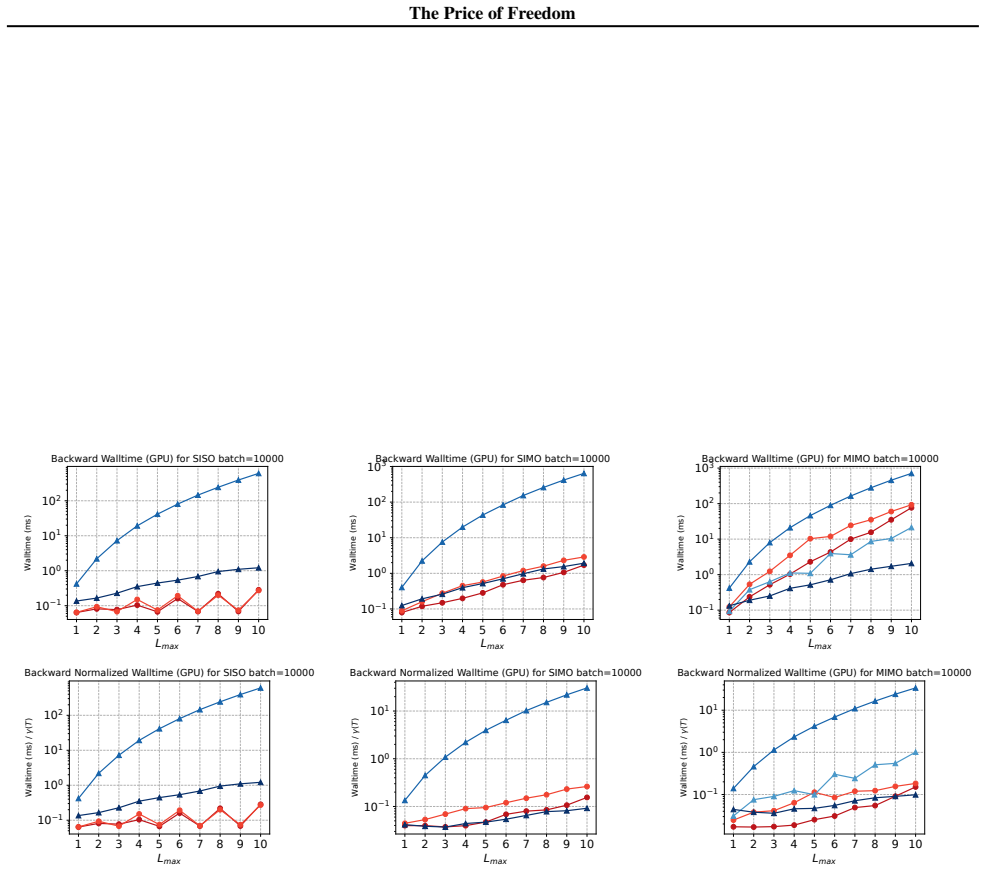
- Asymptotic order does not predict wall-clock behavior: sparse CGTP has the fewest FLOPs but the slowest wall time, while GTP's higher FLOP count is offset by higher GPU utilization.
- The commonly cited $O(L^6)$ cost of CGTP overstates the gap by an order of $L$; exploiting Clebsch-Gordan sparsity gives $O(L^5)$, narrowing the asymptotic gap the $O(L^3)$ alternatives advertise.
Reading between the lines
- A testable extension of the paper's own logic: on tasks dominated by symmetric couplings GTP and MTP should match CGTP accuracy at lower cost, while on tasks with strong antisymmetric coupling they should lag regardless of width; the paper itself concedes the loss can be irrelevant when the missing interactions are not needed.
- If the expressivity proxy is accepted, the practical Pareto frontier is nearly degenerate after normalization, which suggests the next real speedup for equivariant layers will come from faster spherical-harmonic transforms or GPU-native sparse CGTP kernels rather than from new bilinear interaction designs.
- Interactability offers a quick theoretical screen: any proposed tensor product operation can be classified by which irrep triples it permits and how many independent bilinearities it constructs, letting designers check for expressivity loss before writing GPU code.
- The paper's framing implies that benchmarking claims about tensor products should always be paired with an expressivity measure; otherwise a reported speedup may simply be a report of an operation that computes less.
Signed reviews
Editorial analysis
A structured set of objections, weighed in public.
Referee Report
Summary. This paper analyzes the runtime and expressivity tradeoffs of several equivariant tensor product operations (TPOs) used in E(3)-equivariant neural networks: the Clebsch-Gordan tensor product (CGTP), the Gaunt tensor product (GTP), and the matrix tensor product (MTP). It introduces two measures, expressivity (the dimension of the space of constructible bilinear maps, Definition 2.2) and interactability (which irrep triples can interact, Definition 2.3), and uses them to argue that reported asymptotic speedups of GTP and MTP over sparse CGTP come from reduced expressivity. The paper proposes a simplified grid-based implementation of GTP, which it claims is a drop-in replacement for the original Fourier-based GTP and is about 30% faster in practice, and it presents extensive microbenchmarks on GPU and CPU. It also demonstrates experimentally that GTP cannot classify chiral 3D Tetris pieces because it lacks antisymmetric interactions, while CGTP can. The main theoretical findings are summarized in Table 1: after normalizing runtime by the expressivity measure, most TPOs have O(L^2) asymptotic runtime per unit expressivity, with only a variant using fast spherical transforms (S2FFT) achieving O(L log^2 L).
Significance. If the claims hold, this is a useful and timely contribution to the equivariant neural network literature. The paper provides the first systematic comparison of TPOs along both asymptotic and empirical axes, and its emphasis on the distinction between a true tensor product and a TPO clarifies an important conceptual point. The asymptotic analyses in Appendix E are careful, the expressivity and interactability definitions are explicit and mathematically well posed, and the Tetris experiment gives a clean behavioral demonstration of the interactability claims. The grid-based GTP implementation is simple and seems genuinely faster in practice, and the public code release supports reproducibility. The main significance hinges on whether the expressivity proxy is accepted as the right normalization for the headline 'no true speedup' conclusion; this is the central point that needs strengthening.
major comments (2)
- [Definition 2.2; §4 / Table 1] The headline conclusion that 'when normalized for expressivity, most TPOs have the same asymptotics as sparse CGTP' and that GTP/MTP 'do not truly speed up tensor products but rather remove degrees of freedom' relies entirely on Definition 2.2, which measures expressivity as the dimension of the parameterized family of bilinear maps. The paper itself labels this a proxy in Section 2.3, and Section 5.4 concedes that missing interactions may be irrelevant to a task. Moreover, Appendix H and the Tetris experiment (Section 6.2) demonstrate that two TPOs with the same expressivity dimension can have opposite task-level capabilities: for example, a one-path CGTP can realize the pseudoscalar needed for the chiral Tetris task while GTP cannot, even though both have comparable expressivity dimension. As written, the normalized-runtime comparison establishes a statement about a specific parameter-count proxy, not a general statement about practical speed per unit of usable expressivity. Please either scope the conclusion explicitly to this proxy, or provide additional evidence (for example, interactability-weighted counts or a task-based calibration) that supports the stronger practical claim.
- [§6.1 / Appendix E.2.2] The paper calls the grid GTP a 'drop-in replacement' for the Fourier GTP, but I could not find any test of numerical output equivalence. The grid construction replaces exact spherical-harmonic transforms by quadrature (Appendix E.2.2), so the two implementations are not bitwise identical and may differ for finite L and for the chosen quadrature rule. Please report the maximum pointwise or normwise deviation between grid GTP and Fourier GTP on random inputs across a range of L, or provide an error bound derived from the quadrature rule. Without this, the 30% speedup claim is not tied to a demonstrated equivalence of the operation that is being sped up.
minor comments (5)
- [Section 7 / Abstract / Section 6.1] The abstract and Section 6.1 report a 30% speedup for grid GTP, but the conclusion (Section 7) says it 'perfroms 20% faster in practice'; please reconcile the two numbers.
- [Section 2.5] There is a typo in Section 2.5: 'this construction is cheap aaand so we focus' should read 'and'.
- [Section 5.2] Section 5.2 contains the placeholder phrase '(some details about the hardware here)', which should be replaced with an actual hardware description or removed.
- [Appendix L.2] In Appendix L.2, 'we could not colleft hardware-counters for them' should read 'collect'.
- [Table 4 / Appendix E.4] In the caption of Table 4, the phrase 'for output settings' is slightly ambiguous; specifying that the three settings are SISO, SIMO, and MIMO would improve readability.
Circularity Check
No significant circularity: expressivity is a stated modeling definition, runtime analyses are independent, benchmarks are external, and the Tetris experiment provides a behavioral check.
full rationale
The central claims of the paper are built on an explicitly stated proxy, Definition 2.2, which defines expressivity as the dimension of the space of constructible bilinear maps. This is a transparent modeling choice, not a hidden fitted parameter, and the paper does not present it as an empirical prediction. The runtime asymptotics in Table 1 are derived independently in Appendix E from the algebraic structure of each tensor product operation, and the expressivity counts in Appendix F are direct consequences of the same definitions and of known Clebsch-Gordan/Gaunt selection rules. Dividing runtime by expressivity is then arithmetic on these independently obtained quantities. The wall-clock and FLOP benchmarks in Section 5 are external measurements, and the Tetris experiment in Section 6.2 is an independent behavioral test of the interactability claim, showing that GTP's missing antisymmetric path has observable consequences. The paper's self-citations, such as Geiger & Smidt (2022) or Batzner et al. (2022), are contextual references to standard equivariant-network tools and are not load-bearing for the paper's main theoretical or empirical conclusions. The limitation noted in Section 5.4, that reduced expressivity may not matter for tasks that do not need the missing interactions, is an honest qualification rather than a circular rescue. The skeptical concern that dimension is not a perfect measure of task-level capacity is a validity criticism of the proxy, not evidence that the derivation reduces to its own inputs.
Assumptions & free parameters
assumptions (3)
- domain assumption The dimension of the space of constructible bilinear maps is a meaningful proxy for expressivity of a tensor product operation.
- domain assumption The O(L^2)-point spherical grid exactly computes the pointwise product projection for band-limited signals, making grid GTP equivalent to Fourier GTP.
- standard math Schur's lemma and the Clebsch-Gordan and Gaunt coefficient selection rules as stated in the cited literature.
Cite this review
Pith. "Pith review of The Price of Freedom: Exploring Expressivity and Runtime Tradeoffs in Equivariant Tensor Products." pith.science (2026). https://pith.science/paper/6VRR4MV6
@misc{pith2026250613523,
  author       = {Pith},
  title        = {Pith review of: The Price of Freedom: Exploring Expressivity and Runtime Tradeoffs in Equivariant Tensor Products},
  year         = {2026},
  howpublished = {\url{https://pith.science/paper/6VRR4MV6}},
  note         = {Machine review of arXiv:2506.13523}
}
abstract
$E(3)$-equivariant neural networks have demonstrated success across a wide range of 3D modelling tasks. A fundamental operation in these networks is the tensor product, which interacts two geometric features in an equivariant manner to create new features. Due to the high computational complexity of the tensor product, significant effort has been invested to optimize the runtime of this operation. For example, Luo et al. (2024) recently proposed the Gaunt tensor product (GTP) which promises a significant speedup. In this work, we provide a careful, systematic analysis of a number of tensor product operations. In particular, we emphasize that different tensor products are not performing the same operation. The reported speedups typically come at the cost of expressivity. We introduce measures of expressivity and interactability to characterize these differences. In addition, we realized the original implementation of GTP can be greatly simplified by directly using a spherical grid at no cost in asymptotic runtime. This spherical grid approach is faster on our benchmarks and in actual training of the MACE interatomic potential by 30%. Finally, we provide the first systematic microbenchmarks of the various tensor product operations. We find that the theoretical runtime guarantees can differ wildly from empirical performance, demonstrating the need for careful application-specific benchmarking. Code is available at https://github.com/atomicarchitects/PriceofFreedom.
Figures


Figures from the paper (6 more)


Forward citations
Cited by 1 Pith paper
-
Reconstructing local environments from concise atomistic representations
Atomic environments can be recovered from what amounts to dozens of rotation-invariant numbers, and the same inversion reveals new pairs of distinct geometries that the descriptors cannot tell apart.
Reference graph
Works this paper leans on
-
[1]
write newline
" write newline "" before.all 'output.state := FUNCTION n.dashify 't := "" t empty not t #1 #1 substring "-" = t #1 #2 substring "--" = not "--" * t #2 global.max substring 't := t #1 #1 substring "-" = "-" * t #2 global.max substring 't := while if t #1 #1 substring * t #2 global.max substring 't := if while FUNCTION format.date year duplicate empty "emp...
-
[2]
Aykent, S. and Xia, T. Gotennet: Rethinking efficient 3d equivariant graph neural networks. In The Thirteenth International Conference on Learning Representations
-
[3]
Barham, P. and Isard, M. Machine learning systems are stuck in a rut. In Proceedings of the Workshop on Hot Topics in Operating Systems, HotOS '19, pp.\ 177–183, New York, NY, USA, 2019. Association for Computing Machinery. ISBN 9781450367271. doi:10.1145/3317550.3321441. URL https://doi.org/10.1145/3317550.3321441
arXiv 2019
-
[4]
Batatia, I., Kovacs, D. P., Simm, G. N. C., Ortner, C., and Csanyi, G. MACE: Higher Order Equivariant Message Passing Neural Networks for Fast and Accurate Force Fields . In Oh, A. H., Agarwal, A., Belgrave, D., and Cho, K. (eds.), Advances in Neural Information Processing Systems, 2022. URL https://openreview.net/forum?id=YPpSngE-ZU
work page 2022
-
[5]
P., Kornbluth, M., Molinari, N., Smidt, T
Batzner, S., Musaelian, A., Sun, L., Geiger, M., Mailoa, J. P., Kornbluth, M., Molinari, N., Smidt, T. E., and Kozinsky, B. E(3)-equivariant graph neural networks for data-efficient and accurate interatomic potentials . 13, May 2022. URL https://doi.org/10.1038/s41467-022-29939-5
-
[6]
Beentjes, C. H. Quadrature on a spherical surface. Working note available on the website http://people. maths. ox. ac. uk/beentjes/Essays, 2015
work page 2015
-
[7]
An efficient sparse kernel generator for o(3)-equivariant deep networks, 2025
Bharadwaj, V., Glover, A., Buluc, A., and Demmel, J. An efficient sparse kernel generator for o(3)-equivariant deep networks, 2025. URL https://arxiv.org/abs/2501.13986
arXiv 2025
-
[8]
J., Leary, C., Maclaurin, D., Necula, G., Paszke, A., Vander P las, J., Wanderman- M ilne, S., and Zhang, Q
Bradbury, J., Frostig, R., Hawkins, P., Johnson, M. J., Leary, C., Maclaurin, D., Necula, G., Paszke, A., Vander P las, J., Wanderman- M ilne, S., and Zhang, Q. JAX : composable transformations of P ython+ N um P y programs, 2018. URL http://github.com/jax-ml/jax
2018
Show all 50 references
-
[9]
Does equivariance matter at scale?, 2024
Brehmer, J., Behrends, S., de Haan, P., and Cohen, T. Does equivariance matter at scale?, 2024. URL https://arxiv.org/abs/2410.23179
2024 arXiv
-
[10]
Are high-degree representations really unnecessary in equivariant graph neural networks? In The Thirty-eighth Annual Conference on Neural Information Processing Systems
Cen, J., Li, A., Lin, N., Ren, Y., Wang, Z., and Huang, W. Are high-degree representations really unnecessary in equivariant graph neural networks? In The Thirty-eighth Annual Conference on Neural Information Processing Systems
-
[11]
Christensen, A. S. and von Lilienfeld, O. A. On the role of gradients for machine learning of molecular energies and forces, 2020. URL https://arxiv.org/abs/2007.09593
2020 arXiv
-
[12]
G., Mavor-Parker, A
Cobb, O., Wallis, C. G., Mavor-Parker, A. N., Marignier, A., Price, M. A., d'Avezac, M., and McEwen, J. Efficient generalized spherical cnns. In International Conference on Learning Representations
-
[13]
S., Dresselhaus, G., and Jorio, A
Dresselhaus, M. S., Dresselhaus, G., and Jorio, A. Group theory: application to the physics of condensed matter. Springer Science & Business Media, 2007
2007
-
[14]
A., Chou, H.-Y., Stadler, M., Hoehnerbach, M., Wang, T., Lin, D., Kucukbenli, E., Sprueill, H
Firoz, J., Pellegrini, F., Geiger, M., Hsu, D., Bilbrey, J. A., Chou, H.-Y., Stadler, M., Hoehnerbach, M., Wang, T., Lin, D., Kucukbenli, E., Sprueill, H. W., Batatia, I., Xantheas, S. S., Lee, M., Mundy, C., Csanyi, G., Smith, J. S., Sadayappan, P., and Choudhury, S. Optimizi...
2025 arXiv
-
[15]
T., and Muller, K
Frank, T., Unke, O. T., and Muller, K. R. So3krates: Equivariant attention for interactions on arbitrary length-scales in molecular systems. In Advances in Neural Information Processing Systems, 2022
2022
-
[16]
C., Soklaski, R., Axelrod, S., Samsi, S., Gómez-Bombarelli, R., Coley, C
Frey, N. C., Soklaski, R., Axelrod, S., Samsi, S., Gómez-Bombarelli, R., Coley, C. W., and Gadepally, V. Neural scaling of deep chemical models. Nature Machine Intelligence, 5 0 (11): 0 1297--1305, October 2023
2023
-
[17]
A recipe for charge density prediction, 2024
Fu, X., Rosen, A., Bystrom, K., Wang, R., Musaelian, A., Kozinsky, B., Smidt, T., and Jaakkola, T. A recipe for charge density prediction, 2024
2024
-
[18]
Gaunt, J. A. Iv. the triplets of helium. Philosophical Transactions of the Royal Society of London. Series A, Containing Papers of a Mathematical or Physical Character, 228 0 (659-669): 0 151--196, 1929
1929
-
[19]
and Smidt, T
Geiger, M. and Smidt, T. e3nn: Euclidean neural networks. arXiv preprint arXiv:2207.09453, 2022
2022 arXiv
-
[20]
M., Rockmore, D
Healy, D. M., Rockmore, D. N., Kostelec, P. J., and Moore, S. FFTs for the 2-sphere-improvements and variations . Journal of Fourier analysis and applications, 9: 0 341--385, 2003
2003
-
[21]
G., Vignac, C., and Welling, M
Hoogeboom, E., Satorras, V. G., Vignac, C., and Welling, M. Equivariant diffusion for molecule generation in 3d, 2022
2022
-
[22]
Jumper, J., Evans, R., Pritzel, A., Green, T., Figurnov, M., Ronneberger, O., Tunyasuvunakool, K., Bates, R., Z \' dek, A., Potapenko, A., Bridgland, A., Meyer, C., Kohl, S. A. A., Ballard, A. J., Cowie, A., Romera-Paredes, B., Nikolov, S., Jain, R., Adler, J., Back, T., Peter...
2021
-
[23]
N-body networks: a covariant hierarchical neural network architecture for learning atomic potentials, 2018
Kondor, R. N-body networks: a covariant hierarchical neural network architecture for learning atomic potentials, 2018. URL https://arxiv.org/abs/1803.01588
2018 arXiv
-
[24]
Clebsch-gordan nets: a fully fourier space spherical convolutional neural network
Kondor, R., Lin, Z., and Trivedi, S. Clebsch-gordan nets: a fully fourier space spherical convolutional neural network. Advances in Neural Information Processing Systems, 31, 2018
2018
-
[25]
P., Oord, C
Kov \'a cs, D. P., Oord, C. v. d., Kucera, J., Allen, A. E. A., Cole, D. J., Ortner, C., and Cs \'a nyi, G. Linear atomic cluster expansion force fields for organic molecules: Beyond rmse. Journal of Chemical Theory and Computation, 17 0 (12): 0 7696--7711, Dec 2021. ISSN 1549...
2021 doi
-
[26]
Fourcastnet: Accelerating global high-resolution weather forecasting using adaptive fourier neural operators
Kurth, T., Subramanian, S., Harrington, P., Pathak, J., Mardani, M., Hall, D., Miele, A., Kashinath, K., and Anandkumar, A. Fourcastnet: Accelerating global high-resolution weather forecasting using adaptive fourier neural operators. In Proceedings of the Platform for Advanced...
2023
-
[27]
Lebedev, V. I. Quadratures on a sphere. USSR Computational Mathematics and Mathematical Physics, 16 0 (2): 0 10--24, 1976
1976
-
[28]
H., Yadollahpour, P., Watkins, A., Frey, N
Lee, J. H., Yadollahpour, P., Watkins, A., Frey, N. C., Leaver-Fay, A., Ra, S., Cho, K., Gligorijevic, V., Regev, A., and Bonneau, R. Equifold: Protein structure prediction with a novel coarse-grained structure representation. bioRxiv, 2022. doi:10.1101/2022.10.07.511322. URL ...
2022 doi
-
[29]
and Smidt, T
Liao, Y.-L. and Smidt, T. Equiformer: Equivariant graph attention transformer for 3d atomistic graphs. In The Eleventh International Conference on Learning Representations, 2023. URL https://openreview.net/forum?id=KwmPfARgOTD
2023
-
[30]
Luo, S., Chen, T., and Krishnapriyan, A. S. Enabling efficient equivariant operations in the fourier basis via gaunt tensor products. arXiv preprint arXiv:2401.10216, 2024
2024 arXiv
-
[31]
T., and M \"u ller, K.-R
Maennel, H., Unke, O. T., and M \"u ller, K.-R. Complete and efficient covariants for 3d point configurations with application to learning molecular quantum properties. arXiv preprint arXiv:2409.02730, 2024
2024 arXiv
-
[32]
McLaren, A. D. Optimal numerical integration on a sphere. Mathematics of Computation, 17 0 (84): 0 361--383, 1963
1963
-
[33]
J., Kornbluth, M., and Kozinsky, B
Musaelian, A., Batzner, S., Johansson, A., Sun, L., Owen, C. J., Kornbluth, M., and Kozinsky, B. Learning local equivariant representations for large-scale atomistic dynamics. Nature Communications, 14 0 (1): 0 579, 2023
2023
-
[34]
cuequivariance, 2024
NVIDIA. cuequivariance, 2024. URL https://docs.nvidia.com/cuda/cuequivariance/index.html
2024
-
[35]
J., Torrisi, S
Owen, C. J., Torrisi, S. B., Xie, Y., Batzner, S., Bystrom, K., Coulter, J., Musaelian, A., Sun, L., and Kozinsky, B. Complexity of many-body interactions in transition metals via machine-learned force fields from the TM23 data set. Npj Comput. Mater., 10 0 (1), May 2024
2024
-
[36]
and Zitnick, C
Passaro, S. and Zitnick, C. L. Reducing so (3) convolutions to so (2) for efficient equivariant gnns. In International Conference on Machine Learning, pp.\ 27420--27438. PMLR, 2023
2023
-
[37]
A., Tecot, L., Geiger, M., and Smidt, T
Rackers, J. A., Tecot, L., Geiger, M., and Smidt, T. E. A recipe for cracking the quantum scaling limit with machine learned electron densities. Mach. Learn.: Sci. Technol., 4 0 (1): 0 015027, February 2023
2023
-
[38]
Xla : Compiling machine learning for peak performance, 2020
Sabne, A. Xla : Compiling machine learning for peak performance, 2020
2020
-
[39]
High-rank irreducible cartesian tensor decomposition and bases of equivariant spaces
Shao, S., Li, Y., Lin, Z., and Cui, Q. High-rank irreducible cartesian tensor decomposition and bases of equivariant spaces. arXiv preprint arXiv:2412.18263, 2024
2024 arXiv
-
[40]
and Liang, R
Snider, D. and Liang, R. Operator fusion in xla: Analysis and evaluation, 2023. URL https://arxiv.org/abs/2301.13062
2023 arXiv
-
[41]
W., Descoteaux, M
Tan, C. W., Descoteaux, M. L., Kotak, M., de Miranda Nascimento, G., Kavanagh, S. R., Zichi, L., Wang, M., Saluja, A., Hu, Y. R., Smidt, T., Johansson, A., Witt, W. C., Kozinsky, B., and Musaelian, A. High-performance training and inference for deep equivariant interatomic pot...
2025 arXiv
-
[42]
Why the compute throughputs value is different from the actual performance (peak performance)?, 2023
TensorCoreWeight. Why the compute throughputs value is different from the actual performance (peak performance)?, 2023. URL https://forums.developer.nvidia.com/t/why-the-compute-throughputs-value-is-different-from-the-actual-performance-peak-performance/227563/5
2023
-
[43]
Tensor field networks: Rotation- and translation-equivariant neural networks for 3d point clouds, 2018
Thomas, N., Smidt, T., Kearnes, S., Yang, L., Li, L., Kohlhoff, K., and Riley, P. Tensor field networks: Rotation- and translation-equivariant neural networks for 3d point clouds, 2018. URL https://arxiv.org/abs/1802.08219
2018 arXiv
-
[44]
Unke, O. T. and Maennel, H. E3x: E(3) -equivariant deep learning made easy. arXiv preprint arXiv:2401.07595, 2024
2024 arXiv
-
[45]
A., Moskalev, A
Varshalovich, D. A., Moskalev, A. N., and Khersonskii, V. K. Quantum theory of angular momentum. World Scientific, 1988
1988
-
[46]
3d steerable cnns: Learning rotationally equivariant features in volumetric data, 2018
Weiler, M., Geiger, M., Welling, M., Boomsma, W., and Cohen, T. 3d steerable cnns: Learning rotationally equivariant features in volumetric data, 2018. URL https://arxiv.org/abs/1807.02547
2018 arXiv
-
[47]
Fast and accurate spherical harmonics products
Xin, H., Zhou, Z., An, D., Yan, L.-Q., Xu, K., Hu, S.-M., and Yau, S.-T. Fast and accurate spherical harmonics products. ACM Trans. Graph., 40 0 (6): 0 280--1, 2021
2021
-
[48]
Hierarchical roofline analysis: How to collect data using performance tools on intel cpus and nvidia gpus, 2020
Yang, C. Hierarchical roofline analysis: How to collect data using performance tools on intel cpus and nvidia gpus, 2020. URL https://arxiv.org/abs/2009.02449
2020 arXiv
-
[49]
Hierarchical roofline performance analysis for deep learning applications, 2020
Yang, C., Wang, Y., Farrell, S., Kurth, T., and Williams, S. Hierarchical roofline performance analysis for deep learning applications, 2020. URL https://arxiv.org/abs/2009.05257
2020 arXiv
-
[50]
Higher-rank irreducible cartesian tensors for equivariant message passing
Zaverkin, V., Alesiani, F., Maruyama, T., Errica, F., Christiansen, H., Takamoto, M., Weber, N., and Niepert, M. Higher-rank irreducible cartesian tensors for equivariant message passing. In The Thirty-eighth Annual Conference on Neural Information Processing Systems
Reviewed August 15, 2026 · model on record in the stance chip above.
Discussion (0). Continue with ORCID to comment.