REVIEW 5 major objections 4 minor 41 references
Agent Capability Negotiation and Binding Protocol (ACNBP)
T0 review · 5 major / 4 minor · reviewed 2026-08-07 · deepseek-v4-flash
Pith's one-line read This paper proposes a ten-step protocol for secure, verifiable negotiation and binding of agent capabilities.
desk verdict A coherent, well-specified protocol draft whose central security claims rest on a self-authored threat model and deferred formal verification; worth a referee's time as a design proposal, not as a validated result. read the letter →
The pith
A machine-rendered reading of the paper's core claim, the machinery that carries it, and where it could break.
The reading
What carries the argument
The load-bearing mechanism is the ten-step protocol sequence itself, anchored by three formal objects: the capability tuple, the Agent Name Resolution Item in the Agent Name Service, and the signed Capability Binding. The protocolExtension tuple (version, extensions, compatibility) is the designed evolution path: it lets agents supporting different protocol versions or additional features interoperate while the core security logic remains intact. These objects together carry the argument that discovery, negotiation, verification, and commitment can be made explicit, signed, and auditable in a way that earlier announce-bid-award protocols did not provide.
What would settle it
Run the reference implementation of ACNBP with a modified directory service that returns a forged capability record for a provider, and check whether the provider can reach a binding commitment without presenting a valid capability attestation; if the forged record is accepted, the verifiability claim fails.
Extended reading notes
Core claim
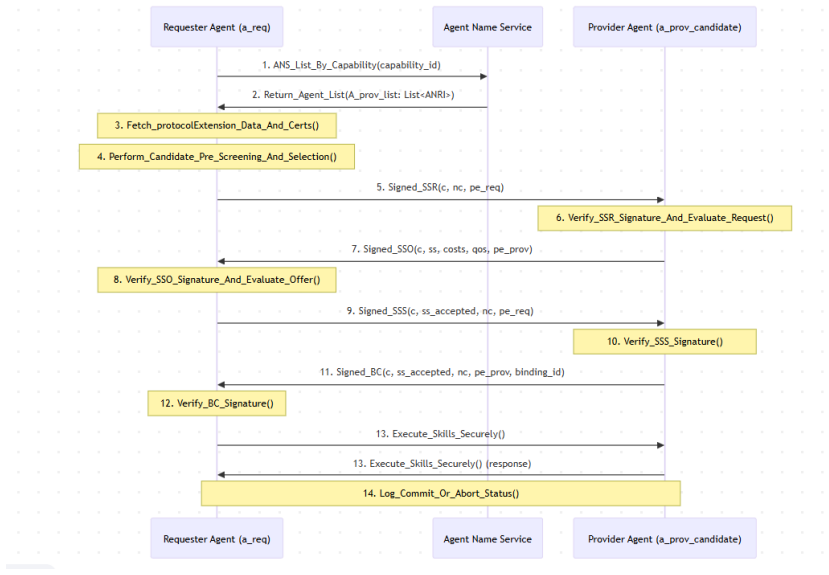
The central claim is that secure agent collaboration can be reduced to a structured negotiation-and-binding pipeline mediated by a name service. The paper specifies ten steps: capability discovery, candidate pre-screening, secure session request, secure session offer, secure session establishment, session agreement or rejection, binding commitment, execution, commit or abort, and distributed commitment update. It defines formal objects for each stage: a capability is a tuple of description, input, output, constraints, and security requirements; an Agent Name Resolution Item is the directory record; and a Capability Binding is a signed agreement between requester and provider. Every message is digitally signed, sessions are encrypted, and capability attestation is supposed to prove that a provider can actually deliver what it advertises. The security argument maps each protocol feature onto the layers of a seven-layer agent threat model rather than offering a formal proof of security.
Load-bearing premise
The security guarantee rests on the completeness of the layered threat model used in the analysis: if that model misses a relevant class of attacks, the claim that ACNBP is secure is not supported.
Editorial extensions
If this is right
- Heterogeneous agents can be composed into workflows at run time, since a requester can find, vet, and bind a provider it has never met using only the directory and signed messages.
- Capability claims stop being self-reports, because a provider must offer attestation and a signed binding commitment before execution, and the audit trail records the outcome.
- The protocol can be adopted incrementally: an agent speaking only the core protocol can still interoperate with agents using extensions, provided the compatibility fields are satisfied.
- Security assessment of an agent system can be structured layer by layer, from ecosystem governance down to model-level input validation, which makes gaps easier to locate.
- Disputes over whether a capability was delivered can be resolved from the signed audit trail rather than by relying on the word of either party.
Reading between the lines
- The paper leaves open how an agent without any prior reputation or certificate gets its first binding; a bootstrapping mechanism would be needed before the protocol can actually start.
- The pre-screening and selection stage is essentially a multi-criteria decision or matching problem, and formalising it as such would let the protocol inherit known results on truthful bidding and market design.
- If the directory service is ever compromised or returns stale capability records, the security of the whole chain degrades to the quality of the directory's integrity checks; the paper treats this as partial trust, not as a solved problem.
- A testable extension would be to measure the overhead of the ten steps in messages, latency, and cryptographic operations against a simple announce-bid-award baseline in a simulated agent market, to see whether the security features remain affordable in practice.
Editorial analysis
A structured set of objections, weighed in public.
Referee Report
Summary. The paper proposes the Agent Capability Negotiation and Binding Protocol (ACNBP), a 10-step framework for capability discovery, negotiation, and binding in heterogeneous multi-agent systems, built on an Agent Name Service (ANS). The protocol is specified through sixteen formal definitions and a step-by-step sequence (Steps 1–10), and the paper argues for its security, efficiency, and verifiability. Evidence offered includes a mapping of the protocol onto the seven layers of the MAESTRO threat-modeling framework (Section VII-I), a document translation walkthrough (Section VI), and a qualitative discussion of implementation considerations (Section VIII). The paper concludes that ACNBP provides a comprehensive solution for secure, verifiable agent collaboration. The protocol specification is internally coherent and the protocolExtension mechanism addresses a real interoperability concern; the open-source schema repository [37] and the detailed walkthrough are useful for practitioners. However, the paper's central claims of security, efficiency, and verifiability are not demonstrated. The "comprehensive security analysis" is a layer-by-layer mapping without concrete adversary models, attack trees, or proven security properties. Formal verification is explicitly deferred (Section X.A), and no experimental evaluation is provided.
Significance. The protocol specification is internally coherent and the protocolExtension mechanism addresses a real interoperability concern; the open-source schema repository [37] and the detailed walkthrough are useful for practitioners. However, the paper's central claims of security, efficiency, and verifiability are not demonstrated. The "comprehensive security analysis" is a layer-by-layer mapping without concrete adversary models, attack trees, or proven security properties. Formal verification is explicitly deferred (Section X.A), and no experimental evaluation is provided. Because the manuscript presents a protocol design rather than a validated system, its contribution is a proposal whose significance depends entirely on future work. If the authors had supplied machine-checked proofs or an independent threat evaluation, the paper would be far stronger; as it stands, the claims exceed the evidence.
major comments (5)
- [VII-I] Section VII-I provides only a qualitative mapping of ACNBP features to the seven MAESTRO layers; it does not define an adversary model, enumerate concrete attacks, or state the security properties (e.g., authentication, confidentiality, non-repudiation) that are to be guaranteed. The abstract's and Section XI's claim that ACNBP is 'secure' is therefore not supported by the analysis. A threat analysis must show that specific attack strategies are defeated by the protocol's message exchanges and verification steps, not merely assert that the protocol has mechanisms in each framework layer.
- [VII-A, Definition 14] Definition 14 defines capability attestation as a 'cryptographically verifiable proof,' and Section VII-A states that ACNBP implements zero-knowledge proofs for capability demonstration, yet no attestation protocol, proof system, or verification algorithm appears anywhere in Steps 1-10. The only cryptographic objects specified are digital signatures in Definitions 11 and in the message tuples of Section III-B. This gap means the 'verifiable' property is asserted but not realized in the protocol specification.
- [X.A] Section X-A explicitly defers 'formal verification of protocol correctness, security property validation' to future work. Since the paper's central contribution is a protocol claimed to be secure and verifiable, this deferral removes the main evidence for the contribution. The conclusion in Section XI that the formal specification provides 'strong theoretical foundations' is not justified without at least a machine-checked proof or a rigorous informal correctness argument.
- [III.B Steps 8-10] The execution and commit/abort phases (Steps 8-10) are under-specified: Step 9 states that a commit or abort decision is made, but does not describe an atomicity protocol, a recovery mechanism, or the compensation procedures that are mentioned. In a distributed multi-agent environment, partial failures and concurrent executions are the norm, so this omission is material to the protocol's correctness. Similarly, Section VIII-E offers optimization strategies but no complexity analysis or measurements, leaving the claim of 'efficiency' unsupported.
- [VII-I, IX.D] The MAESTRO framework [9], [10] is authored by the first author and cited via a blog and a ResearchGate guide, and the protocol depends on the authors' own ANS [4] and MCP-security preprints ([25], [29]) for prerequisites. This self-referential validation chain does not independently establish that ACNBP meets its security goals. Even if MAESTRO were a sound framework, the mapping in Section VII-I is an assertion of coverage, not a validation; an independent threat model or a formal analysis is needed.
minor comments (4)
- [References] Reference [28] is labeled as a placeholder for an anticipated IBM ACP publication; it should be replaced with a real citation or omitted.
- [Figures 4 and 5] The captions for Figures 4 and 5 describe sequence diagrams, but the actual diagrams are not embedded in the manuscript; the figures should be included or the references removed.
- [IV.E] The paper claims a reference implementation and schema files at https://github.com/appsec2008/ACNBP, but no artifact description or version identifier is given, making the claim unverifiable from the manuscript alone.
- [Intellectual Property and Copyright Compliance] The 'Intellectual Property and Copyright Compliance' section is not standard for a research paper and should be removed or moved to an appendix; it does not contribute to technical content.
Circularity Check
Security evaluation rests on a self-authored, unvalidated threat-model framework; the protocol design itself is not circular.
-
self citation load bearing
[Section VII-I (MAESTRO Framework Analysis); Section XI Conclusion; refs [9]-[10]]
"The MAESTRO (Multi-layered Agent Ecosystem Security, Trust, Risk, and Operations) framework [9], [10] provides comprehensive threat modeling for agent systems through seven distinct layers of security analysis: ... The comprehensive security analysis using the MAESTRO framework addresses the full spectrum of threats relevant to agent communication, providing confidence for deployment in trust-critical applications."
The central claim that ACNBP is 'secure' is supported by mapping protocol features onto MAESTRO layers. MAESTRO is not an external standard: ref [9] is a Cloud Security Alliance blog by K. Huang (first author) and ref [10] is an OWASP/ResearchGate guide by K. Huang and A. Sheriff (co-authors). No adversary model, attack tree, or security property is proven; the paper asserts that ACNBP 'implements' protections at each layer. The conclusion that MAESTRO 'addresses the full spectrum of threats' therefore rests entirely on the authors' own unverified framework, rather than on independent validation or formal proof. This makes the security evaluation load-bearing on self-citation.
full rationale
The protocol's 10-step negotiation/binding design is a concrete, self-contained artifact and does not, by itself, reduce to its inputs. However, the paper's principal security claim is not self-contained: Section VII-I validates ACNBP using MAESTRO, a threat-modeling framework authored by the first author (and co-authored by a co-author), cited via a blog and a ResearchGate guide rather than a peer-reviewed or machine-checked source. The layer-by-layer mapping asserts mitigations but does not derive any security property; the paper itself defers 'formal verification of protocol correctness, security property validation' to future work (Section X.A). Additional self-citations (ANS [4]-[6], MCP/A2A security [25],[29]) are used as background or assumptions, but the decisive support for the 'secure and verifiable interactions' claim is the MAESTRO self-citation. This is a partial circularity: the evaluation is not independent of the authors, while the protocol design itself remains an original proposal. Score set to 5 rather than higher because the design is not derived from MAESTRO and no fitted parameter is renamed as a prediction.
Assumptions & free parameters
assumptions (4)
- domain assumption Agents can create cryptographically verifiable capability attestations, including zero-knowledge proofs of capability possession.
- ad hoc to paper MAESTRO framework is an adequate and complete threat model for multi-agent systems.
- domain assumption A distributed, partially trusted ANS infrastructure will be available and provide correct discovery.
- standard math Standard cryptographic primitives (ECC, SHA-3, HMAC, X.509, OCSP) remain secure in the intended deployment.
invented entities (3)
-
Agent Name Resolution Item (ANRI)
-
Capability Binding
-
protocolExtension
Cite this review
Pith. "Pith review of Agent Capability Negotiation and Binding Protocol (ACNBP)." pith.science (2026). https://pith.science/paper/J6PJZPNY
@misc{pith2026250613590,
  author       = {Pith},
  title        = {Pith review of: Agent Capability Negotiation and Binding Protocol (ACNBP)},
  year         = {2026},
  howpublished = {\url{https://pith.science/paper/J6PJZPNY}},
  note         = {Machine review of arXiv:2506.13590}
}
read the original abstract
As multi-agent systems evolve to encompass increasingly diverse and specialized agents, the challenge of enabling effective collaboration between heterogeneous agents has become paramount, with traditional agent communication protocols often assuming homogeneous environments or predefined interaction patterns that limit their applicability in dynamic, open-world scenarios. This paper presents the Agent Capability Negotiation and Binding Protocol (ACNBP), a novel framework designed to facilitate secure, efficient, and verifiable interactions between agents in heterogeneous multi-agent systems through integration with an Agent Name Service (ANS) infrastructure that provides comprehensive discovery, negotiation, and binding mechanisms. The protocol introduces a structured 10-step process encompassing capability discovery, candidate pre-screening and selection, secure negotiation phases, and binding commitment with built-in security measures including digital signatures, capability attestation, and comprehensive threat mitigation strategies, while a key innovation of ACNBP is its protocolExtension mechanism that enables backward-compatible protocol evolution and supports diverse agent architectures while maintaining security and interoperability. We demonstrate ACNBP's effectiveness through a comprehensive security analysis using the MAESTRO threat modeling framework, practical implementation considerations, and a detailed example showcasing the protocol's application in a document translation scenario, with the protocol addressing critical challenges in agent autonomy, capability verification, secure communication, and scalable agent ecosystem management.
Figures


Figures from the paper (1 more)

Reference graph
Works this paper leans on
-
[28]
(placeholder for anticipated ibm acp publication/spec- ification link),
IBM Research, “(placeholder for anticipated ibm acp publication/spec- ification link),” 2025, anticipated Publication
work page 2025
-
[37]
ACNBP Protocol Schema Speci- fications,
ACNBP Development Team, “ACNBP Protocol Schema Speci- fications,” https://github.com/appsec2008/ACNBP/tree/master/schemas/ acnbp, 2025, accessed: June 14, 2025
work page 2025
-
[9]
Agentic AI Threat Modeling Framework: MAESTRO,
K. Huang, “Agentic AI Threat Modeling Framework: MAESTRO,” Cloud Security Alliance Blog, Feb. 2025, accessed: 2025-04-27. [Online]. Available: https://cloudsecurityalliance.org/blog/2025/02/06/ agentic-ai-threat-modeling-framework-maestro
work page 2025
-
[10]
Multi-agentic system threat modelling guide OW ASP GenAI security project,
K. Huang, A. Sheriff, J. Sotiropoulos, R. F. Del, and V . Lu, “Multi-agentic system threat modelling guide OW ASP GenAI security project,” Apr. 2025. [Online]. Available: https://www.researchgate.net/publication/391204915_Multi-Agentic_ system_Threat_Modelling_Guide_OW ASP_GenAI_Security_Project
-
[4]
Agent name service (ans): A universal directory for secure ai agent discovery and interoperability,
H. Ken, V . S. Narajala, I. Habler, and A. Sheriff, “Agent name service (ans): A universal directory for secure ai agent discovery and interoperability,”arXiv preprint arXiv:2505.10609, 2025. [Online]. Available: https://arxiv.org/abs/2505.10609
arXiv 2025
-
[25]
V . S. Narajala and I. Habler, “Enterprise-Grade Security for the Model Context Protocol (MCP): Frameworks and Mitigation Strategies,”arXiv preprint arXiv:2504.08623, 2025. [Online]. Available: https://arxiv.org/abs/2504.08623
arXiv 2025
-
[29]
Building a secure agentic AI application leveraging A2A protocol,
I. Habler, K. Huang, V . S. Narajala, and P. Kulkarni, “Building a secure agentic AI application leveraging A2A protocol,”arXiv preprint arXiv.2504.16902, 2025. [Online]. Available: https://www.arxiv.org/abs/ 2504.16902
arXiv 2025
-
[1]
The contract net protocol: High-level communication and control in a distributed problem solver,
R. G. Smith, “The contract net protocol: High-level communication and control in a distributed problem solver,”IEEE Transactions on Computers, vol. C-29, no. 12, pp. 1104–1113, 1980
work page 1980
Show all 41 references
-
[2]
FIPA Agent Communication Language Specifications,
Foundation for Intelligent Physical Agents (FIPA), “FIPA Agent Communication Language Specifications,” FIPA, Tech. Rep., 2002. [Online]. Available: http://www.fipa.org/repository/aclspecs.html
2002
-
[3]
A novel zero-trust identity framework for agentic ai: Decentralized authentication and fine-grained access control,
H. Ken, V . S. Narajala, and E. al, “A novel zero-trust identity framework for agentic ai: Decentralized authentication and fine-grained access control,”arXiv preprint arXiv:2505.19301, 2025. [Online]. Available: https://arxiv.org/abs/2505.19301
2025 arXiv
-
[5]
Scalable Agent Name Service Architecture for Large-Scale Multi-Agent Systems,
P. Johnson and H. Liu, “Scalable Agent Name Service Architecture for Large-Scale Multi-Agent Systems,” inDistributed Computing Systems Conference, 2024, pp. 445–452
2024
-
[6]
Securing genai multi- agent systems against tool squatting: A zero trust registry-based approach,
V . S. Narajala, k. huang, and I. Habler, “Securing genai multi- agent systems against tool squatting: A zero trust registry-based approach,”arXiv preprint arXiv:2504.19951, 2025. [Online]. Available: https://arxiv.org/abs/2504.19951
2025 arXiv
-
[7]
Domain names - implementation and specification,
P. Mockapetris, “Domain names - implementation and specification,” RFC Editor, RFC 1035, Nov. 1987. [Online]. Available: https: //www.rfc-editor.org/info/rfc1035
1987
-
[8]
DNS-Based Service Discovery,
S. Cheshire and M. Krochmal, “DNS-Based Service Discovery,” RFC Editor, RFC 6763, Feb. 2013. [Online]. Available: https: //www.rfc-editor.org/info/rfc6763
2013
-
[11]
Fipa contract net interaction protocol specification,
Foundation for Intelligent Physical Agents, “Fipa contract net interaction protocol specification,” FIPA, Tech. Rep. FIPA00029, 2002. [Online]. Available: http://www.fipa.org/specs/fipa00029/
2002
-
[12]
Designing a family of coordination algorithms,
K. Decker and V . R. Lesser, “Designing a family of coordination algorithms,” inProceedings of the First International Conference on Multi-Agent Systems. AAAI Press, 1995, pp. 73–80
1995
-
[13]
Bringing semantics to web services with owl-s,
D. Martin, M. Burstein, D. Mcdermott, S. Mcilraith, M. Paolucci, K. Sycara, D. L. McGuinness, E. Sirin, and N. Srinivasan, “Bringing semantics to web services with owl-s,”World Wide Web, vol. 10, no. 3, pp. 243–277, 2007
2007
-
[14]
Integrating applications on the semantic web,
J. Hendler, T. Berners-Lee, and E. Miller, “Integrating applications on the semantic web,”Journal of the Institute of Electrical Engineers of Japan, vol. 122, no. 10, pp. 676–680, 2001
2001
-
[15]
Auctions and bidding: A guide for computer scientists,
S. Parsons, J. A. Rodriguez-Aguilar, and M. Klein, “Auctions and bidding: A guide for computer scientists,”ACM Computing Surveys (CSUR), vol. 43, no. 2, pp. 1–59, 2011
2011
-
[17]
A proposal for a new kqml specification,
Y . Labrou and T. Finin, “A proposal for a new kqml specification,” Autonomous Agents and Multi-Agent Systems, vol. 4, no. 1, pp. 93–108, 1997
1997
-
[18]
Software agents,
M. R. Genesereth and S. P. Ketchpel, “Software agents,”Communica- tions of the ACM, vol. 37, no. 7, pp. 48–53, 1994
1994
-
[19]
Agent theories, architectures, and languages: A survey,
M. Wooldridge and N. R. Jennings, “Agent theories, architectures, and languages: A survey,” inIntelligent Agents. Springer, 2000, pp. 1–39
2000
-
[20]
Agent2Agent (A2A) Protocol Specification,
Agent2Agent Protocol Specification Authors, “Agent2Agent (A2A) Protocol Specification,” https://github.com/google/A2A, 2025, accessed: 2025-04-27
2025
-
[21]
Announcing the Agent2Agent Protocol (A2A),
R. Surapaneni, M. Jha, M. Vakoc, and T. Segal, “Announcing the Agent2Agent Protocol (A2A),” Google for Developers Blog, Apr. 2025, accessed: 2025-04-27. [Online]. Available: https://developers. googleblog.com/en/a2a-a-new-era-of-agent-interoperability/
2025
-
[22]
Model context protocol (MCP),
Anthropic, “Model context protocol (MCP),” https://www.anthropic. com/news/model-context-protocol, 2024, accessed: 2025-04-27
2024
-
[23]
Model Context Proto- col (MCP) Specification,
Model Context Protocol Specification Authors, “Model Context Proto- col (MCP) Specification,” https://modelcontextprotocol.io/specification/ 2025-03-26, Mar. 2025, accessed: 2025-04-27
2025
-
[24]
MCP Introduction,
P. Schmid, “MCP Introduction,” https://www.philschmid.de/ mcp-introduction, 2025, accessed: 2025-04-27
2025
-
[26]
Etdi: Mitigating tool squatting and rug pull attacks in model context protocol (mcp) by using oauth-enhanced tool definitions and policy-based access control,
M. Bhatt, V . S. Narajala, and I. Habler, “Etdi: Mitigating tool squatting and rug pull attacks in model context protocol (mcp) by using oauth-enhanced tool definitions and policy-based access control,”arXiv preprint arXiv:2506.01333, 2025. [Online]. Available: https://arxiv.o...
2025 arXiv
-
[27]
Agent Communication Pro- tocol: A Modern Approach to Multi-Agent Interaction,
M. Zhang, S. Kumar, and A. Rodriguez, “Agent Communication Pro- tocol: A Modern Approach to Multi-Agent Interaction,”Journal of Artificial Intelligence Research, vol. 68, pp. 123–156, 2025
2025
-
[30]
Distributed Reputation Systems for Multi- Agent Environments,
S. Davis and J. Thompson, “Distributed Reputation Systems for Multi- Agent Environments,”Autonomous Agents and Multi-Agent Systems, vol. 38, no. 2, pp. 167–189, 2024
2024
-
[31]
Internet x.509 public key infrastructure certificate and certificate revocation list (crl) profile,
D. Cooper, S. Santesson, S. Farrell, S. Boeyen, R. Housley, and W. Polk, “Internet x.509 public key infrastructure certificate and certificate revocation list (crl) profile,” RFC Editor, RFC 5280, May
-
[32]
X.509 Internet Public Key Infrastructure Online Certificate Status Protocol - OCSP,
S. Santesson, M. Myers, R. Ankney, A. Malpani, S. Galperin, and C. Adams, “X.509 Internet Public Key Infrastructure Online Certificate Status Protocol - OCSP,” RFC Editor, RFC 6960, Jun. 2013. [Online]. Available: https://www.rfc-editor.org/info/rfc6960
2013
-
[33]
The javascript object notation (JSON) data interchange format,
E. T. Bray, “The javascript object notation (JSON) data interchange format,” RFC Editor, RFC 7159, Mar. 2014. [Online]. Available: https://www.rfc-editor.org/info/rfc7159
2014
-
[34]
FATA: A Framework-Agnostic, Task-Agnostic Agentic AI Platform for Serverless Multi-Agent Orchestration,
A. Sheriff, “FATA: A Framework-Agnostic, Task-Agnostic Agentic AI Platform for Serverless Multi-Agent Orchestration,” 2025
2025
-
[35]
Zero-Knowledge Proofs for Agent Capability Verification,
T. Wilson and R. Patel, “Zero-Knowledge Proofs for Agent Capability Verification,” inCryptography and Security Symposium, 2025, pp. 78– 85
2025
-
[36]
Regulatory Compliance Frameworks for Agent Com- munication in Financial Services,
R. Milleret al., “Regulatory Compliance Frameworks for Agent Com- munication in Financial Services,”Financial Technology and Regulation, vol. 7, no. 1, pp. 45–62, 2025
2025
-
[38]
LLM and GenAI data security best practices,
E. G. Junior, S. Clinton, C. Hughes, V . S. Narajala, and T. Holmes, “LLM and GenAI data security best practices,” Feb. 2025. [Online]. Available: https://www.researchgate.net/publication/391204648_LLM_ and_GenAI_Data_Security_Best_Practices
2025
-
[39]
Blockchain Integration for Agent Capa- bility Verification and Payment Processing,
M. Garcia and C. Anderson, “Blockchain Integration for Agent Capa- bility Verification and Payment Processing,” inBlockchain Technology Conference, 2025, pp. 112–119
2025
-
[40]
Lightweight Agent Communication Protocols for IoT and Edge Computing,
J. Lee and Y . Kim, “Lightweight Agent Communication Protocols for IoT and Edge Computing,”Internet of Things Journal, vol. 11, no. 4, pp. 234–248, 2024
2024
-
[2008]
Available: https://www.rfc-editor.org/info/rfc5280
[Online]. Available: https://www.rfc-editor.org/info/rfc5280
-
[2025]
Available: https://arxiv.org/abs/2506.01900
[Online]. Available: https://arxiv.org/abs/2506.01900
Reviewed August 7, 2026 · model on record in the stance chip above.
Discussion (0). Sign in to comment.