REVIEW 5 major objections 5 minor 50 references
Personalized Constitutionally-Aligned Agentic Superego: Secure AI Behavior Aligned to Diverse Human Values
T0 review · 5 major / 5 minor · reviewed 2026-08-07 · deepseek-v4-flash
Pith's one-line read A modular 'superego' guardrail checks each proposed agent action against a universal safety floor and user-chosen constitutions before execution, and on benchmark tests cuts harm by up to 98.3% and raises harmful-prompt refusals to…
desk verdict A real prototype with a plausible architecture, but the headline harm-reduction numbers depend on an unnamed LLM judge, and the personalization feature that is actually novel is never benchmarked. read the letter →
The pith
A machine-rendered reading of the paper's core claim, the machinery that carries it, and where it could break.
The reading
What carries the argument
The load-bearing mechanism is the hierarchical enforcement loop of Algorithm 1: every proposed action is first checked against the Universal Ethical Floor (UEF), a non-negotiable safety baseline; only if that passes are the user-selected constitutions applied, each with a dialable 1–5 adherence level. The compliance enforcer then emits one of four verdicts—Allow, Block, Modify with a compliant alternative, or Request Clarification. Constitutions are delivered to the agent at runtime through the Model Context Protocol, so the rule set is external, versionable, and shareable rather than baked into weights.
What would settle it
Run the same superego configuration against a jailbreak suite generated after the UEF was frozen, using an inner agent explicitly optimized to produce plans that are harmful but phrased in the constitution's own language; if harm scores return to baseline levels, the classification premise that carries the architecture fails.
Extended reading notes
Core claim
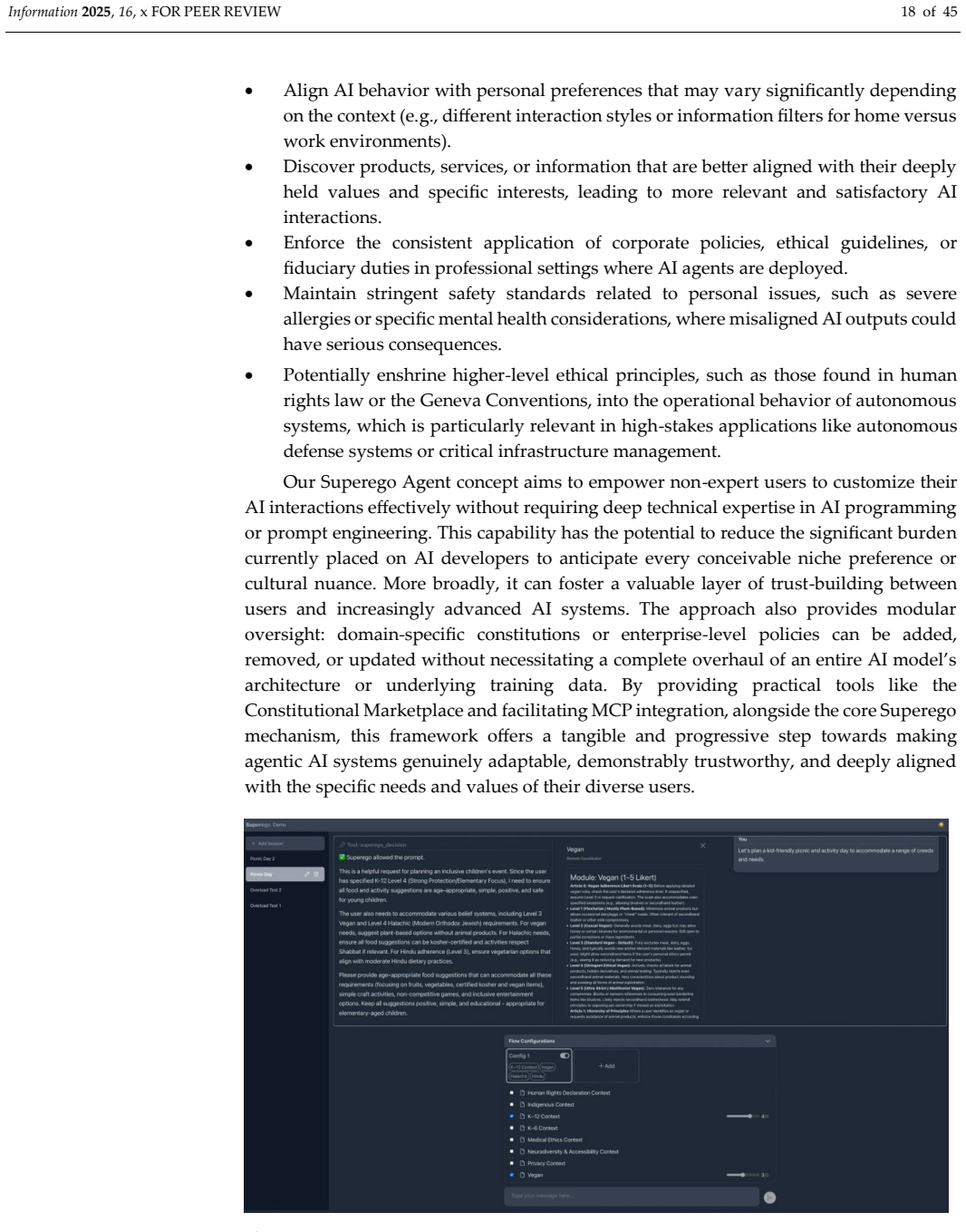
On the paper's own terms, the discovery is that a modular, externally enforced constitutional layer can steer existing LLM agents toward safer and more personalized behavior with no change to the base model. Even configured with only the universal floor, the superego reduces HarmBench attack success rates substantially across several inner models and, on AgentHarm's harmful set, brings average refusal rates to 99.4% for one leading model and 100% for another. The same mechanism is what lets a user apply a vegan, Halachic, or K-12 constitution: the compliance enforcer evaluates the inner agent's plan against the selected rules and the user's 1–5 adherence dial before execution.
Load-bearing premise
The approach depends on the LLM doing the superego's judging being able to correctly tell whether a proposed plan violates the hand-written rules; the paper does not specify which model performs this judgment or show that its judgments generalize, and it admits that a weaker judge can be outmaneuvered by a cleverer inner agent.
Editorial extensions
If this is right
- Existing agentic systems can be retrofitted with a stronger safety and personalization layer without retraining or altering the underlying model.
- Personalization shifts from prompt engineering to selecting, forking, and dialing constitutions, lowering the technical burden on non-expert users.
- The non-negotiable Universal Ethical Floor prevents personalization from sliding into moral relativism, since it takes priority over every user-selected rule.
- If the benchmark results hold, harmful outputs on tested adversarial and agentic suites can be reduced to near-total refusal levels, while targeted tuning can keep genuine false positives near baseline rates.
Reading between the lines
- Beyond the paper's own experiments, the same pre-execution checkpoint could double as an auditable compliance log for regulated deployments, since every plan carries a recorded allow/block/modify verdict and a reason.
- A marketplace of shared constitutions will need an explicit arbitration mechanism for conflicts between constitutions at different adherence levels; the paper sketches weights and thresholds but leaves the resolution algorithm unspecified.
- The architecture's ceiling is set by the judge model's capability: if a sufficiently clever inner agent can hide harmful intent from the judge, the guardrail becomes cosmetic, so the most decisive extension is measuring judge-versus-agent capability gaps.
- The mechanism could be extended beyond natural-language outputs to tool calls, potentially catching patterns like tool poisoning or data exfiltration that look benign as text but dangerous as API invocations.
Editorial analysis
A structured set of objections, weighed in public.
Referee Report
Summary. The manuscript proposes an external 'Superego Agent' oversight layer for agentic LLMs: a compliance enforcer intercepts inner-agent plans and checks them against a Universal Ethical Floor plus user-selected, dialable 'Creed Constitutions,' with a prototype exposed via the Model Context Protocol and a constitutional marketplace. The authors report large safety gains on HarmBench and AgentHarm, including a 98.29% harm-score reduction for Gemini 2.5 Flash and refusal rates of 96.6-100% for Claude Sonnet 4, and claim a novel framework for personalized alignment.
Significance. If the benchmark results were reproducible, the paper would make a useful practical contribution: an external guardrail that enforces a universal safety floor while allowing user-level personalization would be model-agnostic and deployable without retraining. Strengths include a working prototype, MCP integration, use of established external benchmarks (HarmBench, AgentHarm), and a candid discussion of governance and limitations. However, the central quantitative claims are currently not reproducible because the judge model is unnamed, and the headline numbers disagree with the final tuned configuration.
major comments (5)
- [Abstract and Section 5.4.2] The abstract's claim of '100% with Claude Sonnet 4 on AgentHarm's harmful set' is contradicted by the final configuration reported in Section 5.4.2, which gives a 96.6% harmful-prompt refusal rate after the iterative refinement. Because the refinement occurred after the 100% result, the final configuration is the one that should be reported; the abstract, the body text, and Table 6 must be reconciled so that all headline numbers refer to the same final system.
- [Section 3.3.1, Algorithm 1 and Section 5.4] The load-bearing predicate violates(proposed_action, rule) is never instantiated. The paper does not name the LLM that implements the Superego compliance enforcer, its version, decoding parameters, or its agreement with human judgments on the benchmark items. Section 6.4 explicitly concedes that a substantially less capable Superego can be outmaneuvered, so the reported 98.3% harm-score reduction cannot be attributed to the architecture unless the judge model is specified and its classification behavior is characterized.
- [Section 5.4.2] The two-round iterative refinement of the Superego prompt and UEF on AgentHarm's benign set means the reported numbers are a joint product of judge capability, hand-written rules, and benchmark-specific calibration. The paper asserts that the revisions were universally applicable rather than benchmark-specific gaming, but no held-out evaluation, pre-registered protocol, or development/test split supports this. Please report the exact revision log and evaluate the final configuration on a separate benign or false-positive benchmark to demonstrate generalization.
- [Section 5.4.1, Table 5] The HarmBench reporting is too loose for the headline claim: prompt counts are approximate ('~120 (approx.)'), processed counts differ between baseline and Superego conditions (3972 vs 3938) without explanation, and one harmful output is reclassified as a false positive by the authors based on their own judgment. Report exact counts, standard API settings, unmodified classifier verdicts, and paired statistics or confidence intervals so the reductions can be independently verified.
- [Sections 5.1 and 5.4] The quantitative evaluation tests only the UEF, not user-selected Creed Constitutions, adherence levels, or conflict resolution, despite the paper's title and stated contribution of personalized alignment. The two experiments described in Section 5.1 are not reported as executed studies. Either add experiments with at least one non-trivial constitution and different adherence levels, or explicitly limit the empirical claims to the UEF-only safety-floor setting.
minor comments (5)
- [Section 3.1] The sentence 'There are at least two distinct paths to realizing this concept of a personalized superego agent' appears twice within a few paragraphs; one occurrence should be removed.
- [Section 5.4.2] The qualitative review of 'benign' set refusals is repeated nearly verbatim for the intermediate tuning stage and again for the final stage; please consolidate to avoid duplication and clarify which numbers correspond to which stage.
- [Section 5.4.3] The phrase 'logged as per Figures 1 and 3' is incorrect because Figures 1 and 3 are architecture and data-flow diagrams, not reasoning logs; please cite the actual figure or supplementary material containing the reasoning example.
- [Table 5] The table uses '~120 (approx.)' and inconsistent decimal places (0.7% vs 0.025%) without clear conventions; make the table self-contained and provide exact denominators for every row.
- [Section 5.3] The 'poemtest' observation is reported as 'emergent agent resistance' and 'intuitive suspicion,' but no experimental protocol or replication evidence is given; please label this as an anecdotal observation and note that it is not a controlled result.
Circularity Check
No significant circularity: the benchmark results are measured against external suites with an independent harm classifier, and the self-citations do not carry the empirical claim.
full rationale
The paper's central empirical claim is evaluated against external benchmarks (HarmBench and AgentHarm) using an independent harm classifier, so the reported harm-score reductions and refusal rates are not defined by the inputs. The Superego is given a Universal Ethical Floor that says to refuse harmful content, but whether an LLM-based judge correctly applies that constitution to benchmark prompts is an empirical outcome, not a tautology. The self-citations ([6], [7], [11]) motivate the UEF and personalization concept but are not load-bearing for the quantitative benchmark results. The strongest concerns are reproducibility and generalizability, not circularity: Section 5.4.2 describes two rounds of prompt/UEF tuning on AgentHarm's benign set before reporting final harmful-set numbers, and Algorithm 1's core violates() predicate is implemented by an unnamed LLM whose capability is conceded in Section 6.4 ('A substantially less capable Superego risks being outmaneuvered'). These are serious evaluation-validity issues, but they do not amount to a circular derivation: no equation or reported quantity is shown to equal its own input by construction, and the benchmark outcomes remain externally falsifiable.
Assumptions & free parameters
free parameters (3)
- Universal Ethical Floor (UEF) rule text =
not disclosed
- Superego system prompt =
not disclosed (two-plus revisions)
- Adherence level scale (1-5) =
1-5 Likert (design choice)
assumptions (4)
- domain assumption A prompted LLM can reliably interpret natural-language rules and detect violations in proposed plans.
- domain assumption HarmBench's Llama-2-13B classifier and AgentHarm's scoring correctly measure harmfulness.
- ad hoc to paper The UEF is a sufficient universal ethical baseline.
- domain assumption The inner agent's proposed plans and chain-of-thought are legible to the Superego.
invented entities (4)
-
Superego Agent
independent evidence
-
Creed Constitution
independent evidence
-
Universal Ethical Floor (UEF)
-
Constitutional Marketplace
Cite this review
Pith. "Pith review of Personalized Constitutionally-Aligned Agentic Superego: Secure AI Behavior Aligned to Diverse Human Values." pith.science (2026). https://pith.science/paper/MBIIOPUF
@misc{pith2026250613774,
  author       = {Pith},
  title        = {Pith review of: Personalized Constitutionally-Aligned Agentic Superego: Secure AI Behavior Aligned to Diverse Human Values},
  year         = {2026},
  howpublished = {\url{https://pith.science/paper/MBIIOPUF}},
  note         = {Machine review of arXiv:2506.13774}
}
read the original abstract
Agentic AI systems, possessing capabilities for autonomous planning and action, show great potential across diverse domains. However, their practical deployment is hindered by challenges in aligning their behavior with varied human values, complex safety requirements, and specific compliance needs. Existing alignment methodologies often falter when faced with the complex task of providing personalized context without inducing confabulation or operational inefficiencies. This paper introduces a novel solution: a 'superego' agent, designed as a personalized oversight mechanism for agentic AI. This system dynamically steers AI planning by referencing user-selected 'Creed Constitutions' encapsulating diverse rule sets -- with adjustable adherence levels to fit non-negotiable values. A real-time compliance enforcer validates plans against these constitutions and a universal ethical floor before execution. We present a functional system, including a demonstration interface with a prototypical constitution-sharing portal, and successful integration with third-party models via the Model Context Protocol (MCP). Comprehensive benchmark evaluations (HarmBench, AgentHarm) demonstrate that our Superego agent dramatically reduces harmful outputs -- achieving up to a 98.3% harm score reduction and near-perfect refusal rates (e.g., 100% with Claude Sonnet 4 on AgentHarm's harmful set) for leading LLMs like Gemini 2.5 Flash and GPT-4o. This approach substantially simplifies personalized AI alignment, rendering agentic systems more reliably attuned to individual and cultural contexts, while also enabling substantial safety improvements. An overview on this research with examples is available at https://superego.creed.space.
Figures


Figures from the paper (2 more)

Reference graph
Works this paper leans on
-
[1]
Artificial Intelligence, Values, and Alignment
Gabriel, I. Artificial Intelligence, Values, and Alignment. Minds Mach. 2020, 30, 411–437
work page 2020
-
[2]
Artificial Morality: Top -down, Bottom-up, and Hybrid Approaches
Allen, C.; Smit, I.; Wallach, W. Artificial Morality: Top -down, Bottom-up, and Hybrid Approaches. Ethics Inf. Technol. 2005, 7, 149–155
work page 2005
-
[3]
Translating Principles into Practices of Digital Ethics: Five Risks of Being Unethical
Floridi, L. Translating Principles into Practices of Digital Ethics: Five Risks of Being Unethical. Philos. Technol. 2019, 32, 185–193
work page 2019
-
[4]
Open Problems and Fundamental Limitations of Reinforcement Learning from Human Feedback
Casper, S.; Davies, X.; Shi, C.; Gilbert, T.K.; Scheurer, J.; Rando, J.; Freedman, R.; Korbak, T.; Lindner, D.; Freire, P.; e t al. Open Problems and Fundamental Limitations of Reinforcement Learning from Human Feedback. arXiv 2023, https://arxiv.org/abs/2307.15217
arXiv 2023
-
[5]
Personalized Large Language Models
Woźniak, S.; Koptyra, B.; Janz, A.; Kazienko, P.; Kocoń, J. Personalized Large Language Models. arXiv 2024, https://arxiv.org/abs/2402.09269
arXiv 2024
-
[6]
Towards an End -to-End Personal Fine -Tuning Framework for AI Value Alignment
Watson, E.; Viana, T.; Sturgeon, B.; Petersson, L.; Zhang, S. Towards an End -to-End Personal Fine -Tuning Framework for AI Value Alignment. Electronics 2024, 13, 4044
work page 2024
-
[7]
Watson, N.; Hessami, A. Safer Agentic AI. SaferAgenticAI.org. Available online: https://www.saferagenticai.org (accessed on 18 July 2025)
work page 2025
-
[8]
Introducing the Model Context Protocol
Anthropic. Introducing the Model Context Protocol. Available online: https://www.anthropic.com/news/model -context- protocol (accessed on 28 May 2025)
work page 2025
Show all 50 references
-
[9]
Deep Reinforcement Learning from Human Preferences
Christiano, P.; Leike, J.; Brown, T.B.; Martic, M.; Legg, S.; Amodei, D. Deep Reinforcement Learning from Human Preferences. Adv. Neural Inf. Process. Syst. 2017, 30, 1–9
2017
-
[10]
Confabulation: The Surprising Value of Large Language Model Hallucinations
Sui, P.; Duede, E.; Wu, S.; So, R.J. Confabulation: The Surprising Value of Large Language Model Hallucinations. arXiv 2024, https://arxiv.org/abs/2406.04175
2024 arXiv
-
[11]
Choice Vectors: Streamlining Personal AI Alignment Through Binary Selection
Watson, E.; Nguyen, M.; Pan, S.; Zhang, S. Choice Vectors: Streamlining Personal AI Alignment Through Binary Selection. Multimodal Technol. Interact. 2025, 9, 22
2025
-
[12]
Freud, S. (1923). The Ego and the Id. In J. Strachey (Ed. & Translator), The Standard Edition of the Complete Psychological Works of Sigmund Freud; The Ego and the Id and Other Works (Vol. XIX, pp. 1–66). London: Hogarth Press and the Institute of Psycho-Analysis, 1953–1974
1923
-
[13]
Universality of Representation in Biologic al and Artificial Neural Networks
Hosseini, E.; Casto, C.; Zaslavsky, N.; Conwell, C.; Richardson, M.; Fedorenko, E. Universality of Representation in Biologic al and Artificial Neural Networks. bioRxiv 2024, https://doi.org/10.1101/2024.12.26.629294
2024 doi
-
[14]
The neural bases of cognitive conflict and control in mo ral judgment
Greene, J.D.; Nystrom, L.E.; Engell, A.D.; Darley, J.M.; Cohen, J.D. The neural bases of cognitive conflict and control in mo ral judgment. Neuron 2004, 44, 389–400
2004
-
[15]
The neural basis of human social values: Evidence from functional MRI
Zahn, R.; Moll, J.; Paiva, M.; Garrido, G.; Krueger, F.; Huey, E.D.; Grafman, J. The neural basis of human social values: Evidence from functional MRI. Cereb. Cortex 2009, 19, 276–283
2009
-
[16]
A Cognitive Theory of Consciousness: The Workspace of the Mind; Cambridge University Press: Cambridge, UK, 1988
Baars, B.J. A Cognitive Theory of Consciousness: The Workspace of the Mind; Cambridge University Press: Cambridge, UK, 1988
1988
-
[17]
Unified Theories of Cognition; Harvard University Press: Cambridge, MA, USA, 1990
Newell, A. Unified Theories of Cognition; Harvard University Press: Cambridge, MA, USA, 1990
1990
-
[18]
Revealing economic facts: LLMs know more than they say
Buckmann, M.; Nguyen, Q.A.; Hill, E. Revealing economic facts: LLMs know more than they say. arXiv 2025, https://arxiv.org/abs/2505.08662
2025
-
[19]
Zeng, W.; Kurniawan, D.; Mullins, R.; Liu, Y.; Saha, T.; Ike -Njoku, D.; Gu, J.; Song, Y.; Xu, C.; Zhou, J. et al. ShieldGemma 2: Robust and tractable image content moderation. arXiv 2025, https://arxiv.org/bs/2504.01081
2025 arXiv
-
[20]
Superego -Agent LGDemo (Branch: Fastapi_Mcp)
Superego GitHub. Superego -Agent LGDemo (Branch: Fastapi_Mcp). GitHub, 2025. Available online: https://github.com/Superego-Agent/superego-lgdemo/tree/fastapi_mcp (accessed on 16 July 2025)
2025
-
[21]
HarmBench: A standardized evaluation framework for automated red teaming and robust refusal
Mazeika, M.; Phan, L.; Yin, X.; Zou, A.; Wang, Z.; Mu, N.; Sakhaee, E.; Li, N.; Basart, S.; Li, B.; et al. HarmBench: A standardized evaluation framework for automated red teaming and robust refusal. arXiv 2024, https://doi.org/10.48550/arXiv.2402.04249
-
[22]
AgentHarm: A benchmark for measuring harmfulness of LLM agents
Andriushchenko, M.; Souly, A.; Dziemian, M.; Duenas, D.; Lin, M.; Wang, J.; Hendrycks, D.; Zou, A.; Kolter, Z.; Fredrikson, M.; et al. AgentHarm: A benchmark for measuring harmfulness of LLM agents. In Proceedings of the International Conference on Learning Representations (IC...
2025
-
[23]
Do the rewards justify the means? Measuring trade -offs between rewards and ethical behavior in the Machiavelli benchmark
Pan, A.; Chan, J.S.; Zou, A.; Li, N.; Basart, S.; Woodside, T.; Ng, J.; Zhang, H.; Emmons, S.; Hendrycks, D. Do the rewards justify the means? Measuring trade -offs between rewards and ethical behavior in the Machiavelli benchmark. In Proceedings of the International Conferenc...
2023
-
[24]
Who validates the validators? Aligning LLM-assisted evaluation of LLM outputs with human preferences
Shankar, S.; Zamfirescu -Pereira, J.D.; Hartmann, B.; Parameswaran, A.G.; Arawjo, I. Who validates the validators? Aligning LLM-assisted evaluation of LLM outputs with human preferences. arXiv 2024, https://doi.org/10.48550/arXiv.2404.12272
-
[25]
Vijil Test Library: Evaluating LLM Trustworthiness Across Eight Dimensions
Vijil, Inc. Vijil Test Library: Evaluating LLM Trustworthiness Across Eight Dimensions. Available online: https://docs.vijil.ai/tests-library/index.html (accessed on 20 May 2025). Information 2025, 16, x FOR PEER REVIEW 44 of 45
2025
-
[26]
INSPECT: An Extensible Toolkit for AI Behavior Evaluation
AI Safety Institute. INSPECT: An Extensible Toolkit for AI Behavior Evaluation. Available online: https://inspect.aisi.org.uk (accessed on 20 May 2025)
2025
-
[27]
Governance in Agentic Workflows: Leveraging LLMs as Oversight Agents
Nasim, I. Governance in Agentic Workflows: Leveraging LLMs as Oversight Agents. OpenReview, 2025. Available online: https://openreview.net/forum?id=fP02TFDJh8 (accessed on 18 July 2025)
2025
-
[28]
Controllable Safety Alignment: Inference-Time Adaptation to Diverse Safety Requirements
Zhang, J.; Elgohary, A.; Magooda, A.; Khashabi, D.; Van Durme, B. Controllable Safety Alignment: Inference-Time Adaptation to Diverse Safety Requirements. arXiv 2024, https://arxiv.org/abs/2410.08968
2024 arXiv
-
[29]
Disentangled Safety Adapters Enable Efficient Guardrails and Flexible Inference-Time Alignment
Krishna, K.; Cheng, J.Y.; Maalouf, C.; Gatys, L.A. Disentangled Safety Adapters Enable Efficient Guardrails and Flexible Inference-Time Alignment. arXiv 2025, https://arxiv.org/abs/2506.00166
2025 arXiv
-
[30]
InferAligner: Inference -Time Alignment for Harmlessness through Cross-Model Guidance
Wang, P.; Zhang, D.; Li, L.; Tan, C.; Wang, X.; Ren, K.; Jiang, B.; Qiu, X. InferAligner: Inference -Time Alignment for Harmlessness through Cross-Model Guidance. arXiv 2024, https://arxiv.org/abs/2401.11206
2024 arXiv
-
[31]
Almost Surely Safe Alignment of Large Language Models at Inference-Time
Ji, X.; Ramesh, S.S.; Zimmer, M.; Bogunovic, I.; Wang, J.; Bou Ammar, H. Almost Surely Safe Alignment of Large Language Models at Inference-Time. arXiv 2025, https://arxiv.org/abs/2502.01208
2025 arXiv
-
[32]
Dynamic Search for Inference-Time Alignment in Diffusion Models (DSearch)
Li, X.; Uehara, M.; Su, X.; Scalia, G.; Biancalani, T.; Regev, A.; Levine, S.; Ji, S. Dynamic Search for Inference-Time Alignment in Diffusion Models (DSearch). arXiv 2025, https://arxiv.org/abs/2503.02039
2025 arXiv
-
[33]
Constit utional Classifiers: Defending against Universal Jailbreaks across Thousands of Hours of Red Teaming
Sharma, M.; Tong, M.; Mu, J.; Wei, J.; Kruthoff, J.; Goodfriend, S.; Ong, E.; Peng, A.; Agarwal, R.; Anil, C.; et al. Constit utional Classifiers: Defending against Universal Jailbreaks across Thousands of Hours of Red Teaming. arXiv 2025, https://arxiv.org/abs/2501.18837
2025 arXiv
-
[34]
Constitutional AI: Harmlessness from AI Feedback
Bai, Y.; Kadavath, S.; Kundu, S.; Askell, A.; Kernion, J.; Jones, A.; Chen, A.; Goldie, A.; Mirhoseini, A.; McKinnon, C.; et al. Constitutional AI: Harmlessness from AI Feedback. arXiv 2022, https://arxiv.org/abs/2212.08073
2022 arXiv
-
[35]
T raining a Helpful and Harmless Assistant with Reinforcement Learning from Human Feedback
Bai, Y.; Jones, A.; Ndousse, K.; Askell, A.; Chen, A.; DasSarma, N.; Drain, D.; Fort, S.; Ganguli, D.; Henighan, T.; et al. T raining a Helpful and Harmless Assistant with Reinforcement Learning from Human Feedback. arXiv 2022, https://arxiv.org/abs/2204.05862
2022 arXiv
-
[36]
Monitoring Reasoning Models for Misbehavior and the Risks of Promoting Obfuscation
Baker, B.; Huizinga, J.; Madry, A.; Zaremba, W.; Pachocki, J.; Farhi, D. Monitoring Reasoning Models for Misbehavior and the Risks of Promoting Obfuscation. OpenAI, 2025. Available online: https://openai.com/index/chain -of-thought-monitoring (accessed on 12 March 2025)
2025
-
[37]
AI Control: Improving Safety Despite Intentional Subversion
Greenblatt, R.; Shlegeris, B.; Sachan, K.; Roger, F. AI Control: Improving Safety Despite Intentional Subversion. arXiv 2024, https://arxiv.org/abs/2312.06942
2024 arXiv
-
[38]
OpenAI x DFT: The First Moral Graph
Edelman, J.; Klingefjord, O. OpenAI x DFT: The First Moral Graph. Meaning Alignment Institute, 2023. Available online: https://meaningalignment.substack.com/p/the-first-moral-graph (accessed on 12 March 2025)
2023
-
[39]
Model Integrity
Edelman, J.; Klingefjord, O. Model Integrity. Meaning Alignment Institute, 2024. Available online: https://meaningalignment.substack.com/p/model-integrity (accessed on 18 July 2025)
2024
-
[40]
The Global Landscape of AI Ethics Guidelines
Jobin, A.; Ienca, M.; Vayena, E. The Global Landscape of AI Ethics Guidelines. Nat. Mach. Intell. 2019, 1, 389–399
2019
-
[41]
WhatsApp MCP Exploited: Exfiltrating Your Message History via MCP
Beurer-Kellner, L.; Fischer, M. WhatsApp MCP Exploited: Exfiltrating Your Message History via MCP. Invariant Labs Blog
-
[42]
MCP Security Notification: Tool Poisoning Attacks
Beurer-Kellner, L.; Fischer, M. MCP Security Notification: Tool Poisoning Attacks. Invariant Labs Blog. 2025. Available online: https://invariantlabs.ai/blog/mcp-security-notification-tool-poisoning-attacks (accessed on 12 March 2025)
2025
-
[43]
Emergent misalignment: Narrow finetuning can produce broadly misaligned LLMs
Betley, J.; Tan, D.; Warncke, N.; Sztyber -Betley, A.; Bao, X.; Soto, M.; Labenz, N.; Evans, O. Emergent misalignment: Narrow finetuning can produce broadly misaligned LLMs. arXiv 2025, https://arxiv.org/abs/2502.17424
2025
-
[44]
On Emergent Misalignment
Mowshowitz, Z. On Emergent Misalignment. Don’t Worry About the Vase. 2025. Available online: https://thezvi.substack.com/p/on-emergent-misalignment (accessed on 26 January 2025)
2025
-
[45]
Model Plurality
Lu, C. Model Plurality. Combinations Magazine, 2024. Available online: https://www.combinationsmag.com/model-plurality/ (accessed on 26 January 2025)
2024
-
[46]
Model Plurality: A Taxonomy for Pluralistic AI
Lu, C.; Van Kleek, M. Model Plurality: A Taxonomy for Pluralistic AI. OpenReview, 2024. Available online: https://openreview.net/forum?id=kil2mabTqx (accessed on 18 July 2025)
2024
-
[47]
Collaborating Action by Action: A Multi-agent LLM Framework for Embodied Reasoning
White, I.; Nottingham, K.; Maniar, A.; Robinson, M.; Lillemark, H.; Maheshwari, M.; Qin, L.; Ammanabrolu, P. Collaborating Action by Action: A Multi-agent LLM Framework for Embodied Reasoning. arXiv 2025, https://www.arxiv.org/abs/2504.17950
2025 arXiv
-
[48]
OASIS: Open Agent Social Interaction Simulations with One Million Agents
Yang, Z.; Zhang, Z.; Zheng, Z.; Jiang, Y.; Gan, Z.; Wang, Z.; Ling, Z.; Chen, J.; Ma, M.; Dong, B.; et al. OASIS: Open Agent Social Interaction Simulations with One Million Agents. arXiv 2024, https://doi.org/10.48550/arXiv.2411.11581
-
[49]
Project Sid: Many- agent simulations toward AI civilization
Altera, A.L.; Ahn, A.; Becker, N.; Carroll, S.; Christie, N.; Cortes, M.; Demirci, A.; Du, M.; Li, F.; Luo, S.; et al. Project Sid: Many- agent simulations toward AI civilization. arXiv 2024, https://doi.org/10.48550/arXiv.2411.00114. Information 2025, 16, x FOR PEER REVIEW 45...
-
[2025]
Available online: https://invariantlabs.ai/blog/whatsapp-mcp-exploited (accessed on 12 March 2025)
2025
Reviewed August 7, 2026 · model on record in the stance chip above.
Discussion (0). Sign in to comment.