REVIEW 4 major objections 4 minor 300 references
A Survey of Physics-Informed AI for Complex Urban Systems
T0 review · 4 major / 4 minor · reviewed 2026-08-07 · deepseek-v4-flash
Pith's one-line read A survey maps physics-AI fusion for cities into seven method types.
desk verdict A genuinely useful taxonomy for physics-AI fusion in urban systems, but the supporting classification tables are so misaligned that every assignment needs verification before the framework can be trusted. read the letter →
The pith
A machine-rendered reading of the paper's core claim, the machinery that carries it, and where it could break.
The reading
What carries the argument
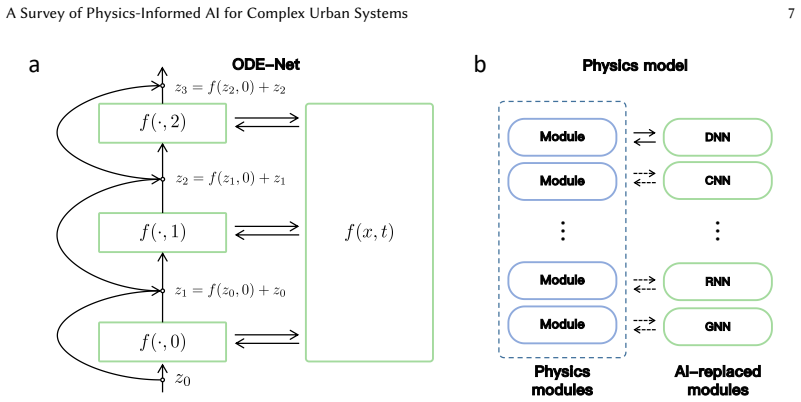
The organizing device is a two-level taxonomy: three paradigms based on the direction and degree of physics-AI integration, further split into seven representative method types—PINN with loss function, PINN with weight initialization, PINN with architecture design, sequential physics-AI ensemble, parallel physics-AI ensemble, AI-discovered physics model, and neural physics model. The taxonomy does not itself solve any urban problem; it works as a classification and selection instrument, and it carries the survey's claim that method choice should be driven by physical knowledge, data availability, and spatiotemporal scale.
What would settle it
Re-examine citation [197] across the tables: it appears as "Hydro-Mechanical PDEs" under water (Table S4), as "2D Soil Consolidation PDE" under soil (Table S4), and as "Social force model" under public services (Table S8). One citation cannot instantiate three different physical models, so a reproducible assignment of papers to physical theories is missing; checking such duplicates on a sample of the cited papers would determine whether the taxonomy's classifications are stable.
Extended reading notes
Core claim
On the paper's own terms, the central contribution is a structured map of how physics and AI can be combined in urban modeling. The three paradigms are ordered by which side dominates: physics laws embedded into neural networks (Physics-Integrated AI, including PINNs with physics loss, physics-based weight initialization, and physics-guided architecture), balanced pipelines where physics and AI alternate or run in parallel and their outputs are fused (Physics-AI Hybrid Ensemble), and physics-dominated structures with AI replacing specific modules or discovering the governing equations (AI-Integrated Physics, including AI-discovered physics and neural physics models). The paper argues this classification clarifies the degrees and directions of integration, making it easier to match methods to urban applications and data conditions.
Load-bearing premise
The taxonomy's practical guidance works only if each reviewed paper has been classified into the correct method type and paired with the correct physical theory; the survey's own tables show that some citations are assigned to different physical models in different places.
Editorial extensions
If this is right
- A practitioner can use the taxonomy to pick a starting point: physics-dominant methods when physical laws are explicit and data is scarce, AI-dominant methods when data is rich and dynamics are complex, and hybrid ensembles in between.
- The taxonomy exposes gaps: the paper notes PINNs lack convergence and generalization guarantees, most applications are domain-specific, and no unified framework yet integrates heterogeneous physical laws into AI architectures.
- The paper points to foundation models and world models that embed physical priors as the likely next step for urban digital twins.
- Cross-domain urban modeling, such as coupling flood dynamics with traffic flow, emerges as a growth area enabled by physics-informed graph networks and neural ODEs.
- The survey concludes that urban computing is a natural arena for this fusion because cities combine strong physical priors with abundant, heterogeneous observational data.
Reading between the lines
- If the taxonomy is right, it implies a cost-benefit ordering among the seven methods that the paper does not make explicit: methods 1-3 trade training cost for physical consistency, while methods 4-5 trade architectural complexity for flexibility.
- A testable extension would be to apply the taxonomy to a fresh batch of recently published urban PIAI papers and measure inter-annotator agreement; the paper's own Table S4 suggests such agreement may be low when the same citation is mapped to different physical models.
- The taxonomy could be operationalized as a decision rule linking data quantity, physics explicitness, and chosen method, turning the survey's qualitative guidance into a falsifiable design recipe.
- The paper's grouping suggests that the eight-domain matrix could be remapped onto subsystem-level physical processes, which would sharpen selection guidance for practitioners.
Editorial analysis
A structured set of objections, weighed in public.
Referee Report
Summary. This manuscript surveys physics-informed AI (PIAI) methods for urban systems. It proposes a taxonomy of three paradigms—Physics-Integrated AI, Physics-AI Hybrid Ensemble, and AI-Integrated Physics—subdivided into seven methods (PINN with loss function, PINN with weight initialization, PINN with architecture design, sequential and parallel physics-AI ensembles, AI-discovered physics models, and neural physics models), and reviews applications across seven or eight urban domains. The paper claims that this taxonomy clarifies the varying degrees and directions of physics-AI integration and guides method selection for urban modeling tasks.
Significance. A reliable survey of this kind would be valuable: the literature is scattered across energy, environment, transportation, economy, information, public services, and emergency management communities, and Table S2's compilation of typical physical laws per urban domain is a useful reference service. The paper also articulates relevant open problems, including theoretical foundations, data efficiency, cross-domain transfer, and digital twin deployment. However, the contribution is primarily classificatory, and the value of the taxonomy depends entirely on the accuracy and consistency of the paper-to-method and paper-to-physical-theory assignments in Tables S3–S9. The current version contains systematic misassignments, so the central claim is not yet supported at the level of reproducibility that a survey of this kind requires.
major comments (4)
- [Table S4 and Section 4.2.2] The mapping in Table S4 between cited papers, physical models, and fusion methods is systematically misaligned with both the main text and the actual cited papers. For example, [119] is Ouyang et al. 2024 on physics-informed neural networks for laterally loaded piles, but the Soil block lists it as 'Solid Waste System Dynamics'; [116] is Oikawa and Saito 2024 on inverse analysis of soil hydraulic parameters, but the table lists it as 'Battery Degradation Models'; [165] is Tao et al. 2025 on battery degradation, but the table lists it as 'Vegetation-Soil Combustion Physics'; [55] is He et al. 2023 on solid waste management, but the Waste block lists it as 'Radar Backscatter Dynamics'; [154] is Singh and Gaurav 2024 on soil moisture estimation, but the table lists it as 'Pile-Soil Dynamics Models'; [142] is Seydi et al. 2024 on vegetation and soil burn severity, but the table lists it as 'Richards Soil Hydrodynamics'; and [180] is Xie et al. 2024 on soil temperature simulation, but the table lists it as 'Terzaghi Consolidation PDE'. These are not cosmetic typos: Table S4 is the evidence base for the environmental classification, and a reader attempting to use the taxonomy for method selection would be directly misled.
- [Tables S4, S8, S9 and Section 2.7] Reference [197] (Zhang et al., KDD 2022, a crowd-simulation paper) is assigned four different fusion methods across the supplementary tables: Method 5 in Table S4 under Water ('Hydro-Mechanical PDEs'), Method 6 in Table S4 under Soil ('2D Soil Consolidation PDE'), Method 7 in Table S8 under Safety and Social Security ('Social force model'), and Method 4 in Table S9 under Mobility Simulation ('Social Force'). It is also cited in Section 2.7 as an example of replacing subgrid closure models in large-eddy simulation. A single paper cannot instantiate four method types and several unrelated physical models; the classification is therefore not applied consistently and cannot be independently reproduced. This directly weakens the Section 5.1 claim that the taxonomy, illustrated through reviewed examples, guides method selection.
- [Abstract, Section 1, Section 3, Section 4.8] The number of urban domains is internally inconsistent. The abstract states that the paper examines applications across 'eight key urban domains: energy, environment, economy, transportation, information, public services, emergency management, and the urban system as a whole', while Section 1 and Section 3 explicitly define seven core subsystems and Fig. 6 shows seven subsystems. Section 4.8 then treats 'the urban system as a whole' as an additional category. The abstract, introduction, and conclusion need to agree on whether the taxonomy covers seven subsystems plus one holistic category or eight co-equal domains, since the survey's coverage claim is part of its advertised contribution.
- [Table S7 and Section 4.5] The 'AI-Discovered Physics Model' label (Method 6) is applied to papers that do not appear to discover governing equations from data. For instance, [35] (SLANT) uses labeled jump-diffusion stochastic differential equations in a probabilistic framework, [117] (SINN) transforms existing opinion dynamics models into ODEs approximated by neural networks, and [170] (ODID) adopts a heat transfer equation to model information diffusion. Labeling these as Method 6 conflates 'using a known equation in a neural network' with 'discovering a governing law', which contradicts the definition of Method 6 in Section 2.6. If Method 6 is intended more broadly, the definition should say so; otherwise the assignments in Table S7 are inconsistent with the taxonomy.
minor comments (4)
- [Section 4.5.1 and Section 4.7.2] There are several typographical errors, including 'Reaserch' in the Section 4.5.1 heading and 'for for' in Section 4.7.2; a careful proofreading pass is needed.
- [Section 4.7.2] The spatiotemporal decay model equation contains a stray double comma and an unbalanced parenthesis in the displayed formula; the notation should be cleaned up.
- [Tables S3–S9] The method labels in the rightmost columns are written inconsistently, sometimes as 'Method 1 & 6' and sometimes as 'Method 1 & 6.' with a period, and the tables do not state whether multiple labels mean that one paper uses multiple methods or that the assignment is uncertain; this should be clarified for reproducibility.
- [Section 5.3] The statement that 'data-driven strategies often favor AI-dominant approaches' is a reasonable high-level observation, but it is not derived from the surveyed tables; tying this claim to a quantitative breakdown of the papers in Tables S3–S9 would strengthen it.
Circularity Check
No circularity in the derivation chain; the taxonomy is an imposed classification and self-citations are illustrative, though table assignments are inconsistent.
full rationale
The paper's central claim is a survey taxonomy, not a quantity derived from equations or fitted parameters. Section 2 defines the three paradigms and seven methods, and Tables S3-S9 assign papers to those categories; the assignment is a labeling exercise, not a prediction forced by the labels. The observed table inconsistencies (e.g., reference [197] is listed as Fusion Method 5 in Table S4 Water, Method 6 in Table S4 Soil, Method 7 in Table S8, and Method 4 in Table S9; Table S4's Soil block contains waste and battery entries) are accuracy/reproducibility defects in the survey's evidence, not circular reductions: mislabeling a cited paper does not make the taxonomy equivalent to its inputs. Several examples are the authors' own prior works ([161], [163], [191], [193], etc.), but these are illustrative applications; the load-bearing organizational claim would stand or fall on the quality of the whole corpus, not on whether those specific citations are true. No fitted parameter is relabeled as a prediction, no uniqueness theorem is imported from the authors' prior work, and no definition is stated in terms of the conclusion. Accordingly, no circular step can be exhibited, and the paper should be scored at the low end for self-citation without load-bearing circularity.
Assumptions & free parameters
assumptions (3)
- ad hoc to paper The assignment of each reviewed paper to a specific method type and physical theory type is accurate and reproducible.
- ad hoc to paper The three-paradigm taxonomy (Physics-Integrated AI, Physics-AI Hybrid Ensemble, AI-Integrated Physics) is exhaustive and has non-overlapping categories.
- ad hoc to paper The representative papers selected are representative of the state of the art in each urban domain.
Cite this review
Pith. "Pith review of A Survey of Physics-Informed AI for Complex Urban Systems." pith.science (2026). https://pith.science/paper/TUS54G5J
@misc{pith2026250613777,
  author       = {Pith},
  title        = {Pith review of: A Survey of Physics-Informed AI for Complex Urban Systems},
  year         = {2026},
  howpublished = {\url{https://pith.science/paper/TUS54G5J}},
  note         = {Machine review of arXiv:2506.13777}
}
read the original abstract
Urban systems are typical examples of complex systems, where the integration of physics-based modeling with artificial intelligence (AI) presents a promising paradigm for enhancing predictive accuracy, interpretability, and decision-making. In this context, AI excels at capturing complex, nonlinear relationships, while physics-based models ensure consistency with real-world laws and provide interpretable insights. We provide a comprehensive review of physics-informed AI methods in urban applications. The proposed taxonomy categorizes existing approaches into three paradigms - Physics-Integrated AI, Physics-AI Hybrid Ensemble, and AI-Integrated Physics - and further details seven representative methods. This classification clarifies the varying degrees and directions of physics-AI integration, guiding the selection and development of appropriate methods based on application needs and data availability. We systematically examine their applications across eight key urban domains: energy, environment, economy, transportation, information, public services, emergency management, and the urban system as a whole. Our analysis highlights how these methodologies leverage physical laws and data-driven models to address urban challenges, enhancing system reliability, efficiency, and adaptability. By synthesizing existing methodologies and their urban applications, we identify critical gaps and outline future research directions, paving the way toward next-generation intelligent urban system modeling.
Figures


Figures from the paper (10 more)



Reference graph
Works this paper leans on
-
[197]
Guozhen Zhang, Zihan Yu, Depeng Jin, et al. 2022. Physics-infused Machine Learning for Crowd Simulation. In KDD ’22: The 28th ACM SIGKDD Conference on Knowledge Discovery and Data Mining, Washington, DC, USA, August 14 - 18,
2022
-
[119]
Weihang Ouyang, Guanhua Li, Liang Chen, et al. 2024. Machine learning-based soil–structure interaction analysis of laterally loaded piles through physics-informed neural networks. Acta Geotechnica (2024), 1–26
2024
-
[116]
Koki Oikawa and Hirotaka Saito. 2024. Inverse analysis of soil hydraulic parameters of layered soil profiles using physics-informed neural networks with unsaturated water flow models. Vadose Zone Journal 6 (2024), e20375
2024
-
[165]
Shengyu Tao, Mengtian Zhang, Zixi Zhao, et al. 2025. Non-destructive degradation pattern decoupling for early battery trajectory prediction via physics-informed learning. Energy & Environmental Science (2025)
2025
-
[55]
Rui He, Mitchell J Small, Ian J Scott, et al. 2023. A novel domain knowledge-informed machine learning approach for modeling solid waste management systems. Environmental Science & Technology 46 (2023), 18215–18224
2023
-
[154]
Abhilash Singh and Kumar Gaurav. 2024. PIML-SM: Physics-informed machine learning to estimate surface soil moisture from multi-sensor satellite images by leveraging swarm intelligence. IEEE Transactions on Geoscience and Remote Sensing (2024)
2024
-
[142]
Seyd Teymoor Seydi, John T Abatzoglou, Amir AghaKouchak, et al. 2024. Predictive understanding of links between vegetation and soil burn severities using physics-informed machine learning. Earth’s Future 8 (2024), e2024EF004873
2024
-
[180]
Xiaoting Xie, Hengnian Yan, Yili Lu, et al. 2024. Simulating field soil temperature variations with physics-informed neural networks. Soil and Tillage Research (2024), 106236
2024
-
[35]
Abir De, Isabel Valera, Niloy Ganguly, et al. 2016. Learning and Forecasting Opinion Dynamics in Social Networks. In Proc. of NeurIPS. 397–405
2016
-
[117]
Maya Okawa and Tomoharu Iwata. 2022. Predicting Opinion Dynamics via Sociologically-Informed Neural Networks. In KDD ’22: The 28th ACM SIGKDD Conference on Knowledge Discovery and Data Mining, Washington, DC, USA, August 14 - 18, 2022 . 1306–1316
2022
-
[170]
Hong T Tu, Tuoi T Phan, and Khu P Nguyen. 2022. Modeling information diffusion in social networks with ordinary linear differential equations. Information Sciences (2022), 614–636
2022
Show all 300 references
-
[1]
Amine M Aboussalah, Xuanze Li, Cheng Chi, et al. 2024. The AI Black-Scholes: Finance-Informed Neural Network. ArXiv preprint (2024)
2024
-
[2]
Adoubi Vincent De Paul Adombi, Romain Chesnaux, Marie-Amélie Boucher, et al. 2024. A causal physics-informed deep learning formulation for groundwater flow modeling and climate change effect analysis. Journal of Hydrology (2024), 131370
2024
-
[3]
Ravindra K Ahuja, Thomas L Magnanti, James B Orlin, et al. 1993. Network flows: theory, algorithms, and applications
1993
-
[4]
Muhammad Rehan Anwar and Lintang Dwi Sakti. 2024. Integrating artificial intelligence and environmental science for sustainable urban planning. IAIC Transactions on Sustainable Digital Innovation (ITSDI) 2 (2024), 179–191
2024
-
[5]
Ashutosh Arun, Md Mazharul Haque, Simon Washington, et al . 2023. A physics-informed road user safety field theory for traffic safety assessments applying artificial intelligence-based video analytics.Analytic methods in accident research (2023), 100252
2023
-
[6]
N Kh Arystanbekova. 2004. Application of Gaussian plume models for air pollution simulation at instantaneous emissions. Mathematics and Computers in Simulation 4-5 (2004), 451–458
2004
-
[7]
Inaam Ashraf, Janine Strotherm, Luca Hermes, et al . 2024. Physics-Informed Graph Neural Networks for Water Distribution Systems. In Thirty-Eighth AAAI Conference on Artificial Intelligence, AAAI 2024, Thirty-Sixth Conference on Innovative Applications of Artificial Intelligen...
2024
-
[8]
Second Order
A. Aw and M. Rascle. 2000. Resurrection of "Second Order" Models of Traffic Flow. SIAM J. Appl. Math. 3 (2000), 916–938
2000
-
[9]
Toshiyuki Bandai and Teamrat A Ghezzehei. 2022. Forward and inverse modeling of water flow in unsaturated soils with discontinuous hydraulic conductivities using physics-informed neural networks with domain decomposition. Hydrology and Earth System Sciences 16 (2022), 4469–4495
2022
-
[10]
Marc Barthelemy. 2019. The statistical physics of cities. Nature Reviews Physics 6 (2019), 406–415
2019
-
[11]
Ross Beckley, Cametria Weatherspoon, Michael Alexander, et al. 2013. Modeling epidemics with differential equations. Tennessee State University Internal Report (2013)
2013
-
[12]
Sanchit Bedi, Karn Tiwari, Prathosh AP, et al. 2025. A neural operator for forecasting carbon monoxide evolution in cities. npj Clean Air 1 (2025), 2
2025
-
[13]
Michael Behrisch, Laura Bieker, Jakob Erdmann, et al. 2011. SUMO–simulation of urban mobility: an overview. In Proceedings of SIMUL 2011, The Third International Conference on Advances in System Simulation . ThinkMind
2011
-
[14]
Daan Bertels and Patrick Willems. 2023. Physics-informed machine learning method for modelling transport of a conservative pollutant in surface water systems. Journal of Hydrology (2023), 129354
2023
-
[15]
Kaifeng Bi, Lingxi Xie, Hengheng Zhang, et al. 2023. Accurate medium-range global weather forecasting with 3D neural networks. Nature 7970 (2023), 533–538
2023
-
[16]
David A Bies, Colin H Hansen, Carl Q Howard, et al. 2023. Engineering noise control
2023
-
[17]
Alex Bihlo and Roman O Popovych. 2022. Physics-informed neural networks for the shallow-water equations on the sphere. J. Comput. Phys. (2022), 111024
2022
-
[18]
Josh Bongard and Hod Lipson. 2007. Automated reverse engineering of nonlinear dynamical systems. Proceedings of the National Academy of Sciences 24 (2007), 9943–9948
2007
-
[19]
Prabhav Borate, Jacques Rivière, Chris Marone, et al. 2023. Using a physics-informed neural network and fault zone acoustic monitoring to predict lab earthquakes. Nature communications 1 (2023), 3693
2023
-
[20]
Luca Bottero, Francesco Calisto, Giovanni Graziano, et al. 2020. Physics-informed machine learning simulator for wildfire propagation. ArXiv preprint (2020)
2020
-
[21]
Ayaz Hussain Bukhari, Muhammad Asif Zahoor Raja, Muhammad Shoaib, et al. 2022. Fractional order Lorenz based physics informed SARFIMA-NARX model to monitor and mitigate megacities air pollution. Chaos, Solitons & Fractals (2022), 112375
2022
-
[22]
Giuseppe Carleo, Ignacio Cirac, Kyle Cranmer, et al. 2019. Machine learning and the physical sciences. Reviews of Modern Physics 4 (2019), 045002
2019
-
[23]
Tsang-Jung Chang, Chia-Ho Wang, and Albert S Chen. 2015. A novel approach to model dynamic flow interactions between storm sewer system and overland surface for different land covers in urban areas. Journal of Hydrology (2015), 662–679
2015
-
[24]
Hongyi Chen, Jingtao Ding, Yong Li, et al. 2024. Social Physics Informed Diffusion Model for Crowd Simulation. In Thirty-Eighth AAAI Conference on Artificial Intelligence, AAAI 2024, Thirty-Sixth Conference on Innovative Applications of Artificial Intelligence, IAAI 2024, Four...
2024
-
[25]
Tian Qi Chen, Yulia Rubanova, Jesse Bettencourt, et al . 2018. Neural Ordinary Differential Equations. In Proc. of NeurIPS. 6572–6583. , Vol. 1, No. 1, Article . Publication date: June 2025. 28 Xu et al
2018
-
[26]
Xinlei Chen, Xiangxiang Xu, Xinyu Liu, et al . 2018. Pga: Physics guided and adaptive approach for mobile fine- grained air pollution estimation. In Proceedings of the 2018 ACM International Joint Conference and 2018 International Symposium on Pervasive and Ubiquitous Computin...
2018
-
[27]
Yongbao Chen, Qiguo Yang, Zhe Chen, et al. 2023. Physics-informed neural networks for building thermal modeling and demand response control. Building and Environment (2023), 110149
2023
-
[28]
Zhangtao Cheng, Fan Zhou, Xovee Xu, et al . 2024. Information Cascade Popularity Prediction via Probabilistic Diffusion. TKDE (2024)
2024
-
[29]
Salvatore Cuomo, Vincenzo Schiano Di Cola, Fabio Giampaolo, et al . 2022. Scientific machine learning through physics–informed neural networks: Where we are and what’s next. Journal of Scientific Computing 3 (2022), 88
2022
-
[30]
Joel Janek Dabrowski, Daniel Edward Pagendam, James Hilton, et al. 2023. Bayesian physics informed neural networks for data assimilation and spatio-temporal modelling of wildfires. Spatial Statistics (2023), 100746
2023
-
[31]
Carlos F. Daganzo. 1994. The cell transmission model: A dynamic representation of highway traffic consistent with the hydrodynamic theory. Transportation Research Part B: Methodological 4 (1994), 269–287
1994
-
[32]
Arka Daw, Anuj Karpatne, William D Watkins, et al. 2022. Physics-guided neural networks (pgnn): An application in lake temperature modeling. In Knowledge guided machine learning . 353–372
2022
-
[33]
Quinn Thomas, Cayelan C
Arka Daw, R. Quinn Thomas, Cayelan C. Carey, et al. 2020. Physics-Guided Architecture (PGA) of Neural Networks for Quantifying Uncertainty in Lake Temperature Modeling. In Proceedings of the 2020 SIAM International Conference on Data Mining, SDM 2020, Cincinnati, Ohio, USA, Ma...
2020
-
[34]
Susanna Dazzi. 2024. Physics-informed neural networks for the augmented system of shallow water equations with topography. Water Resources Research 10 (2024), e2023WR036589
2024
-
[36]
Laura Boca de Giuli, Alessio La Bella, and Riccardo Scattolini. 2024. Physics-informed neural network modeling and predictive control of district heating systems. IEEE Transactions on Control Systems Technology 4 (2024), 1182–1195
2024
-
[37]
Niharika Deshpande and Hyoshin (John) Park. 2024. Physics-informed deep learning with Kalman filter mixture for traffic state prediction. International Journal of Transportation Science and Technology (2024)
2024
-
[38]
Mahesh S Dhar, Robin Marwal, Radhakrishnan Vs, et al. 2021. Genomic characterization and epidemiology of an emerging SARS-CoV-2 variant in Delhi, India. Science 6570 (2021), 995–999
2021
-
[39]
Jingtao Ding, Chang Liu, Yu Zheng, et al. 2024. Artificial intelligence for complex network: Potential, methodology and application. ArXiv preprint (2024)
2024
-
[40]
Jingtao Ding, Yunke Zhang, Yu Shang, et al. 2024. Understanding World or Predicting Future? A Comprehensive Survey of World Models. ArXiv preprint (2024)
2024
-
[41]
MWM Gamini Dissanayake and Nhan Phan-Thien. 1994. Neural-network-based approximations for solving partial differential equations. communications in Numerical Methods in Engineering 3 (1994), 195–201
1994
-
[42]
Yucheng Dong, Min Zhan, Gang Kou, et al. 2018. A survey on the fusion process in opinion dynamics. Information Fusion (2018), 57–65
2018
-
[43]
Arinan D Dourado and Felipe Viana. 2020. Physics-informed neural networks for bias compensation in corrosion- fatigue. In Aiaa scitech 2020 forum . 1149
2020
-
[44]
Bowen Duan, Henggang Deng, Jinghua Piao, et al. 2025. Bi-Dynamic Graph ODE for Opinion Evolution. InProceedings of the 29th ACM SIGKDD international conference on knowledge discovery & data mining
2025
-
[45]
Ujjal Kr Dutta, Aldo Lipani, Chuan Wang, et al. 2024. Application of Zone Method based Physics-Informed Neural Networks in Reheating Furnaces. (2024)
2024
-
[46]
Jie Feng, Jun Zhang, Junbo Yan, et al. 2024. Citybench: Evaluating the capabilities of large language model as world model. ArXiv preprint (2024)
2024
-
[47]
Ferdinando Fioretto, Terrence W. K. Mak, and Pascal Van Hentenryck. 2020. Predicting AC Optimal Power Flows: Combining Deep Learning and Lagrangian Dual Methods. In The Thirty-Fourth AAAI Conference on Artificial Intelli- gence, AAAI 2020, The Thirty-Second Innovative Applicat...
2020
-
[48]
Bochao Fu, Yuqing Gao, and Wei Wang. 2024. A physics-informed deep reinforcement learning framework for autonomous steel frame structure design. Computer-Aided Civil and Infrastructure Engineering (2024)
2024
-
[49]
Federico Gatta, Vincenzo Schiano Di Cola, Fabio Giampaolo, et al . 2023. Meshless methods for American option pricing through physics-informed neural networks. Engineering Analysis with Boundary Elements (2023), 68–82
2023
-
[50]
Gargya Gokhale, Bert Claessens, and Chris Develder. 2022. Physics informed neural networks for control oriented thermal modeling of buildings. Applied Energy (2022), 118852
2022
-
[51]
Samuel Greydanus, Misko Dzamba, and Jason Yosinski. 2019. Hamiltonian Neural Networks. In Proc. of NeurIPS . 15353–15363. , Vol. 1, No. 1, Article . Publication date: June 2025. A Survey of Physics-Informed AI for Complex Urban Systems 29
2019
-
[52]
Yu Han, Meng Wang, Linghui Li, et al. 2022. A physics-informed reinforcement learning-based strategy for local and coordinated ramp metering. Transportation Research Part C: Emerging Technologies (2022), 103584
2022
-
[53]
Zhongkai Hao, Songming Liu, Yichi Zhang, et al. 2022. Physics-informed machine learning: A survey on problems, methods and applications. ArXiv preprint (2022)
2022
-
[54]
Kaiming He, Xiangyu Zhang, Shaoqing Ren, et al. 2016. Deep Residual Learning for Image Recognition. In 2016 IEEE Conference on Computer Vision and Pattern Recognition, CVPR 2016, Las Vegas, NV, USA, June 27-30, 2016 . 770–778
2016
-
[56]
Shaobo He, Yuexi Peng, and Kehui Sun. 2020. SEIR modeling of the COVID-19 and its dynamics. Nonlinear dynamics (2020), 1667–1680
2020
-
[57]
Dirk Helbing and Peter Molnar. 1995. Social force model for pedestrian dynamics. Physical review E 5 (1995), 4282
1995
-
[58]
Kethmi Hirushini Hettige, Jiahao Ji, Shili Xiang, et al. 2024. AirPhyNet: Harnessing Physics-Guided Neural Networks for Air Quality Prediction. In Proc. of ICLR
2024
-
[59]
Haoran Hu, Connor M Kennedy, Panayotis G Kevrekidis, et al . 2022. A modified pinn approach for identifiable compartmental models in epidemiology with application to Covid-19. Viruses 11 (2022), 2464
2022
-
[60]
Huang and Shaurya Agarwal
Archie J. Huang and Shaurya Agarwal. 2020. Physics Informed Deep Learning for Traffic State Estimation. In 2020 IEEE 23rd International Conference on Intelligent Transportation Systems (ITSC) . 1–6
2020
-
[61]
Huang, Animesh Biswas, and Shaurya Agarwal
Archie J. Huang, Animesh Biswas, and Shaurya Agarwal. 2024. Incorporating Nonlocal Traffic Flow Model in Physics-Informed Neural Networks. IEEE Transactions on Intelligent Transportation Systems 11 (2024), 16249–16258
2024
-
[62]
Gang Huang, Zhou Zhou, Fei Wu, et al. 2022. Physics-informed time-aware neural networks for industrial nonintrusive load monitoring. IEEE Transactions on Industrial Informatics 6 (2022), 7312–7322
2022
-
[63]
David L Huff. 1963. A probabilistic analysis of shopping center trade areas. Land economics 1 (1963), 81–90
1963
-
[64]
Ameya D Jagtap, Ehsan Kharazmi, and George Em Karniadakis. 2020. Conservative physics-informed neural networks on discrete domains for conservation laws: Applications to forward and inverse problems. Computer Methods in Applied Mechanics and Engineering (2020), 113028
2020
-
[65]
Luke T Jenkins, Maggie J Creed, Karim Tarbali, et al. 2023. Physics-based simulations of multiple natural hazards for risk-sensitive planning and decision making in expanding urban regions. International Journal of Disaster Risk Reduction (2023), 103338
2023
-
[66]
Jiahao Ji, Jingyuan Wang, Zhe Jiang, et al . 2022. STDEN: Towards Physics-Guided Neural Networks for Traffic Flow Prediction. In Thirty-Sixth AAAI Conference on Artificial Intelligence, AAAI 2022, Thirty-Fourth Conference on Innovative Applications of Artificial Intelligence, ...
2022
-
[67]
Xiaowei Jia, Jared Willard, Anuj Karpatne, et al. 2021. Physics-guided machine learning for scientific discovery: An application in simulating lake temperature profiles. ACM/IMS Transactions on Data Science 3 (2021), 1–26
2021
-
[68]
Xiaowei Jia, Jacob Zwart, Jeffrey Sadler, et al. 2021. Physics-guided recurrent graph model for predicting flow and temperature in river networks. In Proceedings of the 2021 SIAM International Conference on Data Mining (SDM) . SIAM, 612–620
2021
-
[69]
Guangyin Jin, Yuxuan Liang, Yuchen Fang, et al. 2023. Spatio-temporal graph neural networks for predictive learning in urban computing: A survey. TKDE 10 (2023), 5388–5408
2023
-
[70]
Eunhan Ka, Jiawei Xue, Ludovic Leclercq, et al. 2024. A physics-informed machine learning for generalized bathtub model in large-scale urban networks. Transportation Research Part C: Emerging Technologies (2024), 104661
2024
-
[71]
George Em Karniadakis, Ioannis G Kevrekidis, Lu Lu, et al. 2021. Physics-informed machine learning. Nature Reviews Physics 6 (2021), 422–440
2021
-
[72]
William Ogilvy Kermack and Anderson G McKendrick. 1927. A contribution to the mathematical theory of epidemics. Proceedings of the royal society of london. Series A, Containing papers of a mathematical and physical character 772 (1927), 700–721
1927
-
[73]
Ehsan Kharazmi, Min Cai, Xiaoning Zheng, et al. 2021. Identifiability and predictability of integer-and fractional-order epidemiological models using physics-informed neural networks. Nature Computational Science 11 (2021), 744–753
2021
-
[74]
Ehsan Kharazmi, Zhongqiang Zhang, and George Em Karniadakis. 2021. hp-VPINNs: Variational physics-informed neural networks with domain decomposition. Computer Methods in Applied Mechanics and Engineering (2021), 113547
2021
-
[75]
Dmitrii Kochkov, Jamie A Smith, Ayya Alieva, et al. 2021. Machine learning–accelerated computational fluid dynamics. Proceedings of the National Academy of Sciences 21 (2021), e2101784118
2021
-
[76]
Peng Lan, Jingjing Su, Shuairun Zhu, et al. 2024. Reconstructing unsaturated infiltration behavior with sparse data via physics-informed deep learning. Computers and Geotechnics (2024), 106162
2024
-
[77]
Pat Langley, Gary L Bradshaw, and Herbert A Simon. 1983. Rediscovering chemistry with the BACON system
1983
-
[78]
Cheng-Chun Lee, Lipai Huang, Federico Antolini, et al . 2024. Predicting peak inundation depths with a physics informed machine learning model. Scientific Reports 1 (2024), 14826. , Vol. 1, No. 1, Article . Publication date: June 2025. 30 Xu et al
2024
-
[79]
Jooyong Lee and Justin S Chang. 2024. Physics-Informed Neural Network Model for Predictive Risk Assessment and Safety Analysis. Transportation Research Record (2024), 03611981241297662
2024
-
[80]
Xingyu Lei, Zhifang Yang, Juan Yu, et al. 2020. Data-driven optimal power flow: A physics-informed machine learning approach. IEEE Transactions on Power Systems 1 (2020), 346–354
2020
-
[81]
Junyi Li, Ningke Xie, Kaihang Zhang, et al. 2022. Network-scale traffic prediction via knowledge transfer and regional MFD analysis. Transportation Research Part C: Emerging Technologies (2022), 103719
2022
-
[82]
Lianfa Li, Jinfeng Wang, Meredith Franklin, et al. 2023. Improving air quality assessment using physics-inspired deep graph learning. npj Climate and Atmospheric Science 1 (2023), 152
2023
-
[83]
Meng Li, Wenyu Bian, Liangxiong Chen, et al. 2024. HiDeS: a higher-order-derivative-supervised neural ordinary differential equation for multi-robot systems and opinion dynamics. Frontiers in Neurorobotics (2024), 1382305
2024
-
[84]
Weiyu Li, Qi Wang, Yuanyuan Liu, et al . 2022. A spatiotemporal decay model of human mobility when facing large-scale crises. Proceedings of the National Academy of Sciences 33 (2022), e2203042119
2022
-
[85]
Yuanzheng Li, Shangyang He, Yang Li, et al. 2023. Federated multiagent deep reinforcement learning approach via physics-informed reward for multimicrogrid energy management. IEEE Transactions on Neural Networks and Learning Systems (2023)
2023
-
[86]
Yong Li, Yuan Yuan, Jingtao Ding, et al . 2023. Learning the complexity of urban mobility with deep generative collaboration network. (2023)
2023
-
[87]
Zhe Li and Xiangchuan Guo. 2024. Physics-Informed Neural Networks for Real-Time Crowd Density Prediction. In 2024 5th International Seminar on Artificial Intelligence, Networking and Information Technology (AINIT) . IEEE, 1125–1128
2024
-
[88]
Zongyi Li, Nikola Borislavov Kovachki, Kamyar Azizzadenesheli, et al. 2021. Fourier Neural Operator for Parametric Partial Differential Equations. In Proc. of ICLR
2021
-
[89]
Jing Liang, Wenzhe Li, Scott A Bradford, et al. 2019. Physics-informed data-driven models to predict surface runoff water quantity and quality in agricultural fields. Water 2 (2019), 200
2019
-
[90]
Michael James Lighthill and Gerald Beresford Whitham. 1955. On kinematic waves II. A theory of traffic flow on long crowded roads. Proceedings of the Royal Society of London. Series A. Mathematical and Physical Sciences 1178 (1955), 317–345
1955
-
[91]
Xuhui Lin, Qiuchen Lu, Tim Broyd, et al. 2024. Enhancing Urban Flood Response: Traffic Flow Prediction with Field Theory-Inspired Physics-Informed Graph Neural Network. (2024)
2024
-
[92]
Julia Ling, Andrew Kurzawski, and Jeremy Templeton. 2016. Reynolds averaged turbulence modelling using deep neural networks with embedded invariance. Journal of Fluid Mechanics (2016), 155–166
2016
-
[93]
Chang Liu, Jingtao Ding, Yiwen Song, et al. 2024. TDNetGen: Empowering Complex Network Resilience Prediction with Generative Augmentation of Topology and Dynamics. In Proceedings of the 30th ACM SIGKDD Conference on Knowledge Discovery and Data Mining, KDD 2024, Barcelona, Spa...
2024
-
[94]
Dehao Liu and Yan Wang. 2021. A dual-dimer method for training physics-constrained neural networks with minimax architecture. Neural Networks (2021), 112–125
2021
-
[95]
Junhua Liu, Fanfan Lin, Xinze Li, et al. 2024. Physics-Informed LLM-Agent for Automated Modulation Design in Power Electronics Systems. ArXiv preprint (2024)
2024
-
[96]
Yu Liu, Jingtao Ding, Yanjie Fu, et al . 2023. Urbankg: An urban knowledge graph system. ACM Transactions on Intelligent Systems and Technology 4 (2023), 1–25
2023
-
[97]
Yu Liu, Jingtao Ding, and Yong Li. 2022. Developing knowledge graph based system for urban computing. In Proceedings of the 1st ACM SIGSPATIAL International Workshop on Geospatial Knowledge Graphs . 3–7
2022
-
[98]
Yue Lu and Gang Mei. 2022. A deep learning approach for predicting two-dimensional soil consolidation using physics-informed neural networks (PINN). Mathematics 16 (2022), 2949
2022
-
[99]
Haixiang Ma, Xuechun Wang, and Dongsheng Wang. 2024. Pump Scheduling Optimization in Urban Water Supply Stations: A Physics-Informed Multiagent Deep Reinforcement Learning Approach. International Journal of Energy Research 1 (2024), 9557596
2024
-
[100]
Alaeddin Malek and R Shekari Beidokhti. 2006. Numerical solution for high order differential equations using a hybrid neural network—optimization method. Appl. Math. Comput. 1 (2006), 260–271
2006
-
[101]
Jiachen Mao and Leslie K Norford. 2021. Urban weather generator: physics-based microclimate simulation for performance-oriented urban planning. Urban Microclimate Modelling for Comfort and Energy Studies (2021), 241–263
2021
-
[102]
Di Mei, Ziwei Mo, Kangcheng Zhou, et al. 2024. Traffic assignment optimization to improve urban air quality with the unified finite-volume physics-informed neural network. Sustainable Cities and Society (2024), 105750
2024
-
[103]
Caterina Millevoi, Damiano Pasetto, and Massimiliano Ferronato. 2024. A Physics-Informed Neural Network approach for compartmental epidemiological models. PLOS Computational Biology 9 (2024), e1012387
2024
-
[104]
Zhaobin Mo, Yongjie Fu, and Xuan Di. 2022. Quantifying Uncertainty In Traffic State Estimation Using Genera- tive Adversarial Networks. In 2022 IEEE 25th International Conference on Intelligent Transportation Systems (ITSC) . , Vol. 1, No. 1, Article . Publication date: June 2...
2022
-
[105]
Zhaobin Mo, Yongjie Fu, Daran Xu, et al. 2022. TrafficFlowGAN: Physics-Informed Flow Based Generative Adversarial Network for Uncertainty Quantification. In Machine Learning and Knowledge Discovery in Databases: European Conference, ECML PKDD 2022, Grenoble, France, September ...
2022
-
[106]
Alexandra Müller, Heléne Österlund, Jiri Marsalek, et al. 2020. The pollution conveyed by urban runoff: A review of sources. Science of the Total Environment (2020), 136125
2020
-
[107]
Nikhil Muralidhar, Jie Bu, Ze Cao, et al . 2020. PhyNet: Physics Guided Neural Networks for Particle Drag Force Prediction in Assembly. InProceedings of the 2020 SIAM International Conference on Data Mining, SDM 2020, Cincinnati, Ohio, USA, May 7-9, 2020 . 559–567
2020
-
[108]
Georgios Mylonas, Athanasios Kalogeras, Georgios Kalogeras, et al. 2021. Digital twins from smart manufacturing to smart cities: A survey. Ieee Access (2021), 143222–143249
2021
-
[109]
Andrew Nash and Daniel Huerlimann. 2004. Railroad simulation using OpenTrack. WIT Transactions on The Built Environment (2004)
2004
-
[110]
Juan Nathaniel, Gabrielle Nyirjesy, Campbell D Watson, et al. 2023. Above ground carbon biomass estimate with physics-informed deep network. In IGARSS 2023-2023 IEEE International Geoscience and Remote Sensing Symposium . IEEE, 1297–1300
2023
-
[111]
Rahul Nellikkath and Spyros Chatzivasileiadis. 2022. Physics-informed neural networks for ac optimal power flow. Electric Power Systems Research (2022), 108412
2022
-
[112]
Isaac Newton and NW Chittenden. 1850. Newton’s Principia: the mathematical principles of natural philosophy
-
[113]
Hossein Noorazar. 2020. Recent advances in opinion propagation dynamics: A 2020 survey. The European Physical Journal Plus (2020), 1–20
2020
-
[114]
The Royal Swedish Academy of Sciences. 2024. The Nobel Prize in Chemistry 2024. https://www.nobelprize.org/ prizes/chemistry/2024/press-release/. Accessed: 2025-04-05
2024
-
[115]
The Royal Swedish Academy of Sciences. 2024. The Nobel Prize in Physics 2024. https://www.nobelprize.org/prizes/ physics/2024/press-release/. Accessed: 2025-04-05
2024
-
[118]
Tomohisa Okazaki, Takeo Ito, Kazuro Hirahara, et al. 2022. Physics-informed deep learning approach for modeling crustal deformation. Nature Communications 1 (2022), 7092
2022
-
[120]
Ali Girayhan Özbay, Arash Hamzehloo, Sylvain Laizet, et al. 2021. Poisson CNN: Convolutional neural networks for the solution of the Poisson equation on a Cartesian mesh. Data-Centric Engineering (2021), e6
2021
-
[121]
Eric J Parish and Karthik Duraisamy. 2016. A paradigm for data-driven predictive modeling using field inversion and machine learning. Journal of computational physics (2016), 758–774
2016
-
[122]
Jinghua Piao, Jiazhen Liu, Fang Zhang, et al. 2023. Human–AI adaptive dynamics drives the emergence of information cocoons. Nature Machine Intelligence 11 (2023), 1214–1224
2023
-
[123]
Kevin Pollock. 2016. Policy: urban physics. Nature 7594 (2016), S64–S66
2016
-
[124]
Daniel Vázquez Pombo, Mario Javier Rincón, Peder Bacher, et al. 2022. Assessing stacked physics-informed machine learning models for co-located wind–solar power forecasting. Sustainable Energy, Grids and Networks (2022), 100943
2022
-
[125]
Hongliang Qiao, Shanshan Feng, Xutao Li, et al . 2023. RotDiff: A hyperbolic rotation representation model for information diffusion prediction. InProceedings of the 32nd ACM International Conference on Information and Knowledge Management. 2065–2074
2023
-
[126]
Jiezhong Qiu, Jian Tang, Hao Ma, et al. 2018. DeepInf: Social Influence Prediction with Deep Learning. In Proceedings of the 24th ACM SIGKDD International Conference on Knowledge Discovery & Data Mining, KDD 2018, London, UK, August 19-23, 2018. 2110–2119
2018
-
[127]
Haohao Qu, Haoxuan Kuang, Qiuxuan Wang, et al. 2024. A physics-informed and attention-based graph learning approach for regional electric vehicle charging demand prediction. IEEE Transactions on Intelligent Transportation Systems (2024)
2024
-
[128]
Dierk Raabe, Jaber Rezaei Mianroodi, and Jörg Neugebauer. 2023. Accelerating the design of compositionally complex materials via physics-informed artificial intelligence. Nature Computational Science 3 (2023), 198–209
2023
-
[129]
Maziar Raissi, Paris Perdikaris, and George E Karniadakis. 2019. Physics-informed neural networks: A deep learning framework for solving forward and inverse problems involving nonlinear partial differential equations. Journal of Computational physics (2019), 686–707. , Vol. 1,...
2019
-
[130]
Omprakash Ramalingam Rethnam and Albert Thomas. 2024. A physics-informed deep learning-based urban building thermal comfort modeling and prediction framework for identifying thermally vulnerable building stock. Smart and Sustainable Built Environment (2024)
2024
-
[131]
Theodore S Rappaport. 2024. Wireless communications: principles and practice
2024
-
[132]
Fabiano L Ribeiro and Diego Rybski. 2023. Mathematical models to explain the origin of urban scaling laws. Physics Reports (2023), 1–39
2023
-
[133]
Richards
Paul I. Richards. 1956. Shock Waves on the Highway. Operations Research 1 (1956), 42–51
1956
-
[134]
Alexander Rodríguez, Jiaming Cui, Naren Ramakrishnan, et al. 2023. EINNs: Epidemiologically-Informed Neural Networks. In Thirty-Seventh AAAI Conference on Artificial Intelligence, AAAI 2023, Thirty-Fifth Conference on Innovative Applications of Artificial Intelligence, IAAI 20...
2023
-
[135]
Alexander Rodríguez, Harshavardhan Kamarthi, Pulak Agarwal, et al . 2024. Machine learning for data-centric epidemic forecasting. Nature Machine Intelligence (2024), 1–10
2024
-
[136]
Can Rong, Jingtao Ding, and Yong Li. 2024. An interdisciplinary survey on origin-destination flows modeling: Theory and techniques. Comput. Surveys 1 (2024), 1–49
2024
-
[137]
Samuel H Rudy, Steven L Brunton, Joshua L Proctor, et al. 2017. Data-driven discovery of partial differential equations. Science advances 4 (2017), e1602614
2017
-
[138]
Ruslan Salakhutdinov. 2014. Deep learning. In Proc. of KDD. 1973
2014
-
[139]
Omer San and Romit Maulik. 2018. Machine learning closures for model order reduction of thermal fluids. Applied Mathematical Modelling (2018), 681–710
2018
-
[140]
Aravind Sankar, Xinyang Zhang, Adit Krishnan, et al . 2020. Inf-VAE: A Variational Autoencoder Framework to Integrate Homophily and Influence in Diffusion Prediction. InWSDM ’20: The Thirteenth ACM International Conference on Web Search and Data Mining, Houston, TX, USA, Febru...
2020
-
[141]
Stanley Schachter. 1964. The interaction of cognitive and physiological determinants of emotional state. In Advances in experimental social psychology . 49–80
1964
-
[143]
Bryan Shaddy, Deep Ray, Angel Farguell, et al. 2024. Generative algorithms for fusion of physics-based wildfire spread models with satellite data for initializing wildfire forecasts. Artificial Intelligence for the Earth Systems 3 (2024), e230087
2024
-
[144]
Mohsen Shamsaei, Alan Carter, and Michel Vaillancourt. 2022. A review on the heat transfer in asphalt pavements and urban heat island mitigation methods. Construction and Building Materials (2022), 129350
2022
-
[145]
Claude E Shannon. 1948. A mathematical theory of communication. The Bell system technical journal 3 (1948), 379–423
1948
-
[146]
Rongye Shi, Zhaobin Mo, and Xuan Di. 2021. Physics-Informed Deep Learning for Traffic State Estimation: A Hybrid Paradigm Informed By Second-Order Traffic Models. In Thirty-Fifth AAAI Conference on Artificial Intelligence, AAAI 2021, Thirty-Third Conference on Innovative Appli...
2021
-
[147]
Rongye Shi, Zhaobin Mo, Kuang Huang, et al. 2021. Physics-Informed Deep Learning for Traffic State Estimation
2021
-
[148]
Rongye Shi, Zhaobin Mo, Kuang Huang, et al. 2022. A Physics-Informed Deep Learning Paradigm for Traffic State and Fundamental Diagram Estimation. IEEE Transactions on Intelligent Transportation Systems 8 (2022), 11688–11698
2022
-
[149]
Wenzhong Shi, Michael F Goodchild, Michael Batty, et al. 2021. Urban informatics
2021
-
[150]
Yan Shi and Michael Beer. 2024. Physics-informed neural network classification framework for reliability analysis. Expert Systems with Applications (2024), 125207
2024
-
[151]
Zeyu Shi, Yangzhou Chen, Jichao Liu, et al. 2023. Physics-Informed Spatiotemporal Learning Framework for Urban Traffic State Estimation. Journal of Transportation Engineering, Part A: Systems 7 (2023), 04023056
2023
-
[152]
Thiago H Silva, Aline Carneiro Viana, Fabrício Benevenuto, et al. 2019. Urban computing leveraging location-based social network data: a survey. ACM Computing Surveys (CSUR) 1 (2019), 1–39
2019
-
[153]
Filippo Simini, Gianni Barlacchi, Massimilano Luca, et al. 2021. A deep gravity model for mobility flows generation. Nature communications 1 (2021), 6576
2021
-
[155]
Michael Philip Sitte and Nguyen Anh Khoa Doan. 2022. Velocity reconstruction in puffing pool fires with physics- informed neural networks. Physics of Fluids 8 (2022)
2022
-
[156]
Oliver Smith, Oliver Cattell, Etienne Farcot, et al. 2022. The effect of renewable energy incorporation on power grid stability and resilience. Science advances 9 (2022), eabj6734. , Vol. 1, No. 1, Article . Publication date: June 2025. A Survey of Physics-Informed AI for Comp...
2022
-
[157]
Frans N Stokman and Patrick Doreian. 2013. Evolution of social networks: processes and principles. In Evolution of social networks. 233–250
2013
-
[158]
Hongyuan Su, Yu Zheng, Jingtao Ding, et al. 2024. Large-scale Urban Facility Location Selection with Knowledge- informed Reinforcement Learning. In Proceedings of the 32nd ACM International Conference on Advances in Geographic Information Systems. 553–556
2024
-
[159]
Su, Andy H.F
Z.C. Su, Andy H.F. Chow, and R.X. Zhong. 2021. Adaptive network traffic control with an integrated model-based and data-driven approach and a decentralised solution method. Transportation Research Part C: Emerging Technologies (2021), 103154
2021
-
[160]
Yu Tang, Li Jin, and Kaan Ozbay. 2024. Physics-Informed Machine Learning for Calibrating Macroscopic Traffic Flow Models. Transportation Science 6 (2024), 1389–1402
2024
-
[161]
Yinzhou Tang, Jinghua Piao, Huandong Wang, et al. 2025. Predicting Cascade Failures in Interdependent Urban Infrastructure Networks. ArXiv preprint (2025)
2025
-
[162]
Yinzhou Tang, Jinghua Piao, Huandong Wang, et al. [n. d.]. MSA-Net: A multi-scale information diffusion model awaring user activity level. ACM Transactions on the web (TWEB) ([n. d.])
-
[163]
Yinzhou Tang, Huandong Wang, and Yong Li. 2023. Enhancing Spatial Spread Prediction of Infectious Diseases through Integrating Multi-scale Human Mobility Dynamics. In Proceedings of the 31st ACM International Conference on Advances in Geographic Information Systems . 1–12
2023
-
[164]
Ruyi Tao, Kaiwei Liu, Xu Jing, et al. 2024. Predicting Company Growth by Econophysics informed Machine Learning. ArXiv preprint (2024)
2024
-
[166]
Michael L Thompson and Mark A Kramer. 1994. Modeling chemical processes using prior knowledge and neural networks. AIChE Journal 8 (1994), 1328–1340
1994
-
[167]
Jindong Tian, Yuxuan Liang, Ronghui Xu, et al. 2024. Air quality prediction with physics-informed dual neural odes in open systems. ArXiv preprint (2024)
2024
-
[168]
Yuyan Tong, Renhao Hong, Ze Zhang, et al. 2023. Earthquake alerting based on spatial geodetic data by spatiotemporal information transformation learning. Proceedings of the National Academy of Sciences 37 (2023), e2302275120
2023
-
[169]
Martin Treiber, Ansgar Hennecke, and Dirk Helbing. 2000. Congested traffic states in empirical observations and microscopic simulations. Physical review E 2 (2000), 1805
2000
-
[171]
Silviu-Marian Udrescu and Max Tegmark. 2020. AI Feynman: A physics-inspired method for symbolic regression. Science advances 16 (2020), eaay2631
2020
-
[172]
Ricardo Vinuesa and Steven L Brunton. 2022. Enhancing computational fluid dynamics with machine learning.Nature Computational Science 6 (2022), 358–366
2022
-
[173]
Pantelis R Vlachas, Georgios Arampatzis, Caroline Uhler, et al. 2022. Multiscale simulations of complex systems by learning their effective dynamics. Nature Machine Intelligence 4 (2022), 359–366
2022
-
[174]
Pantelis R Vlachas, Wonmin Byeon, Zhong Y Wan, et al. 2018. Data-driven forecasting of high-dimensional chaotic systems with long short-term memory networks. Proceedings of the Royal Society A: Mathematical, Physical and Engineering Sciences 2213 (2018), 20170844
2018
-
[175]
Jinjiang Wang, Yilin Li, Robert X Gao, et al. 2022. Hybrid physics-based and data-driven models for smart manufac- turing: Modelling, simulation, and explainability. Journal of Manufacturing Systems (2022), 381–391
2022
-
[176]
Ting Wang, Ye Li, Rongjun Cheng, et al. 2024. Knowledge-data fusion oriented traffic state estimation: A stochastic physics-informed deep learning approach
2024
-
[177]
Chenghao Wei and Ryozo Ooka. 2023. Indoor airflow field reconstruction using physics-informed neural network. Building and Environment (2023), 110563
2023
-
[178]
Yuandi Wu, Brett Sicard, and Stephen Andrew Gadsden. 2024. Physics-informed machine learning: A comprehensive review on applications in anomaly detection and condition monitoring. Expert Systems with Applications (2024), 124678
2024
-
[179]
Jiarong Xie, Fanhui Meng, Jiachen Sun, et al. 2021. Detecting and modelling real percolation and phase transitions of information on social media. Nature Human Behaviour 9 (2021), 1161–1168
2021
-
[181]
Jia Xing, Bok H Baek, Siwei Li, et al. 2024. A physically constrained deep-learning fusion method for estimating surface NO2 concentration from satellite and ground monitors. Environmental Science & Technology 48 (2024), 21218–21228
2024
-
[182]
Fengli Xu, Jun Zhang, Chen Gao, et al. 2023. Urban generative intelligence (ugi): A foundational platform for agents in embodied city environment. ArXiv preprint (2023). , Vol. 1, No. 1, Article . Publication date: June 2025. 34 Xu et al
2023
-
[183]
Haodi Xu, Joshua Fan, Feng Tao, et al . 2025. Biogeochemistry-Informed Neural Network (BINN) for Improving Accuracy of Model Prediction and Scientific Understanding of Soil Organic Carbon. ArXiv preprint (2025)
2025
-
[184]
Yanwen Xu, Sara Kohtz, Jessica Boakye, et al. 2023. Physics-informed machine learning for reliability and systems safety applications: State of the art and challenges. Reliability Engineering & System Safety (2023), 108900
2023
-
[185]
Jiawei Xue, Eunhan Ka, Yiheng Feng, et al. 2024. Network macroscopic fundamental diagram-informed graph learning for traffic state imputation. Transportation Research Part B: Methodological (2024), 102996. Transportation Research Part B: Methodological - ISTTT25
2024
-
[186]
Wenjin Yan, Shuangquan Hu, Yanhui Yang, et al. 2011. Bayesian migration of Gaussian process regression for rapid process modeling and optimization. Chemical engineering journal 3 (2011), 1095–1103
2011
-
[187]
Yuwei Yan, Qingbin Zeng, Zhiheng Zheng, et al. 2024. OpenCity: A Scalable Platform to Simulate Urban Activities with Massive LLM Agents. ArXiv preprint (2024)
2024
-
[188]
Yuxuan Yang, Siyuan Zhou, He Weng, et al. 2024. Siamese learning based on graph differential equation for Next-POI recommendation. Applied Soft Computing (2024), 111086
2024
-
[189]
Kun Yao, John E Herr, David W Toth, et al. 2018. The TensorMol-0.1 model chemistry: a neural network augmented with long-range physics. Chemical science 8 (2018), 2261–2269
2018
-
[190]
Dingguo Yu, Yijie Zhou, Suiyu Zhang, et al. 2024. Information cascade prediction of complex networks based on physics-informed graph convolutional network. New Journal of Physics 1 (2024), 013031
2024
-
[191]
Yuan Yuan, Jingtao Ding, Jie Feng, et al . 2024. UniST: A Prompt-Empowered Universal Model for Urban Spatio- Temporal Prediction. In Proceedings of the 30th ACM SIGKDD Conference on Knowledge Discovery and Data Mining, KDD 2024, Barcelona, Spain, August 25-29, 2024 . 4095–4106
2024
-
[192]
Yuan Yuan, Jingtao Ding, Chenyang Shao, et al. 2023. Spatio-temporal Diffusion Point Processes. In Proceedings of the 29th ACM SIGKDD Conference on Knowledge Discovery and Data Mining, KDD 2023, Long Beach, CA, USA, August 6-10,
2023
-
[193]
Yuan Yuan, Chonghua Han, Jingtao Ding, et al. 2024. Urbandit: A foundation model for open-world urban spatio- temporal learning. ArXiv preprint (2024)
2024
-
[194]
Yuan Yuan, Huandong Wang, Jingtao Ding, et al. 2023. Learning to Simulate Daily Activities via Modeling Dynamic Human Needs. In Proceedings of the ACM Web Conference 2023, WWW 2023, Austin, TX, USA, 30 April 2023 - 4 May
2023
-
[195]
Yun Yuan, Qinzheng Wang, and Xianfeng Terry Yang. 2022. Traffic Flow Modeling With Gradual Physics Regularized Learning. IEEE Transactions on Intelligent Transportation Systems 9 (2022), 14649–14660
2022
-
[196]
Bin Zhang, Di Cao, Weihao Hu, et al. 2024. Physics-Informed Multi-Agent deep reinforcement learning enabled distributed voltage control for active distribution network using PV inverters. International Journal of Electrical Power & Energy Systems (2024), 109641
2024
-
[198]
H.M. Zhang. 2002. A non-equilibrium traffic model devoid of gas-like behavior. Transportation Research Part B: Methodological 3 (2002), 275–290
2002
-
[199]
Jincheng Zhang and Xiaowei Zhao. 2021. Three-dimensional spatiotemporal wind field reconstruction based on physics-informed deep learning. Applied Energy (2021), 117390
2021
-
[200]
Liang Zhang, Gang Wang, and Georgios B Giannakis. 2019. Real-time power system state estimation and forecasting via deep unrolled neural networks. IEEE Transactions on Signal Processing 15 (2019), 4069–4077
2019
-
[201]
Xiyuan Zhang, Xiaohan Fu, Diyan Teng, et al. 2023. Physics-Informed Data Denoising for Real-Life Sensing Systems. In Proceedings of the 21st ACM Conference on Embedded Networked Sensor Systems . 83–96
2023
-
[202]
Yunke Zhang, Yuming Lin, Guanjie Zheng, et al. 2025. MetaCity: Data-driven sustainable development of complex cities. The Innovation (2025)
2025
-
[203]
Yuchen Zhang, Mingsheng Long, Kaiyuan Chen, et al . 2023. Skilful nowcasting of extreme precipitation with NowcastNet. Nature 7970 (2023), 526–532
2023
-
[204]
Yuheng Zhang, Yuan Yuan, Jingtao Ding, et al. 2024. Noise Matters: Diffusion Model-based Urban Mobility Generation with Collaborative Noise Priors. ArXiv preprint (2024)
2024
-
[205]
Chenguang Zhao and Huan Yu. 2022. Integrating PDE Observer with Deep Learning for Traffic State Estimation. In 2022 IEEE 25th International Conference on Intelligent Transportation Systems (ITSC) . 1964–1969
2022
-
[206]
Look-Ahead
Chenguang Zhao and Huan Yu. 2023. Learning "Look-Ahead" Nonlocal Traffic Dynamics in a Ring Road
2023
-
[207]
Chenguang Zhao and Huan Yu. 2024. Observer-Informed Deep Learning for Traffic State Estimation With Boundary Sensing. IEEE Transactions on Intelligent Transportation Systems 2 (2024), 1602–1611
2024
-
[208]
Zhilun Zhou, Jingtao Ding, Yu Liu, et al . 2023. Towards generative modeling of urban flow through knowledge- enhanced denoising diffusion. In Proceedings of the 31st ACM International Conference on Advances in Geographic , Vol. 1, No. 1, Article . Publication date: June 2025....
2023
-
[209]
Zhuang Zhuang, Tianxin Wei, Lingbo Liu, et al. 2024. TAU: Trajectory Data Augmentation with Uncertainty for Next POI Recommendation. In Thirty-Eighth AAAI Conference on Artificial Intelligence, AAAI 2024, Thirty-Sixth Conference on Innovative Applications of Artificial Intelli...
2024
-
[210]
George Kingsley Zipf. 1946. The P 1 P 2/D hypothesis: on the intercity movement of persons. American sociological review 6 (1946), 677–686
1946
-
[211]
Anatoly Zlotnik, Michael Chertkov, and Scott Backhaus. 2015. Optimal control of transient flow in natural gas networks. In 2015 54th IEEE conference on decision and control (CDC) . IEEE, 4563–4570
2015
-
[212]
Navid Zobeiry and Keith D Humfeld. 2021. A physics-informed machine learning approach for solving heat transfer equation in advanced manufacturing and engineering applications. Engineering Applications of Artificial Intelligence (2021), 104232. , Vol. 1, No. 1, Article . Publi...
2021
-
[213]
RMP, 2019 Physical problems Limited to physics-based analysis
2019
-
[214]
JSC, 2022 Technical methods Not targeted at urban systems
2022
-
[215]
Arxiv, 2022 Technical methods Not targeted at urban systems
2022
-
[216]
Nat. Rev. Phys., 2021 Physical problems Not targeted at urban systems
2021
-
[217]
IEEE TPWRS, 2020 Power flow Limited scope
2020
-
[218]
RESS, 2023 Reliability and system safety Limited scope
2023
-
[219]
Typical physical laws in different urban systems
ESWA, 2024 Anomaly and condition monitoring Limited scope B Summary of Physical Laws and Models in Urban Systems Table S2. Typical physical laws in different urban systems. Domain Element Physical model Equation Energy Electricity Power Flow Calculation [156] 𝑑2𝜃𝑖𝑑𝑡2+𝛾𝑑𝜃𝑖𝑑𝑡 =𝑃...
2024
-
[220]
Physical models Method 4
Power generation principle of solar and wind power. Physical models Method 4
-
[221]
Physical equations Method 1 & 6
3-D Navier–Stokes equations. Physical equations Method 1 & 6
-
[222]
Physical models Method 1 & 3
Power converter designing constraints. Physical models Method 1 & 3. Power transmission
-
[223]
Physical equations Method 1
Electrical circults theory. Physical equations Method 1
-
[224]
Physical equations Method 1 & 5
Electrical circults theory. Physical equations Method 1 & 5
-
[225]
Expert knowledge Method 2
Simulation of distributed grids. Expert knowledge Method 2
-
[226]
Rule-based constraints Method 1 Power consumption
Operation rules of distributed grids. Rule-based constraints Method 1 Power consumption
-
[227]
Rule-based constraints Method 4
Relationship between electricity price and demand. Rule-based constraints Method 4
-
[228]
Physical models Method 1 & 7
2R2C model in building thermal modeling. Physical models Method 1 & 7
-
[229]
Physical equations Method 1 Table S4
Navier-Stokes equations in pipes. Physical equations Method 1 Table S4. Summary of representative papers on environment systems. Domain Paper Physical Model Physical Theory Type Fusion Method Air
-
[230]
Diffusion-Advection PDE Physical equations Method 6
-
[231]
Boundary-Aware Diffusion-Advection Physical equations Method 5
-
[232]
Finite Volume and PDE Models Physical equations Method 6
-
[233]
Fractional Lorenz Chaos Model Physical models Method 4
-
[234]
Pollutant Advection-Diffusion PDE Physical equations Method 1
-
[235]
Navier-Stokes and Continuity Rule-based constraints; Physical equations Method 1
-
[236]
Mobility Dynamics Physical models Method 7 Water
-
[237]
HBV Groundwater Dynamics Physical models Method 4
-
[238]
Richardson-Richards Hydrodynamics Physical equations Method 1 & 6
-
[239]
Surface Runoff Advection-Diffusion Physical models; Data Method 4
-
[240]
Flow Conservation and Pressure Relations Physical laws Method 4
-
[241]
Mass Dynamics in Shallow Water Equations Physical equations Method 3
-
[242]
Hydro-Mechanical PDEs Physical equations Method 5
-
[243]
Nonlinear Shallow Water Dynamics Physical models Method 1
-
[244]
Enhanced Shallow Water Models Rule-based constraints Method 1
-
[245]
Richards Hydrodynamics Physical models Method 5 Soil
-
[246]
Kinematic,𝐶𝑂2, and Heat Equations Physical equations Method 6
-
[247]
Solid Waste System Dynamics Physical models Method 6
-
[248]
Battery Degradation Models Physical models Method 6
-
[249]
2D Soil Consolidation PDE Physical models Method 6
-
[250]
Pile-Soil Dynamics Models Physical models Method 1
-
[251]
Richards Soil Hydrodynamics Physical equations Method 5
-
[252]
Terzaghi Consolidation PDE Physical models Method 1 & 6 Waste [55] Radar Backscatter Dynamics Expert knowledge Method 2
-
[253]
Vegetation-Soil Combustion Physics Physical equations Method 4 Carbon [110] Ecosystem Productivity Models Physical models Method 3
-
[254]
Chemical Transport Model Physical equations Method 5 , Vol. 1, No. 1, Article . Publication date: June 2025. 38 Xu et al. Table S5. Summary of representative papers on transportation systems. Research Domain Paper Physical Model Physical Theory Type Fusion Method State Estimat...
2025
-
[255]
Generalized bathtub model Physical models Method 1 [104, 105] LWR & ARZ Physical models, Uncertainty Method 1 & 4
-
[256]
𝛼-SPIDL &𝛽-SPIDL Physical models Method 1 & 3
-
[257]
LWR Physical models, Expert knowledge Method 1 & 2 Data Imputation [160] CTM Physical models Method 1
-
[258]
𝜆-trapezoidal MFD Physical models Method 1 Flow Prediction
-
[259]
LWR, ARZ & CTM Physical models Method 1
-
[260]
PEF, Differential Equation Physical equations Method 1
-
[261]
MFD Physical models Method 4 & 1
-
[262]
LWR Physical models Method 7 Control [159] Kinematic wave model Physical models Method 3 & 4
-
[263]
Summary of representative papers on economy systems
PI-ALINEA Control strategies Method 2 Table S6. Summary of representative papers on economy systems. Research Domain Paper Physical Model Physical Theory Type Fusion Method Manufacturing
-
[264]
Heat Transfer Equations Physical equations Method 1 & 2
-
[265]
Steel Frame Mechanics and Code Constraints Rule-based constraints, Physical laws Method 5
-
[266]
Thermodynamics and Microstructure Evolution Expert knowledge Method 1 & 2
-
[267]
Hottel’s Furnace Radiation Model Physical models Method 1
-
[268]
Physical Knowledge in Simulations Physical laws Method 1 & 3
-
[269]
Structural Reliability Insights Physical models Method 1 & 6
-
[270]
Industrial Load Physics Physical laws Method 1 & 3 Stock [49] Option Pricing Models Physical models Method 1 & 5
-
[271]
Option Pricing Core Physics Physical models Method 1 & 4 Commodity [164] Corporate Growth Dynamics Physical models Method 5 POI [188] User Check-In Modeling Physical equations Method 7
-
[272]
Summary of representative papers on information systems
Trajectory Flow Transition Model Physical models Method 4 Table S7. Summary of representative papers on information systems. Research Domain Paper Physical Model Physical Theory Type Fusion Method Information diffusion
-
[273]
User Activity Level Equations Expert knowledge Method 7
-
[274]
Heat Transfer Equation Physical laws Method 6
-
[275]
Probabilistic Diffusion Equations Physical Equations Method 6
-
[276]
Probabilistic Diffusion Model Physical Equations Method 1 Opinion Evolution Modeling
-
[277]
Jump-Diffusion Stochastic Differential Equations Physical Equations Method 6
-
[278]
Hegselmann-Krause Model Physical models Method 6
-
[279]
Neural ODEs and Higher Derivative Constraint Physical Equations Method 6
-
[280]
Bidirectional Graph ODEs Physical models Method 5 , Vol. 1, No. 1, Article . Publication date: June 2025. A Survey of Physics-Informed AI for Complex Urban Systems 39 Table S8. Summary of representative papers on public service systems. Domain Paper Physical Model Physical The...
2025
-
[281]
Fractional-order epidemiological models Physical models Method 6
-
[282]
SEIRM and SIRS model Physical models Method 1
-
[283]
Compartmental epidemiological models Physical models Method 2
-
[284]
SICRD compartmental model Physical models Method 3
-
[285]
Multi-scale SIS model Physical equations Method 3 Safety and social security
-
[286]
Social force model Physical equations Method 7
-
[287]
Conservation of mass principle Physical laws Method 4
-
[288]
Road user safety field model Physical equations Method 4
-
[289]
Intelligent driver model; Social force model Physical equations Method 3 Service supply and planning
-
[290]
Natural hazard models Physical models Method 4
-
[291]
Four urban weather models Physical models Method 4
-
[292]
Summary of representative papers on emergency management systems
Facility location knowledge Expert knowledge Method 2 Table S9. Summary of representative papers on emergency management systems. Research Domain Paper Physical Model Physical Theory Type Fusion Method Mobility Simulation and Prediction
-
[293]
Spatio-temporal Decay Model Physical Equations Method 7
-
[294]
Social Force Physical Equations Method 4
-
[295]
Social Force Physical Equations Method 7 Disaster Modeling and Prediction
-
[296]
HEC-RAS 2D model Physical Models Method 1
-
[297]
Delay-embedding Theorem Physical Models Method 3
-
[298]
Fault elastic coupling and stiffness model Physical Constraints Method 1
-
[299]
Multi-scale representation Expert Knowledge Method 2
-
[300]
Dislocation model Physical Equations Method 1
Reviewed August 7, 2026 · model on record in the stance chip above.
Discussion (0). Sign in to comment.