REVIEW 3 major objections 4 minor 92 references
Toward a Graph Foundation Model: Pre-Training Transformers With Random Walks
T0 review · 3 major / 4 minor · reviewed 2026-08-15 · deepseek-v4-flash
Pith's one-line read Random walks plus shortest-path distances make node neighborhoods fully reconstructible by a Transformer sequence.
desk verdict A strong empirical recipe for cross-domain graph pre-training via random walks, but the advertised theory does not hold as stated. read the letter →
The pith
A machine-rendered reading of the paper's core claim, the machinery that carries it, and where it could break.
The reading
What carries the argument
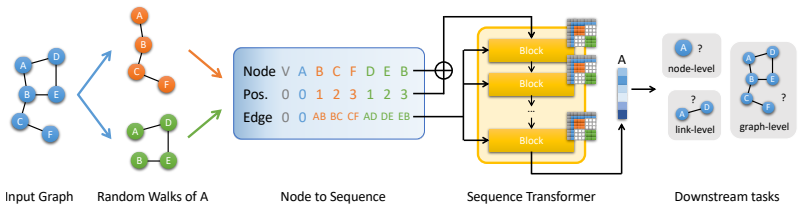
The load-bearing object is the random-walk sequence $\mathrm{seq}(i)=[i_0,i^1_1,\ldots,i^k_\ell]$: $k$ biased random walks of length $\ell$ from a root node, concatenated walk by walk, with the shortest-path distance from the root serving as each token's positional encoding and a dataset-specific virtual token prepended. A per-walk attention mask lets each walk attend only to itself, the root, and the virtual token, cutting the attention cost by about a factor of $k$ while keeping walks as independent structural probes. The mechanism that carries the theoretical argument is the pseudo shortest-path oracle: when a walk has a monotone depth-increasing subsequence, the difference in walk indices equals the true shortest-path distance, so $\Theta(r)$-length walks supply $\Theta(n^2)$ accurate distance estimates for the ball; those estimates are enough, by known bounds, to reconstruct the ball. The pre-training objective is a context-prediction loss that maximizes mutual information between the root representation and averaged $j$-step contexts over all walks while contrasting against other nodes' contexts.
What would settle it
Run the prescribed sampling on bounded-degree graphs (for example, 2D grids and binary trees with a few added edges): take $k=\Theta(\max(nr,n^2/r^2))$ walks of length $\ell=\Theta(r)$ for every node, compute distances from walk-index differences on outward-moving segments, and attempt to reconstruct each $r$-ball. If any ball is not recovered for a graph that satisfies the theorem's assumptions, Theorem 4.4 is false as stated.
Extended reading notes
Core claim
The discovery is that a Transformer fed with random walks is not just a workable heuristic but is carrying enough structural information to rebuild a node's local graph. For an undirected connected graph with bounded degree, Theorem 4.4 says the ball $B_{u,r}$ with $n$ nodes is fully reconstructible from the concatenated random-walk sequence of Eq. (1) together with the shortest-path distance of every node from the root $u=i_0$, whenever $k=\Theta(\max(nr,n^2/r^2))$ and $\ell=\Theta(r)$. The reconstruction goes through a pseudo shortest-path oracle: on any segment of a walk where distances from the root increase by one at each step, the index difference between two nodes equals their true distance; with enough walks these accurate oracles accumulate, and known graph-reconstruction bounds finish the job. Theorem 4.5 then gives a positive-definite kernel that distinguishes non-isomorphic balls, so the random-walk representation is expressive for node representation learning. Empirically, the paper reports that the pre-trained model beats the strongest existing graph foundation baseline on seven of eight tasks across node, link, and graph levels, and that pre-training on a single domain already transfers to unseen datasets.
Load-bearing premise
The theorem's load-bearing premise is that, with the prescribed walk count and length, every pair of nodes in the ball will appear together in some outward-moving stretch of a walk, so that the walk-based distance estimate equals the true shortest-path distance; the proof bounds only the expected number of such pairs, not the guarantee that all pairs are covered.
Editorial extensions
If this is right
- A single pre-trained encoder can be adapted to node, link, and graph-level tasks by training only a task head, because all three output types derive from the same per-node random-walk sequences.
- Graph batching stops being a bottleneck: any graph, from a molecule with tens of atoms to a network with millions of nodes, becomes a set of fixed-length walk sequences that fit a standard Transformer context.
- The theoretical sufficiency result means the random-walk encoding is a principled tokenizer for graph Transformers, not an ad hoc sampling choice; this justifies using it as the input format in a foundation model.
- Walks of modest length reach far beyond small-hop neighborhoods, so the model can capture long-range dependencies; the experiments on long-range benchmarks are consistent with that.
- Transfer experiments indicate that a small representative set of pre-training datasets, or even one domain, already yields strong performance on unseen graph datasets, lowering the data barrier for building graph foundation models.
Reading between the lines
- Editorial extension: if the reconstruction guarantee in Theorem 4.4 can be strengthened from an expected-count argument to a high-probability coverage bound, random walks would become a provably universal tokenizer for graph Transformers, independent of the quality of node text features.
- A testable extension the authors do not run: pre-train with hand-crafted structural features instead of LLM-generated text features on non-textual graphs, to isolate how much of the cross-domain transfer comes from the random-walk encoding and how much from language-model vocabulary unification.
- Editorial inference: the per-walk attention mask keeps walks independent, so the model may be blind to correlations between walks; allowing a few cross-walk attention slots in later layers could improve expressivity without restoring full quadratic cost.
- The context-prediction loss is a hierarchical infomax objective; a natural follow-up is to treat the number of context windows as a scale selector, letting one model serve tasks that need local versus global information.
Signed reviews
Editorial analysis
A structured set of objections, weighed in public.
Referee Report
Summary. The paper proposes RWPT, a Transformer-based graph foundation model that represents each node by multiple biased random walks, encodes the walks with shortest-path-distance positional encodings and per-walk attention masks, and pre-trains with a novel context-prediction contrastive loss. The authors pre-train on ten datasets and adapt to node-, link-, and graph-level tasks, reporting strong cross-domain transfer and few-shot results against ten baselines. The paper additionally claims two theoretical results: that the random-walk sequence plus SP-distance encoding can fully reconstruct an r-ball (Theorem 4.4) and that a positive-definite kernel can distinguish non-isomorphic balls (Theorem 4.5).
Significance. If the theoretical reconstruction claims were sound, the paper would make a substantial contribution to graph foundation models by justifying random-walk sequences as an information-theoretically sufficient input format for Transformer-based graph representation learning. The empirical contribution is strong and carefully executed: the pipeline is specified in detail, hyperparameters are fixed across datasets, results are reported with ten seeds and error bars, and the ablations isolate the contributions of random-walk sampling, the context-prediction loss, edge-feature conditioning, and the attention mask. The cross-domain and few-shot transfer results are internally consistent and demonstrate the practical value of the approach. However, the theoretical section currently overclaims what the proofs establish, and this gap is load-bearing because the abstract and introduction advertise the expressivity analysis as a central contribution.
major comments (3)
- [Appendix C.1 (Lemma C.5 and Theorem C.8)] The proof of Theorem 4.4 does not establish that the ball can be "fully reconstructed." Lemma C.5 bounds only the expected number of distinct reliable pseudo-SP oracles (Eqs. 17-21); it provides no coverage guarantee that every node pair in B_{u,r} is included among those oracles, nor a concentration or high-probability argument. Propositions C.6 and C.7 require the actual all-pairs distance/edge structure of the ball, so an expected count of Θ(n^2) distinct pairs is insufficient: many pairs could remain uncovered, and exact reconstruction would fail. The theorem as stated therefore does not follow from the supplied lemmas.
- [Appendix C.2 (Theorem 4.5 and Proposition C.9)] Theorem 4.5 is unsupported as written. The proof invokes Proposition C.9, but the cited shortest-path kernel of Borgwardt and Kriegel is not known to be isomorphism-complete; in fact, shortest-path kernels do not distinguish all non-isomorphic graphs with the same shortest-path distance multiset. Moreover, the proof of Theorem 4.5 relies on Theorem 4.4's exact recovery of all SP oracles within a ball, which is itself not established. The claim that a positive-definite kernel distinguishes non-isomorphic balls therefore needs either a different completeness argument or a weakened statement.
- [Appendix C.1 (Lemma C.4)] The derivation of the walk count k = O(nr) in Lemma C.4 is not justified. The coupon-collector argument for covering m nodes in a DFS tree yields k = Θ(m log m) walks, and with m ≤ n this gives O(n log n), not O(nr), unless one assumes r ≥ log n, which is not stated or proven. Since this k bound feeds into the complexity expression in Theorem 4.4, the stated Θ(max(nr, n^2/r^2)) complexity is not established by the given reasoning.
minor comments (4)
- [Table 1] The column header "GRAPH CLASSI ." appears truncated; it should read "GRAPH CLASSIFICATION."
- [Section 5.3] The phrase "a fewN-wayk-shot experiments" contains a typographical error; it should be "a few N-way k-shot experiments."
- [Section 3.4 (Eq. 9)] The notation "∀other" in the loss is informal; clarifying that the negative contexts are sampled from other root nodes in the same batch would improve precision.
- [Section 5.2] The claim that RWPT outperforms GFT on seven of eight tasks is correct, but it would be helpful to also report the one task where GFT wins (PubMed) in the main text for full transparency.
Circularity Check
No circularity: empirical results are benchmarked externally and the theoretical claims rest on external reconstruction theorems; the proof gap in Lemma C.5 is a correctness issue, not circularity.
full rationale
No circularity found. The paper's central empirical claim is benchmarked against external baselines (GCN, GIN, GAT, DGI, BGRL, GraphMAE, GIANT, PRODIGY, OFA, GFT), with random-walk and Transformer hyperparameters fixed across datasets (Appendix F: k=8, l=4, p=1.0, q=0.1) and verified by ablations over sampling, loss, and attention mask; no parameter is fit to a test set and then reported as a prediction. The theoretical expressivity claim is an independent argument: Theorem 4.4 proposes that a ball can be reconstructed from the random-walk sequence (Eq. 1) plus SP distances from the root, and its proof relies on external results (Lemma 4.7 of Blum-Hopcroft-Kannan; Propositions C.6/C.7 from Reyzin-Srivastava and Mathieu-Zhou) rather than on the paper's own conclusions. The input includes the SP distance of every node from the root, but that is part of the stated representation, not a fitted output, and it does not by itself determine the edges of the ball; reconstructing edge structure from pairwise oracles is the actual external reconstruction step. The one weakness visible in the proof of Theorem 4.4 - Lemma C.5 gives only an expected count Theta(n^2) of reliable pseudo-SP oracles and does not prove coverage of every pair needed for exact reconstruction - is a correctness/concentration gap, not a circularity: the theorem's conclusion is not equivalent to its assumptions by construction. Theorem 4.5 is likewise a direct application of the cited shortest-path kernel [5] plus Theorem 4.4, with no self-citation chain or ansatz smuggled in. The paper's few self-references (e.g., [9], FastGCN) are not load-bearing for the main claims.
Assumptions & free parameters
free parameters (5)
- walk length ℓ =
4
- number of walks k =
8
- node2vec bias p =
1.0
- node2vec bias q =
0.1
- dataset mixture multiplier α_D =
PubMed 3.0, Products 0.5, WikiCS 2.0, Arxiv 0.7, WN18RR 0.8, FB15k237 0.1, PCBA 0.2, ChEMBL 0.1, HIV 1.0, Tox21 2.0
assumptions (4)
- standard math Graph reconstruction from all-pairs shortest-path distances requires Θ(n^2) oracle queries for general graphs, reducible to Θ(n^{3/2}) with randomization (Propositions C.6, C.7).
- domain assumption The input graphs to Theorem 4.4 are undirected, connected, and of bounded degree d.
- ad hoc to paper The biased random walk satisfies 1/q ≥ ((C+1)/(C-1))(1/p) + (1/(C-1))d for some C≥2 (Eq. 10), so the expected walk length to reach distance r is O(r).
- ad hoc to paper There exists a shortest-path graph kernel that is positive definite, polynomial-time computable, and distinguishes graphs up to isomorphism (Proposition C.9).
invented entities (2)
-
Virtual dataset token v
-
Pseudo shortest-path oracle ψ~_w (Eq. 17)
Cite this review
Pith. "Pith review of Toward a Graph Foundation Model: Pre-Training Transformers With Random Walks." pith.science (2026). https://pith.science/paper/PZTKKXXU
@misc{pith2026250614098,
  author       = {Pith},
  title        = {Pith review of: Toward a Graph Foundation Model: Pre-Training Transformers With Random Walks},
  year         = {2026},
  howpublished = {\url{https://pith.science/paper/PZTKKXXU}},
  note         = {Machine review of arXiv:2506.14098}
}
read the original abstract
A foundation model like GPT elicits many emergent abilities, owing to the pre-training with broad inclusion of data and the use of the powerful Transformer architecture. While foundation models in natural languages are prevalent, can we build similar models for graphs? This paper describes an approach toward a graph foundation model that is pre-trained with diverse graph datasets by adapting the Transformer backbone. A central challenge toward this end is how a sequence model encodes graphs of varying sizes and from different domains. We propose representing a node as multiple random walks, such that the Transformer can extract node representations from sequences, which in turn form edge and graph representations. We develop a novel context prediction loss for these random walks and theoretically analyze their expressive power in distinguishing neighborhoods and graphs. We also demonstrate the pre-training of our model and its adaptation to downstream tasks, showcasing its potential as a foundation for processing and reasoning with graph-structured data.
Figures


Reference graph
Works this paper leans on
-
[1]
Peter W. Battaglia, Jessica B. Hamrick, Victor Bapst, Alvaro Sanchez-Gonzalez, Vinicius Zam- baldi, Mateusz Malinowski, Andrea Tacchetti, David Raposo, Adam Santoro, Ryan Faulkner, Caglar Gulcehre, Francis Song, Andrew Ballard, Justin Gilmer, George Dahl, Ashish Vaswani, Kelsey Allen, Charles Nash, Victoria Langston, Chris Dyer, Nicolas Heess, Daan Wierst...
arXiv 2018
-
[2]
Foundations of data science
Avrim Blum, John Hopcroft, and Ravindran Kannan. Foundations of data science. To appear, 280, 2015
2015
-
[3]
On the opportunities and risks of foundation models
Rishi Bommasani et al. On the opportunities and risks of foundation models. Preprint arXiv:2108.07258, 2021
arXiv 2021
-
[4]
Translating embeddings for modeling multi-relational data
Antoine Bordes, Nicolas Usunier, Alberto Garcia-Duran, Jason Weston, and Oksana Yakhnenko. Translating embeddings for modeling multi-relational data. Advances in neural information processing systems, 26, 2013
2013
-
[5]
Shortest-path kernels on graphs
Karsten M Borgwardt and Hans-Peter Kriegel. Shortest-path kernels on graphs. In Fifth IEEE international conference on data mining (ICDM’05), pages 8–pp. IEEE, 2005
2005
-
[6]
Graphllm: Boosting graph reasoning ability of large language model
Ziwei Chai, Tianjie Zhang, Liang Wu, Kaiqiao Han, Xiaohai Hu, Xuanwen Huang, and Yang Yang. Graphllm: Boosting graph reasoning ability of large language model. arXiv preprint arXiv:2310.05845, 2023
arXiv 2023
-
[7]
Structure-aware transformer for graph representation learning
Dexiong Chen, Leslie O’Bray, and Karsten Borgwardt. Structure-aware transformer for graph representation learning. In ICML, 2022
2022
-
[8]
Learning Long Range Dependencies on Graphs via Random Walks
Dexiong Chen, Till Hendrik Schulz, and Karsten Borgwardt. Learning long range dependencies on graphs via random walks. Preprint arXiv:2406.03386, 2024
work page Pith review arXiv 2024
Show all 92 references
-
[9]
FastGCN: Fast learning with graph convolutional networks via importance sampling
Jie Chen, Tengfei Ma, and Cao Xiao. FastGCN: Fast learning with graph convolutional networks via importance sampling. In ICLR, 2018
2018
-
[10]
NAGphormer: A tokenized graph transformer for node classification in large graphs
Jinsong Chen, Kaiyuan Gao, Gaichao Li, and Kun He. NAGphormer: A tokenized graph transformer for node classification in large graphs. In ICLR, 2023
2023
-
[11]
Simple and deep graph convolutional networks
Ming Chen, Zhewei Wei, Zengfeng Huang, Bolin Ding, and Yaliang Li. Simple and deep graph convolutional networks. In ICML, 2020
2020
-
[12]
Llaga: Large language and graph assistant
Runjin Chen, Tong Zhao, Ajay Jaiswal, Neil Shah, and Zhangyang Wang. Llaga: Large language and graph assistant. arXiv preprint arXiv:2402.08170, 2024
2024 arXiv
-
[13]
Exploring the potential of large language models (LLMs) in learning on graph
Zhikai Chen, Haitao Mao, Hang Li, Wei Jin, Hongzhi Wen, Xiaochi Wei, Shuaiqiang Wang, Dawei Yin, Wenqi Fan, Hui Liu, and Jiliang Tang. Exploring the potential of large language models (LLMs) in learning on graph. In NeurIPS Workshop, 2023
2023
-
[14]
Node feature extraction by self-supervised multi-scale neighborhood prediction
Eli Chien, Wei-Cheng Chang, Cho-Jui Hsieh, Hsiang-Fu Yu, Jiong Zhang, Olgica Milenkovic, and Inderjit S Dhillon. Node feature extraction by self-supervised multi-scale neighborhood prediction. In ICLR, 2022
2022
-
[15]
Rethinking attention with performers
Krzysztof Choromanski, Valerii Likhosherstov, David Dohan, Xingyou Song, Andreea Gane, Tamas Sarlos, Peter Hawkins, Jared Davis, Afroz Mohiuddin, Lukasz Kaiser, David Belanger, Lucy Colwell, and Adrian Weller. Rethinking attention with performers. In ICLR, 2021
2021
-
[16]
Convolutional 2d knowledge graph embeddings
Tim Dettmers, Pasquale Minervini, Pontus Stenetorp, and Sebastian Riedel. Convolutional 2d knowledge graph embeddings. In Proceedings of the AAAI conference on artificial intelligence, volume 32, 2018
2018
-
[17]
A generalization of transformer networks to graphs
Vijay Prakash Dwivedi and Xavier Bresson. A generalization of transformer networks to graphs. In AAAI Workshop on Deep Learning on Graphs: Methods and Applications, 2021
2021
-
[18]
Long range graph benchmark
Vijay Prakash Dwivedi, Ladislav Rampášek, Mikhail Galkin, Ali Parviz, Guy Wolf, Anh Tuan Luu, and Dominique Beaini. Long range graph benchmark. In NeurIPS Track on D&B, 2022. 10
2022
-
[19]
Talk like a graph: Encoding graphs for large language models
Bahare Fatemi, Jonathan Halcrow, and Bryan Perozzi. Talk like a graph: Encoding graphs for large language models. In ICLR, 2024
2024
-
[20]
Towards foundation models for knowledge graph reasoning
Mikhail Galkin, Xinyu Yuan, Hesham Mostafa, Jian Tang, and Zhaocheng Zhu. Towards foundation models for knowledge graph reasoning. arXiv preprint arXiv:2310.04562, 2023
2023 arXiv
-
[21]
Predict then propagate: Graph neural networks meet personalized pagerank
Johannes Gasteiger, Aleksandar Bojchevski, and Stephan Günnemann. Predict then propagate: Graph neural networks meet personalized pagerank. In ICLR, 2019
2019
-
[22]
Chembl: a large-scale bioactivity database for drug discovery
Anna Gaulton, Louisa J Bellis, A Patricia Bento, Jon Chambers, Mark Davies, Anne Hersey, Yvonne Light, Shaun McGlinchey, David Michalovich, Bissan Al-Lazikani, et al. Chembl: a large-scale bioactivity database for drug discovery. Nucleic acids research, 40(D1):D1100– D1107, 2012
2012
-
[23]
Citeseer: An automatic citation indexing system
C Lee Giles, Kurt D Bollacker, and Steve Lawrence. Citeseer: An automatic citation indexing system. In Proceedings of the third ACM conference on Digital libraries, pages 89–98, 1998
1998
-
[24]
Schoenholz, Patrick F
Justin Gilmer, Samuel S. Schoenholz, Patrick F. Riley, Oriol Vinyals, and George E. Dahl. Neural message passing for quantum chemistry. In ICML, 2017
2017
-
[25]
node2vec: Scalable feature learning for networks
Aditya Grover and Jure Leskovec. node2vec: Scalable feature learning for networks. In KDD, 2016
2016
-
[26]
GPT4Graph: Can large language models understand graph structured data ? an empirical evaluation and benchmarking
Jiayan Guo, Lun Du, Hengyu Liu, Mengyu Zhou, Xinyi He, and Shi Han. GPT4Graph: Can large language models understand graph structured data ? an empirical evaluation and benchmarking. Preprint arXiv:2305.15066, 2023
2023 arXiv
-
[27]
Gutmann and Aapo Hyvärinen
Michael U. Gutmann and Aapo Hyvärinen. Noise-contrastive estimation of unnormalized statistical models, with applications to natural image statistics. JMLT, 13(11):307–361, 2012
2012
-
[28]
Hamilton, Rex Ying, and Jure Leskovec
William L. Hamilton, Rex Ying, and Jure Leskovec. Inductive representation learning on large graphs. In NIPS, 2017
2017
-
[30]
Harnessing explanations: Llm-to-lm interpreter for enhanced text-attributed graph representation learning
Xiaoxin He, Xavier Bresson, Thomas Laurent, Adam Perold, Yann LeCun, and Bryan Hooi. Harnessing explanations: Llm-to-lm interpreter for enhanced text-attributed graph representation learning. arXiv preprint arXiv:2305.19523, 2023
2023 arXiv
-
[31]
Unigraph: Learning a cross-domain graph foundation model from natural language
Yufei He and Bryan Hooi. Unigraph: Learning a cross-domain graph foundation model from natural language. arXiv e-prints, pages arXiv–2402, 2024
2024
-
[32]
Learning deep representations by mutual information estimation and maximization
R Devon Hjelm, Alex Fedorov, Samuel Lavoie-Marchildon, Karan Grewal, Phil Bachman, Adam Trischler, and Yoshua Bengio. Learning deep representations by mutual information estimation and maximization. In ICLR, 2019
2019
-
[33]
Rae, Oriol Vinyals, and Laurent Sifre
Jordan Hoffmann, Sebastian Borgeaud, Arthur Mensch, Elena Buchatskaya, Trevor Cai, Eliza Rutherford, Diego de Las Casas, Lisa Anne Hendricks, Johannes Welbl, Aidan Clark, Tom Hennigan, Eric Noland, Katie Millican, George van den Driessche, Bogdan Damoc, Aurelia Guy, Simon Osin...
2022 arXiv
-
[34]
GraphMAE: Self-supervised masked graph autoencoders
Zhenyu Hou, Xiao Liu, Yukuo Cen, Yuxiao Dong, Hongxia Yang, Chunjie Wang, and Jie Tang. GraphMAE: Self-supervised masked graph autoencoders. In KDD, 2022
2022
-
[35]
Open graph benchmark: Datasets for machine learning on graphs
Weihua Hu, Matthias Fey, Marinka Zitnik, Yuxiao Dong, Hongyu Ren, Bowen Liu, Michele Catasta, and Jure Leskovec. Open graph benchmark: Datasets for machine learning on graphs. Preprint arXiv:2005.00687, 2020
2005 arXiv
-
[36]
Strategies for pre-training graph neural networks
Weihua Hu, Bowen Liu, Joseph Gomes, Marinka Zitnik, Percy Liang, Vijay Pande, and Jure Leskovec. Strategies for pre-training graph neural networks. In ICLR, 2020
2020
-
[37]
PRODIGY: Enabling in-context learning over graphs
Qian Huang, Hongyu Ren, Peng Chen, Gregor Kržmanc, Daniel Zeng, Percy Liang, and Jure Leskovec. PRODIGY: Enabling in-context learning over graphs. In NeurIPS, 2023. 11
2023
-
[38]
Brown, Benjamin Chess, Rewon Child, Scott Gray, Alec Radford, Jeffrey Wu, and Dario Amodei
Jared Kaplan, Sam McCandlish, Tom Henighan, Tom B. Brown, Benjamin Chess, Rewon Child, Scott Gray, Alec Radford, Jeffrey Wu, and Dario Amodei. Scaling laws for neural language models. Preprint arXiv:2001.08361, 2020
2001 arXiv
-
[39]
Bert: Pre-training of deep bidirectional transformers for language understanding
Jacob Devlin Ming-Wei Chang Kenton and Lee Kristina Toutanova. Bert: Pre-training of deep bidirectional transformers for language understanding. In Proceedings of naacL-HLT, volume 1. Minneapolis, Minnesota, 2019
2019
-
[40]
Kipf and Max Welling
Thomas N. Kipf and Max Welling. Semi-supervised classification with graph convolutional networks. In ICLR, 2017
2017
-
[41]
Hamilton, Vincent Létourneau, and Prudencio Tossou
Devin Kreuzer, Dominique Beaini, William L. Hamilton, Vincent Létourneau, and Prudencio Tossou. Rethinking graph transformers with spectral attention. In NeurIPS, 2021
2021
-
[42]
What’s behind the mask: Understanding masked graph modeling for graph autoencoders
Jintang Li, Ruofan Wu, Wangbin Sun, Liang Chen, Sheng Tian, Liang Zhu, Changhua Meng, Zibin Zheng, and Weiqiang Wang. What’s behind the mask: Understanding masked graph modeling for graph autoencoders. In Proceedings of the 29th ACM SIGKDD Conference on Knowledge Discovery and...
2023
-
[43]
Deeper insights into graph convolutional networks for semi-supervised learning
Qimai Li, Zhichao Han, and Xiao-Ming Wu. Deeper insights into graph convolutional networks for semi-supervised learning. In AAAI, 2018
2018
-
[44]
Gated graph sequence neural networks
Yujia Li, Daniel Tarlow, Marc Brockschmidt, and Richard Zemel. Gated graph sequence neural networks. In ICLR, 2016
2016
-
[45]
One for all: Towards training one graph model for all classification tasks
Hao Liu, Jiarui Feng, Lecheng Kong, Ningyue Liang, Dacheng Tao, Yixin Chen, and Muhan Zhang. One for all: Towards training one graph model for all classification tasks. In ICLR, 2024
2024
-
[46]
Towards graph foundation models: A survey and beyond
Jiawei Liu, Cheng Yang, Zhiyuan Lu, Junze Chen, Yibo Li, Mengmei Zhang, Ting Bai, Yuan Fang, Lichao Sun, Philip S Yu, et al. Towards graph foundation models: A survey and beyond. arXiv preprint arXiv:2310.11829, 2023
2023 arXiv
-
[47]
Generating Wikipedia by summarizing long sequences
Peter J Liu, Mohammad Saleh, Etienne Pot, Ben Goodrich, Ryan Sepassi, Lukasz Kaiser, and Noam Shazeer. Generating Wikipedia by summarizing long sequences. Preprint arXiv:1801.10198, 2018
2018 arXiv
-
[48]
Graphprompt: Unifying pre-training and downstream tasks for graph neural networks
Zemin Liu, Xingtong Yu, Yuan Fang, and Xinming Zhang. Graphprompt: Unifying pre-training and downstream tasks for graph neural networks. In Proceedings of the ACM Web Conference 2023, pages 417–428, 2023
2023
-
[49]
Zheyuan Liu, Xiaoxin He, Yijun Tian, and Nitesh V . Chawla. Can we soft prompt llms for graph learning tasks? In WWW, 2024
2024
-
[50]
Decoupled weight decay regularization
I Loshchilov. Decoupled weight decay regularization. arXiv preprint arXiv:1711.05101, 2017
2017 arXiv
-
[51]
Dokania, Mark Coates, Philip Torr, and Ser-Nam Lim
Liheng Ma, Chen Lin, Derek Lim, Adriana Romero-Soriano, Puneet K. Dokania, Mark Coates, Philip Torr, and Ser-Nam Lim. Graph inductive biases in transformers without message passing. In ICML, 2023
2023
-
[52]
Position: Graph foundation models are already here
Haitao Mao, Zhikai Chen, Wenzhuo Tang, Jianan Zhao, Yao Ma, Tong Zhao, Neil Shah, Mikhail Galkin, and Jiliang Tang. Position: Graph foundation models are already here. In ICML, 2024
2024
-
[53]
Graph reconstruction via distance oracles
Claire Mathieu and Hang Zhou. Graph reconstruction via distance oracles. In International Colloquium on Automata, Languages, and Programming, pages 733–744. Springer, 2013
2013
-
[54]
Automating the construction of internet portals with machine learning
Andrew Kachites McCallum, Kamal Nigam, Jason Rennie, and Kristie Seymore. Automating the construction of internet portals with machine learning. Information Retrieval, 3:127–163, 2000
2000
-
[55]
Wiki-cs: A wikipedia-based benchmark for graph neural networks
Péter Mernyei and C˘at˘alina Cangea. Wiki-cs: A wikipedia-based benchmark for graph neural networks. arXiv preprint arXiv:2007.02901, 2020
2007 arXiv
-
[56]
Graph-to-graph transformer for transition- based dependency parsing
Alireza Mohammadshahi and James Henderson. Graph-to-graph transformer for transition- based dependency parsing. arXiv preprint arXiv:1911.03561, 2019. 12
1911 arXiv
-
[57]
Recursive non-autoregressive graph-to-graph transformer for dependency parsing with iterative refinement
Alireza Mohammadshahi and James Henderson. Recursive non-autoregressive graph-to-graph transformer for dependency parsing with iterative refinement. Transactions of the Association for Computational Linguistics, 9:120–138, 2021
2021
-
[58]
DeepWalk: Online learning of social representations
Bryan Perozzi, Rami Al-Rfou, and Steven Skiena. DeepWalk: Online learning of social representations. In KDD, 2014
2014
-
[59]
Gcc: Graph contrastive coding for graph neural network pre-training
Jiezhong Qiu, Qibin Chen, Yuxiao Dong, Jing Zhang, Hongxia Yang, Ming Ding, Kuansan Wang, and Jie Tang. Gcc: Graph contrastive coding for graph neural network pre-training. In Proceedings of the 26th ACM SIGKDD international conference on knowledge discovery & data mining, pag...
2020
-
[60]
Improving language understanding by generative pre-training
Alec Radford. Improving language understanding by generative pre-training. OpenAI, 2018
2018
-
[61]
Recipe for a general, powerful, scalable graph transformer
Ladislav Rampášek, Mikhail Galkin, Vijay Prakash Dwivedi, Anh Tuan Luu, Guy Wolf, and Dominique Beaini. Recipe for a general, powerful, scalable graph transformer. In NeurIPS, 2022
2022
-
[62]
Learning and verifying graphs using queries with a focus on edge counting
Lev Reyzin and Nikhil Srivastava. Learning and verifying graphs using queries with a focus on edge counting. In International Conference on Algorithmic Learning Theory, pages 285–297. Springer, 2007
2007
-
[63]
DropEdge: Towards deep graph convolutional networks on node classification
Yu Rong, Wenbing Huang, Tingyang Xu, and Junzhou Huang. DropEdge: Towards deep graph convolutional networks on node classification. In ICLR, 2020
2020
-
[64]
GPPT: Graph pre-training and prompt tuning to generalize graph neural networks
Mingchen Sun, Kaixiong Zhou, Xin He, Ying Wang, and Xin Wang. GPPT: Graph pre-training and prompt tuning to generalize graph neural networks. In KDD, 2022
2022
-
[65]
All in one: Multi-task prompting for graph neural networks
Xiangguo Sun, Hong Cheng, Jia Li, Bo Liu, and Jihong Guan. All in one: Multi-task prompting for graph neural networks. In KDD, 2023
2023
-
[66]
Walklm: A uniform language model fine-tuning framework for attributed graph embedding
Yanchao Tan, Zihao Zhou, Hang Lv, Weiming Liu, and Carl Yang. Walklm: A uniform language model fine-tuning framework for attributed graph embedding. Advances in neural information processing systems, 36:13308–13325, 2023
2023
-
[67]
Graphgpt: Graph instruction tuning for large language models
Jiabin Tang, Yuhao Yang, Wei Wei, Lei Shi, Lixin Su, Suqi Cheng, Dawei Yin, and Chao Huang. Graphgpt: Graph instruction tuning for large language models. In Proceedings of the 47th International ACM SIGIR Conference on Research and Development in Information Retrieval, pages 4...
2024
-
[68]
Dyer, Rémi Munos, Petar Veliˇckovi´c, and Michal Valko
Shantanu Thakoor, Corentin Tallec, Mohammad Gheshlaghi Azar, Mehdi Azabou, Eva L. Dyer, Rémi Munos, Petar Veliˇckovi´c, and Michal Valko. Large-scale representation learning on graphs via bootstrapping. In ICLR, 2022
2022
-
[69]
Chawla, and Panpan Xu
Yijun Tian, Huan Song, Zichen Wang, Haozhu Wang, Ziqing Hu, Fang Wang, Nitesh V . Chawla, and Panpan Xu. Graph neural prompting with large language models. In AAAI, 2024
2024
-
[70]
Llama 2: Open foundation and fine-tuned chat models
Hugo Touvron, Louis Martin, Kevin Stone, Peter Albert, Amjad Almahairi, Yasmine Babaei, Nikolay Bashlykov, Soumya Batra, Prajjwal Bhargava, Shruti Bhosale, et al. Llama 2: Open foundation and fine-tuned chat models. arXiv preprint arXiv:2307.09288, 2023
2023 arXiv
-
[71]
Gomez, Lukasz Kaiser, and Illia Polosukhin
Ashish Vaswani, Noam Shazeer, Niki Parmar, Jakob Uszkoreit, Llion Jones, Aidan N. Gomez, Lukasz Kaiser, and Illia Polosukhin. Attention is all you need. In NIPS, 2017
2017
-
[72]
Graph attention networks
Petar Veliˇckovi´c, Guillem Cucurull, Arantxa Casanova, Adriana Romero, Pietro Liò, and Yoshua Bengio. Graph attention networks. In ICLR, 2018
2018
-
[73]
Hamilton, Pietro Liò, Yoshua Bengio, and R Devon Hjelm
Petar Veliˇckovi´c, William Fedus, William L. Hamilton, Pietro Liò, Yoshua Bengio, and R Devon Hjelm. Deep graph infomax. In ICLR, 2019
2019
-
[74]
Can language models solve graph problems in natural language? In NeurIPS, 2023
Heng Wang, Shangbin Feng, Tianxing He, Zhaoxuan Tan, Xiaochuang Han, and Yulia Tsvetkov. Can language models solve graph problems in natural language? In NeurIPS, 2023
2023
-
[75]
GFT: Graph foundation model with transferable tree vocabulary
Zehong Wang, Zheyuan Zhang, Nitesh V Chawla, Chuxu Zhang, and Yanfang Ye. GFT: Graph foundation model with transferable tree vocabulary. In NeurIPS, 2024. 13
2024
-
[76]
Chi, Tatsunori Hashimoto, Oriol Vinyals, Percy Liang, Jeff Dean, and William Fedus
Jason Wei, Yi Tay, Rishi Bommasani, Colin Raffel, Barret Zoph, Sebastian Borgeaud, Dani Yogatama, Maarten Bosma, Denny Zhou, Donald Metzler, Ed H. Chi, Tatsunori Hashimoto, Oriol Vinyals, Percy Liang, Jeff Dean, and William Fedus. Emergent abilities of large language models. I...
2022
-
[77]
NodeFormer: A scalable graph structure learning transformer for node classification
Qitian Wu, Wentao Zhao, Zenan Li, David Wipf, and Junchi Yan. NodeFormer: A scalable graph structure learning transformer for node classification. In NeurIPS, 2022
2022
-
[78]
Wright, Azalia Mirhoseini, Joseph E
Zhanghao Wu, Paras Jain, Matthew A. Wright, Azalia Mirhoseini, Joseph E. Gonzalez, and Ion Stoica. Representing long-range context for graph neural networks with global attention. In NeurIPS, 2021
2021
-
[79]
Moleculenet: a benchmark for molecular machine learning
Zhenqin Wu, Bharath Ramsundar, Evan N Feinberg, Joseph Gomes, Caleb Geniesse, Aneesh S Pappu, Karl Leswing, and Vijay Pande. Moleculenet: a benchmark for molecular machine learning. Chemical science, 9(2):513–530, 2018
2018
-
[80]
Opengraph: Towards open graph foundation models
Lianghao Xia, Ben Kao, and Chao Huang. Opengraph: Towards open graph foundation models. arXiv preprint arXiv:2403.01121, 2024
2024 arXiv
-
[81]
How powerful are graph neural networks? In ICLR, 2019
Keyulu Xu, Weihua Hu, Jure Leskovec, and Stefanie Jegelka. How powerful are graph neural networks? In ICLR, 2019
2019
-
[82]
Revisiting semi-supervised learning with graph embeddings
Zhilin Yang, William Cohen, and Ruslan Salakhudinov. Revisiting semi-supervised learning with graph embeddings. In International conference on machine learning, pages 40–48. PMLR, 2016
2016
-
[83]
Do transformers really perform bad for graph representation? In NeurIPS, 2021
Chengxuan Ying, Tianle Cai, Shengjie Luo, Shuxin Zheng, Guolin Ke, Di He, Yanming Shen, and Tie-Yan Liu. Do transformers really perform bad for graph representation? In NeurIPS, 2021
2021
-
[84]
Graph contrastive learning with augmentations
Yuning You, Tianlong Chen, Yongduo Sui, Ting Chen, Zhangyang Wang, and Yang Shen. Graph contrastive learning with augmentations. In NeurIPS, 2020
2020
-
[85]
Hierarchical graph transformer with adaptive node sampling
Zaixi Zhang, Qi Liu, Qingyong Hu, and Chee-Kong Lee. Hierarchical graph transformer with adaptive node sampling. In NeurIPS, 2022
2022
-
[86]
All in one and one for all: A simple yet effective method towards cross-domain graph pretraining
Haihong Zhao, Aochuan Chen, Xiangguo Sun, Hong Cheng, and Jia Li. All in one and one for all: A simple yet effective method towards cross-domain graph pretraining. In Proceedings of the 30th ACM SIGKDD Conference on Knowledge Discovery and Data Mining , pages 4443–4454, 2024
2024
-
[87]
Gophormer: Ego-graph transformer for node classification
Jianan Zhao, Chaozhuo Li, Qianlong Wen, Yiqi Wang, Yuming Liu, Hao Sun, Xing Xie, and Yan- fang Ye. Gophormer: Ego-graph transformer for node classification. Preprint arXiv:2110.13094, 2021
2021 arXiv
-
[88]
Graphtext: Graph reasoning in text space
Jianan Zhao, Le Zhuo, Yikang Shen, Meng Qu, Kai Liu, Michael Bronstein, Zhaocheng Zhu, and Jian Tang. Graphtext: Graph reasoning in text space. arXiv preprint arXiv:2310.01089, 2023
2023 arXiv
-
[89]
Hierarchical transformer for scalable graph learning
Wenhao Zhu, Tianyu Wen, Guojie Song, Xiaojun Ma, and Liang Wang. Hierarchical transformer for scalable graph learning. In IJCAI, 2023
2023
-
[90]
Deep graph contrastive representation learning
Yanqiao Zhu, Yichen Xu, Feng Yu, Qiang Liu, Shu Wu, and Liang Wang. Deep graph contrastive representation learning. Preprint arXiv:2006.04131, 2020
2006 arXiv
-
[91]
Graph contrastive learning with adaptive augmentation
Yanqiao Zhu, Yichen Xu, Feng Yu, Qiang Liu, Shu Wu, and Liang Wang. Graph contrastive learning with adaptive augmentation. In WWW, 2021. 14 Contents 1 Introduction 1 2 Related work 3 3 Methodology 3 3.1 Random-walk representation of nodes . . . . . . . . . . . . . . . . . . . ...
2021
-
[92]
and RNGTr [57] adapt Transformers to handle graph-structured input and output in dependency parsing tasks. Although not originally designed for general graphs, these models incorporate structure- aware mechanisms that capture local connectivity within sequential input, typical...
-
[93]
PAPER TITLE AND ABSTRACT:
(20) Letpf = 1− 1/r by tuning the biased random walk. Then we have: E[nSP ]≈ 1 4(r + 1)2 = Θ(r2), (21) which leads to the conclusion given the assumptions. In practice,k can often be much smaller, particularly when the graph is sparse or far from complete. For instance, in a 2...
Reviewed August 15, 2026 · model on record in the stance chip above.
Discussion (0). Continue with ORCID to comment.