REVIEW 2 major objections 4 minor 1 cited by
Detecting local topology with the spectral localizer
T0 review · 2 major / 4 minor · reviewed 2026-08-07 · deepseek-v4-flash
Pith's one-line read The paper proves that a positive local spectral gap is enough, under two explicit inequalities on a tuning parameter, to guarantee a protected spectral-localizer gap and a box-independent local Chern marker.
desk verdict A genuinely useful improvement to the spectral localizer criterion, with a solid central theorem and one soft spot: the advertised constant improvement is only numerically supported. read the letter →
The pith
A machine-rendered reading of the paper's core claim, the machinery that carries it, and where it could break.
The reading
What carries the argument
The load-bearing objects are the even spectral localizer $L_\kappa(H,x)=-H\Gamma+\kappa D(x)$, the $\rho$-local gap $g_\rho(H,x)=\inf\mathrm{spec}\big((H^2)_\rho(x)\big)$, and the tapering estimate $\big\|[F_\rho(D(x)),H](\imath 1+\delta^{-1}D(x))^{-1}\big\|\le \frac{C_F}{\rho}\,\big\|[D(x),H](\imath 1+\delta^{-1}D(x))^{-1}\big\|$ for a smoothed indicator $F_\rho$ of a $\rho$-ball. The proof inserts the smoothed ball through $1_\rho\ge F_\rho^2$, applies the local-gap inequality $F_\rho H^2 F_\rho\ge g_\rho^2F_\rho^2$, and controls the commutator terms through the tapering estimate with relative resolvent damping. The resolvents of $D(x)$ are what make the criterion depend on $H$ only through relative norms, and the constant $C_F$, improved to $4.56$ with numerical support for roughly $2$, sets the quantitative scale of the admissible $\kappa$ and hence the minimal system size needed for certification.
What would settle it
Compute, for a concrete weakly local Hamiltonian whose parameters satisfy (12), the smallest singular value $\mu_{\kappa,\rho'}(H,x)$ over boxes $\rho'\ge\rho$; Theorem 6 predicts $\mu_{\kappa,\rho'}(H,x)\ge b\,g_\rho(H,x)$, so a numerical instance below this bound would refute the statement. A sharp adversarial test is a model with hopping decaying as $(1+|n-m|)^{-(1+\delta)}$ for tiny $\delta>0$ plus a strong impurity just outside $B_\rho(x)$, checking whether the impurity's effect indeed decays with its distance as the resolvent bounds predict.
Extended reading notes
Core claim
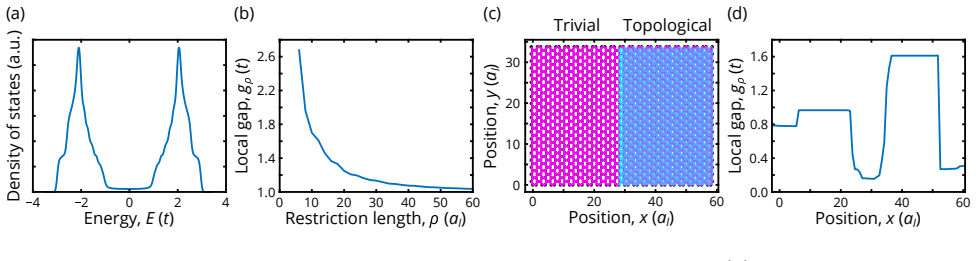
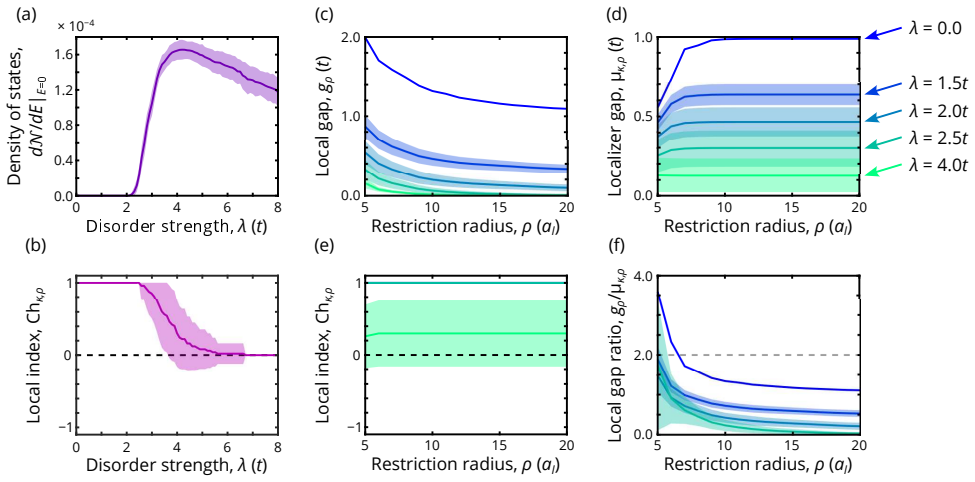
The central discovery is that local topology can be certified locally: no global gap of the Hamiltonian is needed. For a weakly local Hamiltonian with $\rho$-local gap $g_\rho(H,x)>0$, the paper proves that two inequalities on $\kappa$—the lower bound $2g_\rho/\rho<\kappa$ and an upper bound built from $C_F\|H R_\kappa\|+g_\rho$ times $\|[D(x),H]R_\kappa\|$, with $R_\kappa=(\imath 1+c\,\kappa\,g_\rho^{-1}D(x))^{-1}$ and constants $a,b,c$ satisfying $1-a-b^2>0$—force the squared localizer $L_{\kappa,\rho'}(H,x)^2$ to be at least $b^2g_\rho^2\,1_{\rho'}(x)$ on every box $\rho'\ge\rho$. Hence the localizer gap satisfies $\mu_{\kappa,\rho'}(H,x)\ge b\,g_\rho(H,x)$, and the half-signature $\mathrm{Ch}_{\kappa,\rho'}(H,x)$ is constant under continuous changes inside the admissible region, and even for any enclosing set that contains $B_\rho(x)$. The mechanism is that a smoothed indicator $F_\rho(D(x))$ localizes the gap estimate, while resolvent factors suppress the Hamiltonian and its commutator with position far from $x$; a separate estimate improves the tapering constant from $C_F=8$ to $C_F\le 4.56$, with numerical evidence for $C_F\approx 2$ in short-range models.
Load-bearing premise
The load-bearing premise is weak locality of $H$: the Hamiltonian must keep the domain of the Dirac operator $D(x)$ invariant and make $[D(x),H]$ a bounded operator; if hopping is so long-range that this commutator is unbounded, the theorem's proof and conclusion do not apply even when a local spectral gap exists.
Editorial extensions
If this is right
- A positive $\rho$-local gap at one point, together with the explicit inequalities (12), guarantees that the spectral localizer stays gapped in every larger enclosing region, with $\mu_{\kappa,\rho'}(H,x)\ge b\,g_\rho(H,x)$.
- The local Chern marker $\mathrm{Ch}_{\kappa,\rho'}(H,x)$ is box-independent: it is the same for all $\rho'\ge\rho$ and for any finite set containing $B_\rho(x)\cap\mathbb{Z}^d$.
- Perturbations supported far from $x$ cannot close the localizer gap; their effect enters the bounds divided by a power of the distance from their support to $B_\rho(x)$, so the local index is genuinely local.
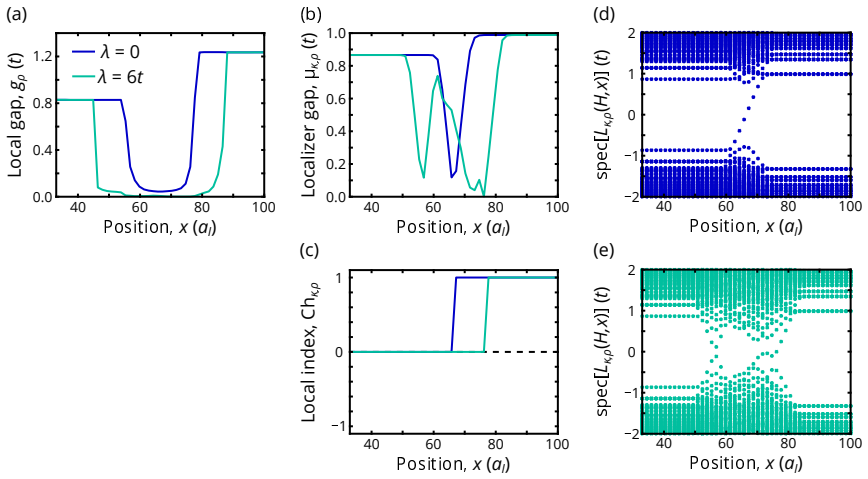
- The spectral flow of the localizer along a path crossing a topological phase boundary is stable under weakly local perturbations whose support avoids the two endpoints, even if the perturbation cuts across the path.
- The improved tapering constant makes the criterion quantitatively realistic: with $C_F\approx 2$, the bounds predict that a few tens of unit cells per direction suffice to certify a stable local gap.
Reading between the lines
- Editorial inference: the ratio $g_\rho(H,x)/\mu_{\kappa,\rho}(H,x)$ could serve as a spatially resolved confidence map, because regions where the local gap closes are exactly where the ratio diverges; scanning $x$ at fixed $\kappa,\rho$ would locate topological phase boundaries directly from numerical or experimental localizer data.
- Editorial inference: because Theorem 6 needs only the finite-volume quantity $g_\rho(H,x)$, it suggests an adaptive protocol in which one estimates the local gap from measured local spectra and then chooses $\kappa$ to satisfy (12), rather than assuming a known global gap.
- Editorial inference: a rigorous reduction of the tapering constant to $C_F\approx 2$ would make the sufficient condition nearly tight, aligning the predicted minimal volumes with the sizes at which local Chern markers are already observed to stabilize.
- Editorial inference: the same proof scheme should extend recognisably to odd and real versions of the localizer, giving local-gap validity criteria for $\mathbb{Z}_2$ and spin-Chern invariants; the paper indicates the even case but leaves those extensions implicit.
Signed reviews
Editorial analysis
A structured set of objections, weighed in public.
Referee Report
Summary. The paper develops three improvements to the spectral localizer framework for detecting local topological invariants. The main mathematical result, Theorem 6, states that if a weakly local Hamiltonian has a rho-local spectral gap g_rho and the tuning parameter kappa satisfies the two inequalities in (12), then all finite-volume spectral localizers of radius rho' >= rho have a localizer gap at least b g_rho, and the local Chern marker is independent of rho'. The proof uses a commutator/tapering estimate (11) whose constant C_F enters the criterion. The paper also introduces and studies the rho-local gap notion, proves a stability result for the localizer gap under distant perturbations (Proposition 12), establishes a spectral-flow stability result near phase boundaries (Proposition 13), and illustrates the theory with numerical simulations on the Haldane model and disordered variants. The central implication theorem is proven from the stated assumptions, but part of the advertised quantitative improvement—the constant C_F ≈ 4.56 and the headline criterion (2) with C_F ≈ 2—rests on numerical or heuristic evaluations rather than rigorous estimates.
Significance. If accepted in full, the paper would make a valuable contribution to the spectral localizer literature. The replacement of a global gap by a rho-local gap is a genuinely useful weakening of the hypothesis, and the relative operator bounds in (12) give a concrete quantitative form to the locality of the localizer. The arbitrary-shape stability statement in Proposition 12 and the spectral-flow stability in Proposition 13 are clean and go beyond prior work. The proofs of Theorem 6 and Proposition 12 are, apart from the constant issue discussed below, coherent and self-contained. I also credit the paper for being unusually explicit about the status of the numerical constant: Appendix A distinguishes the rigorously proven C_F = 8, the numerically evaluated C_F ≈ 4.56, and the heuristic C_F ≈ 2. However, the presentation of Eq. (2) in the introduction and the claimed factor-4.5 improvement in Remark 7 rely on the unproven heuristic value, so the advertised quantitative criterion is not yet on rigorous footing.
major comments (2)
- [Appendix A and Eq. (12)] The claim that the tapering estimate (11) holds with C_F ≤ 4.56 is not proven rigorously. After the explicit integral representation (26), the paper states 'Mathematica then gives' the values 9.16, 4.56, 5.12, 5.75, with no numerical error control for the improper integral. This matters because C_F enters the denominator of the sufficient condition (12), so the quantitative content of Theorem 6 is only as strong as the proven value of C_F. The rigorous C_F = 8 bound from the earlier function keeps the theorem valid, but the advertised improvement of the tapering constant is conditional. I ask the authors to either supply a rigorous bound on the integral (for example, by interval arithmetic or by a convergent majorant) or to state explicitly in all theorem statements, remarks, and the abstract that the improved constants C_F ≈ 4.56 and C_F ≈ 2 are numerical/heuristic and not part of the proven results.
- [Introduction, Eq. (2), and Remark 7] The criterion (2) is presented in the introduction as a main result, but it implicitly uses the heuristic value C_F ≈ 2. Comparing (2) with (17) and Remark 11 shows that (2) is obtained only after setting C_F = 2 and identifying ||[D(x),H](i 1 + 1/rho |X|)^-1|| with ||[X1+iX2,H](i 1 + 1/rho |X|)^-1||. If the actual constant is larger, a kappa chosen from (2) need not satisfy (12), and the lower bound mu >= b g_rho is not guaranteed. The exact relation between (2), (17), and the rigorous value of C_F should be spelled out; in particular, the introduction should not state (2) as a proven quantitative criterion unless the constant issue is resolved.
minor comments (4)
- [Throughout] There are several typos that should be corrected: 'criterium' should be 'criterion' in the abstract and introduction, the affiliation contains stray spaces ('L aboratories'), and 'F AU Erlangen-N¨ urnberg' should be cleaned up.
- [Section 6] The formula for rho_c near the end of Section 6 contains a typo: 'CF ||[H||' should presumably be 'C_F ||[H,D]||' or similar; please correct the norm notation.
- [Proposition 14 proof] In the proof of Proposition 14, the formula '⟨φ−|W|φ−⟩ − ⟨φ−|W|φ−⟩' should read '⟨φ+|W|φ+⟩ − ⟨φ−|W|φ−⟩'.
- [Remark 7] The sentence 'CF = 2 implies that 4/3 C_F = 8/3, notably an improvement by a factor 4.5' should be explicitly marked as relying on the heuristic value C_F ≈ 2, not on the proven estimate, to avoid misleading readers.
Circularity Check
No circularity: the main theorem is a conditional derivation and does not reduce to its inputs.
full rationale
The derivation chain is not circular. Theorem 6 is an implication: the assumptions are weak locality, a rho-local gap g_rho = inf spec((H^2)_rho), and the parameter criterion (12) involving relative norms and a tapering constant C_F obeying (11); the conclusion is a lower bound on a different operator, the finite-volume spectral localizer. The proof is written out: it inserts F_rho(D), uses (6) from the local-gap definition, applies the tapering/commutator estimate (11), and completes a square to obtain L^2 >= b^2 g_rho^2 1. There is no step where the conclusion is assumed or where a quantity is fitted to the predicted localizer gap. The local gap and localizer gap are distinct operators, so the first advertised improvement is not self-definitional. The self-citations to [21,22,11] supply background and some earlier estimates, but the needed commutator bound is reproduced in Appendix A and the homotopy argument is adapted in the proof; none of the central implications reduces to an unverified self-citation. The only soft spot is the numerical/heuristic values C_F ~ 4.56 and C_F ~ 2 in Appendix A, which are not rigorously proven; this weakens the quantitative constants in the advertised criterion but does not make the derivation circular, since Theorem 6 is stated conditional on (11) and the paper proves the C_F = 8 case.
Assumptions & free parameters
assumptions (3)
- domain assumption H is weakly local: H leaves the domain of D(x) invariant and [D(x),H] is bounded (Definition 1).
- domain assumption H has a ρ-local gap gρ > 0 at x, meaning (H^2)_ρ(x) ≥ g^2 1_ρ(x) (Definition 2).
- standard math The position operators X_j and Clifford generators γ_j give a selfadjoint Dirac operator D(x); H is extended to ℓ^2(Z^d,C^L) ⊗ C^{d'}.
invented entities (1)
-
ρ-local gap gρ(H,x)
Cite this review
Pith. "Pith review of Detecting local topology with the spectral localizer." pith.science (2026). https://pith.science/paper/6A3WZ5FS
@misc{pith2026250614174,
  author       = {Pith},
  title        = {Pith review of: Detecting local topology with the spectral localizer},
  year         = {2026},
  howpublished = {\url{https://pith.science/paper/6A3WZ5FS}},
  note         = {Machine review of arXiv:2506.14174}
}
read the original abstract
The spectral localizer is a predictive framework for the computation of topological invariants of natural and artificial materials. Here, three crucial improvements on the criterion for the validity of the framework are reported: first, merely a properly defined local spectral gap of the Hamiltonian is required, second, only relative bounds on the Hamiltonian and its noncommutative derivative are relevant, and, third, the numerical constant in a tapering estimate is improved. These developments further stress the local nature of the spectral localizer framework, enabling more precise predictions in heterostructures, aperiodic, and disordered systems. Moreover, these results strengthen the bounds on the spectral localizer's spectral flow when crossing topological phase boundaries.
Figures


Figures from the paper (3 more)

Forward citations
Cited by 1 Pith paper
-
Spectral localizers in KK-theory
The index homomorphism of even K-groups from a KK-class is computed by a spectral localizer built from continuous functions of an unbounded Dirac operator.
Reference graph
Works this paper leans on
-
[1]
M. Aizenman, S. Warzel, Random Operators: Disorder Effects on Quantum Spectra and Dynamics, (American Mathematical Society, Providence, 2015)
work page 2015
-
[2]
J. Bellissard, A. van Elst, H. Schulz-Baldes, The Non-Commutative Geometry of the Quan- tum Hall Effect , J. Math. Phys. 35, 5373-5451 (1994)
work page 1994
- [3]
-
[4]
O. Bratteli, D. W. Robinson, Operator Algebras and Quantum Statistical Mechanics 1 , (Springer, Berlin, 1979)
work page 1979
- [5]
- [6]
- [7]
-
[8]
K. Y. Dixon, T. A. Loring, A. Cerjan, Classifying Topology in Photonic Heterostructures with Gapless Environments , Phys. Rev. Lett. 131, 213801 (2023)
work page 2023
Show all 30 references
-
[9]
N. Doll, H. Schulz-Baldes, Approximate symmetries and conservation laws in topological insulators and associated Z-invariants, Annals Physics 419, 168238 (2020)
2020
-
[10]
N. Doll, H. Schulz-Baldes, Skew localizer and Z2-flows for real index pairings , Advances Math. 392, 108038 (2021)
2021
-
[11]
N. Doll, H. Schulz-Baldes, N. Waterstraat, Spectral flow: A functional analytic and index- theoretic approach , (De Gruyter, Berlin/Boston, 2023)
2023
-
[12]
Franca, A
S. Franca, A. G. Grushin, Topological zero-modes of the spectral localizer of trivial metals , Phys. Rev. B 109, 195107 (2024)
2024
-
[13]
I. C. Fulga, D. I. Pikulin, T. A. Loring, Aperiodic Weak Topological Superconductors , Phys. Rev. Lett. 116, 257002 (2016)
2016
-
[14]
Germinet, F
F. Germinet, F. Klopp, Spectral statistics for random Schr¨ odinger operators in the localized regime, J. European Math. Soc. 16, 1967-2031 (2014)
2014
-
[15]
Parity Anomaly
F. D. M. Haldane, Model for a Quantum Hall Effect without Landau Levels: Condensed - Matter Realization of the “Parity Anomaly” , Phys. Rev. Lett. 61, 2015 (1988). 29
1988
-
[16]
H. C. Po, H. Watanabe, A. Vishwanath, Fragile Topology and Wannier Obstructions , Phys. Rev. Lett. 121 126402 (2018)
2018
-
[17]
J. Kaad, M. Lesch, Spectral flow and the unbounded Kasparov product , Adv. Math. 248 495-530, (2013)
2013
-
[18]
Kato, Perturbation theory of linear operators , 2nd edition, (Springer, Berlin, 2012)
T. Kato, Perturbation theory of linear operators , 2nd edition, (Springer, Berlin, 2012)
2012
-
[19]
K. Y. Lee, S. Wong, S. Vaidya, T. A. Loring, and A. Cerjan, arXiv:2503.03948
-
[20]
T. A. Loring, J. Lu, A. B. Watson, Locality of the windowed local density of states , Numerische Mathematik 156, 741-775 (2024)
2024
-
[21]
Loring, H
T. Loring, H. Schulz-Baldes, Finite volume calculation of K-theory invariants, New York J. Math. 22, 1111-1140 (2017)
2017
-
[22]
Loring, H
T. Loring, H. Schulz-Baldes, The spectral localizer for even index pairings , J. Noncommu- tative Geometry 14, 1-23 (2020)
2020
-
[23]
Lozano Viesca, J
E. Lozano Viesca, J. Schober, H. Schulz-Baldes, Chern numbers as half-signature of the spectral localizer , J. Math. Phys. 60, 072101 (2019)
2019
-
[24]
Ochkan, R
K. Ochkan, R. Chaturvedi, V. K¨ onye, L. Veyrat, R. Giraud, D . Mailly, A. Cavanna, U. Gennser, E. M. Hankiewicz, B. B¨ uchner, J. van den Brink, J. Du fouleur, I. C. Fulga, Non-Hermitian topology in a multi-terminal quantum Hall device , Nat. Phys. 20, 395 (2024)
2024
-
[25]
Prodan, H
E. Prodan, H. Schulz-Baldes, Bulk and boundary invariants for complex topological insu- lators: From K-theory to physics , (Springer Int. Pub., Switzerland, 2016)
2016
-
[26]
Schulz-Baldes, T
H. Schulz-Baldes, T. Stoiber, The spectral localizer for semifinite spectral triples , Proc. AMS 149, 121-134 (2021)
2021
-
[27]
Schulz-Baldes, T
H. Schulz-Baldes, T. Stoiber, Harmonic analysis in operator algebras and its applications to index theory and topological solid state systems , (Springer Int. Pub., Cham, Switzerland, 2022)
2022
-
[28]
C. D. Spataru, W. Pan, A. Cerjan, Topological Phenomena in Artificial Quantum Materials Revealed by Local Chern Markers , Phys. Rev. Lett. 134, 126601 (2025)
2025
-
[29]
W. P. Su, J. R. Schrieffer, A. J. Heeger, Solitons in Polyacetylene , Phys. Rev. Lett. 42, 1698 (1979)
1979
-
[30]
S. Wong, T. A. Loring, A. Cerjan, Probing topology in nonlinear topological materials using numerical K-theory , Phys. Rev. B 108, 195142 (2023). 30
2023
Reviewed August 7, 2026 · model on record in the stance chip above.
Discussion (0). Continue with ORCID to comment.