REVIEW 4 major objections 4 minor 2 cited by
DESI results and Dark Energy from QCD topological sectors
T0 review · 4 major / 4 minor · reviewed 2026-08-07 · deepseek-v4-flash
Pith's one-line read Dark energy is the leftover vacuum energy from tunnelling between QCD topological sectors, proportional to the Hubble rate.
desk verdict A self-consistent but conjecture-dependent QCD dark-energy model; the new Friedmann solution is fine, but the central transfer to de Sitter is unproven and the z≥0 'DESI consistency' is driven by an arbitrary activation function. read the letter →
The pith
A machine-rendered reading of the paper's core claim, the machinery that carries it, and where it could break.
The reading
What carries the argument
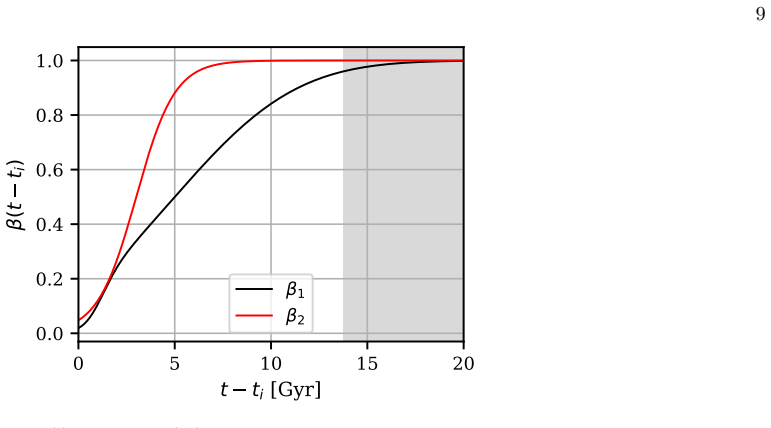
The central object is Eq. (1), the vacuum-energy difference $\Delta E_{\rm vac} \approx c_\kappa\, \kappa\, \Lambda_{\rm QCD}^3$ between the hyperbolic spacetime $H^3_\kappa \times S^1_{\kappa-1}$ and Minkowski spacetime, where $\kappa$ is the curvature of the hyperbolic factor. The linear dependence on $\kappa$ is produced by non-perturbative QCD configurations — monopole configurations with nontrivial holonomy (a nonzero gauge phase around a closed loop) — whose energy is sensitive to infrared distances despite the mass gap. The cosmological extension replaces $\kappa$ with the Hubble parameter $H$, giving $\rho_{\rm DE} = c_H \Lambda_{\rm QCD}^3 H$; this is a conjecture the authors state explicitly because the analogous computation in de Sitter space is not yet possible. Substituting the linear law into the Friedmann equation yields a quadratic whose solution is $H(a) = (\bar{H}/2)\bigl(1 + \sqrt{1 + B(a_i/a)^3 + C(a_i/a)^4}\bigr)$, with $\bar{H}$ the asymptotic de Sitter Hubble constant, and an activation function $\beta(t) \in (0,1)$ switches the QCD term on as matter dilutes and generates the $z \ge 0$ behaviour, including multiple phantom-divide crossings.
What would settle it
A computation (for example a lattice simulation) of the QCD vacuum-energy difference in a de Sitter background that yields $\Delta E_{\rm vac} \propto H^2$ instead of $\propto H$ would falsify the central relation $\rho_{\rm DE} = c_H\Lambda_{\rm QCD}^3 H$; this is precisely the missing calculation the authors identify.
Extended reading notes
Core claim
The central claim is that the difference between the QCD vacuum energy of an expanding universe and the QCD vacuum energy of Minkowski spacetime is dominated by topological sectors and yields a positive dark-energy density $\rho_{\rm DE} = c_H \Lambda_{\rm QCD}^3 H$ that is proportional to the Hubble rate rather than a constant. The linear dependence is the load-bearing feature: it turns the Friedmann equation into a quadratic whose late-time attractor is de Sitter with $\bar{H} = c_H (8\pi/3)\Lambda_{\rm QCD}^3/M_{\rm Pl}^2$, giving a Hubble time of order 10 Gyr from the QCD scale alone. Away from that limit the equation of state is time dependent, with $w_{\rm DE,0} > -1$, $w_{\rm DE} \to -1$ in the future, and possible multiple crossings of $w_{\rm DE} = -1$ for $z \ge 0$ once the activation function $\beta(t)$ is included. The construction uses only Standard Model physics, with no new fields or couplings, and the authors interpret the behaviour as qualitatively consistent with DESI, emphasizing that any deviation from $\Lambda$CDM must come with a correlated deviation in $H(z)$ since $\rho_{\rm DE} \propto \beta(t) H(t)$.
Load-bearing premise
The entire mechanism depends on the conjecture that the linear vacuum-energy difference computed for a hyperbolic spacetime remains linear when transplanted to an expanding nearly de Sitter universe, with the Hubble parameter playing the role of the curvature parameter; the paper concedes that this de Sitter calculation cannot currently be done.
Editorial extensions
If this is right
- Today's equation of state must satisfy $w_{\rm DE,0} > -1$ and flow to $w_{\rm DE} = -1$ in the future, because the universe is approaching the de Sitter solution of the modified Friedmann equation.
- For $z \ge 0$, $w_{\rm DE}(z)$ can cross the $w = -1$ line multiple times without invoking a phantom scalar field, so the usual unitarity and stability objections do not apply.
- Any deviation from $\Lambda$CDM has to be accompanied by a specific deviation in $H(z)$, because $\rho_{\rm DE} \propto \beta(t) H(t)$; independent measurements of $H(z)$ and $w(z)$ can therefore test the framework.
- The asymptotic Hubble constant is fixed by $\Lambda_{\rm QCD}$ and $M_{\rm Pl}$ (up to the coefficient $c_H$), so the dark-energy scale is an output rather than an input of the model.
- All standard cosmological probes (CMB, BAO, supernovae, large-scale structure) must be reprocessed with the modified Friedmann equation, and a single activation function $\beta(z)$ would have to fit them all.
Reading between the lines
- If the linear relation $\rho_{\rm DE} \propto H$ holds locally, then regions of different density experience slightly different effective dark-energy densities, which would mimic clustered or environment-dependent dark energy; the paper gestures at this possibility but does not develop it.
- For $z \ge 0$ the model's freedom is concentrated in the uncalculated activation function $\beta(t)$, so the currently falsifiable core is the predicted correlation between $H(z)$ and $w(z)$ rather than a specific $w(z)$ curve; reconstructing $\beta(z)$ from data would either pin down a physical shape or show that the model can absorb arbitrary histories.
- The same topological-tunnelling logic at a higher, unknown strongly coupled gauge-theory scale could generate inflation, which the paper mentions as a hypothetical extension; if developed, both accelerating epochs of the universe would share one mechanism.
- A positive detection of the proposed topological contribution to the Casimir force in tabletop experiments would provide laboratory evidence, independent of cosmology, that tunnelling between topological sectors deposits real vacuum energy; the paper flags this test but leaves the experimental design open.
Editorial analysis
A structured set of objections, weighed in public.
Referee Report
Summary. The paper proposes that dark energy is the leftover vacuum-energy difference between the QCD vacuum in an expanding FRW universe and Minkowski spacetime, generated by transitions between topological sectors. The central relation is ρ_DE = c_H Λ_QCD^3 H (Eq. 6), from which the authors derive a modified Friedmann equation whose solution asymptotes to a de Sitter state, obtain w_DE > -1 near the present epoch under an adiabatic approximation, and introduce an activation function β(t) so that for z≥0 the equation of state can cross w = -1, claimed to be qualitatively consistent with DESI. The framework is intended to use only Standard Model physics, with no new fields or couplings.
Significance. If the central conjecture were established, the framework would be highly significant: it would tie the observed dark-energy scale to a Standard Model parameter, offer a natural resolution of the coincidence problem, and avoid phantom-field instabilities by removing dynamical fields. The paper is transparent about the conjectural nature of the de Sitter extension, and its discussion in Section 3.4 correctly notes that late-time modifications alone cannot resolve the H0 tension. The algebra from the ansatz is internally consistent, and the predicted correlation between H(z) and w(z) is a testable feature. However, because the quantitative core rests on an unverified conjecture and the z≥0 behavior is governed by an arbitrary function, the paper does not currently establish its central claims.
major comments (4)
- [Section 2.2, Eq. (1)] The central relation ρ_DE = c_H Λ_QCD^3 H (Eq. 6) is not derived in a Friedmann or de Sitter background. The linear vacuum-energy difference in Eq. (1) is computed for the product geometry H^3_κ × S^1_{κ^{-1}}, where the curvature scale and the compact-cycle circumference are locked together and where conformal equivalence to R^4 makes the Zeldovich subtraction well defined (Appendix B). The manuscript states explicitly that "it is not currently possible to perform analogous computations" for de Sitter and that "one can conjecture" the result follows with κ replaced by H. Euclidean de Sitter is S^4, which has no S^1 cycle for the holonomy and whose curvature enters at order H^2, so the linear scaling is not a small-curvature consequence. Every quantitative estimate in Eqs. (2)-(3), including the claimed DE density and the "why now" explanation, is therefore contingent on an unverified analytic-continuation claim. This is the load-bearing step of the paper, and it is acknowledged by the authors as a conjecture.
- [Section 2.3, Eq. (3) and footnote 5] The claim that the DE scale is fixed by a single QCD parameter is not parameter-free. Footnote 5 states that c_H "can always be redefined to absorb all numerical coefficients that arise in the calculations," including the factor m_q/Λ_QCD ≈ 0.05. Because c_H is also the coefficient converting the QCD scale into the Hubble constant in Eq. (3), the numerical agreement with the observed ρ_DE is achieved by choosing the free coefficient to match the very quantity being explained. This undercuts the paper's repeated claim that no ad hoc constants are introduced.
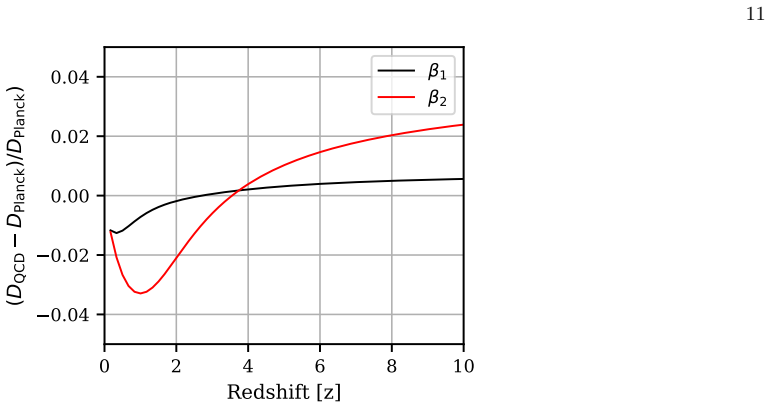
- [Section 3.3, Eqs. (19)-(21)] For z≥0, the entire redshift dependence is carried by an arbitrary activation function β(t) with six free parameters (t_1, Δt_1, t_2, Δt_2, t_3, Δt_3 in Eq. 21). The authors state that for z>0, w_DE "can take any form as a function of redshift, depending on the activation function." Consequently, the claimed consistency with DESI, including multiple crossings of w = -1, is a property of an unconstrained function rather than a prediction of the QCD mechanism. No derivation of β(t) from the underlying theory is provided, and the paper does not perform a fit to cosmological data; the z≥0 phenomenology is therefore illustrative rather than evidence for the model.
- [Section 3.2, Eqs. (16)-(18)] The prediction w_DE,0 > -1 at the present epoch is derived in the asymptotic regime x(t) ≪ 1, i.e. ρ_M ≪ ρ_DE. The paper's own adiabatic criterion (18) is only "marginally satisfied today at z=0," with the left-hand side ≈ 0.5 compared with the bound 3/2. Since Eq. (16) gives w ≈ -0.7 at x(t_0) ~ 1, the quantitative value at z=0 is outside the regime where the derivation is controlled. The qualitative direction w > -1 may survive, but the specific value quoted in the text is not justified.
minor comments (4)
- [Abstract] The abstract lists two items labeled (b); the second data item should be renumbered.
- [Equations (2)-(3) and (10)-(11)] The notation for the asymptotic Hubble constant is inconsistent: the abstract uses \bar{H}, while several equations use H for both the asymptotic value and the time-dependent Hubble parameter, making the derivation harder to follow.
- [Section 3.3] There is a typo in the sentence "In practice,forz≥0" — a space is missing after the comma.
- [Figure 2(d)] The text does not specify the exact expression used to compute w_DE(z) from the numerical solution; since Eq. (13) involves w in the acceleration equation, the plot of w(z) appears to be derived from H(z) and its derivative, but the formula used should be stated explicitly.
Circularity Check
Central cosmological predictions reduce to a self-cited conjecture and two free inputs: ρ_DE∝H is imported from H^3_κ×S^1 via an unproven de Sitter conjecture, c_H absorbs all numerical factors, and β(t) is arbitrary, so w_DE(z≥0) can be made to match DESI.
-
ansatz smuggled in via citation
[Sec. 2.2, paragraph after Eq. (1)]
"For de Sitter spacetime, it is not currently possible to perform analogous computations ... However, as argued in A. O. Barvinsky & A. R. Zhitnitsky (2018), one can conjecture that the resulting expression is expected to closely resemble Eq.(1). It means that, in de Sitter spacetime, holonomy is expected to emerge dynamically (as the Universe expands), and the role of κ in Eq.(1) is assumed by the Hubble parameter in the de Sitter Universe, with the replacement c_κ ∼1 by c_H ∼1."
Eq. (6), the paper's central result, states ρ_DE = c_H Λ^3_QCD H. The only support for this in de Sitter/FRW is the quoted conjecture, taken from Barvinsky & Zhitnitsky (2018), which is prior work by the same authors. Eq. (1) itself was obtained on H^3_κ × S^1_{κ^{-1}}, where an explicit S^1 cycle and conformal equivalence to R^4 make the subtraction well-defined; de Sitter has neither, and the paper admits the relevant monopole saddles are unknown there. Replacing κ by H is therefore an assumed input, not a derivation. Every later prediction (H_0, ρ_DE, w_DE(z)) inherits this imported ansatz, which is load-bearing self-citation.
-
fitted input called prediction
[Sec. 2.3, footnote 5 and Eqs. (2)-(3)]
"We do not lose any generality by fixing Λ_QCD ≈100 MeV. This is because the dimensionless parameter c_H can always be redefined to absorb all numerical coefficients that arise in the calculations. In particular, a small numerical QCD-related factor ∝ m_q/Λ_QCD ≈0.05, which consistently accompanies tunnelling transitions in QCD, is also absorbed into c_H."
Eq. (3) is presented as the order-of-magnitude prediction of H_0 and ρ_DE, with values 'very close to the observed values today.' But c_H (or \bar c_H) is a free dimensionless coefficient that, by the paper's own statement, can always be redefined to absorb all numerical factors, including the m_q/Λ_QCD≈0.05 factor. Since c_H is not computed from first principles here ('not currently feasible'), the numerical agreement is not an independent prediction; it is a restatement of choosing c_H≈1 to match the observed Hubble/de Sitter scale. The resulting 'why now' timescale t_0=H^{-1} is likewise fixed by the same adjusted constant.
1 more flagged steps
-
fitted input called prediction
[Sec. 3.3, around Eq. (21) and Fig. 2(d)]
"For z > 0, however, w_DE can take any form as a function of redshift, depending on the activation function of the QCD-induced dark energy, β(t). Although we cannot derive β(t) theoretically, it is likely to be strongly constrained by observational data. ... Although our choice of the β(t) function is entirely arbitrary and not based on any physical model, it is still possible to test the self-consistency of the framework."
To make predictions for z≥0, Sec. 3.3 introduces β(t)∈(0,1) as a 'switch' whose time dependence is unspecified; the paper says w_DE can take any form depending on the activation function and that the specific β_1, β_2 used are 'entirely arbitrary.' The claimed qualitative DESI consistency — w crossing −1 once or multiple times — is therefore generated by the free choice of β(t), not by QCD topology. Since any observed w(z) can be accommodated by some β(t), this is a fitted input presented as a prediction, not a falsifiable consequence of the framework.
full rationale
The paper contains a genuine, non-circular calculation: the linear-in-κ vacuum-energy difference Eq. (1) on H^3_κ × S^1_{κ^{-1}}, supported by deformed-QCD box computations and a lattice study of particle production proportional to H. Those pieces are external to the fitted values and are not themselves circular. The circularity enters when this special-geometry result is transferred to cosmology: (i) the ρ_DE∝H law is imported from the same authors' unproven conjecture for de Sitter, not computed there; (ii) the numerical amplitude is matched to observations through a freely redefinable coefficient c_H; and (iii) the z≥0 w_DE behavior, including the claimed DESI-compatible crossings, is produced by an arbitrary activation function β(t). Thus the paper's headline cosmological predictions reduce, by its own admissions, to a conjectured analytic continuation plus two adjustable inputs. This warrants a 6 on the circularity scale: partial, because the underlying special-geometry computation is real, but the central DE predictions are not independently derived.
Assumptions & free parameters
free parameters (3)
- c_H (or c̄_H) =
Effectively matched to observed H0; numerical examples use H̄ = 50 km/s/Mpc
- β(t) parameters (t1, Δt1, t2, Δt2, t3, Δt3) =
(5, 5, 1, 0.5, 3, 1) Gyr in Eq. (21)
- H̄ asymptotic Hubble constant =
50 km/s/Mpc in the numerical integration
assumptions (4)
- domain assumption The vacuum energy difference between hyperbolic spacetime H^3_κ × S^1_{κ-1} and Minkowski spacetime is linear in κ, ΔE_vac ≈ c_κ κ Λ_QCD^3 (Eq. 1).
- domain assumption The same linear behavior holds in de Sitter spacetime with κ replaced by H.
- domain assumption The adiabatic theorem allows using the constant-H formulas when H(t) varies, as long as condition (18) holds.
- ad hoc to paper The activation function β(t) parameterizes the onset of QCD-induced DE at z≥0.
Cite this review
Pith. "Pith review of DESI results and Dark Energy from QCD topological sectors." pith.science (2026). https://pith.science/paper/OF3J7A4Q
@misc{pith2026250614182,
  author       = {Pith},
  title        = {Pith review of: DESI results and Dark Energy from QCD topological sectors},
  year         = {2026},
  howpublished = {\url{https://pith.science/paper/OF3J7A4Q}},
  note         = {Machine review of arXiv:2506.14182}
}
abstract
We present a physically motivated dark-energy (DE) model rooted in the topological structure of the Quantum ChromoDynamic (QCD) vacuum. In this framework, DE arises from the difference between the vacuum energy of an expanding FRW universe and Minkowski spacetime, induced by QCD topological sectors. The resulting DE term in the Friedmann equation scales with the Hubble rate, $\rho_{\rm DE}(t)\propto H(t)$, once DE dominates cosmic expansion, i.e. when the Universe is close to the de Sitter regime with $H\approx$ constant. The QCD scale, $\Lambda_{\rm QCD}\sim100~{\rm MeV}$, naturally fixes the DE density and explains why its influence becomes significant only recently. The construction relies solely on the Standard Model of particle physics, introducing no new fields or couplings. The most fundamental change is the possibility of modifying the evolution of the background cosmology in the Friedmann equation. Key predictions include: (a) A present-day equation of state parameter $w_{\rm DE,0}>-1$ that asymptotically approaches the de Sitter limit $w_{\rm DE}=-1$ in the future. (b) A present-day Hubble constant $H_0$ that asymptotically approaches a constant $\overline{H}$ set by $\Lambda_{\rm QCD}$. (b) For $z\ge 0$, $w_{\rm DE}(z)$ may lie above or below $-1$ and can cross this boundary multiple times at different $z$, behavior qualitatively consistent with the recent DESI findings. (c) In our framework, any deviation from $\Lambda$CDM leads to a corresponding deviation of $H(z)$, which can be tested with existing and future cosmological observations.
Figures

Forward citations
Cited by 2 Pith papers
-
Evolving Dark Energy Is Vacuum Energy After All
A QCD-vacuum dark-energy model with a two-parameter switch reproduces the DESI-preferred late-time expansion and is mildly favoured over ΛCDM by Bayesian evidence (lnB≈2.7).
-
Phantom crossing from the Standard Model and General Relativity
Fermion-condensate vacuum energy plus Buchert backreaction from nonlinear structure formation yields a low-redshift phantom crossing consistent with DESI+CMB+SNIa data for a chosen backreaction density.
Reference graph
Works this paper leans on
-
[1]
Adil, A., Albrecht, A., & Knox, L. 2023, Phys. Rev. D, 107, 063521, doi: 10.1103/PhysRevD.107.063521
-
[2]
Barvinsky, A. O., & Zhitnitsky, A. R. 2018, Phys. Rev. D, 98, 045008, doi: 10.1103/PhysRevD.98.045008
-
[3]
Bernal, J. L., Verde, L., & Riess, A. G. 2016, JCAP, 2016, 019, doi: 10.1088/1475-7516/2016/10/019
-
[4]
Biswas, M., Debnath, U., Ghosh, S., & Guha, B. K. 2019, Eur. Phys. J. C, 79, 659, doi: 10.1140/epjc/s10052-019-7147-z
-
[5]
2025, https://arxiv.org/abs/2503.17659
Brandenberger, R. 2025, https://arxiv.org/abs/2503.17659
arXiv 2025
-
[6]
Cai, R.-G., Tuo, Z.-L., Zhang, H.-B., & Su, Q. 2011, Phys. Rev. D, 84, 123501, doi: 10.1103/PhysRevD.84.123501
-
[7]
2025, https://arxiv.org/abs/2505.24732
Cai, Y., Ren, X., Qiu, T., Li, M., & Zhang, X. 2025, https://arxiv.org/abs/2505.24732
arXiv 2025
-
[8]
Cai, Y.-F., Saridakis, E. N., Setare, M. R., & Xia, J.-Q. 2010, Phys. Rept., 493, 1, doi: 10.1016/j.physrep.2010.04.001
Show all 35 references
-
[9]
Cao, C., van Caspel, M., & Zhitnitsky, A. R. 2013, Phys. Rev., D87, 105012, doi: 10.1103/PhysRevD.87.105012
2013 doi
-
[10]
Cao, C., Yao, Y., & Zhitnitsky, A. R. 2016, Phys. Rev. D, 93, 065049, doi: 10.1103/PhysRevD.93.065049
2016 doi
-
[11]
L., Johnson, K., & Thorn, C
Chodos, A., Jaffe, R. L., Johnson, K., & Thorn, C. B. 1974a, Phys. Rev. D, 10, 2599, doi: 10.1103/PhysRevD.10.2599
-
[12]
Weisskopf, V. F. 1974b, Phys. Rev. D, 9, 3471, doi: 10.1103/PhysRevD.9.3471
- [13]
-
[14]
2013, Astron
Durrer, R., & Neronov, A. 2013, Astron. Astrophys. Rev., 21, 62, doi: 10.1007/s00159-013-0062-7
2013 doi
-
[15]
2011, Int
Ebrahimi, E., & Sheykhi, A. 2011, Int. J. Mod. Phys. D, 20, 2369, doi: 10.1142/S021827181102041X
2011 doi
-
[16]
2020, PhRvD, 101, 043533, doi: 10.1103/PhysRevD.101.043533
Knox, L., & Millea, M. 2020, PhRvD, 101, 043533, doi: 10.1103/PhysRevD.101.043533
2020 doi
- [17]
-
[18]
1999, ApJ, 517, 565, doi: 10.1086/307221
Perlmutter, S., Aldering, G., Goldhaber, G., et al. 1999, ApJ, 517, 565, doi: 10.1086/307221
1999 doi
-
[19]
2024, PhRvL, 132, 191001, doi: 10.1103/PhysRevLett.132.191001
Pitrou, C., & Uzan, J.-P. 2024, PhRvL, 132, 191001, doi: 10.1103/PhysRevLett.132.191001
2024 doi
- [20]
-
[21]
1989, Phys
Reznik, B., & Aharonov, Y. 1989, Phys. Rev. D, 40, 4178, doi: 10.1103/PhysRevD.40.4178
1989 doi
-
[22]
G., Filippenko, A
Riess, A. G., Filippenko, A. V., Challis, P., et al. 1998, AJ, 116, 1009, doi: 10.1086/300499 Sch¨ oneberg, N., Abell´ an, G. F., S´ anchez, A. P., et al. 2022, PhR, 984, 1, doi: 10.1016/j.physrep.2022.07.001 ’t Hooft, G. 1976, Phys. Rev. D, 14, 3432, doi: 10.1103/PhysRevD.14.3432
1998 doi
-
[23]
Thomas, E., & Zhitnitsky, A. R. 2012, Phys. Rev. D, 86, 065029, doi: 10.1103/PhysRevD.86.065029
2012 doi
-
[24]
R., & Zhitnitsky, A
Urban, F. R., & Zhitnitsky, A. R. 2010a, Phys. Lett. B, 688, 9, doi: 10.1016/j.physletb.2010.03.080
2010 doi
-
[25]
R., & Zhitnitsky, A
Urban, F. R., & Zhitnitsky, A. R. 2010b, Nucl. Phys. B, 835, 135, doi: 10.1016/j.nuclphysb.2010.04.001
2010 doi
-
[26]
2023, Universe, 9, 393, doi: 10.3390/universe9090393
Vagnozzi, S. 2023, Universe, 9, 393, doi: 10.3390/universe9090393
2023 doi
-
[27]
2022, Journal of High Energy Astrophysics, 36, 27, doi: https://doi.org/10.1016/j.jheap.2022.07.004
Vagnozzi, S., Pacucci, F., & Loeb, A. 2022, Journal of High Energy Astrophysics, 36, 27, doi: https://doi.org/10.1016/j.jheap.2022.07.004
2022 doi
- [28]
- [29]
-
[30]
Yao, Y., & Zhitnitsky, A. R. 2017, Phys. Rev. D, 95, 065018, doi: 10.1103/PhysRevD.95.065018
2017 doi
-
[31]
Zeldovich, Y. B. 1967, JETP Lett., 6, 316
1967
-
[32]
Zhitnitsky, A. R. 2013, Annals Phys., 336, 462, doi: 10.1016/j.aop.2013.05.020
2013 doi
-
[33]
Zhitnitsky, A. R. 2014, Phys. Rev., D89, 063529, doi: 10.1103/PhysRevD.89.063529
2014 doi
-
[34]
Zhitnitsky, A. R. 2015, Phys. Rev., D92, 043512, doi: 10.1103/PhysRevD.92.043512 17
2015 doi
-
[35]
Zhitnitsky, A. R. 2019, Phys. Rev. D, 99, 103518, doi: 10.1103/PhysRevD.99.103518
2019 doi
Reviewed August 7, 2026 · model on record in the stance chip above.
Discussion (0). Sign in to comment.