REVIEW 4 major objections 5 minor 41 references
ImpReSS: Implicit Recommender System for Support Conversations
T0 review · 4 major / 5 minor · reviewed 2026-08-07 · deepseek-v4-flash
Pith's one-line read ImpReSS is an add-on that recommends solution product categories from support conversations alone, with no user preferences or purchase intent, achieving MRR@1 up to 0.85 on three datasets.
desk verdict A genuinely new problem framing for need-based, implicit recommendations in support chats, with a plausible pipeline and two real datasets; the synthetic third dataset and closed-catalog evaluation keep me from treating the numbers as strong evidence. read the letter →
The pith
A machine-rendered reading of the paper's core claim, the machinery that carries it, and where it could break.
The reading
What carries the argument
The load-bearing mechanism is the three-step pipeline around the LLM. Step 1 turns the conversation into a 'summary and diagnosis' object and then into a query object: a short list of solution product categories with one-line explanations. Step 2 unites results from five catalog indexes—web-searched features, web-searched use cases, LLM-generated descriptions, LLM-generated features, and LLM-generated use cases—with an L2 nearest-neighbor search over text embeddings, so the same query can match an SPC from several angles. Step 3 re-ranks the retrieved candidates with an LLM, repeating the ranking three times on shuffled candidate orders to reduce position bias; the paper's ablation shows this ranking step is what lifts a raw retrieval list into a usable top-1 recommendation.
What would settle it
Take a test conversation whose correct solution product is deliberately left out of all five catalog indexes and run the pipeline; if recall is zero whenever the true category is absent, the method is bounded by its catalog rather than by the conversation. For DS_GE, re-label a sample of conversations from the transcript content alone and compare MRR@1 against the prompt-derived labels.
Extended reading notes
Core claim
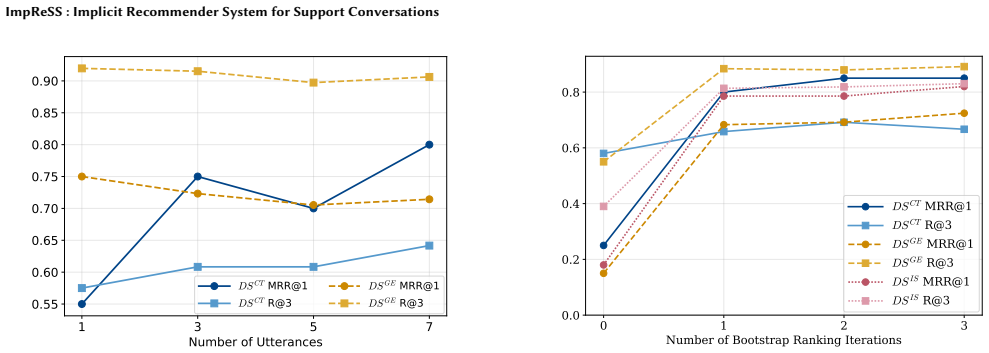
The paper's central claim is that the need for a product can be inferred implicitly from a problem-solving conversation, and that this is sufficient for useful recommendations. ImpReSS first asks an LLM to produce a conversation summary with a root-cause diagnosis and a preliminary list of solution product categories; it then searches five catalog databases—two built from web-search results on features and use cases, three generated by an LLM as descriptions, features, and use cases—and retrieves candidates by embedding similarity; finally, an LLM ranks the candidates, repeating the ranking three times on shuffled input to counter position bias. Evaluated on real cybersecurity-troubleshooting chats, information-security forum threads, and synthetic general-problem conversations, the system achieves MRR@1 of 0.85, 0.82, and 0.72 respectively (recall@3 of 0.67, 0.83, and 0.89). The paper also argues that the method works early in a conversation and that every component—each catalog and the bootstrap ranking—contributes to the result.
Load-bearing premise
The approach assumes the true solution category for every conversation is already in its catalog list; if the right category is missing, no retrieval or ranking can surface it, so all reported scores are upper bounds for that fixed catalog.
Editorial extensions
If this is right
- A support chatbot can present one top-ranked SPC as a natural continuation after resolving an issue, without first asking the user what they want to buy.
- Organizations can map general SPCs to their own product catalog, so the same model transfers across businesses that sell different items in the same categories.
- Because performance is already high after a few utterances, recommendations can be generated early in a conversation rather than at its end.
- If token or latency budgets are tight, using any single use-case-based catalog is the best fallback; the full five-catalog set is the best configuration when costs permit.
- Skipping the bootstrap ranking step causes a marked performance drop, while even one or two ranking iterations recover most of the gain.
Reading between the lines
- Inference: If the fixed SPC catalog is extended or changed, the reported MRR values will move; the method can only retrieve categories present in its indexes, so the numbers are ceilings for this catalog, not for open-ended domains.
- Inference: The synthetic general-problem dataset inherits its ground truth from the generation prompt, so a human re-annotation of the same conversations could shift its scores and is a natural next check.
- Inference: Success on forum threads suggests the approach may also work on human-agent chat logs where the assistant is a person, not a bot, since no conversation-control assumption is made.
- Inference: A production test could measure whether the recommended SPC, when shown after resolution, actually prevents repeat contacts or generates sales; the paper lists conversion as future work, so this remains an open empirical question.
Editorial analysis
A structured set of objections, weighed in public.
Referee Report
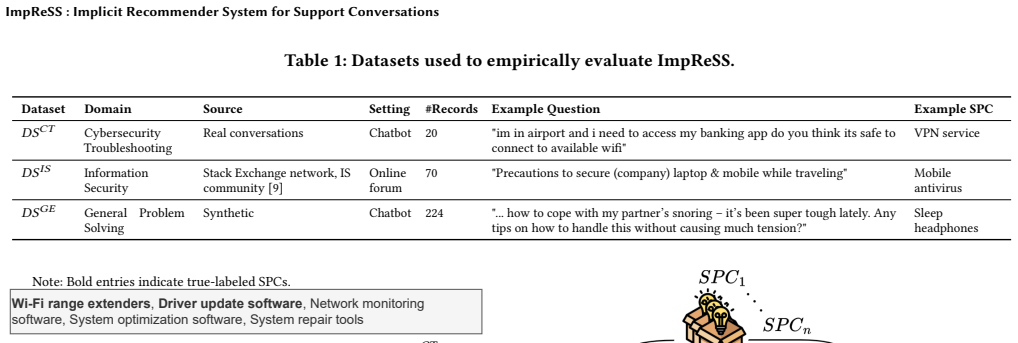
Summary. The paper proposes ImpReSS, an LLM-based add-on for support conversations that implicitly infers a user's needs and recommends solution product categories (SPCs). The pipeline consists of query generation (summarizing the conversation and diagnosing the issue), candidate retrieval from five catalog databases, and bootstrap ranking. The authors evaluate on three datasets: 20 real cybersecurity troubleshooting conversations from their own chatbot, 70 information-security Q&A pairs from Stack Exchange, and 224 synthetic general problem-solving conversations. Reported MRR@1/R@3 are 0.85/0.67 on DS_CT, 0.82/0.83 on DS_IS, and 0.72/0.89 on DS_GE using GPT-4o with text-embedding-3-small. Ablation studies examine the effect of individual catalog DBs and bootstrap iterations.
Significance. If the evaluation were unbiased, the paper would make a useful contribution: it addresses a gap in conversational recommendation by removing the assumptions of purchasing intent and explicit preference elicitation, and it provides a concrete pipeline plus three datasets. The strengths include a clearly specified three-step architecture, sensitivity analyses for LLM/embedding choices and conversation length, and a component ablation. However, the central empirical claim is weakened by the closed-catalog setup, test-set-based model selection, and the absence of baselines; the absolute numbers therefore cannot currently support the claim that ImpReSS 'identifies opportunities to recommend relevant SPCs' in an open-ended sense.
major comments (4)
- [§3.1.3, §3.2, Table 2] The evaluation is closed-catalog by construction. The SPC list is undocumented, and each ground-truth SPC (for DS_GE, taken from the generation prompt; for DS_IS and DS_CT, defined within the same catalog space) is guaranteed to have a catalog entry. Therefore MRR@1/R@k measure ranking among an enumerated set, not open-ended opportunity identification as claimed in Sec. 1. The paper should report the catalog size and SPC selection procedure, and evaluate with an open-set protocol (held-out SPCs) or at least discuss this upper-bound property explicitly. Without this, the 0.72-0.85 MRR@1 is not evidence for the central qualitative claim.
- [§3.3, Table 3] The best configuration (GPT-4o with text-embedding-3-small) is selected based on performance on the same test datasets used to report the main results in Table 2. No validation split or nested cross-validation is used, so the reported numbers are subject to selection bias. The comparison across LLMs and embedding models in Table 3 should be treated as model selection on the test set, and the final reported performance should be evaluated on a hold-out set.
- [§4.4] The paper does not compare ImpReSS against any baseline, such as embedding the raw conversation and retrieving from the same SPC catalog, using the assistant's last response as the query, or BM25/keyword matching. The ablation study only removes components of ImpReSS itself. Without baselines, the absolute MRR@1 and R@3 values cannot be attributed to the need-based pipeline; simpler methods may achieve comparable results. Adding such baselines is necessary to support the novelty claim.
- [§3.1.1, Table 1] DS_CT contains only 20 conversations from one lab-specific chatbot with student users, and DS_IS is 70 single-turn Q&A pairs. The MRR@1 of 0.85 on DS_CT is based on 20 items; one mis-ranked conversation changes it by about 0.05, and no confidence intervals or significance tests are provided. The abstract and Sec. 6.1 report these numbers as evidence of effectiveness, which is disproportionate given the sample sizes.
minor comments (5)
- [Fig. 7] Figure 7 is illegible: several axis labels appear as corrupted placeholder characters (e.g., '/uni00000013/uni00000011/uni00000013'). The figure should be regenerated with proper text labels.
- [§3.2] The list of SPCs used to build the five catalog DBs is not reported; it should be included as supplementary material for reproducibility and for interpreting the closed-catalog results.
- [§4.4.2 and §4.5] The text in §4.4.2 refers to 'Sec. 4.5' and the overhead discussion before Sec. 4.5 is presented; consider reordering to avoid forward references.
- [References] Reference [36] contains a placeholder-style entry ('zhao2021recbole') and should be corrected to the standard RecBole citation.
- [Table 3] In Table 3, the claim in §4.2 that GPT-4o outperforms other LLMs 'in almost all cases' should be qualified; e.g., on DS_GE with the multi-e5 embedding, GPT-4o mini achieves the same R@3 as Llama-3.3-70B, and the margins vary widely.
Circularity Check
No significant circularity: ImpReSS is an unfitted RAG-style pipeline, no load-bearing self-citation, and the synthetic DS_GE label source is an evaluation caveat rather than a derivation-circular step.
full rationale
ImpReSS's derivation chain is an empirical LLM pipeline: query generation, embedding-based candidate retrieval from fixed catalogs, and bootstrap ranking. No parameters are fitted to the evaluation labels, and no load-bearing claim is justified by a self-citation: the cited works (e.g., Abbasiantaeb et al. [1], Hou et al. [8]) are external, and the bootstrap-ranking citation is to prior work by other authors. The only evaluation-design concern is the synthetic DS_GE set, where Sec. 3.1.3 states "The ground-truth SPC label is derived from the conversation generation prompt" and DS_GE was generated with GPT-4o mini while inference uses GPT-4o (Sec. 3.3). This raises a label-contamination risk (the model may exploit regularities of the same LLM family's generations), and the catalogs are built from an undocumented SPC list (Sec. 3.2) so the scores are closed-catalog retrieval scores. However, neither concern reduces the reported MRR/R@k to the inputs by construction: the pipeline never sees the prompt or the label, the retrieval and ranking steps are not fitted to the labels, and DS_CT and DS_IS are human-generated real conversations. The closed-catalog design and the synthetic-label provenance are measurement-scope limitations, not self-definitional or fitted-parameter circularity. Per the hard rules, I therefore do not flag them as circular steps.
Assumptions & free parameters
free parameters (4)
- Number of bootstrap ranking iterations =
3
- LLM and embedding model configuration =
GPT-4o with text-embedding-3-small
- Temperature for synthetic conversation generation =
1.0
- Temperature for catalog and search generation =
0.3
assumptions (6)
- domain assumption Support conversations encode enough information to infer the user's underlying need without explicit preference statements.
- domain assumption The five catalog DBs cover the relevant SPCs for each test conversation.
- domain assumption Embedding similarity between the LLM-generated query and catalog entries is a valid proxy for relevance.
- ad hoc to paper For DS_GE, the ground-truth SPC from the conversation generation prompt is a valid label of the user's need.
- domain assumption For DS_IS, the accepted answer's product recommendation is the correct SPC for the question.
- ad hoc to paper For DS_CT, the 20 conversations with the lab's own cybersecurity chatbot are representative of real support traffic.
Cite this review
Pith. "Pith review of ImpReSS: Implicit Recommender System for Support Conversations." pith.science (2026). https://pith.science/paper/OZDBUYRB
@misc{pith2026250614231,
  author       = {Pith},
  title        = {Pith review of: ImpReSS: Implicit Recommender System for Support Conversations},
  year         = {2026},
  howpublished = {\url{https://pith.science/paper/OZDBUYRB}},
  note         = {Machine review of arXiv:2506.14231}
}
read the original abstract
Following recent advancements in large language models (LLMs), LLM-based chatbots have transformed customer support by automating interactions and providing consistent, scalable service. While LLM-based conversational recommender systems (CRSs) have attracted attention for their ability to enhance the quality of recommendations, limited research has addressed the implicit integration of recommendations within customer support interactions. In this work, we introduce ImpReSS, an implicit recommender system designed for customer support conversations. ImpReSS operates alongside existing support chatbots, where users report issues and chatbots provide solutions. Based on a customer support conversation, ImpReSS identifies opportunities to recommend relevant solution product categories (SPCs) that help resolve the issue or prevent its recurrence -- thereby also supporting business growth. Unlike traditional CRSs, ImpReSS functions entirely implicitly and does not rely on any assumption of a user's purchasing intent. Our empirical evaluation of ImpReSS's ability to recommend relevant SPCs that can help address issues raised in support conversations shows promising results, including an MRR@1 (and recall@3) of 0.72 (0.89) for general problem solving, 0.82 (0.83) for information security support, and 0.85 (0.67) for cybersecurity troubleshooting. To support future research, our data and code will be shared upon request.
Figures


Figures from the paper (5 more)



Reference graph
Works this paper leans on
-
[1]
Zahra Abbasiantaeb, Yifei Yuan, Evangelos Kanoulas, and Mohammad Alianne- jadi. 2024. Let the llms talk: Simulating human-to-human conversational qa via zero-shot llm-to-llm interactions. InProceedings of the 17th ACM International Conference on Web Search and Data Mining. 8–17. Omri Haller, Yair Meidan, Dudu Mimran, Yuval Elovici, and Asaf Shabtai
work page 2024
-
[2]
Martin Adam, Michael Wessel, and Alexander Benlian. 2021. AI-based chatbots in customer service and their effects on user compliance.Electronic Markets31, 2 (2021), 427–445
work page 2021
-
[3]
Soufyane Ayanouz, Boudhir Anouar Abdelhakim, and Mohammed Benhmed
-
[4]
Junyi Chen, Lu Chi, Bingyue Peng, and Zehuan Yuan. 2024. HLLM: Enhancing Sequential Recommendations via Hierarchical Large Language Models for Item and User Modeling. arXiv:2409.12740 [cs.IR] https://arxiv.org/abs/2409.12740
arXiv 2024
-
[5]
Yang Deng, Wenxuan Zhang, Weiwen Xu, Wenqiang Lei, Tat-Seng Chua, and Wai Lam. 2023. A Unified Multi-task Learning Framework for Multi-goal Con- versational Recommender Systems.ACM Trans. Inf. Syst.41, 3, Article 77 (Feb. 2023), 25 pages. doi:10.1145/3570640
-
[6]
Esha Manideep Dinne. 2024. How LLMs Are Transforming The Customer Support Industry. https://www.forbes.com/councils/forbestechcouncil/2024/09/20/how- llms-are-transforming-the-customer-support-industry/
work page 2024
-
[7]
Momchil Hardalov, Ivan Koychev, and Preslav Nakov. 2018. Towards Automated Customer Support. InArtificial Intelligence: Methodology, Systems, and Appli- cations: 18th International Conference, AIMSA 2018, Varna, Bulgaria, September 12–14, 2018, Proceedings(Varna, Bulgaria). Springer-Verlag, Berlin, Heidelberg, 48–59. doi:10.1007/978-3-319-99344-7_5
-
[8]
Yupeng Hou, Junjie Zhang, Zihan Lin, Hongyu Lu, Ruobing Xie, Julian McAuley, and Wayne Xin Zhao. 2024. Large Language Models are Zero-Shot Rankers for Recommender Systems. InAdvances in Information Retrieval: 46th European Conference on Information Retrieval, ECIR 2024, Glasgow, UK, March 24–28, 2024, Proceedings, Part II(Glasgow, United Kingdom). Springe...
Show all 41 references
-
[9]
Information Security Stack Exchange. 2025. Information Security Stack Exchange. https://security.stackexchange.com
2025
-
[10]
MuhammadZaid Katlariwala and Aakash Gupta. 2024. Product Recommendation System Using Large Language Model: Llama-2. In2024 IEEE World AI IoT Congress (AIIoT). IEEE, 0491–0495
2024
-
[11]
Wenqiang Lei, Gangyi Zhang, Xiangnan He, Yisong Miao, Xiang Wang, Liang Chen, and Tat-Seng Chua. 2020. Interactive Path Reasoning on Graph for Conver- sational Recommendation. InProceedings of the 26th ACM SIGKDD International Conference on Knowledge Discovery & Data Mining(Vi...
2020
-
[12]
Jianghao Lin, Xinyi Dai, Yunjia Xi, Weiwen Liu, Bo Chen, Hao Zhang, Yong Liu, Chuhan Wu, Xiangyang Li, Chenxu Zhu, Huifeng Guo, Yong Yu, Ruiming Tang, and Weinan Zhang. 2025. How Can Recommender Systems Benefit from Large Language Models: A Survey.ACM Trans. Inf. Syst.43, 2, A...
2025 doi
-
[13]
Shikib Mehri and Maxine Eskenazi. 2020. USR: An Unsupervised and Reference Free Evaluation Metric for Dialog Generation. InProceedings of the 58th Annual Meeting of the Association for Computational Linguistics. 681–707
2020
-
[14]
OpenAI. 2023. text-embedding-3-small. https://openai.com/blog/new-embeddin g-models-and-api-updates. Accessed: May 4, 2025
2023
-
[15]
Keivalya Pandya and Mehfuza Holia. 2023. Automating Customer Service using LangChain: Building custom open-source GPT Chatbot for organizations.arXiv preprint arXiv:2310.05421(2023)
2023 arXiv
-
[16]
Xuhui Ren, Hongzhi Yin, Tong Chen, Hao Wang, Zi Huang, and Kai Zheng
-
[17]
Rohan Sanghera, Arun James Thirunavukarasu, Marc El Khoury, Jessica O’Logbon, Yuqing Chen, Archie Watt, Mustafa Mahmood, Hamid Butt, George Nishimura, and Andrew AS Soltan. 2025. High-performance automated abstract screening with large language model ensembles.Journal of the A...
2025
-
[18]
Kathari Santosh, Timur Kholmukhamedov, M Sandeep Kumar, Mohd Aarif, Iskan- dar Muda, and B Kiran Bala. 2024. Leveraging GPT-4 Capabilities for Developing Context-Aware, Personalized Chatbot Interfaces in E-commerce Customer Sup- port Systems. In2024 10th International Conferen...
2024
-
[19]
Fu Shang, Fanyi Zhao, Mingxuan Zhang, Jun Sun, and Jiatu Shi. 2024. Personal- ized recommendation systems powered by large language models: Integrating semantic understanding and user preferences.International Journal of Innovative Research in Engineering and Management11, 4 (...
2024
-
[20]
Farooq Shareef. 2024. Enhancing Conversational AI with LLMs for Customer Support Automation. In2024 2nd International Conference on Self Sustainable Artificial Intelligence Systems (ICSSAS). 239–244. doi:10.1109/ICSSAS64001.2024 .10760403
2024
-
[21]
Yubo Shu, Haonan Zhang, Hansu Gu, Peng Zhang, Tun Lu, Dongsheng Li, and Ning Gu. 2024. RAH! RecSys–Assistant–Human: A Human-Centered Recom- mendation Framework With LLM Agents.IEEE Transactions on Computational Social Systems11, 5 (2024), 6759–6770. doi:10.1109/TCSS.2024.3404039
2024
-
[22]
Stack Exchange. 2025. Stack Exchange. https://www.stackexchange.com
2025
-
[23]
Stack Exchange. 2025. Stack Overflow. https://stackoverflow.com
2025
-
[24]
Yueming Sun and Yi Zhang. 2018. Conversational Recommender System. InThe 41st International ACM SIGIR Conference on Research & Development in Infor- mation Retrieval(Ann Arbor, MI, USA)(SIGIR ’18). Association for Computing Machinery, New York, NY, USA, 235–244. doi:10.1145/32...
2018
-
[25]
Tavily. 2025. Tavily Search API. https://tavily.com/
2025
-
[26]
Ajay Krishna Vajjala, Dipak Meher, Ziwei Zhu, and David S Rosenblum. 2024. Cross-Domain Recommendation Meets Large Language Models.arXiv preprint arXiv:2411.19862(2024)
2024 arXiv
-
[27]
Lingzhi Wang, Huang Hu, Lei Sha, Can Xu, Kam-Fai Wong, and Daxin Jiang
-
[28]
Liang Wang, Nan Yang, Xiaolong Huang, Linjun Yang, Rangan Majumder, and Furu Wei. 2024. Multilingual E5 Text Embeddings: A Technical Report. arXiv:2402.05672 [cs.CL] https://arxiv.org/abs/2402.05672
2024 arXiv
-
[29]
Xiaolei Wang, Kun Zhou, Ji-Rong Wen, and Wayne Xin Zhao. 2022. Towards Unified Conversational Recommender Systems via Knowledge-Enhanced Prompt Learning. InProceedings of the 28th ACM SIGKDD Conference on Knowledge Discovery and Data Mining(Washington DC, USA)(KDD ’22). Associ...
2022 doi
-
[30]
Yancheng Wang, Ziyan Jiang, Zheng Chen, Fan Yang, Yingxue Zhou, Eunah Cho, Xing Fan, Xiaojiang Huang, Yanbin Lu, and Yingzhen Yang. 2024. RecMind: Large Language Model Powered Agent For Recommendation. arXiv:2308.14296 [cs.IR] https://arxiv.org/abs/2308.14296
2024 arXiv
-
[31]
Zhefan Wang, Yuanqing Yu, Wendi Zheng, Weizhi Ma, and Min Zhang. 2024. MACRec: A Multi-Agent Collaboration Framework for Recommendation. In Proceedings of the 47th International ACM SIGIR Conference on Research and Development in Information Retrieval(Washington DC, USA)(SIGIR...
2024
-
[32]
Dinithi Weerabahu, Agra Gamage, Chathurya Dulakshi, Gamage Upeksha Gane- goda, and Thanuja Sandanayake. 2019. Digital Assistant for Supporting Bank Customer Service. InArtificial Intelligence, Jude Hemanth, Thushari Silva, and Asoka Karunananda (Eds.). Springer Singapore, Sing...
2019
-
[33]
Kerui Xu, Jingxuan Yang, Jun Xu, Sheng Gao, Jun Guo, and Ji-Rong Wen. 2021. Adapting User Preference to Online Feedback in Multi-round Conversational Recommendation. InProceedings of the 14th ACM International Conference on Web Search and Data Mining(Virtual Event, Israel)(WSD...
2021
-
[34]
Lanling Xu, Zhen Tian, Bingqian Li, Junjie Zhang, Daoyuan Wang, Hongyu Wang, Jinpeng Wang, Sheng Chen, and Wayne Xin Zhao. 2024. Sequence-level Semantic Representation Fusion for Recommender Systems. InProceedings of the 33rd ACM International Conference on Information and Kno...
2024
-
[35]
Chao Zhang, Shiwei Wu, Haoxin Zhang, Tong Xu, Yan Gao, Yao Hu, and Enhong Chen. 2024. NoteLLM: A Retrievable Large Language Model for Note Recommen- dation. InCompanion Proceedings of the ACM Web Conference 2024(Singapore, Singapore)(WWW ’24). Association for Computing Machine...
2024
-
[36]
Wayne Xin Zhao, Shanlei Mu, Yupeng Hou, Zihan Lin, Yushuo Chen, Xingyu Pan, Kaiyuan Li, Yujie Lu, Hui Wang, Changxin Tian, Yingqian Min, Zhichao Feng, Xinyan Fan, Xu Chen, Pengfei Wang, Wendi Ji, Yaliang Li, Xiaoling Wang, and Ji-Rong Wen. 2021. RecBole: Towards a Unified, Com...
2021
-
[37]
Wayne Xin Zhao, Kun Zhou, Junyi Li, Tianyi Tang, Xiaolei Wang, Yupeng Hou, Yingqian Min, Beichen Zhang, Junjie Zhang, Zican Dong, Yifan Du, Chen Yang, Yushuo Chen, Zhipeng Chen, Jinhao Jiang, Ruiyang Ren, Yifan Li, Xinyu Tang, Zikang Liu, Peiyu Liu, Jian-Yun Nie, and Ji-Rong W...
2025 arXiv
-
[38]
Yuhan Zhao, Rui Chen, Qilong Han, Hongtao Song, and Li Chen. 2024. Unlocking the Hidden Treasures: Enhancing Recommendations with Unlabeled Data. In Proceedings of the 18th ACM Conference on Recommender Systems(Bari, Italy) (RecSys ’24). Association for Computing Machinery, Ne...
2024
-
[2020]
InProceedings of the 3rd International Conference on Networking, Information Systems & Security(Marrakech, Morocco)(NISS ’20)
A Smart Chatbot Architecture based NLP and Machine Learning for Health Care Assistance. InProceedings of the 3rd International Conference on Networking, Information Systems & Security(Marrakech, Morocco)(NISS ’20). Association for Computing Machinery, New York, NY, USA, Articl...
-
[2021]
InProceedings of the 44th International ACM SIGIR Conference on Re- search and Development in Information Retrieval(Virtual Event, Canada)(SI- GIR ’21)
Learning to Ask Appropriate Questions in Conversational Recommen- dation. InProceedings of the 44th International ACM SIGIR Conference on Re- search and Development in Information Retrieval(Virtual Event, Canada)(SI- GIR ’21). Association for Computing Machinery, New York, NY,...
-
[2022]
arXiv:2110.07477 [cs.CL] https://arxiv.org/ab s/2110.07477
RecInDial: A Unified Framework for Conversational Recommendation with Pretrained Language Models. arXiv:2110.07477 [cs.CL] https://arxiv.org/ab s/2110.07477
Reviewed August 7, 2026 · model on record in the stance chip above.
Discussion (0). Sign in to comment.