Factored Classifier-Free Guidance
Pith reviewed 2026-05-19 09:24 UTC · model grok-4.3
The pith
Factored Classifier-Free Guidance reduces spurious attribute changes in diffusion-based counterfactuals by scaling guidance separately for each attribute according to a causal graph.
A machine-rendered reading of the paper's core claim, the machinery that carries it, and where it could break.
Core claim
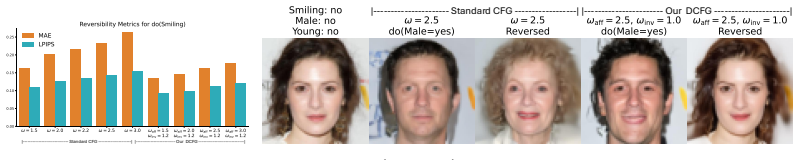
Classifier-free guidance prescribes a global guidance scale for all attributes, leading to significant spurious changes in inferred counterfactuals. Factored Classifier-Free Guidance is a flexible and model-agnostic guidance technique that enables attribute-wise control following a causal graph. It complements recent advances in classifier-free guidance and can be seamlessly extended to advanced guidance schemes such as CFG++ and APG. Experiments demonstrate that FCFG significantly improves the axiomatic soundness of inferred counterfactuals across both natural and medical image datasets, mitigating spurious amplification effects, and enhancing counterfactual reversibility.
What carries the argument
Factored Classifier-Free Guidance (FCFG), which factors the standard classifier-free guidance update into per-attribute terms scaled independently according to edges in a supplied causal graph over image attributes.
If this is right
- Counterfactuals exhibit fewer unintended alterations in attributes unrelated to the intervention.
- Reversing the generated counterfactual more reliably recovers the original input image.
- The improvement holds on both natural-image benchmarks and medical-image datasets.
- FCFG integrates directly with existing extensions such as CFG++ and APG.
Where Pith is reading between the lines
- If the supplied causal graph is only approximate, some but not all spurious effects may remain.
- The same factoring idea could be tested on conditional generative models outside the diffusion family whenever attribute-level conditioning is available.
- In medical imaging this approach would let clinicians intervene on one diagnostic feature while keeping others stable, aiding interpretability.
Load-bearing premise
A complete causal graph over the attributes is available and the attributes have no residual interactions that would require joint rather than independent scaling.
What would settle it
On a dataset with known ground-truth causal relations, measure the average change in non-targeted attributes after a single-attribute intervention; the claim is supported if this spurious change drops substantially when switching from standard CFG to FCFG while keeping all other factors fixed.
Figures




read the original abstract
Counterfactual generation aims to simulate realistic hypothetical outcomes under causal interventions. Diffusion models have emerged as a powerful tool for this task, combining DDIM inversion with conditional generation and classifier-free guidance (CFG). In this work, we identify a key limitation of CFG for counterfactual generation: it prescribes a global guidance scale for all attributes, leading to significant spurious changes in inferred counterfactuals. To mitigate this, we propose Factored Classifier-Free Guidance (FCFG), a flexible and model-agnostic guidance technique that enables attribute-wise control following a causal graph. FCFG complements recent advances in classifier-free guidance and can be seamlessly extended to advanced guidance schemes such as CFG++ and APG. Our experiments demonstrate that FCFG significantly improves the axiomatic soundness of inferred counterfactuals across both natural and medical image datasets, mitigating spurious amplification effects, and enhancing counterfactual reversibility.
Editorial analysis
A structured set of objections, weighed in public.
Referee Report
Summary. The paper proposes Factored Classifier-Free Guidance (FCFG), an attribute-wise extension of classifier-free guidance for diffusion models that follows a provided causal graph over attributes. The central claim is that this factoring mitigates spurious amplification in non-intervened attributes during counterfactual generation, improves axiomatic soundness, and enhances reversibility, with reported benefits on both natural and medical image datasets.
Significance. If the empirical claims hold, FCFG would offer a practical, model-agnostic way to improve counterfactual fidelity in diffusion-based generation without requiring retraining. The approach complements existing CFG variants and could be particularly useful in domains like medical imaging where uncontrolled attribute leakage is costly. The manuscript does not yet supply the quantitative evidence needed to establish this significance.
major comments (3)
- Abstract: The abstract asserts that FCFG 'significantly improves the axiomatic soundness of inferred counterfactuals' and 'mitigates spurious amplification effects' on natural and medical datasets, yet supplies no quantitative metrics, error bars, baseline comparisons, or description of how spurious changes or reversibility were measured. This absence prevents verification of the central claim from the available text.
- Method section (causal-graph factoring): The proposal assumes that per-attribute guidance scales can be applied independently following the causal graph without inducing residual interactions. No derivation or ablation is shown demonstrating that the diffusion score function factors cleanly along the supplied graph edges; any unmodeled correlations learned during training would cause leakage, directly undermining the claim that spurious changes are mitigated.
- Experiments: The manuscript reports improvements across datasets but provides neither the specific guidance-scale values used, the exact causal graphs, nor statistical tests comparing FCFG against standard CFG and recent variants (CFG++, APG). Without these, the cross-dataset claim cannot be assessed for robustness.
minor comments (2)
- Notation: The distinction between the global CFG scale and the per-attribute FCFG scales is introduced without an explicit equation relating the two; adding a compact definition would improve clarity.
- Related work: The discussion of classifier-free guidance extensions would benefit from explicit comparison to recent work on disentangled or conditional diffusion guidance that also uses attribute graphs.
Simulated Author's Rebuttal
We thank the referee for the constructive and detailed feedback. We address each major comment point by point below, indicating where revisions will be made to strengthen the manuscript.
read point-by-point responses
-
Referee: Abstract: The abstract asserts that FCFG 'significantly improves the axiomatic soundness of inferred counterfactuals' and 'mitigates spurious amplification effects' on natural and medical datasets, yet supplies no quantitative metrics, error bars, baseline comparisons, or description of how spurious changes or reversibility were measured. This absence prevents verification of the central claim from the available text.
Authors: We agree that the abstract is high-level and would benefit from concrete numbers to support the claims. The body of the paper reports these metrics (e.g., mean spurious attribute change rates with standard deviations across 5 seeds, reversibility scores, and comparisons to CFG) in Sections 4.2 and 4.3. We will revise the abstract to include the key quantitative improvements, such as the observed reduction in spurious changes. revision: yes
-
Referee: Method section (causal-graph factoring): The proposal assumes that per-attribute guidance scales can be applied independently following the causal graph without inducing residual interactions. No derivation or ablation is shown demonstrating that the diffusion score function factors cleanly along the supplied graph edges; any unmodeled correlations learned during training would cause leakage, directly undermining the claim that spurious changes are mitigated.
Authors: FCFG applies guidance conditionally on the intervened attributes according to the supplied causal graph, which by design limits amplification along non-intervened paths. We provide empirical ablations in the supplementary material comparing factored versus non-factored guidance on graphs with varying edge densities. A full closed-form derivation of the factored score under arbitrary correlations is beyond the current scope but represents a valuable direction for future analysis; the current results demonstrate reduced leakage in practice. revision: partial
-
Referee: Experiments: The manuscript reports improvements across datasets but provides neither the specific guidance-scale values used, the exact causal graphs, nor statistical tests comparing FCFG against standard CFG and recent variants (CFG++, APG). Without these, the cross-dataset claim cannot be assessed for robustness.
Authors: The guidance scales (e.g., 7.5 on intervened attributes and 1.0 otherwise), the exact causal graphs per dataset, and direct comparisons to CFG and APG appear in Section 4.1 and Tables 1–2. Statistical significance (paired t-tests, p < 0.05) is reported in the supplementary material. We will add a dedicated paragraph in the main experimental section that explicitly lists these values and highlights the comparisons for improved clarity and reproducibility. revision: yes
Circularity Check
No circularity: FCFG is an independent modeling proposal validated by experiment
full rationale
The paper introduces Factored Classifier-Free Guidance (FCFG) as a new, model-agnostic technique that factors classifier-free guidance attribute-wise according to an assumed causal graph. The abstract and description frame this as a direct response to the global-scale limitation of standard CFG, with extensions to CFG++ and APG presented as straightforward generalizations. No equations, derivations, or first-principles results are exhibited that reduce by construction to fitted parameters, self-referential quantities, or prior self-citations. Claimed improvements in counterfactual soundness and reversibility are positioned as empirical outcomes of the proposed guidance scheme rather than tautological consequences of the inputs. The work is therefore self-contained against external benchmarks.
Axiom & Free-Parameter Ledger
free parameters (1)
- per-attribute guidance scales
axioms (1)
- domain assumption Attributes in the image can be controlled independently according to an explicit causal graph without unmodeled interactions.
Lean theorems connected to this paper
-
IndisputableMonolith/Foundation/RealityFromDistinction.leanreality_from_one_distinction unclear?
unclearRelation between the paper passage and the cited Recognition theorem.
we partition attributes into intervened and invariant sets based on a causal graph and apply distinct guidance to each
-
IndisputableMonolith/Cost/FunctionalEquation.leanwashburn_uniqueness_aczel unclear?
unclearRelation between the paper passage and the cited Recognition theorem.
Under the assumption that the groups pa(1), …, pa(M) are conditionally independent given the latent variable xt
What do these tags mean?
- matches
- The paper's claim is directly supported by a theorem in the formal canon.
- supports
- The theorem supports part of the paper's argument, but the paper may add assumptions or extra steps.
- extends
- The paper goes beyond the formal theorem; the theorem is a base layer rather than the whole result.
- uses
- The paper appears to rely on the theorem as machinery.
- contradicts
- The paper's claim conflicts with a theorem or certificate in the canon.
- unclear
- Pith found a possible connection, but the passage is too broad, indirect, or ambiguous to say the theorem truly supports the claim.
Forward citations
Cited by 1 Pith paper
-
Causal-Adapter: Taming Text-to-Image Diffusion for Faithful Counterfactual Generation
Causal-Adapter introduces a modular adapter for diffusion models that uses structural causal modeling, prompt-aligned injection, and conditioned token contrastive loss to enable faithful counterfactual image generatio...
Reference graph
Works this paper leans on
-
[2]
Correa, Duligur Ibeling, and Thomas Icard
Elias Bareinboim, Juan D. Correa, Duligur Ibeling, and Thomas Icard. On Pearl’s Hierarchy and the Foundations of Causal Inference, page 507–556. Association for Computing Machinery, New York, NY , USA, 1 edition, 2022. ISBN 9781450395861. URLhttps://doi.org/10. 1145/3501714.3501743
-
[3]
Dreamr: Diffusion-driven counterfactual explanation for functional mri
Hasan A Bedel and Tolga Çukur. Dreamr: Diffusion-driven counterfactual explanation for functional mri. IEEE Transactions on Medical Imaging, 2024
work page 2024
-
[4]
Modeling causal mechanisms with diffusion models for interventional and counterfactual queries
Patrick Chao, Patrick Blöbaum, Sapan Patel, and Shiva Prasad Kasiviswanathan. Modeling causal mechanisms with diffusion models for interventional and counterfactual queries. arXiv preprint arXiv:2302.00860, 2023
-
[5]
Very deep vaes generalize autoregressive models and can outperform them on images
Rewon Child. Very deep vaes generalize autoregressive models and can outperform them on images. In International Conference on Learning Representations, 2020
work page 2020
-
[6]
Hyungjin Chung, Jeongsol Kim, Geon Yeong Park, Hyelin Nam, and Jong Chul Ye. Cfg++: Manifold-constrained classifier free guidance for diffusion models. arXiv preprint arXiv:2406.08070, 2024
-
[7]
arXiv preprint arXiv:2210.11427 , year=
Guillaume Couairon, Jakob Verbeek, Holger Schwenk, and Matthieu Cord. Diffedit: Diffusion- based semantic image editing with mask guidance. arXiv preprint arXiv:2210.11427, 2022
-
[8]
Evaluating and mitigating bias in image classifiers: A causal perspective using counterfactuals
Saloni Dash, Vineeth N Balasubramanian, and Amit Sharma. Evaluating and mitigating bias in image classifiers: A causal perspective using counterfactuals. In Proceedings of the IEEE/CVF winter conference on applications of computer vision, pages 915–924, 2022
work page 2022
-
[9]
High fidelity image counterfactuals with probabilistic causal models
Fabio De Sousa Ribeiro, Tian Xia, Miguel Monteiro, Nick Pawlowski, and Ben Glocker. High fidelity image counterfactuals with probabilistic causal models. ICML, 2023
work page 2023
-
[10]
Diffusion models beat gans on image synthesis
Prafulla Dhariwal and Alexander Nichol. Diffusion models beat gans on image synthesis. Advances in Neural Information Processing Systems, 34:8780–8794, 2021
work page 2021
-
[11]
Diffusion self-guidance for controllable image generation
Dave Epstein, Allan Jabri, Ben Poole, Alexei Efros, and Aleksander Holynski. Diffusion self-guidance for controllable image generation. Advances in Neural Information Processing Systems, 36:16222–16239, 2023
work page 2023
-
[12]
Diffusion models for counterfactual generation and anomaly detection in brain images
Alessandro Fontanella, Grant Mair, Joanna Wardlaw, Emanuele Trucco, and Amos Storkey. Diffusion models for counterfactual generation and anomaly detection in brain images. IEEE Transactions on Medical Imaging, 2024
work page 2024
-
[13]
Algorithmic encoding of protected characteristics in chest x-ray disease detection models
Ben Glocker, Charles Jones, Mélanie Bernhardt, and Stefan Winzeck. Algorithmic encoding of protected characteristics in chest x-ray disease detection models. Ebiomedicine, 89, 2023
work page 2023
-
[14]
Ian Goodfellow, Jean Pouget-Abadie, Mehdi Mirza, Bing Xu, David Warde-Farley, Sherjil Ozair, Aaron Courville, and Yoshua Bengio. Generative adversarial nets. Advances in neural information processing systems, 27, 2014. 10
work page 2014
-
[15]
Prompt-to-Prompt Image Editing with Cross Attention Control
Amir Hertz, Ron Mokady, Jay Tenenbaum, Kfir Aberman, Yael Pritch, and Daniel Cohen-Or. Prompt-to-prompt image editing with cross attention control. arXiv preprint arXiv:2208.01626, 2022
work page internal anchor Pith review Pith/arXiv arXiv 2022
-
[16]
Classifier-Free Diffusion Guidance
Jonathan Ho and Tim Salimans. Classifier-free diffusion guidance. arXiv preprint arXiv:2207.12598, 2022
work page internal anchor Pith review Pith/arXiv arXiv 2022
-
[17]
Denoising diffusion probabilistic models
Jonathan Ho, Ajay Jain, and Pieter Abbeel. Denoising diffusion probabilistic models. Advances in Neural Information Processing Systems, 33:6840–6851, 2020
work page 2020
-
[18]
Jiwoong J Jeong, Brianna L Vey, Ananth Bhimireddy, Thomas Kim, Thiago Santos, Ramon Correa, Raman Dutt, Marina Mosunjac, Gabriela Oprea-Ilies, Geoffrey Smith, et al. The emory breast imaging dataset (embed): A racially diverse, granular dataset of 3.4 million screening and diagnostic mammographic images. Radiology: Artificial Intelligence, 5(1):e220047, 2023
work page 2023
-
[19]
Mimic-cxr, a de-identified publicly available database of chest radiographs with free-text reports
Alistair EW Johnson, Tom J Pollard, Seth J Berkowitz, Nathaniel R Greenbaum, Matthew P Lungren, Chih-ying Deng, Roger G Mark, and Steven Horng. Mimic-cxr, a de-identified publicly available database of chest radiographs with free-text reports. Scientific data, 6(1):1–8, 2019
work page 2019
-
[20]
Progressive Growing of GANs for Improved Quality, Stability, and Variation
Tero Karras, Timo Aila, Samuli Laine, and Jaakko Lehtinen. Progressive growing of gans for improved quality, stability, and variation. arXiv preprint arXiv:1710.10196, 2017
work page internal anchor Pith review Pith/arXiv arXiv 2017
-
[21]
Guiding a diffusion model with a bad version of itself
Tero Karras, Miika Aittala, Tuomas Kynkäänniemi, Jaakko Lehtinen, Timo Aila, and Samuli Laine. Guiding a diffusion model with a bad version of itself. arXiv preprint arXiv:2406.02507, 2024
-
[22]
Auto-Encoding Variational Bayes
Diederik P Kingma and Max Welling. Auto-encoding variational bayes. arXiv preprint arXiv:1312.6114, 2013
work page internal anchor Pith review Pith/arXiv arXiv 2013
-
[23]
Aneesh Komanduri, Xintao Wu, Yongkai Wu, and Feng Chen. From identifiable causal repre- sentations to controllable counterfactual generation: A survey on causal generative modeling. arXiv preprint arXiv:2310.11011, 2023
-
[24]
Causal diffusion autoencoders: Toward counterfactual generation via diffusion probabilistic models
Aneesh Komanduri, Chen Zhao, Feng Chen, and Xintao Wu. Causal diffusion autoencoders: Toward counterfactual generation via diffusion probabilistic models. In ECAI 2024, pages 2516–2523. IOS Press, 2024
work page 2024
-
[25]
Amar Kumar, Anita Kriz, Mohammad Havaei, and Tal Arbel. PRISM: High-resolution & precise counterfactual medical image generation using language-guided stable diffusion. In Medical Imaging with Deep Learning, 2025. URL https://openreview.net/forum?id= UpJMAlZNuo
work page 2025
-
[26]
Matt J Kusner, Joshua Loftus, Chris Russell, and Ricardo Silva. Counterfactual fairness. Advances in neural information processing systems, 30, 2017
work page 2017
-
[27]
Applying guidance in a limited interval improves sample and distribution quality in diffusion models
Tuomas Kynkäänniemi, Miika Aittala, Tero Karras, Samuli Laine, Timo Aila, and Jaakko Lehtinen. Applying guidance in a limited interval improves sample and distribution quality in diffusion models. arXiv preprint arXiv:2404.07724, 2024
-
[28]
Compositional visual generation with composable diffusion models
Nan Liu, Shuang Li, Yilun Du, Antonio Torralba, and Joshua B Tenenbaum. Compositional visual generation with composable diffusion models. In European Conference on Computer Vision, pages 423–439. Springer, 2022
work page 2022
-
[29]
Controllable counterfactual generation for interpretable medical image classification
Shiyu Liu, Fan Wang, Zehua Ren, Chunfeng Lian, and Jianhua Ma. Controllable counterfactual generation for interpretable medical image classification. In International Conference on Medical Image Computing and Computer-Assisted Intervention , pages 143–152. Springer, 2024
work page 2024
-
[30]
Benchmarking counterfactual image generation
Thomas Melistas, Nikos Spyrou, Nefeli Gkouti, Pedro Sanchez, Athanasios Vlontzos, Yannis Panagakis, Giorgos Papanastasiou, and Sotirios Tsaftaris. Benchmarking counterfactual image generation. Advances in Neural Information Processing Systems, 37:133207–133230, 2024. 11
work page 2024
-
[31]
Null-text inversion for editing real images using guided diffusion models
Ron Mokady, Amir Hertz, Kfir Aberman, Yael Pritch, and Daniel Cohen-Or. Null-text inversion for editing real images using guided diffusion models. In Proceedings of the IEEE/CVF conference on computer vision and pattern recognition, pages 6038–6047, 2023
work page 2023
-
[32]
Miguel Monteiro, Fabio De Sousa Ribeiro, Nick Pawlowski, Daniel C. Castro, and Ben Glocker. Measuring axiomatic soundness of counterfactual image models. In The Eleventh International Conference on Learning Representations, 2023. URL https://openreview.net/forum? id=lZOUQQvwI3q
work page 2023
-
[33]
Scientific discovery by generating counterfactuals using image trans- lation
Arunachalam Narayanaswamy, Subhashini Venugopalan, Dale R Webster, Lily Peng, Greg S Corrado, Paisan Ruamviboonsuk, Pinal Bavishi, Michael Brenner, Philip C Nelson, and Avinash V Varadarajan. Scientific discovery by generating counterfactuals using image trans- lation. In Medical Image Computing and Computer Assisted Intervention–MICCAI 2020: 23rd Interna...
work page 2020
-
[34]
Yushu Pan and Elias Bareinboim. Counterfactual image editing. In International Conference on Machine Learning, pages 39087–39101. PMLR, 2024
work page 2024
-
[35]
Normalizing flows for probabilistic modeling and inference
George Papamakarios, Eric Nalisnick, Danilo Jimenez Rezende, Shakir Mohamed, and Balaji Lakshminarayanan. Normalizing flows for probabilistic modeling and inference. Journal of Machine Learning Research, 22(57):1–64, 2021
work page 2021
-
[36]
Deep structural causal models for tractable counterfactual inference
Nick Pawlowski, Daniel Coelho de Castro, and Ben Glocker. Deep structural causal models for tractable counterfactual inference. Advances in Neural Information Processing Systems, 33: 857–869, 2020
work page 2020
- [37]
-
[38]
The causal mediation formula—a guide to the assessment of pathways and mechanisms
Judea Pearl. The causal mediation formula—a guide to the assessment of pathways and mechanisms. Prevention science, 13(4):426–436, 2012
work page 2012
-
[39]
Radedit: stress-testing biomedical vision models via diffusion image editing
Fernando Pérez-García, Sam Bond-Taylor, Pedro P Sanchez, Boris van Breugel, Daniel C Castro, Harshita Sharma, Valentina Salvatelli, Maria TA Wetscherek, Hannah Richardson, Matthew P Lungren, et al. Radedit: stress-testing biomedical vision models via diffusion image editing. In European Conference on Computer Vision, pages 358–376. Springer, 2024
work page 2024
-
[40]
Elements of causal inference: founda- tions and learning algorithms
Jonas Peters, Dominik Janzing, and Bernhard Schölkopf. Elements of causal inference: founda- tions and learning algorithms. The MIT Press, 2017
work page 2017
-
[41]
SDXL: Improving Latent Diffusion Models for High-Resolution Image Synthesis
Dustin Podell, Zion English, Kyle Lacey, Andreas Blattmann, Tim Dockhorn, Jonas Müller, Joe Penna, and Robin Rombach. Sdxl: Improving latent diffusion models for high-resolution image synthesis. arXiv preprint arXiv:2307.01952, 2023
work page internal anchor Pith review Pith/arXiv arXiv 2023
-
[42]
Hierarchical Text-Conditional Image Generation with CLIP Latents
Aditya Ramesh, Prafulla Dhariwal, et al. Hierarchical text-conditional image generation with clip latents. arXiv preprint arXiv:2204.06125, 2022
work page internal anchor Pith review Pith/arXiv arXiv 2022
-
[43]
Demystifying variational diffusion models
Fabio De Sousa Ribeiro, Ben Glocker, et al. Demystifying variational diffusion models. Foundations and Trends® in Computer Graphics and Vision, 17(2):76–170, 2025
work page 2025
-
[44]
Diffusion causal models for counterfactual estimation
Pedro Sanchez and Sotirios A Tsaftaris. Diffusion causal models for counterfactual estimation. In Conference on Causal Learning and Reasoning, pages 647–668. PMLR, 2022
work page 2022
-
[45]
What is healthy? generative counterfactual diffusion for lesion localization
Pedro Sanchez, Antanas Kascenas, Xiao Liu, Alison Q O’Neil, and Sotirios A Tsaftaris. What is healthy? generative counterfactual diffusion for lesion localization. In Deep Generative Models: Second MICCAI Workshop, DGM4MICCAI 2022, Held in Conjunction with MICCAI 2022, Singapore, September 22, 2022, Proceedings, pages 34–44. Springer, 2022
work page 2022
-
[46]
Causal machine learning for healthcare and precision medicine
Pedro Sanchez, Jeremy P V oisey, Tian Xia, Hannah I Watson, Alison Q O’Neil, and Sotirios A Tsaftaris. Causal machine learning for healthcare and precision medicine. Royal Society Open Science, 9(8):220638, 2022
work page 2022
-
[47]
Counterfactual generative networks
Axel Sauer and Andreas Geiger. Counterfactual generative networks. arXiv preprint arXiv:2101.06046, 2021. 12
-
[48]
Amelia Schueppert, Ben Glocker, and Mélanie Roschewitz. Radio-opaque artefacts in digi- tal mammography: automatic detection and analysis of downstream effects. arXiv preprint arXiv:2410.03809, 2024
-
[49]
Rethinking the spatial inconsistency in classifier-free diffusion guidance
Dazhong Shen, Guanglu Song, Zeyue Xue, Fu-Yun Wang, and Yu Liu. Rethinking the spatial inconsistency in classifier-free diffusion guidance. In Proceedings of the IEEE/CVF Conference on Computer Vision and Pattern Recognition, pages 9370–9379, 2024
work page 2024
-
[50]
Deep unsuper- vised learning using nonequilibrium thermodynamics
Jascha Sohl-Dickstein, Eric Weiss, Niru Maheswaranathan, and Surya Ganguli. Deep unsuper- vised learning using nonequilibrium thermodynamics. In International Conference on Machine Learning, pages 2256–2265. PMLR, 2015
work page 2015
-
[51]
Deep unsu- pervised learning using nonequilibrium thermodynamics
Jascha Sohl-Dickstein, Eric Weiss, Niru Maheswaranathan, and Surya Ganguli. Deep unsu- pervised learning using nonequilibrium thermodynamics. In Francis Bach and David Blei, editors, Proceedings of the 32nd International Conference on Machine Learning, volume 37 of Proceedings of Machine Learning Research, pages 2256–2265, Lille, France, 07–09 Jul 2015. P...
work page 2015
-
[52]
Denoising diffusion implicit models
Jiaming Song, Chenlin Meng, and Stefano Ermon. Denoising diffusion implicit models. In International Conference on Learning Representations, 2020
work page 2020
-
[53]
Doubly abductive counterfactual inference for text-based image editing
Xue Song, Jiequan Cui, Hanwang Zhang, Jingjing Chen, Richang Hong, and Yu-Gang Jiang. Doubly abductive counterfactual inference for text-based image editing. In Proceedings of the IEEE/CVF conference on computer vision and pattern recognition, pages 9162–9171, 2024
work page 2024
-
[54]
Generative modeling by estimating gradients of the data distribution
Yang Song and Stefano Ermon. Generative modeling by estimating gradients of the data distribution. Advances in neural information processing systems, 32, 2019
work page 2019
-
[55]
Locinv: localization-aware inversion for text-guided image editing
Chuanming Tang, Kai Wang, Fei Yang, and Joost van de Weijer. Locinv: localization-aware inversion for text-guided image editing. arXiv preprint arXiv:2405.01496, 2024
-
[56]
Nvae: A deep hierarchical variational autoencoder
Arash Vahdat and Jan Kautz. Nvae: A deep hierarchical variational autoencoder. Advances in Neural Information Processing Systems, 33:19667–19679, 2020
work page 2020
-
[57]
Edict: Exact diffusion inversion via coupled transformations
Bram Wallace, Akash Gokul, and Nikhil Naik. Edict: Exact diffusion inversion via coupled transformations. In Proceedings of the IEEE/CVF Conference on Computer Vision and Pattern Recognition, pages 22532–22541, 2023
work page 2023
-
[58]
Fast diffusion-based counterfactuals for shortcut removal and generation
Nina Weng, Paraskevas Pegios, Eike Petersen, Aasa Feragen, and Siavash Bigdeli. Fast diffusion-based counterfactuals for shortcut removal and generation. In European Conference on Computer Vision, pages 338–357. Springer, 2024
work page 2024
-
[59]
Christina Winkler, Daniel Worrall, Emiel Hoogeboom, and Max Welling. Learning likelihoods with conditional normalizing flows. arXiv preprint arXiv:1912.00042, 2019
-
[60]
Consistency and accuracy of celeba attribute values
Haiyu Wu, Grace Bezold, Manuel Günther, Terrance Boult, Michael C King, and Kevin W Bowyer. Consistency and accuracy of celeba attribute values. In Proceedings of the IEEE/CVF Conference on Computer Vision and Pattern Recognition, pages 3258–3266, 2023
work page 2023
-
[61]
Counterfactual generative modeling with variational causal inference
Yulun Wu, Louie McConnell, and Claudia Iriondo. Counterfactual generative modeling with variational causal inference. ICLR, 2025
work page 2025
-
[62]
Neural causal models for counter- factual identification and estimation
Kevin Muyuan Xia, Yushu Pan, and Elias Bareinboim. Neural causal models for counter- factual identification and estimation. In The Eleventh International Conference on Learning Representations, 2023. URL https://openreview.net/forum?id=vouQcZS8KfW
work page 2023
-
[63]
Miti- gating attribute amplification in counterfactual image generation
Tian Xia, Mélanie Roschewitz, Fabio De Sousa Ribeiro, Charles Jones, and Ben Glocker. Miti- gating attribute amplification in counterfactual image generation. In International Conference on Medical Image Computing and Computer-Assisted Intervention, pages 546–556. Springer, 2024
work page 2024
-
[64]
Weihao Xia, Yulun Zhang, Yujiu Yang, Jing-Hao Xue, Bolei Zhou, and Ming-Hsuan Yang. Gan inversion: A survey. IEEE transactions on pattern analysis and machine intelligence, 45(3): 3121–3138, 2022. 13
work page 2022
-
[65]
Achieving causal fairness through generative adversarial networks
Depeng Xu, Yongkai Wu, Shuhan Yuan, Lu Zhang, and Xintao Wu. Achieving causal fairness through generative adversarial networks. In Proceedings of the Twenty-Eighth International Joint Conference on Artificial Intelligence, 2019
work page 2019
-
[66]
Dynamic prompt learning: Addressing cross-attention leakage for text-based image editing
Fei Yang, Shiqi Yang, Muhammad Atif Butt, Joost van de Weijer, et al. Dynamic prompt learning: Addressing cross-attention leakage for text-based image editing. Advances in Neural Information Processing Systems, 36:26291–26303, 2023
work page 2023
-
[67]
Pearl causal hierarchy on image data: Intricacies & challenges
Matej Zeˇcevi´c, Moritz Willig, Devendra Singh Dhami, and Kristian Kersting. Pearl causal hierarchy on image data: Intricacies & challenges. arXiv preprint arXiv:2212.12570, 2022
-
[68]
Adding Conditional Control to Text-to-Image Diffusion Models
Lvmin Zhang, Anyi Rao, and Maneesh Agrawala. Adding conditional control to text-to-image diffusion models. arXiv preprint arXiv:2302.05543, 2023
work page internal anchor Pith review Pith/arXiv arXiv 2023
-
[69]
The unrea- sonable effectiveness of deep features as a perceptual metric
Richard Zhang, Phillip Isola, Alexei A Efros, Eli Shechtman, and Oliver Wang. The unrea- sonable effectiveness of deep features as a perceptual metric. In Proceedings of the IEEE conference on computer vision and pattern recognition, pages 586–595, 2018. 14 A Background A.1 Notation Summary Symbol Description x0 (also denoted as x) Original observed image...
work page 2018
-
[70]
We adopt this preprocessing pipeline and extract the circle attribute from their predictions
manually labeled 22,012 images with circular markers and trained a classifier on this subset, which was then applied to the full dataset to infer circle annotations. We adopt this preprocessing pipeline and extract the circle attribute from their predictions. To define the density label, we binarize the original four-category breast density annotations by...
discussion (0)
Sign in with ORCID, Apple, or X to comment. Anyone can read and Pith papers without signing in.